Andreas Vesalius as a renaissance innovative
neuroanatomist: his 5
th
centenary of birth
Andreas Vesalius como neuroanatomista inovador renascentista: seu 5° centenário de
nascimento
Marleide da Mota Gomes
1, Mauricio Moscovici
2,*, Eliasz Engelhardt
3,4ABSTRACT
Andreas Vesalius (1514-1564) is considered the Father of Modern Anatomy, and an authentic representative of the Renaissance. His studies, founded on dissection of human bodies, differed from Galeno, who based his work on dissection of animals, constituted a notable scientific advance. Putting together science and art, Vesalius associated himself to artists of the Renaissance, and valued the images of the human body in his superb workDe Humani Corporis Fabrica.This paper aims to honor this extraordinary European Renaissance physician and anatomist, who used aesthetic appeal to bind text and illustration, science and art. His achievements are highlighted, with an especial attention on neuroanatomy. Aspects about his personal life and career are also focused.
Keywords:neuroanatomy, history of medicine, Vesalius.
RESUMO
Andreas Vesalius (1514-1564) é considerado o Pai da Anatomia Moderna e um autêntico representante da Renascença. Seus estudos, baseados na dissecação de corpos humanos, diferiam dos de Galeno, que baseava seu trabalho em dissecação de animais, constituiu-se em um notável avanço científico. Reunindo ciência e arte, Vesalius associou-se a artistas da Renascença e valorizou as imagens do corpo humano em seu soberbo trabalhoDe Humani Corporis Fabrica. Este artigo visa honrar esse extraordinário médico e anatomista da Renascença europeia, que fez uso do apelo estético para coligar texto e ilustração, ciência e arte. Suas realizações são realçadas, com atenção especial na neuroanatomia. Também são colocados em foco aspectos da sua vida pessoal e de sua carreira.
Palavras-chave:neuroanatomia, história da medicina, Vesalius.
Andreas Vesalius (31 December 1514, Brussels
–
15
October 1564, Zante) combined the skills of physician,
ana-tomist, teacher, philologist, artist, philosopher, and poet, was
a man worthy to be known as
“
un uomo universal
”
, in the
booming Renaissance meaning. He may be considered the
best scientist of the Renaissance since Leonardo da Vinci
1,2.
The 5
thcentenary of his birth gives the opportunity to
pay tribute to this gifted man.
VESALIUS
’
TRAJECTORY
Vesalius studied Medicine in Louvain and Paris (1533-1536),
where he obtained the degrees of Bachelor and of Doctor of
Medicine (1537). Immediately nominated Professor of
Surgical Anatomy in Padua, he stayed there between
1537-1542
3,4(Figure 1).
Before
Vesalius
time,
Galen
(Claudius
Galenus
[129-216[?]) pontificated among the anatomists, hindered
by religious norms that only permitted to dissect animals.
Despite this, Galen was one of the most influential
anato-mists ever, remaining uncontested for 1300 years
4. Such
norms were changed by Pope Sixtus IV (1471-1484) who
issued a bill permitting studies on human bodies, confirmed
by Clement VII (1523-1534)
5. Initiated by artists occurred a
change in the way of studying anatomy, among them was
Leonardo da Vinci (1452-1519), who performed dissections
of human cadavers. His work and his drawings provided
1Universidade Federal do Rio de Janeiro, Faculdade de Medicina, Instituto de Neurologia Deolindo Couto, Programa de Epilepsia, Rio de Janeiro RJ, Brazil; 2(*)Universidade Federal do Rio de Janeiro, Anatomista, Professor titular (aposentado), Rio de Janeiro RJ, Brazil;
3Universidade Federal do Rio de Janeiro, Instituto de Neurologia, Unidade de Neurologia Cognitiva e Comportamental, Rio de Janeiro RJ, Brazil; 4Universidade Federal do Rio de Janeiro, Instituto de Psiquiatria, Rio de Janeiro RJ, Brazil.
Correspondence: Marleide da Mota Gomes; Universidade Federal do Rio de Janeiro, Instituto de Neurologia Deolindo Couto; Av. Venceslau Braz, 95; 22290-140 Rio de Janeiro RJ, Brasil; E-mail: [email protected]
(*)The authors are sorry to notify that Professor Moscovici died on 25thSeptember, 2014. The present paper now represents a homage to the personality, his life
and deeds.
Conflict of interest:There is no conflict of interest to declare.
Received 25 July 2014; Received in final form 26 September 2014; Accepted 15 October 2015.
DOI:10.1590/0004-282X20140201
HISTORICAL NOTES
realistic anatomical illustrations
1,6. A short time later,
Vesalius begun to dissect human cadavers, revealing novel
anatomical details, in disagreement with many longstanding
Galen
’
s findings
2. Considered a heretic by Galen
’
s followers,
among them his former teacher Jacobus Sylvius, whose
request to renounce his heretical statements, Vesalius
denied
6. He counted with many defensors, as students and
numerous physicians, as Abroise Paré (1510-1590) who
popularized Vesalius
’
ideas among surgeons
3.
Vesalius introduced a revolutionary concept of teaching
based on dissection, observation, and use of illustrative
sketches, combined with a critical spirit and a sense of
experiment. The usefulness of the sketches resulted in the
Anatomicae Tabulae, published in 1538. Dissection became
a practical activity, different from the traditional way, exerted
by assistants, with a doctor of Medicine reading Galen
’
s
books, and without manual labor
6.
He married Anne Hamme (1534), and about a year later,
they had Anne, their only daughter
3. Possibly to have a
pre-text to leave the position as imperial physician first of
Charles V and after of Philippe II and go back to Padua,
he engaged in a trip to the Holy Land in 1564. He died
tra-gically on his way home, in a shipwreck
2,3.
VESALIUS
’
ANATOMY
The publication of his masterpiece, the
Fabrica, and
the partial digest, the
Epitome, in 1543, represented a
break-through for the knowledge of anatomy of the human body,
being still considered the jewels of medical literature and
ana-tomic iconography
2,3,4(Box 1). There is a plethora of
anatom-ical data with details of rare precision, and descriptions and
illustrations of all bodily systems
4. Leonardo
’
s meticulous
and artistic anatomical drawings were quite unknown to
the scientific world, whereas the
Fabrica
caused an immense
commotion, mainly among physicians and surgeons
6.
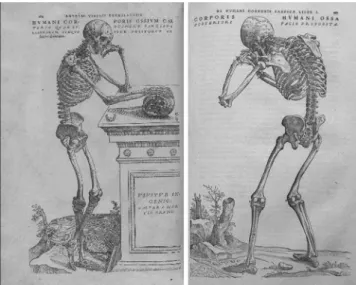
His illustrations, famous not only for their artistic
excel-lence, but also because many displayed the human body
(skeleton, muscular system, others) in dynamic positions of
real life situations, and with panoramic landscape
back-grounds. Some illustrations may permit inferences about
behavior, e.g., the skeletons postures may suggest ways of
thinking, concern with life and death (Figure 2).
The
Fabrica
is constituted by seven books
–
Bones and
cartilages
,
Ligaments and muscles
,
Veins and arteries
,
Nerves
,
Organs of nutrition and generation
,
Heart and
associated organs
,
and Brain
7
. The abriged
Epitome, intended
to be "the guide, index, and compendium of the
Fabrica", was
dedicated to "the students as a handbook for dissections and
Figure 1.Vesalius Portrait (Vesalius’s Fabrica, 1555)7.De humani corporis fabrica libri septem,theFabrica, 1stedition, came to light in 1543, by the printer Johannes Oporinus, from Basel.
It is one of the most influential books on human anatomy, and considered one of the great scientific and artistic oeuvre of mankind. TheFabricais illustrated with detailed illustrations, printed with woodcut engravings, in Venice, with the identity of the artist is uncertain. Possibly the contribution was of one of the artists, the Flemish Van Kalcar, and possibly of others, of the atelier of master Titian, and some of the plates are credited to Vesalius. It is constituted by 7 books, comprising all systems of the human body. The
Fabrica, 2ndedition, released in 1555, dedicated to Charles V, is considered more sumptuous than the 1stone. There are also
corrections, decrease of redundancies, as well as inclusion of physiological experiments, by means of nervous section, e.g., section of the recurrent nerve, with consequent laryngeal paralysis.De Humani corporis fabrica librorum Epitome, theEpitome, printed in 1543, was intended by Vesalius to be a very brief descriptive book, being a remarkable condensation of the 1stedition of the main book. It
has 6 chapters, the 5thconcerned with The brain and the nervous system. These oeuvres constitute a milestone in the study of human
anatomy and neuroscience. However his work was not limited to these publications, including, among others:Paraphrasis in nonum librum Rhazae, 1stVesalius book, with Paraphrase of the ninth book by the most famous Arab physician Rhazes [addressed] to King
Almansor, deals with treatment of diseases affecting the various parts of the body, with several editions, between 1537 and 1592.
Box 1.De Humanis corporis fabrica libri septem, or theFabrica, and others3,7,8.
to physicians and surgeons, who, preparing for an operation,
had to recall the position and the form of a bone or of an
organ". It contains six chapters, the 5
thone concerning the
"Brain and the Nervous System
1,6,8, which merits here a
spe-cial mention (Box 2).
VESALIUS AS A PHYSICIAN
After his publications, as he felt that he had already
over-come the lamentable situation of anatomical knowledge, he
decided to start medical practice, as traditionally members
of his family were at service of the holy Roman emperor as
physicians for at least four generations
2,3,9. He received the
position of imperial household physician (1544), leaving his
post in Padua. However, his traditionalist new colleagues,
con-demned Vesalius
’
s modern perspective
2,6. However, he
main-tained interest in anatomy, and participated in postmortems
in a nearby School of Medicine, and while acting as a military
surgeon during the Emperor
’
s various battles
2. Surgery and
anatomy were then considered of little importance in
compar-ison to the other branches of Medicine. However, Vesalius
believed that surgery had to be grounded in anatomy
6.
Over the next years he traveled with the court, treating
injuries from battle or tournaments, performing
postmor-tems, administering medications, and writing private letters
addressing specific medical questions. He wrote a pamphlet
on blood letting, a popular treatment for a variety of illnesses,
supported by his knowledge of the vascular system, showing
how anatomical dissection could be used to test
specula-tion, and underlining the importance of understanding the
structure of the body in Medicine
2,6. He also became the first
person to describe mechanical ventilation, an outstanding
achievement in Anaesthesia
10.
FINAL REMARKS
This tribute to Vesalius honors his detailed dissection
of the human body, which reconsidered profoundly Galen
’
s
millennial findings, and connected anatomy to high
qual-ity artistic illustrations. This distinguished him from his
contemporaries, some with relevant contributions to
ana-tomy. Vesalius set a solid foundation of anatomy, paving
the way for its further development in the next centuries.
Thus he may be seen as the Father of modern anatomy,
and an authentic representative of the Renaissance in the
field of science and art.
Figure 2.Illustrations from Vesalius’Fabrica(1555)7. Skeletons and their expressive postures.
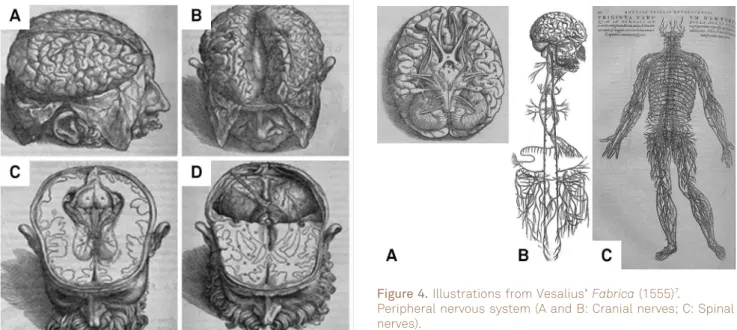
TheFabricais an extended and profusly illutrated book, while theEpitome, appears in a condensed format. Vesalius begins the chapter of theEpitome, concerning The Brain and the Nervous System, with the statement: The brain, the seat of the animal and the principal faculty, lies in the skull and admirably fits the form of the cavity in the upper region of the head which it occupies throughout its length. Some excerpts, cited in a abridged form, follow. The opening of the vault of the cranium shows (Figures 3A, 3B, 3C and 3D) the cerebrum protected by a though membrane (dura mater), and after its removal, right and left parts of the brain, joined at the midlinebase, and continuous with the dorsal medulla (oblongata and spinalis) may be seen. The dura mater sends a fold between the two parts of the cerebrum (falx cerebri), and between the cerebrum and the cerebellum (tentorium cerebelli). The exposed cerebrum permits to see the internal structures in axial sections at several levels; the upper level reveals two large cavities (lateral ventricles), the cortical convolutions, subcortical white matter, caudate nucleus, thalamus, and the choroid plexus; a deeper level shows subcortical structures, as the thalamus, globus pallidus, putamen and caudate nucleus, internal and external capsules, and the intervening white matter, as well as the cerebral cortex. Ablating the posterior part of the cerebrum reveals the cerebellum and the upper brain stem, and after flipping anteriorly the cerebellum, the entire brain stem and upper spinal cord are disclosed. Internally, the lateral ventricles are in connection with the 3rdone, and the latter continues with a canal (acqueduct) that ends in the 4thventricle. Inside the ventricles may be
seen a plexus or network (choroid plexus). The septum (septum pellucidum), corpus callosum, the vault (fornix), and the cerebellum, and their relation with these cavities are described. A basal view of the cerebrum reveals the seven pairs of nerves (cranial nerves), the 1stpair
represent the optic nerves, which end in the tunic of the eye. The organ of smell (olfactory tract and bulb), not classified as a nerve, is described at the base of the brain. Then Vesalius continues with detailed description of the cranial, spinal, and peripheral nerves (Figures 4A, 4B and 4C). He also offers functional considerations proper of his time, citing the phlegm of the brain and its flow through a funnel shaped channel (infundibulum) down to the nostrils, after having been destilled by a quadrate gland (pituitary gland). And follows with the reflection that the vital spirit adapted in the plexus, and from the air drawn to the ventricles by the breath, the inborn force of the brains substance creates the animal spirit of which the brain makes use partly for the functions of the chief portion of the mind.
Box 2.Neuroanatomical observations from theFabricaand the Epitome1,3,7,8.
References
1. The epitome of Andreas Vesalius. New York: Macmillan; 1949.
2. O’Malley CD. Andreas Vesalius 1514-1564: in memoriam. Med
Hist.1964;8(4):299-308.
3. Saunders JBCM, O’Malley CD. The illustrations from the works of Andreas Vesalius of Brussels. New York: Dover; 1950.
4. Vons J, Velut S. La Fabrique de Vésale et autres textes. Paris: BIU Santé; 2014 [cited 2014 July 23 ]. Available from: http://www3. biusante.parisdescartes.fr/vesale/debut.htm
5. King LS, Meehan MC. A history of the autopsy: a review. Am J Pathol. 1973;73(2):514-44.
6. Castiglioni A. Andreas Vesalius: professor at the Medical School of Padova. Bull N Y Acad Med. 1943;19(11):766-77.
7. Vésale A. Andreae Vesalii,... de humani corporis fabrica libri septem... Basel: J. Oporinus; 1555 [cited 2014 July 23]. Available from: http:// www2.biusante.parisdescartes.fr/livanc/?cote=00302a&do=pdf
8. Vesalius A. De Humani corporis fabrica librorum epitome. Basel: J. Oporinus, Basel. 1543 [cited 2014 July 1]. Available from: http://www. bium.univ paris5.fr/histmed/medica/cote?09863
9. Norwich I. Andreas Vesalius. A bio-bibliographic study. S Afr Med J. 1967;41(17):431-40.
10. Vallejo-Manzur F, Perkins Y, Varon J, Baskett P. Andreas Vesalius, the concept of an artificial airway. Resuscitation. 2003;56(1):3-7. http:// dx.doi.org/10.1016/S0300-9572(02)00346-5
Figure 3.Illustrations from Vesalius’Fabrica(1555)7. Series of brains (description in Box 2).
Figure 4.Illustrations from Vesalius’Fabrica(1555)7.
Peripheral nervous system (A and B: Cranial nerves; C: Spinal nerves).