OISTRIBUTION ANO ANNUAL OCCURRENCE OF CHAETOGNATHA OFF CANANEIA
ANO SANTOS COAST (SÃO PAULO, BRAZIL)
M. S. DE ALMEIDA PRADO
Instituto Oceanográfico da Universidade de São Paulo
SYNOPSIS
Plankton samples were fortnightly taken at three fixed stations off Cananéia (1958, 1959, 1960) and off Santos (1960, 1961) by vertical hauling. They contain-ed the following species: Sagitta enfTata, S. triderici, S. hispida, S. minima, S. seT-ratodentata, Krohnitta pacifica and Pterosagitta draco. S. friderici is a typical coas tal water species. S. enfTata is a typical shelf water species. S. hispida and K. pacifica were present more frequently in shelf water but they Were sometimes very abundant in coastal water. S. serratodentata, S. minima and P. draco occurr-ed sparingly in tropical water, however, very few samples were taken in this water mass. Three different maturity stages were established (juvenile, intermediate and adult) in order to study the annual variation of the Chaetognatha. A special breeding period throughout the year was not observed as great swarms of juve-uiles and intermediates were found in spite of the very small number of adults.
Two series of samples taiken off Santos at a fixed station (Pt.
lIn
during a period of 24 hours in three different leveIs were aIs o counted to study the vertical distribution of the Chaetognatha in this area. The three most abundant species were: S. enfTata, S. hispida and K. pacifica. S. enfULta was more frequent at mid~water. S. hispida and K. pacifica seemed to prefer the surface Iayer. The thermocline did not affect their vertical migration except for S. hispida. There is indication that S. serratodentata performs vertical movements. S. minima seems to live below 25 m depth. K. subtilis occurred exceptionally in this vertical series of samples.INTRODUCTION
This paper is a study on Chaetognatha from Cananéia and Santos regions, at the coast of S. Paulo State, Brazil (Table 1). Two diHerent environments were chosen, one in the open sea oH Santos and the other off Cananéia more exposed to the influence of the outflow from the coastal lagoon system (TAVARES, 1967 p. 88 figo 1). The systematics and general distribution of this group in the western side of the 50uth Atlantic were already studied by V ANNUCCI &
~IOSOE (1952), HOSOE (1956) and ALMEIDA PRADO (1961 a, b). However only the spatial problen was considered and the annual variation of Chaetognatha was not investigated. There are several papers on annual variation and biological cycle of the Chaetog-natha in cold waters (RUSSELL, 1932-33) but for tropical water very few have been published, such as OWRE'S (1960) on seasonal variation of Chaetog-natha from the Florida Current, and REEVE'S (1964 a) on Chaetognatha from Biscayne Bay also in the Flo-rida Current.
AnotheJ:' aspect treated in this paper is the esta· blishment of the indicator species of different water masses and their vertical distribution.
Publ. n.O 275 do Inst. Oceano da USP.
~lm Inst. oceano{!r. S PAl.llo, 17(1) :33-55, 1968
MATERIAL AND METHODS
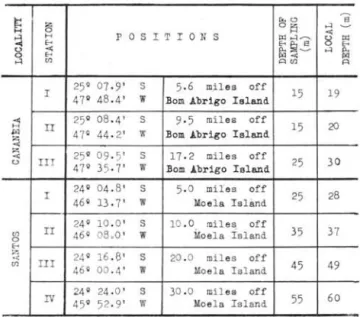
Three fixed points were established at the coastal adjacent waters of the lagoon region of Cananéia for collection of plankton during three years (1958, 1959, 1960). Samples were also collected at other three points oH Santos during 1960 and 1961. In 1961 a fourth point was added oH Santos over deeper waters (Table 1). The plankton samples and the hydrographical data were taken every fortnight.
Uno
fortunately there are some gaps due to bad weathel or rehauling of the boat. However, those gaps are compensated by the great number of samples and so· me taken in other occasions. The samples were taken vertically by a Hensen net rigged with silk or nylon gauze, 58 meshjinch.As many as 419 samples were counted totally for Chaetognatha. AlI adults and 'tIl developmental
TABLE I - Position of stations, depth of sampling and local depth
~
1'<.'" 8'6
°R
H ~<>:
~ H E-< POSITIONS t:rI H ... 8 ~
~!il--=- E-<
<> <>: H ."
o E-< I'il<>: I'il
H Cf} A Cf} A
25 · 07· -9' s 5· 6 m.iles off
I 47· 48.4' w
Bom Abrigo Island 15 19
<>: 25 · 08.4' - s 9·5 miles off
20
H Ir 15
1%1 47· 44. 2' W Bom Abrigo Island
':ã
z <>: 25 · 09 · 5' S 17.2 miles off
25 30 <> TIl 47· 35·7' w Bom Abrigo Island
24· 04. 8' S 5. 0 miles off 28 I 46· 13.7' W Moela Islànd 25
24· 10 .0 ' S 10 .0 mi l es off
Cf} rI 46° 08.0 ' w Moela Ísland 35 37
o
E-<
z 24 · 16 . 8' s 20 .0 mi l es off
-< rII
{/}
46· 00 . 4' w Moe l a I sland 45 49
24· 24. 0 ' S 30 .0 mi l es off 60
IV 45 · 52 . 9' w Moe l a Island 55
stages were counted. The density of the species per m3 of water was determined by calculating the volume
of water filtered through the neto
Two other series of samples taken oH Santos Pt.
IH
(Lat. 24°16. 8'S; Long. 46°00. 4'W) were counted totalIy in order to study the vertical distribution of Chaetognatha in this area. The samples were taken horizontalIy by means of a Closing Standard Plankton net rigged with nQ 3 gauze (64 mesh to the inch)which was towed for fifteen minutes at three diHerent leveIs O m, 25 m and 45 mover a depth of 50 m. These samples were taken on April 8, 1960 and July 6, 1961, and were towed at each of the diHerent given depth, every four hours during the period of 24 hours (Table IH). The speed of hauling was kept as near as possible to half a knot. The amount of water filtered was estimated by the evaluated volume of water filtered beca use data of the fIowmeters were not reIiable.
These samples are stocked in the Plankton Section of Instituto Oceanográfico da Universidade São Paulo.
HYDROGRAPHICAL NOTES
A brief account of the water masses of both areas is given for a better understanding of the Chaetog. natha distribution. They can be described as folIows, according to EMILSON (1959; 1961).
1 - The coastal water mass has salinity under
35.00°/00 and temperature above 20.00°C
nea-rest the coast.
2 The shelf water has salinity ranging from
35 .00°/00 to 36 .00% 0, temperature above
20.00°C and lies over the shelf immediately next to the coastal waters. Sometimes this wa-ter mass shows temperature as low as 10. OO°C in deeper layers due to the mixing with the subtropical water mass which fIows north and westwards under the tropical water.
34:
3 - Tropical water has salinity above 36.00%0 and tempe-rature higher than 20. OO°C. It fIows southwards to the east of the sheIf water. The regions of Cananéia and Santos are hydro-graphicaIly similar as to the presence of these water masses but they are diHerent in the extent and fre-quency of occurrence of each water mass in each point. Cananéia is an extensive lagoon region with a large outfIow and therefore the coastal water there has lower salinity than oH Santos. The salinity at Pt. I oH Santos was generaIly around 35.00%0 and oH Cananéia was always under 33.00% 0 and even as low as 29.50% 0, although the distance of the two
points from the coastline is about the same. Altoge-ther the fixed points oH Cananéia suHer a higher infIuence of coastal water than those oH Santos where the shelf water and to a less extent the tropical water come closer to land.
As these regions are very near to the coast the hydrographical variation and general condition of the environments are strikingly changeable due to the amount of rain and water drained from land.
DISTRIBUTION OF THE SPECIES ACCORDING TO WATER MASSES
Seven species of Chaetognatha beIonging to three genera were taken oH Santos and Cananéia. These are: Sagitta enflata Grassi; S. friderici
R.
Zahony,S.
hispida Conant,S.
minima Grassi,S.
serratodentataKrohn, Krohnitta pacifica Aida, Pterosagitta draco
Krohn.
The two most abundant and frequent species in both areas were
S.
enflata andS.
friderici, foIlowed byS.
hispida and K. pacifica.S.
minina andS.
serra-todentata appear last in abundance and frequency.
These two species occurred scarcely at Cananéia and the latter was taken only in 1960 when the infIuence of tropical water was stronger. Pterosagitta draco
occurred very seldom in quite smaIl number. Earlier papers showed the reIationship between the distribu-tion of these species and salinity and temperature in the western South AtIantic (ALMEIDA PRADO 1961 a, p. 31).
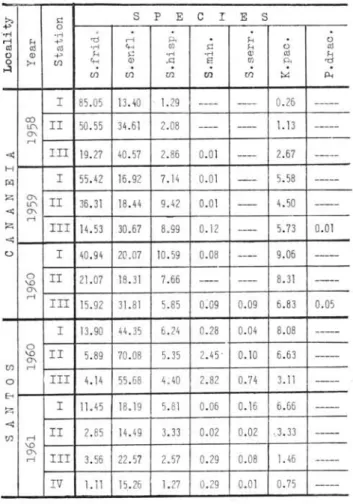
The annual average of specimensjm3 was calculat-ed in order to give a concise picture of the occurrences and frequencies of each species.
The distribution of each species as shown in Table 11 varies graduaIly from Pt. I, the shalIowest and neritic to Pt.
IH
and IV the deepest and oceanic one or vice-versa, depending however, on the water mass.The study of the association of each species with a water mass was made by selecting the samples which were hauled through only one water mass in order to be sure of the origin of the species. The two most abundant species were studied in more detail. Each species was considered separately to discuss its ecological parameters.
Sagitta friderici - Studied in the tropical
Atlan-tic by ALMEIDA PRADO (1961 a, p. 21; 1961 b, p. 32)
to
%
°
5
ali n
i
t Y
S2.s
...
i;l
30.00
31.00
32.00
33.00
34.00
35.00
36.00
..
o'"'
•
•
•
-In $ll
::s
•
•
•
o S. f r i der i ci
oq
•
•
:-s
•
•
rJl .%..Sallnity
••
•
'd
$ll
• •
~
'9
o Temperature C·•
•
...
•
•
•
°
•
..
p150
~
150
'"
'"
u,•
•
!J1 o
~ ~
•
~
~
E
•
O>
•
E
00
•
'-
'--.°c
o•
°
o c
o
>-~IOO
I
100
+-•
(/)fi) c
c
o• •
Q)Q) o O
o o
Cl o
•
o501
~ ). ~1150
°
°
••
o°
°
o o
8
°
o
°
°
°
o
°
oO
00fi
° cPO°
c oo !;lQ°
•
J
200
21.00
23.00
25.00
27.00
29.00
Temperature °c
TABLE II - Annual average of each species per cubic meter
~ s:: S P E C I E S
.p o
" M · ri
ccJ ri P, H C)
ri H +'
al ro ro ·ri 'H [fJ s:: H o ro
C) Q) +' H s:: ·ri ' ri Q) ro H
o >-< (fJ 'H Q) ~ E [fJ p, <d
H (fJ r;) {fJ {fJ (fJ
~ p.,
I 85 .05 13.40 1.29 ---- ---- 0. 26 ---<X)
II 50 . 55 34 .61 2.08 1.1 3
---U"\ ----
----O'.
ri
4! IH 19. 27 40 . 57 2.86 0.01 ---- 2.67
---H
li1 I 55 . 42 16. 92 7.14 0.01 -- 5.58 ---z O'.
H 36 . 31 18.44 9. 42 0.01 4.50
U"\ ---
----4! O'.
ri
z III 14. 53 30.67 8.99 0.12 ---- 5.73 0.01
4!
C> I 40 .94 20.07 10.59 0.08 ---- 9.06
---o H 21 .07 18. 31 7.66 --- ---- 8. 31
----\O
O'.
ri
IH 15. 92 31. 81 5.85 0:09 0.09 6.83 0.05 I 13.90 44 . 35 6. 24 0. 28 0.0 4 8.08 ---o
6.63
\O II 5.89 70 .08 5.35 2.4 5 ' 0.1 0
---O'.
{fJ ri
o III 4.1 4 55 .68 4; 40 2. 82 0. 74 3.11 ----8
Z I 11.45 18.19 5. 81 0.06 0.1 6 6.66
----4!
14.49 3. 33 0.02 0.02 ,,3.33
II 2.85
---{fJ ri
\O
O'.
Ilr
ri 3. 56 22 . 57 2.57 0. 29 0.08 1. 46
---IV 1.11 15. 26 1.27 0.29 0.01 0.75 ---was also firstly recorded by FURNESTIN, (1953, p. 413) and ROSE & HAMON (1953, p. 168) in the Mediterranean, by BIERI (1959, p. 1) in Peru and California Current, in blue-green water oH Lower California by TOKIOKA (1961, p. 11).
Sagitta friderici was more abundant oH
Cana-néia than oH Santos and its abundance decreases from Pt. I to III and IV in both areas showing its preference for coastal waters (Table lI). The dis-tribution of this species (Fig. 4) according to the distance from the coast, shows that the abundance decreases from Pt. I towards Pt. III in Cananéia and continues to decrease from Pt. I towards Pt. III in Santos, suggesting that Pt. IH in Cananéia is similar to Pt. I in Santos. The new records used in this paper confirm previous ones by ALMEIDA PRADO (1961 a, p. 22) since the greatest abundance of S.
friderici falls between 33.00 and 35.00% 0 salinity
and 21. 00 and 27. OO°C temperature in the T-S-P diagram (Figs. 1 and 2).
DUCRET (1962, p. 334) mentions the presence
of S. friderici in the mouth of the Congo River in
water of 32.61% 0 salinity. CAVALIERI (1963, p. 233) registered this species as neritic preferring water of low salinity. He found S. friderici in Argentinean
water of 15. 95°C of temperature and 33.66% 0 sali-nity. SAINT-BON (1963, p. 324) recorded this species abundantly in the Ivory Coast in salinity ranging
36
from 33.33 to 35.48% 0, Y et she mentioned the presence of S. friderici in higher salinity (39.72% 0) as well as in the oriental Mediterranean oH the coast of Israel. The present material shows a very rare occurrence of S. friderici in water with more than
36 .00%°' These two data suggest that S. friderici
is a typical neritic form and eurythermic as it endu-res higher salinities in coastal water oH Israel than in the western South Atlantic beca use in this area the water mass with salinity above 36.00% 0 is oceanlC.
Sagitta enflata - according to PIERCE & W ASS
(1962, p. 409) is an epiplanktonic warm water species found in the Atlantic, Indian, Pacific Oceans and in the Mediterranean by FURNESTIN (1957, p. 213).
The two forms of S. enflata occurred here, one with short and the other with long ovaries, however the long-ovary form appeared always in small num-bers and it was impossible to establish its relationship with the diHerent water masses. DUCRET (1962, p. 332) observed the same in equatorial regions of the western si de of Africa.
Sagitta enflata like S. friderici was one of two
most abundant species (Table lI). It occurred in all samples from Santos and Cananéia. In the T-S-P diagram (Fig. 2 and 3) the highest abundance of this species was found between 35.00% 0 to 36.00% 0
salinity and 21.00 to 23. OO°C temperature. The pre-sent data confirm those recorded earlier by ALMEIDA PRADO (1961 a, p. 21, figo 4). Figure 4 shows that the number of S. enflata increases from Pt. I towards Pt. IH (Cananéia) and from Pt. I towards Pt. III and IV (Santos), in other words it increases from coas tal water to shelf and tropical water. The diHerence in the distribution of S. friderici and S. enflata (Fig. 4) is very clear. The abundance of S. enflata is strik-ingly higher oH Santos than oH Cananéia. S. enflata
has also been observed by SAINT-BON (1963, p. 317--318) in the Ivory Coast withstanding a range of sali-nity from 33.33 to 35.48% 0 and temperature from
21. 99 and 29. 40°C. FURNESTIN & RADIGUET (1964, p. 61) found this species in water with temperature ranging from 21.00 to 29. OO°C and salinity from 35.00 to 37 .50%0' FURNESTIN (1957, p. 222-224) states that S. enflata is a neritic species in the
Medi-terranean where the environmental conditions are more stable, while it is an oceanic species in the oceans where its relationship with coastal waters is smaller especially in the subtropical regions. The present ma-terial also shows that here it is more oceanic than neritic since it is replaced by S. friderici in the
inshore water off Cananéia where the salinity is lower.
Sagitta hispida - According to FURNESTIN &
RADIGUET ( 1964, p. 68) the distribution of this species is Indian, Pacific and tropical Atlantic.
This species shares the second place in abundan-ce with Krohnitta pacifica. The pattern of distribu-tion of S. hispida, according to annual average, is
different each year and does not show the same dis-tribution in diHerent water masses as the two previous
to
T.
S.P.
e.
3
36.00
....
::l
ri>
©
(Q
©
~
r+
~~
o
©
'"'
~
<1
'"
~
C!
::l
o lI1l
~
:-s
11
w
~
>IJ
~
.:
9'
35.00
...
..,
~
v
-o
<1
G
'õ (] -
1- 50
~
"
(}
CiO CiO
@
c'n
o
~
.-50-100
<:il
-~
~
(}
~
f-'
'O
©
0
'"'
o
~
D
-100-150
a> 00
~
34~00
I
ujO-150-200
~®OO
{)
-i)
(jcH
,
o
V'-O
c
-; -- 50-100
t)
~
0-100-150
~
o
l ;
0-
15(>-200
Cf)~
@
33 .00
(}
32.00'~---~---~---~---~---~---~
17
19
21
23
25
27
29
Tem p e r a
t
u r
e
°c
Fig. 2 - T -S-P d!agram of S. friderici and S. en/lata.
c.>
00
Salinity
0/0030.00
31.00
32.00
33.00
34.00
35.00
36.00
•
I •'.
•
•
•
•
•
•
• • •
•
•
•
•
•
~ enfloto
•
•
•
•
•
•
•
0/00 Solinity
•
• •
Temperoture
°c
•
•
•
•
1501
•
•
150
o
•
•
~.
•
•
1'01'0
E
E
Õ'-
"'-o
c•
c100
o••
•
100
>->- o o o
•
+-+- o
(/)
(/) c
c
Q) o Q)
o
o
8
o 00•
til o
o
S
50
oo
1150
H
::s 00
ti> O O
...
O O
O
"
O'"
O O~
::s
O O O
0<1 O O O
:-s O O
til O
000 O
O O
'ti O O O
~ O
.: O O 00
9'
...
17.00
19.00
21.00
23.00
25.00
27.00
29.00
..
2
c.>
Temperature
°c
c.>
U.
,SJl
f-'
'"
Fig. 3 - Density or S. enflata accord!ng to temperature a nd salinity....,
E"-OI
'"
~
OI
:> o o
::J C C
o
...,
E"-OI
'"
o
OI
:> o o
::J C C
o
15
10
5
o
90
80
70
60
50
40
30
2 0
10
CANANEIA
1960 ~ . hisp..JJl.g 0--0 -K" ~ . - - . 1 0
1959
5
~
/"
, , /195:..:8:.-_---0-0 / / / /
o-- _ ...
1958
---
_ - - - - - STO
11 III
90 1958
2 · fridericl 0----0 8 0 ~ enflata
.
- - -..
70
60
50
40
30 /
/
1960 / /
--/-
20
~~2<--':::.'-::,-==-/
/
1958
10 ST
1960
...
SANTOS
~ hispida~
!L~.--~
...
......
....
"
",
11
,
, ,
...
...
...
....
_-
---111
2 f r iderici 0---0 "', 2 e nflata . - - . .
/
"
I ,
I ,
I ,
I ,
I ,
I '
I '
I ''\
I ,
I ,
I '
I ~
I I
/ /
/
, 1960
....--~
---.
STIV
1961 "..-," ...
._---
"",...".,.."..'
...~---;
--~
196 1
~
____~======a~
.
Sío O
11 111 11 111
Fig. 4 _ DIstrlbutlon o f S. frid erici, S. enfIa ta, S. h i spida and K. pacifica accordlng to the dlstance trom the coa st (Santos and Ca n a néia ).
IV
SpecÍes. Thís fact suggests that there Ís another fac-tor acting on its distributioll _which is neither tempe-rature nor salinity. '
The annual average of S. hispida per cubic meter
is inconsistent in the three years of coIlection in Ca-nanéia, but in Santos, it shows the general tendency to decrease from Pt. I to Pt. IV. Comparing the distribution of S. enfiata, S. friderici and S. hispida
according to the distance from the coast there is a suggestion that S. hispida endures a wider range of
salinity and temperature as it does not show the regular distribution of the two other species (Fig. 4, Table 11). The T-S-P diagram (Fig. 5 and 6) shows that S. hispida occurred more frequently in shelf water with salinity ranging from 35.00 to 36.00%0 and temperature from 20.00 to 22. OO°C, but that it can successfuIIy survive in coastal waters. Similar data were already recorded by ALMEIDA PRADO (1961 a, p. 25, figo 8). It is interesting to observe (Fig. 5) that in spite of being more frequent in shelf water there are two samples taken in coas tal water with sali-nity ranging from 33.00 to 34.40% 0 and tempera-ture from 25.00 to 27. OO°C in which it was very abundant (19.6 and 16.8 number of specimens/m3 ).
These two samples were taken (March, 3 and 27, 1958) a few days after strong winds which could have caused a mixture of coastal and shelf water by pushing the latter towards the coast. In fact the thermal structure of the column of water in both days was homogeneous. The range of salinity recorded by SAINT-BON (1963, p. 313) in the I vory Coast is from 33.00 to 34.48% 0, therefore it is partially coin-cident with the present data. SAINT-BoN (op. cit.)
states that the temperature is not a very important factor in the distribution of this species, though it seems to prefer higher temperatures. S. hispida is
a surface and diluted water species, according to the same a,uthor.
Krohnitta pacifica - Oceanic species in the
tro-pical equatorial region in the three oceans (ALVA. HINO 1964 b, p. 70). " S. bipunctata, S.
serratoden-tata, K. pacifica are also found more commonly in
the Current (Florida) but their apparent tolerance for Coastal water raises a question concerning their value as indicator of recent mixing of the two kinds of water" (PIERCE & WASS 1962, p. 428). On the other hand SAINT-BoN (1963, p. 333 ) attributes a semi-neritic character to this species.
This species, like S. hispida, has an inconsistent
occurrence in the three-year colIections at Cananéia especiaIIy in 1958 when it occurred very scarcely (Fig. 4, Table
11).
Krohnitta pacifica was already registered by ALMEIDA -PRADO (1961 a, p. 32) in the western , South Atlantic though it has not yet been possible to fix its ecological parameters. In the pre-sent material it does not show an oceanic preference since its density decreases from Pt. I towards Pt.111
in Santos although the T-S-P diagram (Fig. 5 and 6) shows that K. pacifica was more frequent and
abun-dant in shelf water and that it has a pattern of distribution similar to, S: hispida. The highest fre-quency and abundance océurred inwater of salinity ranging from 35.00 to 36.00% 0 and temperature
40
rangíng from 21.00 to 23.00°C. SAIN-BoN (1963, p. 332) found this species in water of salinity rang-ing between 33.64 and 35.46% 0 and temperature between 22.00 and 29.40°C off the Ivory Coast.
Sagitta mm~ma - According to FURNESTIN &
RADIGUET (1964, p. 74) the distribution of this spe-cies ranges from 400
N
to 400S in the Atlantic,Paci-fic and Indian Oceans, and in the Red Sea and the Mediterranean. ALVARINO (1964 a, p. 344) recorded
S. minima as a cosmopolitan and warm water species.
OWRE (1960, p. 261) studying material from the Florida Current, states that its distribution oH Miami shows that it is most abundant in the western edge of the Current, which flows over the outer part of the continental shelf and here also it was never found in typical coastal water. S. minima was represented by
small number of specimens in a few samples of shelf water (Table 11). This result was expected since S.
minima was previously associated with shelf and
tro-pical water (ALMEIDA PRADO 1961 a, p. 27) and the latter water mass was very seldom sampled in this collection. It was found also (op. cit.) lhat S.
minima endures a small range of temperature from
18.00 to 21.00°C. It occurred in Santos and Cana-néia in water with salinity ranging from 35.00 to 36.00% 0 and temperature from 19.00 to 23. OO°C. FURNESTIN (1957, p. 199) found S. minima in
Mo-roccan water with a range of temperature from 15.80 to 20.40°C and salinity from 36.20 to 36.58%0_ REYSSAC (1963, p. 263) recorded S. minima in the European Atlantic as an eurythermic species which withstands a range of temperature from 10.60 to 20.50°C and is a species of mixed coas tal and oceanic water with salinity about 35.500/ 00, These data con-firm our findings and show that S. minima prefers colder water.
Sagitta serratodentata - was recorded by OWRE
(1960, p. 211) as an oceanic species, more abundanl in open sea are as, than in coastal water. It is record-ed by FRASER (1952, p. 8) as the commonest oceanic species in north European waters and found in all the oceans of the world. According to HEYDORN (1959, p. 12) S. serratodentata is a cosmopolitan species.
S. serratodentata was found mainly Off Santos
where the conditions, on the whole, are more oceanic than oH Cananéia. It was represented by very few specimens (Table 11) in water of salinity ranging from 35.00 to 56.00% 0 and temperature ranging from 21.00 to 23. OO°C. According to ALMEIDA PRA-DO (1961 a, p. 27, figo 12) S. serratodentata is ty-picaI of the tropical water mass and only survives in shelf water. Therefore, I did not expect lo collect it abundantly in these are as where the coas tal and shelf water were predominant. PIERCE & WASS (1962, p. 412) remark that this species is noticeably absent in coastal water stations oH Florida. In 1960 a few stray specimens of S. serratodentata occurred in Cananéia in rather low salinity. VANNUCCI (1962, p. 3) studying the zooplankton standing-stock oH Cananéia during the period of three years (1958-1960) found that the 1960 curve has a quite diHerent
txl
o
S
0/00S a I
i
n ,i t,
y , .....
&l
r+
o
30.00
31,00
32.00
33.00
34.00
35.00
36.00
'"'
~I
•
tt>
o
P>
•
::s 6
•
o
•
Yr
oq
i
"
~6~!~
rn o/o o
S a I
i
I)i
t Y
6"d
o
•
6 6,.,
6 ~ hiseida<=::
•
p
•
K. pacifico• •
6...
- o...
Temperature C
6...
150
o
6•
150
~
•
~, pacifi co
'"
'"
• 6
cJ.
o
5 , hlsplda•
5Jl
...
w,.,
E
,.,
6 6 6
E
Ol
00 6
...
•
6Õ'
°c c
~
100
o
6\00
+-:>'I•
•
Cf)Cf)
c c
Q)
o
Q)o
OO
•
•
cP
•
o
6o
501
•
o
•
1150
•
•
o
o
6
•
•
o
•
~
i
•
•
o
o
o
17.00
19.00
21.00
23.00
25.00
2700
29.00
Temperature
°c
Fig. 5 - Denslty of S. hispida and K . pacifica accordlng to temperature and sallnlty.
~
li>-t.:>
36.00
rT.S.P
~v
~
©
v
~
~
~~
~
~
©
l,jI.,
35.00
I
t7
~
t7S. hisRida
~
WIo
34.00
~
17 O t7 t7 t7
~
ai-lo
~
CF
WI>. .10-20
t7V'
~t7
-
~ .Racifica
p- WI~ V
C 17 O V
• 1-10
Wlp-~
c
o
10-20•
t7C!)
~
tl:l
g,
33.00
8
~
....
o
~
ri>
r+
o t7
"
ti)
10
~
o
OQ
:;
til
'ti
32 .00
10
E.
l7.00
19.00
21.00
23.00
25.00
27.00
29.00.
.0
~
...
2
Temperature
°C
Co> Co>
tn
SJl
f-" Fig. 6 - T-S-P dlagram or 8. hi 8pida and K. pacifica.
<&!
'"
pattern and a much lower mean value. She suggests that some diHerent factors were present during that year which aHected the annual distribution of zoo-plankton. The presence of
S.
serratodentata in this water mass may also be the result of the influence of different factors. S. serratodentata is associated with water of high salinity, although SAINT-BoN (1963, p. 328) found it oH the Ivory Coast in temperature ranging from 22.00 to 29. 40°C and salinity rang-ing from 33.58 to 35.480/ 00 and explained the occurrence of this species in diluted watcr by a de-crease of its halophyle character with the inde-crease of temperature.Pterosagitta draco - FURNESTIN (1957, p. 572)
recorded this species as tropical and subtropical in the Atlantic, Indian and Pacific Oceans in the Red Sea and the Mediterranean. Pterosagitta draco was represented by a single specimen in three samples (Table
11)
in Pt.111
oH Cananéia and Santos duro ing 1959 and 1960 in waters of salinity ranging from 34.41 to 36.60%0 and temperature ranging from 16.50 to 24.00°C. As recorded by ALMEIDA PRADO (1961 a, p. 31) this species is associated to tropical water, more abundant northward in higher tempera-ture and therefore not expected in large numbers in these latitudes, in coastal and shelf water.REYSSAC (1963, p. 271) found P. draco in water with temperature ranging from 18.00 to 24. OO°C, more abundant at 23. 20°C and salinity around 36.50%0' SAINT-BoN (1963, p. 335) registered it in water of high temperature from 25.20 to 28. 90°C and salinity lower than those already mentioned from 33.58 to 34.48%0'
REMARKS - The Chaetognatha in this area seem to be more tolerant to a wider variation of tempe-rature than of salinity. The same was observed by VANNUCCI (1963, p. 180) for medusae from Cana-néia: "As a whole these medusae are more tempe-rature than salinity tolerant, this may be due to the samples coming from shallow water and thus the species present are those that are usually subjected to and adapted to relatively wide temperature chan-ges". Among copepods there are some neritic species which have temperature as an important factor aHect-ing their distribution, thus BJORNBERG (1963, p. 43--45) describes two neritic species, namely Centropages
furcatus as thermophile occurring above 20. OO°C and
C. branchiatus as a cold water species occurring under
15. 18°C. FORNERIS (1965, p. 87) studying the appendicularians in the western south Atlantic suggests that the physical properties analysed as temperature and salinity are less important for the explanation of their distribution than the knowledge of the history and biological dynamics of the water masses. She observed also that the majority of the ' appendicula-rian species found showed a strong eurythermy and euryhalinity. Apart from these specific relationships of each diHerent group, BOGOROV (1958, p. 150) re-marks that the temperature is a particularly impor-tant factor in subtropical and temperate seas, whereas the quantity of biogenic salts becomes more important in tropical are as.
Bolm Inst. oceanogr. S Paulo, 17(1) :33-55, 1968
VERTICAL DISTRIBUTION
An attempt is made here to establish the vertical distribution of the Chaetognatha in the area studied in order to obtain a clear picture of their di!::tribution and migration besides their relationship to water masses. According to BOGOROV (1946-47, p. 30) it is impossible to assign any species or any age group to a definite water layer or to a definite physico-che-mical conditions without a knowledge of the diurnal vertical migration of the particular group and so all the water layers in which the organisms dwell during the 24 hours must be considered as forming the ecolo-gical conditions characteristic of a given species. Many studies have bcen done on zooplankton vertical migration which shollld be mentioned, especially those which de aI with Cbaetognatha: MICHAEL (1911); HUNTSMAN & REID (1921); ROSE (1925) ; RUSSELL (1927, 1932-1933); CLARKE, BUMPUS and PIERCE (1943); BOGOHOV (1946-1947, 1958) ; Ft'f?NESTIN (1957); OWRE (1960); LACRoIX & MORISSET (1962). Most of them studied the problem from direct obser-vation in nature Lut ROSE made some experiments on vertical migration in the laboratory.
This study is based on two series of samples taken at I't.
111
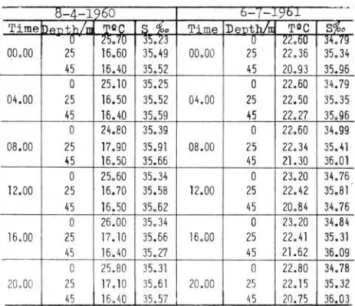
(Table 1). The first was taken when the therr.ml structure presented a marked thermocline and tm second one, when the thermal structure was unHorm. These two structures are respectively typical of summer and of winter (SOARES MOREIRA, in press). On April 8, 1960 .there was shelf water and a mixture of shelf and subtropical water in the deeper layer where the temperature was markedly lower. On July 6, 1961, the shelf water was predominant but there was coastal water in the surface layer (Table lU). The Chaetognatha collected at Pt.lU
include seven species representing two genera: Sagitta enflata,S.
hispida, S. friderici, S. serratodentata, S. minima,Krohnitta pacifica and K. subtilis.
TABLE lU Hydrographical data of the samples taken to study the vertical distribution
of Chaetognatha
8-4 1960 b C{ - 1)'0
..
Time \o oth/T1l 'l'QC I S %. Tim" DpnWn Toe 8%0
U 25;10 35.23
o
22.bU 3 •• "1900.00 25 16.60 35. 49 00.00 25 22.36 35.34 45 16.40 35.52 45 20.93 35.96
o
25.10 35.25o
22.60 34.79 . 04 . 00 25 16.50 35.52 04 .00 25 22.50 35.35 45 16.40 35.59 45 22.27 35.96o
24.80 35.39o
22.60 34.99 08 .00 25 17.90 35.91 08.00 25 22.34 35 •• 1 45 16.50 35.66 45 21.30 36 .01o
25.60 35.34o
23.20 34.76 12.00 25 16.70 35.58 12.00 25 22.42 35.81 45 16.50 35.62 45 20.84 3 •• 76o
26.00 35.34o
23.20 34.84 16.00 25 17.10 35 .66 16.00 25 22.41 35.31 45 16. 40 35.27 45 21.62 36.09o
25.80 35.31o
22.80 34.78 20. 00 25 17 . 10 35.51 20.00 25 22. 15 35.32 45 16.40 35.57 45 20 .75 35.03S. enflata and S. ' hispida were the most abundant species in this collection, as was expected, since both were sheIf water indicators. These species will be treated in .detail as they are abundant enough to give a good picture of their vertical distribution a.nd ver· tical migration.
Sagitta enflata - was the most abundant species
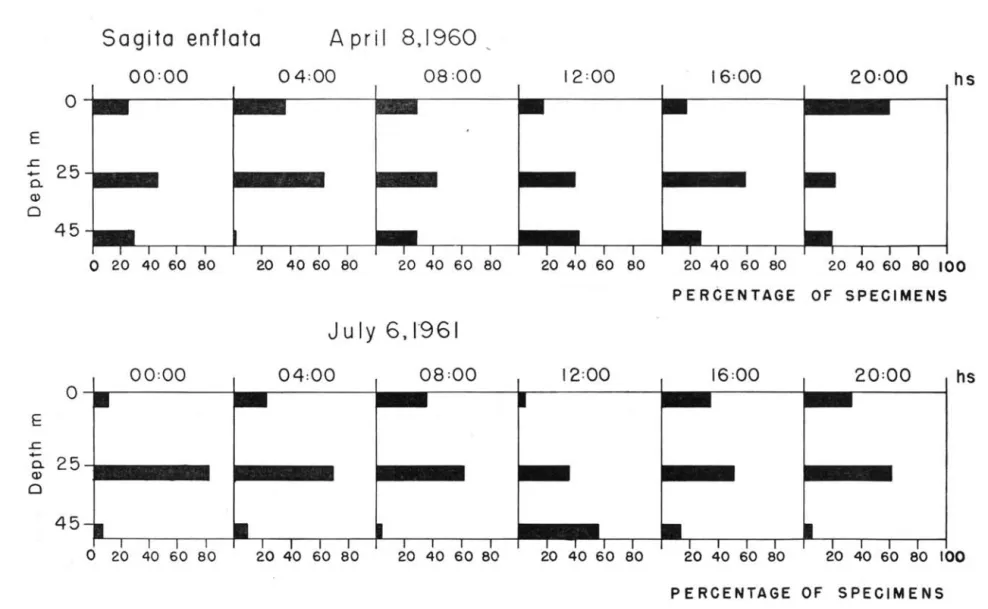
and occurred in all the samples but one, which was taken at 04:00 hours in the deeper layer (Table IV). The records indicate that it performs vertical migra. tíon although not very markedly. Figure 7 shows a general tertdency of the Sagitta enflata population to
sink at noon whether there is a thermocline or not, while the highest percentage of specimens stays ,at mid·water for the rest of the períod during which the collection was , made. As mentioned before
S.
enflata has its optimum temperature in the area betwe·
en 21.00 to 23. OO°C although it may survive in higher and lower temperatures. Thus thermocline is not a barrier to its vertical migration. In the summer hauls only 49 adult specimens were found in 2.882 counted. These adults occurred indiHerently at the three depths in 6 samples. In the winter hauls only
TABLE IV - Density of each species , at th,ree different depths ,oif Santos '
"-f,.
,umbe Df mecimens per cu 1C lIIe ,er
e
..,
Q) Q) ' ...
-
_ _ o +" El ..CI,.;
P.
'"
~ro 'ri +' ri f.1 (\ ~ .
A 8 P< 4-< 'ri O'l f.1 a
ª
<ll <: f.1 ' ri <ll
El
A <ll
"':
,Q O'l ,.""
ui
fi)ui
til til ~ 1>4O 1.02 0.13 1.86 0.33
-
-
0.20 00.00 25 7.22 - 0.53 0.46 0.13-
0.02-45 -0.53 0.51 0.20 0.07
-
-
' 0,02O 2.80 0.06 2.86 0.62 0.02
-
1.04 04.00 25 8.46 0.22 0.28 0.20 0.13-
-45 0.86 0.06 0.17 0.42 0.02 .
-
-O 0.20
-
0.17-
-
-
0.01 o 08.00 25 3.75 0.08 0.17 0.06 0.02-
-~
45 2.17 0.17 0.68 0.57 0.02 --~ O 1.42 0.08 3.42 0.62 - - 0.24
1 12.00 25 5.62 0.06 0.06 0.37 0.33
-
-ct:J
45 8.86 0.77 1.33 4.40
-
- 0.02 O 3.17 0.02 2.02 0.53-
-
0.08I
16.00 25 UO 0.02 0.40 0.28 0.06-
-45 1.22 0.64 0.24 0.08-
-
-O 5.68 0.42 5.77 1.60-
-
0.13 20.00 25 10.50 0.33 0.17 0.37 0.06-
-45 1.00 0.08 0.02 0.33 0.17
-
-O 0.86 0.02 0.68 0.80-
0.17 0.02 00.00 25 1.64-
0.22 0.08 0.11 0.80 0.08 45 1.00 0.04 0.04 0.15 0.17 0.04-O 0.35
-
0.15 0.04-
0.26 0.06 04.00 25 0.62-
0.20 0.11 0.06 0.33-45
-
0.66 0.04 0.15 0.64 0.02 -O 0.26-
0.37 0;02-
0.51 -08.00 25 0.37-
0.02 0.02 0.06 0.29 -ri 45 0.25 - 0.04 0.08 0.04 0.02-'8
ri O 1.20 0.08 2.62 0.20-
0.42 0.200.06 1.87 ~.04 ' I 12.00 25 2.71 0.04 0.02 0.20
- ~ 45 2911
-
0.04 0.15 0.13 0.13-\D
O 0.65 0.08 0.24 0.60
-
0.86 0.02 16.00 25 1.33 0.08 0.08 a.33 0.02 1.02 0.02 45 2.82 0.02 0.06 0.20 - 0.06-O 2.75 1.00 1.82 2.37
-
1.04 -20.00 25 0.97 0.15 0.08-
0.02 0.42 0.0445 (!.!I8 O 04 0.08 0.06 0.04 O 31
-44
6 adults occurred in 1.018 counted, in one samples taken at noon at 45 m depth. In the sumrríer collec· tion the adults represented 1.70% of the total speci· mens and in the winter they represented · onl)' 0.58% of the total specimens.
FURNESTIN (1957, p. 221) says tha! S . enflata
is an epiplanktonic species as it was caught very fre· quently oH Morocco in diurnal hauls insurface layers.
S. enflata seemed to be concentrated in the mid·water
oH Santos. Hawever this area is considerably shal: lower than that studied byFuRNESTIN.OWRE (1960, p. 278) studying the vertical migration of S. enflata
over deeper areas than the present, found ' that most animaIs occurred in the upper 20D m . and that its vertical distribution during ~a 24 hour'period clearly indicated diurnal mígration. '
Sagitta frid'frici -;- as a typical coastal water
species waJl sparingly represented in t~ese samples thereforç it did not Plovide enough data to give an idea of its vertical distributiçm and migration (Table IV). , The presence of some larger specimens of
S.
friderici was noticeable, beçause t~ey were not found
before in this arei~ , They occurred twice at 45 m depth: at midnight
5n
cold water below the thermo· cline. An attempt was . made to m~asure them but they were too badly preserved to take accurate measu· rement "so orily a ' comparison between the two lots was ma de and it was observea that they were visibly larger than' the specimens usually ' fotind in this partoi 'lhe A'tlantic. The bíggest size registered for this soecies in ' the southern western Adantlc' is 8.5 mII1 (VANNucci & HOSOE 1952, p. 14; ALMEIDA PRADO 1961 b, p. 33). There is no doubt about the classifi· cation of the largest specimens since the adults, in spite of the ' diHererice in size, havê exactly the same specific characteis as the smaller speciinens (ALMEIDA PRADO 1961 b, p. 33).
Sagitta hispida - occurred in all samples and
showed a tendency to concentrate in the surface layer above 25 m even during the hours ' of more intense illumination. Migration to deeper layers was observ, ed only once at 08 :00 hours when fhe thermocline was absent (Fig. 8, Table IV) and then the migration was more marked than that performed by S. enflata
at noon. This fact can be interpreted to a certairi extent as a more restriCted eurythermy of ' S. hispida.
The vertical distribution of S. hispida in the Florida
Current was irregular, the population wás concen· trated in the upper 200 ' m, and there is no irifór· mation on thediurnal migration' of ' thIs ' species according to OWRE (1960) . . Here only 33 adults were found in 1.288 specimens counled in the first series of samples, they occurred in five samples taken in the upper 25 m. In the second series only 7 adtilts were found in two surface hauls, in ' 313 specimens counted. In the summer collection the , adúlts repre· sented -2.69% ànd in the winter collectiori, 2.20% of the total specimens counted; ,
S. serr'atodentata and S. minima - : were neve r
abundant at the collecting point as they are indicators of tropical water. The highest density of S. serra·
tll
g.
a
....
Fil
r<'
o (")
."
g
~
til
~
~
...
oi8.
~
1Jl
~
00
""
UI,
O
E
.c
25
+-
o-Q)
o
45
o
E
.c
Õ.
25
Q)
o
45
Sagita enflata
A pril 8.1960 ,
00 :00
04 :00
08 :00
12:00
16:00
20:00
I
hs
I I I I I
40 60 80 20 40 60 80 20 40 60 80 20 40 60 80 20 40 60 80 20 40 60 80 100
PERCENTAGE OF SPECIMENS
J
u I y 6. 1
'9 6 I
00 :00
04 :00
08 :00
12:00
16 :00
20:00
hs
o
20 40 60 80 20 40 60 80 20 40 60 80 20 40 60 80 20 40 60 80 20 40 60 80 100PERCENTAGE OF SPECIMENS
11>-, O')
,tll o
ã
...::s
~
o n
'"
i»::s o
OQ
:>
fJl
tU
Il>
E.
S'...
...
B
, ~
c"
SJl
,...
<O
m ao
S agitta hispida
A
pr
i
1-8.1-960
00 :00
04 :00
08 :00
12 :00
16 :00
20 :00
hs
E
O~I
....
r4 . .
'---"""""""""~""~
.c
...
a.
25
<1>o
E
.c
+-a.
<1>o
45
o
25
45
I
o
20 40 60 8000 :00
O
20 40 60 8020 40 60 80 20 40 60 80 _20 ~O 60 80 20 40 60 80 40 60 80 100
PERCENTAGE OF SPECIMENS
, J
ui
y
6.1961
04 :00
08 :00
12 :00
16 :00
20 :00
hs
20 40 60 80 20 40 60 80 20 40 60 80 20 40 60 80 20 40 60 80 100
PERCENTAGE OF SPECIMENS
todentata was found below the thermocline at 45 m depth at midday. On the other hand an homogeneous vertical distribution in the second series of samples which was taken in a column of water with a uniform thermal structure was observed (Table IV). FUR: NESTIN (1957, p. 163-164) studying plankton from the surface layer oH Morocco and Mediterranean Iound that S. serratodentata was always more Ire-quent and abundant in the nocturnal hauls. OWRE (1960, p. 283) records a deÍinite diurnal migration
of S. serratodentata in the Florida Current. She found
that a large night surface population remained at the surface well into the morning, on the eastern side of the Current and although the majority retreated at midday a small number remained there all the time. MICHAEL (1911, p. 150) studying the Chaetognatha ot the San Diego region states that S. serratOdentata
is a mesoplanktonic species for which optimum con-ditions are found between 100 and 200 fathoms and that it migrates toward the surface when twilight is very subdued, but rarely ascends above 10 fathoms.
Sagitta minima - was represented by few
spe-cimens in these two series of samples.
It
appeared only once in the surface layer at 04:00 hours where the salinity was always u~der 35.500/00
and the tem-perature higher than 22. OO°C (Table IV). ALMEIDA PRADQ (1961 a, p. 27) records the highest frequencyoI S. minima in waters of salinity ranging from 35.00
to 35.50% 0 and temperature from 18.00 to 22.00°C.
Although there are insuHicient data to determine its vertical distribution, its constant absence in the sur-face layer suggests that this species lives in deeper waters than those mentioned. In fact FURNESTIN (1957, p. 198) considers S. minima a mesoplanktonic
species and says that the predominance of this species in nocturnal hauls oH Madeira indicates diurnal ver-tical migration. OWRE (1960, - p. 285) records
S.
mínima usually between 100 and 200 m and
ocasio-nally in the upper 100 m, though he had no data on diurnal migration.
Krohnitta pacifica - occurred only in the second
series in a sample taken when the thermal structure was homogeneous (Table IV). It was mentioned be-fore that this species has inconsistent distribution dur-ing the three-year collection at Cananéia and that there are unknown -factors affecting its distribution. It may need a - mixture of water masses to survive well as suggested by its occurrence- when the surface and deeper water masses were inixed and there 'was no thermocline (Fig. 9). At nóon the lowest percen-tage of K. pacífica was recorded in the surface layer
and the highest at 45 m depth imd during therest of the period of 24 hours the ' population remained in the upper 25 m. Altho1,lgh these data are insuf-ficient to come to a defini te conclusion there are indi-cations that K. -pacifica performs vertical migration.
OWRE (1960, p. 288) records that most of the popu-lation is found in the upper 250 m at night and that it migrates below 250 m in daytime.
Krohnittá subtilis - though not abundant its
occurrence was noted as it was never found in SANTOS during the two-year coIlection 1960-196l.
K. subtilis was already registered off Ilha da
Trin-dade (South western Atlantic) by VANNUCCI & HOSOE (1952, p. 24). The present data are insufficient to suggest any preference of water mass or to indicate vertical migration (Table IV). OWRE (1960, p. 286) reports that itfrequently occurred below 200 m in the Florida Current and found also evidence indicating slight diurnal migration.
REMARKs - Although a differential vertical dis-tribution of the different deveIopmental stages was not found here, due to the scarcity of fuIly sexuaIly developed specimens, there are many indications in other regions, especiaIly in cold waters, that adult planktonic specimens live in deeper layers and younger specimens in the upper layers. In the Bay of Fundy and Gulf of St. Lawrence the adults are confined to lower leveIs during the breeding season but the eggs were found near the surface (HUNTSMAN & REID 1921, p. 108). With increasing age the species be-comes graduaIly restricted to the darker and coIder water which is deeper (HUNTSMAN 1919, p. 465). Off Plymouth young specimens may have a different vertical distribution from the adults (RussELL 1927, p. 239), younger S. elegans and S. setosa have a
ten-dency to remain nearer the surface than the older ones (RussELL 1932-33, p. 561). The highest abun-dance of the largest specimens of S. elegans are found in the deeper layer during daylight and in interme-diate layer at midnight (LACROIX & MORIssET 1962, p. 36) so that it was inferred that they perform ver-tical migration but never up to the surface. The area ' here studied and the Florida Current are similar when data are compared to those already cited (Rus-SELL 1927, 1932-33; HUNTSMAN, 1919; HUNTSMAN
& REID, 1921; LACROIX & MORIssET, 1962). There-fore our results cannot be compared to Owre's as the frequency of young specimens in Santos is remar-kably higher than that of the adults. OWRE (1960, p. '313) did not find a special concentration of smalI juveniles in the surface layer even at a time when spawning appeared to have been intense.
According to CLARKE, PIERCE & BUMPUS (1943, p. 211) the vertical distribution of Sagitta depends
on the seasons and is correIated to size and stage of maturity. The two series of samples do not show a special behaviour of the total population of Chae-tognatha, characteristic of summer or of winter. Yet
S. enflata the most representa tive species showed a
similar pattern of vertical distribution on both occa-sions. Based on records obtained from Santos and Cananéia (Pt. I, lI, III and IV) an appreciable variation between summer and winter was not to be expected. It seems that the thermoeline is not a barrier to the vertical migrations of most Chaetogna-tha in the area considered. This fact can be explain-ed to some extent as due to the eurythermy of the species of Chaetognatha found here speciaIly: S.
enfla-ta, K. pacifica. SOARES MOREIRA (in press) studied
the vertical migration of Hydromedusae from the same material and found that Ectopleura dU1TWrtieri, Tur-ritopsis nutricula, Cyteis tetrastyla, Proboscidactyla
48
ornata and Aglaura hemistoma did not migrate
through the thermoeline and explains that in spite of their wide spectrum of eurythermy they appear not to be able to stand sudden variation of tempe-rature. SOARES MOREIRA (1965, p. 247-248) men-tions that the thermoeline does not act as a barrier for the foIlowing species: Euphysora gracilis, Liriope
tetraphylla, Cunina octonaria. According to VANNUCCI
(1963, p. 155) Euphysora gracilis is an indicator of sheIf water 50 that it is interesting to observe that
it behaves in the same way as S. enflata which is
also an indicator of sheIf water.
OCCURRENCE OF THE DEVELOPMENTAL
STAGES
It is known that the zooplankton in higher lati-tudes has a marked seasonal variation and that in the equatorial and tropical regions this variation is only slight throughout the year. According to Bo-GOROV (1958, p. 155) seasonal variations are proba-bly less marked in the tropical region, with its reIa-tiveIy insignificant elimatic changes. This statement refers especiaIly to surface layer which is more affect-ed by seasonal changes. One of the purpose of this paper is to determine whether there is an annual variation of Chaetognatha in the present area. For these purpose three different developmentaI stages we-re considewe-red in the coIlections of samples studied.
Three stages were established as foIlows: juve-nile (completeIy wi thout gonads), intermediate (go-nads and seminal vesieles in deveIopment) and aduIt
(completeIy fulI or emptied seminal vesieles) in order to simplify the nomenelature. The criteria for elas-sification of maturity stages suggested by previous authors (RussELL, 1932-33, KRAMP, 1917, 1939, in
ALVARlNO, 1965; OWRE, 1960; GHIRARDELLI, 1960 and DucRET, 1960) are not folIowed here for the difficulty of recognizing at first sight the different intermediate deveIopmental stages of the gonads in the large number of specimens to be counted.
The data obtained here show that the va-riation in number of organisms is not directly affect-ed by the different seasons of the year as great swarms of young specimens were commonly found alI year round. Thus the slight changes due to the different seasons do not determine an annual rhythm in the quantitative variation (Fig. 10 and 11) and of the life cyeles of alI species in this region. The frequency of adults was noticeably small in relation to the juveniles and even to the intermediate stage specimens (Table V and VI). The scarcity of adults may be due to the sampling, as the number of adults found was never sufficient enough to produce such high frequency of juveniles, and also, to a smaIler extent, due to mortality. Data from other places show that adults can occur in equal or higher frequency than juveniles. A higher number of lárge fuIly mature specimensof S. serratodentata
were found from April to
J
uly in the Atlantic southwest of the British Isles and in August and September the large specimens occurred to the west of IreIand (BAINBRIDGE 1963, p. 46). AIso the~
s
5'
OIr+ o ()
'"
Il> ::s o OQ :-' 1/l ~ ~.9
~..
B
~
Cn 9'~
00""'.
\O t>:. .p -ri ri ctl O o H <: H rzlz
<:z
<: o Ul o E-< Z <: <" H al Q) >-<co m
(]\ ri (]\ m (]\ ri o \D (]\ ri o \D (]\ ri ri \D. (]\ ri
Month Jan.
~
Stage.
I
rII
juvenile 59.0 85.5
interm. 39.5 14.5
adult 1.5 0.0
juvenile 72.9 77 .6
interm. 27.1 21 .8
adult 0.0 0.6
juvenile 45.6 46 .7
inter m. 54 . 4 53 .2
adult G.O 0.0
juvenile ----
---interm . ---
----adult ----
---juvenile 70 .8 72 . 4·
interm . 29 .2 27 .6
adu lt 0.0 0.0
Feb. Mar. Apr.
I
UI I
UI I
UI
51.5 80. 3 6G.9 71.1 49.9 76 .7
22.2 19.0 38.3 28.0 49 .9 18.6
26.3 0.7 0.7 0.8 0. 2 4. 6
51.7 87.6 19.5 68 .4
-
-47.6 12. 4 80.4 31.5 ---
---0.6 0.0 0.1 0.0 ----
-57 . 2 67 . 5 75.0 100 .0 30 .7 79.3 42 .8 32. 5 24 . L 0.0 68 .4 20 .7
0.0 0.0 0.9 0.0 0. 8 0.0
61.1 86 .9 70.5 55.7 75.4 57 .8
35 . 5 13.0 29 .4 43,6 24 .6 41. 9
3. 4 0.0 0.0 0.7 0.0 0. 3
42 .2 66 .7 79 . 3 89 . 1 ----
----57 . 5 33.3 20 .7 10 .7 ----
---0. 3 C.O ---0.0 0.1 ----
----I
May Jun. Jul. Aug.
I
lU I
IH I
rII I
UI
38 . 3 59.4 79.1 57.4 66.0 71.7
-
-61.6 '40.5 20 .7 24 .6 33 .6 19 . 4
-
-0.0 0.0 0. 2 8.0 0. 3 8.9
-
-35 .9 19.0 53 .7 84 . 8 63.7 70 .0 57. 5 95 .8 60 .1 66 .6 44 .6 15.2 33 .7 29 . 2 40 .7 4.2
3.9 14.3 1.7 0.0 2.6 0. 8 1.7 0.0
40 .7 55.5 55.6 63 .1 84 .7 57.8 0.0 89.7 59. 3 41.1 44 . 1 36 . 2 15.2 37.0 0.0 10.3
0.0 3. 3 0.2 0.6 0.0 5.1 0.0. 0.0
49 .8 54 .1 76. 8 84 .5 49.9 90 .5 63 .1 60.7
48 . 8 43 . 5 21.6 15.5 39.0 9.4 36 .0 39 . 2
1.3 2. 4 1.6 0.0 11.1 0.0 0.8 0.0
37 .2 95 .0 38 , 1 89 .6 72 .2 50 .0 48 .8 91.7 62 . 4 5.0 51.4 10 . 4 27 .8 50.0 51.2 8. 3
0. 4 0.0 10. 4 0.0 0.0 0.0 I 0.0 0.0
Sep. Oct.
I
UI I
UI
97.3 70.6 75.2 85. 2
2.6 23.9 24.4 13.1
0.0 5.4 0.4 1.6
91.3 70.8 86.9 81 . 5
8.7 27 .0 12.3 17. 0
0.0 2.2 0.8 1.4
97.9 90 .1 78.7 76.3
2.0 9.9 21.3 23 . 3
0.0 0.0 0.0 0.4
70.0 65.7 57.7 65 . 2
29 .9 34 . 3 42 . 3 33. 3
0.0 0.0 0.0 1.4
43.6 50.0 51.9 73 . 3
56 . 3 50 .0 47.7 26.7
0.0 0.0 0. 3 0.8
Nov.
I
IH
66.6 74.7
32.6 24.0
0.8 1.2
32.7 69.1
67.2 30 .6
0.0 0. 3
58.9 38 .9
41. 0 61.1
0.0 0.0
34.7 70.4
65 . 3 27 .1
0.0 2.4
33 .5 36 .5
64.3 52.8
2.2 10.6
Dec • .
I
rI43.7 64.8
56.0 34.9
0. 3 0.2
57. 9 62.0
42 .1 38.0
0.0 0.0
67 . 3 76 . 2
32.7 23 .8
0.0 0.0
47.3 79.5
52.7 20.4
0.0 0.0
45.5 29.2
52.7 68.9
1.8 1.9
I
~
tJj t"' M<:
o
o o .::~
::I o (1)g,
~
....
.::::r' ::lo
g-<'
l1Q rn
::r' .... o
\ll
'::11Q ... (1)
rn
...
::r'o
(J) ...
'<
(1) tI.l
\ll •
:-s
!
...
o ::i: Ul \ll~
rn \ll8-~
\ll::I