The Use of Preoperative Intra-Aortic Balloon
in Myocardial Revascularization Surgery
Associated to Severe Ventricular Dysfunction
Marcelo Kern, João Ricardo M. Santanna
Instituto de Cardiologia do Rio Grande do Sul / Fundação Universitária de Cardiologia - Porto Alegre, RS - Brazil
Mailing Address: Marcelo Kern • IC/FUC – Unidade de Pesquisa – Av. Princesa Isabel, 370 – 90620-001 – Porto Alegre, RS - Brazil E-mail: [email protected] Received on 03/18/04 • Accepted on 03/30/05
O
BJECTIVETo evaluate the effectiveness of prophylactic intra-aortic balloon (IAB) in elective myocardial revascularization surgery (MRS), to prevent trans or post-operative infarction and reduce intra-hospital mortality in patients with low left ventricular ejection fraction.
M
ETHODUsing a cohort study model, 239 patients with left ventricular ejection fraction ≤40%, submitted to elective MRS with extracorporeal circulation (ECC) were evaluated from March 1995 to February 2001.
R
ESULTSOf these,58 patients received preoperative IAB and the remainder underwent surgery without circulatory assistance (control group). The two groups of patients had similar characteristics regarding factors associated to the pertaining outcomes. There were fi ve demises (8.6%) in the group with IAB and 21 (11.6%) in the control group (non-signifi cant difference). There were 2 (3.4%) infarctions in the IAB group and 28 (15.5%) in the control group (p< 0.05), relative risk of 0.22 with an interval of confi dence of 95% from 0.05 to 0.85.
C
ONCLUSIONThe use of pre-operative IAB can signifi cantly reduce the risk of trans or post-operative acute myocardial infarction (AMI) in patients with decreased systolic function, without increasing vascular complications. In this same situation, the IAB does not signifi cantly decrease mortality. Randomized studies are necessary to establish more precise conclusions.
K
EY WORDS:
Improvements in medical assistance, especially in the ischemic cardiopathy area, with the development of pharmacological treatment and interventionist cardiology, resulted in an increased number of high-risk patients that need myocardial revascularization surgery (MRS)1-3. The stenosis of the left coronary trunk, surgical coronary reintervention, unstable angina and low ejection fraction of the left ventricle have been identifi ed in previous studies, as risk factors for the worst post-operative prognosis4,5. However, patients with decreased left ventricle ejection fraction are among those that can benefi t the most, in time, from the surgical treatment6.
The signifi cant change in the type of patient who is submitted to myocardial revascularization surgery with extracorporeal circulation resulted in a considerable increase of the cost of the procedure, as well as in a relative increase of mortality7-10. It became necessary to institute measures to neutralize risk factors capable to attaining acceptable results at reasonable costs.
The intra-aortic balloon (IAB) counterpulsation produces hemodynamic effects that signifi cantly benefi t the cardiac outcome. These effects are due to the increase of oxygen fl ow to the myocardium and consequent improvement of diastolic perfusion, as well as by the reduction in oxygen consumption due to the decreased left ventricular post-load11. Patients with systolic dysfunction of ischemic etiology present an important reduction in the myocardial energetic reserve, and can benefi t from the use of the intra-aortic balloon through the redistribution of blood fl ow to the ischemic myocardium12. This improvement in coronary fl ow, even for a reduced treatment period, can result in a higher energetic reserve for the transoperative ischemia period, resulting in improved hemodynamic recovery after extracorporeal circulation. It also reduces cardiac load, offering continuing circulatory support during and after surgery.
This study aims at verifying whether the preoperative use of intra-aortic balloon during elective myocardial revascularization surgery in clinically stable patients with poor left ventricular function can result in the reduction of perioperative mortality and morbidity.
M
ETHODS
We prospectively evaluated 239 patients by means of a study protocol; all patients presented severe ischemic cardiopathy, left ventricular dysfunction, characterized by left ventricular ejection fraction ≤ 40% defi ned by radioisotopic ventriculography at rest, with technetium-labeled red blood cells, indication of elective myocardial revascularization surgery and consecutively underwent surgery at Hospital São Lucas/Pontifícia Universidade Católica do Rio Grande do Sul, from March 1995 to February 2001. Patients with recent coronary event (less than 10 days before), associated surgical valvopathy, absolute contraindication for the
use of IAB, preoperative hemodynamic instability or formal indication for circulatory assistance by intra-aortic balloon were excluded from the study. Of the patients, 88 (36.8%) were females and 151 (63.2%) were males, with age ranging between 40 and 81 years, with mean of 61 ± 9 years. Mean ejection fraction, according to the radioisotopic ventriculography, was 31 ± 6%, ranging from 18% to 40%.
Although a decreased left ventricular ejection fraction represents an indication for the use of intra-aortic balloon in the pre-operative period of the revascularization surgery at the institution, the device implantation could not be accomplished for all patients included in the study, which resulted in patients being divided in two study groups:
Control group: included 181 patients (75.7%) who did not receive an intra-aortic balloon due to the device unavailability or the presence of a relative contraindication, such as peripheral vascular disease, aortic or iliac-femoral graft, moderate aortic regurgitation, tachyarrhythmia with ventricular frequency over 160 bpm, and contraindication to heparin or other intravenous anticoagulant drug.
IAB group: consisted of 58 patients (24.2%) who received an implant of intra-aortic balloon pump, between 2 and 24 hours before the moment of aortic clamping during cardiac surgery.
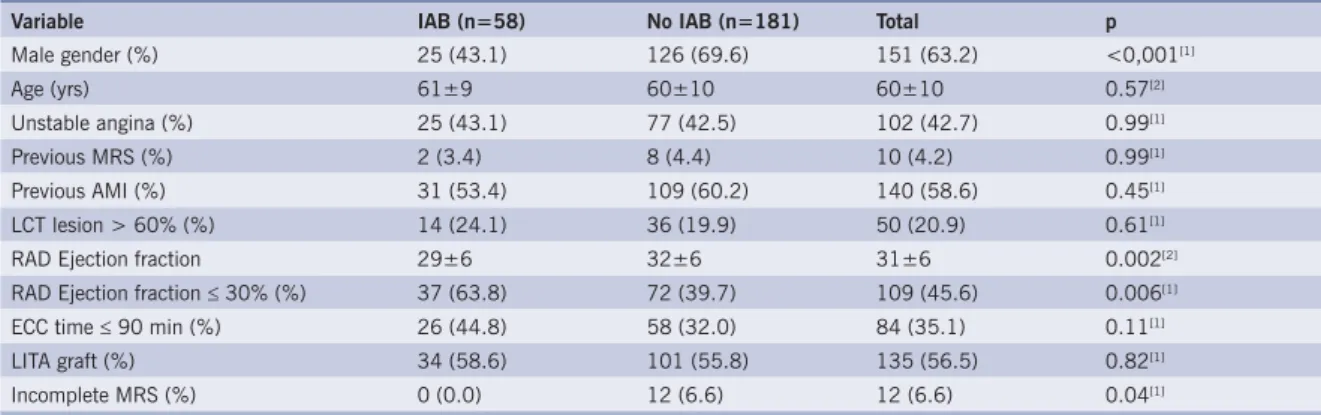
The patients’ demographic characteristics are shown in Table 1
Implant and removal of the intra-aortic balloon - The intra-aortic balloon was routinely implanted in one of the rooms at the hemodynamic laboratory of the hospital. Balloon-catheters were utilized, following the standard categorization, according to the individual anthropometrical data.
All patients underwent a percutaneous puncture of the femoral artery, with the insertion of a 10F arterial sheath and positioning of a balloon-catheter by radioscopy. After the implant of the intra-aortic balloon, the patients were anticoagulated with heparin and taken to the Intensive Care Unit (ICU), to await the myocardial revascularization surgery start. The counterpulsation equipment utilized was Datascope, adequatelyadjusted by the clinical staff of the surgical team.
The device was kept during the post-operative period for up to 48 hs, and its removal followed the clinical criteria of hemodynamic stability.
Perioperative Care – All patients were evaluated at the pre-operative period through laboratory fi ndings, hemodynamic study (coronary arteriography and left ventriculography), electrocardiogram and radioisotopic myocardial ventriculography, which allowed the assessment of the left ventricular function.
by infusion of hypothermic crystalloid cardioplegic St Thomas II solution (4oC) and coronary bypass and/or internal thoracic artery implantation.
After surgery, the patients received routine care.
Variables – For correlation with patients’ evolution, in addition to gender, age and left ventricular ejection fraction, the following pre-operative characteristics were selected: 1) unstable angina; report of more than 2 episodes of typical thoracic pain at rest, during oral pharmacological treatment, for more than 48 hs since the inclusion in the research protocol; 2) previous myocardial revascularization: history of coronary surgery; 3) previous myocardial infarction: history of infarction; pathological Q wave at electrocardiogram or ventriculography with compatible hypokinetic area; 4) left coronary trunk lesion: obstruction > 60%, identifi ed at coronary arteriography. Surgical characteristics were also considered regarding the analysis of post-surgical evolution: 5) time of extracorporeal circulation > 90 min; 6) internal thoracic artery implantation; 7) incomplete myocardial revascularization: when the coronary bypass or internal thoracic artery implantation was not possible in a coronary artery with a lesion considered appropriate for revascularization by coronary arteriography.
Outcomes –The events capable of interfering with the post-operative evolution were considered as primary and secondary events, according to the degree of importance and consequence.
Primary outcomes were: 1) intra-hospital demise, which happened at the intra or immediate post-operative period, considered the hospital stay period, regardless of its cause; 2) myocardial infarction at the trans or post-operative period: infarction that occurred presumably during the period encompassing from the anesthetic induction to the hospital release from the ICU, following the diagnostic criteria of the occurrence of a new pathological Q wave or the left bundle branch block at the electrocardiogram, and serum creatine phosphokinase mb (CPKmb) > 50 mg/dl or CPKmb > 80 mg/dl in the absence of a new Q wave or left bundle branch block13.
The outcomes considered as secondary ones were: 1) low cardiac output, characterized by clinical or laboratory signs of reduced tissue perfusion, such as decreased urine output < 400 within 24 hs, increase of serum lactate > 3 mg/dl, arterial pH < 7.28 with sodium bicarbonate < 20 mEq/l;. 2) use of vasopressor for a period > 24 hs, from the admission at the ICU; 3) mechanical ventilation by orotracheal intubation for period of time > 24 hs, from the admission at the ICU; 4) acute renal failure, having as criterion the elevation of serum creatine on the 2nd post-operative day to a value > 50% of the pre-post-operative control; 5) vascular complications, such as the ones attributable to the intra-aortic balloon, which needed surgical intervention in order to re-establish blood fl ow or that implicated in a permanent functional decrease of the limb, used for the insertion of the balloon-catheter.
This cohort study did not determine ethical implications or risk increase for the patients who participated in it. The fact that only part of the patients who had an indication for intra-aortic balloon due to reduced left ventricular fraction actually received the treatment, according to the routine of the institution where the study was carried out, did not depend on the decision of the researchers or the doctors who performed the therapeutic interventions, but on the moment’s availability. The research project was analyzed by the Review Boards of the institutions where the study was carried out, and they approved the study.
The data collected were transcribed to contingency tables, with the quantitative data being shown as mean±standard deviation (SD), whereas the categorical variables are presented as percentages. Data processing was carried out by the SPSS software (release 11.0).
Group comparison was carried out by Student’s T test, for quantitative variables, and Chi-square test for categorical variables.
For low frequency situations, Fisher exact test was used. To evaluate the power of association, the relative risk was used, with its respective confi dence interval of 95%.
Table 1 – Basal demographical characteristics of the groups with and without prophylactic intra-aortic balloon
Variable IAB (n=58) No IAB (n=181) Total p
Male gender (%) 25 (43.1) 126 (69.6) 151 (63.2) <0,001[1]
Age (yrs) 61±9 60±10 60±10 0.57[2]
Unstable angina (%) 25 (43.1) 77 (42.5) 102 (42.7) 0.99[1]
Previous MRS (%) 2 (3.4) 8 (4.4) 10 (4.2) 0.99[1]
Previous AMI (%) 31 (53.4) 109 (60.2) 140 (58.6) 0.45[1]
LCT lesion > 60% (%) 14 (24.1) 36 (19.9) 50 (20.9) 0.61[1]
RAD Ejection fraction 29±6 32±6 31±6 0.002[2]
RAD Ejection fraction ≤ 30% (%) 37 (63.8) 72 (39.7) 109 (45.6) 0.006[1]
ECC time ≤ 90 min (%) 26 (44.8) 58 (32.0) 84 (35.1) 0.11[1]
LITA graft (%) 34 (58.6) 101 (55.8) 135 (56.5) 0.82[1]
Incomplete MRS (%) 0 (0.0) 12 (6.6) 12 (6.6) 0.04[1]
In order to adjust the effect of important risk factors in the relation between the use of intra-aortic balloon and the occurrence of considered outcomes, Cox proportional-hazards regression model was utilized.
An alpha of 5% was considered as level of signifi cance, with higher signifi cance levels being indicated.
R
ESULTS
Regarding the significant differences in the characteristics of the patients distributed between the two groups, we observed a predominance of the male gender in the control group (69.9%), differently from the study group (43.1%, p< 0.001). As for the mean ejection fraction, a higher value was observed for control group, when compared to the study group (32 ± 6% vs 29 ± 6%, p < 0.01, respectively). Regarding the percentage of patients with an ejection fraction ≤ 30%, it was signifi cantly lower in the control group, when compared to the group that received the intra-aortic balloon (39.7% vs 63.8%; p < 0.01, respectively). Regarding the incomplete revascularization, it was observed in 6.6% of the patients in the control group, but it did not occur in any of the patients treated with intra-aortic balloon (0.0%, p< 0.05).
Concerning the remaining variables, there were no signifi cant differences between the two groups, as shown in Table 1.
There were 26 demises, which correspond to a global mortality of 10.9%. There were 21 demises in the control group (mortality of 11.7%) and 5 in the IAB group (8.6% of mortality). The 30% reduction in mortality related to the treatment with IAB was not signifi cant, as shown in Table 2 and Figure 1.
Acute myocardial infarction (AMI) occurred in 30 patients (18.9%). When the groups are considered, 28 patients (15.5%) from the control group suffered an AMI, whereas only 2 patients from the study group (3.4%) had the same complication, which is a statistically signifi cant difference (p< 0.05). The relative risk of myocardial infarction in a revascularization surgery was 0.22 for patients who received the intra-aortic balloon in the pre-operative period (confi dence interval of 95%, with a value ranging from 0.05 to 0.85).
For a higher degree of confi dence concerning the relation between the use of intra-aortic balloon and decrease of perioperative infarction risk, a multivariate analysis with Cox regression was carried out, controlling the following variables: age, gender, left ventricle ejection fraction, time of extra-corporeal circulation > 90 min and incomplete myocardial revascularization, previous myocardial revascularization surgery, unstable angina and left coronary trunk lesion. As shown in Table 2, the protective effect of the intra-aortic balloon remained signifi cant, after the variables were adjusted (Table 2).
Table 2 – Comparison between the groups with and without intra-aortic balloon, regarding the occurrence of hospital mortality outcome and trans and post-operative acute myocardial infarction
Outcome IAB use Univariate analysis Multivariate analysis
Yes (n=58) No (n=181) RRb IC95% p RRa* IC95% p
Hospital mortality 5 (8.6) 21 (11.7) 0.7 0.26 to 2.00 0.70 0.66 0.24 to 1.82 0.43
Trans and post-op AMI 2 (3.4) 28 (15.5) 0.22 0.05 to 0.85 0.029 0.19 0.04 to 0.80 0.02
IAB – intra-aortic balloon; AMI – acute myocardial infarction; RRb – non-adjusted relative risk; RRa –relative risk adjusted in a regression model of Cox proportional hazards, including the terms: time of extracorporeal circulation ≥ 90 min, gender, incomplete myocardial revascularization, ejection fraction, left coronary trunk lesion > 60%, age, previous myocardial revascularization surgery and unstable angina
Fig. 1 - Power of association of the intra-aortic balloon and variables of interest in primary outcomes. IAB – intra-aortic balloon; ECCT – extracorporeal circulation time ≥ 90 min; M gender – male gender; INCOMPMR – incomplete myocardial revascularization surgery; LVEF – left ventricular ejection fraction; LCT - left coronary trunk lesion; UANG – unstable angina; PMR - previous myocardial revascularization
IAB ECCT M gender INCOMPMR LVEF LCT UANG PMR
IAB ECCT M gender INCOMPMR LVEF LCT UANG PMR
Relative risk and 95%CI for in-hospital mortality
The variable extracorporeal circulation > 90 min showed to be associated to trans and post-operative myocardial infarction outcome in our sample. The remaining variables did not correlate to such outcome.
No signifi cant differences were observed regarding the occurrence of secondary outcomes such as prolonged mechanical ventilation, acute renal failure, low cardiac output, prolonged vasopressor drug use, and in the occurrence of vascular complications in the two groups studied, as shown in Table 3.
D
ISCUSSION
Previous studies that identified poor operative prognosis factors in MRS with extracorporeal circulation (ECC) indicated that the following factors are relevant: left coronary trunk lesion, unstable angina, previous MRS and systolic dysfunction of the left ventricle. The profi le change in patients who were candidate to MRS was mainly characterized by a larger proportion of individuals with ventricular dysfunction2. In our study, we aimed at evaluating whether the benefi cial hemodynamic effects of the IAB persisted as a protective factor for the MRS, when taking into account only the reduced ventricular function as a risk factor.
We used the left ventricle ejection fraction, measured by radioisotopic ventriculography at rest, as a criterion to defi ne ventricular dysfunction, and therefore, high risk for the concerning outcomes. Previous multicentric studies14 identifi ed left ventricular failure as the main risk factor for sudden death and new coronary events in ischemic patients. In most of the reviewed studies, the criterion of ejection fraction was present at the defi nition of high operative risk. Associated to that, one can affi rm that most of the remaining criteria mentioned somehow infl uence the myocardial contractile performance.
We considered 40% of the ejection fraction as the cut-off level to characterize high risk, as it was the most often used value in the reviewed studies.
As described by Antman12, trans and post-operative myocardial infarctions occur in 5 to 15% of MRS. Autopsy analyses indicate that most of the grafts performed were patent, so the physiopathological mechanism of the perioperative infarction seems to be related to the disproportion between oxygen offer and demand by the myocardium, and not to the occlusion
of the bypass grafts. This supports the idea that the prophylactic IAB can be benefi cial in MRS.
According to our literature review, starting in 1992 with Georgeson and cols.15 and mainly from the studies by Christenson and cols.16, the pre-operative prophylactic use of the IAB has shown to be important to prevent trans and post-operative complications in selected groups of patients.
In 1976, Cooper and cols.17, in a case series, reported that the prophylactic use of the balloon in revascularization surgery in the presence of left coronary trunk lesion was a safe strategy, with no increment of vascular complications. The surgical results were adequate and comparable to those obtained in lower risk surgeries.
Georgeson and cols.15, in a small review study, concluded that the pre-operative use of the balloon in non-cardiac surgery was benefi cal, when the patients were classifi ed as having higher risk (Goldman class IV).
In a 27-year review of the use of IAB, carried out at the Massachusetts General Hospital, mortality among patients who received pre-operative IAB at the myocardial revascularization surgery was 13.6%, whereas the mortality of patients who received trans or post-operative IAB was approximately 35%18.
The use of pre-operative IAB started to consolidate as a myocardial protection method for patients with increased risk in MRS as of the studies by Jan T. Christenson, initially published in 1997, producing a sequence of scientifi c work in this area until the recent publication in 200219.
The series of articles produced by the team at Hospital Columbia de Ia Tour, led by Christenson, was the inspiration for our study. These studies concluded that the pre-operative use of the intra-aortic balloon in high-risk patients decreased the chance of infarction and death, reduced the hospital stay duration and was cost-effective.
They also defi ned, as the main risk factors for post-operative complications, left coronary trunk lesion, urgent surgery, unstable angina, reoperation and decreased ejection fraction, and that in the presence of two of these factors, the use of prophylactic IAB would be indicated20.
This study series showed the ideal time for pre-operative device implanting was between 24 and 2 hours
Table 3 – Comparison between the groups with and without IAB, regarding the occurrence of secondary outcomes
With IAB (%) Without IAB (%) Total (%) p
MV 6 (10,3) 15 (8,3) 21 (8.8) 0.83
LCO 0 9 (5) 9 (3.8) 0.11
VDU 15 (25,9) 32 (17,7) 47 (19.7) 0.24
ARF 4 (6,9) 15 (8,3) 19 (7.9) 1
Vasc. Comp. 2 (3,4) 4 (2,20) 6 (2.51) 0.061
before the surgery21. It also demonstrated that the use of pre-operative IAB reduced the need for post-operative hemodynamic support and that the post-operative use of the balloon is an indication of poor prognosis22.
The results obtained by Christenson and cols were so remarkable that, in a letter to the Editor of the Annals of Thoracic Surgery Journal (2001) there was a discussion regarding the ethical aspect of conducting further randomized studies with a control group, considering the known great benefi ts of the pre-operative use of IAB for a selected group of patients23. However, it is noteworthy that a large number of patients from the samples studied by Christenson consisted of unstable patients, differently from our study, where all patients were clinically stable.
The results of our study point to a 30% decrease in mortality among patients treated with IAB, compared to patients from the control group. There was, however, no statistically signifi cant difference. They also showed an important decrease in the risk of trans and post-operative myocardial infarction, of around 78%, which is statistically signifi cant, with a relative risk for infarction of 0.22. After adjusting the results for the variables of interest, with the use of Cox multivariate regression, the reduction of the relative risk remained important and statistically signifi cant.
Although there was heterogeneity between the two groups of patients, the differences in the sample indicated a tendency for more severe patients in the group with IAB, thus excluding the confusion bias in the results obtained.
For the correct analysis of our results, we identifi ed variables, which in previous studies were related to the concerning outcomes, mainly trans and post-operative infarction, such as increased time of extracorporeal circulation24,25, left coronary trunk lesion26-28, and incomplete MRS29, in addition to variables already established as higher risk factors: age, unstable angina, and previous myocardial revascularization. These variables were controlled at the multivariate analysis, as well as the severity of the left ventricular dysfunction, expressed by the left ventricular ejection fraction.
There was no difference in the distribution of the increased extracorporeal circulation time variable (time of ECC ≥ 90 min) between the two groups of patients. However, this variable was signifi cantly associated to a higher frequency of trans and post-operative acute myocardial infarction, in accordance to previous studies. The incomplete myocardial revascularization variable was unevenly distributed between the groups of patients. All incomplete MRS cases occurred in the group without IAB. Likewise, there was no association between this variable with the concerning outcome.
The frequency analysis of the variables: prolonged mechanical ventilation, acute renal failure, low cardiac output and prolonged use of vasoactive drugs in the group
treated with IAB and the control group, were established as secondary outcomes, for being somewhat related to the left ventricular function.
The ischemia of lower limbs, related to the insertion site, and thrombocytopenia are the most frequent complications observed with the use of IAB30. These complications are mainly related to the diameter of the balloon-catheter, the time of counterpulsation use, prolonged hypotension periods and the presence of previous vasculopathy. An incidence of up to 20% of vascular complications with the use of IAB is mentioned in the literature31. These complications can be minimized if catheters < 9.5 F are used, while thrombocytopenia is directly related to the time of counterpulsation use.
Regarding patients with vasculopathy and indication of IAB, the relation between the risks and the benefi ts of method must be assessed, as this situation is strongly associated to posterior vascular complications.
In our sample, vascular complications reached 2.51%, with no signifi cant difference between the two groups of patients. The criterion used for vascular complication was the need for surgical measures to re-establish perfusion in the affected limb. Amputation was not necessary in any of the two groups of patients. Compared with the literature, in the same cohort study by Merharval with 911 patients, a frequency of 5.9% of vascular complications was observed using criteria that were very similar to ours.
Considering such results, some questions called our attention: if we used only the criterion of ejection fraction in elective surgery to defi ne high risk, would the protective effects of the IAB remain? Would the results obtained in Europe be reproducible in our country?
As we observed on our study, there was a signifi cant reduction in trans and post-operative infarction risk, but there was no signifi cant reduction in mortality. Perhaps, if the risk criteria were stricter, the protective effects of the balloon would be more relevant, regarding intra-hospital death. However, the important reduction in the number of infarctions should probably refl ect positively on the intra-hospital mortality13.
In face of these results, one must question whether it is possible to be fl exible regarding the indication IAB use, using only the ejection fraction criterion, when one intends to prevent outcomes similar to those researched by Christenson. In order to do so, further randomized studies would be necessary, which, as mentioned previously, would need ethical analysis.
The results of this cohort study allow us to conclude that the use of pre-operative IAB in elective MRS in patients with ejection fraction ≤ 40% can signifi cantly reduce the risk of trans and post-operative AMI without increasing vascular complications.
frequencies, prolonged mechanical ventilation time and occurrence of acute renal failure. One must consider the fact that conclusions drawn from cohort studies
1. Colón G, Pérez CM, Gúzman M. Peruoperative outcomes. In: Octegenarians Undergoing Cardiac Surgery in Porto Rico. PRHSJ 2000; 19(2): 115-22.
2. Disch DL, O’Connor GT, Birkmeyer JD et al. Changes in patients undergoig coronary artery bypass grafting: 1987-1990. Ann Thorac Surg 1994; 57: 416-23.
3. Samuels LE, Sharma S, Kaufman MS, Morris RJ, Brockman SK. Coronary artery bypass grafting in patients in theur third decade of life. J Card Surg 1996: 11: 402-407.
4. Christenson JT, Simonet F, Badel P. Schmuziger M .Evaluation of preoperative intra-aortic balloon pump support in high risk coronary patients. Eur J Cardio-Thorac Surg 1997; 11: 1097-1103.
5. Christenson JT, Simonet F, Badel P. Schmuziger M. Preoperative intraaortic balloon pump enhances cardiac performance and improves the outcome of redo CABG. AnnThorac Surg 1997; 64: 1237-44.
6. Rogers WJ, Coggin CJ, Gersh BJ et al. Tem year follow-up of quality of life in patients randomized to recieve medical therapy or coronary artery bypass graft surgery: The Corobnary Artery Surgical Study (CASS). Circulation 1990; 82: 1647.
7. Légaré JF, Hirsch GM, Buth KJ, MacDougall C, Sullivan JA. Preoperative prediction of prolonged mechanical ventilation following coronary artery bypass grafting. European J Cardiothorac Surg 2001; 20: 930-6.
8. Poveda JJ, Calvo M, Llorca J, Bernal JM. Factores pre y perioperatorios determinantes de la mortalidad precoz em pacientes mayores de 75 años sometidos a circulación extracorpórea. Rev Esp Cardiol 2000; 53(10): 1365-72.
9. Hirose H, Amano A, Yoshida S, Takahashi A, Nagano N, Kohmoto T. Coronary artery bypass grafting in the elderly. Chest 2000; 5(117): 1262-9.
10. Rosengart TK, Krieger K, Lang Samuel J et al - Reoperative coronary artery bypass surgery. Circulation 1993; 88(5-Part 2): 330-5.
11. Lazar HL, Yang XM, Rivers S, Treanor P, Bernard S, Shemin RJ. Retroperfusion and balloon support to improve coronary revascularization. J Cardiovasc Surg (Torino)1992; 23: 538-44.
12. Gill C, Wechler A, Newman G, Oldman H. Augmentation and redistribution of myocardial blood flow during acute ischemia by intraaortic balloon pupming. Ann Thorac Surg 1975; 16: 44-53.
13. Antman, Elliott M. Medical management of the patient undergoing cardiac surger y. In: Braunwald E. Heart Disease A Textbook of Cardiovascular Medicine. Vol.2. Londres: W.B. Saunders; 1992:.1670-93.
14. The GUSTO Investigators - An international randomized trial comparing four thrombolytic strategies for acute myocardial infarction. N Engl J Med 1993; 329: 673.
15. Georgeson S, Coombs AT, Eckman MH. Prophylatic use of the intra-aortic ballon pump in high-risk cardiac patients undergoig noncardiac surgery: a decision analytic view. Am J Med 1992; 92: 665-77.
16. Christenson JT, Simonet F, Schmuziger M. The effect of preoperative intra-aortic balloon pump support in High risck patients requiring myocardial
R
EFERENCES
revascularization. J Cardiovasc Surg 1997; 38: 397-402.
17. Cooper GN, Singh AK, Christian FC et al. Preoperative intra-aortic balloon support in surgery for left main coronary stenosis. Ann Surg 1977; 185: 242-6.
18. Torchiana DF, Hirsch G, Buckley MJ et al. Intra-aortic balloon pumping fpr cardiac support: trends in practice and outcome, 11968-1995. J Thorac Cardiovasc Surg 1997; 113: 758-64.
19. Christenson JT, Cohen M, Ferguson JJ et al. Trends in intraaortic balloon counterpulsation complications and outcomes in cardiac surgery. Ann Thorac Surg 2002;74(4):1086-90; discussion 1090-1.
20. Christenson JT, Schmuziger M, Simonet F. Effective surgical managemnet of high risk coronary patients using preoperative intra-aortic balloon couterpulsation therapy. Cardiovasc Surg 2001; 9: 4: 383-90.
21. Christenson JT, Simonet F, Badel P, Schmuziger M. Optimal timing of preoperative intraaortic balloon pump support in high-risk coronary patients. Ann Thorac Surg 1999; 68: 934-9.
22. Christenson JT, Simonet F, Badel P. Schmuziger M.Preoperative intraaortic balloon pump enhences cardiac performance and improves the outcome of redo CABG. Ann Thorac Surg 1997; 64: 1237-44.
23. Baskett RJF, Hirsch GM, Ghati WA. Preoperative intraaortic balloon pump in high-risk patients. Letters to the Editor. Ann Thorac Surg 2001; 71: 1399-404.
24. Graves SC, Rutherford JD, Aranki SF et al. Current incidence and determinants of perioperative myocardial infarction in coronary artery surgery. Am Heart J 1996; 132(3): 572-8.
25. Heineck G, Bolsi DC, Silva RP et al. Fatores associados ao infarto agudo do miocárdio em cirurgia de revascularização miocárdica. Revista Médica da PUCRS 2000; 10(4): 360.
26. Schaff HV, Gersh BJ, Fissher LD et al. Detrimental effect of perioperative myocardial infarction on late survival after coronary artery bypass. J Thorac Cardiovasc Surg 1984; 88: 972-7.
27. Yau TM, Fedak PWM, Weisel RD, Teng C, Ivanov J. Predictors of operative risk for coronary bypass operations in patients with left ventricular dysfunction. J Thorac Cardiovasc Surg 1999; 118(6): 1006-13.
28. Brewer DL, Bilbro RH, Bartel AG. Myocardial infarction as a complication of coronary bypass surgery. Circulation 1973; 47: 58-64.
29. Force T, Hibbert P, Weeks G et al - Perioperative myocardial infarction after coronary artery bypass surgery. clinical signifi cance and approach to risk stratifi cation. Circulation 1990; 82: 903-12.
30. Scholz KH, Ragab S, von zur Muhlen F et al. Complications of intra-aortic balloon counterpulsation. The role of catheter size and duration of support in a multivariate analysis of risk. Eur Heart J 1998; 19(3): 458-65.
31. Meharwal ZS, Trehan N. Vascular complications of intra-aortic balloon insertion in patients undergoing coronary reavscularization: analysis of 911 cases. Eur J Cardiothorac Surg 2002; 21(4): 741-7.