w w w . r b o . o r g . b r
Original Article
Translation and cultural adaptation of the Hip Outcome
Score to the Portuguese language
夽
,
夽夽
Liszt Palmeira de Oliveira
a,∗, Themis Moura Cardinot
b,
Letícia Nunes Carreras Del Castillo
a, Marcelo Cavalheiro Queiroz
c,
Giancarlo Cavalli Polesello
caFaculdade de Ciências Médicas da Universidade do Estado do Rio de Janeiro, Rio de Janeiro, RJ, Brazil bUniversidade Federal Rural do Rio de Janeiro, Seropédica, RJ, Brazil
cFaculdade de Ciências Médicas da Santa Casa de São Paulo, São Paulo, SP, Brazil
a r t i c l e
i n f o
Article history: Received 6 April 2013 Accepted 13 May 2013 Available online 27 March 2014
Keywords: Hip Translation Questionnaires Evaluation of results
a b s t r a c t
Objective:to translate the Hip Outcome Score clinical evaluation questionnaire into Por-tuguese and culturally adapt it for Brazil.
Methods:the Hip Outcome Score questionnaire was translated into Portuguese following the methodology consisting of the steps of translation, back-translation, pretesting and final translation.
Results:the pretesting was applied to 30 patients with hip pain without arthrosis. In the domain relating to activities of daily living, there were no difficulties in comprehending the translated questionnaire. In presenting the final translation of the questionnaire, all the questions were understood by more than 85% of the individuals.
Conclusion: the Hip Outcome Score questionnaire was translated and adapted to the Por-tuguese language and can be used in clinical evaluation on the hip. Additional studies are underway with the objective of evaluating the reproducibility and validity of the Brazilian translation.
© 2014 Sociedade Brasileira de Ortopedia e Traumatologia. Published by Elsevier Editora Ltda. All rights reserved.
Traduc¸ão e adaptac¸ão cultural do Hip Outcome Score para a língua
portuguesa
Palavras-chave: Quadril Traduc¸ão Questionários
Avaliac¸ão de resultados
r e s u m o
Objetivo:traduzir para o português e adaptar culturalmente para o Brasil o questionário de avaliac¸ão clínica Hip Outcome Score (HOS).
Métodos:o questionário HOS foi traduzido para o português com metodologia constituída pelas etapas de traduc¸ão, retrotraduc¸ão, pré-teste e traduc¸ão final.
夽
Please cite this article as: de Oliveira LP, Moura Cardinot T, Nunes Carreras Del Castillo L, Cavalheiro Queiroz M, Cavalli Polesello G. Traduc¸ão e adaptac¸ão cultural do Hip Outcome Score para a língua portuguesa. Rev Bras Ortop. 2014;49:297–304.
夽夽
Work performed in the Department of Surgical Specialties, School of Medical Sciences, Universidade do Estado do Rio de Janeiro, Rio de Janeiro, RJ, Brazil.
∗ Corresponding author.
E-mail: [email protected] (L.P. de Oliveira).
Resultados: o pré-teste foi aplicado a 30 pacientes com dor no quadril sem artrose. No domínio relacionado a atividades de vida diária, não houve dificuldades de compreen-são do questionário traduzido. Na apresentac¸ão da traduc¸ão final do questionário, todas as questões foram compreendidas por mais de 85% dos pacientes.
Conclusão: o questionário HOP foi traduzido e adaptado culturalmente para a língua por-tuguesa e pode ser usado na avaliac¸ão clínica do quadril. Estudos adicionais estão em andamento com o objetivo de avaliar a reprodutibilidade e validade da traduc¸ão brasileira. © 2014 Sociedade Brasileira de Ortopedia e Traumatologia. Publicado por Elsevier Editora Ltda. Todos os direitos reservados.
Introduction
Quality-of-life evaluations are increasingly used within the field of healthcare, especially since it was proven that
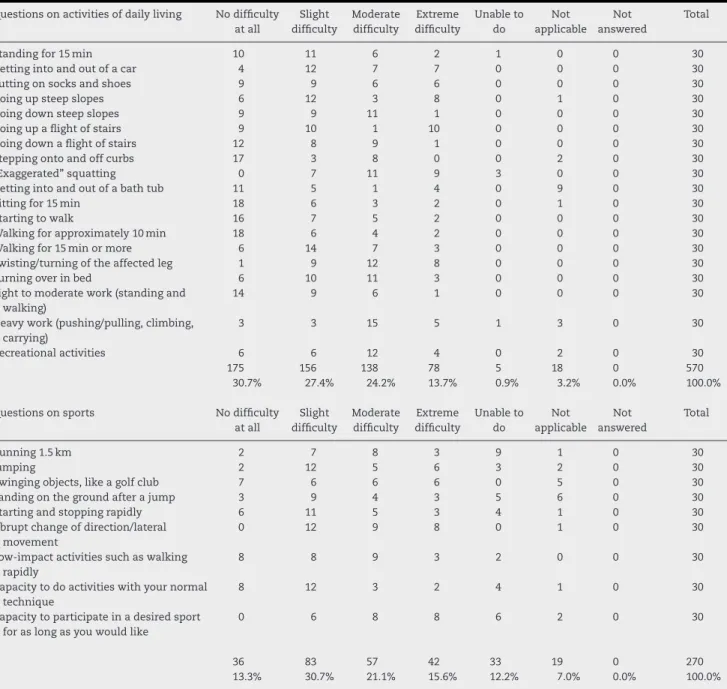
Table 1 – Pretest applied to 30 patients.
Questions on activities of daily living No difficulty at all
Slight difficulty
Moderate difficulty
Extreme difficulty
Unable to do
Not applicable
Not answered
Total
Standing for 15 min 10 11 6 2 1 0 0 30
Getting into and out of a car 4 12 7 7 0 0 0 30
Putting on socks and shoes 9 9 6 6 0 0 0 30
Going up steep slopes 6 12 3 8 0 1 0 30
Going down steep slopes 9 9 11 1 0 0 0 30
Going up a flight of stairs 9 10 1 10 0 0 0 30
Going down a flight of stairs 12 8 9 1 0 0 0 30
Stepping onto and off curbs 17 3 8 0 0 2 0 30
“Exaggerated” squatting 0 7 11 9 3 0 0 30
Getting into and out of a bath tub 11 5 1 4 0 9 0 30
Sitting for 15 min 18 6 3 2 0 1 0 30
Starting to walk 16 7 5 2 0 0 0 30
Walking for approximately 10 min 18 6 4 2 0 0 0 30
Walking for 15 min or more 6 14 7 3 0 0 0 30
Twisting/turning of the affected leg 1 9 12 8 0 0 0 30
Turning over in bed 6 10 11 3 0 0 0 30
Light to moderate work (standing and walking)
14 9 6 1 0 0 0 30
Heavy work (pushing/pulling, climbing, carrying)
3 3 15 5 1 3 0 30
Recreational activities 6 6 12 4 0 2 0 30
175 156 138 78 5 18 0 570
30.7% 27.4% 24.2% 13.7% 0.9% 3.2% 0.0% 100.0%
Questions on sports No difficulty
at all
Slight difficulty
Moderate difficulty
Extreme difficulty
Unable to do
Not applicable
Not answered
Total
Running 1.5 km 2 7 8 3 9 1 0 30
Jumping 2 12 5 6 3 2 0 30
Swinging objects, like a golf club 7 6 6 6 0 5 0 30
Landing on the ground after a jump 3 9 4 3 5 6 0 30
Starting and stopping rapidly 6 11 5 3 4 1 0 30
Abrupt change of direction/lateral movement
0 12 9 8 0 1 0 30
Low-impact activities such as walking rapidly
8 8 9 3 2 0 0 30
Capacity to do activities with your normal technique
8 12 3 2 4 1 0 30
Capacity to participate in a desired sport for as long as you would like
0 6 8 8 6 2 0 30
36 83 57 42 33 19 0 270
13.3% 30.7% 21.1% 15.6% 12.2% 7.0% 0.0% 100.0%
information about patients’ evolution and making decisions about the treatment that is most indicated.
The Medical Outcomes Study Short Form questionnaire (SF-36) is a generic quality-of-life measurement that was vali-dated for Brazil by Ciconelli et al.6It is often used as a reference point for other tests. However, despite being an excellent quality-of-life questionnaire, it is less specific for conditions resulting from diseases of the hip.5,7
The clinical assessment methods most frequently used for degenerative hip diseases that have been translated into the Portuguese language are the Western Ontario and McMasters Universities Osteoarthritis Index (WOMAC),8 the Lequesne algofunctional index9 and the Harris Hip Score.10 These are aimed at patients with moderate to severe osteoarthro-sis who present major physical capacity limitations. When used in young and active populations, they often present a
so-called ceiling effect, i.e. a large proportion of the individuals evaluated reach the maximum score, which is erroneously interpreted as a satisfactory result.11
Hip pain in young and physically active individuals has received special attention since the importance of labral lesions as one of the factors involved in the origin of degen-erative hip joint disease was recognized.12,13In 2005, Martin described the Hip Outcome Score (HOS),14a hip assessment questionnaire that was created with the aim of analyzing the results from therapeutic interventions in individuals with acetabular labral tears and high functional demands.15This questionnaire is considered to be valid for measuring function among individuals undergoing hip arthroscopy who present acetabular labral tears.16,17
With few exceptions, these questionnaires were devel-oped in English-speaking countries, which makes it more
Table 2 – Hip Outcome Score (HOS) questionnaire in English.
Hip Outcome Score (HOS)
Activity of Daily Living Scale
Please answer every question with one response that most closely describes to your condition within the past week.
If the activity in question is limited by something other than your hip mark not applicable (N/A).
No
difficulty difficulty at all
Slight Moderate difficulty
Extreme difficulty
Unable to do
N/A
Getting into and out of an average car
Standing for 15 minutes
Putting on socks and shoes
Walking up steep hills
Walking down steep hills
Going up 1 flight of stairs
Stepping up and down curbs
Deep squatting
Sitting for 15 minutes
Walking initially
Rolling over in bed Going down 1 flight of stairs
Getting into and out of a bath tub
Walking approximately 10
minutes
Walking 15 minutes or
greater
Because of your hip how much difficulty do you have with:
No
difficulty difficulty at all
Slight Moderate difficulty
Extreme difficulty
Unable to do
N/A
Table 2(Continued )
Light to moderate work (standing, walking) Heavy work (push/pulling, climbing, carrying)
Recreational activities
How would you rate your current level of function during your usual activities of daily living from 0
to 100 with 100 being
your level of function prior to yo
ur hip problem and 0 being the inab ility to perform any of your usual
daily activities?
Hip Outcome Score (HOS)
Running one mile
Jumping
Swinging objects like a golf club
Landing
Starting and stopping quickly
Cutting/lateral movements .0%
Sports Scale
Because of your hip how much difficulty do you have with:
No
difficulty at all
Slight difficulty
Moderate difficulty
Extreme difficulty
Unable to do
N/A
Low impact activities like fast
walking
Ability to perform activity with your normal technique Ability to participate in your
desired
sport as long as you would like
How would you rate your current level of function during your sports related activities from 0 to 100
with 100 being your
level of function prior to your hip problem and 0 being the inability to perform any of your usual daily activities?
.0 %
How would you rate your current level of function?
Nor mal
Nearly normal
Abnormal
Severely abnormal
difficult to use them in countries where the language is not English. Moreover, between countries that speak the same language, their individual and culturally distinct character-istics give rise to the need for assessment instruments to undergo adaptations to make them appropriate for the cul-tural context of the target population.18 The present study had the aim of translating and culturally adapting the HOS
quality-of-life questionnaire to the Portuguese language of Brazil.
Methods
of Rio de Janeiro (Universidade do Estado do Rio de Janeiro), under the number CEP/HUPE: 2674. All the patients were given information about the objectives of the study before they signed the free and informed consent statement.
HOS is a questionnaire relating to hip pain that can be self-administered. It contains 28 items divided into two subscales: activities of daily living (ADL) and sports activities.
The method used for translating and culturally adapt-ing the HOS to the Portuguese language used the criteria described by Guillemin et al.18and revised by Beaton et al.19 These consist of a set of standardized instructions for cul-tural adaptation of quality-of-life instruments, including four stages: initial translation, back-translation, consensus trans-lation and pretesting.
The instrument in English was translated into the Por-tuguese language by two independent translators who were orthopedists with experience in hip surgery who were famil-iar with the original language and aware of the aims of the study. After evaluation of the two translations (T1 and T2) and comparison with the original instrument, these were com-bined into a single document called the initial translation (IT). In the next stage, the back-translation was done by two independent translators who were unaware of the objective of the study. Thus, two back-translations into English (BT1 and BT2) were produced from the IT. A committee formed by a multidisciplinary team then met to analyze the divergences between the original instrument and the translations and, from this process, to produce the consensus translation (CT). During the review process on the translations, the semantic, idiomatic, experience/cultural and conceptual
equivalences were examined. The semantic equivalence was based on evaluation of the grammatical and vocabulary equiv-alence, i.e., between words. Many words in one language may not have adequate translations into other languages, or verb tenses may be used in some languages and not in others, such as words likedancingoreatingtranslated into languages that do not use the present participle or gerund form.2,20Idiomatic equivalence, i.e., the translation of certain idiomatic expres-sions, is very difficult. Certain expressions in English lose their meaning completely when translated into Portuguese, or they may be understood with a meaning other than that of the mother language.2,20 For a good translation, equivalence of experience or culture is important, so that the terms used are coherent with the experience of life of the population for which the questionnaire is destined, within its cultural context. If a term or situation is found to be outside of the con-text or experience of the population, it should be changed.2,20 Some items used in evaluating quality of life may present semantic equivalence but not have conceptual equivalence. For example, in the social context of many cultures in devel-oping countries, the terms “brother” or “aunt” might mean more than just a degree of kinship. In such cases, the terms presenting divergence of conceptual equivalence should be replaced by more appropriate terms that exist in the language into which the questionnaire is being translated.2,20
For the pretesting stage, 30 consecutive patients with com-plaints of hip pain but without coxarthrosis were selected from the hip outpatient clinic of the Orthopedic Institute of Tijuca. Patients were excluded if they presented with the fol-lowing: (i) visual or cognitive disorders that impeded reading
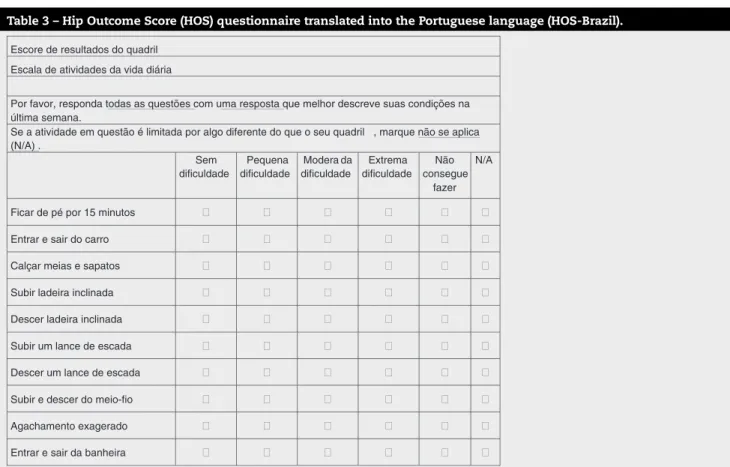
Table 3 – Hip Outcome Score (HOS) questionnaire translated into the Portuguese language (HOS-Brazil).
Escore de resultados do quadril
Escala de atividades da vida diária
Por favor, responda todas as questões com uma resposta que melhor descreve suas condições na última semana.
Se a atividade em questão é limitada por algo diferente do que o seu quadril , marque não se aplica (N/A) .
Sem dificuldade
Pequena dificuldade
Modera da dificuldade
Extrema dificuldade
Não consegue
fazer N/A
Ficar de pé por 15 minutos
Entrar e sair do carro
Calçar meias e sapatos
Subir ladeira inclinada
Descer ladeira inclinada
Subir um lance de escada
Descer um lance de escada
Subir e descer do meio-fio
Agachamento exagerado
Table 3(Continued )
Sentar por 15 minutos
Início da caminhada
Andar por aproximadam ente 10 minutos
Andar por 15 minutos ou mais
Por causa do seu quadril, quanta dificuldade você tem para: Sem
dificuldade dificuldade dificuldade dificuldade consegue Pequena Moderada Extrema Não
fazer N/A
Girar/virar sobre a perna acometida
Virar -se na cama
Trabalho leve a moderado (ficar de pé e andar)
Trabalho pesado
(empurrar/puxar/escalar/carregar)
Atividades recreativas
Como você quantificaria seu nível funcional durante as atividades usuais da vida diária de 0 a 100, com 100 sendo seu nível de função antes do seu problema de quadril e 0 sendo a impossibilidade de fazer quaisquer atividades usuais da vida diár ia?
.0 %
Escore de resultados do quadril
Escala de esportes
Por causa do seu quadril, quanta dificuldade você tem para: Sem
dificuldade dificuldade dificuldade dificuldade consegue Pequena Moderada Extrema Não
fazer N/A
Correr 1,5 km
Pular
Balançar objetos, como numa tacada de golfe
Aterrisar no solo após salto
Iniciar e parar rapidamente
Mudança brusca de direção/movimentos laterais Atividades de baixo impacto, como andar rapidamente Capacidade de fazer atividades com sua técnica normal Capacidade de participar do seu esporte desejado durante o tempo que você gostaria
Como você quantificaria seu nível funcional durante as atividades esportivas, variando de 0 a 100, sendo 100 o nível de
função nessas atividades antes do problema de quadril e 0 a impossibilidade de fazer quaisquer atividades usuais
da vida diária?
.0 %
Como você quantifica seu nível funcional atual?
Normal
Quase normal
Anormal
and interpretation of the questionnaire; (ii) coxarthrosis, char-acterized by a minimum joint space of less than 1.5 mm21 and by severe limitation of hip range of motion.14 The CT was applied to these 30 patients. The questions that were not understood by at least 85% of the patients were modified to the extent that was necessary and were then presented again to all the patients, until good understanding was achieved. After elimination of all situations that did not form part of the patients’ day-to-day lives, and questions or terms that were not well understood, the CT was considered to be the final translation of the questionnaire (FT).
Results
In the pretesting, the CT was applied to 30 individuals in order to assess comprehension and semantic, idiomatic, cultural and conceptual equivalences.
With regard to semantic equivalence, verbs used in the present continuous tense in the HOS questionnaire were translated into Portuguese in the infinitive. The only word in the original questionnaire that did not have an exact transla-tion into the Portuguese language was one in the title of the questionnaire. Thus, within the context, the word “outcome” was translated as “resultado” (result).
Regarding idiomatic equivalence, the HOS questionnaire did not present any idiomatic expressions that necessitated adaptations to Portuguese.
Regarding cultural equivalence, only one item, on the ADL scale, was slightly modified for greater coherence with the cul-tural context of the Brazilian population. Item 2 of the original questionnaire speaks of “getting into and out of an average car”, and this was translated as “entrar e sair do carro” (get-ting into and out of a car), which is sufficient to transmit the idea of a small to medium-sized car, which accounts for the absolute majority of cars in Brazil.
Regarding conceptual equivalence, when the activities of the original questionnaire were translated into Portuguese, they did not present any need for conceptual adaptations.
All the individuals answered all of the questions in the pretest and all of the questions were understood by more than 85% of the interviewees (Table 1). Thus, the CT did not need to be modified and it became the FT (HOS-Brazil).
Table 2 presents the original HOS questionnaire and Table 3 presents HOS-Brazil, after translation and cultural adaptation.
Discussion
In evaluating the semantic equivalence, the original HOS ques-tionnaire was seen to use the present continuous verb tense, which in the Portuguese language may lead to “gerundismo”, i.e., improper use of the gerund. Thus, words like stand-ing, walkstand-ing, sitting and running were translated as the infinitives of these verbs (stand, walk, sit and run), which in Portuguese are used to indicate the action without sit-uating it in time. Also in relation to semantic equivalence, in translating the term “deep squatting” in item 9 of the activities of daily living, it was decided to translate the adjec-tive as “exagerado” (exaggerated or overdone), which is used in Portuguese to denote a connotation of greater intensity
and would be more easily understood by the interviewees, such that the term was translated in the HOS-Brazil as “agachamento exagerado”. Recent published articles on trans-lations of questionnaires used in orthopedics have followed the same strategy.10,22
Among the limitations of this study, we did not evalu-ate the schooling levels of the individuals who answered the questionnaire. This factor could have led to difficulty in under-standing the questions, given that the patients were at a public healthcare service in a developing country (social). Likewise, the level of physical activity could have interfered with the understanding of sports movements (“landing on the ground after a jump” or “swinging objects, like a golf club”). All the questionnaires were applied at a single center that perhaps did not completely correspond to the realities of the Brazilian population.
Despite the growing interest in clinical studies on non-degenerative diseases of the hip, many obstacles have been encountered within the Brazilian setting with regard to mak-ing assessments of greater precision on the results from such studies. This particularly so in relation to observational stud-ies on new therapeutic interventions such as arthroscopy, and this has resulted in stimulating translations and cul-tural adaptations of specific evaluation instruments.8,10The absence of a specific instrument destined for evaluat-ing individuals with non-degenerative hip diseases who practice sports that is validated in Portuguese makes it dif-ficult to understand the various factors that make up the problem.2,10
The HOS was created with the objective of evaluating the results from therapeutic interventions among individuals with high functional demands who present acetabular labral tears.16,17 Since the HOS is a specific questionnaire for hip conditions in active individuals that has already been vali-dated and tested in populations that use the English language, our hypothesis is that its translation and validation for the Portuguese language of Brazil will be viable and acceptable for the realities of this country. Because of the growing num-bers of hip arthroscopy procedures performed in Brazil, it is necessary to use an instrument that has been translated and culturally adapted for Brazilian Portuguese and which eval-uates the quality of life in this specific group of patients, so as to have better knowledge of the state of the disease and better assessment of the results from interventions that are implemented.
Conclusion
The Hip Outcome Score questionnaire was translated and culturally adapted to the Portuguese language of Brazil and can be used for clinical evaluations on the hip. Addi-tional studies are underway with the aim of evaluating the reproducibility and validity of the Brazilian transla-tion.
Conflicts of interest
r e f e r e n c e s
1. Castillo L, Leporace G, Cardinot TM, Levy R, Oliveira LP. Importância dos questionários para avaliac¸ão da qualidade de vida. Rev Hosp Univ Pedro Ernesto. 2012;11(1):12–7. 2. Ciconelli RM. Medidas de avaliac¸ão de qualidade de vida. Rev
Bras Reumatol. 2003;43(2):9–13.
3. Loures ED, Leite IC. Análise da qualidade de vida de pacientes osteoartrósicos submetidos à artroplastia total do quadril. Rev Bras Ortop. 2012;47(4):498–504.
4. Metsavaht L, Leporace G, Sposito MMdM, Riberto M, Batista LA. Qual o melhor questionário para avaliar os aspectos físicos de pacientes com osteoartrite no joelho na populac¸ão brasileira? Rev Bras Ortop. 2011;46(3):256–61.
5. Lopes AD, Ciconelli RM, Reis FBd. Medidas de avaliac¸ão de qualidade de vida e estados de saúde em ortopedia; quality of life and health status evaluation measurements. Rev Bras Ortop. 2007;42(11/12):355–9.
6. Ciconelli R, Ferraz M, Santos W, Meinão I, Quaresma M. Traduc¸ão para a língua portuguesa e validac¸ão do questionário genérico de avaliac¸ão de qualidade de vida SF-36 (Brasil SF-36). Rev Bras Reumatol. 1999;39(3):143–50. 7. Jenkinson C, Coulter A, Wright L. Short form 36 (SF36) health
survey questionnaire: normative data for adults of working age. Br Med J. 1993;306(6890):1437–40.
8. Fernandes M [dissertac¸ão] Traduc¸ão e validac¸ão do questionário de qualidade de vida específico para
osteoartrose Womac (Western Ontario McMaster Universities) para a língua portuguesa. São Paulo: Universidade Federal de São Paulo; 2003.
9. Marx FC, Oliveira LMd, Bellini CG, Ribeiro MCC. Traduc¸ão e validac¸ão cultural do questionário algofuncional de Lequesne para osteoartrite de joelhos e quadris para a língua
portuguesa. Rev Bras Reumatol. 2006;46(4):253–60.
10. Guimarães RP, Alves DP, Silva GB, Bittar ST, Ono NK, Honda E, et al. Traduc¸ão e adaptac¸ão transcultural do instrumento de avaliac¸ão do quadril Harris Hip Score. Acta Ortop Bras. 2010;18(3):142–7.
11. Safran MR, Hariri S. Hip arthroscopy assessment tools and outcomes. Oper Tech Orthop. 2010;20(4):264–77.
12. Byrd JW, Jones KS. Diagnostic accuracy of clinical assessment, magnetic resonance imaging, magnetic resonance
arthrography, and intra-articular injection in hip arthroscopy patients. Am J Sports Med. 2004;32(7):1668–74.
13. Narvani AA, Tsiridis E, Kendall S, Chaudhuri R, Thomas P. A preliminary report on prevalence of acetabular labrum tears in sports patients with groin pain. Knee Surg Sports Traumatol Arthrosc. 2003;11(6):403–8.
14. Martin RL. Hip arthroscopy and outcome assessment. Oper Tech Orthop. 2005;15(3):290–6.
15. Birrell F, Croft P, Cooper C, Hosie G, Macfarlane G, Silman A. Predicting radiographic hip osteoarthritis from range of movement. Rheumatology. 2001;40(5):506–12.
16. Martin RL, Philippon MJ. Evidence of validity for the hip outcome score in hip arthroscopy. Arthroscopy. 2007;23(8):822–6.
17. Martin RL, Kelly BT, Philippon MJ. Evidence of validity for the hip outcome score. Arthroscopy. 2006;22(12):1304–11. 18. Guillemin F, Bombardier C, Beaton D. Cross-cultural
adaptation of health-related quality of life measures: literature review and proposed guidelines. J Clin Epidemiol. 1993;46(12):1417–32.
19. Beaton DE, Bombardier C, Guillemin F, Ferraz MB. Guidelines for the process of cross-cultural adaptation of self-report measures. Spine (Philadelphia, PA, 1976). 2000;25(24):3186–91, 15.
20. Rizzini M, Donatti TL, Bergamaschi DP, Brunken GS. Equivalência conceitual, de itens e semântica da versão brasileira do instrumento Dysfunctional Voiding Scoring System (DVSS) para avaliac¸ão de disfunc¸ão do trato urinário inferior em crianc¸as. Cad Saúde Pública Rio de Janeiro. 2009;25(8):1743–55.
21. Croft P, Coope RC, Wickham C, Coggon D. Defining osteoarthritis of the hip for epidemiologic studies. Am J Epidemiol. 1990;132(3):514–22.
22. Metsavaht L, Leporace G, Riberto M, de Mello Sposito MM, Batista LA. Translation and cross-cultural adaptation of the Brazilian version of the International Knee Documentation Committee Subjective Knee Form: validity and