Rev Bras Med Esporte _ Vol. 13, Nº 5 – Set / Out, 2007
287e
1. Laboratório de Avaliação Motora, Faculdade de Educação Física eDes-portos, Universidade Federal de Juiz de Fora.
2. Laboratório de Pesquisa Morfofuncional, Centro de Educação Física, Fisioterapia e Desportos, Universidade do Estado de Santa Catarina, Florianópolis.
Approved in 14/6/07.
Correspondence to: Jonas Almeida Neves Martins, Rua Oscar Vidal, 569 / 502 – 362016-290 – Juiz de Fora – MG.
E-mail: [email protected]
Conconi test adapted to aquatic bicycle
Jonas Neves Martins1, Mauricio Gattás Bara Filho1, Vitor Pereira Costa2 and Jorge Roberto Perrout de Lima1
O
RIGINALA
RTICLEKeywords: Aerobic training. Cicloergometer. Heart rate. ENGLISH VERSION
dium, and maybe due to the fact of this trend is relatively recent, procedures for prescription and load control of aquatic activities which can be applied to health clubs routine, especially for aerobic activities developed in aquatic bicycle, are still scarce.
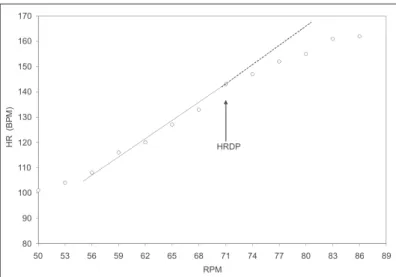
In the trial to present a simple method for identification of the anaerobic threshold (Lan), Conconi et al.(6), presented a continuous running protocol with growing velocity in which the heart rate (HR), represented in Cartesian axis, presented a linear initial phase fol-lowed by a second curvilinear one. The authors verified that the transition point between these phases called cardiac deflexion point (HRDP), corresponded to the Lan. From its release on, the Conco-ni test has been successfully applied to different activities such as: swimming, canoeing, skiing, cycling, skating, rowing and athletic marching(7-8).
In the conventional cycle ergometer, the developed power is a product of the velocity (circumference x wheel rotation) by the re-sistive load applied over the wheel. On the aquatic bicycle, since the resistance is imposed by the water resistance, the workload manipulation occurs by alterations in the pedal rotation (RPM). Once the water resistance is proportional to the wheel velocity (in the aquatic bicycle, with paddles), the increase in RPM causes both increase in wheel velocity and resistance applied over it. Martins
and Lima(9) used a protocol with increases of 10 RPM, at every 2
min. and observed that the HR curve, after an initial phase relative-ly linear with increases of approximaterelative-ly 23 BPM at each stage, presented in higher loads a tendency to curvilinear behavior similar to the one proposed by Conconi et al.(6).
The findings by Martins and Lima(9), who observed a HR
non-linear behavior in aquatic bicycle point to the possibility of HRDP identification in this kind of ergometer, as proposed by Conconi et al.(6). Considering the need to reach simple aerobic exercise pre-scription method which is able to be applied in practical situations,
the aim of the study was to adapt the Conconi et al. test(6) for
identification of the HRDP in aquatic bicycle.
METHODOLOGY
Subjects – 27 subjects were evaluated (24 ± 6 years, 171 ± 8
cm, 66 ± 12 kg): 15 males and 12 females. All individuals signed a consent form for studies involving humans. After weight and height measurements, all participants were submitted to the progressive test, performed in a swimming pool at least 1.2 m deep and water
temperature ranging from 25 to 28oC.
Aquatic bicycle – the test was performed in an aquatic bicycle
HIDROCYCLE® brand name. The used model had seat height
reg-ulation in relation to the pool bottom, so that it was possible for all individuals to perform the test with water at the umbilical scar lev-el.
Pilot study – In the study by Martins and Lima(9), with incre-ment of 10 RPM at every 2 min., HR increase of approximately 23 BPM was observed. Conconi et al.(10) suggest that, for identifica-tion of the HRDP, the HR increases are not higher than 8 BPM. As first trial to diminish the HR increases, in a pilot study increment protocols of 5RPM at every min were performed, which was not ABSTRACT
Physical exercise has been considered one of the mechanisms that improve health and quality of life. As a consequence of the enhanced demand for fitness centers, physical activities in liquid environment, especially aquatic cycling, have increased in the last years. However, methods of assessment and prescription of aero-bic training in these equipments are still scarce. The objective of this study was to propose an adapted test of Conconi et al. (1982) to aquatic bicycle. 27 participants (24 ± 6 years, 171 ± 8 cm, 66 ± 12 kg), 15 male and 12 female, were assessed. The participants have been submitted to a graded test in aquatic bicycle, with initial load of 50 RPM and increments of 3 RPM each minute, until ex-haustion. HR was registered during the entire test. For data analy-sis, descriptive statistics were used as well as Student “t” test for comparison between genders. HRDP was identified in 85% of the subjects. There were not significant differences in HRmax (181 ± 12 and 181 ± 10 BPM), HRDP (162 ± 10 and 172 ± 9 BPM) and
%HRD-Prpm (91 ± 4 and 90 ± 3 %RPMmax) between males and females,
respectively. On the other hand, RPMmax (81 ± 6 and 72 ± 5 RPM),
%HRDP (90 ± 5 and 93 ± 3 %HRmax) and HRDPrpm (74 ± 6 and 66 ±
4 RPM) were significantly different. In conclusion, the adapted Conconi test can be performed in aquatic bicycle.
INTRODUCTION
Regular practice of physical exercises is one of the factors which aids in health and quality of life improvement. Its benefits include physiological, (improvement in cardiorespiratory conditioning), psy-chological (improvement in self-esteem), and social factors (im-provement in interpersonal relations)(1-5). The search for these re-sults has motivated the increase of the number of activities offered by health clubs. It is believed that countries such as Brazil, the United States and Australia are world leaders in the amount of establishments, in the number of practitioners and in the release of new exercise modalities created to fulfill the specific needs of their clients.
me-288e
Rev Bras Med Esporte _ Vol. 13, Nº 5 – Set / Out, 2007Figure 1 – Heart rate individual curves in the progressive test
Figure 2 – Heart rate mean curves in the progressive test
Figure 3 – Heart rate increase per stage of the progressive test
Figure 4 – Identification example of the heart rate deflexion point of one of the individuals
sufficient – the HR increments were in mean higher than 10 BPM. This fact suggests that increments should be lower than 5 RPM.
Test protocol – Before the test beginning, a standardized stretch-ing which consisted of 5 min of exercise for lower limbs was per-formed. Afterwards, specific warm-up of 5 min cycling at 45 RPM was performed, followed by 2-min interval of passive recovery. The protocol consisted of initial load of 50 RPM and increase of 3 RPM at every min, until exhaustion. The pedaling cadence was set
by a metronome, Quick Time®brand name.
HR monitoring – The HR was continuously registered by a
Po-lar monitor, model S810. The values registered at the end of each stage were used for construction of the HR x RPM curves.
HRDP identification – From the HR x RPM curves, dispersion
charts were elaborated in the Excel®program. The HRDP was
iden-tified by visual inspection, by two independent evaluators. Statistical treatment – Descriptive statistics with values ex-pressed as mean and standard deviation was used and for the com-parison between sexes, the t-student test for independent sam-ples was used (P < 0.05).
RESULTS
All subjects were able to satisfactorily complete the test,
reach-ing HRmax of 181 ± 12 BPM, in the maximal load of 81 ± 6 RPM for
men and 181 ± 10 BPM, in the 72 ± 5 RPM load for women. Signif-icant difference was observed between men and women only in the maximal RPM (table 1). The mean curve of HR x RPM, pre-sented tendency to curvilinear behavior in the higher loads. In the individual curves, such tendency has not observed in only 15% of the subjects (figures 1 and 2).
The mean growth of the HR during the test was of 4 BPM per stage for men and 6 BPM per stage for women, which is below the threshold recommended by Conconi et al.(10) for identification of HRDP. The first derivate of the HR x Stage which represents the mean growth of the HR of men and women during the test, adjust-ed by polinomy of third order, is presentadjust-ed in figure 3.
When using the proposed protocol, one may observe that the minimum recommendations suggested by the test’s authors for
TABLE 1
Variables identified in the progressive test
Men Women
Mean SD Mean SD
HRmax (bpm) 181* 12 181 10 RPMmax 081* 06 072 05
HRDP (bpm) 162* 10 172 09 HRDP (rpm) 074* 06 066 04 HRDP (% HRmax) 090* 05 093 03 HRDP (%RPMmax) 091* 04 090 03
* Significant difference between men and women (p < 0.05).
Rev Bras Med Esporte _ Vol. 13, Nº 5 – Set / Out, 2007
289e
stages which were completed until the maximal load was reached. For the Conconi test, adaptations concerning increase in number of stages and decrease in mean growth of HR per stage were need-ed so that the recommendations by Conconi et al. for the HRDP identification were followed(10). The solution found in this study (initial load of 50 RPM and increments of 3 RPM at every min.) was satisfactory, once it resulted in the conclusion of 11 ± 2 stages with growth of 4 BPM per stage for men and 8 ± 2 stages with growth of 6 BPM per stage for women. Despite being successful for women, the adopted protocol was very close to the threshold recommended by the authors for the test. A protocol with lower initial load and smaller increments would maybe be more suitable for them, though.
The HRDP was identified by visual inspection in 85% of the par-ticipants. The HR behavior during the test in the remaining individ-uals behaved in a linear way. These findings are similar to the ones reported by De-Oliveira(15) who has identified the HRDP in 87% in runners in a field test. The visual method used in this study, usual-ly presents a certain degree of subjectivity in the data anausual-lysis. In the trial to improve the HRDP identification, Kara et al.(16) have adapt-ed the Dmax model with polynomial adjustment of third order and reported to have identified the HRDP in all individuals in their study.
Corroborating Piovezana and De-Oliveira(17) who have sued the
Dmax method and found the HRDP in 100% of the Physical Edu-cation students tested in cycle simulator. These divergences are doubtful concerning the efficiency of use of the Dmax in this study in increasing the probability of identifying the HRDP. Nevertheless, the fact that the HRDP has been identified in 100% of the subjects is in agreement with the literature data, which also reports that the
HRDP is found in approximately 90% HRmax regardless sex, age,
physical capacity and kind of exercise(11).
The HRDP of men was identified in the same values of HR than in women; however, in higher loads which suggests that the test is able to discriminate the individuals with greater aerobic
capaci-ty. Concerning the HRmax, no significant difference was found
ei-ther between men and women, suggesting hence that all individu-als have reached similar relative maximal effort levels. However, the HR values reached at the end of the effort, show that the par-ticipants did not reach the HRmax predicted by age, as for instance by the equation HRmax = 220 – age(18). The reached HR
Max (181 BPM) corresponds to 92% of what would be expected for 26 years old individuals (196 BPM). This value is within the interval in which the HR peak values are usually found in conventional cycle ergome-ters (90 to 95%) in non-cyclist individuals(19). Additionally, we could speculate that the immersion in cold water could have triggered bradicardia(20), which was not the case in this study, once the
wa-ter temperature was kept between 25 and 28o Celsius. We
sug-gest that HRmax prediction studies in aquatic bicycle would be relevant.
CONCLUSION
Considering the results of this study, one may preview the Con-coni test applications to aquatic bicycle classes or ‘aquatic cycling’ as they are commonly called. The HRDP evaluation with the use of the proposed protocol is very accessible, since it needs only a metronome and a HR monitor. The test is performed in approxi-mately 12 min and it is of easy comprehension from the part of the evaluated subject. Once the HRDP is identified, the aerobic train-ing can be prescribed based on the HR or on the RPM observed at this point. Thus, one may affirm that it is possible to identify the HRDP in aquatic bicycle with the use of a protocol of initial load of 50 RPM and increments of 3 RPM at every minute.
All the authors declared there is not any potential conflict of inter-ests regarding this article.
identified in similar HR, when men and women are compared (162
± 10 BPM and 172 ± 9 BPM respectively), but in HRmax
percentag-es significantly higher in women (90 ± 5% and 93 ± 3%). The men presented HRDP in loads significantly higher than in women, but which represented similar maximal load percentage (74 ± 6 RPM, 91 ± 4% and 66 ± 4 RPM, 90 ± 3%).
DISCUSSION
The performance of this study was motivated by the lack of in-struments for evaluation of the aerobic capacity and prescription of exercise in aquatic bicycle. The cause of this lack may be partly attributed to the difficulty in quantifying the power developed in this equipment. In conventional mechanical cycle ergometers– ground ones, the power developed is given by the multiplication of the wheel velocity by the resistive load applied over it. The wheel velocity measurement is not a problem in water or out of the wa-ter, as long as its circumference is known and it is possible to count its rotations. On the determination of resistive load on the other hand, some problems are found. In the conventional cycle ergom-eter, the resistive load is applied by a tape which involves the wheel and its quantification can be done by a pendulum scale attached to it. In the aquatic bicycle, the resistive load is the resistance that the water offers to the dislocation of the wheel’s paddles – great-ness of difficult quantification.
In rectilinear dislocations, the resistance offered by the water may be described by a quadratic function. In the aquatic bicycle, the wheel paddles in their circular movement find at each rotation the water already in movement, caused by the previous rotation. Such event makes the water resistance smaller than what would be expected in a rectilinear movement. Therefore, the linear in-crease of the numbers of rotations adds an inin-crease approximate-ly linear of the resistive load. The study by Martins and Lima(9) had already evidenced that, in a protocol with increments of 10 RPM at every 2 min., the HR X RPM curve was similar to what usually is found in tests performed in conventional cycle ergometer.
From the observation that the HR curve in aquatic bicycle with linear increments was similar to the one usually found in conven-tional cycle ergometer, it was hypothesized that it would be possi-ble to perform the Conconi et al. test(6) in aquatic bicycle. Although there are still controversies concerning the physiological meaning of the HRDP, its identification is a datum concerning the Lan of the individual and may occasionally be used in the functional evalua-tion as well as prescripevalua-tion of aerobic training.
The literature shows that the HRDP is a phenomenon which really occurs in many subjects; however, the physiological mecha-nisms which trigger it are not completely clear yet(11). According to Conconi et al.(6), this issue is strongly connected with the Lan; yet, the different methods used for identification of metabolic transi-tions thresholds may result in less convincing correlatransi-tions. Pokan
et al.(12) have suggested that there is a connection between the
myocardial functions and the HRDP. In subjects where the HRDP was identified, the ejection volume of the left ventricle remained high until reaching the maximal aerobic load, allowing that the car-diac debt remained high with no great increase in HR. Lucia et al.(13) verified that the cardiac dimensions of professional cyclists may help in the HRDP explanation. The loss of linearity of the HR during the progressive test was predominantly found in cyclists who present thicker cardiac walls. Leprete et al.(14) defend that the lower increase of the Hr in high loads could be a cardiovascular strategy to preserve the systolic volume.
290e
Rev Bras Med Esporte _ Vol. 13, Nº 5 – Set / Out, 20071. Buchner DM. Physical activity and quality of life in older adults. Jama. 1997;1:64-6.
2. Shephard RJ. Exercise and relaxation in health promotion. Sports Med. 1997;4: 211-7.
3. Pollock ML, Wilmore JH. Exercício na saúde e na doença: avaliação e prescrição para prevenção e reabilitação. 2ª ed. Rio de Janeiro: Medsi; 1993.
4. Shephard RJ. Worksite Health Promotion and Productivity. In: Opatz JP, editor. Economic impact of worksite health promotion. Champaign, Human Kinetics; 1994. p. 147-68.
5. Weinberg RS, Gould D. Foundations of sport and exercise psychology. Cham-paign: Human Kinetics; 1995.
6. Conconi F, Ferrari M, Zioglio P, Droghetti P, Codeca. Determination of the anaer-obic threshold by a noninvasive field test in runners. J Appl Physiol. 1982;52:869-837.
7. Droghetti P, Borsetto C, Casoni I, Cellini M, Ferrari M, Paolini AR, et al. Noninva-sive determination of the anaerobic threshold in canoeing, cross-country skiing, cycling, roller and icekating, rowing and walking. Eur J Appl Physiol. 1985;53: 299-303.
8. Cellini M, Vitello P, Nagliat A, Ziglio PG, Martinelli S, Ballarin E, et al. Noninvasive determination of the anaerobic threshold in swimming. Int J Sports Med. 1996; 7:347-51.
9. Martins JAN, Lima JRP. Freqüência cardíaca e percepção do esforço em bicicle-ta aquática, Anais, I Encontro Mineiro de Fisiologia do Exercício, Juiz de Fora, Outubro; 2005.
10. Conconi F, Grazzi G, Guglielmini C, Borsetto C, Ballarin E, Mazzoni G, et al. The Conconi Test: Methodology after 12 years of application. Int J Sports Med. 1996; 17:509-19.
11. Boadner ME, Rhodes EC. A review of the concept of the heart rate deflection point. Sports Med. 2000;30:31-46.
12. Pokan R, Hofmann P, Preidler K, Leitner H, Dusleag G, Eber B, et al. Correlation between inflection of the heart rate/work performance curve and myocardial function in exhausting cycling ergometer exercise. Eur J Appl Physiol Occup Physiol. 1993;67:385-8.
13. Lucia A, Carvajal A, Boraita A, Serratosa L, Hoyos J, Chicharro J. Heart dimen-sions may influence the occurrence of the heart rate deflection point in highly trained cyclists. Br J Sports Med. 1999;33:387-92.
14. Leprete PM, Foster C, Koralsztein JP, Billat VL. Heart rate deflection point as a strategy to defend stroke volume during incremental exercise. J Appl Physiol. 2005;98:1660-5.
15. De-Oliveira FR. Prediccion de los umbrales de lactato y ajustes de frecuencia cardiada em el test de Léger-Boucher. Tesis Doctoral, Universidad del Pais Bas-co/Euskal Herriko Unibertsitatea, San Sebastian, España; 2004.
16. Kara M, Gökbel H, Bediz C, Ergene N, Üçok K, Uysal H. Determination of the heart rate deflexion point by the Dmáx method. J Sports Med Phys Fitness. 1996;
36:31-4.
17. Piovezana P, De-Oliveira. Reprodutibilidade das variáveis derivadas das curvas da freqüência cardíaca em teste progressivo. www.efdeportes.com. 2005;90. 18. Robergs RA, Landwehr R. The surprising history of the “Hrmax = 220 – age”
equation. J Exerc Physiol. 2002;5:1-10.
19. Londeree BR, Moeschberger ML. Effect of age and other factors on maximal heart rate. Res Q Exerc Sport. 1982;53:297-304.
20. Mcardle WD, Magel JR, Lesmes GR, Pechar GS. Metabolic and cardiovascular adjustment to work in air and water at 18, 25 and 33oC. J Appl Physiol. 1976;40:
85-90.