Corresponding Author: Jan-Feb 2010; 18(1):3-10 www.eerp.usp.br/rlae
Corresponding Author: Priscilla Hortense
Universidade Federal de São Carlos, Departamento de Enfermagem Rodovia Washington Luis, km 235 Caixa Postal 676
CEP: 13565-905 São Carlos, SP, Brazil E-mail: [email protected].
1 RN, Full Professor, Escola de Enfermagem de Ribeirão Preto, Universidade de São Paulo, WHO Collaborating Centre for Nursing Research Development, Brazil, e-mail: [email protected].
2 Faculty, Faculdade de Enfermagem, Universidade Federal de Goiás, Brazil, e-mail: [email protected]. 3 Adjunct Professor I, Universidade Federal de São Carlos, Brazil, e-mail: [email protected].
4 Post-doctoral fellow, Lawrence S. Bloomberg Faculty of Nursing, University of Toronto, Canada, e-mail: [email protected]. This study developed a pain evaluation scale and validated it for the Portuguese language.
Development of the inventory – 308 readily available pain descriptors - were searched in
international literature and validated by six judges. One hundred descriptors of acute pain
and 100 descriptors of chronic pain were found, which were used in the next stage. Statistical
validation - 493 health professionals and 146 patients experiencing acute and chronic pain
participated in the study. Instructions, pain descriptors and respective definitions, pen
and measuring tape were provided to participants. Psychophysical methods were used to
establish categories, magnitude and cross-modality matching using line-length. Results
revealed the ranking of the most frequently used descriptors of acute and chronic pain,
with power equal to 0.99, close to the predicted (one), using line-length estimations. The
Multidimensional Pain Evaluation Scale is thus validated for the Portuguese language.
Descriptors: Subject Headings; Pain; Pain Measurement.
Fátima Aparecida Emm Faleiros Sousa
1Lilian Varanda Pereira
2Roberta Cardoso
3Priscilla Hortense
4Escala Multidimensional de Avaliação de Dor (EMADOR)
Os objetivos deste estudo foram elaborar escala de avaliação de dor e validá-la para a
língua portuguesa. Elaboração de inventário - foram pesquisados 308 descritores de dor
da literatura mundial e, a partir desses, seis juízes realizaram a validação aparente e de
conteúdo. Como resultados foram encontrados 100 descritores de dor aguda e 100 de
crônica, os quais foram utilizados na próxima etapa. Validação estatística - participaram 493 proissionais da saúde e 146 portadores de dor aguda e de crônica. Usou-se, como material, instruções aos participantes, descritores de dor e suas deinições, caneta e trena. Foram utilizados métodos psicofísicos: estimação de categorias, estimação de
magnitudes e emparelhamento intermodal com modalidade em comprimento de linhas.
Os resultados mostram escalonamento dos descritores de maior caracterização para a
dor aguda e para a dor crônica, tendo sido encontrado expoente igual a 0,99, próximo
ao predito (um) ao utilizar comprimentos de linhas e estimativas numéricas. Foi validada
para a língua portuguesa a Escala Multidimensional de Avaliação de Dor (EMADOR).
Descritores: Descritores; Dor; Medição da Dor.
Escala Multidimensional de Evaluación del Dolor (EMEDOR)
Los objetivos de este estudio fueron elaborar una escala de evaluación del dolor y
validarla para la lengua portuguesa. Elaboración de inventario - fueron investigados
308 descriptores del dolor en la literatura mundial y, a partir de estos, seis jueces
realizaron la validación aparente y de contenido. Como resultados fueron encontrados
100 descriptores del dolor agudo y 100 del crónico, los cuales fueron utilizados en la
próxima etapa. Validación estadística - participaron 493 profesionales de la salud y 146
portadores de dolor agudo y de crónico. Se usó, como material, instrucciones a los participantes, descriptores de dolor y sus deiniciones, lápiz y cinta de medir. Fueron utilizados métodos psicofísicos: estimación de categorías, estimación de magnitudes y
emparejamiento intermodal con modalidad en largo de líneas. Los resultados muestran
escalonamiento de los descriptores de mayor caracterización para el dolor agudo y para
el dolor crónico, fue encontrado exponente igual a 0,99, próximo al predicho (uno) al
utilizar el largo de líneas y estimativas numéricas. Fue validado para la lengua portuguesa
la Escala Multidimensional de Evaluación del Dolor (EMEDOR).
Descriptores: Descriptores; Dolor; Dimensión del Dolor.
Introduction
can determine whether the risks of a given treatment
are worse that the harm caused by the clinical problem
and choose the best and safest treatment among those
available. Appropriate measurement also permits
examining the nature, origins and clinical reports of pain
related to clients’ emotional, motivational and cognitive
characteristics and personality.
To understand the phenomenon of pain and evaluate the eficacy of interventions, more sophisticated
measures are needed to determine not only the intensity Subjective concepts and phenomena such as pain
are dificult to accurately measure, that is, to quantify
through instruments and processes that are free of
systematic errors, which is a common issue in Social,
Health and Human Sciences. It is impossible to manipulate
a problem of this nature without a measure on which to base the treatment or therapeutic practice, with dificulty determining whether a treatment is necessary, eficient or even when it must be interrupted.
of pain, but also to evaluate motivational, cognitive and
affective responses to pain. In addition, methods to quantify the subjective experience with scientiic rigor and reproducibility are needed as well as follow-up and
analysis of the mechanisms of action of different drugs
and therapies, monitoring changes in the quality and/
or dimensions of pain, permitting the client him/herself
to opt to report, describe and evaluate his/her own
perception of pain(1-2).
Pain can be misinterpreted and underestimated if
not appropriately evaluated, which can lead to inadequate
manipulation and consequently harm clients’ quality of life. Pain is inluenced by cultural and situational factors
as well as by the care received, motivation, emotion
and other psychological variables in addition to external
ones. Evaluations of pain are mostly based on what
clients report complemented by clinical examination.
The client is considered (in a clinical or research setting)
a measurement tool.
Psychophysics’ main assumption is that the
perceptual system is a measurement instrument that
generates results (experiences, judgments, responses)
that can be systematically measured and analyzed.
Hence, it is worth mentioning the importance of
attentively listening to another person with empathy,
interest, respecting differences and uniqueness so that
the researcher does not project his/her own values
and beliefs and inner world and thereby distort his/her
perception in relation to the other’s perception of life
and pain.
The psychophysical methodology and procedures
developed in sensorial psychophysics, currently
used in Sciences, are promising in ranking subjective
phenomena. They are an active system capable of
grasping the diversity and multidimensionality of the
human being and the beauty of the human mind and
brain through descriptors(3-6).
Objectives
To develop a Multidimensional Pain Evaluation
Scale in the Portuguese language. To subjectively and
statistically validate the Multidimensional Pain Evaluation
Scale.
Method
Inventory’s development
Participants: six professionals, faculty members of federal and state universities also working in medium
and large general hospitals: two physicians, two nurses,
one psychologist and one physiotherapist were invited
to be judges in the face and content validation process
of the developed instrument.
Material: a list of descriptors contained in the McGill Pain Questionnaire(7), books, scientiic articles from the international literature in the ield, a Portuguese dictionary(8), a medical dictionary(9), an English/ Portuguese dictionary(10), and paper and pen were used to develop this instrument. A paper pad with speciic instructions for the participants and a list of 308 pain descriptors with their respective deinitions and pen
were used for the face and content validations.
Procedure: the descriptors that compose the instrument were selected as following:
- descriptors extracted from international and national scientiic literature were translated to Portuguese by a English teacher who has lived in the United States
for four years and from Portuguese to English by a
Portuguese teacher living in Brazil;
- identiication of descriptors based on the authors’
professional experience with patients experiencing acute
and chronic pain;
- searching for words that could be used to describe pain
in a Portuguese dictionary(8) and a medical dictionary(9). The instrument contained a list of 308 descriptors and their respective deinitions developed according to Portuguese and medical dictionaries. A 7-item scale was added to each deinition with alternatives that varied
from 0 to 6, to which participants should match their
judgments and attribute scores that would represent,
according to their perceptions, the extent to which such
descriptor characterized their pain.
Data analysis: for each of the 308 identiied
descriptors an average and standard deviation of
this average was computed. The 100 descriptors that
represented the highest average were selected to
compose the inventory. Among the descriptors with
equal averages, those with the smallest standard
deviation were chosen.
The inal inventory contained 100 descriptors for acute pain and 100 for chronic pain.
Statistical validation
Participants: 493 health professionals (physicians, nurses and psychologists) and 146 participants with
acute and chronic pain participated in the study. All
participants signed free and informed consent forms
approved by the Research Ethics Committee at the
Rev. Lat-Am. Enfermagem 2010 Jan-Feb; 18(1):3-10.
Ribeirão Preto, Medical School (Processes HCRP no 7481/98 e HCRP no 11696/2004).
Material: paper pad containing speciic instructions
for each used method and respective tasks for
participants followed by pain descriptors and respective deinitions, pen and measuring tape.
Study setting: Hospital das Clínicasat the University of São Paulo at Ribeirão Preto, Medical School.
Procedure: direct and indirect psychophysical methods, estimation of categories, estimation of
magnitudes and cross-modality matching of answers
regarding line-length. Method to rank categories
(participants’ task: to chose a number in a 7-item
scale for each descriptor that better characterized the
studied pain – acute or chronic); method to estimate
the magnitude of pain (participants’ task: to choose a
number for the pain descriptor, which proportionally
corresponded to the intensity of the studied pain – acute
or chronic – in relation to the standard stimulus, whose
numerical value was 100 for a given descriptor);
cross-modality matching method – line-length (participants’
task: to designate a line-length proportional to the level
of attribution of the descriptor to acute or chronic pain –
in relation to the standard stimulus, whose visual value
was 50 cm for a given descriptor). Such procedures were
used both with professionals and patients. Professionals were asked to judge the descriptor according to their
professional experience related to the perception of
acute or chronic pain in others, while patients were
asked to judge the descriptor according to their own perceived pain.
Data analysis: the geometric average, standard deviation and position order of estimates attributed to each descriptor of acute pain and chronic pain were
computed. The geometric average of the estimates
of acute and chronic pain were graphically depicted in logarithmic scale as a function of the geometric
averages of the line-length paired to each descriptor, and a regression line was itted to the data through the least squares method. Then, the power was calculated and compared to the predicted power(6).
Results
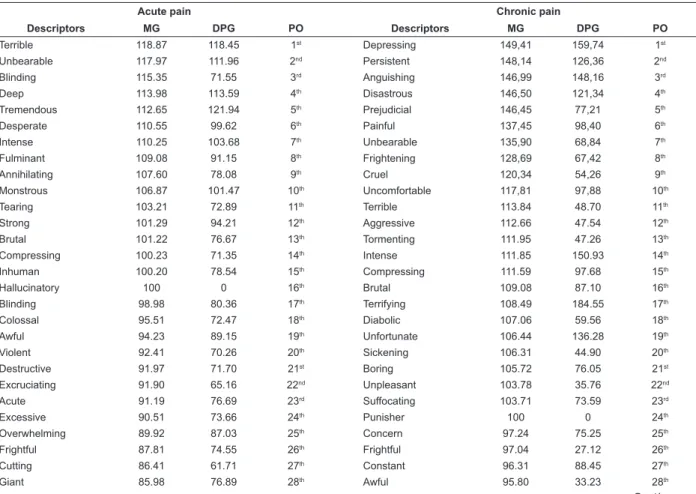
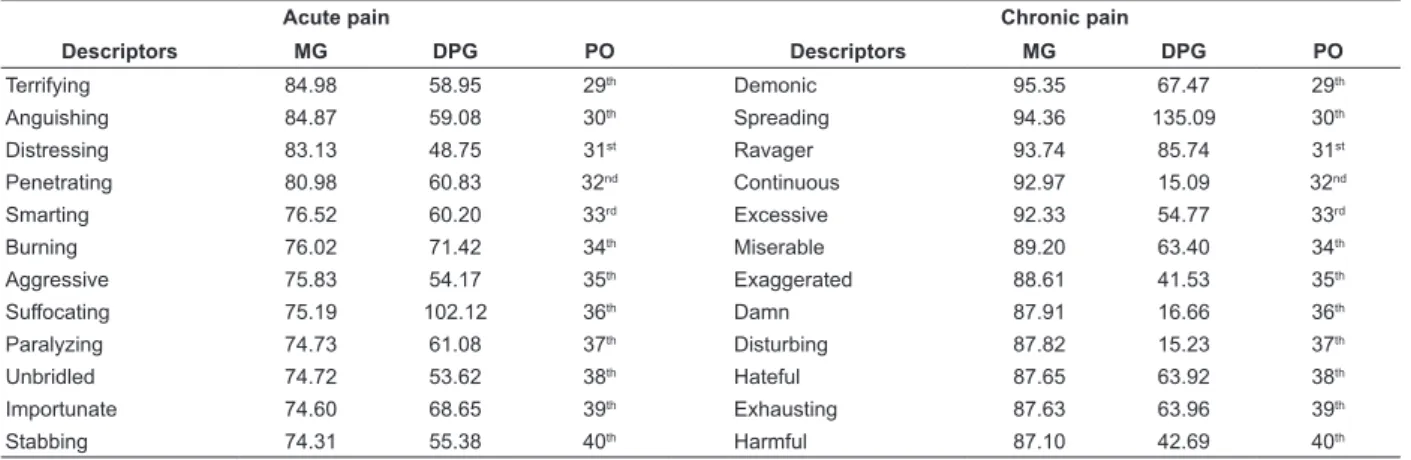
The results presented in Table 1 show the 40 descriptors that most characterize acute pain and the 40
descriptors that most characterize chronic pain.
Table 1 – Geometric Average (GA) and geometric standard deviation (GSD) and positions order (PO) of the estimation
of magnitude attributed to the 40 descriptors that most characterize acute pain and the 40 descriptors the most
characterize chronic pain(11-12).
Acute pain Chronic pain
Descriptors MG DPG PO Descriptors MG DPG PO
Terrible 118.87 118.45 1st Depressing 149,41 159,74 1st
Unbearable 117.97 111.96 2nd Persistent 148,14 126,36 2nd
Blinding 115.35 71.55 3rd Anguishing 146,99 148,16 3rd
Deep 113.98 113.59 4th Disastrous 146,50 121,34 4th
Tremendous 112.65 121.94 5th Prejudicial 146,45 77,21 5th
Desperate 110.55 99.62 6th Painful 137,45 98,40 6th
Intense 110.25 103.68 7th Unbearable 135,90 68,84 7th
Fulminant 109.08 91.15 8th Frightening 128,69 67,42 8th
Annihilating 107.60 78.08 9th Cruel 120,34 54,26 9th
Monstrous 106.87 101.47 10th Uncomfortable 117,81 97,88 10th
Tearing 103.21 72.89 11th Terrible 113.84 48.70 11th
Strong 101.29 94.21 12th Aggressive 112.66 47.54 12th
Brutal 101.22 76.67 13th Tormenting 111.95 47.26 13th
Compressing 100.23 71.35 14th Intense 111.85 150.93 14th
Inhuman 100.20 78.54 15th Compressing 111.59 97.68 15th
Hallucinatory 100 0 16th Brutal 109.08 87.10 16th
Blinding 98.98 80.36 17th Terrifying 108.49 184.55 17th
Colossal 95.51 72.47 18th Diabolic 107.06 59.56 18th
Awful 94.23 89.15 19th Unfortunate 106.44 136.28 19th
Violent 92.41 70.26 20th Sickening 106.31 44.90 20th
Destructive 91.97 71.70 21st Boring 105.72 76.05 21st
Excruciating 91.90 65.16 22nd Unpleasant 103.78 35.76 22nd
Acute 91.19 76.69 23rd Suffocating 103.71 73.59 23rd
Excessive 90.51 73.66 24th Punisher 100 0 24th
Overwhelming 89.92 87.03 25th Concern 97.24 75.25 25th
Frightful 87.81 74.55 26th Frightful 97.04 27.12 26th
Cutting 86.41 61.71 27th Constant 96.31 88.45 27th
Giant 85.98 76.89 28th Awful 95.80 33.23 28th
Acute pain Chronic pain
Descriptors MG DPG PO Descriptors MG DPG PO
Terrifying 84.98 58.95 29th Demonic 95.35 67.47 29th
Anguishing 84.87 59.08 30th Spreading 94.36 135.09 30th
Distressing 83.13 48.75 31st Ravager 93.74 85.74 31st
Penetrating 80.98 60.83 32nd Continuous 92.97 15.09 32nd
Smarting 76.52 60.20 33rd Excessive 92.33 54.77 33rd
Burning 76.02 71.42 34th Miserable 89.20 63.40 34th
Aggressive 75.83 54.17 35th Exaggerated 88.61 41.53 35th
Suffocating 75.19 102.12 36th Damn 87.91 16.66 36th
Paralyzing 74.73 61.08 37th Disturbing 87.82 15.23 37th
Unbridled 74.72 53.62 38th Hateful 87.65 63.92 38th
Importunate 74.60 68.65 39th Exhausting 87.63 63.96 39th
Stabbing 74.31 55.38 40th Harmful 87.10 42.69 40th
Results show that the most frequently used
descriptors to characterize acute pain were: terrible,
unbearable, blinding, deep, tremendous, desperate,
intense, fulminant, annihilating and monstrous. The most
frequently used descriptors to characterize chronic pain
were: depressing, persistent, anguishing, disastrous,
prejudicial, painful, unbearable, frightening, cruel and
uncomfortable.
A line was itted to data by the least square method and graphically depicted, n=1.12; r2=0.98 (Figure 1).
Considering that the participants tend to restrict the
range of their adjustments according to the variable they control, inverted coordinates were used in the igure, that is, length of lines as a function of corresponding
estimates, for each descriptor. The result was a straight
line with n=0.87; r2=0.98. In order to mediate the regression effect, the geometric average of the powers
of the length of lines versus an estimate of magnitude
and an estimate of magnitude versus lengths of lines(13) was computed and 0.99 was the resulting value.
Figure 1 – Logarithms of geometric averages of estimates
of magnitudes and the logarithms of geometric averages
of pairing of length of lines attributed to descriptors of
acute pain
In relation to the descriptors of chronic pain, the
geometric averages of the estimates of magnitudes were
graphically depicted in a logarithmic scale as a function
of the corresponding geometric averages of estimates
of the pairing of length of lines to each descriptor of chronic pain (Figure 2). A line was itted by the least square method, n=1.12; r2=0,98.
The estimates of the pairing to length of lines were
depicted as a function of the corresponding estimates of
magnitudes for each descriptor, which resulted in a line
with n=0.87; r2=0.98.
Taking the geometric average of the two slopes is
adequate to mediate the regression effect; 0.99 was the
value found.
Figure 2 – Logarithms of geometric averages of
magnitudes and logarithms of geometric average of
the pairing of length of lines attributed to descriptors of
chronic pain 2,5
2,0
1,5
1,0
0,5
0,5 1,0 1,5 2,0 2,5
n= 1,12 r2= 0,98
Estimate of magnitudes
Length of lines Table 1 – Continuation
Hence, the psychophysical scale to associate
descriptors of acute and chronic pains is validated for
Portuguese.
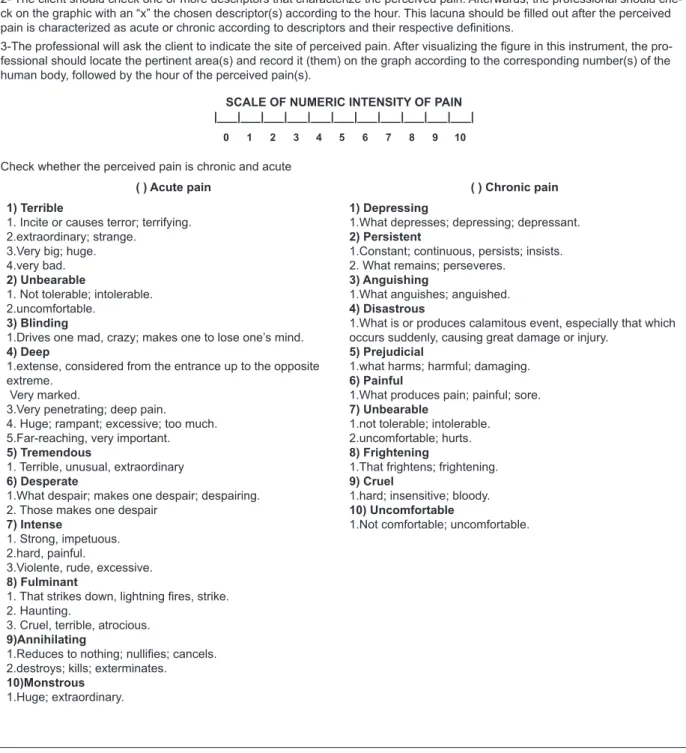
The multidimensional Pain Evaluation Scale is validated
for Portuguese and is presented in Figures 3 and 4. 2.5
2.0
1.5
1.0
0.5
0.5 0.7 0.9 1.1 1.3 1.5 1.7 1.9 2.1 2.3
Estimate of magnitudes
Rev. Latino-Am. Enfermagem 2010 Jan-Feb; 18(1):3-10.
MULTIDIMENSIONAL PAIN EVALUATION SCALE (MPES)
(Faleiros Sousa et. al.)
Instructions
1- The professional will ask the client to judge the intensity of pain using values from 0 to 10 in the scale below in which 0 indica-tes “no pain”, 10 “highest pain” and the other scores, from 2 to 9, should be used to indicate intermediate levels of pain. Afterwar-ds, check on the graphic the value attributed according to the hour.
2- The client should check one or more descriptors that characterize the perceived pain. Afterwards, the professional should
che-ck on the graphic with an “x” the chosen descriptor(s) according to the hour. This lacuna should be illed out after the perceived pain is characterized as acute or chronic according to descriptors and their respective deinitions.
3-The professional will ask the client to indicate the site of perceived pain. After visualizing the igure in this instrument, the pro -fessional should locate the pertinent area(s) and record it (them) on the graph according to the corresponding number(s) of the human body, followed by the hour of the perceived pain(s).
SCALE OF NUMERIC INTENSITY OF PAIN |___|___|___|___|___|___|___|___|___|___|___|
0 1 2 3 4 5 6 7 8 9 10
Check whether the perceived pain is chronic and acute
( ) Acute pain ( ) Chronic pain
1) Terrible
1. Incite or causes terror; terrifying. 2.extraordinary; strange.
3.Very big; huge. 4.very bad. 2) Unbearable
1. Not tolerable; intolerable. 2.uncomfortable.
3) Blinding
1.Drives one mad, crazy; makes one to lose one’s mind. 4) Deep
1.extense, considered from the entrance up to the opposite extreme.
Very marked.
3.Very penetrating; deep pain.
4. Huge; rampant; excessive; too much. 5.Far-reaching, very important. 5) Tremendous
1. Terrible, unusual, extraordinary 6) Desperate
1.What despair; makes one despair; despairing. 2. Those makes one despair
7) Intense
1. Strong, impetuous. 2.hard, painful.
3.Violente, rude, excessive. 8) Fulminant
1. That strikes down, lightning ires, strike.
2. Haunting.
3. Cruel, terrible, atrocious. 9)Annihilating
1.Reduces to nothing; nulliies; cancels.
2.destroys; kills; exterminates. 10)Monstrous
1.Huge; extraordinary.
1) Depressing
1.What depresses; depressing; depressant. 2) Persistent
1.Constant; continuous, persists; insists. 2. What remains; perseveres.
3) Anguishing
1.What anguishes; anguished. 4) Disastrous
1.What is or produces calamitous event, especially that which occurs suddenly, causing great damage or injury.
5) Prejudicial
1.what harms; harmful; damaging. 6) Painful
1.What produces pain; painful; sore. 7) Unbearable
1.not tolerable; intolerable. 2.uncomfortable; hurts. 8) Frightening
1.That frightens; frightening. 9) Cruel
1.hard; insensitive; bloody. 10) Uncomfortable
1.Not comfortable; uncomfortable.
Rev. Latino-Am. Enfermagem 2010 Jan-Feb; 18(1):3-10.
Discussion
The obtained power of 0.99 was very close to 1.0,
such as observed in studies in which such estimates
of magnitudes are matched to line-length(13-14). The equivalence between the empirical and the predicted
power, when two modalities are used, is an evidence of conirmation of Steven’s Power Law(13).
This result indicates that any change in the stimulus
would produce similar changes in judgments performed
through two modalities. Studies have used line-length,
matching them to other modalities such as brightness
and loudness and the found prediction was nearly
perfect(14-15).
This study resulted in a pain descriptors inventory
for the Portuguese language, inserting Brazil into the
world scene of human pain evaluation. With this published
inventory, we can say that there is a multidimensional
scale, and not an only one-dimensional scale, for such
purposes.
The instrument of descriptors for the Portuguese
language captures indicators that allow analyzing the
sensitive, affective and cognitive dimensions. Studies
previously published aimed to generate knowledge in the ield so that a culture of teaching, research and care would be constructed in the ield of human pain evaluation
in Brazil(1-2,4-5). The eficiency of treatments and their development, though, depends on the reliable and valid
evaluation and measurement of pain, as represented by
this study, in laboratory and clinical settings.
Conclusions
Pain is considered a vital signal (the ifth), as
important as any other, which should be always
evaluated in a clinical environment in order to implement
interventions.
We developed a practical, reliable, sensitive, and
valid instrument, and we also advanced from ordinal measurement to quantiication in Brazilian pain research,
placing us at the forefront of the world scene. These
measurements are methodologically sound, present
reproducibility and the possibility to follow-up and
analyze the mechanisms of action of different drugs and
other therapies.
The evaluation and measurement of pain are
essential for nursing and useful in all stages of care
delivery and production of knowledge, which among other
objectives, aim to determine the appropriate metrological
characteristics to different types of pain, management and
monitoring performed by the nursing team, and is vital for
the success of treatment of those who experience pain.
References
Received: Dec. 1st 2008 Accepted: Oct. 6th 2009
1. Pereira LV, Sousa FAEF. Psychophysical evaluation of the descriptors of pain in the postoperative. Rev Latino-am Enfermagem 2007 junho;15(3):474-9.
2. Pereira LV, Sousa FAEF. Categorization of postoperative pain descriptors in the sensitive, affective and evaluative dimensions of painful experiences. Rev Latino-am Enfermagem 2007 agosto; 15(4):563-7.
3. Melzack R, Torgerson WS. On the language of pain. Anesthesiology 1971; 34(1):50-9.
4. Sousa FAEF, Da Silva JA. Uso e aplicação da metodologia psicofísica na pesquisa em Enfermagem. Rev Latino-am Enfermagem 1996; 4(2):147-78.
5. Sousa FAEF, Hortense P. Social perception of nursing professional assessed by different scales. Rev Latino-am Enfermagem 2006 agosto; 14(6):857-62.
6. Sousa FAEF, Pereira LV, Hortense P. Avaliação e mensuração da percepção da dor. In: Alves O Neto, Costa CMC, Siqueira JTT, Teixeira MJ, et al Dor: Princípios e prática. Porto Alegre (RS): Artmed; 2009. p. 370-81.
7. Melzack R. The McGill pain questionnaire: major properties
and scoring methods. Pain 1975; 1:277-99.
8. Ferreira ABH. Novo dicionário Aurélio da língua portuguesa. 2ª ed. Rio de Janeiro (RJ): Nova Fronteira; 1986.
9. Hoerr NL, Osol A. Dicionário médico ilustrado: Blakiston. São Paulo (SP): Andrei; 1970.
10. Michaelis H. Dicionário inglês-português. São Paulo (SP): Melhoramentos; 1989.
11. Sant’Ana RPM, Sousa FAEF. Identification and validation of Brazilian Chronic Pain Descriptors. Pain Manag Nurs 2009; 10(2):85-93.
12. Sant´Ana RPM, Pereira LV, Saltareli S, Faleiros Sousa FAE. Chronic pain descriptors: a Psychophysical study. Fechner Day 2004; 20:512-7.
13. Stevens SS. On predicting exponents for cross-modality matches. Percept Psychophys 1969; 6:385-401.