Effects of drug involvement on long-term users’ family members*
Efeitos do envolvimento com drogas na vida de familiares de usuários por longo período
Cleiton José Santana1, Magda Lucia Félix de Oliveira1
Objective: to analyze the effects of drugs on the families of users included in sentinel events. Methods: an
exploratory study with epidemiological investigation of 30 cases of hospitalized patients with a diagnosis of physical trauma associated with drug use (sentinel events). Results: there was a predominance of males, with
an average of 40.1 years, low schooling and unemployed. Most had used drugs on average for 20.8 years and were in families with addictive behavior. The most commonly used drug was alcohol, and traumas were due to
traffic accidents, falls and aggression (73.4%). Conclusion: drug abuse determined aggressiveness in the family
context, previous trauma, illicit maneuvers for buying drugs, and home use of drugs, thus reinforcing social and family vulnerability.
Descriptors: Sentinel Surveillance; Street Drugs; Epidemiological Surveillance; Wounds and Injuries.
Objetivo: analisar os efeitos das drogas em famílias de usuários incluídos em eventos sentinelas. Métodos: estudo
exploratório, com investigação epidemiológica de 30 casos de pacientes de um centro de assistência toxicológica
internados com diagnóstico de trauma físico associado ao uso de drogas (eventos sentinelas). Resultados: houve
predomínio do sexo masculino, com média de 40,1 anos, baixa escolaridade e desempregados. A maioria usava drogas em média há 20,8 anos e fazia parte de famílias com comportamento aditivo. A droga mais utilizada foi
o álcool, e os traumas aconteceram por acidente de trânsito, queda e agressão (73,4%). Conclusão: o abuso
das drogas determinou a agressividade no contexto familiar, os traumas anteriores, as manobras ilícitas para aquisição da droga e o uso domiciliar de drogas, reforçando a vulnerabilidade social e familiar.
Descritores: Vigilância de Evento Sentinela; Drogas Ilícitas; Vigilância Epidemiológica; Ferimentos e Lesões.
*Extracted from the dissertation “Internação hospitalar e trauma: evento sentinela para monitoramento dos efeitos das drogas de abuso”, Universidade Estadual de Maringá, 2015.
1Universidade Estadual de Maringá. Maringá, PR, Brazil.
Corresponding author: Cleiton José Santana
Introduction
Knowledge about the use and effects of dru -gs on the lives of users, families and society helps in coping with the complexity of this phenomenon, thus contributing to prevention programs, treatment, rehabilitation and reinsertion of users in various seg
-ments of society. Thus, drug abuse and its effects are considered serious social and public health problems worldwide, as they consist of risk factors for accident, trauma and/or violence. Also, they cause undesirable intercurrences, such as family crises, violent acts and hospital admissions, with aggravations that generate
high social and financial costs, arousing the attention
of the public power and health professionals, and they may culminate in deaths and temporary and perma -nent functional losses(1).
It is important to know the circumstances in
which drug-associated traumas with occur, as well as
the factors related to this event in the family context, in the environment of drug use and in the social cir
-cle of the victim in order to identify and disintegrate
the established relationship between drug-violence--hospitalization(2-3).
One of the repercussions of drug abuse is the increasing demand of occurrences of intoxicated pa -tients in emergency services and hospital admission units with medical diagnoses directly related to drugs abuse due to acute and/or chronic intoxication or se -condary to use, such as organic diseases, psychiatric comorbidities, violence and traumatic events of va -rious types(4-5).
In Brazil, there is no continuous epidemiologi -cal surveillance to measure the effect of drugs on the
health of the population. Cross-sectional surveys on
samples for large regions or capitals have been used to guide prevention and care interventions(6-8). Howe -ver, epidemiological surveillance can be performed from passive and active reporting systems, such as
active search for cases, verification of marking
condi-tions and investigation of sentinel events(9-10).
-table illness, incapacity or unexpected death, the oc -currence of which serves as a warning to question the quality of prevention or therapy(9). Upon detection, the surveillance system is activated so that its inves -tigation determines how to prevent similar events in the future and quickly institute control measures(9-11). A “sentinel” event is then organized for the epidemio -logical surveillance of the phenomenon of drug abuse in a local health system(6).
Users of drugs usually access health services only when they have complications related to compul
-sive consumption, clinical impairment due to chronic use or in situations of violence and physical trauma. The use of these occurrences as sentinel events(9) to monitor the repercussions of drug abuse on the heal -th of -the population is consistent wi-th -the principles of health surveillance, since it allows measuring the trajectory of the user and their families by health ser -vices and social protection, and evaluating the quality of care(9,11).
The objective of this study was to analyze the effects of drugs in the families of users included in sentinel events.
Methods
This is an exploratory study developed from an epidemiological investigation of a sentinel event. For this study, the sentinel event used was developed in an academic way to adapt this methodology to the epi -demiological surveillance of the repercussions of drug abuse on the health of drug users and their families, as well as to build the monitoring indicators of the phenomenon drug abuse, from records of a reference information and toxicological assistance center in the city of Maringá/PR, in the Brazilian Southern Region, through documentary analysis and home interview, from April to September 2014.
The sample was intentional, established within
criteria that met a specific set for inclusion as drug users, with a compatible clinical picture or
hospital and accessed from the notification to the
in-formation and toxicological assistance center. The ca
-ses were denominated sentinel events hospitalization with diagnosis of trauma associated to intoxication due to drug abuse, being a family member considered the key informant.
The sources of data were: the listing of inpa -tients; the form for toxicological occurrence by alcoho
-lic poisoning and/or other drugs, nationally standar -dized; and the patient’s hospital chart for diagnostic
confirmation, evaluation of hospital admission and
clinical management.
We found the records of 100 cases with medi -cal diagnosis of trauma associated with drug use, of which 50 were residents in Maringá. Considering the inclusion criteria regardless of sex and age, with per -manent housing in the municipality of Maringá and fa -mily bond, the losses and refusals, 30 sentinel events
were notified to the center. Hospital documents and telephone contacts supported the confirmation of
the inclusion criteria. Also, the relatives were invited to participate in the survey by telephone contact. Ca
-ses in which there was no family relationship missing were excluded.
The data collection instruments were the Sen
-tinel Events Research Scrip, following the investiga -tion steps and the model proposed by the authors(6),
composed of four thematic blocks, which address the socioeconomic and demographic information of the drug user; sentinel event and clinical evaluation; hou -sehold and family research; and evaluation and con
-clusion.
For the analysis of the documents and the home interview, we listed records related to characterization of the sentinel event in hospital documents from the
history of intoxication, pre-hospital care and hospital
admission data; signs and symptoms on admission, duration and intercurrences during hospitalization, diagnosis and medical treatment; interview with the family member; sociodemographic conditions of the family and the drug user’s data as reported by family
members; behavior in the family environment, work and social life; date of beginning and motivation for drug use; time between the beginning of the use and the discovery of the family; time of drug use; history of treatment for addiction; abstinence/relapse cycle; and access to public policies.
Following the technique recommended for stu -dies of sentinel events(9), the reconstruction of the in -dividual trajectory of each case was performed, with data on the toxicological occurrence, hospital admis -sion with medical diagnosis for physical trauma and home interview. The data were compiled in a data -base of the Statistical Package for Social Sciences for Windows, and descriptive statistics were used by the
Pearson’s non-parametric chi square test, and those with p <0.05 were considered significant associations at the 95% confidence level. Due to the low number of
cases, the analysis was performed using Fisher’s exact test.
The study complied with the formal require -ments contained in the national and international regulatory standards for research involving human beings.
Results
The participants’ profile was predominantly male (96.7%), aged between 13 and 65 years, with an
average of 40.1 years and a median of 43.2. Of them,
70.0% were single and 6.6% were separated/divor-ced. They had low schooling (33.3%), and half were unemployed (50.0%). The predominant occupation
area of the 15 participants who worked was civil cons
-truction, totaling 66.6%.
Alcohol was referred by the majority and con
-firmed by clinical and/or laboratory criteria.
Table 1 -Pattern of drug use among users with long trajectory and distribution of effects of drug use ob
-served by families among the investigated cases of sentinel event.
Variable n (%)
Drugs
Alcohol 28 (93.3)
Combination 13 (43.3)
Frequency of weekly use (times) 20(66.7)
>3 11(23.6)
<3 4(13.3)
Time of use (year)
<1 1(3.3)
1-10 8(26.6)
10-20 6(20.0)
20-30 8(26.6)
30-40 5(16.8)
>41 2(6.6)
Beginning of use and family knowledge (years)
<1 21(70.0)
1-10 5(16.7)
>20 4(13.3)
Knowledge
Behavior change 12 (40.0)
Use at home 8 (26.7)
Report by neighbor/relative 4 (13.3)
Others 6 (20.0)
The duration of drug use ranged from less than
one month to 56 years, but 63.4% had already been
using drugs of abuse between 10 and 40 years. Alco -hol, alone, was the main drug associated with the long trajectory of use, with an average time of 20.8 years. Most families had perceived the use of drugs in a pe -riod of less than 12 months due to changes in behavior and the reports of people close to the family.
In five families the father did not exist as a
member of the family, and the mother was responsible
ly members interviewed, 53.3% reported some
disea-se or chronic health problem. The average number of residents per household was 4.1, with 1.8 for children and 1.4 for the elderly, totaling 124 people living daily
with drug use. Of these, 36.6% were children.
Regarding family and social relationships,
40.0% of the families reported violence in childhood, and 83.3% reported a history of trauma prior to the
event (transportation accidents, falls and aggression), illegal maneuvers for acquiring drugs, and repetitive physical aggressive behavior. The trauma functioned as a turning point for seven users who moved from the compulsive phase of drug use to the controlled pat -tern, improving the relationship in the family context. In relation to the family additive behavior,
other drug users were found in 46.7% of the families,
besides the event investigated. The parents were the
main ones (30.0%). In 13.3% of the cases, the onset of drug use was related to the influence of family mem-bers and, in 20.0%, it happened inside the household.
Table 2 - Effects of drug use and withdrawal period on
sentinel events.
Variable n (%)
Effects of drug use
Repetitive physical aggressive behavior 16(53.3)
Trauma prior to the event 25(83.3)
Illicit maneuvers for acquiring drugs 15(50.0)
Chronic disease in relatives 16(53.3)
Withdrawal phase/relapse
Yes 17(56.7)
No 13(43.3)
Withdrawal period (n=17)
<30 days 7 (41.1)
<6 months 4 (23.5)
<1 year 3 (17.7)
>5 years 3 (17.7)
In 43.3% of the cases, there was no
withdra-wal phase or relapse. Among those who went through
withdrawal, 64.6% reported that this period was less
Nine families (30.0%) reported that at some
point in their life they had recourse to institutions providing mutual help for the treatment of their relati
-ve, and 40.0% said they had never sought help for the
treatment and social reintegration of their relative.
Only 27.7% reported seeking care at the Psychosocial
Care Center for Alcohol and Drugs.
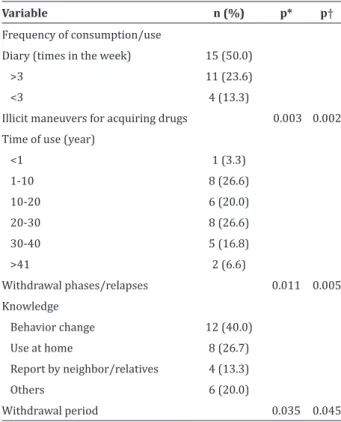
Table 3 - Frequency of use, family knowledge and
behavior, according to illicit maneuvers for acquiring drugs, withdrawal phases/relapses and withdrawal period.
Variable n (%) p* p†
Frequency of consumption/use
Diary (times in the week) 15 (50.0)
>3 11 (23.6)
<3 4 (13.3)
Illicit maneuvers for acquiring drugs 0.003 0.002
Time of use (year)
<1 1 (3.3)
1-10 8 (26.6)
10-20 6 (20.0)
20-30 8 (26.6)
30-40 5 (16.8)
>41 2 (6.6)
Withdrawal phases/relapses 0.011 0.005
Knowledge
Behavior change 12 (40.0)
Use at home 8 (26.7)
Report by neighbor/relatives 4 (13.3)
Others 6 (20.0)
Withdrawal period 0.035 0.045
*Non-parametric Chi-square test at the 95% confidence level; † Fisher test at the 95% confidence level
Table 3 shows the significant statistical associa-tions at the 95% confidence level between the illicit
maneuvers for drug acquisition and the frequency of drug use; the existence of withdrawal phases and the time of use; and the existence of withdrawal periods and changes in the behavior of the subject. However, for the variables type of drug abuse, repetitive aggres -sive behavior, beginning of drug use and family know
-ledge, no statistical significance was observed.
Discussion
This study was limited to investigating data from a toxicological information and assistance cen -ter, which corresponds to a specific reality, so that its findings cannot be generalized. The epidemiological
research of sentinel events, the population and the region in which it was conducted presented different characteristics in relation to the age of the users and the average time of drug use. The sample is not similar
to that of a population-based survey, since it is an
epi-demiological investigation of sentinel events.
The sociodemographic characteristics of those investigated corroborate previous studies in which male drug users are 2.4 times more likely to be victims of trauma and at risk behaviors than women(2,7).
The drug use trajectory differs from the natio
-nal average established in population-based surveys,
which is 13 years old(7). Alcohol was the drug reported by most sentinel events at hospital admission, and the pattern of drug use was related to the vulnerability to which the user and his/her family were exposed, which contributed to the onset and continuity of drug abuse. Additive behavior, intrafamily and social vio
-lence, and recurrent traumatic events are also asso -ciated with the long trajectory of drug use. In addition, men have greater use in life and dependence on alco
-hol and other drugs than women in all age groups(2,7). Chemical dependence is associated with seve -ral factors, causing harm to the health and life of users and their families(12). Some events prior to hospital ad
-mission of trauma associated with drug abuse should be investigated so that causal factors for substance
abuse are identified and health promotion and
pre-vention strategies be developed.
The desire to use the drug leads to recurrence, due to some particular reason or stimulated by exter
-nal factors. The main causes identified for returning to
use drugs, or relapses, were continuing with the same
rehabili-tation treatment. There is the possibility of changing
behavior by drug users in the so-called turning points, and significant life events favor the cessation of drug
use(13-14). Thus, these should be detected and the he -alth, social and cultural devices should be offered as supporters to change the exclusivity with the drug(15).
From the statistical analyzes, frequent relap -ses were better understood. Relapse rates decrease when the individual is aware of their dependence, de -termined and committed to behavior change, as well as involved in actions for a new lifestyle(16). The cases
studied were highlighted by a long period of drug use, and the relapses were associated with the time of use.
There was a statistically significant association
between individuals who used drugs at home and the longer periods of withdrawal. This factor has been re -lated to support and family support to maintain wi -thdrawal and to progress in rehabilitation and social reintegration. The lower the belief in the ability to
cope with a high-risk situation and to remain
absti-nent, the greater the likelihood of relapse(16).
Illicit maneuvers for drug acquisition are a situ
-ation of extreme vulnerability and are markers of the severity of drug abuse, since the individual is exposed to several risk factors that contribute to situations of violence and trauma(6). These maneuvers have been
associated with individuals who use drugs more than three times a week.
Knowing the profile of the drug user, from their
reason/motivation and the beginning of use, the situa -tion observed by the family and the family knowledge helps analyzing the risk and vulnerability of groups, besides contributing to the development of preven -tive actions to the losses and symptoms associated with this picture. It is important to emphasize that the change in user behavior and the short period for the family’s knowledge about the beginning of drug use were highlighted in this research(17).
Living in a family that has a dependent is a challenge for children, as this reality can trigger the early use of drugs(12). The family can be considered a
risk or protective factor for the user. Whereas family addictive behavior and the use of drugs in the home
can influence the beginning or the indiscriminate use of psychoactive substances, a structured and
well-in-tegrated family plays an important role in leading its members in ways that are opposed to drugs(12,15).
In Brazil, the Psychosocial Care Network esta -blishes attention points for the care of people with harmful effects of alcohol and other drugs, and is made up of services and equipment of variable complexity, such as the Psychosocial Care Centers for Alcohol and Drugs. However, some families were unaware of these services, using only the emergency services as a ga
-teway to assistance in the Unified Health System(7,18-19). The use of the Psychosocial Care Center for
Alcohol and Drugs was reported by less than 30% of
the families, and none of the users were in treatment when the trauma happened, unlike the national ave
-rage (50.0%) of families that had knowledge on the
Psychosocial Care Centers for Alcohol and Drugs and sought care in these places(7).
Research related to drugs, violence and trauma involves global problems of social assistance, health and public safety. Epidemiological research contribu -tes to the construction of nursing knowledge related to the needs of the user and families, aiming at inter -vention actions. The nurse, as a care promoter, should work together with users, family and community, identifying possible signs of severity associated with
drug dependence, family conflicts and vulnerabilities,
thus putting into practice the public policies actions with a focus on prevention and reduction of harms inherent to chemical dependence.
Conclusion
Acknowledgements
We tank to the Research Program for the
Unified Health System: Shared management in health
- Fundação Araucária/Health Secretariat of the State
of Paraná. (2013-2014) for financing the project No.
6614/2013.
Collaborations
Santana CJ contributed with the conception and design, analysis and interpretation of the data,
writing of the article and approval of the final version
to be published. Oliveira MLF contributed with the conception and design, relevant critical review of the
intellectual content and approval of the final version
to be published.
References
1. Sudhinaraset M, Wigglesworth C, Takeuchi DT. So
-cial and cultural contexts of alcohol use. Influen- ces in a social-ecological framework. Alcohol Res [Internet]. 2016 [cited 2017 Aug 11];
38(1):35-45. Available from: https://www.ncbi.nlm.nih.
gov/pmc/articles/PMC4872611
2. Alvarez BD, Razente D, Lacerda DA, Lother NS,
Von-Batahten LC, Stahlschmidt C. Analysis of
the Revised Trauma Score (RTS) in 200 victims of different trauma mechanisms. Rev Col Bras
Cir. 2016; 43(5):334-40. doi: http://dx.doi. org/10.1590/0100-69912016005010
3. Degenhardt L, Mathers B, Hall WD. Response to Hseret al. (2014): The necessity for more and better data on the global epidemiology of opioid
dependence. Addiction. 2014; 109(8):1335-7. doi:
http://dx.doi.org/10.1111/add.12612
4. Okumura Y, Shimizu S, Ishikawa KB, Matsuda S, Fushimi K, Ito H. Comparison of emergency hospital admissions for drug poisoning and major diseases: a retrospective observational study using a nation wide administrative discharge
database. BMJ Open. 2012; 2(6):1857. doi: http:// dx.doi.org/10.1136/bmjopen-2012-001857
5. Jang HS, Kim JY, Choi SH, Yoon YH, Moon SW, Hong YS, et al. Comparative analysis of acute toxic poisoning in 2003 and 2011: Analysis of 3 academic hospitals. J Korean Med Sci. 2013;
28(10):1424-30. doi: http://dx.doi.org/10.3346/
jkms.2013.28.10.1424
6. Santana CJ, Silvino MC, Rosa NM, Almeida EG, Reis LM, Oliveira ML. Potentiality of a sentinel event for epidemiological surveillance of drug abuse. Rev
Enferm UFPE online [Internet]. 2014 [cited 2017 Oct 11]; 8(12):4337-44. Available from: http://
www.revista.ufpe.br/revistaenfermagem/index.
php/revista/article/viewArticle/7013
7. Laranjeira R, Madruga CS, Pinsky I, Caetano
R, Mitsuhiro SS, Castelo G, organizadores. II Levantamento Nacional de Álcool e Drogas
(LENAD) – 2012 [Internet]. 2014 [citado 2017
Aug. 11]. Disponível em: http://inpad.org.
br/wp-content/uploads/2014/03/Lenad-II-Relat%C3%B3rio.pdf
8. Ministério da Saúde (BR). Secretaria de Vigilância em Saúde. Guia de vigilância em saúde. Brasília: Ministério da Saúde; 2014.
9. Rutstein DD, Berenberg W, Chalmers TC, Child CG
Fishman AP, Perrin EB. Measuring the quality of
medical care: a clinical method. N Engl J Med. 1976; 294(11):582-8. doi: http://dx.doi.org/10.1056/ NEJM197603112941104
10. Fernandes CA, Vieira VCL, Scochi MJ. Infant
mortality and a voidance classification:
researching cities of the 15 Paraná health regional. Cienc Cuid Saúde [Internet]. 2013 [cited
2017 Aug 13]; 12(4):752-9. Available from:
http://www.periodicos.uem.br/ojs/index.php/
CiencCuidSaude/article/view/16537/pdf_89
11. Teixeira TC, Cassiani SH. Root cause analysis of falling accidents and medication errors in
hospital. Acta Paul Enferm. 2014; 27(2):100-7. doi: http://dx.doi.org/10.1590/1982-0194201400019
12. Oliveira EB, Mendonça JL. Family member with chemical dependence and consequent overburden suffered by family: descriptive research. Online
13. Silva ML, Guimarães CF, Salles DB. Risk and pro -tective factors to prevent relapses of psychoactive
substances users. Rev Rene. 2014; 15(6):1007-15. doi: http://dx.doi.org/10.15253/2175-6783.2014000600014
14. Whiteford HA, Degenhardt L, Rehm J, Baxter AJ, Ferrari AJ, Erskine HE, et al. Global burden of disease attributable to mental and
substance use disorders: findings from the
Global Burden of Disease Study 2010. Lancet.
2013; 382(9904):1575-86. doi: http://dx.doi. org/10.1016/S0140-6736(13)61611-6
15. Santos JA, Oliveira ML. Políticas públicas sobre álcool e outras drogas: breve resgate histórico.
J Nurs Health [Internet]. 2012 [citado 2017 Out. 11]; 2(1):82-93. Disponível em: http://
incubadora.periodicos.ufsc.br/index.php/
saudeetransformacao/article/view/1909
16. Ferreira ACZ, Czarnobay J, Borba LO, Capistrano FC, Kalinke LP, Maftum MA. Functionality comparison of elderly residing in two institutional modalities. Rev Eletr Enf. 2016; 18:e1144. doi: http://dx.doi.
org/10.5216/ree.v18.34292
17. Korcha RA, Cherpitel CJ, Witbrodt J, Borges G, Hejazi-Bazargan S, Bond JC, et al.
Violence-related injury and gender: The role of alcohol and alcohol combined with illicit drugs. Drug Alcohol
Rev. 2014; 33(1):43-50. doi: http://dx.doi. org/10.1111/dar.12087
18. Alves VS, Lima IM. Atenção à saúde de usuários de álcool e outras drogas no Brasil: convergência entre a saúde pública e os direitos humanos.
R Disan. 2013; 13(3):9-32. doi: http://dx.doi. org/10.11606/issn.2316-9044.v13i3p9-32 19. Costa PH, Mota DC, Paiva FS, Ronzani TM.
Unravelling the skein of care networks on drugs: a narrative review of the literature. Ciênc Saúde