PEER GROUP, FAMILY RELATIONSHIPS, SPIRITUALITY AND
ENTERTAINMENT INFLUENCES ON DRUG CONSUMPTION OF
STUDENTS AT ONE UNIVERSITY IN MANABI, ECUADOR
Magaly Scott,1 Samuel Noh2,Bruna Brands3, Hayley Hamilton4, Denise Gastaldo5, Maria da Gloria Miotto Wright6, Francisco Cumsille7, Akwatu Khenti8
1 Ph.D. Investigator, Professor, Facultad de Ciencias de la Salud, Universidad Tecnica de Manabí. Portoviejo, Ecuador. E-mail: [email protected]
2 Ph.D. Investigador, Centro para Adiccion y Salud Mental, CAMH, Universidad de Toronto, Canada. Toronto, Canadá. E-mail: [email protected]
3 Ph.D. Senior Scientist. Ofice of Research and Surveillance, Drug Strategy and Controlled Substances Programme, Health Canada and Public Health and Regulatory Policies, CAMH, University of Toronto. Toronto, Canada. E-mail: [email protected] 4 Ph.D. Investigator, CAMH, University of Toronto. Toronto, Canada. E-mail: [email protected]
5 Ph.D. Professor in Lawrence S. Bloomberg Faculty of Nursing de la University of Toronto. Toronto, Canada. E-mail: denise. [email protected]
6 Ph.D. Former Coordinator Educational Development Program Inter-American Drug Abuse Control Commission (CICAD), Secretariat for Multidimensional Security. Washington, USA. E-mail: [email protected]
7 Ph.D. Director Interamerican Drug Observatory, CICAD, Secretariat for Multidimensional Security at Organization of American States. Washington, USA. E-mail: [email protected]
8 Doctoral Student. Director, Ofice of Transformative Global Health, CAMH. Toronto, Canada. E-mail: [email protected]
ABASTRACT: We examined the effect of family relationships, spirituality and entertainment on the relationship between resistance to peer inluence and drug use among students of one university in Manabi in Ecuador, using a cross-sectional, descriptive-quantitative (m=250) design. The Questionnaire Socio-cultural Factors and Drug CICAD-CAMH 2011-2012 was applied. The 55.2% of the population reported having consumed legal drugs (8.4% for illegal drugs) in the last twelve months and 58.8% (9.6% for illegal drugs) in the past three months. The most widely used drugs in the past 12 months were alcohol and snuff, with 52.8% and 24.4% respectively. The level of sampling error was set at 0.01%. We found that there is a signiicant relationship between the inluence of peers and drug use. Family relationships and spirituality (gender differences) are protective factors.
DESCRIPTORS: Family. Spirituality. Narcotics. Students.
INFLUÊNCIA DE PARES, RELAÇÕES FAMILIARES, ESPIRITUALIDADE E
ENTRETENIMIENTO NO CONSUMO DE DROGAS POR ESTUDANTES DE
UMA UNIVERSIDADE EM MANABI, EQUADOR
RESUMO: Examinamos o efeito das relações familiares, espiritualidade e entretenimento sobre a relação entre a resistência e uso de drogas entre estudantes de uma universidade em Manabi, no Equador, utilizando um delineamento transversal, descritivo-quantitativa (n=250). O questionário de fatores sócioculturais e da toxicodependência CICAD-CAMH 2011-2012 foi aplicado. 55.2% da população referiu ter consumido drogas legais (8.4% para drogas ilegais), nos últimos doze meses, e 58.8% (9.6% para drogas ilegais) nos últimos três meses. As drogas mais utilizadas nos últimos 12 meses foram álcool e tabaco, com 52.8% e 24.4%, respectivamente. O nível de erro de amostragem foi de 0,01%. Descobrimos que existe uma relação signiicativa entre a inluência dos pares e o uso de drogas. As relações familiares e a espiritualidade (com diferenças de gênero) são fatores de proteção.
DESCRITORES: Familiares. Espiritualidade. Entorpecentes. Estudantes.
INFLUENCIA DE PARES, FAMILIA, ESPIRITUALIDAD,
ENTRETENIMIENTO Y CONSUMO DE DROGAS EN ESTUDIANTES DE
UNIVERSIDAD EN MANABI, ECUADOR
RESUMEN: Se examinó el efecto de las relaciones familiares, la espiritualidad y el entretenimiento sobre la relación entre la resistencia a la inluencia de compañeros y el consumo de drogas entre estudiantes en una universidad en Manabí, Ecuador. Estudio con un diseño transversal, cuantitativo de tipo descriptivo (n=250). Se aplicó el Cuestionario Factores Socio-culturales y el Consumo de Drogas CICAD-CAMH 2011-2012. El 55.2% de la población manifestó haber consumido drogas legales (8.4% para las drogas ilegales) en los últimos doce meses y el 58.8% (9.6% para las drogas ilegales) en los últimos tres meses. Las drogas de mayor uso en los últimos 12 meses fueron el alcohol y el tabaco, con 52.8% y 24.4% respectivamente. El nivel de error de la muestra se ijó en el 0.01%. Se determinó que existe relación entre la inluencia de compañeros y el consumo de drogas. Las relaciones familiares y la espiritualidad (con diferencias de género) son factores protectores.
155 -Inluencia de pares, familia, espiritualidad, entretenimiento y...
INTRODUCTION
Drug use among young people is recognized as a set of behaviors that encompasses learning processes, cultural agents, and socialization.1 These agents, such as the family, peer groups, spirituality, and the entertainment industry, are some of the social institutions that young adults are exposed to daily and that have a very impor-tant cognitive inluence on the decision-making process.2
The use and abuse of addictive substances is a complex phenomenon that has adverse con-sequences upon the user’s health, family inte -gration, and social development. Nowadays, the problems related to drugs have an impact at both the individual and collective level and constitute a public health problem that can trigger violence, the disintegration of families, and inancial hardships.
Not only has the prevalence of alcohol and tobacco grown rapidly among the Ecuadorian po-pulation, but the average age of irst use continues to decrease. In this survey, it was 12.8 years, in comparison with 13.7 and 14.8 noted in the 2005 and 1998 surveys, respectively. In other words, the age in this survey is almost one year younger than in the second survey and two years younger than in the irst. In Ecuador, the consumption rate of over-the-counter tranquilizers among Ecuado -rian students is 11.5%, higher than that registered in the 2005 survey. However, average age of irst use remains the same as in the 2005 survey (13.2 years). On the other hand, the consumption rate of over-the-counter stimulants jumped signiicantly to 7.2% (2.7% in the 2005 survey), with the average age of irst use remaining steady (13.4 years).3
Cultural agents, however, have the potential to affect the traditional consumption process of alcohol, tobacco, and other drugs, as well as the social norms or practices that govern the use of certain substances within a culture.4
All beliefs, habits, and practices are determi-ned by culture, country, or region. For this reason, it is necessary to take into account cultural and legal aspects surrounding the use of drugs. Due to their daily presence and ancient origin in rising civilizations they became accepted and approved socially, providing individual characteristics, situational conditions, and/or environmental contexts that can be observed, and which inhibit, reduce, or mitigate the probability of use and/or abuse of drugs or transition in the level of invol-vement therewith.
The Ecuadorian executive branch submitted a bill for the Organic Integral Penal Code, which deines, in Article 8, Chapter 1, the “maximum dose for personal consumption,” where “pos -session of any drug intended exclusively for personal consumption and not exceeding the [set] amount, will not be punishable.” The limit is 10 grams for marijuana, ive grams for cocaine, and 80 milligrams for methamphetamines, in granula-ted, powder, or crystal form or in units up to 400 milligrams.5
This research is part of a multicentric study whose objective was to understand the correlation between cultural factors and drug use among students from an Ecuadorian university located in the city of Portoviejo, Manabí.6
METHOD
This study used a cross-sectional descriptive approach, and examined the moderating factors of family relationships, spirituality, and entertain-ment in terms of the relationship between peers and legal and illegal drug use.
The study took place in a university in Mana -bí, Ecuador, a country located in northeastern Sou-th America, wiSou-th an area of 245,370 km2. There are 14,306,876 inhabitants and the national language is Spanish.7 The quota sampling technique was used for the study, and 250 students, 18 years of age or over, were selected: 125 from the department of social sciences and 125 from the areas of human sciences/faculties of health sciences.
A self-administered questionnaire was used to collect data, which contained six sections and 81 questions, involving socio-demographics (7 questions), peer inluence (4), family relationships (25), entertainment (9), spirituality (26), and drug use (10).
Participation in the study was voluntary. Each participant signed a free and informed con-sent form in advance. The study was previously approved by the Research Ethics Committee of the Addiction and Mental Health Center (CAMH). It took the students approximately 30 minutes to complete the questionnaire.
The selection process was performed by the main researcher, after the project was submitted to the respective authorities of the university (i.e., the dean of the scientiic research committee of the faculty selected) to obtain their approval.
provided that: 1) the speciic inclusion and exclu -sion criteria were met; 2) they were in agreement after receiving a detailed explanation regarding the research objectives, processes, the informed consent form and assurance of conidentiality; 3) all of their questions about the study and data collection process were answered; and 4) the free and informed consent form was signed.
The data were collected in the classrooms and the process was conducted by the main re-searcher, who explained the questionnaire and the consent form and distributed the questionnaire to the students to be completed in 10 minutes. As the participants completed the forms, they put them in two separate boxes that were placed in the classroom for that purpose.
An electronic database was developed using the Statistical Package for the Social Sciences (SPSS, Version 17.0 for Windows). The data was input by the main researcher. This database was tested with preliminary data from ten questionnai -res completed by other students outside the study. This pilot study was performed to determine the effectiveness of the electronic database and the questionnaire.
A descriptive statistical analysis, with ab-solute and relative frequencies for the categorical variables and measures of central tendency, was performed; the measures of dispersion (standard deviation) for the numeric variables and bivariate correlations were also calculated. The relations-hips of the variables were considered statistically signiicant at p<0.01.
The research proposal was approved by the Ethics Committee of CAMH in November 2011 and by the Ethics Committee of the university in May 2012.
RESULTS
Sociodemographic characteristics
The sample consisted of 250 students, aged 18 to 24, from a university in Manabi, Ecuador.
Of the students surveyed, 58.8% were female and 41.2% were male. The odds ratio for gender was 0.3 > 1. Of the interviewees, 77.2% did not have children, 72.4% did not work, and 84% lived in the family home. The odds ratio for household situation was 4.7 > 1.
In the study, 12.8% of the students were part-time and 87.2% were full-time. The odds ratio for enrollment was 3 > 1; 79.5% of the stu-dents were in the 18 to 22 age range, as would be expected for university students.
Interviewees reported that there was a great deal of love in the family “most of the time” or “all the time” among 70.8% of the participants. They reported that they were proud of their fami-lies “most of the time.” Eight point four percent reported that they never use electronic media for entertainment. In terms of shopping-based entertainment, 55.2% responded “never”; 20.8% reported watching pornography as a form of en-tertainment, “very often.”
As far as the use of social networks, it was found that 26.4% “often participate.” The odds ra -tio for respondents who use interactive screen-ba-sed entertainment was 1.1 >1.
Drug use
157 -Inluencia de pares, familia, espiritualidad, entretenimiento y...
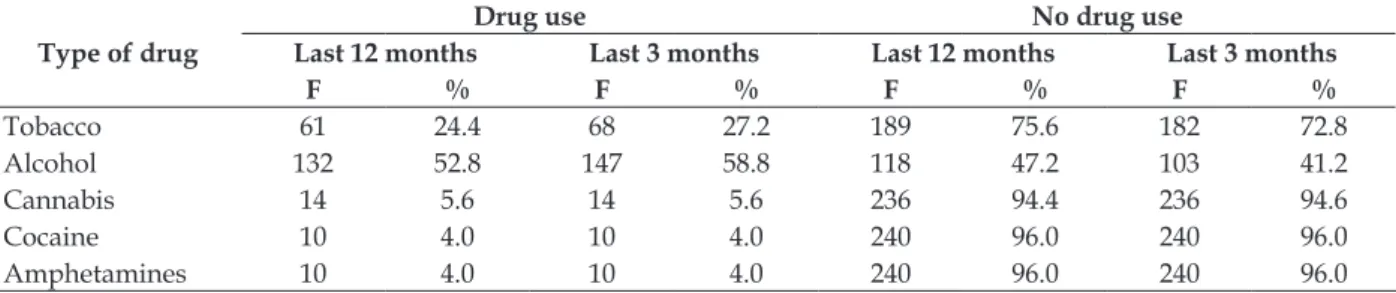
Table 1 - Prevalence of drug use according to type of drugs by students in the last 12 and 3 months Manabí, Ecuador, 2012
Type of drug
Drug use No drug use
Last 12 months Last 3 months Last 12 months Last 3 months
F % F % F % F %
Tobacco 61 24.4 68 27.2 189 75.6 182 72.8
Alcohol 132 52.8 147 58.8 118 47.2 103 41.2
Cannabis 14 5.6 14 5.6 236 94.4 236 94.6
Cocaine 10 4.0 10 4.0 240 96.0 240 96.0
Amphetamines 10 4.0 10 4.0 240 96.0 240 96.0
n=250.
Relationship between peer inluence and
drug use
EIn terms of the relationship between drug use and peer inluence it was found, with a pro -bability of error less than 0.01, that students who use drugs were inluenced by their peers to do so. With regard to alcohol consumption in the last three months, 33.6% report having used it once or twice a month.
The statistical correlation of 0.01% demons-trates that there is a relationship between friends who use drugs and drug use, wherein a change in one of the variables has an inluence on changes in the other. In this case, the variables are corre-lated: 14% of the university students report that their friends do not use drugs. Of the 250 students surveyed, 86% said that their friends have taken drugs at some point in their lives.
There is a direct relationship between peer inluence and drug use, and this association is sta -tistically signiicant at a level of 0.01 (two-tailed). Of the 250 students surveyed, 91.6% report that they have never used illegal drugs, compared to 8.4% who have used them a few times in the last 12 months and 9.6% in the last three months.
The mean of the measurements is not too far from the prediction (with distance measured in standard deviations). Therefore, we do not consi-der that the measurements contradict the theory. The statistical correlation of 0.01% indicates a relationship between peer inluence and drug use, wherein a change in one of the variables has an inluence on changes in the other. In this case, the variables are correlated. There is a perfect positive correlation. The index indicates a total dependence and direct relationship between the two variables: when one variable increases, so does the other in a consistent proportion. (Table 2)
Table2 - ACorrelation analysis of peer inluence and drug use. Manabí, Ecuador, 2012
Variables Rpb
Peer inluence and legal drug use in the last 12
months
-.332*
Peer inluence and illegal drug use in the last 12
months
-.291*
Peer inluence and legal drug use in the last 3
months
-.320*
Peer inluence and illegal drug use in the last 3
months
-.239*
n=250; *p <0.01.
DISCUSSION
The perception that drugs are either not very dangerous or not at all dangerous can constitute a risk factor that leads to experimentation and continued use of psychoactive substances, whereas negative perceptions are viewed as a protective factor that signiicantly inluences the decision not to starting using drugs.
The use of drugs by university students and their peers, especially tobacco and alcohol, occurs among a substantial percentage of the university population. We found that a high percentage of students surveyed claim that only 14% of their friends do not use drugs, which would indicate that a major percentage of the students’ friends have used drugs at some point in their lives. The fact that their friends use drugs is therefore a risk factor for drug use and abuse by university students.
Respondents living at home were less likely to have used illegal drugs during the past 12 mon-ths than those not living with their families. Those who live at home were less likely to use drugs than those who live alone or with friends.
useful for understanding the etiology and progress of the use of these substances and to develop more speciic prevention and intervention strategies among university students.
Parents should communicate with their chil-dren and know how to promptly detect the signs that may be manifested by drug users. This is an important and valid protective factor in drug use prevention. Parents often close their eyes to this reality, but should confront it through good com-munication and by being close to their children.
One way parents can protect their children from drugs and other unwanted behaviors is to discourage their association with friends who engage in these behaviors, set bad examples, and otherwise exert negative socialization inluences.
As far as the quality of family relationships, it should be noted that a large majority of parti-cipants responded that their family cares about them “all the time” and that they enjoy their family “most of the time,” indicating that there is much love in the family unit.
Participants claimed that their family is a source of great happiness to them and that they are proud of their family “all the time.” The beha -vior of parents is extremely important to counter the peer pressure to use drugs experienced by university students.
In terms of electronic entertainment, a lo-gistic regression analysis showed that there is a significant relationship between technological entertainment and parties, as well as between poor family relationships and the inability to moderate the relationship between friends and drug use (p<0.01). A large number of participants stated that they had never used shopping-based entertainment. Technological progress, such as advances in the music industry and exposure to screen-based entertainment, has had a major in-luence on entertainment as a socio-cultural factor. Social networks are widely used, undersco -ring that individuals, therefore, comply with the needs to be accepted and belong to a social ne-twork of their psychological peers outside the cir -cle of their family, and this social relationship can affect an individual’s behavior. Social networks are important because related information is shared and perceptions of others and rules are formed. However, it is only reasonable that others know the amount of time they spend on them and the nature of the relationships—for example, proximi-ty, reciprocity and frequency of contact—which, together, are contributors to social inluence.7-8
Peer inluence is deined as social pressure or extrinsic motivation exerted by peers or friends to behave in a manner acceptable to them. In its simplest form, a social network is a map of all relevant relationships between individuals and groups.9 The social context determines the oppor-tunity for social interaction through the formation of social networks.
At parties attended in the past three mon-ths, participants reported that there was tobacco, alcohol, and drugs such as marijuana, cocaine, or amphetamines available, thus increasing the chan-ces that students would use one of these drugs. As a result of technological advances in the music industry, there has also been a similar increase in the prevalence of drug use by young people, coinciding with dance parties or the rap scene.10
The leisure activities of people from ages 18 to 25 have changed dramatically over the past 10 to 15 years. For example, video games and Inter-net use increasingly dominate the leisure time of this population. A large proportion of university students are in this age range, and one can assume that this trend is likewise the case with them. They are entertained by watching pornography “often” or “very often,” or according to whatever new te -chnological advance in the entertainment industry has the potential to provide for wide audiences in terms of information and leisure activities in new and innovative ways.11
Spirituality is correlated to the use of drugs and alcohol. The important role that religion has in the everyday life of students should not be downplayed, because the belief in a higher power plays its part in the continuation of society and social life. An independent sample involving spiri-tuality (t-test) revealed that there was a signiicant difference between men and women, where fema-les have higher levels of spirituality than mafema-les.
159 -Inluencia de pares, familia, espiritualidad, entretenimiento y...
drugs or cause them to take action in relation to de -cisions they have made about drug use in general. It can be seen that individuals are socialized by their friends in regard to drug use and that they choose their friends according to similar interests and lines of thought on the use of drugs.
When considered from a comprehensive perspective, the relationship between the peer group and drug use is evident in the results. This attests to the inluence and effect that deviant beha -vior has on others in the group and demonstrates the importance of socialization as a continuous process, because this involves the resocialization of individuals by peers at a later stage in their lives and focuses on different groups and their impact, namely, the structure of family cohesion and re-ligion/spirituality.12 In the socialization process, groups accept the individual based on common characteristics. To be accepted, the individual takes on the attitudes and behaviors of the group and yields to peer pressure.
Among those surveyed, the most commonly used drugs in the last 30 days were alcohol and tobacco, with increased consumption noted in the last 30 days. This is to be expected insofar as legal drugs such as alcohol and tobacco are the most accessible drugs for this population. It is worth no-ting that Article 63 of the current Law on Narcotics and Psychotropic Substances in Ecuador makes drug-dependent individuals subject to oversight. This will be determined, before trial, after an ex-pert report from medical examiners. The current law punishes illegal tenure and possession with 12 to 16 years of imprisonment.5
In Ecuador, the executive branch has sub-mitted a bill to the Organic Integral Penal Code, which, in Article 8, Chapter 1, deines the “maxi -mum dose for personal consumption” as “posses -sion of any drug intended exclusively for personal consumption and not exceeding the [set] amount, will not be punishable.” The limit is 10 grams for marijuana and hashish; 4 grams for opium; 100 milligrams for heroin (diacetylmorphine); 5 grams for cocaine; 0.020 milligrams for LSD (lysergide); and 80 milligrams for methamphetamines, in granulated, powder, or crystal form or in units up to 400 milligrams. With the exception of these amounts, the law proposes direct punishment in ive different areas for the production and trans -port of narcotics and psychotropic substances
.5
CONCLUSIONS
LMost of the friends of the university stu-dents surveyed use drugs (Socio-Cultural Factors and Drug Use Questionnaire CICAD-CAMH 2011-2012). The substance most used by young people is alcohol, closely followed by tobacco and, to a lesser extent, by illegal substances such as marijuana, co-caine, and, lastly, amphetamines. Those surveyed totally agree with the importance of spirituality in dificult times, which indicates the level of princi -ples and values that are imparted in Ecuadorian families, with spirituality acting as a protective factor, where females have higher levels of spiri-tuality than males. Entertainment (screen-based entertainment and sports entertainment) had a moderating effect on the relationship between peer inluence and drug use among university students. Family relationships also moderated the relationship between peer inluence and drug use, serving as a protective factor against drug use.
Limitations
The data obtained is limited in its ability to make predictive conclusions about any other population in the sample, due to the sampling technique used. This limitation is acknowledged in order to avoid generalizations being made in relation to the entire university or general popu-lation based on the results of this study
Recommendations
ATo the university that participated in the study, it is recommended to include in the curri-culum, at both the undergraduate and graduate level, the topic of drug use prevention as cross axes in the curricula of every ield of study and consider, as lines of research, different themes on drugs as part of its Institutional Research Policy. It is recommended to develop prevention programs for drugs that require medical prescriptions, par -ticularly in terms of psychotropic drugs in the university population. Due to the important role of spirituality in the everyday lives of individuals, this variable should not be downplayed, because belief in a higher power plays its part in the conti-nuation of society and social life, and can therefore have a protective effect against alcohol and drugs.
ACKNOWLEDGMENTS
(CICAD) of the OAS, to the Centre for Addiction and Mental Health (CAMH) in Toronto, Canada, and to its team of professionals and administrati-ve staff for the opportunity that was provided; to the advisors and professors, and university and student population who participated in the study, and to all those who were directly or indirectly involved with it.
REFERENCES
1. Hallam C, Bewley-Taylor D. Brieing Paper 21: drug use: knowledge, culture and context. Oxford (UK): The Beckley Foundation Drug Policy Programme; 2010. 2. European Regeneration Areas Network. Quartiers in
crise. gender stereotypes: the impact of socialization and education [online], 2005 [acesso 2011 Jul 18]. Disponível em: http://qeceran.cluster003.ovh.net/ network/genderstereotypes.pdf
3. Gobierno Nacional de la Republica del Ecuador. Consejo Nacional de Control de sustancias estupefacientes y psicotrópicas del Ecuador. Observatorio Nacional de Drogas de Ecuador. Quito (EC): CICAD-OEA; 2010.
4. United Nations Ofice On Drugs and Crime. World Drug Report. Washington (US) UN; 2004.
5. Asemblea Nacional de la República del Ecuador. Proyecto Código Orgánico Integral Penal. Ley de sustancias estupefacientes y psicotrópicas. Ecuador: Comisión Especializada; 2014 [cited 2014 Aug 22]. Disponível em: http://www.consep.gob.ec/ descargas/ley_de_sustancias_estupefacientes_y_ psicotropicas.pdf
6. Universidad Técnica de Manabí. Boletín Guia Virtual UTM: Guía de Carreras 2010. Manabí (EC): UTM; 2010.
7. Berkman LF. Introduction: seeing the forest and the tres - from observation to experiments in social epidemiology. Epidemiol Rev. 2004; 26:2-6. 8. Valente TW, Gallaher P, Mouttapa M. Using social
networks to understand and prevent substance use: A transdisciplinary perspective. Subst Use Misuse. 2004; 39(10-12):1685-712.
9. Measham F, Parker H, Aldridge J. The teenage
transition: From adolescent recreational drug use to the young adult dance culture in Britain in the mid-1990s. J Drug Issues 1998; 28(1):9-32.
10. Whitehorne-Smith P, Simich L, Strike C, Brands B Giesbrecht N, Khenti Au. Gender differences in simultaneous polydrug use among undergraduate students of one university, Kingston - Jamaica. Texto Contexto Enferm [online]. 2012 [cited 2014 Aug 22]; 21(Spe):74-8. Disponível em: http://www. scielo.br/scielo.php?script=sci_arttext&pid=S0104-07072012000500010&lng=pt
11. Consejo Provincial de Manabí. Cantones de Manabi. Folleto educativo y cultural. Ecuador: Editorial MANABÍ; 2005.
12. Comisión Clínica. Cannabis: Informes de la Comisión Clínica. Madrid (ES): Ministerio de Sanidad y Consumo, Delegación del Gobierno para el Plan Nacional sobre Drogas; 2006.
Correspondence: Magaly Scott Álava Universidad Técnica de Manabí Avenida Urbina y calle Che Guevara Portoviejo, Manabí, Ecuador