COMPARISONS BETWEEN TWO ECONOMICALLY VALUABLE FOREST
SPECIES (Eucalyptus grandis AND Pinus taeda) IN RELATION TO SEED
BEHAVIOUR UNDER CONTROLLED DETERIORATION
1Jussara Bertho Fantinatti2 e Roberto Usberti3
1 Recebido em 03.02.2009 e aceito para publicação em 25.08.2010.
2 Faculty of Agricultural Engineering, UNICAMP, Campinas, Brazil. E-mail: <[email protected]>. 3 Plant Protection Agency, Sao Paulo State, Campinas, Brazil. E-mail: <[email protected]>.
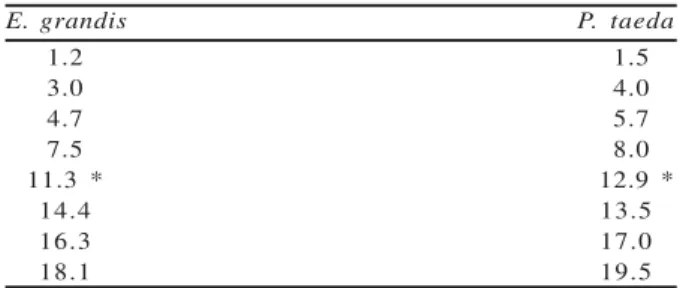
ABSTRACT – The objectives of this work were to analyze seed behaviour under controlled deterioration and estimate viability equations for forest species Eucalyptus grandis and Pinus taeda. Desired moisture content levels were achieved from initial values after either rehydration over water or drying over silica gel, both at 25 oC. Seed sub samples with 8 moisture contents each for E. grandis (1.2 to 18.1%, initial value of 11.3%)
and P. taeda (1.5 to 19.5%, initial value of 12.9%) were sealed in laminate aluminium-foil packets and stored
in incubators maintained at 40, 50 and 65 oC. The seeds from these species exhibited true orthodox and
sub-orthodox storage behaviour, respectively, however E. grandis showed higher seed storability, probably due to a different seed chemical composition. Lowest moisture content limits estimated for application of the viability equations at 65 oC were 4.9 and 4.1 mc for E. grandis and P. taeda, on equilibrium with ±20%
RH. The viability equation estimated quantified the response of seed longevity to storage environment well with KE = 9.661 and 8.838; CW= 6.467 and 5.981; CH= 0.03498 and 0.10340; CQ = 0.0002330 and 0.0005476,
for E. grandis and P. taeda, respectively. .
COMPARAÇÕES ENTRE DUAS ESPÉCIES FLORESTAIS DE VALOR
ECONÔMICO (Eucalyptus grandis AND Pinus taeda) COM RELAÇÃO AO
COMPORTAMENTO DAS SEMENTES SOB DETERIORAÇÃO CONTROLADA
RESUMO – Os objetivos deste trabalho foram analisar o comportamento de sementes sob deterioração controlada
e estimar as equações de viabilidade das espécies florestais Eucalyptus grandis e Pinus taeda. Os graus de
umidade desejados foram obtidos a partir dos valores iniciais após a reidratação sobre água ou secagem sobre
sílica-gel, ambos a 25 oC. Subamostras de sementes com 8 C graus de umidade cada de E. grandis (1,2
a 18,1%, valor inicial de 11,3%) e de P. taeda (1,5 a 19,5%, valor inicial de 12,9%) foram colocadas em
envelopes laminados de alumínio e mantidas em incubadoras a 40, 50 e 65 oC. O comportamento das espécies
durante o armazenamento foi ortodoxo e subortodoxo, respectivamente. Entretanto, o potencial de armazenamento
de sementes de E. grandis foi maior, talvez devido à diferente composição química das sementes. Os limites
inferiores de graus de umidade para aplicação da equação de viabilidade a 65 oC foram 4,9 e 4,1% em
E. grandis e P. taeda, em equilíbrio com ± 20% UR. As equações de viabilidade estimadas quantificam bem
a resposta da longevidade das sementes ao ambiente de armazenamento, como se segue: KE = 9,661 e 8,838;
CW = 6,467 e 5,981; CH = 0,03498 e 0,10340; CQ = 0,0002330 e 0,0005476, em E. grandis e P. taeda, respectivamente.
Palavras-chave: Espécies florestais, Armazenabilidade de sementes e Equação de viabilidade.
1. INTRODUCTION
Eucalyptus spp. and Pinus spp. are the main sources for supplying raw material for the production of short and long fiber cellulose and mechanical processing and have been established around 3,800,000 ha of brazilian reforested areas.
Seed storability is affected mainly by moisture content (mc) and storage temperature (T). According to Harrington (1963), mc is the most important factor in seed longevity and the viability period could be doubled after reductions of either 1% in mc or 5.6°C in T.
Roberts (1973) classified the seeds in storage as orthodox, showing a medium life around 3-15 years, with seed longevity inversely proportional to T and mc whereas recalcitrant seeds have short viability and more difficult conservation. The orthodox seed behavior can be investigated thereby reducing both moisture content and temperature, and their longevity can be described in a quantifiable and predictable way
Bonner (1990) proposed a specific classification for forest species: true orthodox, which tolerates desiccation at low T and maintains seed viability for
long periods in dry conditions (Eucalyptus, Pinus and
Acacia); sub-orthodox, which could be stored in the same conditions above for the maximum of 6 years, presenting high lipid content, small size and fine seed coats; recalcitrant temperate, which are sensitive to desiccation but could be stored at T around freezing (Quercus spp.) and recalcitrant tropical, presenting big seeds and being sensitive to desiccation and freezing (coconut, cocoa and mango).
Several equations have been proposed to relate storage conditions with seed viability, aiming at predicting seed survival as well as seed sensibility to mc and T. The viability equation presented by Ellis and Roberts (1980) (v = Ki p/10 K
E C
W log m C
H t C
Q
t²) allows estimates
of any seed lot viability during storage at different T and mc and includes five constants, as follows: one
quantifying the initial seed lot quality (Ki), one for
each species (KE), one indicating the logarithmic response
of seed longevity to mc (CW) and two constants for
linear and quadratic T (CHand CQ, respectively).
The main objectives of this work were (1) analyzing
E. grandis W.Hill ex Maiden and P. taeda L. seed behavior under controlled deterioration and (2) estimating viability equations.
2. MATERIAL AND METHODS
This research work was carried out at the Laboratory of Post-harvest Technology, Faculty of Agricultural Engineering, Campinas State University, Brazil, from
2000 to 2003. E. grandis and P. taeda seed lots were
harvested in 1999/2000 and 2000/2001 seasons, in Forest Experimental Stations of Anhembi and Itapetininga, Sao Paulo State, respectively.
E. grandis physical purity analysis was performed using a 5-g-working sample, which was separated in pure seeds, other seeds and inert matter. The 1,000-seed weight determination for both species was carried out using eight 100-pure seed sub samples (ISTA, 2006).
Lipid content was detected in 2-g-ground seed samples, placed in Whatman paper cartridges (80 mm length x 33 mm of internal diameter); the extraction was performed with ether of petroleum in a Soxhlet apparatus for 5 h and the amount of lipids was determined gravimetrically (AOAC, 1995). Activity of water was carried out at 25 ± 0.3°C on three replicates of ground seeds for each mc, using the chilled-mirror dew point technique.
Seed mc were adjusted to eight levels from initial values, using desiccators with silica gel or through rehydration over water (4 cm), both at 25°C. Seed sub samples were weighed periodically for controlling the amount of removed or absorbed water, until desired mc had been achieved. After a 4 day-period for stabilization at 4°C in sealed containers, seed mc (%, f.wt.) was determined at 130-133°C during 2 hours for each mc (ISTA, 2006), using three 5 g sub samples
of intact (E. grandis) and ground seeds (P. taeda) and
the values recorded are listed in Table 1.
Table 1 – Seed moisture content analyzed for the species.
Tabela 1– Graus de umidade de sementes analisados para
as espécies.
E. grandis P. taeda
1.2 1.5
3.0 4.0
4.7 5.7
7.5 8.0
11.3 * 12.9 *
14.4 13.5
16.3 17.0
18.1 19.5
Seeds were sealed in laminated paper (polyester / aluminium / low density polyethylene, with total thickness of 65 µ m) with a minimum of 10 x 0.6 g sub
samples for E. grandis and 10 x 200 seed sub samples
for P. taeda for each combination mc / T and stored at 40, 50 and 65 (± 0.5°C), until complete survival curves were achieved (Table 2).
E. grandis seed germination tests were performed
using 4 x 0.15 g sub samples; for P. taeda, a previous
dormancy releasing through stratification was proceeded (5°C, 28 days), using 8 x 25 seed sub samples. Seed sub samples were placed over a moistened filter paper in 11 x 11 cm plastic boxes and kept in an incubator under alternate temperature regime (20-30°C, 16-8 hours, 40 W white light at 30°C); seedling counts were recorded
at 7 and 14 days (E. grandis) and at 7 and the final
one at 28 days (P. taeda). Seeds were considered
germinated according to the criterion of the radicle protrusion (SOUZA and CARDOSO, 2000).
Seeds with mc below 6% were previously rehydrated at 25°C during 48 hours over a nylon screen in a plastic box with 1.5 cm of distilled water on the bottom, aiming at avoiding predictable damages due to fast rehydration.
The origin of the survival curves on the Y-axis doesn’t converge to the same point, requiring a statistical
adjustment in order to get the same value (Ki) with
the smallest possible deviation. The germination percentage values were plotted in X-Y graphs and regression lines were fitted to probit values through Y-axis scale transformation. The residual deviances for survival curves at different T were analyzed to give
the best fit to the viability equation, using the multiple regression analysis within the generalized linear model (HAY et al., 2003).
The specific constants of each species were achieved using decimal logarithms of sigma (frequency of seed deaths distribution in time or the number of days required for seed germination drop by one probit) and mc for each combination mc / T. Seed germination with or without rehydration was analyzed through a randomized statistical design.
3. RESULTS AND DISCUSSION
Seed physical pure percentages and 1,000-seed
weights detected were 19.0% and 0.226 g (E. grandis)
and 100.0% and 25.0 g (P. taeda). Extraction relationship or fruit / seed relationship is the amount of capsules required to produce one kg of mixed seeds and presented a medium rate of 15:1 for E. grandis. Taking into account those values, the numbers of pure seeds / kg were
estimated in 841,643 and 40,000 for E. grandis and P.
taeda, respectively, which is similar to the result reported
by Vieira and Diniz, 1995 (± 700,000 / kg, E. grandis).
According to Gentil and Ferreira (2002), the 1,000-seed weight is affected by seed size uniformity, foundation plants and environmental factors.
Table 2 –E. grandis and P. taeda seed mc analyzed during storage at 40, 50 and 65°C.
Tabela 2 – Graus de umidade de sementes de E. grandis e
P. taeda analisados durante o armazenamento
a 40, 50 e 65 °C.
Storage temperature (°C) Temperatura de armazenamento (°C)
E. grandis P. taeda
4 0 5 0 6 5 4 0 5 0 6 5
1.2 1.2 1.5 1.5 1.5
3.0 3.0 4.0 4.0 4.0
4.7 4.7 5.7 5.7 5.7
7.5 7.5 7.5 8.0 8.0 8.0
11.3 11.3 11.3 12.9 12.9 12.9 14.4 14.4 14.4 13.5 13.5 13.5 16.3 16.3 16.3 17.0 17.0
18.1 18.1 18.1 19.5
0 5 10 15 20 25 30 35
0 1 2 3 4 5 6 7 8 9 10 11 12 13 14
Pinus taeda Eucalyptus grandis
Seed
m
o
is
tu
re
con
te
n
t
(%
)
Drying period (days)
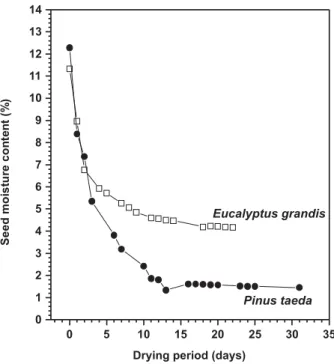
Figure 1 – Seed drying rates over silica gel at 25°C for E.
grandis and P. taeda.
Figura 1 – Taxas de secagem de sementes sobre sílica gel
Seed lipid contents recorded in E. grandis and
P. taeda were 24.2 and 52.3%, which were higher than
those achieved for Dalbergia nigra and Dimorphandra
mollis (7.0% and 14%), respectively (CHAVES and USBERTI, 2004)
E. grandis seeds lost water faster over silica gel
after 48-h-drying, E. grandis and P. taeda presented
seed mc around 6.8 and 7.4% (Figure 1), probably due to the different lipid contents (BROOKER et al., 1992). Seed mc for both species presented an inverse relationship with drying period. The drying process over silica gel revealed positive results for the species and the lowest mc were obtained without damages to the seeds.
No statistical differences were recorded for
E. grandis seed germination among mc (Table 3); however the highest and lowest percentages were obtained with 7.5 / 11.3% mc (no rehydration) and with 1.2% mc (with rehydration), emphasizing the need for rehydration before germination test for mc lower than 6%. Lowest
P. taeda seed germination percentages were recorded with 8.0 and 1.5% mc, unrelated to rehydration however seeds with 12.9% mc presented a significant increase in germination after rehydration. Bradford (1995) reported that seed germination normally increases after rehydration.
Seeds of P. taeda presented a lower equilibrium
relative humidity (erh) than E. grandis, when stored
in similar conditions. Oily seeds present erh lower than starchy ones, when exposed to similar environments, since they don’t absorb or absorb less water, due to being hydrophobic.
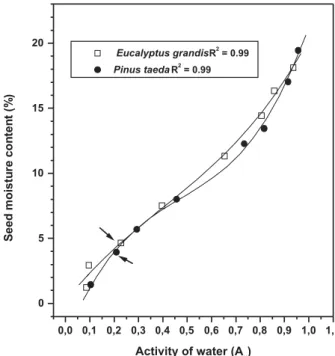
Seed longevity increased logarithmically according to reduction of mc until all weak bound water had been removed. The inflection points of the desorption isotherms for E. grandis and P. taeda (4.9% mc, erh at 22.9% and 4.1% mc, erh at 21.2%, Figure 2) mean the discontinuity of the inverse relationship between longevity and mc or the lowest mc limits for application of the viability
Table 3 – Seed germination (%) of E. grandis and P. taeda
after drying over silica gel.
Tabela 3 –Germinação de sementes (%) de E. grandis e
P. taeda após a secagem sobre sílica- gel.
Seed mc E. grandis
No rehydration With rehydration Sem reidratação Com reidratação
11.3 87.5 a 82.5 a
7.5 84.5 a 70.5 a
4.7 78.0 a 79.0 a
3.0 68.0 a 80.0 a
1.2 68.0 a 77.0 a
P. taeda
12.9 82.0 a B 95.0 a A
8.0 75.5 ab A 78.5 b A
5.7 81.0 a A 85.0 ab A
4.0 85.0 a A 89.0 ab A
1.5 63.0 b A 74.0 b A
Means followed by different lower case letters in the columns and upper case letter in the lines, are statistically different at p<0,05.
Médias seguidas por diferentes letras minúsculas nas colunas e maiúsculas nas linhas são estatisticamente diferentes a p<0,05.
Figure 2 – Relationship between seed mc (%, f.wt.) and activity of water (%) of E. grandis and P. taeda, at 25 C. The curves represent sorption and desorption isotherms, above and below the initial mc values (11.3 and 12.9%, respectively). The arrows point out the inflection points of the isotherms (4.9 and 4.1% mc), which mean the lowest mc limit for application of the viability equations at 65 C.
Figura 2 – Relações entre grau de umidade (%, b.u.) e atividade
de água (%) de E. grandis e P. taeda a 25 °C. As
curvas representam isotermas de sorção e desorção, acima e abaixo dos valores inicias de graus de umidade (11,3 e 12,9%, respectivamente). As setas apontam para os pontos de inflexão das isotermas (graus de umidade de 4,9 e 4,1%), que indicam os limites inferiores de grau de umidade para a aplicação da equação de viabilidade a 65 °C.
0,0 0,1 0,2 0,3 0,4 0,5 0,6 0,7 0,8 0,9 1,0 1,1 0
5 10 15 20
Eucalyptus grandisR2= 0.99
Pinus taedaR2= 0.99
S
eed
m
o
is
tu
re
con
ten
t
(%
)
equation at 65°C. Those values have already been estimated for another species with variable results, as follows: 2.4% mc for peanuts (USBERTI and GOMES, 1998); 6.2% mc for peas (ELLIS et al., 1989); 2.9 and
4.0% mc for D. nigra and D. mollis (CHAVES and
USBERTI, 2004) and 3.6% mc for cottonseed (USBERTI et al., 2006).
Probit seed survival curves for the species after storage at 40, 50 and 65°C are displayed in Figure 3, showing the effects of mc and T on seed storability. When mc and T were reduced, predictable seed longevity increases were observed. Ellis (1984) reported that seed survival curves always present the same format, differing among them just in relation to the deterioration period,
Figure 3 – Seed survival curves (probit) for E. grandis (A, on the left) and P. taeda (B, on the right), stored at 40, 50 and 65°C. Symbols and straight lines mean germination percentages and survival curves, respectively.
Figura 3 – Curvas de sobrevivência de sementes (em probitProbit) para de E. grandis (A, à esquerda) e P. taeda (B, à direita), após o armazenamento a 40, 50 e 65 °C. Símbolos e retas significam porcentagens médias de germinação e curvas de sobrevivência, respectivamente.
0 50 100 150 200 250 300 350 400
0 10 20 30 40 50 60 70 80 90 100
Storage period (days)
S e e d ge rm ina tion (pr obit ) 40ºC A 14.4% 11.3% 7.5%
0 50 100 150 200 250 300 350 400
0 10 20 30 40 50 60 70 80 90 100 50ºC A 11.3% 7.5% 4.7% S e e d ge rm ina tion (pr obit )
Storage period (days)
0 20 40 60 80 100 120 140 160 180 200 0 10 20 30 40 50 60 70 80 90 100 7.5% 4.7% 3.0% 1.2% 65ºC A S e e d ge rm in a tion (pr obit )
Storage period (days)
0 2 4 6 8 10 12 14
0 10 20 30 40 50 60 70 80 90
100 40ºC B
S e e d ge rm ina tion (pr obit ) 13.5% 12.9% 8.0%
Storage period (days)
0 5 10 15 20 25 30 35
0 10 20 30 40 50 60 70 80 90
100 50ºC B
S e e d ge rm in a tion (pr o b it ) 8.0% 5.7% 4.0%
Storage period (days)
0 2 4 6 8 10 12 14
0 10 20 30 40 50 60 70 80 90
100 65ºC B
S e e d ge rm in a tion (pr obit ) 5.7% 4.0% 1.5%
but presenting the same standard deviation. In the present study the sigmoid shape of the survival curves was strongly affected by temperature and mc increase
especially for P. taeda seeds.
Relationship differences between mc and longevity
were observed and P. taeda seed sensitivity to mc was
higher than E. grandis. Tompsett (1986) worked with
two arboreal species and verified that Ulmus carpinifolia
Borkh. seed was significantly more sensitive to mc than
Terminalia brassii Exell.
Seeds of E. grandis stored at 40°C with 7.5% mc
had a sigma of 90 days, while for P. taeda with 8.0% mc
that value was reduced to 5 days (Figure 3). The combination of highest T and mc resulted in seed longevity reductions, confirming the tremendous effect of mc on seed longevity.
E. grandis seeds stored at 50°C with 7.5% mc
presented a sigma of 40 days, while for P. taeda with
8.0% mc that value was reduced to 2 days (Figure 3). In seed samples with 4.7 and 4.0% mc, the calculated sigma values were 55 and 4 days, respectively. Almeida
et al., 2005, working with three Pinus species, reported
that P. taeda seed germination was not affected after
a 2-minute-storage at d” 50°C.
Seeds of E. grandis stored at 65C with 1.2 and 7.5%
mc presented sigma values of 40 and 1 days, respectively;
however in P. taeda with 1.5% mc that time was 3 days
(Figure 3). For seed germination to reach values lower than 5%, with 3.0 and 4.0% mc, 96 and 3.25 days were required, respectively. P. taeda seed germination reduction was higher than for E. grandis throughout the experiment, since oily seeds deteriorate faster than starchy ones.
Seed mc and sigma values after storage at 40, 50
and 65°C are presented in Table 4. E. grandis seeds
with 18.1% mc stored at 40 and 50°C presented sigma
values of 0.4 and 0.1 day; in P. taeda with 17.0% mc
stored at 40 and 50°C, those values decreased to 0.009 and 0.002 day.
Constraining 24 survival curves to the same origin point on the Y-axis yielded different Ki values for E. grandis
and P. taeda (1.351 and 1.819; 90 and 98% seed germination). Significant effects for log mc and T were observed while non-significant ones were calculated for the interaction log mc / T (F = 0.47 P. taeda; 3.08 E. grandis).
Better statistic adjustments to estimate viability constants were achieved after removal of the lowest mc results at 65 and 50°C (1.2, 3.0 and 4.7% mc for
E. grandis; 1.5 and 4.0% mc for P. taeda). The constants K (K = KE - CHt - CQt2) obtained define
the equations at 40, 50 and 65°C, as follows: E. grandis:
K = 8.084; 5.745; 2.486 and CW = 6.641; 5.103; 2.777;
P. taeda: K = 8.802; 4.673; 1.454 and CW = 8.748; 5.596; 2.949.
The constants KE and CW estimated for E. grandis
(9.661 and 6.467) were different from those calculated for P. taeda (8.838 and 5.981), confirming the observation done by Ellis (1984) that for cereal seeds those values are higher than oily seeds, indicating the need for drying those seeds to lower mc levels. The constants that reflect seed sensitivity to T (CH and CQ) were 0.03498
and 0.0002330 (E. grandis) and 0.10340 and 0.0005476
(P. taeda).
The viability equation constants for E. grandis
appear to be close to that reported for cottonseed (KE = 9.240, CW = 5.190, CH = 0.03965 and CQ = 0.000426) (USBERTI et al., 2006). An inverse relationship was observed between mc and seed longevity for both species.
The viability equations estimated for E. grandis
and P. taeda seeds were:
v= Ki- p/10 9.661-6.467.logm-0.03498t-0.0002330t2 E. grandis
v= Ki- p/10 8.838-5.981.logm-0.10340t-0.0005476t2 P. taeda Table 4 – Seed mc (%) and sigma (days) for E. grandis and
P. taeda. stored at 40, 50 and 65°C.
Tabela 4 – Graus de umidade (%) e sigma (dias) de sementes de E. grandis e P. taeda, armazenadas a 40, 50 e 65 °C.
Mc Sigma (days)
E. grandis P. taeda
40 °C 50 °C 65 °C 40 °C 50 °C 65 °C
1.2 - - 43.19 - -
-1.5 - - - 3.29
3.0 - - 27.81 - -
-4.0 - - - - 7.35 0.97
4.7 - 97.27 14.51 - -
-5.7 - - - - 4.59 0.6
7.5 137.6 40.83 3.59 - -
-8.0 - - - 4.7 1.27 0.15
11.3 17.33 4.97 0.44 - -
-12.9 - - - 0.3 0.06 0.006
13.5 - - - 0.15 0.023 0.005
14.4 4.2 0.84 0.13 - - -16.3 0.76 0.29 0.03 - -
-17.0 - - - 0.009 0.002
-18.1 0.4 0.1 - - -
-Figure 4 shows the logarithmic relationship between seed mc and sigma at 40, 50 and 65°C and reveals the parallelism among the straight lines, due to different T used. Dickie et al. (1990) reported that the viability equation could be applied from -13 to 90°C and also
observed a negative relationship between CW values
and seed oil content, among different species.
Medeiros et al. (1998), using KE = 7.5498 and CW = 3.76 and adopting CH= 0.0329 and CQ = 0.000478 as universal constants, estimated the sigma value of 1,167 years for
the species Astronium urundeuva (Fr.All.) Engl. stored
at -20°C with mc in equilibrium at 15°C and 15% RH.
Using the viability equations and adopting 4°C (domestic refrigerator) and 7.5 and 8.0% mc (erh at 40 and 45%), achieved in a 2-day drying period over
silica gel, it is expected that E. grandis and P. taeda
seeds would present sigma values of 19.9 and 2.9 years. That different performance could be due to the different
chemical composition of those seeds, since P. taeda
presented higher lipid content.
Figure 4 – Relationship between the logarithm of seed mc and the logarithm of sigma for E. grandis (A, on the left) and
P. taeda (B, on the right), stored at 40, 50 and 65°C. Solid lines represent slopes, which are constrained to
one common value. The dotted lines show different trends at 65°C, below the lower mc limit for application of the viability equation, pointed out by the arrows.
Figura 4 – Relações entre o logaritmo de grau de umidade da semente e o logaritmo de sigma para de E. grandis (A, à esquerda) e P. taeda (B, à direita), após o armazenamento a 40, 50 e 65 °C. Linhas sólidas representam curvas, após serem direcionadas a um ponto comum. As linhas pontilhas mostram diferentes tendências a 65 °C, abaixo do limite inferior de grau de umidade para a aplicação da equação de viabilidade, indicados indicado pelas setas.
0,0 0,2 0,4 0,6 0,8 1,0 1,2 1,4 -2,0
-1,5 -1,0 -0,5 0,0 0,5 1,0 1,5 2,0 2,5
A
65ºC 50ºC 40ºC
S
ig
m
a
(l
o
g
d
ay
s)
Seed moisture content (log %, f.wt.)
0,2 0,4 0,6 0,8 1,0 1,2 1,4 -3,0
-2,5 -2,0 -1,5 -1,0 -0,5 0,0 0,5 1,0 1,5 2,0 2,5
B
65ºC 50ºC 40ºC
Seed moisture content (log %, f.wt.)
S
igma
(l
o
g)
4. CONCLUSIONS
. P. taeda and E. grandis presented, respectively, sub- and true orthodox seed behaviour to storage.
. P. taeda revealed erh and seed storability lower
than E. grandis.
. Lowest limits for application of the viability equation
at 65°C were 4.9 and 4.1% mc for E. grandis and P.
taeda, respectively.
5. ACKNOWLEDGEMENTS
To FAPESP (Brazilian Research Agency) for the doctorate scholarship to the first author.
6. REFERENCES
ALMEIDA, F.A.C. et al. Efeito da temperatura
sobre a germinação de três espécies de Pinus
cultivadas no Brasil. (Effect of temperature on
germination of three Pinus species cultivated in
Brazil). Brazilian Journal of Forest
ASSOCIATION OF OFFICIAL ANALYTICAL
CHEMISTRY - AOAC. Official Methods of
Analysis. Washington: 1995.
BONNER, F. T. Storage of seeds: potential and
limitations for germoplasm conservation. Forest
Ecology and Management, v.35, n.1-2,
p.35-43, 1990.
BRADFORD, K. J. Water relations in seed germination. In: KIGEL, J.; GALILI, G. (Eds.).
Seed development and germination.
New York: Marcel Dekker, 1995. p.351-396.
BROOKER, D. B.; BAKKER-ARKEMA, F. W.; HALL, C. W. Grain equilibrium moisture content.
In: Drying and storage of grains and
oilseeds. New York: 1992. p.67-86.
CHAVES, M. M. F.; USBERTI, R. Controlled seed
deterioration in Dalbergia nigra and
Dimorphandra mollis, endangered Brazilian forest
species. Seed Science and Technology,
v.32, n.3, p.883-893, 2004.
DICKIE, J. B. et al. Temperature and seed storage
longevity. Annals of Botany, v.65, n.2,
p.197-204. 1990.
ELLIS, R. H. The meaning of viability. In: DICKIE, J.
B.; LININGTON, S. H.; WILLIAMS, J. T. (Eds.). Seed
management techniques for genebanks: a
report of a workshop. Rome: International Board for
Plant Genetic Resources, 1984. 294p.
ELLIS, R. H.; ROBERTS, E. H. Improved equations
for the prediction of seed longevity. Annals of
Botany, v.45, n.1, p.13-30, 1980.
ELLIS, R. H.; HONG, T. D.; ROBERTS, E. H. A comparison of the low-moisture-content limit to the logarithmic relation between seed moisture
and longevity in twelve species. Annals of
Botany, v.63, n.6, p.601-611, 1989.
GENTIL, D. F. O.; FERREIRA, S. A. N. Preparação das subamostras, temperatura e período de secagem na determinação do grau de umidade de sementes de
Camu-Camu (Myrciaria dubia (H.B.K.) Mc Vaugh).
(Preparation of sample, temperature and drying periods in the determination of the moisture content of
Camu-Camu (Myrciaria dubia (H.B.K.) Mc Vaugh) seeds).
Brazilian Seed Journal, v.24, n.2, p.62-69, 2002.
HARRINGTON, J. F. Practical instructions and
advice on seed storage. Proceedings of the
International Seed Testing Association,
v.28, n.4, p.989-994, 1963.
HAY, F.R. et al. One-step analysis of seed storage
data and the longevity of Arabidopsis thaliana
seeds. Journal of Experimental Botany,
v.54, n.384, p.993-1011, 2003.
INTERNATIONAL SEED TESTING ASSOCIATION
- ISTA. International rules for seed
testing. Zurich: 2006. 462p.
MEDEIROS, A. C. S. et al. The moisture relations
of seed longevity in Astronium urundeuva (Fr.
All.) Engl. Seed Science and Technology,
v.26, n.2, p.289-298, 1998.
ROBERTS, E. H. Predicting the storage life of
seeds. Seed Science and Technology, v.1,
n.3, p.499-514, 1973.
SOUZA, G. M.; CARDOSO, V. J. M. Effects of different environmental stresses on seed
germination. Seed Science and
Technology, v.28, n.3, p.621-630, 2000.
TOMPSETT, P. B. The effect of temperature a n d m o i s t u r e c o n t e n t o n t h e l o n g e v i t y o f s e e d o f U l m u s c a r p i n i f o l i a a n d Te r m i n a l i a b r a s s i i. Annals of Botany, v. 5 7 , n . 6 , p.875-83, 1986.
USBERTI, R.; GOMES, R. B. G. Seed viability
constants for groundnut. Annals of Botany,
v.82, n.5, p.691-694, 1998.
USBERTI, R.; ROBERTS, H. E.; ELLIS, H. R.
Prediction of cottonseed longevity. Brazilian
Journal of Agricultural Research, v.41,
n.9, p.1435-1441, 2006.
VIEIRA, J. D.; DINIZ, A. S. Colheita, secagem e
beneficiamento de sementes de Eucalyptus na
Champion Papel e Celulose Ltda. (Eucalyptus
harvesting, drying and seed processing at
Champion Paper and Cellulose Co.) In: Manual
Técnico de Sementes Florestais.