Some Wood Species Impregnated with Styrene and Methyl Methacrylate
*e-mail: [email protected]
Wood-Polymer Composite: Physical and Mechanical Properties of Some
Wood Species Impregnated with Styrene and Methyl Methacrylate
Denise Ortigosa Stolfa*, Francisco Antonio Rocco Lahrb
a
São Carlos School of Engineering, University of São Paulo, Brazil, Av. Trabalhador Sãocarlense, 400, 13566-590 São Carlos - SP, Brazil b
Department of Structural Engineering, São Carlos School of Engineering, University of São Paulo, Brazil
Av. Trabalhador Sãocarlense, 400, 13566-590 São Carlos - SP, Brazil
Received: June 1, 2004; Revised: August 10, 2004
This study aimed to demonstrate the feasibility of obtaining wood-polymer composites (WPC) displaying a performance superior to that of untreated wood from reforested genera. To this end, wood samples of Pine (Pinus caribaea) and Eucalyptus (Eucalyptus grandis), whose density is compatible with this process, were impregnated with the polymeric monomers styrene and methyl methacrylate, using benzoyl peroxide to initiate the polymerization process forming free radicals. The vacuum-pressure method was used to impregnate the samples with monomer-initiator solu-tion. The results indicated a significant improvement of all the properties investigated, including dimensional stability, for the Pine-WPC, while Eucalyptus-WPC, owing to the wood’s low per-meability, showed only increased values of hardness parallel and perpendicular to grain.
Keywords:wood, physical and mechanical properties, styrene, methyl methacrylate
1. Introduction
Brazil has considerable reserves of tropical species. However, selective and predatory exploitation has reduced the offer of traditional species, of which demand still per-sists. The reserves of some of these species have therefore become almost completely depleted, causing prices to soar prohibitively and making the use of these raw materials unfeasible.
In the search for solutions to this issue, the South and Southeastern regions have fallen back on reforested spe-cies, particularly the genera Eucalyptus and Pinus. Increas-ing interest has focused on the study of Wood-Polymer Com-posites (WPC) obtained from reforested species for the aforementioned reasons. However, for this alternative to be feasible on an industrial scale, it is essential that the per-formance of WPCs be well characterized, from their pro-duction process to the requisites for their various applica-tions in the construction and furniture industries, among others.
The work reported on here, developed in the Wood and Timber Structures Laboratory (LaMEM) of the São Carlos School of Engineering (EESC), University of São Paulo
(USP), aims at demonstrating the possibility of producing WPC with superior mechanical properties to those of un-treated wood, using reforested species of the genera Euca-lyptus and Pinus and in situ polimerization of styrene and methyl methacrylate monomers.
2. Literature Review
2.1. Structure and chemical composition of wood
Wood is composed of millions of individual units called cells, which differ in shape and size, depending on the tree’s physiological function1. The cells that make up the xylem of conifers have structures simpler than those of the dicoty-ledons. The tracheids in conifers and the fibers in dicotyle-dons constitute the greatest part of the cell wall and can be credited with most of the wood’s physical and chemical properties2.
are long and narrow, with pointed and closed ends – the fibers. Other important constituents are the parenchyma and, in relatively small quantities, the vessels that, in transversal cuts, are called pores3. These cells have open ends and are usually shorter than fibers, varying considerably in shape and size.
Wood cells are connected to each other through a ce-mented substance called intercellular layer or medium la-mella. A mature cell is made up of two layers: the primary wall – a thin external layer, and the secondary wall – a thicker internal layer composed of three other layers. The interior of the cell contains the cellular lumen which, in most ma-ture cells, is completely empty1.
The main wall constituents of xylem cells are cellulose, hemicellulose and lignin1. In addition to these structural components, wood presents inclusions of organic and inor-ganic matter with high and low molecular weights.
2.2. Polymers
Polymers are a large class of materials consisting of many small molecules (called monomers) that can be linked together to form long chains, otherwise known as macro-molecules4. Polymerization is the chemical process whereby monomers are joined to form a polymer. Polymers are widely used in composites as fibers or as the matrix5. More information about polymers can be found in the literature indicated6-8.
2.3. Wood-polymer composites
Wood-polymer composites (WPC) result from the po-lymerization of liquid monomers or oligomers already im-pregnated in the wood. Wood porous structure, composed of lignin, cellulose and hemicellulose, is filled with a solid, plastic and fairly hard substance. In principle, WPCs should display superior mechanical properties, dimensional stabil-ity, greater resistance to chemical and biological degrada-tion, and less moisture absorption than non-impregnated wood9. WPC production necessarily goes through two dif-ferent phases: impregnation with a monomer/oligomer10, followed by its polymerization inside the wood.
Wood is impregnated injecting certain chemical prod-ucts (liquids), which can be done by immersion, vacuum-immersion and vacuum-pressure1. Insofar as impregnation with natural resins is concerned, it is worth mentioning the improvement of some physical properties of White Fig (Ficus monckii) impregnated with natural resin from Jatobá (Hymenaea courbaril)11.
The impregnated monomer/oligomer can be polymer-ized through two different processes: by the incidence of radiation10 or by the thermal decomposition of initiators12. In thermal polymerization processes, the thermal dissocia-tion of initiators is the most commonly used method to gen-erate radicals to start the reaction13. These initiators are
com-pounds which decompose easily into free radicals as tem-perature rises.
The preliminary study carried out in Brazil presents few information related to modulus of rupture and hardness par-allel to grain, in Pinus Elliottii (Pinus elliottii) specimens impregnated with methyl methacrylate14. The results showed the good potential of WPC but only now circumstances turned possible the research continuation.
3. Materials and Methods
3.1. Wood
Tests were carried out on samples of reforested Euca-lyptus grandis and Pinus caribaea obtained from the Itirapina nursery of the São Paulo Forest Institute, some of them not impregnated and others impregnated with styrene and methyl methacrylate monomers.
3.1.1. Eucalyptus grandis
Eucalyptus grandis, within the class of the dicotyledons, has a parenchyma that is visible under a hand lens, vasicentric, scanty and occasionally dispersed. Its pores are visible to the naked eye, numerous and of medium size, predominantly solitary, frequently containing resins and sometimes obstructed by tyloses; rays visible under a hand lens in the cross section and the tangential face; and a strong pink colored heartwood. This species occurs in the refor-ested areas of southern and southeastern Brazil15.
3.1.2. Pinus caribaea
Pinus caribaea, classified as a conifer, lacks parenchyma and pores. It has very small tracheids with a slightly radial orientation that are individually indistinguishable to the na-ked eye but visible under a hand lens, almost indistinguish-able rays at the cross section and on the tangential face, growth layers marked by initial and late xylem with vari-able thicknesses, a medium texture, and a beige colored core slightly resinous and with a pleasant odor15.
3.2. Monomers and initiator
Styrene, methyl methacrylate, and benzoyl peroxide were obtained from Companhia Brasileira de Estireno, Companhia Química Metacril and Degussa Initiators Ltda., respectively.
3.3. Removal and identification of the test specimens
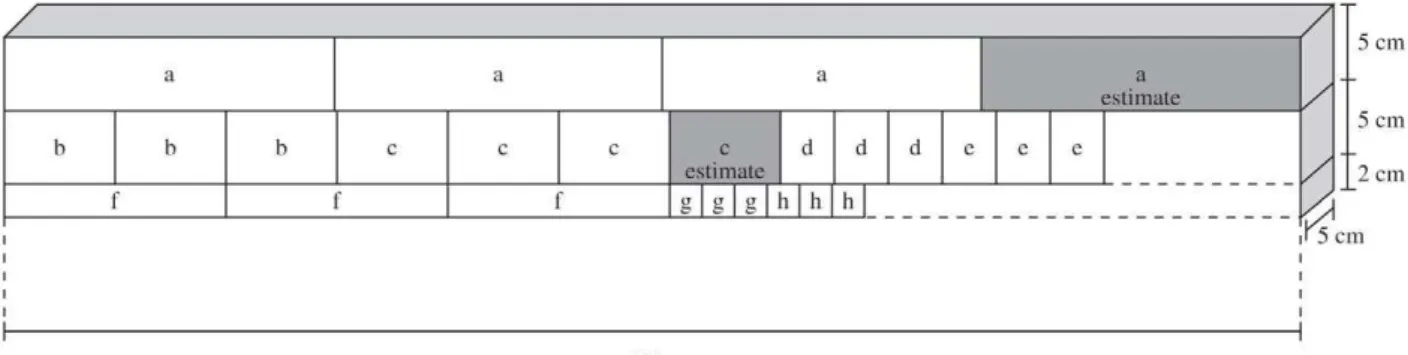
Some Wood Species Impregnated with Styrene and Methyl Methacrylate samples for each of the wood species studied, as illustrated
in Fig. 1. Each test specimen was identified with a capital letter (corresponding to the beam), a small letter (corre-sponding to the type of test) and a number (corre(corre-sponding to the type of impregnation). The samples identified with the number 1 were tested without impregnation, those dis-playing the number 2 were impregnated with styrene monomer, and the ones bearing the number 3 were impreg-nated with methyl methacrylate.
3.4. Phases of the test specimens’ impregnation and polymerization process
Before the wood was impregnated with the monomer, part of the water had to be removed from its pores due to the wood’s moisture content. The test specimens were there-fore oven-dried at a temperature of 40 °C until their mois-ture content decreased to 12%. The oven’s temperamois-ture was gradually raised to 50 °C to reduce the possibility of crack-ing or warpcrack-ing.
The method utilized to impregnate the monomer-initia-tor solution was vacuum-pressure. The autoclave employed for the impregnation work had a capacity of 159,000 mL. A total volume of 20,520 mL of each wood species was placed in the autoclave, which was then closed and the air removed from its interior. When vacuum was reached, the monomer-initiator solution (20,520 mL of monomer + 255 g of ben-zoyl peroxide)17, was injected into the autoclave for each wood species. A pressure of 0.66 MPa was then applied for 30 min to complete the impregnation process.
The test specimens were then removed from the auto-clave and wiped with paper towels to remove any excess impregnation resin. The next step consisted of weighing the test specimens, wrapping them in aluminum foil and plac-ing them in the oven, where they were left for 48 h at a temperature of 60 °C. The samples were then removed from the oven, unwrapped, weighed and put back into the oven
for another period of 72 h at 50 °C to consolidate the po-lymerization process inside the wood. Finally, the samples were removed from the oven, weighed, and their dimen-sions measured, in preparation for the tests to obtain the desired properties.
3.5. Tests to determine the properties of impregnated and non-impregnated wood
Tests were carried out to determine the following prop-erties: Density (ρ); Total radial shrinkage (εr,2); Total tan-gential shrinkage (εr,3); Total radial swelling (εi,2); Total tan-gential swelling (εi,3); Strength in compression parallel to grain (fc0); Modulus of elasticity in compression parallel to grain (Ec0); Strength in tension parallel to grain (ft0); Modu-lus of elasticity in tension parallel to grain (Et0); Strength in tension perpendicular to grain (ft90); Shear strength (fv0); Toughness (W); Impact bending (fbw); Hardness parallel to grain (fH0) and Hardness perpendicular to grain (fH90). The tests were performed following the specifications of Attach-ment B of the Brazilian NBR 7190:1997 standard16. The toughness was calculated based on the ASTM D143-52:1981 standard18.
3.6. Procedures for analyzing the results
The results were analyzed using the pairing test, proce-dure commonly employed in such cases19. The test consists of making a comparative analysis of the test specimens non-impregnated and non-impregnated with styrene and methyl meth-acrylate monomers to discover whether the difference be-tween the averages of the physical and mechanical proper-ties under study could be null, evidencing that they can be admitted to be statistically equivalent.
The first step in order to apply this methodology con-sists in calculating the difference between two population means (impregnated and non-impregnated specimens). Val-ues obtained in this way are considered as a third
tion. The second step consists in estimating the mean and confidence interval of this population, which is obtained through the following expression:
(1)
Where: is the sample mean of the third population, sm is the sample standard deviation of this population, n is the sample size,
α is the confidence level usually adopted 95% and is the percentage point of the t distribution with n-1 degrees of freedom.
Analysis is carried out using this interval. If zero be-longs to it, the means of the two populations (impregnated and non-impregnated) can be considered as equivalent. If zero does not belong to the interval, these means can be considered as different.
4. Presentation and Discussion of the Results
Tests were carried out on a total of 576 samples, 288 of Eucalyptus grandis (EG) and 288 of Pinus caribaea (PC), with 96 samples of each species without impregnation (wi), 96 impregnated with styrene monomer (i-E) and 96 impreg-nated with methyl methacrylate monomer (i-M). Small vari-ations in the toughness values caused by differences in the nominal dimensions of the samples were corrected20. The results obtained from the tests performed to determine the physical and mechanical properties of the wood at 12% moisture content are listed as follows:
4.1. Eucalyptus grandis
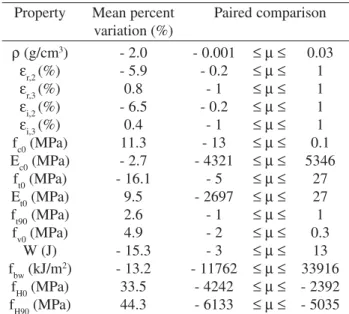
Tables 1 and 2 list the results and pairing tests obtained
Table 1. Results and pairing test – Eucalyptus grandis (wi) and (i-E).
Property Mean percent Paired comparison variation (%)
ρ (g/cm3) 0.2 - 0.02 ≤µ≤ 0.01
εr,2 (%) - 4.7 - 0.3 ≤µ≤ 1
εr,3 (%) 1.6 - 0.6 ≤µ≤ 0.3
εi,2 (%) - 5.1 - 0.3 ≤µ≤ 1
εi,3 (%) 1.4 - 0.7 ≤µ≤ 0.4
fc0 (MPa) 13.2 - 15 ≤µ≤ 0.03 Ec0 (MPa) - 0.9 - 3046 ≤µ≤ 3398
ft0 (MPa) - 7.2 - 13 ≤µ≤ 23
Et0 (MPa) 13.0 - 3988 ≤µ≤ 353
ft90 (MPa) 11.8 - 2 ≤µ≤ 0.4
fv0 (MPa) 5.5 - 3 ≤µ≤ 1
W (J) - 21.2 - 0.4 ≤µ≤ 14
fbw (kJ/m2) - 16.9 - 3936 ≤µ≤ 32219 fH0 (MPa) 36.9 - 4239 ≤µ≤ - 3079 fH90 (MPa) 49.1 - 6858 ≤µ≤ - 5512
Table 2. Results and pairing test – Eucalyptus grandis (wi) and (i-M).
Property Mean percent Paired comparison variation (%)
ρ (g/cm3) - 2.0 - 0.001 ≤µ≤ 0.03
εr,2 (%) - 5.9 - 0.2 ≤µ≤ 1
εr,3 (%) 0.8 - 1 ≤µ≤ 1
εi,2 (%) - 6.5 - 0.2 ≤µ≤ 1
εi,3 (%) 0.4 - 1 ≤µ≤ 1
fc0 (MPa) 11.3 - 13 ≤µ≤ 0.1
Ec0 (MPa) - 2.7 - 4321 ≤µ≤ 5346
ft0 (MPa) - 16.1 - 5 ≤µ≤ 27
Et0 (MPa) 9.5 - 2697 ≤µ≤ 27
ft90 (MPa) 2.6 - 1 ≤µ≤ 1
fv0 (MPa) 4.9 - 2 ≤µ≤ 0.3
W (J) - 15.3 - 3 ≤µ≤ 13
fbw (kJ/m2) - 13.2 - 11762 ≤µ≤ 33916 fH0 (MPa) 33.5 - 4242 ≤µ≤ - 2392 fH90 (MPa) 44.3 - 6133 ≤µ≤ - 5035 when comparing samples of Eucalyptus grandis without impregnation and impregnated, respectively, with styrene and methyl methacrylate monomers.
The statistical analysis revealed that, except for the hard-ness parallel (fH0) and perpendicular to grain (fH90), all the other properties studied showed a zero within the confidence interval of the mean differences. Hence, equivalence is ad-mitted between the properties of the wood without impreg-nation and impregnated with the two monomers involved in this study.
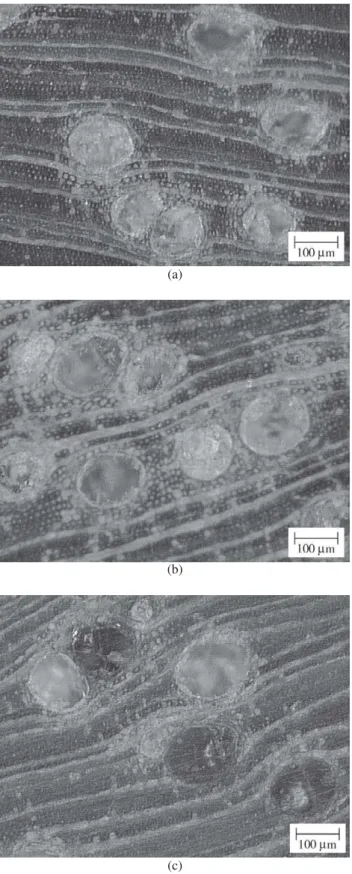
The analysis of the microscopic structure of the non-impregnated samples of Eucalyptus grandis compared with the samples impregnated with the styrene and methyl meth-acrylate monomers shown in Fig. 2 revealed that there was little penetration and subsequent polymerization of the monomers inside the wood’s anatomical structure. How-ever, some of the pores are clearly filled with polystyrene and with polymethyl methacrylate. The reason for this poor penetration is that, despite the large quantity of fibers, their small diameter almost completely precludes impregnation. In addition, the interior of the pores may present contents generically called gum-resins.
4.2. Pinus caribaea
Tables 3 and 4 show the results and pairing tests ob-tained when comparing samples of Pinus caribaea non-impregnated and non-impregnated with styrene and methyl methacrylate monomers, respectively.
There-Some Wood Species Impregnated with Styrene and Methyl Methacrylate
Figure 2. Microscopic structure of Eucalyptus grandis observed by optic microscope (100 ×): a) without impregnation; b) impreg-nated with styrene monomer; c) impregimpreg-nated with methyl meth-acrylate monomer.
(c) (a)
fore, one can state a statistical non-equivalence between the properties of the wood without impregnation and impreg-nated with the styrene and methyl methacrylate monomers. The analysis of the microscopic structure of the non-impregnated samples of Pinus caribaea compared with the samples impregnated with the styrene and methyl methacr-ylate monomers shown in Fig. 3 indicated that penetration and subsequent polymerization of the monomers occurred inside the wood’s anatomical structure. This Pine species has a permeable structure, facilitating its impregnation and the subsequent retention of the polystyrene and the polymethyl methacrylate.
Table 4. Results and pairing test – Pinus caribaea (wi) and (i-M).
Property Mean percent Paired comparison variation (%)
ρ (g/cm3) 69.8 - 0.4 ≤µ≤ - 0.3
εr,2 (%) - 15.9 0.2 ≤µ≤ 1
εr,3 (%) - 12.2 0.2 ≤µ≤ 1
εi,2 (%) - 11.5 0.01 ≤µ≤ 1
εi,3 (%) - 18.2 0.1 ≤µ≤ 2
fc0 (MPa) 106.7 - 53 ≤µ≤ - 36 Ec0 (MPa) 58.4 - 9638 ≤µ≤ - 3136
ft0 (MPa) 67.2 - 40 ≤µ≤ - 26 Et0 (MPa) 38.0 - 5269 ≤µ≤ - 2492
ft90 (MPa) 63.0 - 2 ≤µ≤ - 1
fv0 (MPa) 61.4 - 8 ≤µ≤ - 4
W (J) 100.0 -17 ≤µ≤ - 8
fbw (kJ/m2) 99.1 - 44829 ≤µ≤ - 20307 fH0 (MPa) 457.6 - 14123 ≤µ≤ - 9057 fH90 (MPa) 298.4 - 15251 ≤µ≤ - 12843
Table 3. Results and pairing test – Pinus caribaea (wi) and (i-E).
Property Mean percent Paired comparison variation (%)
ρ (g/cm3) 79.3 - 1 ≤µ≤ - 0.3
εr,2 (%) - 10.5 0.1 ≤µ≤ 1
εr,3 (%) - 8.8 0.1 ≤µ≤ 1
εi,2 (%) - 11.0 0.1 ≤µ≤ 1
εi,3 (%) - 12.5 0.1 ≤µ≤ 1
fc0 (MPa) 102.9 - 49 ≤µ≤ - 37 Ec0 (MPa) 74.3 - 12392 ≤µ≤ - 3883
ft0 (MPa) 71.5 - 47 ≤µ≤ - 23 Et0 (MPa) 47.0 - 6599 ≤µ≤ - 3001
ft90 (MPa) 66.7 - 2 ≤µ≤ - 1
fv0 (MPa) 65.3 - 10 ≤µ≤ - 4
W (J) 81.9 - 14 ≤µ≤ - 7
fbw (kJ/m2) 85.2 - 37067 ≤µ≤ - 18938 fH0 (MPa) 425.8 - 12642 ≤µ≤ - 8924 fH90 (MPa) 299.9 - 15928 ≤µ≤ - 12306
5. Conclusions
The results obtained for Eucalyptus grandis showed a statistically non-significant variation in all the properties studied here between impregnated and non-impregnated wood, except for the hardness parallel and perpendicular to grain. This poor outcome can, in principle, be attributed to the merely superficial penetration of the aforementioned monomers as a result of the species’ anatomical peculiari-ties (small diameter fibers and ends, and vessels or pores frequently containing resins). The presence of styrene and methyl methacrylate in these regions caused minor varia-tions of the measured properties.
The comparison between Pinus caribaea impregnated with the aforementioned monomers showed a significant increase in all the physical and mechanical properties re-lated to the non-impregnated samples. The dimensional sta-bility of the composite increased in comparison with the untreated wood, rendering it more impermeable to mois-ture absorption and retention. The two types of impregna-tion led to a strong improvement in the wood’s hardness parallel and perpendicular to grain, with an average percent increase of over 400% and 300%, respectively, rendering this composite very interesting for flooring applications, for instance. It is also worth noting that the incorporation of polystyrene and polymethyl methacrylate was also highly satisfactory in Pinus caribaea, reaching an average of 80% and 50%, respectively, in wood mass.
Based on these results, it can be concluded that Euca-lyptus grandis does not exhibit performance suitable for this type of impregnation, owing to its low permeability. Pinus caribaea, on the other hand, absorbs styrene and methyl methacrylate monomers easily, indicating the efficiency of the wood impregnation process and thus allowing for its use in applications that require materials with superior me-chanical properties.
Acknowledgements
The authors gratefully acknowledge CNPq – National Council for Scientific and Technological Development (Bra-zil) for its financial support of this work. We are also in-debted to the companies Degussa Initiators Ltda., of São Paulo/SP, Companhia Brasileira de Estireno of Cubatão/SP and Companhia Química Metacril, of São Bernardo do Campo/SP, for their supply of the materials studied here.
References
1. Kollmann, F.F.P.; Côté, W.A. Principles of wood science and technology. v. 1. Solid wood. Springer Verlag, 1968. 2. Bodig, J.; Jayne, B.A. Mechanical of wood and wood composites. New York, Van Nostrand Reinhold, 1992. 3. Esau, K. Anatomia das plantas com sementes. Trad. de
Figure 3. Microscopic structure of Pinus caribaea observed by optic microscope (100 ×): a) without impregnation; b) impregnated with styrene monomer; c) impregnated with methyl methacrylate monomer.
(a)
(b)
Some Wood Species Impregnated with Styrene and Methyl Methacrylate Berta Lange de Morretes. Edgard Blücher, LTDA, 1976.
4. Mano, E.B.; Mendes, L.C. Introdução a polímeros. ed. 2, São Paulo, Editora Edgard Blücher Ltda, 1999. 5. Challa, G. Polymer chemistry: an introduction. Ellis
Horwood Series in Polymer Science, 1993.
6. Billmeyer Jr., F.W. Textbook of polymer science. ed. 3, New York, John Wiley & Sons, 1984.
7. Blass, A. Processamento de polímeros. Florianópolis, Editora da Universidade Federal de Santa Catarina, 1985. 8. Elias, Hans-Georg. An introduction to plastics.ed. 1,
Verlagsgesellschaft, VCH, 1993.
9. Meyer, J.A. Industrial use of wood-polymer materials: state of the art. Forest Products Journal, v. 32, n. 1, p. 24-29, Jan, 1982.
10. Avilov, A.; Deruyga, V.; Popov, G.; Rudychev, V.; Zalyubovsky, I.Non-waste and resource-saving radia-tion process of polymer modified wood producradia-tion. In: 1999 Particle Accelerator Conference, New York City, Proceedings. v. 4, p. 2549-2551, 1999.
11. Nogueira, J.S.; Lahr, F.A.R.; Priante Filho, N.; Nogueira, M.C. de J.A. Impregnação com resina natu-ral na Figueira Branca como forma alternativa de impermeabilização. Revista Brasileira de Engenharia Agrícola e Ambiental, v. 6, n. 2, p. 321-324, Maio/Ago, 2002.
12. Kenaga, D.L.; Fennessey, J.P.; Stannett, V.T. Radiation grafiting of vinyl monomers to wood. Forest Products Journal, p. 161-168, Abr, 1962.
13. Meyer, J.A. Treatment of wood-polymer systems
us-ing catalyst-heat techniques. Forest Products Journal, v. 15, n. 9, p. 362-364, Sept, 1965.
14. Lepage, E.S. Compostos madeira-plástico: estudo de algumas propriedades mecânicas de madeira Pinus elliotti impregnada com monômero metacrilato de metila. Pesquisa & Desenvolvimento, Instituto de Pesquisas Tecnológicas do Estado de São Paulo (IPT), v. 10, 1982.
15. Morales, E.A.M. Determinação do módulo de elasticidade da madeira: proposta para simplificação de procedimentos metodológicos. São Carlos, SP. Dissertação de Mestrado, Escola de Engenharia de São Carlos, Universidade de São Paulo, 2002.
16. Associação Brasileira de Normas Técnicas. Projeto de Estruturas de Madeira. NBR 7190. ABNT, Rio de Ja-neiro, 1997.
17. Manrich, S. O emprego de madeiras brasileiras na obtenção de compósitos polímero-madeira. São Carlos, SP. Dissertação de Mestrado, Centro de Ciências e Tecnologia, Universidade Federal de São Carlos, 1984. 18. American Society for Testing and Materials. Standard methods of testing small clear specimens of timber. Part 22. D143-52. ASTM, Philadelphia, PA, 1981. 19. Meyer, L.P. Probabilidade: aplicações à estatística. Rio
de Janeiro, Ao Livro Técnico S. A, 1972.