Rev Bras Cir Plást. 2012;27(3):496 496
Carta ao Editor
Letters to the Editor
Designing the rhombic lap in relation to the lines of maximal extension
Ricardo Baroudi
Editor-in-chief of the Revista Brasileira de Cirurgia Plástica
Sir,
The article by Alvarez et al.1 aptly highlights the
versa-tility and usefulness of the rhombic lap in various sites and defects. Accurate designing of a rhombic lap pre-operatively
is of paramount importance for consistent results. The authors
though have described the basic design of a rhombic lap;
one important aspect has been under-emphasized. The least
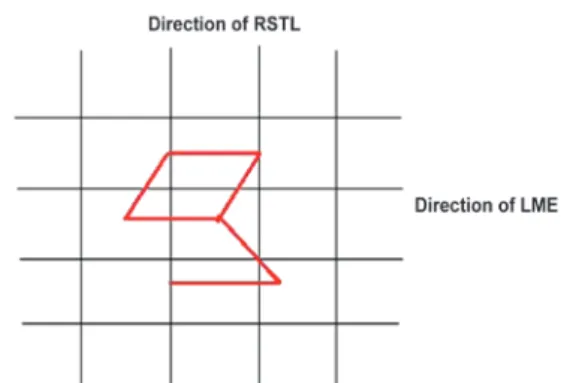
tension in the lap is possible only if the short diagonal of the rhombic lap falls in the lines of maximal extensibility
(LME). This has been previously famously by Borges2.
Such a design minimizes the tension of closure and hence it is important to accurately orient two limbs of the rhombic
lap. We can start by marking two lines of the rhombus along the LME. The other two lines are then marked at 60 and 120 degrees (Figure 1).
Then the short diagonal of the lap is extended such that it
follows the LME. This design however may not be possible
for large defects or if the defect is in close proximity to an important aesthetic landmark. As shown by the authors the rhombic lap is a useful tool in the armamentarium of a
plastic surgeon. Sincerely,
Harinatha Sreekar Senior post-graduate registrar, Department of Plastic and Reconstructive Surgery, Christian Medical College, Vellore, India
Kiran Petkar Senior post-graduate registrar, Department of
Plastic and Reconstructive Surgery, Christian Medical College, Vellore, India
Rahul B. Shetty Senior post-graduate registrar, Department of
Plastic and Reconstructive Surgery, Christian Medical College, Vellore, India
Nithya Raghunath Post-graduate, Department of Dermatology,
MVJ Medical College, Bangalore, India
REFERENCES
1. Alvarez GS, Laitano FF, Siqueira EJ, Oliveira MP, Martins PDE. Use of the rhomboid lap for the repair of cutaneous defects. Rev Bras Cir Plást. 2012;27(1):102-7.
2. Borges AF. The rhombic lap. Plast Reconstr Surg. 1981;67(4):458-66. Correspondence submitted to SGP (Sistema de Gestão de Publicações/ Manager Publications System) of RBCP (Revista Brasileira de Cirurgia Plástica/Brazilian Journal of Plastic Surgery).
Correspondence received: July 1, 2012 Correspondence accepted: July 7, 2012
Correspondence to: Harinatha Sreekar
Department of Plastic Surgery, Christian Medical College – Ida Scudder Road – Vellore, India – 632004 E-mail: [email protected]
Figure 1 – Design of a rhombic lap in relation to LME and RSTL.