An Investigation of Structural and Magnetic Properties of the Nd
16Co
72−xRu
xC
11B Coro-Carbides
C. Paduani and J. A. Valcanover∗
Departamento de F´ısica, Universidade Federal de Santa Catarina,
UFSC, Florian´opolis, CEP 88040-900, SC, Brazil (Fax: (55-48) 3721-9946; Phone: (55-48) 3721-9234)
J. D. Ardisson
Centro de Desenvolvimento da Tecnologia Nuclear, CDTN, Belo Horizonte, CEP 30123-970, MG, Brazil
M. I. Yoshida
Departamento de Qu´ımica, Universidade Federal de Minas Gerais, ICEX-UFMG, Belo Horizonte, Caixa Postal 702, CEP 31270-901, MG, Brazil
Received on 19 February, 2008
Nd16Co72−xRuxC11B boro-carbides have been prepared by arc melting and studied by X-ray diffraction and
magnetization measurements. X-ray diffraction results confirm that all the prepared alloys possess the tetragonal
2:14:1 (P42/mmm) hard magnetic phase. The observed decrease of the magnetization and Curie temperature
in-dicate the development of antiferromagnetic spin correlations with the increase of the Ru content. The combined addition of B and C is favorable to the formation and stabilization of the tetragonal phase in these compounds. At lower Ru contents the Curie temperature is higher than in the corresponding Co-based boride in spite of larger cell volumes.
Keywords: Rare-earths; Permanent magnets; Carbides; Borides; Ferromagnetism; Antiferromagnetism
I. INTRODUCTION
Few decades ago the discovery of a new class of high en-ergy magnets based on the rare earth-transition metal (R-T) compounds has stimulated the search for new ternary inter-metallics as promising candidates for applications as perma-nent magnets[1–6]. Experimental findings have shown that the intrinsic magnetic properties of Nd2Fe14B-based magnets can be improved with the addition of transition metals[7–16]. The R2Fe14B compounds crystallize in a tetragonal structure belonging to the space group P42/mnm. The Fe atoms occupy six different sites, the Nd atoms occupy two different crystal-lographic sites and B occupies one type of position. Among the six nonequivalent crystallographic Fe sites, namely, 16k1, 16k2, 8j1, 8j2, 4e and 4c, the k-sites are preferred by the sub-stituent for transition metals, while a preference of Fe for the j-sites has been found[1, 7–9, 16]. As Co atoms substitute for Fe atoms a deviation from random occupation has already been reported [3, 17]. An increase of the Curie temperature is observed as well as a decrease in the saturation magnetization and in the anisotropy field. The effect of the addition of cobalt on the magnetic properties of Nd-Fe-C ingot magnets has also been investigated. The Co substitution can lead to a signifi-cant decrease in the annealing time required to magnetically harden the ingots[23].
The role of boron is believed to be of that of stabilizing the tetragonal compound, and a deficiency of boron leads to the formation of Nd2Fe17 as a second phase. By substituting B for C in this system a new family which crystallizes with the
same tetragonal crystal structure has been found. The com-mon structure of the tetragonal R-Fe borides and carbides sug-gests that they should form solid solutions over a wide range. The lattice parametercof the borides and carbides differs suf-ficiently to enable easily phase separation[6, 16, 21, 24]. The coercivity mechanism in the carbides must differ from that in the sintered borides because high coercivities are not attain-able in pure borides.
According to the results of Suiet al.[22], in order to make Nd2Fe14C the main phase the Nd:C ratio must be kept within a certain range, because too little C leads to the formation of Nd2Fe14Cx as the main phase, and too much C increases
theα-Fe content inhibiting the formation of Nd2Fe14C. The tetragonal Nd2Fe14C phase is formed at comparatively low temperatures (800◦C) contrarily to the tetragonal Nd
2Fe14B phase which forms at a comparatively high temperature di-rectly from the melt. Primary cristallization products α-Fe and R2Fe17 or a derivative of it[23, 24]. The upper limit of the temperature stability range of the tetragonal phase in the Nd2Fe14C1−xBxincreases very steeply with the B content in
the range 0<x<0.05[23]. Experimental results have shown that Nd2Fe14C does forms but only under the proviso that the annealing treatment following the casting be performed in a fairly narrow temperature range[24]. One of the most inter-esting features of the R-Fe-C alloys is the development of high coercivities in bulk samples after an appropriate thermal treatment. No losses in coercivity occurs when the ingots are crushed and finely pulverized. The substitution of C for B in the 2:14:1 boron-based compounds was first reported by Bolzoni et al.[2]. An increase in the anisotropy field and a decrease of TC and of the saturation magnetization were
There is an increasing interest in the production of coer-cive and anisotropic Nd2Fe14B powder for bonded magnets. The coercive forces are directly related to the microstructure. From experiments it has been found that a microstructure with favorable hard magnetic properties is already developed in the initial stage of the heat treatment and that extended annealing does not lead to improvements in the coercivity. In general the coercivity is very sensitive to variations in the compo-sition, and the possibility of developing high coercivities in castings of R-Fe-C alloys, without resorting to powder metal-lurgy or rapid solidification, has been much sought since the earlier studies. Experiments have shown that the comminu-tion of sintered Nd2Fe14permanent magnets to produce small particles suitable for practical application in bonded magnets leads to a severe loss of coercivity that is not found in the car-bides. Besides, to avoid the propagation of the domain walls the size of the free particles must be controlled as well as the composition and the repartition of the minor intergranular Nd-rich phases. Research on solute replacements in Nd2Fe14C compounds have indicated that Nd2Fe14−xRuxB alloys with 0 <x<2 crystallize in a tetragonal P42/mnm structure isotypic with Nd2Fe14B. The phases which are formed formed in these alloys consist of Nd2(Fe,Ru)C,α-Fe and Nd2(Fe,Ru)Cx. TC decreases when Fe is substituted by Ru [26]. This lowering is ascribed to the weakening of the overall exchange interac-tions which takes place with the lattice shrink and the increase of the Ru concentration as well as with the formation of anti-ferromagnetic Fe-Ru couplings. However, the magnetic prop-erties obtained for the Nd-Fe-C-based alloys still are compar-atively poor, partly due to the presence of very corrosive car-bides. In this work we report an investigation of the structural and magnetic properties of the Nd16Co72−xRuxC11B system with a combined addition of B and C. We investigate the ef-fect of using higher C contents at the expenses of a lowering in the Co concentration, as an extension of a previous study[32]. Results of x-ray diffraction analysis, calorimetric and magne-tization measurements are discussed in this context.
II. EXPERIMENTAL PROCEDURES
Nd16Co72−xRuxC11B ingots of nominal compositions x = 6 and 11 were prepared by arc-melting the starting materials under argon atmosphere in a water-cooled copper crucible. In order to homogenize the structure and composition the cast ingots were vacuum sealed in quartz tubes and annealed at 1000◦C for 3 days, then quenched to room temperature in ice water. The X-ray diffraction analysis was carried out on pow-dered polycrystalline samples by using the Cu-Kα radiation. The temperature dependence of the magnetization was regis-tered above room temperature with a magnetobalance. Hys-teresis loops were registered at 300 K in a field up to 15 kOe by using a vibrating sample magnetometer.
III. RESULTS
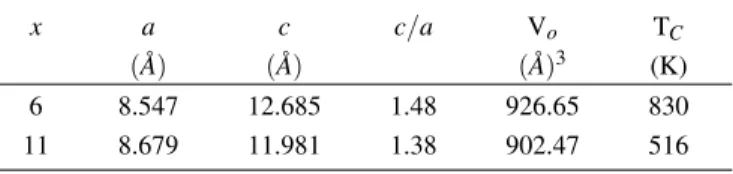
The X-ray powder diffraction patterns are shown in Fig. 1. A diffractogram of Nd2Fe14B is included for the sake of com-parison. A profile analysis with the Rietveld technique indi-cated that all the studied alloys possess the tetragonal 2:14:1 (P42/mmm) phase. Traces of minority phases were also de-tected, which are probably a mixture of rich phases, Nd-carbides (such as Nd2C3) as well as a mixtureα- andε-type structures, as has been observed in this class of compounds[3, 5, 6, 16, 21, 24]. The relative proportion of the secondary phases seemingly diminishes with the Ru content, as can be observed by the decrease of the intensities of the Bragg reflec-tions. The lattice parameters determined for the main tetrag-onal phase are listed in Table 1. As it can be seen, there is a lattice expansion in the basal plane, with the increase of the Ru concentration. Conversely, along thecdirection a shrink-age has been verified. This leads to a decreasing c/a ratio as well as to a decreasing unit cell volume, with the Co sub-stitution by Ru. This behavior differs from that observed in the Co-based borides, where the cell volume increases as Ru substitutes for Co[29].
TABLE I: Composition, lattice parameters, c/a ratio, unit cell volume
and Curie temperature of Nd16Co72−xRuxC11B boro-carbides.
x a c c/a Vo TC
(A˚) (A˚) (A˚)3 (K)
6 8.547 12.685 1.48 926.65 830
11 8.679 11.981 1.38 902.47 516
In Fig. 2 are displayed the hysteresis loops (M(H) isotherms) recorded at 300 K, where characteristics of a fer-romagnetic behavior can be seen. Nevertheless, these alloys possess neither remanence nor coercive field, and besides sat-uration is not attained in applied fields up to 15 kOe at 300 K. The observed behavior indicates that the magnetization de-creases with an increase in the Ru content. However, this effect is smaller than that which could be expected in the case of a simple dilution. The same behavior is expected for the magnetic moment per formula unit. Hence, a conclusion which is withdrawn from the observed trends is that a com-position dependence of the Ru moment might be considered as well as the development of antiferromagnetic spin correla-tions at higher Ru contents, as has been observed in similar compounds[26, 27, 29–32].
Figure 3 shows the magnetization versus temperature curves of the Nd16Co72−xRuxC11B alloys registered with a magnetobalance above room temperature in a measuring field of≈0.5 T. The so obtained TC values are listed in Table 1.
magnetiza-20 30 40 50 60 x = 11
2
θ(degs.)
(222) (311)(004)
(202)
(210)
(105)
(503)
(215)
(330)
(224)
(313)
(205)
(326)
(206)
(113)
(312)
(214)
Intensity
(arb. units)
x = 6
(206) (511) (503) (326)
(413)
(006)
(330)
(215)
(411)
(205)
(224)
(313)
(105)
(214)
(312)
(311)
(222)
(004)
(113)
(202)
(210)
Nd2Fe14B
(202)
(210) (004)
(222)
(503)
(224)
(326)
(206)
(205)
(215)
(330)
(313)
(105)
(214)
(312)
(311)
(113)
FIG. 1: X-ray diagrams of the Nd16Co72−xRuxC11Balloys. Top:
marked reflections of the 2:14:1 tetragonal phase for Nd2Fe14B.
tion takes place only at about 1068 K. This contribution is expected to be arising from the minority phases, as has been revealed from the X-ray diffraction studies. It is noteworthy that the Curie temperature TC of Nd2Fe14C is 535 K, while for the Co-based boride with x = 6, TC = 789 K[29]. Despite
the larger unit cell volume of the tetragonal phase for x = 6, as shown in Table 1, the Curie temperature is even higher than that of the carbide with the same amount of Ru and higher Co content. Furthermore, by increasing the Ru concentration the Curie temperature decreases down to 516 K, for x = 11.
IV. DISCUSSION
In Nd-Fe-C-based alloys the remanence and maximum en-ergy product are improved by increasing both Nd and C contents[22]. An increase in the C content increases the amount of Nd2Fe14C. However, a high C content also in-creases the α-Fe content. In the present case, the addition of boron seemingly is favoring the formation of the tetrago-nal 2:14:1 phase. The Curie temperature TC is strongly
af-fected by variations in composition, which is reflecting the changes occurring in the interaction strengths and unit cell volume. Therefore, the relatively high TC values obtained in
these compounds, as compared to the carbides and borides, indicates that the B atoms also contribute to enhance the inter-action strengths.
In the source of the strong composition dependence of the Curie temperature there is a volume effect: the lattice
ex--40 -20 0 20 40
300 K
x = 6
-15 -10 -5 0 5 10 15
-40 -20 0 20 40
Magnetization (emu/g)
H (kOe)
x = 11
FIG. 2: M(H) isotherms (hysteresis loops) at 300 K of the
Nd16Co72−xRuxC11B alloys.
830 K
x = 6
Magnetization (arb. units)
300 400 500 600 700 800 900 1000 1100
516 K
x = 11
T (K)
FIG. 3: Magnetization versus temperature scanning curves of the
Nd16Co72−xRuxC11B alloys registered with a magnetobalance.
between Ru sites, thus leading to an enhancement of the anti-ferromagnetic exchanges. The development of antiferromag-netic spin correlations inevitably leads to lower Curie points as more and more ferromagnetic interactions are disappearing with the increase of the Ru concentration. However, the dom-inant mechanism for such a sharp decrease of the Curie points seemingly is the decrease of the lattice parameterc. From Ta-ble 1 it can be seen that the Co-richer alloys have larger cell volumes and higher TC.
¿From Fig. 2 it may be inferred that the interaction strengths between the local moments, and consequently TC,
become less dependent on the rare earth ions. Moreover, ow-ing to shorter Co-Co distances in the 2:14:1 structure, as com-pared to the Fe-bearing compounds, the 3d magnetic interac-tions are depleted, if one considers that these are strongly de-pendent on the interatomic distances. The magnitude of the Co moment depends on the local environment of the (six) crystallographic sites. Therefore, the 4f moment is deter-mined by dominant 3d-4f interactions as well as by the crys-talline electric field. It has been pointed out before that B itself does not seems to play a very important role in the magnetism of this type of compound. Nevertheless, the replacement of B by C is expected to affect the magnetocrystaline anisotropy of the Nd ions because these elements locate closer to the Nd ions. In Nd2Fe14C the Nd moments are parallel to the Fe mo-ments at 300 K, the easy magnetization direction being along the caxis. The average magnetic moment of the Nd atoms is 2.95 µB and for the Fe atoms it is 2.44µB at 300 K. The
R-R interactions are proceeded indirectly via the 4f-5d-5d-4f mechanism; the T-T are direct exchange interactions between the 3d spins, whereas the R-T are indirect interactions with a combination of the inter-atomic 4f-5d and interatomic 5d-3d.
The magnetic transition temperature of the R-T compounds is known to be mainly determined by the direct exchange in-teraction of 3d magnetic ions. The magnetic states of the Nd ions depend on the crystalline electric field, which is essen-tially created by the positive charge of the surrounding Nd ions, and on the 3d-4f magnetic interactions, which results in a large 4f anisotropy. A decrease in the magnetic anisotropy can thus be attributed to the combined effects of the decreas-ing of 3d-3d and 3d-4f interactions. The Co-Co distance and the filling up of the 3d sub-band can be slightly modified with the substitution of 3d transition metals which have a different
metallic radius and a different number of 3d electrons, which results in a higher or lower TC as compared to Nd2Fe14B, as a direct consequence of the dependence with distance of the exchange interactions. In the source of the high stability of the rare earth borides is the 3d-p hybridization as well as a decrease in the 3d-5d hybridization. Decreased TC values
are thus expected to lead also to a decrease of the anisotropy fields.
As a final remark, from the results above it may be con-cluded that, as compared to Co-based borides the addition of C is detrimental to the development of a coercivity mechanism in this class of compounds. Lower TCvalues are also observed
at higher Ru contents. The substitution of Ru for Co is also found to hinder the obtention of both remanence and coerciv-ity in these compounds. Nevertheless, at lower Ru contents the Curie temperature in these alloys is noticeably higher than those verified in Co-based borides and Fe-based carbides. The B-C combined addition thus is expected to be favorable to the formation and stabilization of the tetragonal phase and leads to the development of stronger spin correlations at lower Ru contents.
V. SUMMARY
In this study has been performed an investiga-tion of the structural and magnetic properties of the Nd16Co72−xRuxC11B boro-carbides. The unit cell volume of the tetragonal 2:14:1 phase undergoes a significant decrease at higher Ru contents, which leads to a decrease of the distance between Ru sites which in turn is expected to lead to an enhancement of the strength of antiferromagnetic spin correlations. Although the Curie temperature decreases when Co is replaced by Ru, for x<6, TC is higher than in
Co-based borides with the same amount of Ru and higher Co concentration.
Acknowledgments
The authors would like to thank the Brazilian Agencies CNPq and Finep.
[1] M. Sagawa, S. Hirosawa, H. Yamamoto, S. Fujimura, and Y.
Matsuura, Jap. J. Appl. Phys.26, 785 (1987).
[2] F. Bolzoni, F. Leccabue, L. Pareti, and J. L. Sanchez, J. de Phys.
46, coll. 9, C6-305 (1985).
[3] R. Gr¨ossinger, X. C. Chou, J. Krewenka, G. Wiesinger, R.
Eibler, X. K. Sun and Y. C. Chuang, J. de Phys. C 12, 599
(1988).
[4] F. R. de Boeret al., J. Magn. Magn. Mat.72, 167 (1988); F.R.
de Boeret al., J. Magn. Magn. Mat.73, 263 (1988).
[5] M. Rosenberg, P. Deppe, M. W´ojcik, and H. Stadelmeier, J.
Appl. Phys.57, 4124 (1985).
[6] Z. W. Liu, A. H. Davies, IEEE T. Magn.40, 2898 (2004); N.
C. Liu, H. H. Stadelmaier and G. Schneider, J. Appl. Phys.61,
3574 (1987).
[7] M. Rani, R. Kamal, J. Less-Comm Met.128, 343 (1987).
[8] S. Dai, A. H. Morrish, X. Z. Zhou, B. P. Hu, and S. G. Zhang,
J. Appl. Phys.63, 3722 (1988).
[9] A. H. Morrish, Z. W. Li, X. Z. Zhou, S. Dai, J. Phys. D: Appl
Phys29, 2290 (1996).
[10] Y. Bb Kim, M.J. Kim, J.H. Yanget al., J. Magn. Magn. Mat.
234, (2001) 489.
[11] M. Jurczyk, J. Jakubowicz, J. of Alloys and Compd.311, 292
(2000).
485 (2000).
[13] R.S. Mottram, A.J. Williams, I.R. Harris, J. Magn. Magn. Mat.
217, 27 (2000).
[14] C.J. Yang, S.W. Kim, J.S. Kang, J. Magn. Magn. Mat.188, 100
(1998).
[15] A. Zern, M. Seeger, J. Baueret al., J. Magn. Magn. Mat.184,
89 (1998).
[16] W.C. Chang, S.H. Wu, B.M. Maet al., J. Magn. Magn. Mat.
167, 65 (1997).
[17] J.F. Herbst, W.B. Yelon, J. Appl. Phys.60, 4224 (1986).
[18] Y.J. Shi, C.Q. Deng, K.M. Liu, Rare Metal Mat. Eng.27, 42
(1998).
[19] K.T. Wu, Y.D. Yao, I. Klik, Appl. Surf. Sci.114, 174 (1997).
[20] T. Schrefl, H. Roitner, J. Fidler, J. Appl. Phys.81, 5567 (1997).
[21] Y.C. Sui, Z.D. Zhang, W. liu, Q.F. Xiao, X.G. Zhao, T. Zhao
and Y.C. Chuang, J. Alloys Compd.264, 228 (1998).
[22] Y.C. Sui, Z.D. Zhang, Q.F. Xiao, W. liu, T. Zhao, X.G. Zhao,
and Y.C. Chuang, J. Alloys Compd.267, 215 (1998).
[23] K.H.J. Buschow, D.B. de Mooij and G. Martinek, J. Alloys
Comp.190, 95 (1992).
[24] K.H.J. Buschow, D.B. de Mooij and C.J.M. Denissen, J. of the
Less-Common Metals141, L15 (1988).
[25] J.M. Cadogan, J. Phys. D: Appl. Phys.29, 2246 (1996).
[26] A.T. Pedziwiatr, W.E. Wallace and E. Burzo, J. Magn. Magn.
Mat.61, 173 (1986).
[27] Rare-earth Iron Permanent Magnets, In: JMD Coey, editor. Clarendon Press, Oxford, 1996.
[28] C. Paduani, S. Rivoirard, J.L. Soubeyroux, P. de Rango and R.
Tournier, J. Magn. Magn. Mat.223, 273 (2001).
[29] C. Paduani, J.A. Valcanover, J.D. Ardisson, M.I. Yoshida,
Phys-ica Status Solidi b243, 1347 (2006).
[30] C. Paduani, C. Ducruet, S. Rivoirard, P. de Rango and R.
Tournier, J Magn Magn Mat232, 53 (2001).
[31] J.A. Valcanover, C. Paduani, J.D. Ardisson and M.I. Yoshida,
Acta Materialia53, 2815 (2005).
[32] C. Paduani, J.A. Valcanover, J.D. Ardisson and M.I. Yoshida,