592 J.C. Fabris and H.E.S. Velten
MOND virial theorem applied to a galaxy cluster
J.C. Fabris1∗ and H.E.S. Velten1†
1Departamento de F´ısica, Universidade Federal do Esp´ırito Santo, Vit´oria, Esp´ırito Santo, Brasil
(Received on 30 May, 2009)
Large values for the mass-to-light ratio(ϒ)in self-gravitating systems is one of the most important evidences of dark matter. We propose a expression for the mass-to-light ratio in spherical systems using MOND. Results for the COMA cluster reveal that a modification of the gravity, as proposed by MOND, can reduce significantly this value.
Keywords: MOND, COMA cluster, Dark Matter
I. INTRODUCTION
The standard model for cosmology states that 95% of all content of the universe belongs to a dark sector, not yet de-tected, composed by a unknown form of energy called dark energy and some kind of non-baryonic matter or dark mat-ter, while baryogenesis implies that only 5% of the universe is made up of atoms. In general terms, dark matter is the unknown fraction that appears in agglomerated matter, like galaxies and clusters of galaxies, having a effective null pres-sure and suffering consequently the clustering process. Dark energy is a smooth component of the matter content of the Universe which must have negative pressure, inducing the accelerated expansion of the Universe. A review of the ob-servational evidences and theoretical explanations for dark matter and dark energy can be found in references [1–3].
The first evidence on the existence of dark matter came from the analysis of the dynamics of the Coma cluster of galaxies, in the thirties [4]. Using the virial theorem and the hypothesis that the Coma cluster is in dynamical equilib-rium, it was found that there should have much more matter than it could be deduced using the usual mass-to-light ratio for galaxies. Later, the study of the rotation curve of spi-ral galaxies has shown that even at the level of galaxies the major part of matter does not emit any kind of radiation. In galaxies, the mass-to-light ratio using the rotation curves can be as high as 30, in solar unities, while this number is of the order of 180 for the Coma cluster [5].
In general, the existence of dark matter is proposed in or-der to explain anomalies observed in the dynamics of self-gravitating systems, like galaxies and clusters of galaxies. An alternative to dark matter is to admit that the fundamen-tal laws of physics are not the usual ones from a certain scale on. This can be achieved, for example, by changing the grav-itational potential. Another possibility, at newtonian level, is to modify the Newton’s dynamic laws. One interesting pro-posal in this sense is the MOND theory [6], which is based on a changing of the Newton’s second law, such that it takes the form
mµ
a
a0
a=F , (1)
whereµ(x)is a function such thatµ(x)≈1 forx>>1 and
∗Electronic address:[email protected]
†Electronic address:[email protected]; Present address: Fakult¨at f¨ur Physik, Universit¨at Bielefeld, Postfach 100131, 33501, Bielefeld, Germany
µ(x)≈xforx<<1. Hence,a0defines a critical acceleration below which the usual Newton’s second law is not valid any-more. This phenomenological proposal has been very suc-cesfull in explaining the rotation curve of the spiral galax-ies,a0taking a universal value arounda0∼10−8cm.s−2[7]. Some interpolation formula between the ”newtonian” regime and the ”MOND” regime forµ(x)have been proposed in the literature [8].
One of the main criticism with respect to the MOND the-ory is that it is non-relativistic, and it can not be deduced from a Lagrangian. More recently, a relativistic version of the theory has been proposed, involving, beside the usual ge-ometric and matter sector, a vector field and a scalar field [9]. But, it remains some controversy if MOND can succesfully explain the lensing effect in clusters of galaxies [10].
The proposal of the present work is to go back to the dy-namics of cluster of galaxies, in the realm of the MOND the-ory. There has been some studies in this sense using X-ray data [11]. The purpose of the present work is more modest: to generalise the virial theorem using a suitable interpolation expression forµ(x)and from it to deduce the mass-to-light ratio. To be specific, we work with a given set of observa-tional data concerning the Coma cluster. It will be shown that, even if a closed expression for the generalised virial formula is not possible, we can obtain the mass-to-light ra-tio that is compatible with ordinary estimara-tions without dark matter: values as low 10 can be easily obtained. Taking into account the rotation curve of the spiral galaxies leads to a prediction for the mass/luminosity ratio of the order of 70. The paper is organised as it follows. In next section, we present the general expressions for virial theorem. In section 3 the observational data for the Coma cluster are discussed and a estimation for the mass-to-light ratio is obtained. In the last section we present our conclusions.
II. METHOD
The general form of the MOND theory is given by mµ(x)a=−GM m
r2 rˆ , (2)
Brazilian Journal of Physics, vol. 39, no. 3, September, 2009 593
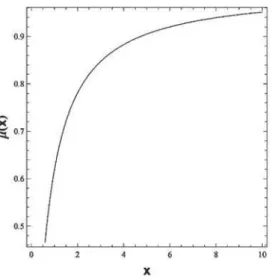
FIG. 1: Behaviour of the functionµ(x). The newtonian limit is reached whenµ→1.
influence of the gravitational field of a spherical large mass distribution with total massM. The functionµ(x)is arbitrary, excepted by the fact it must obey the assymptotic regimes described before. We will adopt the following form for this function:
µ(x) =1+ (2x)−2 1 2
− 1 2x=
1 2x
1+ (2x)2−1
,
(3) with
x= a a0
. (4)
For technical reasons, it is convenient to rewritte equation (2) as
x=−G M µ(x)r2a
0 ˆ
r. (5)
Some simple manipulations lead to the expression
aM=− GM
r2
1+r2a0
GMrˆ . (6)
With the identification GM/a0=rc, wherercis a ”critical distance” beyond which the MOND regime becomes effec-tive, equation (6) becomes
aM=− GM
r2
1+r2 r2 c ˆ
r . (7)
It must be stressed that the MOND critical parameter is the acceleration scale a0. However, with the formal definition of a distance scale, the MOND theory is recast as a (formal) modification of the gravitational potential. The new form of the gravitational potential is dictated by the choice of the functionµ(x). We will use this approach from here on, but
the results does not depend on it: it is just a question of de-scription of the dynamics. Using such approach the potential corresponding to the functionµ(x)chosen is
ΦM(r) =−GM ⎧ ⎪ ⎪ ⎨ ⎪ ⎪ ⎩
1+r rc
2
r −
sinh−1(r rc)
rc ⎫ ⎪ ⎪ ⎬ ⎪ ⎪ ⎭
. (8)
The potential has the usual newtonian form in the limit r<<rc, while it becomes logarithmic whenr>>rc, what corresponds to the full MOND regime.
The first indirect detection of dark matter came from the application of the virial theorem, which is valid in the New-tonian dynamics, to the Coma cluster [4]. This theorem es-tablishes that in a self-gravitating system, in dynamical equi-librium, the potential energy is minus two times the kinetic energy. Measuring the kinetic energy, what can be done through a spectroscopic analysis of the light coming from a distant system like a cluster of galaxies, the potential energy, and hence the mass of the system, can be deduced. But, such simple relation between the potential and kinetic energy can only be possible in the case of a newtonian theory. For a different gravitational potential (or a different dynamic law), the virial theorem in its usual form is not valid. The general relation for the virial theorem assumes the form
K=1 2
∑
i∂Φ(r)
∂r r
mi , (9)
where it was computed the contribution from all i -components of the system with massmi. Introducing (8) in the above relation the kinetic energy of a self-graviting sys-tem orbiting in the full MOND regime can be obtained as
K=GM(r) 2r
1+r 2
r2 c
m, (10)
wheremis the mass of a tiny shell at radiusr, andM(r)is the mass enclosed by this shell.
If we know the kinetic energy of a spherical system it is possible to evaluate the mass-to-light ratioϒ under the as-sumption thatϒis independent of radius. The kinetic energy can be associated with the surface luminosityIand the line-of-sight velocity dispersionσby
K=ϒJ, (11)
whereJis a integral defined as [12] J=3π
∞
0
I(R)σ2(R)RdR. (12) Moreover, a symmetric mass distribution should be de-scribed by some kind of density profile. The mean density may be associated with the observational data and can be written as [12]
ρ(r) =−ϒπ
∞
r dI dR
dR √
R2
594 J.C. Fabris and H.E.S. Velten
the MOND expression for the kinetic energy (10) and com-bining this result with (11) it is possible to determine the mass-to-light ratio using only the velocity dispersion and the surface luminosity data:
ϒM=−2J
J . (14)
In above relationJis the integral define before andJis de-fined as
J=−16G
∞
0
t(r)p(r)r
1+r 2
r2 c
dr, (15)
wheret(r)andp(r)are also auxiliar integral expressions that depend onIandσ
t(r) =
∞
0 dI dR
dR √
R2−r2 p(r) =
r
0
t(r′)r′2dr′. (16)
In order to calculateϒfor a self-gravitating system we need the surface luminosity profileI(R)and the dispersion veloc-ity profile σ(R). Note that the velocity dispersion appears only in term J. Hence, J represents the kinematic contri-bution from the virial theorem. We aply this result for the COMA cluster data in next section.
III. COMA CLUSTER DATA ANALYSIS
The mass-to-light ratio of the COMA cluster was esti-mated, using the Newtonian theory, as ϒN ≈180 [5]. It seems reasonable to interpret this large value for the mass-to-light ratio as a strong evidence in favour of dark matter. If MOND theory provide a succesfully description for the dy-namics of this cluster we hope to find forϒa value at least one order of magnitude less than 180. However, before any tentative to reconstruct a analysis in the COMA cluster using MOND theory, we need to assume some properties about the cluster:
1. We adopt a spherical symmetry. Although COMA have a elongated form, we are interested in the radial structure of the cluster.
2. Any dark component of the system traces the lumi-nous matter. With this assumption we consider a sin-gle component model for the cluster. This condition can be relaxed, however we will not consider this pos-sibility.
3. The cluster is in a stage of dynamical equilibrium and all the mechanics of the cluster is well known and not yet relativistic.
The above assumptions don’t reflect actual gravitational systems, however will allow us to obtain in a simple way the cluster mass-to-light ratio. For a MOND description of orbits in non trivial symmetries see [13].
The COMA cluster has been so widely studied over the years and for this reason there are a lot of available obser-vational data in the literature. In order to obtain the velocity
0 1 2 3 4 5 6 7
RadiusMpc
0 2.5·1011 5·1011 7.5·1011 1·1012 1.25·1012 1.5·1012 1.75·1012
I
r
L
Mpc
2
Surface luminosity
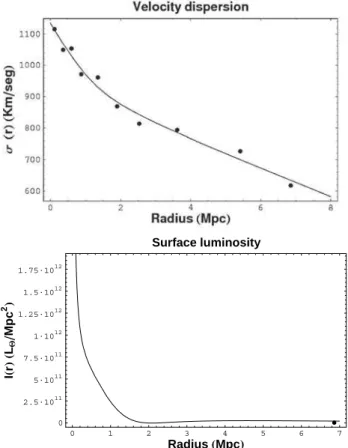
FIG. 2: Best fit for the velocity dispersion and surface luminosity profiles.
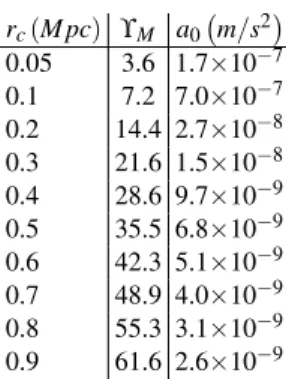
dispersion and the surface luminosity profile we take all the cluster members and binning them radially. We use the ve-locity dispersion data described in reference [5]. Each bin contains aproximately 20 members of the cluster. The equiv-alent data for each bin and the best fit for the velocity disper-sion and the surface luminosity are showed in figure 1. We do not adopt, a priori, any dynamical model for fitting the data. The best fit curves showed in figure 2 correspond to the curve that minimize the quatityχ2that is proportional to the difference between the fitting value and the observational data in each bin. Inserting the surface luminosity profile ob-tained from the best fit, as we can see in figure 1, in the auxil-iar expressions (16) we can compute the integral ˜J, Eq. (15). With the velocity dispersion profile we can evaluate the ki-netic termJin integral (12). The mass-to-light ratio depends on the value of the critical radiusrc. Table 1 shows results forϒMfor various values ofrc.
IV. FINAL REMARKS
Brazilian Journal of Physics, vol. 39, no. 3, September, 2009 595
theory in order to obtain a relation for the mass-to-light ra-tio in self-gravitating systems. Only with surface luminosity and dispersion velocity data from COMA cluster the value of mass-to-light ratio was reduced using the MOND theory when compared with the Newtonian one. The exact value ofϒM depends on the critical radiirc. Table 1 shows sev-eral results of our analysis. For suitable values of rc we found lowers mass-to-light ratios in contrast with the previ-ous Newtonian resultϒN≈180[5]. The Newtonian limit of our relations(rc→∞)indicatesϒN=208.4 for the COMA cluster. We can admit that the estimation of the mass-to-light ratio as considered above is highly uncertain, however MOND correct the huge Newtonian mass-to-light ratio down to values compatible with baryonic matter alone. In partic-ular, using the critical accelerationa0∼10−10m/s2, a value that leads to a good fit of the rotation curve of spiral galax-ies in the MOND theory [7], a mass-to-light ratio of order of 70 is obtained, a third of the Newtonian value. In the analysis presented here, we have not taken into account the gas in the intergalactic medium of the cluster, which is typi-cally responsible for 20% of the total mass of a cluster [14]. Even so, it agrees with the evaluation made in reference [15] where X-ray data are taken into account. Note, however, that our results disagree with the simplified estimations made in [6] where just some general properties of the MOND theory have been used, leading to a very low mass/luminosity ra-tio, typically of order of a few tenths. Even if the necessity of dark matter remains, the dark matter problem is allevi-ate. Moreover, since there are many simplifications in the analysis done (the hypothesis of a continuous matter
distri-bution, the choice of a spherical symmetry for the cluster, etc.), the results obtained using the interpolation function (3) in the context of the MOND theory justify the investigation of a more realistic scenario, perhaps including a discrete dis-tribution of the matter besides a continuous gas disdis-tribution. Of course, such more realistic analysis would imply the ne-cessity of numerical simulations.
rc(M pc) ϒM a0m/s2
0.05 3.6 1.7×10⁻⁷
0.1 7.2 7.0×10⁻⁷
0.2 14.4 2.7×10⁻⁸
0.3 21.6 1.5×10⁻⁸
0.4 28.6 9.7×10⁻⁹
0.5 35.5 6.8×10⁻⁹
0.6 42.3 5.1×10⁻⁹
0.7 48.9 4.0×10⁻⁹
0.8 55.3 3.1×10⁻⁹
0.9 61.6 2.6×10⁻⁹
TABLE I: Critical acceleration parameter(a0)and mass-to-light ra-tio in MOND theory(ϒM). We include the corresponding values for the critical radiirc, an auxiliar quantity derived froma0. The New-tonian analysis(rc→∞)reveals for COMA cluster a value for the mass-to-light ratioϒN=208.4
Acknowledgment: We thank CNPq (Brazil) and FAPES (Brazil) for partial financial support. The remarks made by the anonymous referee has permitted us to improve the text and the interpretation of the results.
[1] S. Hannestad,Dark energy and dark matter from cosmological observations, astro-ph/0509320.
[2] T. Padmanabhan,The dark side of the Universe, in Proceed-ings of the 29th International Cosmic Ray Conference 10, 47(2005).
[3] V. Sahni, Lect. Notes Phys.653, 141(2004). [4] F. Zwicky, Helv. Phys. Acta6, 110(1933).
[5] S. M. Kent and J. E. Gun, Astronomical Journal87, 7(1982). [6] M. Milgrom, Astrophys. J.270, 365(1983); Astrophys. J.270,
371(1983); Astrophys. J.270, 384(1983).
[7] R.H. Sanders and S. C. McGaugh, Ann. Rev. Astron. Astro-phys.40, 263(2002).
[8] M. Milgrom,The modified dynamics: a status review, inDark matter in astrophysics and particle physics, 1998, proceed-ings of the Second International Conference on Dark Matter in Astrophysics and Particle Physics, Heidelberg, Germany, 20-25 July, 1998, edited by H.V. Klapdor-Kleingrothaus and L. Baudis, Institute of Physics Pub., Philadelphia(1999). [9] J.D. Bekenstein, Phys. Rev. D70, 083509(2004);
Erratum-ibid.D71, 069901(2005).
[10] H.S. Zhao, D.J. Bacon, A.N. Taylor and K. Horne, Month. Not. R. Astron. Soc.368, 171(2006); M-C. Chiu, C-M. Ko and Y. Tian, Astrophys. J.636, 565(2006); I. Ferreras, M. Sakel-lariadou, M.F. Yusaf, Phys.Rev.Lett.100031302 (2008). [11] J. R. Brownstein and J. W. Moffat, Month. Not. R. Astron.
Soc.367, 527-540 (2006); G.W. Angus, B. Famaey and D.A. Buote, Month. Not. R. Astron. Soc.387, 1470(2008). [12] J. Binney and S. Tremaine, Galactic Dynamics, Princeton
University Press, Princeton (2004); O. Tiret and F. Combes, in
Formation and Evolution of Galaxy Disks, ASP Conference Series,396, Proceedings of the conference held 1-5 October, 2007 at the Centro Convegni Matteo Ricci, Rome, Italy, edited by Jos´e G. Funes, S.J., and Enrico Maria Corsini, Astronom-ical Society of the Pacific, San Francisco(2008); C. Nipoti, P. Londrillo e L. Ciotti, arXiv:0705.4633 (2007).
[13] G.W. Angus, B. Famaey, H.S. Zhao, Mon. Not. Roy. Astron. Soc.371, 138 (2006).