Article
J. Braz. Chem. Soc., Vol. 25, No. 12, 2417-2424, 2014. Printed in Brazil - ©2014 Sociedade Brasileira de Química 0103 - 5053 $6.00+0.00
A
*e-mail: [email protected]
Photosensitised Degradation of Organic Dyes by Visible Light Using Riboflavin
Adsorbed on the Surface of TiO
2Nanotubes
Claudio W. Backes,a Francine R. Scheffer,a Marcelo B. Pereira,b Sérgio R. Teixeirab and Daniel E. Weibel*,a
aChemical Institute, Universidade Federal do Rio Grande do Sul, 90040-060 Porto Alegre-RS, Brazil
bPhysical Institute, Universidade Federal do Rio Grande do Sul, 91501-970 Porto Alegre-RS, Brazil
A degradação de soluções aquosas de índigo carmim (IC), azul de metileno (MB) e laranja de metilo (MO) assistida pela luz visível foi conseguida sobre a superfície de nanotubos (NTs) de TiO2 impregnados com ribolavina (RF). Soluções aquosas diluídas de RF na presença de RF-NTs TiO2 irradiados com luz UV produziram O2, CO e CO2 como principais produtos gasosos. As mesmas soluções quando irradiadas com luz visível mostraram que o O2 foi o produto principal obtido. Esta geração de O2 in situ com luz visível permite a degradação dos corantes, sem a necessidade de borbulhar ar ou oxigênio no sistema de reação. A degradação fotocatalítica de MO, MB e IC pode ser descrita por um modelo de cinética de pseudo-primeira ordem obtendo ca. 100% de degradação de MB, MO e IC em menos de 3 h de iluminação de luz visível. Os resultados aqui apresentados são altamente promissores em vista da potencial aplicação dos catalisadores RF-TiO2 NTs preparados com dois compostos ambientalmente corretos na degradação de poluentes utilizando radiação solar.
Visible light-assisted degradation of indigo carmine (IC), methylene blue (MB) and methyl orange (MO) aqueous solutions has been achieved on the surface of TiO2 nanotube (NT) arrays impregnated with ribolavin (RF). Diluted RF water solutions in the presence of RF-TiO2 NTs irradiated with UV light produced O2, CO and CO2 as main gas products. On the contrary, the same solutions irradiated with visible light evolved O2 as a main product. This in situ O2 generation under visible light absorption allows the degradation of the dyes without the necessity to bubble air or oxygen in the reaction system The photocatalytic degradation of MO, MB and IC can be described by a pseudo-irst-order kinetic model obtaining ca. 100% degradation of MB, MO and IC in less than 3 h of visible light illumination. The results provided here are highly promising in view of various photocatalytic applications of the prepared RF-TiO2 NTs catalysts by two environmentally friendly compounds in the degradation of pollutants using solar radiation.
Keywords: sensitiser, titanium dioxide, ribolavin, nanotubes, visible light
Introduction
Organic pollutants are a particular type of mankind compound whose concentrations continue to increase each year. As a consequence, their degradation has become a central issue of research efforts in today’s scientiic community. The bio-degradation of pollutants emitted from various sources is often very slow and conventional treatment is mostly ineffective and not environmentally compatible. In this sense, the application of photocatalysis using semiconductor nanostructured systems appears to
be more eficient than conventional chemical oxidation methods for the transformation of toxic compounds to a non-hazardous product which reaches the complete mineralisation of the pollutant.1-3
Titanium dioxide nanoparticles (TiO2 NPs), particularly in their usual commercial form known as P25, have been extensively used to oxidise organic pollutants of water using ultraviolet (UV) light.2,4-8 Despite TiO
2 presenting
from photoexcitation of dye molecules (sensitisers) bound to semiconductor NPs are of great importance for
photochemical solar energy conversion.9 Sensitisation
requires that the distance between the sensitiser and the semiconductor’s surface be as small as possible. This can be achieved by adsorption of the sensitiser to the semiconductor’s surface by an electrostatic, hydrophobic, hydrophilic, or chemical interaction. Thus, after absorption of the photon and electronic excitation, the injection of an electron into the conduction band of the semiconductor is possible, leading to the formation of radical species with high oxidant power. The sensitisation of semiconductors has been widely studied in the past in the development of photoelectrochemical solar cells,10,11 electronic devices,12,13
heterogeneous photocatalysis,3,14-16 and recently many
efforts have been made in the production of a visible light photocatalyst to produce hydrogen through water splitting using sensitiser dyes.17-22 The eficiency of those processes
depends on the properties of the sensitisers, semiconductor and their interaction under photoexcitation.
Colloidal TiO2 can be sensitised with different dyes
and organic molecules, such as arylimidazole derivatives,23
hypocrellin B,24 cyanine dyes,25 chlorophyll,26 ribolavin27
and also by the use of metal NPs.16,28 In particular
riboflavin (RF) photochemistry, the precursor of all the biologically important lavins and recognised as a constituent of the vitamin B complex, has been extensively investigated.27,29-35 It was even hypothesised that water can
be split photochemically with RF.34 The photochemistry
of RF involves two major reactions: (i) normal photolysis (intramolecular photoreduction) and (ii) photoaddition
(intramolecular photoaddition).36 Both reactions may
occur separately or concomitantly; the extent of each reaction depends on the conditions employed, such as the anion concentration, pH and radiation source. Very low concentrations of sensitisers are usually present in water courses, lakes and seas.37,38 Among them, the RF pigment
is relevant in the sensitised photooxidation of contaminants and the kinetic mechanisms, which were recently the object of studies on O2(
1∆
g) generation under concentrations
similar to those frequently found in nature.29,39
Among the various methods available for the preparation of TiO2 nanomaterials,40 the syntheses of TiO2 nanotubes
(NTs) through the anodisation of metallic Ti surfaces has several advantages.41 The main beneits are a simple
synthetic procedure, enhanced charge transport properties, and a cost-effective scale-up process.42 In addition,
self-organised TiO2 NT arrays grown with anodisation processes
present enhanced photocatalytic activity when compared with randomly-oriented NPs or NTs prepared with other methods, such as the sol-gel (hydrothermal) process.42,43 In
the drive to obtain a suitable photocatalyst for harvesting solar energy and converting it to chemical energy, such as hydrogen or hydrocarbons, nanotubes are one of the main choices for the research groups.44-46 This tendency is not
generally found in the ield of degradation of pollutants, where more traditional synthetic methods or commercial
P25 TiO2 are employed to prepare the photocatalyst.
The adsorption of RF on the surface of TiO2 colloidal
particles has already been studied by Kathiravan et al.27
The electron transfer process from its singlet excited state to the conduction band of TiO2 was examined with
absorption and luorescence quenching measurements. The authors suggested a mechanism where there is an electron injection from its singlet excited state into the conduction band of TiO2.
The main aim of the present work was to examine the experimental conditions that show the existence of an eficient sensitisation process of highly ordered TiO2 NTs
arrays impregnated with a natural pigment, RF, using visible light irradiation. The study was carried out under dye-sensitised photooxidation conditions similar to those frequently found in nature, i.e., in the presence of the natural dye sensitiser RF. We describe the photodegradation by visible light irradiation of three organic dyes (methylene blue, methylene orange, and indigo carmine) using a photocatalyst prepared with two environmentally friendly compounds, RF and TiO2. The results show the potential
of the prepared photocatalyst for cleaning waste water using solar light.
Experimental
Materials and methods
All chemicals were purchased from commercial
sources: NH4F (98%), ethylene glycol (99%) (ETG) and
Ti foil (99.6%) from Synth. Solvents and reagents were used as received. RF (98%) and methylene blue (MB) (100%) were obtained from Vetec, Brazil. Methyl orange (MO) (100%) and indigo carmine (IC) (100%) were obtained from Merck, Brazil.
TiO2 NTs were prepared by anodisation of a Ti foil with
a constant applied voltage at room temperature, using an electrolyte containing ethylene glycol + 0.25 wt.% NH4F +
10 wt.% H2O with an ultrasonic bath following a
methodology already described.47-49 After anodisation,
the TiO2 NTs were annealed at 400 °C for 3 h in air
were recorded on a CARY 5000 spectrophotometer with an integrated sphere. UV-Vis absorption spectra were measured with a Varian 50 UV-Visible spectrophotometer. The gaseous products of the photocatalytic reaction were quantiied by gas chromatography at room temperature on an Agilent 6820 GC chromatograph. Gases H2, O2 and CO,
CO2, CH4 were analysed simultaneously with a thermal
conductivity detector (TCD) and a lame ionisation detector (FID), respectively.50
Sensitisation of TiO2 NTs has been done by impregnation
method. The NTs were immersed in an RF solution of about 40 ppm and left in contact in dark ambient conditions for 24 h under continuous stirring. Then the catalysts with adsorbed RF were washed thoroughly with water and inally dried in an oven at 350 K for 2 h.
Photocatalytic activity measurements
Photocatalysis experiments under UV and visible light irradiation were carried out in two different systems. Gas phase product measurements were carried out in a calibrated, gas-closed photochemical reactor made of polytetraluoroethylene (PTFE) under continuous magnetic stirring.49,51 A quartz window allowed irradiation of the
aqueous mixture under a wide incident spectral range, including UV and visible light. A 150 W mercury-xenon lamp (Sciencetech Inc.) operating at about 90% power was used as an excitation source. The light beam was focused to homogeneously cover the whole photocatalyst surface (1.23 cm2). TiO
2 NTs were placed in a special
PTFE support to avoid photocatalytic activity in regions other than the NTs. The reactor was deaerated with argon by using custom-made PTFE valves prior to irradiation. A maximum volume of 500 μL of the gas contained in the closed reactor was collected with a gas-tight syringe, and the amount of gases produced was measured at hourly intervals. When visible light was used, wavelengths higher or equal to 400 nm were allowed to enter the reactor by using a proper cut-off ilter (Newport 10LWF-400-B).
An aqueous solution of the dyes was used to investigate the adsorption performance and photocatalytic activities of the prepared materials. A quartz photochemical reactor was used for the degradation experiments. The same
TiO2 NTs used in the Telon close reactor were placed
in a special PTFE support set in the centre of the reactor and illuminated with the same UV-Vis excitation source. The change in concentration of the dyes was monitored regularly by measuring the absorbance at the correspondent wavelengths: 465 nm (MO), 660 nm (MB), and 610 nm (IC). Most of the time, a 35 mL solution of a dye was irradiated during several hours with a typical concentration
of dyes of 4 ppm (MB), 12 ppm (MO) and 75 ppm (IC), depending on the solubility of the dye. Desorption of RF was observed during the experiments and for this reason the photodegradation of the dyes was carried out with RF dissolved in the water solution at a concentration between 5 and 15 ppm. No decomposition of RF was observed under dark conditions. This was conirmed by UV-Vis spectroscopy analysis.
Results and Discussion
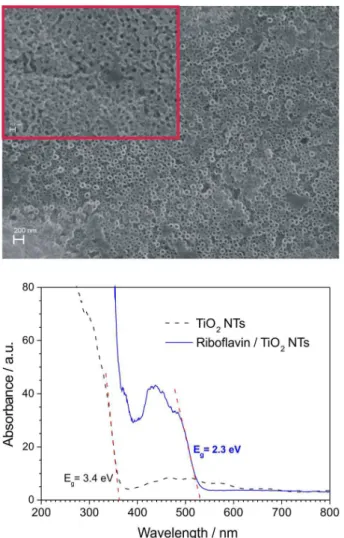
SEM images of the TiO2 NTs with a roughly 100 nm
diameter can be seen in Figure 1-top. TiO2 NTs were
annealed at 400 °C for 3 h in air atmosphere to obtain the anatase phase.47,49,51 Finally, TiO
2 NTs were impregnated
with RF. The inset of Figure 1-top shows that after RF impregnation, the SEM image of the NTs is blurred and the visualisation of the NTs structure is not clear. This may indicate the presence of RF on the NTs’ surface.
The impregnation of the TiO2 NTs with RF was checked
after several cycles of washing in ultrasound with diffuse relectance UV-Vis spectroscopy. The optical properties
of the synthesised TiO2 NTs and RF-TiO2 NTs were
investigated using the Kubelka-Munk model52 and,
assuming that the sample scattering coefficient was constant for the UV-Vis wavelength range, the absorption behaviour of the samples was determined with the following expression:
2
(1−R)
2
s R
α
= (1)
where α and s are the absorption and scattering coeficients
and R is the diffuse relectance of the samples.
Figure 1-bottom shows the corresponding spectra of crystallised pure and RF-impregnated TiO2 NTs after 3 h
of annealing. From the igure, an intense absorption band can be observed between ca. 275 nm (3.5 eV) and 400 nm (3.1 eV), which is indicative of crystalline semiconducting TiO2 with a typical band gap of the anatase phase.
53 The
NTs impregnated with RF show an absorption component between 380 and 540 nm (see Figure 1-bottom), which
indicates the presence of RF adsorbed on the TiO2 NT
arrays. Previous studies on absorption and luorescence spectroscopy showed that RF adsorbs on the surface of colloidal TiO2 through its phenolic group.
27
The general properties of lavins in a free solution
have been extensively studied in the past36 and their
photochemistry has also been the subject of intense research.30,32,54,55 However, a few studies have addressed
reports in the past proposing a reaction scheme that postulates the splitting of water.34 Therefore, the prepared RF-TiO
2 NT
arrays were irst tested to know the photocatalytic activity when their water solutions were irradiated with UV-Vis or with only visible light. A common practice in the study of hydrogen generation by water splitting is the addition of sacriicial species, such as methanol, as an electron donor in deaerated solutions.51 Other alcohols, such as benzyl alcohol,
were also used to study the photooxidation reactions under natural weather conditions during the sensitisation of anatase titanium dioxide (Degussa P25) with the impregnation of several dyes (RF, safranine O, methyl red, eosin B and MB).32
Figure 2 shows the evolution of the amounts of gas products for RF impregnated with TiO2 NTs under UV-Vis or visible
(λ≥ 400 nm) light irradiation. Under dark or illumination
conditions without the presence of the TiO2 NTs, no
formation of gases was detected.
Furthermore, Figure 2 also shows that the main gaseous products detected, O2, CO and CO2, have a strong
dependence on the excitation wavelength. Under our experimental illumination conditions, hydrogen was a minority product, with its amount more than 1000 times lower than the main gaseous products detected. When the photocatalysis was carried out with visible light irradiation (λ≥ 400 nm), the main product obtained was
oxygen. CO and CO2 were detected as minor contributions
of the reaction (Figure 2-top). Additionally, the oxygen concentration increased as the illumination time increased, showing it to be an actual sensitised photocatalytic reaction. Under these visible irradiation conditions, TiO2 NTs are not
able to absorb photons (see Figure 1-bottom) and therefore oxygen has to be produced due to an eficient sensitisation process. Electron injection from the RF singlet excited state into the conduction band of TiO2 was already suggested
by fluorescence quenching experiments on colloidal TiO2.27 The authors calculated the free energy (∆Get) of
the electron transfer process as −3.1 eV. This high negative ∆G
et value indicates that the electron transfer process is
thermodynamically favourable.
When UV-Vis irradiation is allowed to reach the system, the amounts of CO2 detected is comparable with O2 and
in less extension CO (see Figure 2-bottom). This result shows that the TiO2 NTs are now participating directly in
the photodegradation process of RF. In previous studies of photo-induced reforming of alcohols on TiO2 NTs
49,51 the
mineralisation of the alcohols was not observed, probably due to their high concentration in the water solution. In the present study, CO and CO2 may certainly be mineralisation
products of the RF photocatalysis.
Figure 2 also shows that after RF visible light excitation, an eficient electron transfer from the singlet state of the RF to the conduction band of the TiO2 NTs takes place.
Additionally, those results indicate a very interesting property of the RF-TiO2 NTs system under visible light
illumination: the generation of oxygen in situ. This is very relevant, since the degradation of organic pollutants [advanced oxidation processes (AOP)] takes place under aerated conditions with the participation of photogenerated holes. These holes act either directly or indirectly in the degradation process via the generation of hydroxide radicals (OH•), superoxide (O
2 •−
) or hydroperoxide (HO2 •)
radicals produced on the surface of TiO2 by the reduction
of atmospheric oxygen.53 These powerful oxidising agents
attack on pollutant molecules, ultimately leading to the production of mineralisation products. RF-TiO2 NTs under
visible light illumination produce oxygen in situ without the necessity to bubble air or oxygen in the reaction system, which is the standard procedure in photodegradation studies Figure 1. Top view SEM images of a typical TiO2 nanotube (NT) array
grown in an ETG/ammonium luoride solution (top) and TiO2 NTs
of aqueous contaminants, and therefore it seems to be a very suitable photocatalyst for pollutant degradation.
Anaerobic and aerobic photobleaching of RF solutions was studied in the past, showing very interesting properties in its photochemical degradation mechanism.30,35 It was
observed that the concentration of RF decreased with the increase of irradiation time, producing a series of products that were carefully identiied.30,31,54,55 In particular,
when anaerobic conditions were used and air was admitted to the partially bleached solution, reoxidation of the isoalloxazine ring occurred as was indicated by the important recovery of the original absorption at 445 nm and the return of the yellow colour. It was shown that when samples were removed after 17 and 24 h of irradiation, the colour was restored upon admission of air in 89% and
84%, respectively.35 The same mechanism may work in
our experimental conditions to keep a high level of RF concentration in the solution. Simultaneously, a small decrease in the pH of the irradiated solutions with the increase in the irradiation time was observed. This could suggest that the oxidation of the water can lead to oxygen evolution, but the study of the actual mechanism is part of further work.
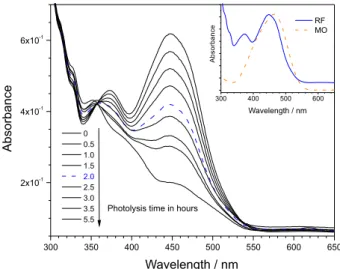
Visible light illumination (λ ≥ 400 nm) of the MO
solutions in the presence of RF-TiO2 NTs shows that the
decolourisation of MO is proportional to the increase in the irradiation time (Figure 3). As can be seen in Figure 3, the absorption spectra of the MO and RF overlap; nevertheless the main features of the MO, with its characteristic absorption maxima located at 445 and 372.5 nm, remained for up to approximately 2 h of irradiation. After this period of visible light irradiation, the degradation of the remaining RF solution is observed and typical products of RF degradation,54,55 such as lumilavin (LF), lumichrome
(LC) and probably minor products formylmethyllavin (FMF) and cyclodehydroribolavin (CDRF), still remained in the UV spectra (Figure 3). The photolysis of RF in an aqueous solution occurs through 7,8-dimethyl-10-(formylmethyl) isoalloxazine (formylmethyllavin) as an intermediate, which is hydrolysed to LC and LF as the major photoproducts.55 A general scheme of the chemical
reactions that occur in RF photolysis is the following:30
RF → CDRF (2)
RF → FMF → LC (3)
D e p e n d i n g o n t h e r e a c t i o n c o n d i t i o n s , t h e photodegradation reactions of RF can lead to the formation of CDRF by photoaddition and FMF by photoreduction,
subsequently leading to LC and LF by hydrolysis.54,55
CDRF and LC are the two major inal products obtained and FMF is an intermediate in the photoreduction reaction. Comparison of the inal UV spectra shown in Figure 3, after 5 h of visible irradiation, with typical UV spectra obtained after photodegradation of RF in water solution30,54,55 may
indicate that LF [main molar absorption coefficients (ε
max at 445 and 356 nm)] and LC (εmax at 356 nm) may
remain as the main RF photocatalytic products. CDRF may also be present in lower concentrations (ε
max at 410 nm). It
is important to point out that an aqueous solution of MO in the presence of pure TiO2 NTs irradiated with a cut of
ilter of λ≥ 400 nm did not produce any decolouration of
the solution after 6 h of irradiation.
To avoid overlapping of the UV-Vis absorption of the dye with the RF, a different dye was photodegraded under the same illumination conditions used for MO. The inset
0.0 0.5 1.0
λ ≥400 nm
1 2 3
0.0 0.1
λ = UV-Vis
O2
CO2
CO
Irradiation time / h
Amount of evolved gases / µmols
Figure 2. Photocatalytic gas evolution from water solutions containing methanol as an electron donor on RF-impregnated TiO2 nanotubes. Water:methanol ratio: 8:1, v/v.
300 350 400 450 500 550 600 650
2x10⁻¹ 4x10⁻¹ 6x10⁻¹ 0 0.5 1.0 1.5 2.0 2.5 3.0 3.5 5.5 A b s o rb a n c e
Wavelength / nm
Photolysis time in hours
300 400 500 600
RF MO A b s o rb a n c e
Wavelength / nm
Figure 3. Decolourisation of a methyl orange (MO) solution vs. time in typical photocatalytic experiments performed using RF-TiO2 NTs under visible light illumination (cut of ilter ≥ 400 nm). Initial MO concentration was 6 ppm. Normalised spectra of pure aqueous solutions of RF and MO are also shown in the inset igure.
0.0 0.5 1.0
λ ≥400 nm
1 2 3
0.0 0.1
λ = UV-Vis
O2 CO2 CO
Irradiation time / h
Amount of evolved gases / µmols
300 350 400 450 500 550 600 650
2x10⁻¹ 4x10⁻¹ 6x10⁻¹ 0 0.5 1.0 1.5 2.0 2.5 3.0 3.5 5.5 A b s o rb a n c e
Wavelength / nm Photolysis time in hours
300 400 500 600
RF MO A b s o rb a n c e
of Figure 4 shows the UV-Vis spectrum of IC, where it is possible to see a large shift to longer wavelengths in the absorption maximum of the IC compared to the RF (Figure 3). In this case, there is not interference in the absorption spectra of both dyes. When an IC aqueous solution of 75 ppm is illuminated with visible light in the presence of pure TiO2 NTs (without RF impregnation), no
change in the IC UV-Vis spectrum is observed (see inset of Figure 4). It means that the presence of IC did not sensitise the TiO2 NTs and there was not any electron transfer process
after photon excitation of the IC dye to the semiconductor. The lack of a photocatalytic reaction of IC in the presence of pure TiO2 NTs contrasted when the NTs were impregnated
with RF and irradiated with λ ≥ 400 nm (see Figure 4).
Figure 4 shows a fast photocatalytic reaction that totally degradates the dye (IC) in less than 3 h of irradiation with visible light. The results presented in Figure 4 show the potential of the impregnated photocatalyst prepared where a complete decolouration of the solution can be obtained only with visible light by using a RF-TiO2 NTs photocatalyst.
The rate of the heterogeneous photocatalytic degradation of a dye has been described with the Langmuir-Hinshelwood mechanism,58 which can be expressed with the following
mathematical equation:
1
ad
ad
kK C
dC r
dt K C
= − =
+
(4)
where r represents the initial rate of photooxidation, C is the variable concentration at any time t, k is the reaction
rate constant, and Kad is the adsorption coeficient of dye on photocatalyst. If the concentration of the dye is low enough, pseudo-irst-order reaction conditions apply and the product Kad × C is very small compared with 1 in the denominator of equation 4. Integrating equation 4, after the above simpliication, the following is obtained:
0
l n C kK Cad kappt
C = = (5)
where kapp = kKad is the apparent pseudo-irst-order reaction rate constant and C0 is the initial concentration of the dye.
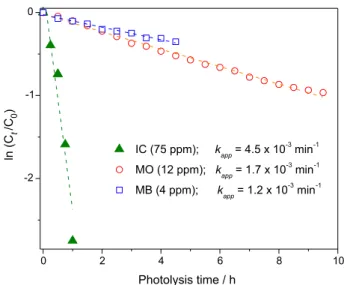
In order to evaluate qualitatively the rate of photodegradation of different dyes under visible light illumination using a RF-TiO2 NT photocatalyst, the linear
relationship of the natural logarithm of the ratio between the initial concentration of the dye and the concentration after photocatalytic degradation [ln(C0/C)] versus the
corresponding irradiation time is plotted in Figure 5. The results indicate that the photocatalytic degradation of MO, MB (without UV-Vis absorption overlapping with the RF spectrum) and IC can be described by the irst-order kinetic model. The value of kapp obtained from the slopes of the linear curves shown in Figure 5 gives a qualitative indication for the activity of the photocatalyst because the concentrations of the dyes used were different and the amount of dyes adsorbed in each case may also be different. Nevertheless, the apparent pseudo-irst-order reaction rates obtained from Figure 5 show that the ratio of the degradation rates for the dyes follow the order 3.6, 1.4, and 1 for IC, MO, and MB, respectively. Additionally, as in the case of MO, the irradiation of IC and MB under visible light in the presence of TiO2 NTs without impregnation
300 350 400 450 500 550 600 650 700 750
1 2 3
Absorbance
Wavelength / nm
0 0.5 1 1.5 2 2.5 3 Irradiation time in hours
300 400 500 600 700 1
Irradiation time in hours 0
0.5 1 2
A
b
s
o
rb
a
n
c
e
Wavelength / nm
Figure 4. Photodegradation of an indigo carmine (IC) solution vs. time in typical photocatalytic experiments performed using RF-TiO2 NTs under
visible light illumination (cut of ilter ≥ 400 nm). Initial IC concentration was 75 ppm. Inset: 75 ppm IC solution irradiated with visible light (λ≥ 400 nm) in the presence of pure TiO2 NTs without RF impregnation.
0 2 4 6 8 10
-2 -1 0
IC (75 ppm); kapp= 4.5 x 10⁻³min-1
MO (12 ppm); kapp= 1.7 x 10⁻³min-1
MB (4 ppm); kapp= 1.2 x 10⁻³min-1
ln (C
/C
)
t
0
Photolysis time / h
Figure 5. Apparent irst-order linear plot of ln(Ct/C0)versus the irradiation
time of indigo carmine (IC), methylene blue (MB) and methyl orange (MO) degradation kinetics for RF-TiO2 NTs photocatalyst under visible light illumination (cut of ilter ≥ 400 nm).
300 350 400 450 500 550 600 650 700 750
1 2 3
Absorbance
Wavelength / nm
0 0.5 1 1.5 2 2.5 3 Irradiation time in hours
300 400 500 600 700 1
Irradiation time in hours 0
0.5 1 2
A
b
s
o
rb
a
n
c
e
Wavelength / nm
0 2 4 6 8 10
-2 -1 0
IC (75 ppm); kapp= 4.5 x 10⁻³min-1 MO (12 ppm); kapp= 1.7 x 10⁻³min-1 MB (4 ppm); kapp= 1.2 x 10⁻³min-1
ln (C
/C
)
t
0
of RF, did not produce any decolouration of the dyes (see Figure S1 in the Supporting Information section).
On the surface of unmodiied crystal TiO2, oxygen
atoms with a high electron density (negative centres)
are mainly present. Thus, the TiO2 NTs may have a
negative charge and adsorption and higher values of the photocatalytic degradation rate constant for cationic dyes should be expected.59 Although the literature survey has
revealed many examples of degradation studies, there is no example of any correlation which might exist between degradation percent and structure or class of dyes.59-61
Our own studies on three different classes of dyes, where MB is a cationic dye and IC and MO are anionic types, have established a relative rank order of ease of dye degradation as follows: IC > MO > MB. Various operational parameters affect the activities of TiO2-based
photocatalysts. Some dyes are degraded at lower pH, while others at higher pH; hence in photocatalytic degradation of dyes in wastewaters, the reaction depends on the proper pH. Oxidising agents, calcination temperature, type of TiO2 catalyst and catalyst loadings are found to exert their
individual inluence on the photocatalytic degradation of any dye. In the present work, a decrease in pH was observed during irradiation with visible light (oxygen was potentially generated by water splitting). Therefore, for the effective study of the photocatalytic degradation of different dyes, all the aforementioned parameters must be given full consideration. This kind of detailed investigation is out of the scope of the present work focused on the photosensitised degradation of organic dyes by visible light using a RF-TiO2 NTs photocatalyst.
Conclusions
An efficient photocatalyst for oxidation of water-dissolved dyes by visible light irradiation was prepared
with RF anchored on the surface of TiO2 NTs. RF water
solutions irradiated in the presence of RF-TiO2 NTs with
UV or visible light led to different gaseous products. RF degradation was observed by UV irradiation producing O2,
CO and CO2 as the main gaseous products. On the other
hand, visible light irradiation mainly evolved O2 with CO
and CO2 as minor products. The fact that oxygen gas was
generated in situ during irradiation with no mineralisation of RF allows the use of the prepared photocatalyst for the degradation of dyes with visible light as excitation source. The results obtained in the present study on photocatalytic degradation of three prototype dyes using a RF-TiO2 NT
photocatalyst demonstrated that in the presence of visible light, surface adsorbed RF can eficiently sensitise a TiO2 NT
semiconductor. Water solutions of IC, MB and MO were
irradiated with λ≥ 400 nm and their degradation kinetics
were measured. The apparent pseudo-irst-order reaction rate constants have been determined from absorption changes, showing that the photocatalytic degradation of MO, MB and IC can be described by a pseudo-irst-order kinetic model. The results provided here are highly promising in view of various photocatalytic applications of the prepared RF-TiO2
NT catalysts in the degradation of water dissolved pollutants using solar radiation, taking into account that RF is frequently found dissolved in water in nature.
Supplementary Information
Supplementary data are available free of charge at http://jbcs.sbq.org.br as PDF ile.
Acknowledgments
This work was partially supported by the Conselho Nacional de Desenvolvimento Cientíico e Tecnológico (CNPq), processes No. 550461/2012-4 and 477200/2012-5, Fundação de Amparo à Pesquisa do Estado do Rio Grande do Sul (FAPERGS - PqG 2011 Proc. 11/0837-0) and CAPES. Thanks are also due to the Centro de Nanociência e Nanotecnologia - CNANO/UFRGS.
References
1. Malato, S.; Fernandez-Ibanez, P.; Maldonado, M. I.; Blanco, J.; Gernjak, W.; Catal. Today2009, 147, 1.
2. Gaya, U. I.; Abdullah, A. H.; J. Photochem. Photobiol., C2008,
9, 1.
3. Chatterjee, D.; Dasgupta, S.; J. Photochem. Photobiol., C2005,
6, 186.
4. Chen, D.; Ray, A. K.; Water Res.1998, 32, 3223.
5. Acosta, D. R.; Martinez, A. I.; Lopez, A. A.; Magana, C. R.;
J. Mol. Catal. A: Chem.2005, 228, 183.
6. Reyes, C.; Fernández, J.; Freer, J.; Mondaca, M. A.; Zaror, C.; Malato, S.; Mansilla, H. D.; J. Photochem. Photobiol., A2006,
184, 141.
7. Patsoura, A.; Kondarides, D. I.; Verykios, X. E.; Catal. Today
2007, 124, 94.
8. Mai, J.; Sun, W.; Xiong, L.; Liu, Y.; Ni, J.; Chemosphere2008,
73, 600.
9. Oregan, B.; Gratzel, M.; Nature1991, 353, 737.
10. Tulloch, G. E.; J. Photochem. Photobiol., A2004, 164, 209. 11. Nazeeruddin, M. K.; Baranoff, E.; Graetzel, M.; Sol. Energy
2011, 85, 1172.
12. Krebs, F. C.; Sol. Energy Mater. Sol. Cells2009, 93, 394. 13. Chen, X.; Li, C.; Graetzel, M.; Kostecki, R.; Mao, S. S.; Chem.
14. Wang, Z. P.; Jun, X.; Cai, W. M.; Zhou, B. X.; He, Z. G.; Cai, C. G.; Hong, X. T.; J. Environ. Sci.2005, 17, 76.
15. Kuznetsov, V. N.; Serpone, N.; J. Phys. Chem. B2006, 110, 25203.
16. Li, W.; Cui, X.; Wang, P.; Shao, Y.; Li, D.; Teng, F.; Mater. Res. Bull.2013, 48, 3025.
17. Jiang, L.; Wang, Q. Z.; Li, C. L.; Yuan, J. A.; Shangguan, W. F.;
Int. J. Hydrogen Energy2010, 35, 7043.
18. Tachan, Z.; Hod, I.; Zaban, A.; Adv. Energy Mater.2014, 4, DOI: 10.1002/aenm.201301249.
19. Maitani, M. M.; Zhan, C.; Mochizuki, D.; Suzuki, E.; Wada, Y.;
Appl. Catal., B2014, 147, 770.
20. Antoniadou, M.; Sfaelou, S.; Dracopoulos, V.; Lianos, P.; Catal. Commun.2014, 43, 72.
21. Waskasi, M. M.; Hashemianzadeh, S. M.; Sarhangi, O. M.; Harzandi, A. P.; Energy Convers. Manage.2012, 62, 154. 22. McCormick, T. M.; Calitree, B. D.; Orchard, A.; Kraut, N. D.;
Bright, F. V.; Detty, M. R.; Eisenberg, R.; J. Am. Chem. Soc.
2010, 132, 15480.
23. Karunakaran, C.; Jayabharathi, J.; Jayamoorthy, K.; Devi, K. B.;
Spectrochim. Acta, Part A2012, 89, 187.
24. Wu, T.; Xu, S.-J.; Shen, J.-Q.; Chen, S.; Zhang, M.-H.; Shen, T.;
J. Photochem. Photobiol., A2000, 137, 191.
25. Chen, C.; Qi, X.; Zhou, B.; J. Photochem. Photobiol., A1997,
109, 155.
26. Kathiravan, A.; Chandramohan, M.; Renganathan, R.; Sekar, S.;
Spectrochim. Acta, Part A2009, 71, 1783.
27. Kathiravan, A.; Renganathan, R.; Spectrochim. Acta, Part A
2008, 71, 1080.
28. Zhang, D.; Wen, M.; Zhang, S.; Liu, P.; Zhu, W.; Li, G.; Li, H.;
Appl. Catal., B2014, 147, 610.
29. Escalada, J. P.; Pajares, A.; Gianotti, J.; Biasutti, A.; Criado, S.; Molina, P.; Massad, W.; Amat-Guerri, F.; Garcia, N. A.;
J. Hazard. Mater.2011, 186, 466.
30. Ahmad, I.; Ahmed, S.; Sheraz, M. A.; Vaid, F. H. M.; Ansari, I. A.; Int. J. Pharm.2010, 390, 174.
31. Ahmad, I.; Ahmed, S.; Sheraz, M. A.; Vaid, F. H. M.;
J. Photochem. Photobiol., B2008, 93, 82.
32. Hussein, F. H.; Alkhateeb, A. N.; Desalination2007, 209, 350. 33. Melo, T. B.; Ionescu, M. A.; Haggquist, G. W.; Naqvi, K. R.;
Spectrochim. Acta, Part A1999, 55, 2299.
34. Enns, K.; Burgess, W. H.; J. Am. Chem. Soc.1965, 87, 1822. 35. Smith, E. C.; Metzler, D. E.; J. Am. Chem. Soc.1963, 85, 3285. 36. Silva, E.; Edwards, A. M.; Flavins: Photochemistry and
Photobiology; The Royal Society of Chemistry: Cambridge,
2006.
37. Chacon, J. N.; McLearie, J.; Sinclair, R. S.; Photochem. Photobiol.1988, 47, 647.
38. Benassi, C. A.; Scoffone, E.; Galiazzo, G.; Iori, G.; Photochem. Photobiol.1967, 6, 857.
39. Escalada, J. P.; Pajares, A.; Gianotti, J.; Massad, W. A.;
Bertolotti, S.; Amat-Guerri, F.; Garcia, N. A.; Chemosphere
2006, 65, 237.
40. Chen, X.; Mao, S. S.; Chem. Rev.2007, 107, 2891.
41. Mor, G. K.; Shankar, K.; Paulose, M.; Varghese, O. K.; Grimes, C. A.; Nano Lett.2005, 5, 191.
42. Zhu, K.; Neale, N. R.; Miedaner, A.; Frank, A. J.; Nano Lett.
2007, 7, 69.
43. Jitputti, J.; Pavasupree, S.; Suzuki, Y.; Yoshikawa, S.; Jpn. J. Appl. Phys.2008, 47, 751.
44. Liu, G.; Wang, K.; Hoivik, N.; Jakobsen, H.; Sol. Energy Mater. Sol. Cells2012, 98, 24.
45. Rajeshwar, K.; J. Appl. Electrochem.2007, 37, 765.
46. Bavykin, D. V.; Friedrich, J. M.; Walsh, F. C.; Adv. Mater.2006,
18, 2807.
47. Wender, H.; Feil, A. F.; Diaz, L. B.; Ribeiro, C. S.; Machado, G. J.; Migowski, P.; Weibel, D. E.; Dupont, J.; Teixeira, S. R.;
ACS Appl. Mater. Interfaces2011, 3, 1359.
48. Feil, A. F.; Weibel, D. E.; Corsetti, R. R.; Pierozan, M. D.; Michels, A. F.; Horowitz, F.; Amaral, L.; Teixeira, S. R. R.;
ACS Appl. Mater. Interfaces2011, 3, 3981.
49. Feil, A. F.; Migowski, P.; Pierozan, M. D.; Corsetti, R. R.; Scheffer, F. R.; Rodrigues, M.; Pezzi, R. P.; Machado, G.; Amaral, L.; Teixeira, S. R.; Weibel, D. E.; Dupont, J.; J. Braz. Chem. Soc.2010, 21, 1359.
50. Gonçalves, R. V.; Migowski, P.; Wender, H.; Eberhardt, D.; Weibel, D. E.; Sonaglio, F. V. C.; Zapata, M. J. M.; Dupont, J.; Feil, A. F.; Teixeira, S. R.; J. Phys. Chem. C2012, 116, 14022. 51. Languer, M. P.; Scheffer, F. R.; Feil, A. F.; Baptista, D. L.;
Migowski, P.; Machado, G. J.; de Moraes, D. P.; Dupont, J.; Teixeira, S. R. R.; Weibel, D. E.; Int. J. Hydrogen Energy2013,
38, 14440.
52. Murphy, A. B.; Sol. Energy Mater. Sol. Cells2007, 91, 1326. 53. Fujishima, A.; Zhang, X.; Tryk, D. A.; Surf. Sci. Rep.2008, 63,
515.
54. Ahmad, I.; Fasiliullah, Q.; Vaid, F. H. M.; J. Photochem. Photobiol., B 2004, 75, 13.
55. Ahmad, I.; Fasihullah, Q.; Noor, A.; Ansari, I. A.; Ali, Q. N. M.;
Int. J. Pharm.2004, 280, 199.
56. Li, Y.; Hsu, P.-C.; Chen, S.-M.; Sensor. Actuat. B-Chem.2012,
174, 427.
57. Yamashita, M.; Rosatto, S. S.; Kubota, L. T.; J. Braz. Chem. Soc.2002, 13, 635.
58. Houas, A.; Lachheb, H.; Ksibi, M.; Elaloui, E.; Guillard, C.; Herrmann, J.-M.; Appl. Catal., B2001, 31, 145.
59. Rauf, M. A.; Ashraf, S. S.; Chem. Eng. J.2009, 151, 10. 60. Devi, L. G.; Murthy, B. N.; Kumar, S. G.; Chemosphere2009,
76, 1163.
61. Akpan, U. G.; Hameed, B. H.; J. Hazard. Mater.2009, 170, 520.
Submitted on: July 27, 2014