Sho
rt
R
ep
or
t
0103 - 5053 $6.00+0.00
*e-mail: [email protected], [email protected]
Iodination of Phenols in Water using Easy to Handle Amine-Iodine Complexes
Lívia C. R. M. da Frota, Raquel C. P. Canavez, Sara L. da Silva Gomes, Paulo R. R. Costa and Alcides J. M. da Silva*
Núcleo de Pesquisas de Produtos Naturais, Universidade Federal do Rio de Janeiro, Centro de Ciências da Saúde, Bloco H, Ilha do Fundão, 21941-540 Rio de Janeiro-RJ, Brazil
A reação entre o iodo e a N-metil-piperazina ou a tiomorfolina em água, na presença de KI, levou a formação de complexos amina-iodo estáveis e de fácil manipulação, tal qual o complexo morfolina-iodo, previamente descrito na literatura. Entretanto, o complexo formado entre o iodo e a N,N-tetrametiletilenodiamina mostrou-se pouco estável, enquanto que nenhum complexo foi isolado quando a piperidina foi usada como base. Estes resultados mostram que a presença do segundo heteroátomo na estrutura das aminas é fundamental para a formação e estabilidade desses complexos. Neste trabalho descrevemos, pela primeira vez, o emprego dos complexos morfolina-iodo, N-metil-piperazina-iodo e tiomorfolina-iodo como agentes de iodação de vários fenóis substituídos, conduzindo a uma série de produtos iodados em rendimentos variando de bons a excelentes.
The reaction between iodo and N-methyl-piperazine or thiomorpholine in water, in the presence of KI, led to the formation of stable and easy to handle amine-iodine complexes, as the complex morpholine-iodo previously reported in the literature. However, the complex obtained using N,N -tetrametylethylenediamine proved less stable, while no complex was formed when piperidine was used as base. These results show that the presence of a second heteroatom in the structure of amines is of fundamental importance for the formation and stability of these complexes. In this work we describe, for the irst time, the use of complexes morpholine-iodo, N-methyl-piperazine-iodo and thiomorpholine-iodo as iodinating reagents of several substituted phenols, leading to iodinated products in good to excellent yields.
Keywords: iodophenols, amine-iodine complexes, aromatic iodination, iodinating reagents,
ortho-iodophenols
Introduction
Aryl iodophenols and other aryl iodides are versatile intermediates in organic synthesis, being used as precursors of new carbon-carbon bonds. These compounds can be used as source of aryl organometalic species as well as substrates for these species in cross-coupling reactions.1-9 In particular,
the palladium catalyzed oxyarylation of chromens by ortho -iodophenols have been used to synthesize pterocarpans and its derivatives.10,11 On the other hand, coumarins were
formed through a tandem Heck-lactonization reaction when these species were allowed to react with enoates and cinnamates.12,13
Continuing interest of organic chemists in iodination reactions are due to the versatility of iodinated compounds
as building blocks in a variety of synthetic transformations in medicinal chemistry, as well as in the biomedical sciences as imaging agents in non-invasive medical diagnostic techniques due to the possible release of the long-lived radioactive 129I isotope.14-18 In the 1950’s the
hormone thyroxine and its analogues were prepared as radioiodinated photoprobes.19-23
A broad range of procedures are described in the literature for the iodination of phenols, involving the use of NIS, ICl, I2 and iodides salts in the presence of an oxidant, in acid or basic conditions.24-34 Recently, Esteves
and Mattos35 described the scope of the triiodoisocyanuric
Amines can also be used to increase the reactivity of I2 and Hinman and Giza36 used iodine in the presence
of morpholine as iodinating agent to synthesize thyroxine analogs from 3-carbethoxy-5-hydroxy-2-methylbenzofuran. Iodine in the presence of amines react readily with benzophenone, cinnamates and chalcones leading to α,β-diamino-benzylacetophenones and
α,β-diamino-benzylacetones derivatives.37 While in most
cases complexes of I2 with amines are generated and used in situ,13,14 a stable and easily to handle complex 1a (Figure
1) was prepared by Rice38 just mixing of morpholine, KI
and I2 in water. Recently Perez et al.39 described the use of
this complex as iodinating reagent to prepare 2-hydroxy-3-iodo-naphthoquinone from lawsone in 87% yield, but did not evaluate the scope of this new iodinating agent using other phenols as substrates.
In this paper we describe the synthesis of new amine-iodine complexes (1b-d), structurally related to complex 1a. The scope of these complexes (1a-d) as iodinating agents was evaluated for the irst time using a series of phenols (2-5) as substrates (Figure 1).
Results and Discussion
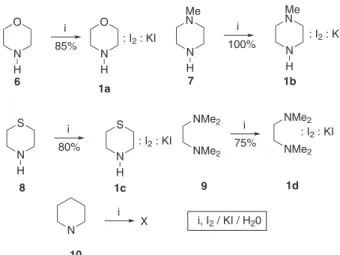
A series of secondary amines (7, 8 and 10) and a tertiary amine (9) were allowed to react with I2 in water in the presence of KI, under the conditions described by Rice38
to prepare 1a. Stable complexes (1b and 1c) were formed when N-methyl-piperazine (7) and thiomorpholine (8) were used (Scheme 1). In contrast, complex 1d, obtained from N,N-tetrametylethylenediamine (9),was unstable and completely decomposes at room temperature after 1 h. In contrast, no complex could be isolated from the reaction of I2 with piperidine (10).
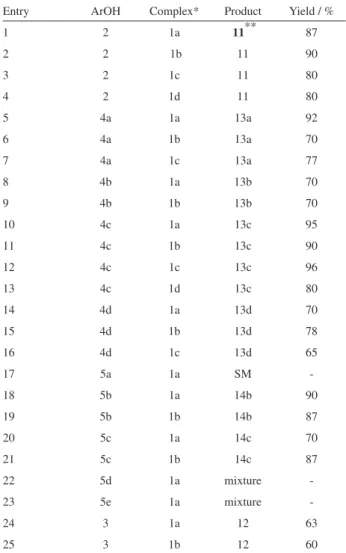
Complexes 1a, 1b, 1c and 1d were used as iodinating agents of phenols 2-5. The reactions are shown in Schemes 2, 3, 4 and 5 and yields obtained are shown in Table 1.
Figure 1.Iodine-amine complexes and phenols studied in this work.
Scheme 1.Synthesis of complexes 1a-d.
i, I2 / KI / H20 N
O
6
N O
H
1a
i 85%
N Me N
7
N Me N
H 1b
i 100%
N S
8
N S
H 1c
i
80% NMe2
NMe2
9
NMe2 NMe2
1d
i 75%
N
10
i X
H H
H
: I2 : KI : I2 : KI
: I2 : KI
: I2 : KI
Scheme 2.Iodination of 2 by complexes 1a-d. O
O OH
2 O
O OH
11 I
Scheme 3.Iodination of 3 by complexes 1a-d. OH
3
OH
12
I
Scheme 4.Iodination of 4a-d by complexes 1a-d.
OH
4
R1
a, R1=H; b, R1=NO2;
c, R1=CO2Me; d, R1=Cl
OH
13
R1
R2
a, R1=I, R2=H; b, R1=NO2, R2=I;
c, R1=CO2Me, R2=I; d, R1=Cl, R2=I
Scheme 5.Iodination of 5a-e by complexes 1a-d. a, R1=NO2, R2=H, R3=NO2, R4=H b, R1=OMe, R2=H, R3=CHO, R4=H c, R1=OMe, R2=H, R3=H, R4=CHO d, R1=H, R2=H, R3=H, R4=CHO e, R1=H, R2=R3=OCH2O, R4=H OH
5
R3
R1
R2
R4
OH
14
R3
R1
R2
R4
The reaction between complexes 1a-d (1.2 eq) with lawsone 2 (entries 1-4) gave 3-iodolawsone (11) in excellent yields, 87%, 90%, 80%, 80%, respectively. Contrasting to the use of some iodinating agents,24,40-42
which in general lead to products of poly-iodination, phenol (4a) furnished para-iodophenol 13a 24 in good
yields by reaction with complexes 1a, 1b and 1c (entries 5-7).We also examined the iodination of the phenols 4b,
4c and 4d, bearing electron withdrawing substituents at the para position (NO2, CO2CH3 and Cl) (entries 8-16) and the desired products 13b,2413c24 and 13d24 were obtained
in good yields by using complexes 1a-d. However, only starting material was observed when highly deactivated phenol 5a was allowed to react with complex 1a (entry 17).
Using the complexes 1a or 1b, vanillin 5b and isovanillin 5c (entries 18-21), having activating and deactivating groups at the aromatic ring, also led to the corresponding ortho-iodophenol derivatives 14b27 and 14c,28 although the para position in 2h is not substituted.
A mixture of non-identiied products was obtained when the m-hydroxy-benzaldehyde (5d) was treated with the complex 1a (entry 22). Unfortunately, sesamol 5e, a very activated phenol, furnished only products of degradation when allowed to react with 1a (entry 23). α-Naphthol 3 led to 12 in 60% and 63% yield, respectively (entries 24-25), by reaction with complexes 1a or 1b.24
Several groups have studied the structure of complexes formed between halogens and interhalogens with n-donors.43-46 According to Manoharan and Ananthavel,47
a suitable interaction exist between σ*-orbital in the interhalogen (LUMO) and lone electron pair of donor (HOMO). The greater the overlap and/or the smaller energy difference between the HOMO of the donor and the LUMO of acceptor, the larger the stabilization energy (D), and the greater the extent of mixing, which causes more charge transfer from the donor to the acceptor. 48-52
Amine-iodine complexes have been studied by UV and IR spectroscopy and a dipolar structure has been suggested (Figure 2).53,54 Based on our results, the presence of the
second hetero-atom in the structure of 1a, 1b and 1c,
respectively, is essential for the stability of the complexes, but donot inluence the reactivity, and consequently the yields of products. Studies toward the structural elucidation of these complexes are underway in our laboratories.
In conclusion, in this paper we report the synthesis of new stable in easy to handle amine-iodine complexes 1b
and 1c from of N-methyl-piparazine (7) and thiomorpholine (8), respectively. These complexes were evaluated for the irst time as iodinating reagents of phenols, leading to iodinated products in similar yields to those observed for complex 1a. The soft conditions used make them useful iodinating agents.
Experimental
General
Melting points were measured with a Fisher-Johns (Fisher Scientiic Co) apparatus. 1H NMR was recorded
on a Varian Gemini-200 instrument.
Synthesis of complexes (1b, 1c and 1d)
Typical procedure for 1b: To a stirred solution N-methyl-piperazine 7 (1.0 g, 10 mmol) in 8.0 mL of water
Table 1. Synthesis of the iodophenols using the complexes 1a-d
Entry ArOH Complex* Product Yield / %
1 2 1a 11** 87
2 2 1b 11 90
3 2 1c 11 80
4 2 1d 11 80
5 4a 1a 13a 92
6 4a 1b 13a 70
7 4a 1c 13a 77
8 4b 1a 13b 70
9 4b 1b 13b 70
10 4c 1a 13c 95
11 4c 1b 13c 90
12 4c 1c 13c 96
13 4c 1d 13c 80
14 4d 1a 13d 70
15 4d 1b 13d 78
16 4d 1c 13d 65
17 5a 1a SM
-18 5b 1a 14b 90
19 5b 1b 14b 87
20 5c 1a 14c 70
21 5c 1b 14c 87
22 5d 1a mixture
-23 5e 1a mixture
-24 3 1a 12 63
25 3 1b 12 60
*1.2 equiv. of complexes 1a, 1b, 1c or 1d was used. ** ref. 39
Figure 2. Structure of 1a, 1b and 1c
1
X=O, NMe, S N X
was added dropwise a solution of a mixture of I2 (2.54 g, 10 mmol) and 4.7 g of the KI in 5.0 mL of water. Orange-red crystals of N-methyl-piperazine iodide (1b) immediately start to precipitate. The solid was iltered off and washed with cold H2O. The product was dried under vacuum to provide the desired complex 1b (3.54 g, 100%).
Forcomplex1c: to thiomorpholine 8 (1.03 g , 10 mmol);
1c (2.85 g, 80%).
Forcomplex1d: to N,N-tetrametylethylenediamine 9
(1.16g; 10 mmol); 1d (2.70 g, 75%).
Synthesis of the compounds 11-14
Typical procedure for 13c: To a mixture of methyl 4-hydroxybenzoate 4c (4.56 g, 30 mmol) and K2CO3 (12.6 g, 90 mmol) in an erlenmeyer flask was added distilled water (300 mL). The dark red solution was stirred at room temperature while the complex 1a or 1b or 1c or 1d
(37.5 mmol) or was added in small portions every 15 min during 2 h. The mixture was cooled in an ice bath and then acidiied with 25% H3PO4 until the pH was approximately 2. At this point, the mixture was allowed to age (24 h) and a bright yellow precipitate was formed. The solid was iltered off and washed with cold H2O. The product was dried under vacuum to provide the desired methyl-3-iodo-4-hydroxybenzoate product 13c (7.92 g, 95%), or (7.50 g, 90%) or (7.96 g, 96%) or (6.67 g, 80%), respectively. mp 156-158 °C (mp 155-159 °C);55 1H NMR (200 MHz;
CDCl3) d 8.37 (1H, d, J 2.0 Hz); 7.93 (1H, dd, J1 8.8 Hz; J
2 2.0 Hz), 7.01 (1H, d, J 8.0 Hz), 3.97 (3H, s).
11: mp 178-180 °C (mp 177-179°C);39 1H NMR (200
MHz; CDCl3) d 8.14 (1H, dd, J 8.0 and 2.0 Hz); 8.08 (1H, dd, J 8.0 and 2.0 Hz); 7.78 (1H, td, J 8.0 and 2.0 Hz); 7.74 (1H, td, J 8.0, 2.0 Hz).
12: mp 90-92°C (mp 92°C);56 1H NMR (200 MHz;
CDCl3) d 7.93 (1H, d, J 9 Hz); 7.73 (overlapping doublets, 2H); 7.54 (1H, t, J 8Hz); 6.90 (1H, d, J 8.0 Hz); 7.38 (1H, t, J 8.0 Hz); 7.26 (1H, d, J 8.0 Hz).
13a: mp 90-92 °C (mp 89-94 °C);10 1H NMR (200 MHz;
CDCl3) d 7.49 (2H, d, J 8.8 Hz); 6.61 (2H, d, J 8.8 Hz).
13b: mp 85-87 °C (mp 86-87°C);57 1H NMR (200 MHz;
CDCl3) d8.60 (1H, d, J 2.0 Hz); 8.09 (1H, dd, J
1 7.0 Hz;
J2 2.0 Hz); 7.08 (1H, d, J 7.0 Hz).
13d: mp 75-77 °C (mp 78°C);58 1H NMR (200 MHz;
CDCl3) d 7.70 (1H, d, J 2 Hz); 7.20 (1H, dd, J
1 8.0 Hz,
J2 2.0 Hz); 6.90 (1H, d, J 8 Hz).
14b: mp 180-182 °C (mp 181-182°C);59 1H NMR (200
MHz; CDCl3) d 9.80 (1H, s); 7. 91 (1H, d, J 1.8 Hz); 7.46 (1H, d, J 1.8 Hz); 3.96 (3H, s).
14c: mp 168-170 °C (mp 169-171.5°C);24 1H NMR (200
MHz; CDCl3) d 10.0 (1H, s); 7.55 (1H, d, J 8.4 Hz); 6.92 (1H, d, J 8.4 Hz); 3.99 (3H, s).
Acknowledgments
Financial supports were provided by CAPES, FAPERJ, CNPq, Group of Oncobiology-UFRJ and FINEP. P.R.R.C., L.C.R.F and S.L.S.G are fellows of CNPq, P.R.R.C. is fellow of FAPERJ.
References
1. Negishi, E.; Coperet, C.; Ma, S.; Liou, S; Liu, F.; Chem. Rev. 1996, 96, 365.
2. Diederich, F.; Stang, P. J.; Metal Catalysed Cross Coupling Reactions; Wiley-VCH: Weinheim, Germany, 1998. 3. Ziegler, C. B.; Heck, R. F.; J. Org. Chem. 1978, 43, 2941. 4. Beletskaya, I. P.; Cheprakov, A. V.; J. Organomet. Chem. 2004,
689, 4055.
5. Negishi, E., ed.; Handbook of Organopalladium Chemistry for Organic Synthesis, John Wiley: New York, 2002.
6. Negishi, E. I.; Pure Appl. Chem. 1981,53, 2333. 7. Suzuki,A.; Miyaura, N.; Chem. Rev. 1995, 95, 2457. 8. Snieckus, V; Anctil, E. J. G.; J. Organomet. Chem.2002 , 653,
150.
9. Beletskaya, I. P.; Cheprakov, A. V.; Chem. Rev. 2000, 100, 3009. 10. Larock, R. C. US pat. 5,721,371 1998.
11. Kiss, L.; Kurtán, T.; Antus, S.; Brunner, H.; ARKIVOC, 2003, 69. 12. Ulgheri, F.; Marchetti,M; Piccolo, O.; J. Org. Chem. 2007, 72,
6056.
13. Fernandes, T. de A.; Carvalho, R. de C. C.; Gonçalves, T. M. D.; da Silva, A. J. M.; Costa, P. R. R.; Tetrahedron Lett.2008, 49, 3322.
14. Tadashi Kometani, T; Watt, D. S.; J. Org. Chem.1985, 50, 5384. 15. Seevers, R. H.; Counsell, R. E.; Chem. Rev.1982, 82, 575. 16. Bayley, H.; Knowles, J. R.; MethodsEnzymol. 1977, 46, 69. 17. Chowdhry, V.; Westheimer, F. H.; Annu. Rev. Biochem. 1979,
48,293.
18. Bayley, H.; Photogenerated Reagents in Biochemistry and Molecular Biology, Elsevier: New York, 1983.
19. Siegel, F-S. M.; Porto, F.; Frost, P.; Arch. Biochem. Biophys. 1959, 81, 330.
20. Siegel, S. M. Frost, P.; Proc. Natl. Acad. Sci.U. S. A. 1959, 46, 1379.
22. Lundberg, W. O.; Autoxidation and Antioxidants; vol. I, Interscience Publishers: New York, 1962, 1069.
23. Siegel, S. M.; F. Porto; Frost, P.; Physiol. Plant.1959, 14, 727. 24. Edgar, K. J.; Fallng, S. N.; J. Org. Chem. 1990, 55, 5287. 25. Liu, Z.; Larock, R. C.; Org. Lett. 2004, 6, 3739.
26. Gershon, H.; McNeil, W.; Greig, A. T.; J. Org. Chem. 1969, 34, 3268.
27. Garden, S. J.; Torres, J. C.; Melo, S.C.S.; Lima, A. S.; Pinto, A. C.; Lima, L. S.; Tetrahedron Lett. 2001, 42, 2089. 28. Markovich, K. M.; Tantishaiyakul, V.; Hamada, A.; Miller,
D. D.; Romstedt, K. J.; Shin, G.; Shams, Y.; Fraudorfer, P. F.; Doyle, K.; Feller, D. R.; J. Org. Chem. 1992, 466.
29. Barluenga, J.; Golzávez, J. M.; Gárcia-Martín, M. A.; Campos, P. J.; Asensio, G.; J. Org. Chem. 1993, 58, 2058.
30. Mukaiyama, T.; Kitagawa, H.; Matsuo, J. I.; Tetrahedron Lett. 2000, 41, 9383.
31. Branytska, O.V; Neumann, R.; J. Org. Chem. 2003, 68, 9510. 32. Brunel, Y.; Rousseav, G.; Tetrahedron Lett. 1995, 36, 8217. 33. Adimurthy, S.; Ramachandraiah, G.; Ghosh, P. K.; Bedekar,
A.V.; Tetrahedron Lett. 2003, 44, 5099.
34. Das, B.; Krishnaiah, M.; Venkateswarlu, K.; Reddy, V. S.; Tetrahedron Lett. 2007, 48, 81.
35. Ribeiro, R. da S.; Esteves, P. M.; de Mattos, M. C S.; J. Braz. Chem. Soc. 2008, 19, 1239.
36. Giza, C. A.; Hinmam, R. L.; J. Og .Chem.1964, 29, 1453. 37. Southwick, P. L.; Christman, D. R.; J. Am .Chem. Soc. 1952,
74, 1886.
38. Rice, R.V.; Heights, H.; US pat. 2,290,710, 1942.
39. Perez, A. L.; Lamoureux, G.; Herrera, A.; Synth. Commun. 2004, 34, 3389.
40. Adimurthy, S.; Ramachandraiah, G.; Ghosh, P. K.; Bedekar, A. V.; Tetrahedron Lett. 2003, 44, 5099.
41. Lista, L.; Pezzella, A.; Napolitano, A.; d’Ischia , M.; Tetrahedron 2008, 64, 234.
42. Tadashi Kometani T.; Watt, D. S.; J. Org. Chem.1985, 50, 5384. 43. Lenderink, L.; Duppen, K.; Everdij, F. P. X.; Mavri, J.; Torre,
R.; Wiersma, D. A.; J. Phys. Chem. 1996, 100, 7822. 44. Cheng, P. Y.; Zhong, D.; Zewail, A. H.; J. Phys. Chem. 1996,
105, 6216.
45. Zhong, D.; Zewail, A. H.; Proc. Natl. Acad. Sci. U. S. A.1999, 96, 2602.
46. Zhong, D.; Bernhardt, T. H.; Zewail, A. H.; J. Phys. Chem. A 1999, 103, 10093.
47. Ananthavel, S. P. ; Monoharan, M.; Chem. Phys. 2001, 269, 49. 48. Kusama, H.;Sugihara, H.; J. Photochem. Photobiol., A 2006,
181, 268.
49. Lu, Y. X.; Zou, J. W.; Wang, Y. H.; Yu, O. S.; J. Mol. Struct. 2006, 776, 83.
50. Huang, Q.; Wang, Z.; Chu, Q.; Zhu, S.; J. Inclusion Phenom. Macrocyclic Chem.2006, 54, 177.
51. Lucassen; A. C. B.; Karton, A.; Leitus, G.; Shimon, L. J. W.; Martin, J. M. L.; van der Boom, M. E.; Cryst. Growth Des. 2007, 7 , 386.
52. Tang; L. T; Wei, Y.; Wang, Y.; Hu, S. W.; Liu, X. O.; Chu, T. W.; Wang, X. Y. J. Mol. Struct. 2004, 686, 25.
53. Eshghi1, H.; Tayyari, S. F.; Sanchuli1, E.; Monatsh. Chem. 2004, 135, 1101.
54. Oetting, T.; Klapötke, T. M.; Polyhedron1989, 24, 2911. 55. Vasil’ev, A. A.; Engman, L.; J. Org. Chem. 1998, 63, 3911. 56. Potts, K. T.; J. Chem. Soc. 1953, 53, 3711.
57. Hodgen, H. H.; Moore, F. H.; J. Chem. Soc. 1925, 2260. 58. Varma, P. S.; Yashoda, K. M.; J. Indian Chem. Soc. 1939, 477. 59. Thorn, G. D.; Purves, C. B.; Can. J. Chem. 1954, 32, 373.
Received: December 17, 2008