191 REM: R. Esc. Minas, Ouro Preto, 67(2), 191-196, apr. jun. | 2014
Abstract
A high demand for mineral resources observed in recent decades has led to an expansion in production in the mining industry. Different process alternatives have been proposed for selective separation between apatite and contaminants (carbonates and silicates) present in phosphate ores. Magnetic separation, calcination and gravity separation processes are methods that present low eficiency and high cost. Flotation is the most common process; however the selectivity is hampered by the supericial similarity of the chemical composition of phosphates and carbonates, high surface activity of the collectors used, interactions between dissolved ionic species of certain mineral with another and also interactions between dissolved ionic species and re-agents. In this study, conducted in a laboratory scale, eight different depressants, or-ganic and inoror-ganic, were tested in the direct lotation of a Brazilian silicate-carbonate phosphate ore. The best performance in the depression of calcite and silicates was achieved with cassava starch.
Keywords: lotation depressants; anionic lotation; silicate-carbonate phosphate ore
Resumo
A forte demanda por bens minerais veriicada nas últimas décadas tem levado o setor mineral a ampliar sua capacidade produtiva. Diferentes métodos de concentração têm sido propostos para separação seletiva da apatita dos contaminantes carbonatos e silicatos presentes em minérios fosfáticos. Separação magnética, hidrogravimétrica e calcinação são métodos que apresentam baixa eiciência e custo elevado. A lotação é o método mais indicado, porém a seletividade é diicultada devido à similaridade da composição química supericial entre fosfatos e carbonatos, a alta atividade su-pericial dos coletores utilizados, interações entre espécies iônicas dissolvidas de um mineral sobre outro e, também, entre espécies iônicas dissolvidas e reagentes. Nesse estudo, realizado em laboratório, oito diferentes depressores, orgânicos e inorgânicos, foram testados na lotação aniônica direta de um fosfato sílico-carbonatado. O melhor desempenho foi obtido com fécula de mandioca, que exerceu boa depressão sobre a calcita e os silicatos.
Palavras chave: Flotação; depressores; fosfato sílico-carbonatado.
Adalberto Leles de Souza
Centro de Desenvolvimento da Tecnologia Nuclear Belo Horizonte- Minas Gerais - Brasil
Rodrigo Oscar de Albuquerque
Centro de Desenvolvimento da Tecnologia Nuclear Belo Horizonte- Minas Gerais - Brasil
Fernando Soares Lameiras
Centro de Desenvolvimento da Tecnologia Nuclear Belo Horizonte- Minas Gerais - Brasil
Plínio Eduardo Praes
Centro de Desenvolvimento da Tecnologia Nuclear Belo Horizonte- Minas Gerais - Brasil
Antônio Eduardo Clark Peres
Departamento de Engenharia Metalúrgica e de Materiais/Escola de Engenharia Universidade Federal de Minas Gerais
Belo Horizonte- Minas Gerais - Brasil [email protected]
Use of depressants in the direct
flotation of a silicate-carbonate
phosphate ore
Uso de depressores na flotação direta de um
fosfato sílico-carbonatado
2. Materials and methods
The ore used in this study was pro-vided by the Centro de Desenvolvimento da Tecnologia Nuclear (CDTN/CNEN), in Belo Horizonte (MG). The chemical determinations of P2O5 and SiO2 were carried out with the use of an X-ray luo-rescence spectrophotometer (EDX-720, Shimadzu), whereas the determination for CaCO3 was done via calcination. The size characterization was performed through combined sieving (Tyler series) and the Sympatec Helos particle analyser. The mineralogical characterization was carried out through the powder method, with the use of an X-ray difratometer - model Gei-gerlex, semi-automatic made by Rigaku.
The batch lotation tests were carried out in a laboratory using a mechanical cell Darma, Model D-1, Sub-A, provided with a mechanical froth scrapper for the removal of the floated material and a bucket with a 3.0 L capacity. Coconut oil was used as collector (Liacid 1218, fatty acid supplied by Miracena-Nuodex, dos-age 700 g/t) and the frother Flotanol D25 (ether polyalkyleneglycol, manufactured by Clariant S/A, dosage 30 g/t), whose dosages were adjusted in preliminary tests and kept constant in this study. The pH value used was 10.0, adjusted with sodium hydroxide. The depressants, inorganic and organic, tested with dosages ranging from
100 to 600 g/t, were: i) sodium hexam-etaphosphate;
ii) sodium silicate;
iii) corn starch (Flotamil 75, non-modiied starch by Caramuru);
iv) cassava starch (Amilogill 1500, non-modiied starch, supplied by Cargill);
v) modified starch I (Filmplus® 9002 ACC, cationic starch, supplied by Cargill);
vi) modiied starch II (EP2031, cat-ionic starch, supplied by Cargill);
vii) dextrin (modiied starch, sup-plied by Cargill); and
viii) CMC (carboxymethylcellulose, supplied by Pietschemical).
1. Introduction
Flotation is the most common con-centration process used by the mineral industry, both in quantity of ores pro-cessed and in diversity of applications (Peres et al, 2007). At present, over 2 x 10⁹ t per year of ore is estimated to
be processed through lotation. In Bra-zil, this technique played an important role in the growth of the mineral sector, especially in the industry of fertilizers. Different typologies of phosphates are concentrated through this process.
Ores presenting complex mineral-ogical associations, such as the Brazil-ian phosphates bearing silicates and carbonates in the gangue, correspond to a significant fraction of the local reserves and present poor response to concentration via lotation or even lack of a process route for economical re-covery (Albuquerque, 2010). The main phosphate reserves in Brazil, such as the ones located in the state of Minas Gerais (Araxá and Tapira) and the ones in Goiás (Catalão), as well as the uranium phosphate of the Santa Quitéria reserve in the state of Ceará present this typol-ogy (Oliveira, 2007).
The world challenge encountered by the phosphate industry is the devel-opment of a process route leading to the concentration of silicate-carbonate ores. For igneous as well as sedimentary de-posits, this achievement would lead to a better economical use and consequently longer lifespan of the mines or it would even make new ventures available. In particular, in the Brazilian case, an im-provement would lead to a signiicant
increase in the mining reserves, and consequently a reduction in the import of phosphate fertilizers.
Amongst the procedures described by Hanna and Somasundaran (1976) to obtain selectivity in the separation between sparingly soluble minerals, as well as in the separation apatite/carbon-ates (calcite/dolomite), the use of depres-sants is uppermost. These modiiers are responsible for inhibiting the absorption of the collector over the surfaces of the minerals whose lotation is not desired, thus keeping the necessary hydroilicity so that the particles get in contact with the aqueous phase. Prasad (1992) de-ines the depressants as reagents which improve the interaction of the mineral surfaces where lotation is not desired with the molecules of water, thus pre-venting the adsorption of collectors.
Since the separation between sparingly soluble minerals is complex, especially when the minerals involved contain similar terrous-alkaline cations, modiiers are steadily used to produce selectivity. Amongst various examples cited in technical literature are organic depressants, (non-modiied and modi-ied starches, guar gum, carboxymeth-ylcellulose and tannins); inorganic depressants (sodium silicate, sodium sulphate, polyphosphates, dicromates, luorates, and certain inorganic acids); pH regulators and modulators of the ionic composition of the pulp. The organic depressants present various advantages over the inorganic ones, for they are biodegradable, more stable,
atoxic and usually less expensive (Liu et al, 2000).
Hanna and Somasundaran (1976) attribute four main effects of the modi-iers to the lotation of the sparingly soluble minerals: (i) direct effect on the property of minerals, such as adsorp-tion capability and zeta potential; (ii) reduction of adsorption of the collector over the surface covered by the layer of the modiier; (iii) effect on the chemical composition of the pulp; (iv) effect on the foaming (frothing) process.
Prasad (1992), referring specii-cally to the organic depressants, stated that their adsorption mechanisms onto mineral surfaces include electrostatic interaction, hydrogen bonds, forma-tion of metal-depressant complexes, covalent bonds and even self-activation of the mineral. Nunes and Peres (2011), in a recent review addressing carbon-ate depressants, showed that the or-ganic agents have a suficient number of highly hydrophilic polar groups in their structure, such as -OH e -COOH, which orient themselves towards the aqueous phase, rendering the adsorbate hydrophilic. They indicate starch as the best depressant for ores presenting high contents of calcite and carboxymethyl-cellulose for ores containing dolomite.
193 REM: R. Esc. Minas, Ouro Preto, 67(2), 191-196, apr. jun. | 2014
3.2 - Flotation tests
3. Results and discussion
3.1 - Characterization of the sample
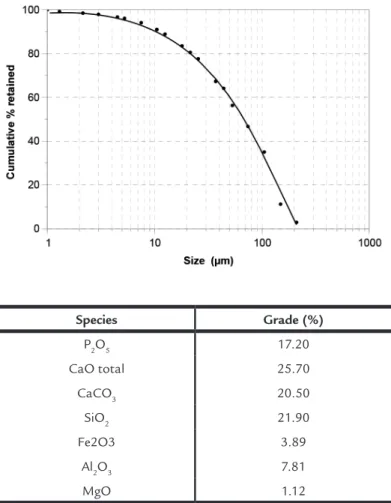
Figure 1 represents the head sample particle size distribution. It shows that 2.9% of the material is retained in 210 µm and 32.7% passing in 37 µm, ad-equate for a high liberation degree of
apatite.
According to results of the chemical analysis presented in Table 1, the grade of P2O5 was 17.2% and the grade of con-taminants CaCO3 and SiO2 was 20.5 and
21.9%, respectively. In terms of mineral-ogy, the sample is made up of apatite and by the contaminants calcite and silicates (albite, quartz, biotite, logopite, monti-morillonite, vermiculite, and amiboles).
Figure 1
Head sample size distribution.
Table 1
Head sample chemical composition
Species Grade (%)
P2O5 17.20 CaO total 25.70 CaCO3 20.50 SiO2 21.90 Fe2O3 3.89
Al2O3 7.81
MgO 1.12
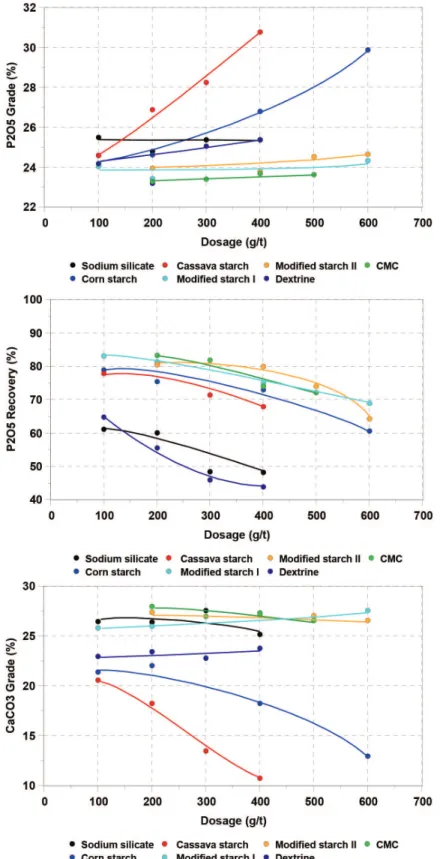
Figure 2 presents the results of the grade of P2O5 obtained in the con-centrates of apatite as a function of the variation of the dosage of the various depressant agents. It is shown that con-centrates with P2O5 content at 30% were only obtained with the high dosage tested of the depressant cassava starch (400 g/t) or corn starch (600 g/t), both non modiied starches. On the other hand,
the worst performances were observed when CMC, cationic starch I, cationic starch II, dextrin, and sodium silicate were employed.
The results of the recovery of P2O5 obtained in the concentrates of apatite as a function of the dosage of the de-pressants tested are presented in Figure 3. Usually, what is observed is the fact that the increase in the dosage of
depres-sant results in a reduction of recovery of P2O5. CMC was the agent which produced concentrates with the highest levels of recovery, reaching 83%, whereas dextrin presented the worst results. With cassava starch and corn starch, agents that yielded concentrates having the highest grades of P2O5, the recovery pre-sented intermediate values, between 61% and 79%.
With exception of dextrin, all starches and CMC were gelatinized with NaOH. The inorganic reagents were diluted as solutions in the required con-centrations.
Depressant and collector condition-ing times were, 5.0 and 3.0 minutes, re-spectively, and the lotation time was 5.0 minutes. These levels were kept constant
in all the tests.
It is worth pointing out that the modiied starch I and II are produced with the introduction of positive charges in its molecules by means of a cation-izing reaction with the use of reagents containing imine, amine, ammonium and sulphonium groups, being the degree of substitution the parameter that tells them
Figure 2 P2O5 grade as a function of the dosage of the different depressants.
Figure 3 P2O5 recovery as a function of the dosage
of the different depressants.
Figure 4 depicts the results of the contents of the contaminant CaCO3 obtained in the apatite concentrates as a function of the variation of the dosage of depressants. One can see that concen-trates having contents below 15% were only achieved with a higher dosage of more selective depressants: cassava and corn starch. The best performance was achieved at 400 g/t of cassava starch, which generated a concentrate with a P2O5 grade of 30.8% and grades of the
contaminants CaCO3 and SiO2 of 10.8 and 7.8%, respectively. Under this condi-tion, the recovery of P2O5 reached 68%. Figure 5 depicts the grade of the contaminant SiO2 obtained in the con-centrates of apatite as a function of the dosage of the depressants. It can be noted that, in general, all the depressants stud-ied perform well as far as the depression of silicate minerals present in the sample is concerned, thus yielding concentrates with the SiO2 content ranging from 6.2%
to 8.5%. A good depressant activity of dextrin and sodium silicate is noticeable. Conversely, the CMC was the reagent which presented the worst performance.
It is worth mentioning that the inorganic depressant sodium hexameta-phosphate, amongst all the depressants investigated, was the one which presented the worst performance, proving incapa-ble of yielding selectivity between apatite and the mineral contaminants under the conditions investigated.
195 REM: R. Esc. Minas, Ouro Preto, 67(2), 191-196, apr. jun. | 2014
Figure 5
SiO2 grade as a function of the dosage of the different depressants.
Confirming Nunes and Peres (2011), which presented starch as an ef-icient depressant for calcite, in the pres-ent study, cassava starch and corn starch were the most eficient agents, leading
to good selectivity. Also to conirm the results presented by Araujo (1988), which showed that a starch based depressant with a higher amylopectin content is more eficient; in this study the best
re-sults obtained were with cassava starch (83% of amylopectin) when compared with corn starch (74% of amylopectin), depressing mainly the contaminant calcite.
4. Conclusions
The results of this study led to the following conclusions:
• Amongst all the depressants in -vestigated, sodium hexametaphosphate was the one which presented the worst performance, not being able to provide good selectivity;
• The modified starches and
carboxymethylcellulose presented low selectivity and were not able to reduce the contents of the contaminants in the
concentrate;
• The non-modiied starches (cas -sava and corn) were the most eficient depressants, providing good selectivity mainly for the contaminant calcite;
• Cassava starch, possibly for its
higher content of amylopectin, proved to be more eficient than corn starch;
• In order to reach similar per
-formance, the dosage of cassava starch was signiicantly lower than that of corn starch; and
• At 400 g/t of cassava starch,
a concentrate was obtained with grade and recovery of P2O5 of 30.8% and 68%, with contaminant grades CaCO3 and SiO2 of 10.8% and 7.8%, respectively.
5. Acknowledgements
The authors of this paper should like to thank the Department of
Mineral Technology of CDTN/CNEN for invaluable contribution towards the
conclusion of this work.
6. References
ALBUQUERQUE, R.O. Process alternatives for the lotation of the Itataia´s phospho-rous-uraniferous ore. CPGEM/UFMG, 2010. 201 p. (Ph.D. Thesis)
ARAUJO, A. C. Starch modiication of the locculation and lotation of apatite. Vancou-ver – Canada: Departament of Mining and Mineral Process Engineering, UniVancou-versity of British Columbia, 1988. (Ph.D. Thesis).
BERTOLINI, A. C. Starches: characterization, properties, and applications. Taylor and Francis Group, 2010.
HANNA, H. S., SOMASUNDARAN, P. Flotation of salt-type minerals. In: FUERSTE-NAU, M. C. (ed.). Flotation A. M. Gaudin Memorial Volume. Baltimore: AIME, vol. 1, p. 197-272, 1976.
LEJA, J. Flotation surfactants. In: Surface Chemistry of Froth Flotation. New York: Ple-num Press, 1982. cap. 5., p. 205-333.
http://www.scopus.com/inward/record.url?eid=2-bc >
NUNES, A. P. L., Peres, A. E. C. Carbonates depressant reagents – a review. Tecno-logia Mineral, CETEM, vol. 1, p. 1-47, 2011.
OLIVEIRA, M. S. Silicate-carbonate phosphate ore: fundamental study. CPGEM/ UFMG, 2007. 207 p. (Ph.D. Thesis).
PERES, A. E. C. et al. Non-sulide minerals plant practice. In: FUERSTENAU, M. C., JAMESON, G., YOON, R. H. Froth lotation: a century of innovation, SME, Colorado, cap. 5, p. 845-868, 2007.
PRASAD, M. S. Reagents in the mineral industry - recent trends and applications. Minerals Engineering, v.5, n. 3-5, p. 279-294, 1992. DOI: 10.1016/0892-6875(92)90211-Q