IMPLICIT STOCHASTIC OPTIMIZATION FOR DERIVING RESERVOIR OPERATING RULES IN SEMIARID BRAZIL
Alcigeimes B. Celeste
Institut für Wasserwirtschaft, Hydrologie und landwirtschaftlichen Wasserbau
Leibniz Universität Hannover Hannover, Germany
[email protected] Wilson F. Curi
Unidade Acadêmica de Física
Universidade Federal de Campina Grande (UFCG) Campina Grande – PB, Brazil
[email protected] Rosires C. Curi
Área de Engenharia de Recursos Hídricos
Universidade Federal de Campina Grande (UFCG) Campina Grande – PB, Brazil
* Corresponding author / autor para quem as correspondências devem ser encaminhadas
Recebido em 08/2008; aceito em 02/2009 após 1 revisão Received August 2008; accepted February 2009 after one revision
Abstract
This paper deals with the application of Implicit Stochastic Optimization (ISO) to determine monthly operating rules for a reservoir system located in the semiarid Northeast of Brazil. ISO employs a deterministic optimization model to find optimal reservoir allocations under several possible inflow scenarios and later constructs the rules by analyzing the ensemble of these optimal releases. The operating policies provide the monthly reservoir release conditioned on the storage at the beginning of the month and the inflow predicted for the month. In addition to the classical regression analysis, this study establishes the rules by a two-dimensional interpolation strategy. After the rules are identified, they are applied to operate the system under new inflow realizations and show ability to produce policies similar to those obtained by deterministic optimization taking the same inflows as perfect forecasts.
Keywords: reservoir operation; implicit stochastic optimization; semiarid regions. Resumo
Este artigo investiga a aplicação de Otimização Estocástica Implícita (OEI) para determinar regras de operações mensais em um sistema de reservatórios localizado no nordeste semi-árido brasileiro. OEI emprega um modelo de otimização determinística para encontrar alocações ótimas do reservatório sob vários cenários possíveis de afluências e posteriormente constrói as regras a partir da análise deste conjunto de liberações ótimas. As políticas operacionais fornecem a alocação mensal do reservatório condicionada ao armazenamento no início do mês e a afluência prevista para o mês. Além da clássica análise de regressão, este estudo estabelece as regras por meio de uma estratégia de interpolação bidimensional. Após a sua identificação, as regras são aplicadas para operar o sistema sob novas realizações de afluências e mostram habilidade para produzir políticas semelhantes às obtidas a partir de otimização determinística tendo estas mesmas afluências como previsão perfeita.
1. Introduction
The extreme climatic conditions of semiarid regions such as high evaporation rates and irregular space-time distribution of precipitation require efficient management of their water resources. This is the case in most of Brazil’s Northeast Region, which comprises the so-called Polygon of Droughts, a polygon-shaped area of about one million square kilometers characterized by periodic occurrence of droughts.
The state of Paraíba is one of the poorest of Brazil and has 98% of its area within the Polygon of Droughts. Over the last years, conflicts due to the multiple uses of water from the region’s main reservoirs have increased in view of the large amount of small dams constructed upstream. Since these dams retain part of the water flowing to the reservoirs that supply the main urban areas and irrigation perimeters, the inflow to such reservoirs has reduced drastically. This has caused an increase in the frequency and duration of water rationing at important economic centers.
Apart from the water scarcity problem, the semiarid zone of Paraíba suffers with frequent disputes caused by competing water users. The region with most conflicts is located within the Piancó River Basin, in the state’s sertão (semiarid inland area). This region contains Paraíba’s largest storage reservoir, the Coremas-Mãe d’Água system, formed by two integrated reservoirs with maximum capacity of 1358 billion cubic meters.
The many and different conflicting users upstream and downstream of this system call for studies to promote its optimal operation. However, most of the studies carried out so far only evaluate the performance of the system under different inflow scenarios such as dry, normal and wet scenarios. These scenarios are used as input to simulation or deterministic optimization models and conclusions are taken from the results obtained. Although such procedure is important to evaluate the system under various conditions, the operator in practice will never be able to perfectly forecast the actual upcoming scenario. Hence, it is difficult to choose which operating policy to use (dry-, normal- or wet-scenario policy). Instead of evaluating the system’s performance under pre-defined inflow scenarios it may be advantageous to find operating policies taking the uncertainties into account.
2. Material and Methods
2.1 The Coremas Mãe d’Água system
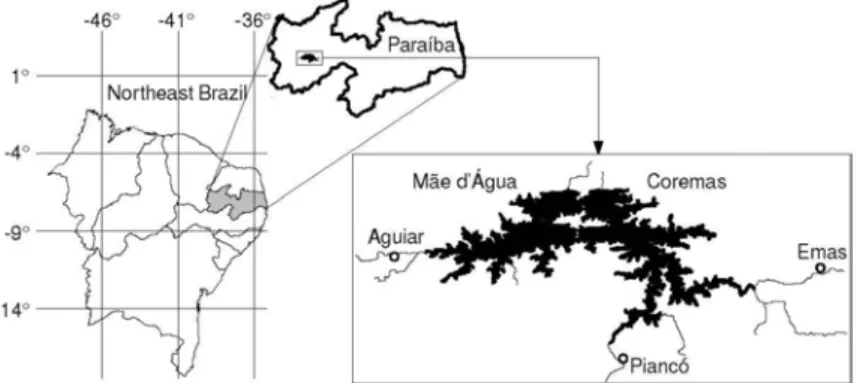
The reservoirs Coremas and Mãe d’Água dam up, respectively, the rivers Piancó and Aguiar, located in southwest Paraíba (Figure 1). The reservoirs are connected to each other by an open canal with a capacity of 12 m3/s, and form a single lake with a water surface area of 115.6 km2 at the top elevation.
Figure 1 – Location of the Coremas-Mãe d’Água system.
The Coremas reservoir, with a 720-million-cubic-meter capacity, is responsible for hydroelectric generation and regulation of the Piancó River by means of the plant discharge that supplies all downstream demands except those of the so-called “Canal da Redenção” (Redemption Canal), which are supplied directly by the Mãe d’Água reservoir. The Coremas reservoir has two important tributaries: the Piancó River (main tributary), which controls 59.4% of the catchment area and is responsible for approximately 50% of all inflow to the system; and the Emas River, which controls 40.6% of the watershed (Lima, 2004).
The Mãe d’Água reservoir, with a 638.7-million-cubic-meter capacity, supplies an irrigation perimeter (5000 ha) at the city of Sousa (in the interior of the state) by means of the Canal da Redenção, with a total extension of 37 km. The Aguiar River is the principal tributary of the Mãe d’Água reservoir and responsible for 19.8% of all inflow to the system (Lima, 2004). The major difficulty for the mathematical modeling of the Coremas-Mãe d’Água system is the implementation of the water transfer between both reservoirs. The difference in water surface elevation at the two lakes and the elevation of the interconnecting canal defines which reservoir is being water-fed by the other and whether there is such feeding or not, the latter case occurring when both maximum levels are below the elevation of the canal.
Table 1 – Characteristics of the equivalent reservoir.
Dead Storage
(hm3) Storage (hmMaximum 3) Active Storage (hm3)
Coremas 32.0 720.0 688.0
Mãe d’Água 14.8 638.7 623.9
Equivalent Reservoir 46.8 1358.7 1311.9
2.2 Implicit Stochastic Optimization
In practice, reservoir operation is usually carried out by the use of rule curves, which serve as guidance to the operators by stipulating the actions that should be taken conditioned on the current state of the system. Rule curves are typically constructed from simulation models but can also be developed by means of optimization strategies. Implicit stochastic optimization, also referred to as Monte Carlo optimization, provides a way to derive rule curves by incorporating the uncertainties of reservoir inflows.
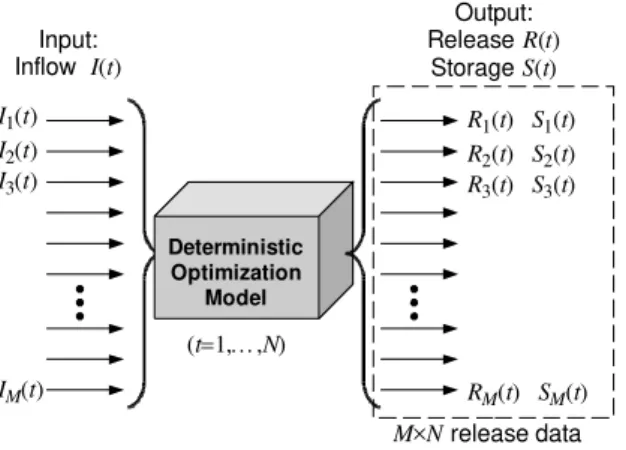
ISO uses a deterministic optimization model to find optimal reservoir releases under several different inflow scenarios. For each inflow realization, a different operating policy is found. The set of all operating policies is then examined in order to construct reservoir release rules (Figure 2). Classically, multiple regression analysis is applied to the optimization results in order to develop operating rules conditioned on observable information such as current storage levels, previous period and/or forecasted inflows (Labadie, 2004).
Input: Inflow I(t)
Deterministic Optimization
Model I2(t)
I3(t)
IM(t)
R1(t) S1(t)
R2(t) S2(t)
R3(t) S3(t)
RM(t) SM(t) (t=1,…,N)
Output: Release R(t)
Storage S(t)
M×N release data I1(t)
Figure 2 – Implicit stochastic optimization.
The releases were again established by least squares multiple regression on the current-period inflow and initial storage. Kim & Heo (2000) used ISO combined with two types of linear equations for the regression analysis to define monthly operating rules for a multipurpose reservoir. Willis et al. (1984) devised a different approach that utilized the probability mass function of the optimal releases, conditioned on reservoir storage and inflow. Other alternatives to regression analysis are the application of artificial neural networks (Farias et al., 2006; Chandramouli & Deka, 2005) and fuzzy rule-based modeling (Shrestha et al., 1996) to inferring the operating rules. Unlike most previous applications of ISO, this study explores its use in a system under semiarid conditions.
In order to develop monthly rule curves, the ISO procedure follows the three basic steps described below:
1. Generate M synthetic N-month sequences of inflows;
2. For each inflow realization, find the optimal releases for all N months by means of a deterministic optimization model;
3. Use the ensemble of optimal releases (M×N data) to develop monthly operating rules.
In this study, the releases obtained by the optimization model are conditioned on the reservoir storage at the beginning of the current month and the inflow predicted for this month. One relationship (rule) is determined for each month of the year. Thus, with information of initial reservoir storage and forecasted inflow for a given month, the amount of water that should be released can be defined by the corresponding rule.
The next section outlines the generation of synthetic inflow data for the system (step 1 of the ISO procedure) and section 2.4 explains the deterministic optimization model used in step 2. For step 3, ISO models may consider various predefined forms of policies, such as linear and nonlinear polynomials, artificial neural networks, fuzzy rules, etc. (Momtahen & Dariane, 2007). The present study applies multiple nonlinear regression together with a strategy based on two-dimensional interpolation, which are described in sections 2.5 and 2.6, respectively.
2.3 Generation of synthetic inflows
The recorded inflow data at the gaging stations of Piancó and Emas were obtained from the HidroWeb data base – Hydrologic Information System of the Brazilian National Water Agency. The Piancó gaging site contains a 39-year monthly series (January 1963 to December 2001) while Emas has two series: one from November 1963 to December 1972 and another from May 1984 to December 2001.
The data of the Aguiar gaging station were taken from the work of Câmara (2000). These data belong to a 35-year series (January 1950 to December 1984) generated by the MODHAC rainfall-runoff model (Lanna & Schwarzbach, 1989). Besides, the period of unrecorded data for the Emas series (January to October 1963 and January 1973 to April 1984) was filled with MODHAC-generated data for this station also available in the work of Câmara (2000).
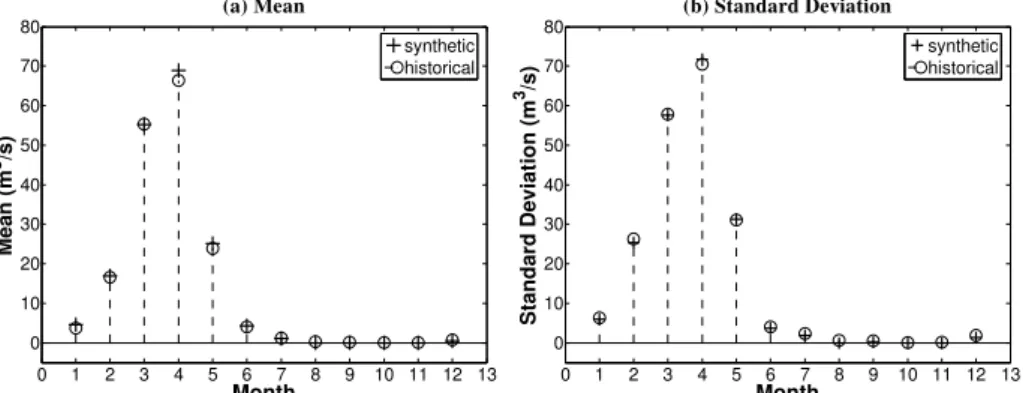
Synthetic inflow series were generated by means of the classic Thomas-Fiering stochastic streamflow model (Thomas & Fiering, 1962). The Thomas-Fiering model may be viewed as a non-stationary first order autoregressive (AR1) model. It was developed to implicitly allow for the non-stationarity of seasonal data (Reddy, 1987). However, as detailed by Celeste et al. (2007), this model is not well suited for semiarid regions because of the problem of zeros in the data. For a better fitting, one of the model’s parameters for the dry months of August and October was heuristically calibrated. Figure 4 shows the comparison of monthly mean and standard deviation between the historical inflow series and a 1000-year synthetic series generated by the model.
1 2 3 4 5 6 7 8 9 10 11 12
0 50 100 150 200 250 In fl ow (m 3/s ) Month
Figure 3 – Box plot of the historical inflow data.
0 1 2 3 4 5 6 7 8 9 10 11 12 13
0 10 20 30 40 50 60 70 80 Month Mea n ( m 3 /s) (a) Mean synthetic historical
0 1 2 3 4 5 6 7 8 9 10 11 12 13
0 10 20 30 40 50 60 70 80 Month St and a rd De vi at io n ( m 3/s )
(b) Standard Deviation
synthetic historical
Figure 4 – Comparison of (a) mean and (b) standard deviation of historical and synthetic inflow series.
2.4 Deterministic optimization model
The deterministic operation optimization model assumes that the main objective of the operation is to find the allocations of water that best satisfy their respective demands without compromising the system. The objective function may be thus written as follows:
2 1 ( ) ( ) minimize ( ) = − ⎡ ⎤ ⎢ ⎥ ⎣ ⎦
∑
N tR t D t
where t is the month index; N is the operating horizon in months; and R(t) and D(t) are, respectively, release and demand in month t.
Release and storage at each period are related to inflow and spill through the continuity equation for the system:
( )= ( − +1) ( )− ( )− ( )− ( ); ∀
S t S t I t E t R t Sp t t (2)
in which S(t) is the reservoir storage at the end of month t (when t=1, S t( −1) is equal to
S0, the initial reservoir storage); I(t) and E(t) are, respectively, inflow and evaporation volumes during month t; and Sp(t) is the water volume that might eventually spill from the reservoir during month t.
The physical limitations of the system define lower and upper bounds of release, storage and spill values:
0≤R t( )≤D t( ); ∀t (3)
dead ≤ ( )≤ max; ∀
S S t S t (4)
( ) 0;≥ ∀
Sp t t (5)
where Sdead is the dead storage and Smax is the storage capacity of the reservoir.
The above optimization model represents a quadratic programming (QP) problem with linear constraints. This model was implemented in MATLAB and solved by a quadratic programming procedure that is part of the MATLAB Optimization Toolbox.
The monthly demand D(t) of the objective function (1) was assumed to be the reservoir yield at 95% reliability. This yield was determined based on the so-called Standard Operating Policy (SOP) that specifies the total reservoir release as a function of the available water: when the water available is less than the demand, all storage water is released; and when the available water exceeds the demands, the excess is stored in the reservoir until its maximum capacity is reached and spillage starts to occur. For the reservoir equivalent to the Coremas-Mãe d’Água system, the SOP was used to construct a curve relating yield vs. reliability from the 1000-year synthetic inflow series generated by the Thomas-Fiering model. The yield at 95% reliability was found to be 12.48 m3/s.
2.5 Regression-based ISO model
The regression-based ISO model initially groups the optimal operating data found during step 2 of the ISO procedure month by month (January to December). This is done by conditioning release on reservoir storage at the beginning of the month and inflow for the month. Then, the model applies regression analysis to fit the following nonlinear equation to the data:
2 2 2 2
dead min
2 2 2 2
max max dead min ( 1) ( )
( )= ( )⎡⎢ − + − + ⎤⎥
⎢ + − + ⎥
⎣ ⎦
m
S t I t S I
R t D t
S I S I
(6)
storage ( (S t− =1) Smax) combined with maximum inflow ( ( )I t =Imax) provide maximum release ( ( )R t =D t( )).
Dry months of semiarid regions usually contain many inflow values equal to zero. A month was considered dry when at least 70% of its inflow values equaled zero. For such months, the releases R(t) were conditioned only on the storage S(t). For dry months, the regression equation becomes:
dead max dead ( 1) ( )= ( )⎡⎢ − − ⎤⎥
−
⎣ ⎦
m
S t S
R t D t
S S (7)
The task is thus to find, for each month, the value of the parameter m that fits the above equations to the data from the optimization model.
2.6 Interpolation-based ISO model
The interpolation-based ISO model uses the same data grouping as in the previous model. However, instead of fitting a curve (actually, a surface) to the data, this model uses two-dimensional interpolation in order to obtain the release given initial storage and inflow. The interpolation is computed by means of a MATLAB routine called gridfit that models two-dimensional surfaces from scattered data (D’Errico, 2005). This routine can handle data with replicates and collinear points and builds a surface over a complete lattice, extrapolating smoothly into the corners. Such interpolation process might be able to better account for the high nonlinearities present in the data than the regression-based model, which uses a smooth surface to fit the data.
3. Results and discussion
The Monte Carlo process was executed over an operating horizon of 228 months (19 years). Fifty inflow sequences were generated by the Thomas-Fiering model. Each 228-month sequence was used as input to the deterministic model (1)-(5). The initial storage was set to Smax. The optimization results for the first and last two years were discarded in order to avoid the influence of the boundary conditions (initial and final storages). This provided 9000 optimal release and storage values.
Release, initial storage and inflow values for January through December were grouped month by month and used to define the rules by the regression and interpolation procedures described in sections 2.5 and 2.6, respectively.
The months of August through December were found to be dry since more than 70% of their inflow values were zero. As mentioned before, the operating rules relate only release and storage for these months.
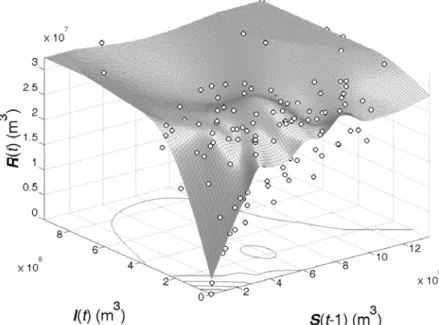
Figure 5 – Rule curve for April by the regression-based ISO approach. The circles represent the data.
0 2 4 6 8 10 12 14 x 108 0
0.5 1 1.5 2 2.5 3 3.5x 10
7
S(t-1) (m3)
R(
t
) (m
3 )
Data Fitted
Figure 7 – Rule curve for October by the regression-based ISO approach.
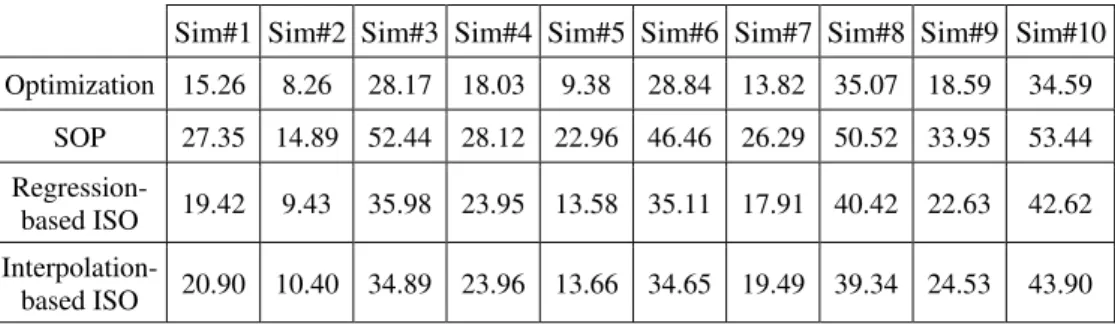
After the construction of the release rules, they were applied to operate the reservoir under 10 new 19-year monthly inflow ensembles (named Sim#1, Sim#2 up to Sim#10) and the results were compared with those obtained by using the deterministic optimization model with these same inflow ensembles as perfect forecasts. The system operation under perfect forecast provides the ideal releases that should be employed for all months within the 19 years given that, in this situation, the model has knowledge of all future monthly inflows. Thus, the solutions from the perfect-forecast optimization model may be used as a benchmark. SOP-based operations were also employed for comparison.
Table 2 – Values of vulnerability for all simulations.
Sim#1 Sim#2 Sim#3 Sim#4 Sim#5 Sim#6 Sim#7 Sim#8 Sim#9 Sim#10 Optimization 15.26 8.26 28.17 18.03 9.38 28.84 13.82 35.07 18.59 34.59
SOP 27.35 14.89 52.44 28.12 22.96 46.46 26.29 50.52 33.95 53.44
Regression-based ISO 19.42 9.43 35.98 23.95 13.58 35.11 17.91 40.42 22.63 42.62
Interpolation-based ISO 20.90 10.40 34.89 23.96 13.66 34.65 19.49 39.34 24.53 43.90
4. Conclusions
In this study, a stochastic optimization strategy based on Monte Carlo analysis was implemented to implicitly incorporate the inflow uncertainties involved in the operation of a reservoir located in the semiarid region of Brazil. Several operating rules were derived for the system and they showed to be able to produce policies comparable to the ones obtained by deterministic optimization using perfectly forecasted inflows. In contrast to the optimization approach, however, the derived rules need to estimate only the inflow for the current month. In this way, implicit stochastic optimization shows to be advantageous against pure simulation procedures and scenario optimization and may assist operators in the management of systems in which the uncertainties cannot be ignored.
Acknowledgements
The first author wishes to acknowledge Brazil’s National Council for Scientific and Technological Development (CNPq) and the State of Paraíba Research Foundation (FAPESQ) for the financial support to this research.
References
(1) Câmara, E.P. (2000). Otimização da água do reservatório Coremas/Mãe d’Água para múltiplos usos. M.Sc. Thesis, Universidade Federal da Paraíba, Campina Grande – PB, Brazil.
(2) Celeste, A.B.; Curi, W.F. & Curi, R.C. (2007). Análise de métodos para geração sintética de vazões em rios intermitentes. In: Proceedings of the XXVII Simpósio Brasileiro de Recursos Hídricos, São Paulo, CD-ROM.
(3) Chandramouli, V. & Deka, P. (2005). Neural network based decision support model for optimal reservoir operation. Water Resources Management, 19(4), 447-464.
(4) D’Errico, J. (2005). Surface fitting using gridfit. Available at <http://www.mathworks.com/matlabcentral/fileexchange/loadFile.do?objectId=8998>. (5) Farias, C.A.S.; Celeste, A.B.; Kadota, A. & Suzuki, K. (2006). ANN- against
(6) Karamouz, M. & Houck, M.H. (1982). Annual and monthly reservoir operating rules generated by deterministic optimization. Water Resources Research, 18(5), 1337-1344. (7) Kim, T. & Heo, J-H. (2000). Application of implicit stochastic optimization in the Han
River basin. In: Proceedings of the 4th International Conference on HydroScience & -Engineering, Seoul, CD-ROM.
(8) Labadie, J.W. (2004). Optimal operation of multireservoir systems: State-of-the-art review. Journal of Water Resources Planning and Management, 130(2), 93-111. (9) Lanna, A.E.L. & Schwarzbach, M. (1989). MODHAC – Modelo hidrológico
auto-calibrável. Instituto de Pesquisas Hidráulicas, UFRGS, Porto Alegre – RS, Brazil. (10) Lima, C.A.G. (2004). Análise e sugestões para diretrizes de uso das disponibilidades
hídricas superficiais da bacia hidrográfica do Rio Piancó, situada no Estado da Paraíba. Doctorate Thesis, Universidade Federal de Campina Grande, Campina Grande – PB, Brazil.
(11) Momtahen, Sh. & Dariane, A.B. (2007). Direct search approaches using genetic algorithms for optimization of water reservoir operating policies. Journal of Water Resources Planning and Management, 133(3), 202-209.
(12) Reddy, P.J. (1987). Stochastic Hydrology. Laxmi Publications, Delhi.
(13) Shrestha, B.; Duckstein, L. & Stakhiv, E. (1996). Fuzzy rule-based modeling of reservoir operation. Journal of Water Resources Planning and Management, 122(4), 262-269. (14) Thomas, H.A. & Fiering, M.B. (1962). Mathematical synthesis of stream-flow sequences
for the analysis of river basins by simulation. In: Design of Water Resource Systems [edited by A. Maass et al.], Harvard Univ. Press, Cambridge, Massachusetts, 459-493. (15) Willis, R.; Finney, B.A. & Chu, W-S. (1984). Monte Carlo optimization for reservoir
operation. Water Resources Research, 20(9), 1177-1182.