Effect of washing on the bioefficacy of insecticide-treated nets (ITNs)
and long-lasting insecticidal nets (LLINs) against main malaria vector
Anopheles stephensi by three bioassay methods
J. Rafinejad
a, H. Vatandoost
a, F. Nikpoor
a, M.R. Abai
a, M. Shaeghi
a, S. Duchen
b&
F.
Rafi
aaSchool of Public Health & Institute of Health Research, Medical Sciences/University of Teheran, Iran; bInstitut de Recherche
pour le Development, Montpellier Cedex 1, France
Abstract
Background & objectives: The use of pyrethoid impregnated bednets is one of the main malaria vec-tor control strategies worldwide. The objective of the present study was to evaluate the bioefficacy of bednets impregnated with various pyrethroids after repeated washings.
Methods: The effectiveness of bednets impregnated with permethrin, deltamethrin, bifenthrin, etofenprox and long-lasting bednets like OlysetNet® and PermaNet® which were provided by
WHOPES was evaluated. The tests were carried out according to the WHO-recommended methods. Malaria vector, Anopheles stephensi was exposed to impregnated bednets for 3 min and the mortality was measured after 24 h recovery period. Knockdown was measured as well.
Results: Results of three methods of bioassay tests showed that between two LLINs, PermaNet® was
more efficient than OlysetNet®. Results of ITNs exhibited that deltamethrin and permethrin were more
effective than etofenprox and bifenthrin as impregnants.
Interpretation & conclusion: Findings of this study will be useful for WHO, local authorities and people who wish to use different pyrethroid-impregnated bednets for malaria vector control.
Key words Anopheles stephensi – bednet – Iran – malaria – pyrethroids
Introduction
Malaria is considered as a main vector-borne diseases worldwide. Different methods for mosquito control have been proposed by the investigators. An impor-tant innovation during the past decade is the wide-spread introduction of insecticide-treated mosquito nets (ITNs and LLINs) for protection against malaria transmission. Pyrethroids are today the only class of insecticides recommended for the impregnation of mosquito nets due to their rapid knock-down effects and high insecticidal potency at low dosages
com-bined with relative safety for human contact, domes-tic handling and their low mammalian toxicity1.
Pyre-throid-impregnated nets have an impact on reducing mortality and morbidity due to malaria2,3. If the
cov-erage is good they also provide community protection by significantly reducing the vector populations4,5.
For the treatment of net, WHOPES recommended alphacypermethrin, cyfluthrin, deltamethrin, perme-thrin, etofenprox and bifenthrin at recommended dosage6,7. The concentration which is recommended
in-secticide. Advantages of LLINs can be categorized as: ready to use, dirt-repellent net, long-lasting effi-cacy, and high durability to washing and wide mesh size to provide good airflow.Applied objectives of current research are comparison between efficacy of ITNs and LLINs and to find sensitivity and calibra-tion of different bioassay tests for ITNs and LLINs.
Material & Methods
Deltamethrin, permethrin, bifenthrin and etofenprox; PermaNets and OlysetNets were provided by WHO Collaborating Centre, Montpellier, France. Out of 6 polyester mosquito nets four nets were 75 denier (ITNs: permethrin, deltamethrin, bifenthrin and etofenprox) and two nets were long-lasting nets (PermaNet with 100 denier and OlysetNet with 150 denier). Mosquito nets were conventionally treated with permethrin EC (500 mg a.i./m2), deltamethrin
SC (25 mg a.i./m2), etofenprox EW (200 mg a.i./m2)
and bifenthrin SC (25 mg a.i/m2) by the WHO
Col-laborating Centre, Montpellier, France. Ten pieces (25 × 25 cm) of the net were cut (two on each side-by-side samples collected for bioassays) and were subjected to chemical assay. A seventh net was left as untreated (negative control). Eight pieces from the same net (40 × 40 cm) were used for cone and tube bioassays and tunnel test before and after every wash-ing (e.g. 0x, 1x, 2x, 3x, 4x), following WHO standard
washing procedure8. The nets were washed and dried
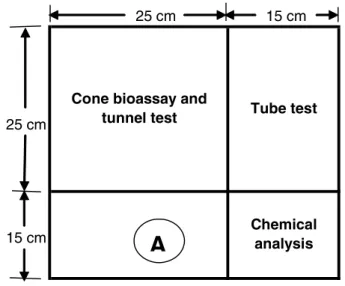
once a week. Cone and tube bioassays and tunnel test were performed on one randomly selected net for each insecticide before next washing. Each selected 40 × 40 cm net was cut into the following pieces (Fig. 1) and used as specified below: (i) a 25 × 25 cm net was used in cone bioassay, followed by tunnel test; (ii) a 25 × 15 cm net was used for tube bioassay; and (iii) a 15 × 15 cm for chemical analysis. Detergent (Le chat) was provided by WHO Collaborating Centre, Montpellier, France via WHOPES.
Washing procedure: Net samples (40 × 40 cm) were individually introduced into 1–l beakers containing
0.5 liter deionized water, with 2 g/L soap “Le chat” (added and fully dissolved just before introduction of net samples). Beakers were immediately introduced into a water bath at 30°C and shaken for 10 min at 155 movements per min. The samples were then removed and rinsed twice for 10 min in clean, deionized wa-ter in the same shaking conditions as stated above. Nets were dried at room temperature and stored at 30°C in the dark between washes.
Bioassay tests: Three bioassay methods were used for the determination of biological efficacy of pyre-throids on treated mosquito nets. Non-blood fed, 2– 3 days old susceptible female Anopheles stephensi
(Diptera: Culicidae) mosquitoes (BEECH strain), susceptible to all pyrethroids reared in the insectary of School of Public Health & Institute of Health Re-search, Teheran University of Medical Sciences were used for all experiments.
Cone and tube tests: Mosquitoes were exposed to netting samples for 3 min after which they were held for 24 h with access to 10% sugar solution. Knock-down was measured in log time up to 64 min post-ex-posure and mortality after 24 h. In cone bioassays,
25 cm 15 cm
25 cm
15 cm
Cone bioassay and
tunnel test Tube test
Chemical analysis
A
five mosquitoes were introduced into a cone at a time. At least 60 mosquitoes were tested on a netting sample (25 × 25 cm).
In tubes (cylinder) bioassays, 10 female mosquitoes were introduced into a cylinder at a time and at least 60 mosquitoes were tested (6 × 10) on a netting sample. The 25 × 15 cm nets were folded to 12.5 × 15 cm and introduced in the test tubes, lining the inside-surface of the tube. Three metallic clips were used instead of two to maintain the netting within test tubes properly. The top screen of the tube (see A in Fig. 1) was also made of the same fabric (same treatment and same number of washes). The tube was kept vertical during the 3 min exposure. The average mortality and knockdown time for mosquitoes in cone bioassay and mosquitoes in tube bioassays were calculated for each insecticide used for treatment of nets separately. Mosquitoes exposed to untreated nets were used as controls. Bioassays were carried out at 25+ 2°C and 75 + 10% relative humidity.
Tunnel test: Efficacy (mortality and blood feeding inhibition) of netting samples was studied in the labo-ratory by releasing non-blood fed female An. stephensi mosquitoes, aged 5–8 days, in a tunnel (square section 25 × 25 cm) made of glass, 60 cm length. At each end of the tunnel, a 25 cm2 cage was
fitted (extension) and covered with polyester netting. At one-third of the length (20 cm within the tunnel), a disposable cardboard frame was placed with the treated netting sample. The surface of netting ‘avail-able’ to mosquitoes was 400 cm2 (20 × 20 cm) with
nine holes, each 1 cm in diameter: one whole was lo-cated at the centre of the square and the other eight were equidistant and located at 5 cm from the border. In the shorter section of the tunnel, a bait (guinea pig) was placed, unable to move. In the cage at the end of the longer section of the tunnel, 100 females were in-troduced at 1800 hrs. Females were free to fly in the tunnel but had to make contact with the piece of net-ting and locate the holes in it before passing through to reach the bait. The following morning, at 0900 hrs
the mosquitoes were removed by hand using a suc-tion glass tube and counted separately from the two sections of the tunnel and the immediate mortality was recorded. Live females were placed in plastic cups with honey solution; delayed mortality was re-corded after 24 h. During tests, cages were main-tained at 27 + 2°C and 80 + 10% relative humidity under subdued light. One tunnel with untreated net-ting was always used as a negative control. Blood feeding inhibition was assessed by comparing the proportion of blood-fed females (alive or dead) in treated and control tunnels. Overall mortality was measured by pooling the immediate and delayed (24 h) mortalities of mosquitoes from the two sec-tions of the tunnel. The proportion of mosquitoes able to pass through the netting was also recorded. By comparison with control, an eventual reduction in penetration was calculated. This reduction provided an indication on the repellent effect of the insecticide and to which extent this effect was correlated with mortality8. If the control mortality was between 5 and
20%, the percentage mortality was corrected using Abbott’s formula9. For calculating KD
50 the probit
analysis of Finney10 and mortality analysis with SPSS
(univariate analysis) was used.
Results
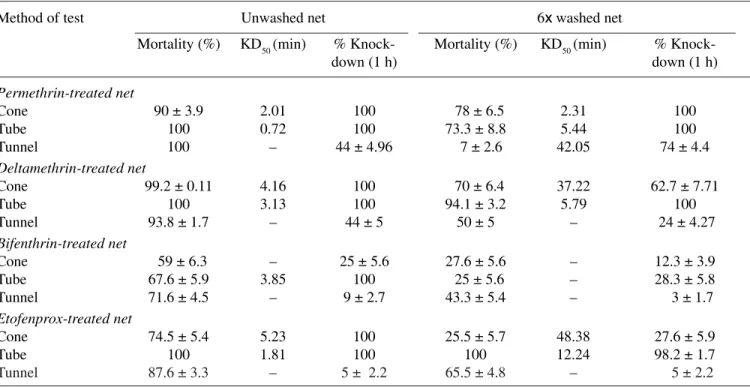
ITNs and cone test: The mortality of An. stephensi ex-posed to permethrin-impregnated nets by using coni-cal test decreased from 90% in unwashed net to 78% after six washes. There was no significant difference in KD50 and 1 h knockdown between unwashed and 6x washed nets (Table 1). The mortality against
deltamethrin-treated nets was 99.2% on unwashed and 70% on 6x washed nets. KD
50 increased
signifi-cantly from 4.16 to 37.2 min (p<0.05). After six washes the 1 h knockdown was 62.7%, which is sig-nificantly lower than that of unwashed net (Table 1). Against bifenthrin-treated nets the mortality was 59% on unwashed and 27.6% on 6x washed nets.
etofenprox-treated nets was 74.5% and 25.5% on unwashed and 6x washed nets, respectively. KD
50
after six washes was 48.38 min which was 9-fold more than the unwashed one. Knockdown after 1 h decreased 3.6 fold after six washes (Table 1). Mor-talities on unwashed nets treated with different insec-ticides were in the order of deltamethrin > permethrin > etofenprox > bifenthrin. However, after six washes the mortalities were in the order of permethrin > deltamethrin > bifenthrin > etofenprox.
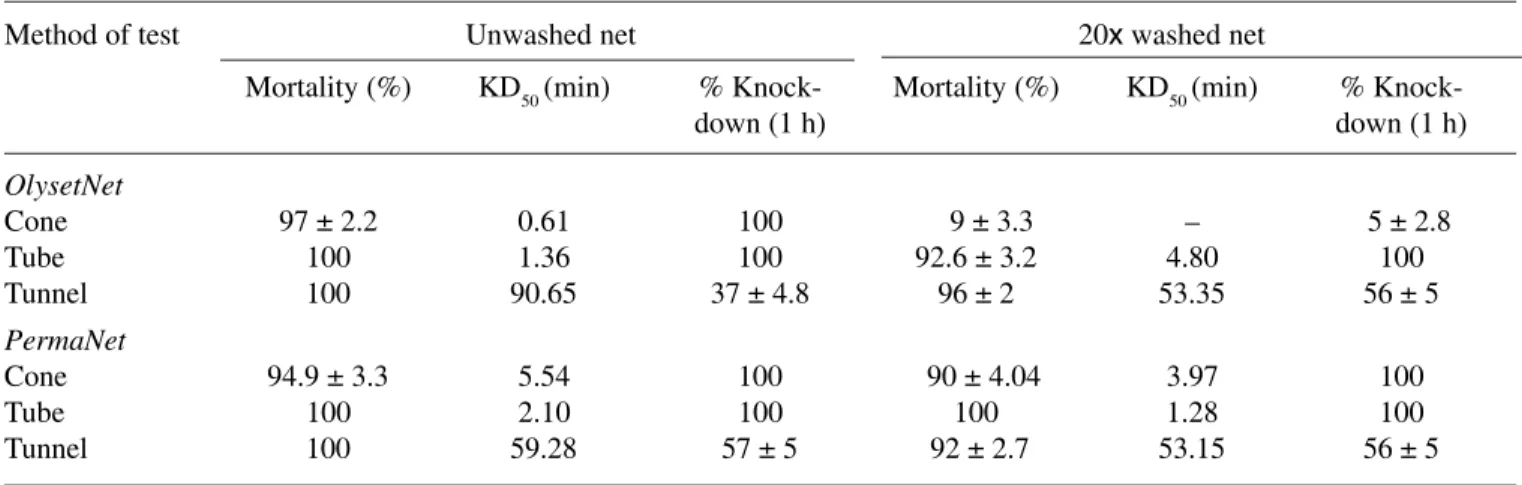
LLINs and conical test:The mortality against Olyset-Net was 97% on unwashed net and decreased to 9% on 20x washed one. Percent knockdown in 1 h
de-clined from 100% to 5% after 20 washes (Table 2), whereas against PermaNet mortality was 94.9% and 90% on unwashed and 20x washed nets, respectively.
There was no significant difference between 1 h knockdown time between the unwashed and 20x
washed ones (Table 2). PermaNet showed higher ef-ficacy than the OlysetNet.
ITNs and tube test: The mortality of An. stephensi
exposed to permethrin-treated nets in tube test de-creased from 100% on unwashed net to 73.3% on 6x
washed net. KD50 values for unwashed and 6x
washed nets were 0.72 and 5.44 min respectively. There was no change in 1 h knockdown. The mor-tality against deltamethrin-treated net was 100 and 94.1% respectively on unwashed and 6x washed nets.
KD50 slightly increased when the nets were washed six times. On bifenthrin-treated nets, the mortality re-duced from 67.6% on unwashed net to 25% in 6x
washed one and 1 h knockdown reduced from 100% to 28.3%. In case of etofenprox-treated nets the mortality was 100% on both unwashed and 6x
washed nets (Table 1). The mortality after 6x washes
was in the order of etofenprox > deltamethrin > permethrin >bifenthrin.
LLINs and tube test:For OlysetNet the mortality rate decreased from 100% on unwashed net to 92.6% on 20x washed net. KD
50 increased 3.6-fold after 20x
washes. But 1 h knockdown time did not change at all. The mortality rate and 1 h knockdown of An. stephensi exposed to PermaNet showed no
signifi-Table 1. Mortality and knockdown of An. stephensi exposed to different types of ITNs in different bioassays
Method of test Unwashed net 6x washed net
Mortality (%) KD50 (min) % Knock- Mortality (%) KD50 (min) %
Knock-down (1 h) down (1 h)
Permethrin-treated net
Cone 90 ± 3.9 2.01 100 78 ± 6.5 2.31 100
Tube 100 0.72 100 73.3 ± 8.8 5.44 100
Tunnel 100 – 44 ± 4.96 7 ± 2.6 42.05 74 ± 4.4
Deltamethrin-treated net
Cone 99.2 ± 0.11 4.16 100 70 ± 6.4 37.22 62.7 ± 7.71
Tube 100 3.13 100 94.1 ± 3.2 5.79 100
Tunnel 93.8 ± 1.7 – 44 ± 5 50 ± 5 – 24 ± 4.27
Bifenthrin-treated net
Cone 59 ± 6.3 – 25 ± 5.6 27.6 ± 5.6 – 12.3 ± 3.9
Tube 67.6 ± 5.9 3.85 100 25 ± 5.6 – 28.3 ± 5.8
Tunnel 71.6 ± 4.5 – 9 ± 2.7 43.3 ± 5.4 – 3 ± 1.7
Etofenprox-treated net
Cone 74.5 ± 5.4 5.23 100 25.5 ± 5.7 48.38 27.6 ± 5.9
Tube 100 1.81 100 100 12.24 98.2 ± 1.7
cant difference between unwashed and 20x washed
nets (Table 2). PermaNet showed higher efficacy than the OlysetNet.
ITNs and tunnel test:The mortality of An. stephensi
exposed to permethrin-treated nets in tunnel test de-creased from 100% on unwashed net to 7% on 6x
washed one. The KD50 of 6x washed net was 42.05
min. The 1 h knockdown increased to 74% on 6x
washed net which is 1.7-fold more than the unwashed one. The mortality against deltamethrin-treated net was 93.8% on unwashed net and 50% on 6x washed
net. KD50 was not measurable. Unwashed bifenthrin-treated net produced a mortality of 71.6% whereas 6x washed net produced 43.3%. Etofenprox-treated
unwashed net produced a mortality of 87.6% whereas 6x washed net produced 65.5% mortality.
There was no significant difference in terms of 1 h knockdown time between unwashed and 6x washed
nets (Table 1). In the tunnel test the order of efficacy of 6x washed nets was: etofenprox > deltamethrin >
bifenthrin > permethrin.
LLINs and tunnel test:For OlysetNet the mortality rate decreased from 100% on unwashed net to 96% on 20x washed nets and KD
50 value reached to 53.35
min after 20 washes. The mortality rate of An. stephensi exposed to PermaNet decreased from 100% on unwashed net to 92% after 20 washes. KD50 also decreased after progressive washes (Table 2).
Discussion
The present study assessed the efficacy and wash-re-sistance of four pyrethroids namely deltamethrin, permethrin, etofenprox and bifenthrin as impregna-nts; and OlysetNet and PermaNet the two long-last-ing insecticidal nets uslong-last-ing different bioassay meth-ods. Results of different bioassay methods on permethrin-impregnated nets revealed 100% mortal-ity on unwashed nets in both tube and tunnel tests, but in cone bioassay only 90% mortality was recorded. In contrary, after six washes the mortality was 7% in tunnel test. In comparison to tunnel test higher mor-tality was observed in cone and tube tests on 6x
washed nets. Percentage of 1 h knockdown on un-washed and 6x washed nets was 100% in both cone
and tube tests, but in tunnel test 44 and 74% mortal-ity was recorded on unwashed and 6x washed nets,
respectively. These results are attributed to the large space of tunnel, hence mosquitoes are not obliged to contact the nets impregnated with insecticide.
Military shirt fabric impregnated with permethrin against An. farauti caused 94–100%mortality in un-washed and decreased to 28% after two washes fab-ric in Australia11. They found <20% knockdown
mor-tality after three washes. Using bifenthrin, the authors
found 100 and 55% mortality on unwashed and 3x
washed nets, respectively11. After two washes they
re-ported only 25% of knockdown. The effect of cold
Table 2. Mortality and knockdown of An. stephensi exposed to OlysetNets and PermaNets in different bioassay tests
Method of test Unwashed net 20x washed net
Mortality (%) KD50 (min) % Knock- Mortality (%) KD50 (min) %
Knock-down (1 h) down (1 h)
OlysetNet
Cone 97 ± 2.2 0.61 100 9 ± 3.3 – 5 ± 2.8
Tube 100 1.36 100 92.6 ± 3.2 4.80 100
Tunnel 100 90.65 37 ± 4.8 96 ± 2 53.35 56 ± 5
PermaNet
Cone 94.9 ± 3.3 5.54 100 90 ± 4.04 3.97 100
Tube 100 2.10 100 100 1.28 100
water washing on the persistence of both chemicals in fabric by chemical assays showed that between 58 and 66% of both chemicals was lost from the test fabric after a single wash. The authors did not men-tion the method for determinamen-tion of amount of chemical loss in impregnated bednets.
Mortality rate of An. stephensi exposed to deltame-thrin impregnated nets revealed differences in meth-ods of tests. Only tube test showed 100% mortality with unwashed nets. Results showed that the tube test is more appropriate than the other two tests. There was no change of 1 h knockdown in unwashed and six washed nets using tube test. However, the results for cone and tunnel test on these parameters were signifi-cantly different (p<0.001)12. In the same study the
field trials with deltamethrin treated nets (KO-Tab) at 25 mg/m2 against An .stephensi and An. culicifacies
in Indiashowed considerably reduced insecticidal action (65–78%) after two washes12.
Nylon bednets impregnated with permethrin, cyper-methrin, deltacyper-methrin, lambdacyhalothrin and pirimi-phos-methyl were evaluated in 1988 against wild adult mosquito populations, mostly Mansonia africana Theobald and An. gambiae Giles sensu lato, entering experimental verandah-trap huts in The Gambia. Washing three times in the traditional man-ner with local cow-fat soap reduced the initial dos-ages by about 85% of cypermethrin and lambda-cyhalothrin, 99.8% of pirimiphos-methyl and left no detectable residues of deltamethrin or permethrin. The unwashed permethrin-treated bednet reduced the number of mosquitoes entering a hut by 60% of
An.gambiaes.l. and 68% of Mansonia spp. Washing completely removed the efficacy of deltamethrin and permethrin treated bednets, whereas nets treated with cypermethrin, lambdacyhalothrin or pirimiphos-methyl remained significantly effective after wash-ing13.
In a study by Corbel et al14, mixture of bifenthrin and
carbosulfan was sprayed on mosquito net samples
and their efficacy was tested against a susceptible strain of An. gambiae and the observed mortality was significantly more than expected in the absence of any interaction. They recommended that one strategy for resistance management would be to treat mos-quito nets with a mixture comprising two insecticides having different modes of action. In the present study, mortality of An. stephensi exposed to etofenprox was more pronounced when tube test was used. Cone test had least efficacy on mortality with unwashed nets.
Prasittisuk et al15 conducted a study on repellency
and killing effect of etofenprox, deltamethrin, lambdacyhalothrin and permethrin-treated mosquito nets on field malaria vector populations in experi-mental huts and local houses in westnorth of Thailand and found permethrin was most toxic to mosquitoes than others.
In the present study, 100% mortality was observed using tube and tunnel tests with OlysetNet. Cone test only yielded 97% mortality on unwashed nets. After 20 washes using cone test the mortality reached to the level of 9%, whereas in tube and tunnel tests the mortalities were 92.6 and 96% respectively. Olyset-Net was evaluated in a hut trial using verandah-trap in Ivory Coast16. Bioassays with 3 min exposure of
susceptible An. gambiae resulted in > 99% mortality. They concluded that OlysetNets remain remarkably effective against susceptible An. gambiae for at least three years under the field conditions. Similarly, OlysetNet trials in India against An. culicifacies and
An. fluviatilis using cone test also reported high ef-ficacy and wash resistance of OlysetNets even after 20 washes17,18.
In the present study, PermaNet caused 100% mortal-ity in both tube or tunnel tests. Similar to OlysetNet cone test only yielded 94.9% mortality. The mortal-ity in 20x washed nets was reduced in cone and
both washes was 100%.
In contrast, in a trial in Colombia and Bolivia19 using
cone test for evaluation of PermaNet, lambdacyhalo-thrin, deltamethrin and alphacypermethrin impreg-nated polyester nets against Anopheles sppreported 100% mortality after three washes. The procedure of their washing was competently different from that in our study. In this study the nets were washed with soap powder and tap water by local women. They found that the mortality after four washes declined considerably for lambdacyhalothrin, deltamethrin and alphacypermethrin. The wash resistance offered by PermaNet was much better and long-lasting. Gra-ham et al20 showed 97% mortality against Anopheles
in Pakistan, Iran and Tanzania trials using PermaNet after 21 washes. However, local washing regimes gradually reduced the insecticidal efficacy of conven-tionally treated nets with deltametrhrin and alphacy-permethrin. In the present study, the results of three methods of bioassay tests showed that deltamethrin and permethrin were more efficient than etofenprox and bifenthrin. For LLINs results of three methods of bioassay tests showed that PermaNet® is more
effec-tive than OlysetNet®. Bioefficacy of PermaNet® was
evaluated in both laboratory and field conditions against An. culicifacies and An. stephensi, in India21
and reported high mortality (>80%) even after 20 washes.
Our observation revealed that in cone test the sample net is located only at the bottom of cone. Due to re-pellency effect of pyrethroids and natural behaviour of mosquitoes, they have no tendency to rest at the bottom of the device. On the other hand, the excito-repellency phenomenon of insecticides may have an influence on the results of this method and the mos-quitoes may easily move upward and rest on the wall of the cone or cotton swab. It seems that the exposure time is not really three min. In tube test, the sample net covers all surfaces of the tube except its bottom where mosquitoes due to their natural behaviour do not rest. To fit the nets inside the tube is sometimes
difficult. In tunnel test, it is assumed that the test situ-ation is close to the natural circumstances but the mosquitoes may rest anywhere in the compartments as well as the sample net. Additionally, the age of mosquito used for tunnel test was older than other methods. Hougard et al22 in their experiments on
seven pyrethroid impregnated nets against suscep-tible and resistant strains of An. gambiae and Cx. quinquefasciatus using cone test found that the per-formance of irritancy and knockdown effect of pyre-throids depends mainly on strain and insecticide. In the present study also similar results were observed.
Although LLINs are recommended for malaria con-trol purposes, their performance should be monitored in the field under various ecological settings to assess their durability and long-term effectiveness for ma-laria prevention and control in Iran. Strategic plan of each country should be carefully designed to preserve the effectiveness of ITNs. Considering the different methods of bioassay it seems that cone bioassay test is an easier to perform than the other methods.
Acknowledgement
The authors would like to appreciate very much the kind cooperation of the staff of Medical Entomology and Vector Control Department, School of Public Health & Institute of Health Research, Medical Sci-ences/Teheran University. The authors were pro-vided useful comments from Dr M. Zaim and Dr P. Guillet, WHO (HQ), Geneva. This research is finan-cially supported by WHO/EMRO.
References
1. Zaim M, Aitio A, Nakashima N. Safety of pyrethroid-treated mosquito nets. Med Vet Entomol 2000; 14: 1–5.
2. Choi HW, Breman JG, Teutsch SM, Liu S, Hightower AW, Sexton JD. The effectiveness of insecticide-impregnated bednets in reducing cases of malaria infection: A meta-analysis of published results. Am J Trop Med Hyg 1995; 5
(5): 377–82.
method for preventing malaria deaths. Ottawa: Internation-al Development Research Center and Geneva: World Health Organization 1996; p. 260.
4. A global strategy for malaria control. Geneva: World Health Organization 1993; p. 40.
5. Takken W. Do insecticide-treated bednets have an effect on malaria? Trop Med Health 2002; 7: 1022–30.
6. Chavasse DC, Yap HH. Chemical methods for the control of vectors and pests of public healthimportance. Geneva: World Health Organization 1997. WHO/CTD/WHOPES/ 97.2.
7. Najera JA, Zaim M. Malaria vector control, decision mak-ing criteria and procedures for judicious use of insecticides.
Geneva: World Health Organization 2002. WHO/CDS/ WHOPES/2002.5.
8. Guidelines for laboratory and field testing of long-lasting insecticidal mosquito nets 2005. Geneva: World Health Organization 2005. WHO/CDS/WHOPES/GCDPP.
9. Abbott WS. A method for computing the effectiveness of insecticides. J Econ Entomol 1925; 18: 265–7.
10. Finney DJ. Probit analysis. III edn. Cambridge: Cambridge University Press 1971; p. 227.
11. Frances SP, Watson K, Constable BG. Comparative tox-icity of permethrin and bifenthrin-treated cloth fabric for
Anopheles farauti and Aedes aegypti. J Am Mosq Control Assoc 2003; 9(3): 275–8.
12. Bhatt RM, Yadav RS, Adak T, Babu CJ. Persistence and wash-resistance of insecticidal efficacy of nettings treated with deltamethrin tablet formulation (K-O Tab) against malaria vectors. J Am Mosq Control Assoc 2005; 21:
54–8.
13. Miller JE, Lindsay SW, Armstrong JR. Experimental hut trials of bednets impregnated with synthetic pyrethroid or organophosphate inseciticide for mosquito control in The Gambia. Med Vet Entomol 1991; 5(4): 465–76.
14. Corbel V, Darriet F, Chandre F, Hougard JM. Insecticide mixture for mosquito net impregnation against malaria vectors. Parasite 2002; 9(3): 255–9.
15. Prasittisuk M, Prasittisuk C, Pothichiti V, Aum_aung B, Mongklangkul P. The effect of pyrethroid impregnated mosquito nets on field malaria vector populations in exper-imental huts and individual local houses. Southeast Asian J Trop Med Public Health 1996; 27(30): 610–6.
16. N’ Guessan R, Darriet F, Doannio JMc, Chandre F, Carnev-ale P. Olyset net efficacy against pyrethroid-resistant of An. gambiae and Cx. quinquefasciatus after 3 years field use in Cote d Ivoir. J Med Vet Entomol 2001; 15: 97–104.
17. Sharma SK, Upadhyay AK, Haque MA, Padhan K, Tyagi PK, Ansari MA, Dash AP. Wash resistance and bioeffica-cy of Olyset net : a long-lasting insecticide-treated mosqui-to net against malaria vecmosqui-tors and non-target household pests. J Med Entomol 2006; 43(5): 884–8.
18. Ansari MA, Sreehari U, Razdan RK, Mittal PK. Bio-effi-cacy of Olyset nets against mosquitoes in India. J Am Mosq Control Assoc 2006; 22(1): 102–6.
19. Ordonez Gonzalez J, Kroeger A, Avina AI, Pabon E. Wash resistance of insecticide-treated materials. Trans R Soc Trop Med Hyg 2002; 96: 70–5.
20. Graham K, Kayedi MH, Maxwell C, Kaur H, Rehman H, Malima R, Curtis CF, Lines JD, Rowland MW. Multi-country field trials comparing wash-resistance of Perma-Net and conventional insecticide-treated nets against anopheline and culicine mosquitoes. Med Vet Entomol
2005 ; 19(1): 72–83.
21. Sreehari U, Mittal PK, Razdan RK, Ansari MA, Rizvi MMA, Dash AP. Efficacy of Permanet® 2.0 against
Anoph-eles culicifacies and Anopheles stephensi, malaria vectors in India. J Am Mosq Control Assoc 2007; 23(2): 220–3.
22. Hougard JM, Duehon S, Darrirt F, Zaim M, Rogier C, Guillet P. Comparative performances under laboratory conditions, of seven pyrethroid insecticide used for impreg-nation of mosquito nets. Bull WHO 2003; 81(5): 324–33.
Corresponding author: Dr H. Vatandoost, School of Public Health & Institute of Health Research, Medical Sciences/ University of Teheran, Teheran, Iran.
E-mail: [email protected]