AACL BI OFLUX
Aqu a cu lt u re , Aqu a riu m , Con se rv a t ion & Le gisla t ion
I n t e rn a t ion a l Jou rn a l of t h e Bioflu x Soci e t y
Com pa r a t ive st u dy on re a r in g som e v a lu a b le
spe cie s in in t e n sive syst e m u sin g n on
-con ve n t ion a l fod de rs
Nicolet a Do
brotă,
Gheorghe Dobrotă,
Mioara Cost ache,
Nino Marica
Research and Development Centre for Pisciculture Nucet, Nucet, no 549, Dâm bovița County. Corresponding author: N. Dobrotă, [email protected]
Abst ract. The authors of t his work proposed an experiment on rearing two valuable fish species (Cyprinus carpio and Polyodon spathula) in int ensive syst em , using non- conventional fodders ( sunflower groat s and rice bran) - first variant (I ) and mixed/ convent ional fodders ( fine grained) – second variant ( I I ) (using as cont rol) . I t is expect ed, t hat testing the fodders t o obt ain the best effect in the opt im izat ion of t he perform ances in rearing the t arget fish species. The experim ent has t aken place in conditions of an int ensive syst em in ground ponds ( pond no 8 - HC8 and pond no 9 - HC9) , at t he Nucet Fish Farm ( Experim ent al Base) , wit h the t wo experim ent al feeding variant s: I . feeding the m at erial with non-convent ional fodders ( 30% prot ein) in HC8, and I I . feeding the m at erial wit h mixed fodders (24.86% crude prot ein) in HC9. Taking int o considerat ion the alm ost identical environm ent al condit ions and the population densit y the rearing of the fish depends on addit ional food given and it s qualit y. Following the perform ed invest igation we can appreciat e t hat , the feeding with non-convent ional fodders in int ensive and semi-int ensive rearing syst em s, in ponds, can provide t he energy and complet e range of essent ial nut rient s for t he combined culture of comm on carps and P. spathula. Using good qualit y st ocking biological m at erial ( obt ained in summ er I ) , a “cheap formula” for feeding, a good qualit y and volum e of wat er, it is possible t o get fish that can be delivered on t he m arket at t he required dim ensions next year. Taking int o account t he obt ained product ion using conventional and non-conventional fodders and having in view t heir price, we can conclude t hat fodders from t he aquaculture m arket can be successfully replaced with non-conventional ones, which have a m ore affordable price, result ing in a lower cost per kilogram of fish in the case of m ixed cult ure C. carpio and P. spat hula.
Key w ords: non- conventional fodders, Cyprinus carpio, Polyodon spat hula, int ensive system .
I n t rod u ct ion. Although the econom ic and/ or ecological im portance in som e countries of
m any cyprinid fish is debatable (Mills et al 1993; Ricciardi & MacIsaac 2000; Montchowui et al 2009; Ozcan & Balık 2009) , in Rom ania, but also in several Christian countries from Europe, they have a quite im portant role in both aquatic biodiversity and hum an alim entation ( Balon 1995; Cioboiu & Brezeanu 2009; Luca et al 2010; Gheorghe et al 2011; Györe et al 2011) , being by tradition very appreciated and therefore the cyprinid group is a com ponent of fish polyculture in Europe but also in Asia ( Sharm a & Leung 2000; Terziyski et al 2009) . In m ixed culture, cyprinids can be reared in ponds together with sturgeons, another im portant category of fish with great econom ic value. However, sturgeons were introduced only recently ( around 2000) in Rom anian aquaculture ( Bura & Szelei 2009; Muscalu et al 2010; Coada et al 2011; Sion et al 2011; Docan et al 2011) .
feeding behavior of the species ( Costin et al 1992) . Som e practical and econom ic problem s as regards fodders production are: the price, accessibility of ingredients, anti-nutritional factors or toxicity of some ingredients ( Sadighara et al 2010; Caipang et al 2011; Muham m ad et al 2011) and the ability of fish to harness the fodders, having in view that different sized fodders are used in aquaculture, depending on the stage of developm ent. The evaluation on the fodders quality is m ade using chem ical and biological m ethods, applicable to different m om ents and reference system s: raw material and/ or finished food, or the qualitative and quantitative conversion of the feed in fish biom ass respectively (Oprea & Georgescu 2000) .
Many countries from wide world have in view the utilization of som e cheap fodders but with a high efficiency in term s of their transformation in fish m eat ( fodder kg/ kg fish) . It is also known that t his kind of feeding, using “ the cheap form ula” principle, is frequently used in intensive and sem i- intensive rearing system s from Rom ania. The authors of this paper proposed an experiment on rearing two valuable species (Cyprinus carpio and Polyodon spat hula) in intensive system , using non- conventional fodders
( sunflower groats and rice bran).
M a t e ria l a n d M et h od. The experim ents were done in Experim ental Base 1 – Nucet Fish
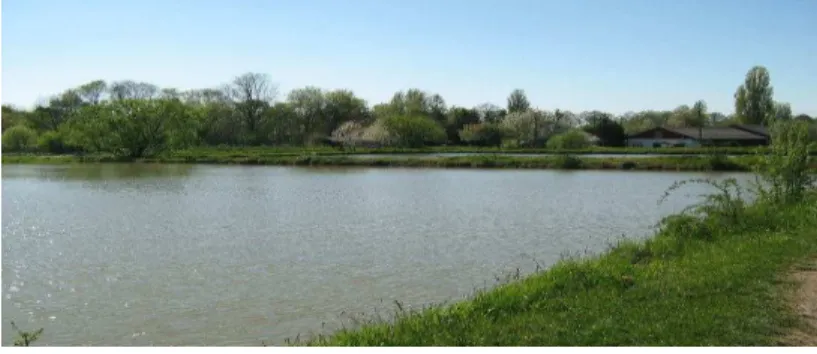
Farm , pond 8 ( called also HC8) with an area of 2.2 ha and pond 9 ( HC9) with an area of 2.5 ha. Both ponds are rectangular in shape, have approxim ately the same area and depth, providing sim ilar conditions for living ( see Figure 1). The experimental ponds are gravitational water supplied from a channel, whose water comes from the Ilfoveni accum ulation lake, located a few hundred meters upstream. The average depth of the experimental ponds is 1.6 m, each of them having the necessary supplying and exhausting equipments. From this brief presentation, it is noticed that the two ponds had alm ost the sam e living conditions for the fish population.
Th e p on d s p re p a ra t ion works for the purpose of populate them were m ade
according to the classical technology ( see Gheracopol 1981) , such as:
- checking and repairing the breakwater, canals and hydro- technical installations; - m obilizing of watersheds in the less deep areas and removing the harsh vegetation; - adm inistering the amendm ents, 200 kg calcium oxide, through uniform scattering all over the ponds surface, and a quantity of 2000 kg/ ha m anure.
The flooding of the ponds was m ade using a m esh of 1 m m in order to prevent the breakthrough of the wild fish larvae.
Figure 1. General view of experimental ponds.
In the second sum m er, the rearing experim ent was m ade in two variants: I. using non-conventional fodders in pond 8 ( HC8), and II. using m ixed fodders in pond 9 ( HC9) .
Th e p op u la t in g of t h e b a sin s was done around the date of 15t h of April in both
rearing variants with one sum m er old young fish from Nucet Fish Farm as it follows: HC8 was populated with 4150 specim ens of Cyprinus carpio, with an average weight of
106g/ ex and 240 specim ens of Polyodon spat hula with average weight of 320g/ ex; HC9
was populated with 4700 specim ens of Cyprinus carpio, with an average weight of
101g/ ex and 270 specim ens of Polyodon spat hula with average weight of 332g/ ex.
W a t e r q u a lit y con t rol. In order to evaluate the environm ental conditions in the
Septem ber in order to determ ine the hydro-chem ical param eters. As it is known, the fish production depends largely on the physical and chem ical quality of water ( Billard 1995). The param eters taken into account in our intensive system of fish rearing were: tem perature, dissolved oxygen, pH, content in essential m ineral elem ents, turbidity and the color ( Billard 1995) .
The m onitoring of the hydro- chem ical param eters was done as presented below. The water tem perature was m easured every day in the m orning, in the afternoon and in the evening using a m ercury therm om eter. In the experim ental ponds the tem perature was reported to be between 17- 27˚C. During June- August the water’s tem perature was favorable ( 22- 27˚C) for production, and in May and Septem ber the tem perature was a little bit lower 17- 21˚C.
The dissolved oxygen was m easured every day, early in the m orning before the sun rise, using portable oxygenom eters OxiGuard and it had optim al value throughout the survey period 5.5- 9.6 m g/ L, the sam e as the pH value 7.2- 8.5.
Turbidity was m easured using the Secchi disk and recorded values between 15 and 30 cm .
The other param eters: pH, alkalinity and water hardness were analyzed every week being determ ined as a result of laboratory analysis on water sam ples ( see guidelines in Hadjinikolova & Ivanova 2009) .
Fe e d ing of a n im a ls. Protein requirem ents for fish are higher than for other land
anim als, because fish have a quick-growing ( Bogatu 1991; Kerepeczki et al 2011) . The efficiency of alimentation in pisciculture depends greatly on their preparation, on how the m ixture is m ade, on optimal concentration of the com ponents in m ixtures which have to fit to the anim al feeding behavior (Cadar 1990) because the feed consum ption and conversion depends on both the taste and the nutritional quality of food.
In the first variant ( HC8) the non- conventional fodders contained two com ponents: sunflower groats 10440 kg representing 75% of the total used fodders am ount and 3480 kg rice bran representing 25% from total.
In our country t he sunflower is the m ost widespread oleaginous plant, which contains a great quantity of protein in its seeds ( 10- 35% ), being well digested (approx. 90% ) ( Oprea & Georgescu 2000) . The sunflower groat is a proteic food with a high content of cellulose and poor in carbohydrates being widespread in Rom anian farm s for anim al feeding.
The rice bran has the following biochem ical features: water 14% , carbohydrates 62% , crude protein 14% , lipids 4% and m ineral substances 6% .
In the second experim ental variant (HC9) the feeding was m ade using m ixed fodders. The m ixed fodder ( com plex and conventional one) was of flour type one, with 24.86% crude protein and containing: corn, wheat, barley, sunflower groat, soy groats, fish flour, prem ix with vitam ins and m inerals, and yeast ( see com position in Table 1) .
The nutritional value of these m ixed ( conventional) fodders grows as in their com position are added grains ( corn, barley, wheat) som e oleaginous seeds and legum inous groats ( soy, sunflower) and m aterials of anim al origin ( Costin et al 1992) .
Table 1 Com position of m ixed fodder used in variant II
Range of products Percent ( % ) Crude protein ( % )
Soy groats 20 8.80
Sunflower groats 24 7.87
Wheat 16 2.01
Barley 17 1.80
Corn 14 1.20
Fish flour 4 1.92
Yeast 4 1.26
Prem ix with vitam ins and m inerals 1 -
Feeding lasted until 21st of October 2011 ( during a total period of 142 days) . The fodder quantity for both experim ental variants ( I and II) , distributed per m onths and days, during all the feeding period is displayed in Tables 2 and 3.
Table 2
Quantity of fodder adm inistered per day and per m onth in experimental variant I
Month May June July August Septem ber October Total
Kg/ m onth 780 1,560 3,380 4,050 3,380 770 13,920
Kg/ day 30 60 130 150 130 70 -
Percentage ( % ) 5.60 11.21 24.28 29.10 24.28 5.53 100.00
Table 3
Quantity of fodder adm inistered per day and per m onth in experimental variant I I
Month May June July August September October Total
Kg/ m onth 1,040 2,080 4,160 5,400 4,160 1,100 17,940
Kg/ day 40 80 160 200 160 100 -
Percentage ( % ) 5.89 11.50 23.19 30.10 23.19 6.13 100.00
Re su lt s a n d Discu ssion. During the warm season control fishing was m ade on 5t h of
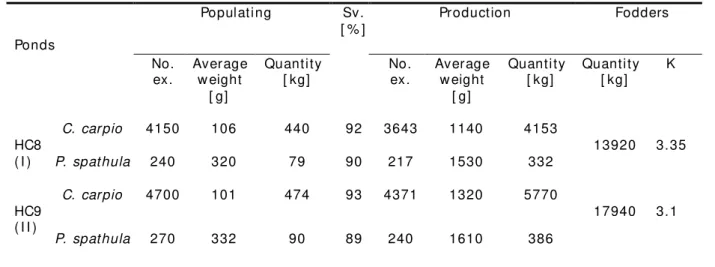
every m onth in order to check the growing and the sanitary status of the anim als. The final results recorded at the harvest fishing, which began on 28th October 2011, are synthesized in Table 4.
In the intensive and sem i-intensive aquaculture system s the parasites control and sanitation is one of the m ost im portant issues as serious infestation with parasites triggers other diseases, the risk of disease increasing with increasing density of fish or other vectors ( Hemananda et al 2009; Düşen et al 2010; Banerjee et al 2011; Ebrahim zadeh Mousavi et al 2011; Mehdizadeh Mood et al 2011; Rahm ati- holasoo et al 2011; Sahandi & Hajim oradloo 2011) .
The sanitary status of the anim als in both experim ental ponds was generally good all over the rearing period. We m ention that, at the first control fishing Lernaea sp.
ectoparasite was detected ( the intensity of the parasitism being low: about 1- 2 parasites/ ex.) together with Dact ylogyrus sp. At the second control fishing, Lernaea sp.
ectoparasite was found only on a sm all num ber of fish and had a m uch lower frequency, while for Dact ylogyrus the problem was solved by bathing the fish in an am m onia
solution 30% in a dose of 1 m L/ L of water, for 30 seconds ( according to recom m endation of Munteanu & Bogatu 2003) .
We can say that the survival was good due to the quality of the fodders, good water quality and due to the volum e that we had at our disposal and transited in ponds. The dynam ics of growth rate of the anim als, in both experimental variants, is presented in Figures 2- 3, while fresh capture of Cyprinus carpio and Polyodon spat hula at final of
Table 4 Output of data acquired at the harvest fishing, in October
Populating Production Fodders
Ponds
No.
ex. Average w eight [ g]
Quantity [ kg]
Sv. [ % ]
No. ex.
Average w eight
[ g]
Quantity
[ kg] Quantity [ kg] K
C. carpio 4150 106 440 92 3643 1140 4153
HC8
( I ) P. spathula 240 320 79 90 217 1530 332
13920 3.35
C. carpio 4700 101 474 93 4371 1320 5770
HC9 ( I I )
P. spathula 270 332 90 89 240 1610 386
17940 3.1
Sv [ % ] = fish survival; K = coefficient of conversion of the fodder.
0 200 400 600 800 1000 1200 1400
02.05. 06.06. 05.07. 05.08. 05.09. 20.10.
Exp.variant I
Exp.variant II
Figure 2. Dynamics of grow th rate in Cyprinus carpio.
0 500 1000 1500 2000
02.05. 06.06. 05.07. 05.08. 05.09. 20.10.
Exp.variant I
Exp.variant II
Figure 3. Dynamics of grow th rate in Polyodon spathula.
Con clu sion s. Following the perform ed investigation we can appreciate that, the feeding
with non- conventional fodders such as sunflower groats ( 75% ) and rice bran ( 25% ) in intensive and sem i-intensive rearing system s, in ponds, can provide the energy and com plete range of essential nutrients for the com bined culture of com m on carps and
Polyodon spat hula.
Using good quality stocking biological m aterial (obtained in sum m er I) , a “ cheap form ula” for feeding, a good quality and volum e of water, it is possible to get fish ( com m on carps and P. spat hula) that can be delivered on the m arket at the required
dim ensions next year.
Taking into account the obtained production using conventional and non-conventional fodders and having in view their price, we can conclude that fodders from the aquaculture m arket can be successfully replaced with non- conventional ones ( sunflower groats and rice bran) , which have a m ore affordable price, resulting in a lower cost per kilogram of fish in the case of m ixed culture Cyprinus carpio and P. spat hula.
Re fe re n ce s
Antofie M.-M., Sand C., Brezeanu A., Doroftei E., 2010 Key elem ents related to GMOs and novel food. Ann Rom Soc Cell Biol 15( 1): 148- 154.
Balon E. K., 1995 Origin and dom estication of the wild carp, Cyprinus carpio, from Rom an
gourm ets to the swim m ing flowers. Aquaculture 129: 3–48.
Banerjee S., Bandyopadhyay P. K., Göçmen B., Mitra A. K., 2011 Myxobolus lalbaghensis
sp. n. from a freshwater fish of West Bengal, India. North- West J Zool 7( 1): 1- 4. Billard R., 1995 Les carpes. Biologie et elevage. INRA, Paris.
Bogatu D., 1991 [ Proteins in alim entation of fishes] . Conference „ Piscicultura şi pescuitul în faţa economiei de piaţă” , Galaţi, p.24- 26 [ in Rom anian] .
Bura M., Szelei Z.- T., 2009 Research regarding the evolution of corporal m asses and feed conversion on sterlet (Acipenser rut henus) juvenile raised in recirculating system .
AACL Bioflux 2( 2) : 223- 228.
Cadar D., 1990 [ Som e actual issues on fish nutrition and feeding] . Piscicultura Moldovei Vol I [ in Rom anian] .
Caipang C. M. A., Dechavez R. B., Apines- Am ar M. J. S., 2011 Potential application of m icrobial phytase in aquaculture. ELBA Bioflux 3( 1) : 55- 66.
Cioboiu O., Brezeanu G., 2009 Hydrobiological and piscicultural features of certain sm all basins within the Oltenia Plain. AACL Bioflux 2( 2) : 133- 136.
Coada M. T., Patriche N., Cristea V., Costache M., Bocioc E., Ion S., 2011 Prelim inary results on growth of the Polyodon spat hula juveniles in recirculating system
conditions. AACL Bioflux 4( 2): 209- 215.
Costin G. M., Bogatu D., Rauţă M., 1992 [ Contributions to optim ization of nutrition for intensive pisciculture] . Sim p. „Acvacultura şi pescuitul viitorului”, p.178-181, Galaţi [ in Rom anian] .
Docan A., Dediu L., Cristea V., 2011 Effect of feeding with different dietary protein level on hem atological indices of juvenile Siberian sturgeon, Acipenser baeri reared under
recirculating system s condition. AACL Bioflux 4( 2) : 180- 186.
Dragoş N., Bercea V., Bica A., Drugă B., Nicoară A., Com an C., 2010 Astaxanthin production from a new strain of Haem at ococcus pluvialis grown in batch culture. Ann
Rom Soc Cell Biol 15( 2): 353- 361.
Düşen S., Oğuz M. C., Barton D. P., Aral A., Şulekoğlu S., Tepe Y., 2010 Metazoan parasitological research on three species of anurans collected from Çanakkale Province, Northwestern Turkey. North- West J Zool 6( 1): 25- 35.
Ebrahim zadeh Mousavi H. A., Behtash F., Rostam i- Bashm an M., Mirzargar S. S., Shayan P., Rahm ati- holasoo H., 2011 Study of Argulus spp. infestation rate in Goldfish, Carassius aurat us ( Linnaeus, 1758) in Iran. HVM Bioflux 3( 3) : 198- 204.
Gheorghe D. C., Razlog G. P., Cristea V., Enache I., 2011 The growth characteristics of com m on carp (Cyprinus carpio) in the northern part of the Sm all Island of Braila
Natural Park. AACL Bioflux 4( 2) : 154- 158.
Gheracopol O., 1981 [ Pisciculture] , University of Galaţi, Galaţi [ in Rom anian] .
Györe K., Józsa V., Wilhelm S., 2011 Monitoring of the fish com m unity in the Hungarian reach of River Tisza in 2009. Studia Universitatis “Vasile Goldiş” Seria Ştiinţele Vieţii 21( 4) : 793- 801.
Hadjinikolova L., Ivanova A., 2009 Dynam ics of the level and ratio of nitrogen and phosphorus in carp ponds water: the effect of m ineral fertilizers upon its quality. AACL Bioflux 2( 2) : 209- 215.
Hem ananda T., Mohılal N., Bandyopadhyay P. K., Mıtra A. K., 2009 Two new Myxosporidia ( Myxozoa: Myxosporea) of the genus Myxobolus Butschli, 1882 from cornea of Clarias bat rachus (Linnaeus, 1758) caught from a fish farm in India. North- West J Zool
5( 1) : 165- 169.
Kerepeczki É., Gál D., Kosáros T., Hegedűs R., Gyalog G., Pekár F., 2011 Natural water treatm ent m ethod for intensive aquaculture effluent purification. Studia Universitatis “Vasile Goldiş” Seria Ştiinţele Vieţii 21(4):827- 837.
Luca C., Suciu R., Costache M., 2010 Com parative karyotype in different lineages of cyprinid fish ( Teleostei: Cypriniformes: Cyprinidae) . Studia Universitatis “ Vasile Goldiş” Seria Ştiinţele Vieţii 20( 1) : 37- 41.
Mehdizadeh Mood S., Shohreh P., Sahandi J., 2011 A survey on ectoparasite fauna of cold water fish farm s in Mazandran Province, Iran. HVM Bioflux 3( 3) : 246- 251.
Mills E. L., Leach J. H., Carlton J. T., Secor C. L., 1993 Exotic species in the Great Lakes: a history of biotic crises and anthropogenic introductions. J Great Lakes Res 46: 1–54. Montchowui E., Laleye P., Moreau J., Philippart J.-C., Poncin P., 2009 Population
param eters of African carp: Labeo parvus Boulenger, 1902 ( Pisces: Cyprinidae) in the
Ouém é River in Bénin ( West Africa) . North- West J Zool 5( 1): 26- 33.
Muham m ad S., Hassan L. G., Dangoggo S. M., Hassan S. W., Um ar K. J., Aliyu R. U., 2011 Nutritional and antinutritional com position of Sclerocarya birrea seed kernel. Studia
Universitatis “Vasile Goldiş” Seria Ştiinţele Vieţii 21(4):693- 699.
Munteanu G., Bogatu D., 2003 [ Treaty of Ichtyopathology] . Editura Excelsior Art, p.383-388 [ in Rom anian] .
Muscalu R., Muscalu C., Nagy M., Bura M., Szelei Z.-T., 2010 Studies on wels catfish (Silurus glanis) development during cold season as an auxiliary species in sturgeon
recirculated aquaculture system s. AACL Bioflux 3( 5) : 362- 366.
Ognean L., Barbu A., 2009 The estim ation of the biostim ulator potential of som e fodder additives based on the m ain hem atological and biom etrical indices of brook trout (Salvelinus font inalis M.) Ann Rom Soc Cell Biol 14( 2): 292- 296.
Oprea L., Georgescu R., 2000 [ Fish nutrition and alim entation] . Editura Tehnică [ in Rom anian] .
Ozcan G., Balık S., 2009 Som e biological param eters of the bergam ae barb, Capoeta bergam ae Karam an, 1969 ( Cyprinidae) , in Kem er reservoir ( Aydin, Turkey) .
North-West J Zool 5( 2) : 242- 250.
Rahm ati- holasoo H., Hajim oham m adi B., Ahm adiara E., Ebrahim zadeh Mousavi H., Rostam i- bashm an M., Haghighi khiabanian asl A., Haghdoost I. S., Shokrpoor S., Ghorbanalipour A., 2011 A study of infestation of Alburnoides bipunct at us with Ligula int est inalis in Latian reservoir Dam Lake, Tehran province, Iran: A histopathological
study. HVM Bioflux 3( 1) : 18- 24.
Ricciardi A., MacIsaac H. J., 2000 Recent m ass invasion of the North Am erican Great Lakes by Ponto- Caspian species. TREE 15: 62–65.
Sadighara P., Salar- Am oli J., Asadinejad S., Zadehhashem E., 2010 Using Art em ia urm iana
in detecting of the cytotoxicity of som e selected food additives. Biharean Biologist 4( 1) : 81- 82.
Sion C., Calin P. G., Oprea L., Nica A., Bacanu G. M., 2011 The influence of pellets quality on the growth of sterlet, in recirculating aquaculture system . AACL Bioflux 4( 2) : 130-136.
Sharm a K. R., Leung P., 2000 Technical efficiency of carp pond culture in South Asia: An application of a stochastic m eta- production frontier m odel. Aquaculture Econom ics & Managem ent 4: 169- 189.
Terziyski D. I., Kalchev R. K., Vasileva P. L., Piskov I. A., Iliev I. Z., 2009 Fish abundance differences and relations to plankton prim ary production in two variants of pond stocking with com m on carp (Cyprinus carpio L.) , grass carp (Ctenopharyngodon idella
Val.) and bighead carp (Arist icht hys nobilis Rich.) larvae. AACL Bioflux 2( 3) : 251- 260.
Received: 26 Sept ember 2012. Accept ed: 10 Oct ober 2012. Published online: 22 Oct ober 2012. Authors:
Nicoleta Dobrotă,Research Developm ent Cent re for Piscicult ure Nucet , Nucet , no 549, Dâm bovița Count y, t el./ fax. 0245267003; e- m ail: dobrot [email protected]
Gheorghe Dobrotă,Research Development Cent re for Pisciculture Nucet , Nucet , no 549, Dâmbovița Count y, t el./ fax. 0245267003; e- m ail: dobrot [email protected]
Mioara Cost ache,Research Developm ent Cent re for Piscicult ure Nucet , Nucet , no 549, Dâm bovița Count y, t el./ fax. 0245267003;
Nino Marica,Research Developm ent Cent re for Piscicult ure Nucet , Nucet , no 549, Dâm bovița Count y, t el./ fax. 0245267003.
How t o cite this art icle: