Property: a Survey
Mitre C. Dourado
N´ucleo de Computac¸˜ao Eletrˆonica [email protected]
F´abio Protti
∗Instituto de Matem´atica and NCE [email protected]
Jayme L. Szwarcfiter
∗Instituto de Matem´atica, NCE and COPPE
Universidade Federal do Rio de Janeiro Caixa Postal 2324, Rio de Janeiro, RJ, Brasil
Abstract
In 1923, Eduard Helly published his celebrated theo-rem, which originated the well known Helly property. Say that a family of subsets has the Helly property when every subfamily of it, formed by pairwise intersecting subsets, contains a common element. There are many generaliza-tions of this property which are relevant to some parts of mathematics and several applications in computer sci-ence. In this work, we survey computational aspects of the Helly property. The main focus is algorithmic. That is, we describe algorithms for solving different problems arising from the basic Helly property. We also discuss the complexity of these problems, some of them leading to NP-hardness results.
Keywords:Computational Complexity, Helly prop-erty, NP-complete problems.
1. Introduction
In 1923, Eduard Helly [24, 57] published the famous theorem which originated the so called Helly property. The theorem asserts that in a d-dimensional euclidian space, if in a finite collection ofn > dconvex sets any
d+ 1sets have a point in common, then there is a point in common to all sets. This theorem has been extensively studied in distinct parts of mathematics and other areas, as computer science. In fact, it has a central role in the studies of geometric transversal theory, combinatorial ge-ometry and convexity theory.
∗Partially supported by CNPq and FAPERJ.
A few surveys have been written on the Helly prop-erty. We mention [27, 43, 51]. The Helly property has been the object of studies in extremal hypergraph theory, as [87], and in other topics of the study of graphs. For in-stance, see [39, 88, 89]. There are many extensions of the Helly property. One of the generalizations, the fractional Helly property, is directly related to Alon and Kleitman’s result [4], solving a famous conjecture by Hadwiger and Debrunner.
Besides the purely theoretical interest, the Helly prop-erty has applications to some different areas. For exam-ple, in the context of optimization, it has been applied to location problems [36], and generalized linear program-ming [5]. In computer science, the Helly property has been used in the theory of semantics [10], coding [9], computational biology [79], data bases [45, 46], image processing [22] and clearly graphs and hypergraphs.
In this work, we survey some of the results on the Helly property, from the computational point of view. Our purpose is to describe algorithms and complexity results for many structural algorithmic problems, related to the Helly property and some of its generalizations. In addi-tion, we also include some new proposals of algorithms, for some specific problems. Besides describing the al-gorithms and complexity for the considered problems, we also formulate the main structural characterizations, which are the basis of the algorithms.
Following, we give some definitions and notation used throughout this paper.
A hypergraph H is an ordered pair (V(H), E(H))
hyper-edgesEi ⊆V(H). When there is no ambiguity we will denote the number of vertices and of hyperedges of a hy-pergraphH byn andm, respectively. Since the Helly property and most variations considered in this work deal with the hyperedges of a hypergraph, isolated vertices are not relevant, and can be dropped. Hence, unless otherwise stated, we assume in all the text that for a hypergraphH,
V(H) =
Ei∈E(H) Ei.
Let H be a hypergraph. We say that H is a k-hypergraphif|E(H)|=k; ak−
-hypergraphif|E(H)| ≤ k; and ak+-hypergraphif|E(H)| ≥k. We use the same notation for a term standing for a set, for example, given a setSwithkelements, we can say thatSis ak-set, or a
(k−1)+-set, and so on.
The rank r(H)of a hypergraph His the maximum cardinality among the hyperedges ofH. A hypergraph
H′
is apartial hypergraph ofHifE(H′
)⊆E(H); and
H′
is asubhypergraph of Hinduced byV′
⊆ V(H)if
H′
contains exactly the hyperedgesEi ∩V′ = ∅, for
1≤i≤m.
The coreofHis defined ascore(H) = E1∩E2∩ . . .∩Em. We say thatHis(p, q)-intersectingif every partialp−
-hypergraph of Hhas aq+-core. We employ the termsintersectingandp-intersectingmeaning(2,1) -intersecting and(p,1)-intersecting hypergraphs, respec-tively.
Two hypergraphsH,H′
areisomorphicif there exists a bijectionf :V(H)→V(H′)
such that:
{v1, . . . , vp} ∈E(H)⇐⇒ {f(v1), . . . , f(vp)} ∈E(H′).
Given a hypergraphH, we construct thedual hyper-graphH∗
ofHcreating one vertexejinV(H∗)for each hyperedgeEj ∈E(H); and one hyperedgeAiinE(H∗) for every vertexai ∈V(H), defined asAi ={ej :ai ∈
Ej}.
A hypergraphHisr-uniformwhen every hyperedge ofHcontains exactlyrvertices. Letr, nbe integers,1≤ r≤n. We define ther-complete hypergraphKr
n to be a hypergraph consisting of all ther-subsets of ann-set.
Agraphis a 2-uniform hypergraph. Usually, a graph is denoted byG. A hyperedge and a partial hypergraph of a graphGare respectively callededgeandsubgraphofG. Aspanning subgraph ofGis a subgraph with vertex set
V(G), and thesubgraph ofGinduced byV′ ,G[V′]
, is the maximal subgraph ofGwith vertex setV′
. Two vertices
uandv forming an edge ofGare adjacent vertices or
neighborsin G, and we denote such edge by uv. The
open neighborhoodof a vertexv,N(v), is the set formed by the neighbors ofv; theclosed neighborhood of v is
N[v] = N(v)∪ {v}; thedisk of radiusk is the set of
vertices whose distance tovis not lerger thank. A vertex
visuniversalinGifN[v] =V(G).
A pathis a sequence of distinct vertices v1, . . . , vq,
q≥1, such thatvivi+1 ∈E(G), for1 ≤i≤q−1. If,
furthermore,q≥3and there exists the edgevqv1, this se-quence is acycle. Achordof a cycleCis any edge joining two non-consecutive vertices inC. Thedistancebetween two vertices is the number of edges of a minimum path joining them.
Acomplete set(independent set) is a subset of pair-wise adjacent (nonadjacent) vertices. A bipartite setis a subset B ⊆ V(G), which can be partitioned into
B = V1∪V2, whereV1, V2 are nonempty independent sets. If everyvi ∈V1andvj∈V2are adjacent, thenBis acomplete bipartite set. AcliqueofGis a maximal com-plete set; and abicliqueis a maximal complete bipartite set. A (complete)bipartite graphis a graph induced by a (complete) bipartite set. A graph isKr-free if it does not containr-complete sets as subgraphs.
A graph is a treeif there exists exactly one path be-tween every pair of vertices of it. If every cycle with at least 4 vertices has a chord, thenGischordal. The com-plementof a graphG, denotedG, hasV(G)as vertex set, anduv∈E(G)⇐⇒uv∈E(G). A graph isperfectif it does not contain an odd cycle or a complement of an odd cycle, with at least 5 vertices, as an induced subgraph.
Theclique hypergraphofG,C(G), is the hypergraph formed by the cliques ofG. Given a hypergraphH, the
intersection graph, orline graph,ofHis the graph con-taining one vertex for every hyperedge of H, and two vertices are adjacent if the corresponding hyperedges in-tersect. Theclique graphK(G)of Gis the intersection graph of the clique hypergraph of G. The i-th iterated clique graphofG, denotedKi(G), is defined as follows:
K0(G) =G, whileKi(G) =K(Ki−1(G)),i≥1.
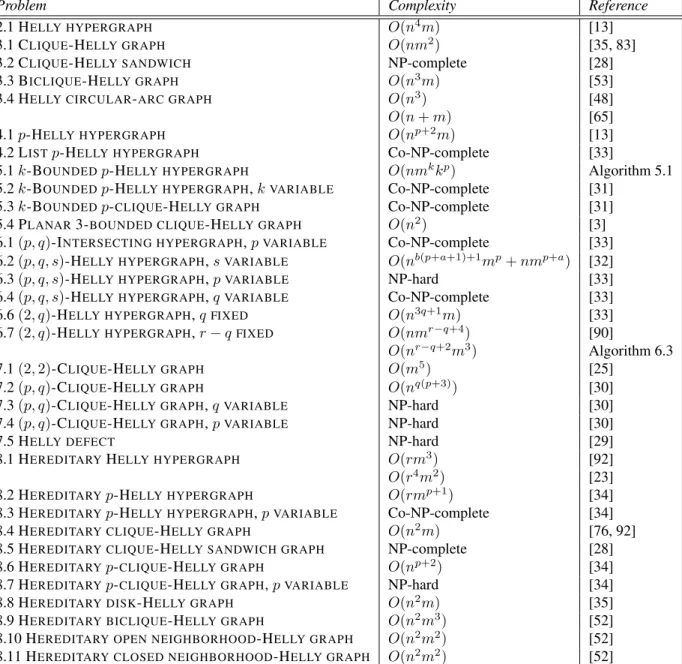
hy-pergraphs and conformal hyhy-pergraphs are given; the last one is a new result. This concept is also used to gener-alize the Helly number of a hypergraph. In Section 7 we apply the(p, q, s)-Helly property to graphs. Character-ization and recognition of(p, q)-clique-Helly graphs are presented. Also the complexity of determining the Helly defect of a graph is discussed. In Section 8 we consider the hereditary Helly property applied to special families of vertices of a graph, such as cliques, disks, bicliques, open and closed neighborhoods. Furthermore we charac-terize the hereditaryp-Helly property on graphs and hy-pegraphs. Section 9 contains a summary of the computa-tional aspects of the problems related in this work. In the last section we list some proposed problems.
2. Basic Helly Property on Hypergraphs
In this section, we discuss the basic Helly property on hypergraphs. First, we describe some classical examples of special families of objects satisfying the Helly prop-erty. Afterwards, we consider general Helly hypergraphs, and give an algorithm for recognizing this class. Fur-ther, we describe some well known classes of hypergraphs where the Helly property holds.
Relevant general references for this section are [11, 12, 14, 21, 38, 70].
2.1. General hypergraphs
A hypergraph is Helly when every intersecting par-tial hypergraph of it has a nonempty core. For ex-ample, the hypergraph H, having V(H) = {1,2,3,4}
and E(H) = {{1,2},{1,3},{1,4}} is Helly, while if
E(H) ={{1,2},{1,3},{2,3}}thenHis not Helly. Some classical examples of objects satisfying the Helly property are the following. Intervals of a straight line form a Helly family, as it can be easily observed. An-other classical example, known as the Chinese Theorem, expresses a property of arithmetic expressions: letHbe the hypergraph having the integers as vertices, and the arithmetic expressions formed by those integers as hyper-edges. Then His Helly. Another commonly employed case of a Helly family is the family of subtrees of a tree. The fact that subtrees of a tree are Helly is the basis for many properties of chordal graphs.
From the computational point of view, a central ques-tion is to describe a method for recognizing Helly hy-pergraphs. Observe that simply applying the definition would not lead to an efficient method, since the number of intersecting partial hypergraphs could be exponential in the number of vertices.
Problem 2.1 (HELLY HYPERGRAPH): Given a hyper-graphH, decide whetherHsatisfies the Helly property.
The following algorithm [11] decides if a given hyper-graphHis Helly.
Algorithm 2.1 [11] (RECOGNIZING HELLY HYPER
-GRAPHS): For every triple T of vertices ofV(H), con-struct the partial hypergraphHT ofHformed by the
hy-peredges ofHcontaining at least two of the vertices of the T. ThenHis Helly precisely whenHT has a nonempty
core for every tripleT.
The above algorithm corresponds to the casep = 2
of the method for deciding ifHisp-Helly. Therefore its correctness follows from Theorem 4.2 (see Section 4).
As for the complexity, there areO(n3)partial hyper-graphs to be considered. Each one can be constructed and checked in linear time, meaning an overall complexity of
O(n3
Ei∈E(H)
|Ei|) =O(n4m).
2.2. Special hypergraphs
We now define some classes of hypergraphs with the aim of showing that they are all Helly.
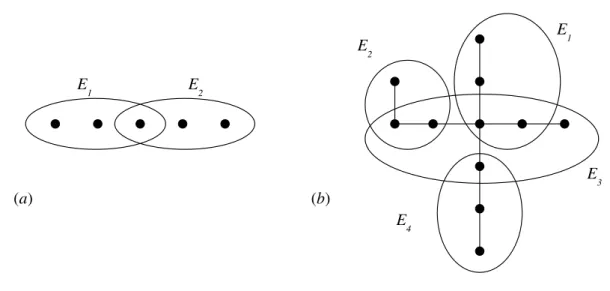
Say thatHis aninterval hypergraphwhen its vertices can be embedded on a line, in such a way that its hyper-edges correspond to intervals of the line. An example is given in Figure 1(a).
Ahypertreeis a hypergraphHsuch that there exists a treeT with vertex setV(H)where the hyperedges of
E(H)induce subtrees in T. See Figure 1(b). Hyper-trees are also called arboreal hypergraphs. The dual of hypertrees are employed in the theory of relational data bases [45, 46].
The following theorem characterizes hypertrees in terms of the Helly property.
Theorem 2.1 [37, 47, 81]A hypergraphHis a hypertree if and only ifHis Helly and its line graph is chordal.
Next, we define more families of hypergraphs, based on the following notion. A special cycle of a hyper-graphH is a sequencev1E1v2E2. . . vkEkvk+1, k ≥ 3 and vk+1 = v1, where v1, . . . , vk and E1, . . . , Ek are distinct vertices and hyperedges of H satisfying Ei ∩
{v1, . . . , vk} ={vi, vi+1}. The valuekis the length of the cycle.
A hypergraph isbalancedif it contains no special cy-cle of odd length [11] and it istotally balancedif it has no special cycles of any length [67]. Finally, a hypergraph is
Figure 1. An interval hypergraph and a hypertree
Theorem 2.2 Normal hypergraphs, hypertrees, bal-anced, totally balbal-anced, and interval hypergraphs are all Helly.
The proof of the above theorem follows from the fact that normal hypergraphs are Helly by definition, balanced hypergraphs are normal [66, 68], and totally balanced hy-pergraphs are balanced. On the other hand, hypertrees are Helly because the subtrees of a tree satisfy the Helly prop-erty, while interval hypergraphs are special hypertrees.
3. Basic Helly Property on Graphs
In the context of graphs, the Helly property has been mainly applied to certain subsets of vertices, such as cliques, disks, open neighborhoods, closed neighbor-hoods, and bicliques. In general, any of these special families of subsets may satisfy or not the Helly property. In this section, we consider the classes of graphs where the above families of subsets of vertices satisfy the Helly property. Theclique-Hellygraphs are exactly the graphs whose families of cliques satisfy the Helly property. Sim-ilarly we define disk-Helly, open neighborhood-Helly,
closed neighborhood-Helly, and biclique-Helly graphs, respectively. Disk-Helly graphs are also called simply
Helly graphs.
We describe characterizations and recognition algo-rithms for these classes, as well as show the containment relations among them. Finally, we consider another class of graphs closely related to the Helly property, the Helly
circular-arc graphs.
3.1. Clique-Helly graphs
Clique-Helly graphs have been well studied, mainly in connection with clique graphs. The first reference to them is the following sufficient condition for a graph to be a clique graph.
Theorem 3.1 [55]Every clique-Helly graph is a clique graph.
This theorem has been generalized to an actual char-acterization of clique graphs, as follows:
Theorem 3.2 [80] A graph G is a clique graph if and only if it contains a family of complete subsets of vertices which covers all its edges and satisfies the Helly property.
The above characterization has not lead so far to a polynomial time algorithm for recognizing clique graphs. In fact, it has been recently proved that recognizing clique graphs is NP-complete [2].
Another result closely related to Theorem 3.1 can be formulated, as follows.
Theorem 3.3 [44] The clique graph of a clique-Helly graph is clique-Helly, and every clique-Helly graph is the clique graph of a clique-Helly graph.
Clique-Helly graphs play a key role in the study of it-erated clique graphs. LetGandH be graphs. Say that G is convergent to H when Ki
(G) =Ki+1
for some i ≥ 0. When H is the one-vertex graph, call G, simply, convergent. On the other hand, when
lim
i→∞|V(K
i(G))| = ∞,Gis adivergentgraph. Finally,
whenK(G) =G, say thatGis aself-cliquegraph. If G is clique-Helly then Ki(G) is again clique-Helly, and furthermore,K2(
G)is an induced subgraph of G[44]. The latter implies that divergent graphs cannot be clique-Helly. The study of divergent graphs has both alge-braic and geometric connections and has attracted much interest, recently. For instance, see [59, 60, 61, 63, 75], among other papers. A general theory for this class is in [62, 72]. Finally, as for self-clique graphs, we can men-tion that self-clique clique-Helly graphs have been fully characterized [15, 64]. However, little is known about self-clique graphs which are not clique-Helly. A survey on clique graphs appears in [84].
Various other classes of graphs have been defined mo-tivated by clique-Helly graphs, or are closely related to them. See, for instance, [16, 19, 20, 85].
Figure 2. The Haj´os Graph
The family of minimal non clique-Helly graphs has been described in [69]. Here, the minimality refers both to induced subgraphs and intersecting families of cliques. The smallest graph which is not clique-Helly is the Haj´os graph, depicted in Figure 2. In general, for rec-ognizing clique-Helly graphs the first idea would be to apply the algorithm of Section 2.1, with the aim of check-ing whether the clique hypergraph of the given graph is Helly. However, since the number of cliques of a graph might be exponential [71], this would not necessarily lead to a polynomial time algorithm.
Problem 3.1 (CLIQUE-HELLY GRAPH): Given a graph
G, decide whetherGis clique-Helly.
However, clique-Helly graphs can be recognized in polynomial time, applying the following concept. LetG be a graph andT a triangle of if. Theextended triangle ofGrelative toTis the subgraph induced inGby the set of all vertices adjacent to at least two vertices ofT. The following theorem characterizes clique-Helly graphs.
Theorem 3.4 [35, 83]A graph is clique-Helly if and only if each of its extended triangles contains a universal ver-tex.
The above theorem leads directly to a polynomial time algorithm for recognizing whether a given graph G is clique-Helly.
Algorithm 3.1 (RECOGNIZING CLIQUE-HELLY GRAPHS): For every triangle T of G, construct its extended triangle and verify if it contains a universal vertex. ThenGis clique-Helly precisely when the answer is positive for every triangleT.
We needO(nm)time to generate all the triangles of G. The computation of the required operations, for each of the triangles, requires O(m). Therefore the overall complexity isO(nm2)
. This complexity can be reduced by applying matrix multiplication for generating the tri-angles.
However, the following generalization of recognizing clique-Helly graphs seems to be more difficult.
A graph sandwich problem consists of given two graphs G1 and G2, finding a graph G with some
de-sired property, thesandwich graph, such thatE(G1) ⊆
E(G) ⊆ E(G2). Graph sandwich problems were
de-fined in the context of Computational Biology and are a natural generalization of recognition problems [50].
Problem 3.2 (CLIQUE-HELLY SANDWICH GRAPH):
Given two graphs G1, G2 such that E(G1) ⊆ E(G2),
is there a sandwich graph for G1 and G2 that is
clique-Helly?
Theorem 3.5 [28] CLIQUE-HELLY SANDWICH GRAPH is NP-complete.
3.2. Disk-Helly graphs
Disk-Helly graphs can also be recognized in polyno-mial time. Such recognition algorithms have been de-scribed in [7, 35]. Disk-Helly graphs have been studied in connection with retracts of a graph, e.g. [6, 8, 56]. This class has been also characterized in terms of convergence, as follows.
Theorem 3.6 [8]A graph is disk-Helly if and only if it is clique-Helly and convergent.
3.3. Open and closed neighbourhood-Helly graphs
Open and closed neighbourhood-Helly graphs can also be recognized in polynomial time, by applying Algo-rithm 2.1, since the size of the neighbourhoods is polyno-mially bounded. The same remark applies for disk-Helly graphs. The following definition is useful for relating clique-Helly and open neighbourhood-Helly graphs.
For a graph G, denote by B(G) the bipartite graph with bipartitionV1∪V2, whereV1 =V2 =V(G), such that vi ∈ V1 andvj ∈ Vj are adjacent precisely when
vi=vjorvivj ∈E(G).
Theorem 3.7 [6]A graph G is clique-Helly if and only if B(G)is open neighbourhood-Helly.
The following concept generalizes extended trian-gles. It has been employed both for characterizing open neighbourhood-Helly graphs and biclique-Helly graphs. For a graphG, letS ⊆V(G),|S| = 3. Denote byBS the family of bicliques ofG, each of them containing at least two vertices ofS. LetGBS be the subgraph ofG
formed exactly by the vertices and edges ofBS. Write
S∗ = V(G
BS). The induced subgraph ofGformed by
the vertices ofS∗is called anextensionofS. Finally,
de-note byS∗
2 ⊆S∗the subset of vertices which are adjacent
to at least two vertices ofS.
Theorem 3.8 [53] A graph G is open neighbourhood-Helly if and only ifGhas no triangles, and for every in-dependent setS,|S| = 3,S∗contains a vertex adjacent to all the vertices ofS∗
2.
3.4. Biclique-Helly graphs
For biclique-Helly graphs, we need an additional def-inition. For a graphG, say that a vertexvdominatesan edgeewhen one of the extremes ofeeither coincides or is adjacent tov. Whenvdominates every edge ofGthen
vis anedge dominatorofG. Biclique-Helly graphs can be characterized as follows.
Theorem 3.9 [53] A graph G is biclique-Helly if and only ifGhas no triangles and each of its extensions has an edge dominator.
Problem 3.3 (BICLIQUE-HELLY GRAPH): Given a graphG, decide whetherGis biclique-Helly.
As for the question of recognizing biclique-Helly graphs, first we remark that unlike neighbourhoods and disks, the number of bicliques of a graph is not polynomi-ally bounded, meaning that a direct application of Algo-rithm 2.1 would not lead to an efficient method. In fact, the number of bicliques of a graph might be exponential in
its number of vertices [78]. However, the above theorem can be used to formulate a polynomial time algorithm, as follows. LetGbe the given graph.
Algorithm 3.2 [53] (RECOGNIZING BICLIQUE-HELLY GRAPHS):First, verify ifGhas a triangle. If it does then stop, asGis not biclique-Helly. Otherwise, for each 3-subset of vertices ofG, construct its extension and verify if it contains an edge dominator. ThenGis biclique-Helly precisely when the answer is affirmative in all cases.
There areO(n3)extensions to be considered. To
con-struct and check each of them, we requireO(m). The total complexity isO(n3m).
3.5. Relation among classes
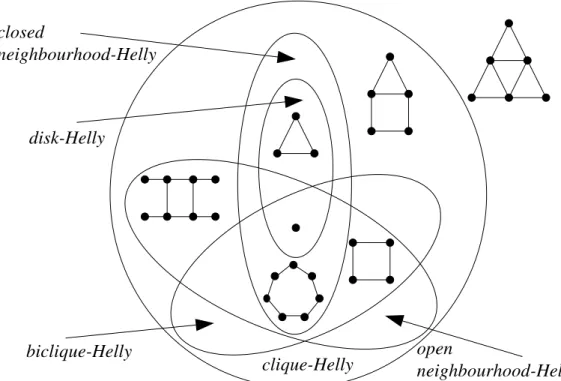
Finally, we relate the Helly classes so far consid-ered in this section. Clearly, clique-Helly graphs contain open neighborhood-Helly and biclique-Helly graphs, be-cause the two last classes are triangle-free (Theorems 3.8 and 3.9) and every triangle-free graph is clique-Helly. Furthermore, if T is a triangle of some graphGwhose extended triangle does not contain a universal vertex, then the closed neighbourhoods of the vertices ofTcontain an intersecting subfamily with no common vertex. Conse-quently, every closed neighbourhood-Helly graph is also clique-Helly. On the other hand, it is clear that closed neighbourhood-Helly graphs contain disk-Helly graphs. However, open and closed neighbourhood-Helly graphs do not contain each other. Clearly, a triangle is closed neighbourhood-Helly and not open neighbourhood-Helly, whereas aC4is open neighbourhood-Helly and not closed neighbourhood-Helly. See Figure 3, where some minimal graphs are also shown.
3.6. Helly circular-arc graphs
A generalization of intervals of a straight line is to consider arcs of a circle, instead. However, the arcs of a circle do not form necessarily a Helly family. For exam-ple, a family of three arcs which together cover the circle, and such that none of them contains another one, is not Helly. See Figure 4. In fact, we are interested in the inter-section graph of arcs of a circle, calledcircular-arc graph G. That is,Ghas a vertex for each arc, and two vertices are adjacent when the corresponding arcs intersect. For a circular-arc graphG, if there exists a Helly family of arcs which representsGthen say thatGis aHelly circular-arc graph.
The above definition motivates the following problem.
Figure 3. Relations among Helly classes
In order to characterize circular-arc graphs, the fol-lowing concept is useful. For a(0,1)-matrizM, say that
M has thecircular1’s property on the columnswhen the 1’s in each column appear consecutively, in the ordering of the lines, considered circularly. The following theorem characterizes Helly circular-arc graphs.
Theorem 3.10 [48]A graph is a Helly circular-arc graph if and only if it admits a clique matrix possessing the cir-cular1’s property on the columns.
This theorem leads to the following algorithm for rec-ognizing Helly circular-arc graphs. LetGbe a graph.
Algorithm 3.3 [48] (RECOGNIZING HELLY CIRCULAR-ARC GRAPHS): Find all cliques of G. IfGhas more thanncliques then stop, asGis not Helly circular-arc. Otherwise, verify if its cliques can be placed in a circular ordering, so that the corresponding clique matrix has the circular 1’s property on its columns. Then Gis a Helly circular-arc graph in the affirmative case, otherwise it is not.
Helly circular-arc graphs can have no more than n
cliques, which can be computed in overallO(n3)time,
using the algorithm in [74]. Determining whether the graph admits a clique matrix with the circular 1’s prop-erty on the columns can also be done within the same bound [48]. Therefore the complexity of the algorithm isO(n3). See [82] for a discussion about this recognition
problem.
Recently, it has been described a forbidden subgraph characterization for Helly circular-arc graphs, which leads to a linear time recognition algorithm for the class [65]. Helly circular-arc graphs have been also studied in relation to clique graphs [16, 42] and clique-perfectness [17].
The corresponding recognition problem of verifying the Helly property for the case of chords of a circle, in-stead of arcs, has not yet been solved. Acircle graphis the intersection graph of chords of a circle. AHelly cir-cle graphis a graph admitting a representation by chords of a circle satifying the Helly property, that is, any subset of intersecting chords contains a common point. A con-jecture [40] asserts that a graph is a Helly circle graph if and only if it is a circle graph with no induced subgraph isomorphic toK4−e. See also [41].
3.7. Matrices of a graph
Another example of the use of the Helly property is in the characterization of clique matrices of a graph, due to Gilmore. It states that a(0,1)-matrix with no zero lines
is the clique matrix of some graph if and only if the 1’s of any row do not cover the 1’s of another row, while the 1’s of the columns satisfy the Helly property. Biclique matrices of a graph have recently been characterized [54], also in terms of the Helly property.
4. The
p-Helly Property
Consider the following generalization of the Helly property. A hypergraphHisp-Hellyif every partial p -intersecting hypergraph of H has a nonempty core. In this section we present two characterizations of this con-cept, one of them leading to a polynomial-time algorithm for recognizingp-Helly hypergraphs whenpis fixed.
4.1. k-Conformal hypergraphs
Define thek-sectionof a hypergraphHto be a hyper-graph[H]k whose hyperedges are setsF ⊆ V(H)such that |F| = k andF ⊆ Ei ∈ E(H); or|F| < k and
F ∈E(H).
Fork ≥ 2, a hypergraphHis k-conformalif every maximal set ofV(H), which induces aKk
j hypergraph of
[H]k, fork≤j, is a hyperedge ofH.
For example, the hypergraph H, where V(H) = {1,2,3,4} and E(H) = {{1,2},{1,3},{1,4}} is 2 -conformal. However, if E(H) = {{1,2,4},{1,3,4}, {2,3,4}} thenH is not 2-conformal. There is a close relationship between k-conformal and k-Helly hyper-graphs.
Theorem 4.1 [12] A hypergraph is k-conformal if and only if its dual isk-Helly.
A generalization of the above theorem, Theorem 6.6, is proved in Section 6.
4.2. Recognition
The following theorem characterizes p-Helly hyper-graphs:
Theorem 4.2 [13]A hypergraphHisp-Helly if and only if for every(p+ 1)-subset V′ ofV(H), the partial hy-pergraph formed by the hyperedges that contain at least pelements ofV′has a nonempty core.
This theorem leads directly to an algorithm for recog-nizing if a given hypergraphHisp-Helly, forp≥2.
Algorithm 4.1 [13] (RECOGNIZING p-HELLY HYPER
-GRAPHS):For each(p+ 1)-subsetV′ofV(H), construct the partial hypergraphH′formed by the hyperedges ofH containing at leastpvertices ofV′, and verify ifH′ has a nonempty core. ThenHisp-Helly precisely when the answer is positive in all cases.
There are O(np+1) partial hypergraphs to be
con-sidered. Each one of these partial hypergraphs as well as its core, can be constructed in O(m(n+p)) time. Then the overall complexity of the above algorithm is
O(m(n+p)np+1), that is, a polynomial for fixedp. As
we shall see in Section 6, this problem is NP-hard for the case when pis variable, since it is a particular case of Problem 6.3.
Observe that if a hypergraph is p-Helly, then it is
(p+ 1)-Helly. From this fact, one can ask, for a given hypergraphH, what is the least numberhfor whichHis
h-Helly? This number is known as theHelly numberof the hypergraph [58]. The Subsection 6.4 is dedicated to the Helly number and related topics.
What happens to the complexity of checking the p -Helly property if we relax the definition, in the sense that some specific partialp-intersecting hypergraphs with an empty core are allowed?
LetHbe a hypergraph andL be a list of partialp
-hypergraphs ofH. Say thatHislistp-Helly relative toL
if every partialp-intersecting hypergraphH′ofHsatisfies
the following condition:
- if all the partialp-hypergraphs ofH′are listed inL,
thencore(H′)=∅.
In particular, if L is the list of all the partial p
-hypergraphs of H, then His listp-Helly if and only if
Hisp-Helly.
Problem 4.2 (LISTp-HELLY HYPERGRAPH):Letp≥2 be a fixed integer. Given a hypergraphHand a listL of partialp-hypergraphs of H, decide whether His list p-Helly relative toL.
Theorem 4.3 [33] LIST p-HELLY HYPERGRAPH is co-NP-complete.
5. The Bounded Helly Property
Remember that a hypergraphHisp-Hellyif everyp -intersecting partial hypergraph ofHhas a nonempty core. As an example, consider V = {a1, . . . , ap+1} and the hypergraph Hformed by the hyperedges V\{ai}, i =
1, . . . , p+ 1. Clearly,His notp-Helly. This definition can be restricted to subfamilies of limited size.
We say that a hypergraph H is k-bounded p-Helly
(k ≤ |E(H)|) if every p-intersecting partial k−
-hypergraph of H has a nonempty core. This defini-tion implies that, in ak-boundedp-Helly hypergraph,p -intersecting subfamilies of size strictly greater thankdo not necessarily contain a common element. As an exam-ple, the hypergraph defined in the previous paragraph is not(p+ 1)-boundedp-Helly, but it isp-bounded(p−1) -Helly. This concept, for the casep= 2, was first consid-ered in [80].
Observe that any hypergraph isk-boundedp-Helly for anyp≥k; consequently, we only need to focus the case
p < k.
Problem 5.1 (k-BOUNDED p-HELLY HYPERGRAPH):
Let p ≥ 1 and k > p be fixed integers. Given a hy-pergraphH, decide whetherHisk-boundedp-Helly.
The following algorithm is straightforward from the definition.
Algorithm 5.1 (RECOGNIZING k-BOUNDED p-HELLY HYPERGRAPHS): For each partialk−-hypergraphH′ of H, verify if it is p-intersecting. If someH′ which is p-intersecting has an empty core, then stop, asHis not k-boundedp-Helly. OtherwiseHisk-boundedp-Helly.
There areO(|E(H)|k)
partialk−-hypergraphs inH.
In order to test if one of them is p-intersecting and to compute its core we requireO(pnkp)
andO(nk), respec-tively. Then the definition leads to an algorithm with time complexityO(pnmkkp)
.
Problem 5.2 (k-BOUNDED p-HELLY HYPERGRAPH,k VARIABLE): Letp ≥ 1be a fixed integer. Given a hy-pergraph H and an integer k, decide whether H is k-boundedp-Helly.
When p is variable, Theorem 5.2 implies that the above problem is NP-hard. Whenpis fixed andk vari-able, Theorem 5.2 asserts the co-NP-completeness of Problem 5.2. The proof of it applies Theorem 5.1.
Theorem 5.1 [26] (SATISFIABILITY): Deciding whether a boolean expression in the conjuntive normal form is satisfiable is NP-complete.
Theorem 5.2 [31] k-BOUNDED p-HELLY HYPER
-GRAPH,kVARIABLEis co-NP-complete.
Proof. It can be checked in polynomial time whether a partial k−-hypergraph is notp-Helly, for fixed p, using
from SATISFIABILITY. LetE be a boolean expression. Denote by X = {x1, . . . , xn}the set of variables of E
and by C = {C1, . . . , Cm} the set of clauses. Build
a hypergraphHin the following way: for each variable ofX and each clause ofC create one vertex inH.
De-noteV(H) =VX∪VC, whereVX ={v1, . . . , vn}and
VC ={c1, . . . , cm}, that is, the vertexvi ∈ VX is
asso-ciated to the variablexi ∈X and the vertexcj ∈VC to the clauseCj ∈C. For each variablexi ∈X create the
hyperedgesExi andExi inH, adding to them the
ver-tices ofVX\{vi}. Furthermore, for each vertexcj ∈VC, includecj in the hyperedgeExi (Exi) if and only if the
literalxi (xi) does not appear in the clause Cj. Finally,
definek=n.
LetH′ be a partial hypergraph ofH. IfH′ does not contain at least one of the hyperedges Exi or Exi,
cor-responding to xi ∈ X, then vi belongs to the core of H′. Hence, in order to verify whetherHis k-bounded p-Helly we need to consider only the partial hypergraphs
H′with exactlykhyperedges such that, for every variable xi ∈ X, eitherExi orExi is a hyperedge ofH′. Then
letH′ be a partialk-hypergraph ofH satisfying such a property. Clearly, everyvi ∈VX does not belong to the
core ofH′ andH′ is(k−1)-intersecting. Hence,H′is p-intersecting, becausep < k.
SinceH′ containsExi orExi for everyxi ∈ X,H′ defines a truth assignment forC. In this truth assignment
a literal has the valuetrueif and only if the corresponding hyperedge belongs toH′. Therefore, let us say thatH′
satisfiesEif and only if this truth assignment satisfiesE. Suppose that H′ satisfies E. Then any clause of C
contains at least one literal associated to some hyperedge ofH′. This means that for each vertexc
i ∈VC there ex-ists one hyperedge inH′which does not contain it; there-fore the core ofH′ is empty, meaning thatHis notk -boundedp-Helly.
Conversely, suppose thatH′does not satisfyE, and let Cj∈C be a clause in which no literal has the valuetrue.
Consider an arbitrary variablexi ∈X. IfExiis the edge
ofH′ representingxithenxi ∈Cj, otherwiseCjwould be satisfied. This impliescj ∈Exi. Similarly, whenever
Exi is the representing edge ofxi, we have cj ∈ Exi.
In either case,cjbelongs to the edge representingxi, for
everyi. Thuscj belongs to the core ofH′, that is,His
k-boundedp-Helly.
Applying this concept to the cliques of a graph, we have thek-boundedp-clique-Hellygraphs. Consider now the recognition problem for graphs. The next theorem states that this problem is co-NP-complete, even for fixed kandp.
Problem 5.3 (k-BOUNDEDp-CLIQUE-HELLY GRAPH):
Letk > p≥1be fixed integers. Given a graphG, decide whetherGis ak-boundedp-clique-Helly graph.
Theorem 5.3 [31] k-BOUNDED p-CLIQUE-HELLY GRAPHis co-NP-complete.
By the definition, it is clear that CLIQUE-HELLY⊂
k-BOUNDED CLIQUE-HELLY⊂k′-BOUNDED CLIQUE -HELLY, fork′< k.
However, forKk+1-free graphs, the classes of clique-Helly andk-bounded clique-Helly coincide.
Lemma 5.1 [80] A Kk+1-free graph is clique-Helly if
and only if it isk-bounded clique-Helly.
Let Gbe a planar graph. Since any planar graph is K5-free, the number of cliques of G is O(n4)
. Using Algorithm 5.1, we conclude that the next problem can be solved in polynomial time.
Problem 5.4 (PLANAR 3-BOUNDED CLIQUE-HELLY GRAPH): Given a graphG, decide whetherGis planar
k-bounded clique-Helly.
A characterization which leads to a good algorithm for recognizing planar3-bounded clique-Helly graphs is presented in [3], Next, we describe it.
For a given triangleT ={x, y, z}ofG, we call:
• Vxy = {v ∈ V(G) : v ∈ N[x], v ∈ N[y], v ∈
N[z]};
• Vxz = {v ∈ V(G) : v ∈ N[x], v ∈ N[z], v ∈
N[y]};
• Vyz = {v ∈ V(G) : v ∈ N[y], v ∈ N[z], v ∈
N[x]};
• Vxyz = {v ∈ V(G) : v ∈ N[x], v ∈ N[y],
v∈N[z]}.
LetGbe a graph andT′ the extended triangle of G relative to the triangleT ={x, y, z}. Say that:
• T′is of type1if at least one of the setsV
xy,Vxz or
Vyzis empty;
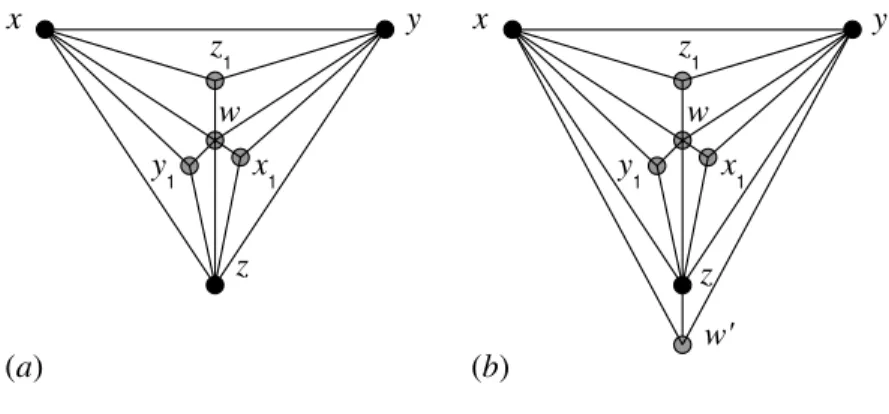
• T′ is of type 2 if Vxy = {z1}, Vxz = {y1}, Vyz={x1},Vxyz ={w}, andwis adjacent tox1,
y1andz1;
• T′ is of type3ifVxy ={z1},Vxz ={y1},Vyz =
{x1},Vxyz = {w, w′}, andwis adjacent tox1,y1
Figure 5. Extended triangles of type 2 and 3
Notice that ifT′
is an extended triangle of type 2, or type 3, of a planar graph, then T′
is isomorphic to the graph (a), or (b), in Figure 5, respectively.
Theorem 5.4 [3]LetGbe a planar graph.
1. G is a clique-Helly graph if and only if every ex-tended triangle ofGis of type1or type2.
2. Gis a3-bounded clique-Helly graph if and only if every extended triangle ofGis of type1, type2or type3.
By this characterization, assintotically, the complex-ities to recognize clique-Helly planar graphs and 3 -bounded clique-Helly planar graphs are the same. There-fore we discuss only the algorithm for 3-bounded 2 -clique-Helly planar graphs.
Algorithm 5.2 (RECOGNIZING 3-BOUNDED CLIQUE -HELLY GRAPHS): Construct the extended triangle for every triangle ofG. If some extended triangle is not of type1, type2, nor of type3, then stop as the graph is not 3-bounded clique-Helly graph, otherwise it is.
Since the triangles of a planar graph can be listed inO(n)time [73], the above algorithm has complexity
O(n2).
6. Cardinality of the Intersections on
Hyper-graphs
In this section we extend the idea of the Helly property by considering the cardinality of the intersections. Such concept was introduced in [91].
6.1. (p, q)-Intersecting
We begin with a generalization ofp-intersecting. Let
p≥1andq≥0. A hypergraphHis(p, q)-intersecting
when every partialp−
-hypergraph ofHhas aq+-core.
Clearly, the following implications hold for any hy-pergraphH.
• If1≤q≤ |core(H)|, thenHis(p, q)-intersecting.
• Forp≥2, ifHis(p, q)-intersecting, thenHis(p− 1, q)-intersecting.
• If H is (p, q)-intersecting, then H is (p, q −1) -intersecting.
• His (1, q)-intersecting if and only if every hyper-edge ofHcontains at leastqvertices.
• IfHis(p, q)-intersecting, then every partial hyper-graph ofHis(p, q)-intersecting.
If pis fixed, then it is possible to test whetherHis
(p, q)-intersecting in polynomial time by simply comput-ing the core of every partialp-hypergraph ofH. For the case in whichpis not fixed it was proved that deciding whetherHis(p, q)-intersecting is co-NP-complete.
Problem 6.1 ((p, q)-INTERSECTING HYPERGRAPH, p VARIABLE): Let q be a fixed positive integer. Given p≥ 1and a hypergraphH, decide whetherHis(p, q)-intersecting.
6.2. (p, q, s)-Helly hypergraphs
The following definition is a generalization of thep -Helly property, and has been introduced in [91].
Let p ≥ 1,q ≥ 0 ands ≥ 0. A hypergraph His
(p, q, s)-Helly when every partial(p, q)-intersecting hy-pergraph ofHhas ans+-core.
The following implications are true for any hyper-graphH.
• IfHis(p, q, s)-Helly, thenHis(p+ 1, q, s)-Helly.
• IfHis(p, q, s)-Helly, thenHis(p, q+ 1, s)-Helly.
• IfHis(p, q, s)-Helly, thenHis(p, q, s−1)-Helly.
• His(1, q, s)-Helly if and only if the partial hyper-graph formed by theq+-hiperedges ofHhas ans+ -core.
The following definitions are employed in a character-ization of(p, q, s)-Helly hypergraphs. LetH1andH2be
hypergraphs. ThenH1✄H2is the partial hypergraph of H1defined in the following way:
H1✄H2={E∈E(H1) : Econtains at least
|E(H2)| −1hyperedges ofH2}.
Lemma 6.1 Let H1 and H2 be hypergraphs and t =
|E(H2)| ≥2. IfH′1is a partial hypergraph ofH1✄H2 and0 < |E(H′
1)| < t, thencore(H′1)contains at least
t− |E(H′
1)|hyperedges ofH2.
Theorem 6.2 [32]Letp ≥ 2, q ≥ 1,s ≥ 1 and Ha hypergraph. Definea= max{q−s,0},b = min{q, s} andI as theKb
nhypergraph with vertex setV(H). Then His(p, q, s)-Helly if and only if:
(i) for every partial(p+a+ 1)-hypergraphH′ofI, if the hypergraphH✄H′ is(p, q)-intersecting then it has ans+-core; and
(ii) every partial (p, q)-intersecting (p + a)− -hypergraph ofHhas ans+-core.
Proof. IfHis(p, q, s)-Helly then Conditions (i) and (ii) are clearly satisfied by the definition. Assume now that
His not(p, q, s)-Helly. Then there exists a partial(p, q) -intersecting hypergraphH′ ofHsuch that|core(H′)| < s.
If |E(H′)| ≤ p +a then H′ is a partial (p, q)
-intersecting(p+a)−-hypergraph ofHthat violates
Con-dition (ii).
Otherwise, if|E(H′)| ≥ p+a+ 1, writeE(H′) = {E1, . . . , E|E(H′)|} and assume thatH′ is minimal, that
is, E(H′)−E′ has an s+-core, for any E′ ∈ E(H′).
(IfH′ is not minimal, one can successively remove
hy-peredges fromH′ until obtaining either a minimal(p+ a+ 1)+-hypergraph or a(p+a)−-hypergraph violating
Condition (ii)).
For eachi,1≤i≤ |E(H′)|, letSi⊆core(H′−Ei)
be ab-subset of vertices such thatSi ⊆EiandSi ⊆Ej
for everyj=i. This means that there existsvi∈Sisuch thatvi ∈Eibutvi∈Ejfor everyj=i.
LetH1be the hypergraph formed by the hyperedges
S1, . . . , Sp+a+1. Note thatH1is a partial(p+a+ 1)
-hypergraph ofI. DefineH′′=H✄H
1. SinceE(H′)⊆
E(H′′),H′′does not have ans+-core. Let us show that
H′′is(p, q)-intersecting.
Consider any partial p-hypergraph H′′′ of H′′. By
Lemma 6.1,core(H′′′)contains at leasta+ 1hyperedges
ofH1, sayS1, . . . , Sa+1. Note thatS1∪ {vi : 2≤i≤
a+ 1}contains exactlyb+a =qvertices. This means that|core(H′′′)| ≥q. Therefore,H′′is(p, q)-intersecting
and does not have ans+-core. This violates Condition (i).
Problem 6.2 ((p, q, s)-HELLY HYPERGRAPH, s VARI
-ABLE): Letp, q ≥ 1 be fixed integers. Given a hyper-graphHands≥1, decide whetherHis(p, q, s)-Helly.
The above theorem leads to the following algorithm for Problem 6.2. Let H be a hypergraph andI be the hypergraphKnb with vertex setV(H).
Algorithm 6.1 (RECOGNIZING (p, q, s)-HELLY HY
-PERGRAPHS):
Part(i): for each partial(p+a+ 1)-hypergraphH′ ofKb
H, construct the partial hypergraphH′′choosing the hyperedges containing at least p+ahyperedges of H′. Then verify ifH′′is(p, q)-intersecting. If so, verify ifH′′ has ans+-core.
Part(ii): for each partial(p+a)−-hypergraph ofH, check if it is(p, q)-intersecting. If so, verify if it has an s+-core.
The complexity of Part (i) of the above algorithm isO(pmpnb(p+a+1)+1), because there areO(nb(p+a+1))
partial (p+a+ 1)-hypergraphs in I, and for each one we spend(m(n+ (p+a)b))steps to construct everyH′′, O(pnmp)to check if it is(p, q)-intersecting andO(nm)
to compute its core. For Part (ii), the complexity is
O(pnmp+a(p+a)p+1). The overall time complexity is
the sum of both. This means that it is polynomial, forp, q
Problem 6.3 ((p, q, s)-HELLY HYPERGRAPH, p VARI
-ABLE): Letq, s ≥ 1be fixed integers. Given a hyper-graphHandp≥2, decide whetherHis(p, q, s)-Helly.
Theorem 6.3 [33] (p, q, s)-HELLY HYPERGRAPH, p VARIABLEis NP-hard.
We deal now with the case in whichqis not fixed.
Problem 6.4 ((p, q, s)-HELLY HYPERGRAPH, q VARI
-ABLE): Letp ≥ 2 ands ≥ 1be fixed integers. Given a hypergraphHandq≥1, decide whetherHis(p, q, s)-Helly.
Theorem 6.4 [33] (p, q, s)-HELLY HYPERGRAPH, q VARIABLEis co-NP-complete.
6.3. The caseq=s
The caseq=sis natural and interesting. For simplic-ity, we write(p, q)-Helly hypergraphs, meaning(p, q, q) -Helly hypergraphs. In special, bounds for(2, q)-Helly hy-pergraphs were described in [90].
The following problem was proposed in [90].
Problem 6.5 ((p, q)-HELLY HYPERGRAPH, q VARI
-ABLE): Find a structural characterization ofr-uniform (2, q)-Helly hypergraphs forr > q+ 1.
This problem remains open. However, if we consider
q = sfixed, we have a polynomial algorithm as a con-sequence of Theorem 6.2. In this case, Condition (ii) of Theorem 6.2 is trivially satisfied. Then we can rewrite the characterization as follows.
Corollary 6.1 [32] A hypergraph H is (p, q)-Helly if and only if H ⊲ H′ has a q+-core for every partial (p+ 1)-hypergraphH′ of the hypergraph Kq
n with
ver-tex setV(H).
Problem 6.6 ((p, q)-HELLY HYPERGRAPH, q FIXED):
Letqbe a fixed integer. Given a hypergraphH, decide whetherHis(p, q)-Helly.
The complexity of recognizing (p, q)-Helly hyper-graphs, given by this characterization and using Algo-rithm 6.1, isO(nq(p+1)m(n+pq)). For the casep= 2,
we haveO(mn3q+1). Note also that, ifq= 1, we obtain
the same complexity as that of Algorithm 4.1.
Now we present two attempts to solve Problem 6.5, which provide a solution for the caseqvariable with the restriction thatr−qis small.
Problem 6.7 ((2, q)-HELLY HYPERGRAPH, r − q FIXED): Let q be an integer andH a hypergraph with rankr. Decide whetherHis(2, q)-Helly.
The first one is a consequence of the following propo-sition.
Proposition 6.1 [90]IfHis a minimal non-(2, q)-Helly hypergraph of rankr with1 ≤ q < r, then|E(H)| ≤ r−q+ 2.
Algorithm 6.2 ((2, q)-HELLY HYPERGRAPHS):For ev-ery partial(r−q+ 2)−-hypergraph of a hypergraphH,
compute its core and verify if it contains at leastq ele-ments. ThenHis(2, q)-Helly precisely when the answer is affirmative in all cases.
There are r−q+2
Σ
i=3 (
m
i) = O(mr−q+3) partial hyper-graphs to be considered. In order to compute the core of each one we needO(nm)time. The overall complexity isO(nmr−q+4).
We present in the sequel another way to verify if a hy-pergraph is(2, q)-Helly. Theq-line graphof a hypergraph
H, denoted byLq(H), has a vertex for every hyperedge of Hand two vertices are adjacent if the corresponding hyperedges share at leastqvertices.
Theorem 6.5 The number of cliques of Lq(H) for a
(2, q)-Helly hypergraphHof rankris not greater than mr
q
.
Proof.LetHbe a(2, q)-Helly hypergraph. First note that ifC′, C′′are cliques ofLq(H)andH′,H′′are the partial hypergraphs ofHformed by the hyperedges associated to the vertices ofC′ andC′′, respectively, then the cores of
H′andH′′are incomparable and each one has at leastq elements.
Letvbe a vertex ofLq(H)andEvbe the hyperedge ofHcorresponding tov. SinceEv contains all the cores of the partial hypergraphs associated to the cliques which
vbelongs to,v appears in at most(r
q)cliques ofLq(H). Since the number of vertices ofLq(H)ism, the number of cliques ofLq(H)is not greater thanmrq
.
The above theorem leads to the following algorithm. LetHbe a hypergraph, andq≥0an integer.
Algorithm 6.3 ((2, q)-HELLY HYPERGRAPHS):
Construct the graphLq(H), and generate its cliques,
C1, . . . , Ci, . . .. For eachCi, proceed as follows.
• Ifi > mr!
q!(r−q)! then stop:His not(2, q)-Helly.
• Otherwise, construct the partial hypergraphHi of
H, formed by the hyperedges ofHcorresponding to the vertices ofCi. Ifcore(Hi)< q, then stop:His
Otherwise, if all the cliques ofLq(H)have been gen-erated, then stop:His(2, q)-Helly.
To construct Lq(H) we spend O(m2
n) steps. We generate at most mr
q
cliques, each with time com-plexity nm by the algorithm of [86]. To compute the core of each partial hypergraph, O(nm) steps are re-quired. The total complexity of the above algorithm is O(m2
n+n2
m3r q
) =O(n2
m3r q
).
The time complexity of this algorithm for solv-ing Problem 2, when q is fixed, is O(n2m3rq) = O(nq+2m3)
, while for Question 3, whenr−qis small, we requireO(n2
m3
rr−q) =O(nr−q+2
m3
)steps.
6.4. Helly numbers
A hypergraphHhasHelly numberhifhis the least number for which H is h-Helly [58]. For the general
(p, q, s)-Helly property it is possible to define variations of the Helly number in the following ways:
– Letq, s≥0be fixed integers. The(p∗, q, s)-Helly numberofHis the least integerp, if it exists, such thatH is(p, q, s)-Helly.
– Let p ≥ 1 and s ≥ 0 be fixed integers. The
(p, q∗, s)-Helly number of H is the least integerq such
that H is (p, q, s)-Helly. This number is well defined
sinceHis(p, n+ 1, s)-Helly for anyp, s.
– Letp≥1and0≤q≤r(H)be fixed integers. The
(p, q, s∗)-Helly numberofHis the largestsfor whichH
is(p, q, s)-Helly.
By Theorem 6.3, we conclude that determining the
(p∗, q, s)-Helly number is NP-hard. Similarly,
Theo-rem 6.4 implies that finding the(p, q∗, s)-Helly number is
also NP-hard. However, using Theorem 6.1, we can de-termine the(p, q, s∗)-Helly number in polynomial time.
6.5. (p, q)-Conformal hypergraphs
Now we generalize Theorem 4.1. In order to do so, we use the following generalizations of the concepts of k-section andk-conformal hypergraphs.
Define the (p, q)-section of H to be a hypergraph
[H]p,q whose hyperedges are setsF ⊆ V(H)such that |F|=pandFis contained in at leastqhyperedges ofH;
or|F|< pandF is a maximal set contained in at leastq
hyperedges ofH.
A hypergraphHis(p, q)-conformalif every maximal set ofV(H), which induces aKjp hypergraph of[H]p,q, forp≤j, is contained in at leastqhyperedges ofH.
Theorem 6.6 A hypergraphHis(p, q)-Helly if and only if its dual is(p, q)-conformal.
Proof. LetH be a hypergraph and H∗ its dual
hyper-graph. Suppose first that H∗ is not (p, q)-conformal.
Hence in[H∗]p,q there is a maximal set that induces ap
-complete hypergraphI, such thatV(I)is not contained inqhyperedges ofH∗. However, the hyperedges ofH,
associated to the vertices ofI, form a(p, q)-intersecting partial hypergraph with noq+
-core.
Conversely, suppose thatHis not(p, q)-Helly. Con-sider a maximal(p, q)-intersecting partial hypergraphH′
ofHwith noq+
-core. The hyperedges ofH′correspond
to a subset of verticesCofH∗with the property that
ev-erypof them belong to at leastqhyperedges ofH∗
simul-taneously. This means thatCis a maximal set inducing a p-complete partial hypergraphIof[H∗]
p,q. Furthermore, ifV(I) =Cis contained in at leastqhyperedges ofH∗,
this implies thatH′contains aq+
-core, which contradicts the hypothesis.
7. Cardinality
of
the
Intersections
on
Cliques of Graphs
In this section we apply the (p, q, s)-Helly property to the clique hypergraph of a graph. Thus, a graph is
(p, q, s)-clique-Hellyif its clique hypergraph is(p, q, s) -Helly. According to this definition, (2,1)-clique-Helly graphs are the clique-Helly graphs. First we focus on the recognition problem of the case q = s, which we call (p, q)-clique-Helly graphs, and after we deal with the problem of deciding if the clique graph of a graph is clique-Helly.
7.1. (p, q)-Clique-Helly graphs
We begin with an example. Define, for two in-tegers p and q, the graph Gp,q as follows: V(Gp,q)
is formed by a (q−1)-complete set Q, a p-complete
set Z = {z1, . . . , zp}, and a p-independent set W =
{w1, . . . , wp}. Further, there are the edges ziwj, for
i=j, and the edgesqx, forq∈Qandx∈Z ∪ W. The general graphGp,q appears in Figure 6, where a thick line joining two sets means that every vertex of a set is adjacent to all vertices of the other. Furthermore, for every vertex ofZ, there is a dotted line joining it to the only vertex ofW which is not adjacent to it.
The graphGp,qcontains exactlyp+ 1cliques of size p+q−1, namely:Q ∪ ZandQ ∪ (Z\{zi}) ∪ {wi}, for1≤i≤p.
Observe thatGp,q is(p, q)-clique-Helly, but it is not
(p−1, q)-clique-Helly. Therefore,Gp,q is(t, q) -clique-Helly fort≥p, and is not(t, q)-clique-Helly fort < p.
Z
z
2
z
1 zP
Q
W
w2w1 wP
Figure 6. GraphGp,q
distinctqandt, the classes of graphs(p, q)-clique-Helly and(p, t)-clique-Helly are incomparable.
The following theorem describes a class of (p, q) -clique-Helly graphs.
Theorem 7.1 [30]Letp, r >1, q >0such thatp+q≥
r. IfGis aKr-free graph, thenGis(p, q)-clique-Helly.
Our aim is now to characterize (p, q)-clique-Helly graphs. We divide the characterization in two cases, the first deals withp= 1.
Theorem 7.2 [30]LetGbe a graph, and letW be the union of theq+
-cliques ofG. ThenGis a(1, q) -clique-Helly graph if and only ifG[W]containsquniversal ver-tices.
The second case corresponds top≥2and we employ some additional definitions.
LetGbe a graph andCap-complete set ofG. The
p-expansion relative toC is the subgraph ofGinduced by the verticeswsuch thatwis adjacent to at leastp−1 vertices ofC.
We remark that thep-expansion forp = 3has been used for characterizing clique-Helly graphs [35, 83]. It is
clear that constructing ap-expansion relative to a given
p-complete set can be done in polynomial time.
LetF be a partial hypergraph ofC(G). Theclique
subgraph induced byF inG, denoted byGc[F], is the
subgraph ofGformed exactly by the vertices and edges belonging to the cliques ofF.
Lemma 7.1 LetGbe a graph,Cap-complete set of it, H the p-expansion ofG relative to C, and C the
par-tial hypergraphC(G)formed by the cliques that contain at leastp−1 vertices ofC. ThenGc[C]is a spanning
subgraph ofH.
LetGbe a graph. The graphΦq(G)is defined as fol-lows. The vertices ofΦq(G)correspond to theq-complete sets ofG, two vertices being adjacent inΦq(G)if the cor-respondingq-complete sets inGare contained in a com-mon clique. As an example see Figure 8.
We remark thatΦq is precisely the operatorΦq,2q de-scribed in [77], p.136, and the graphΦ2(G)is theedge clique graphofG, introduced in [1].
An interesting property ofΦq is that it preserves the
q+
-cliques ofG, that is, everyq+
-clique ofGis a clique ofΦq(G), and vice versa. Then, given aq
+
-cliqueCof
G, denote byϕq(C)the clique ofΦq(G)associated toC. LetGbe a graph andC(G)its clique hypergraph. Let
F be a partial hypergraph ofC(G)containing someq+ -cliques of G. Define ϕq(F) to be the set of cliques {ϕq(C) : C ∈ E(F)}. If C is a partial hyper-graph ofC(Φq(G)), defineϕ−
1
q (C)as the set of cliques {ϕ−1
q (C) : C∈E(C)}. As a consequence we have:
Corollary 7.1 LetGbe a graph,F a partial hypergraph
ofC(G), containing someq+
-cliques ofG, andC, such
thatE(C) =ϕ
q(F). Then|core(F)| ≥qif and only if |core(C)| ≥1.
Lemma 7.2 LetC be a(p+ 1)-complete set of a graph G, and letC be a partialp−-hypergraph ofC(G)such
that every clique ofC contains at leastpvertices ofC.
Thencore(C)=∅.
The next result is a characterization of (2,2) -clique-Helly graphs.
Theorem 7.3 [25]A graphGis(2,2)-clique-Helly if and only if every extended triangle ofΦ2(G)contains a uni-versal vertex.
a
b
c
d
G
a
b
c
d
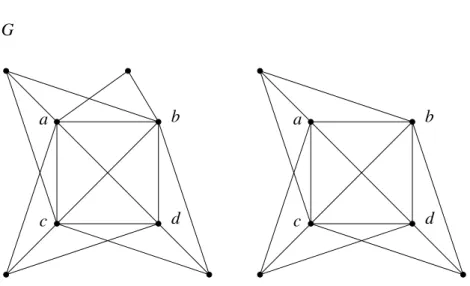
Figure 7. A graphGand the4-expansion relative to{a, b, c, d}.
a
b
e
c
d
f
g
bce
bcd
bde
abe
ceg
cde
cdg
deg
G
Φ
3(G)
Algorithm 7.1 (RECOGNIZING (2,2)-CLIQUE-HELLY GRAPHS):To constructΦ2(G)create one vertex for each edge ofG. Then join two vertices by an edge if the corre-sponding edges are contained in a same clique ofG.
Next, for every triangleT ofΦ2(G), we construct the extended triangle ofTand verify if it contains a universal vertex. If we find one extended triangle which does not have a universal vertex, then we stop asGis not(2, 2)-clique-Helly, otherwise it is.
In order to calculate the complexity of this algorithm, first note that the number of vertices ofΦ2(G)ism. The time complexity to constructΦ2(G)isO(m2), and to
ver-ify if there exists one extended triangle without universal vertex isO(m5). Therefore one can verify if a graph is (2,2)-clique-Helly in timeO(m5).
Now we present a generalization of this result.
Theorem 7.4 [30] Let p > 1 be an integer. Then a graphGis(p, q)-clique-Helly if and only if every(p+ 1)-expansion ofΦq(G)contains a universal vertex.
Proof.Suppose thatGis a(p, q)-clique-Helly graph and there exists a(p+ 1)-expansionT, relative to a(p+ 1) -complete setCofΦq(G), such thatTcontains no univer-sal vertex.
Denote H = Φq(G). Let C be the partial hyper-graphC(H)that contains at leastpvertices ofC. Con-sider a partialp−-hypergraphC′ of C. By Lemma 7.2, core(C′)=∅. This implies thatC is(p,1)-intersecting.
By Corollary 7.1, F = ϕ−1
q (C) is (p, q)-intersecting. SinceG is(p, q)-clique-Helly, we conclude thatF has
aq+-core. By using Corollary 7.1 again,C has an1+
-core, which means thatHc[C]contains a universal vertex. Moreover, by Lemma 7.1,Hc[C]is a spanning subgraph ofT. However,T contains no universal vertex. This is a contradiction. Therefore, every(p+ 1)-expansion ofH
contains a universal vertex.
Conversely, assume by contradiction that G is not
(p, q)-clique-Helly. Let F be a minimal (p, q)
-intersecting partial hypergraph ofC(G)which does not have a q+-core. DenoteE(F) = {C1, . . . , Ck},Ci ∈ C(G). Clearly,k > p.
The minimality of F implies that there exists a q
-subsetQi ⊆core(F −Ci), fori= 1, . . . , k. It is clear thatQi ⊆ Ci. Moreover, every two distinct Qi, Qj are contained in a common clique, sincek ≥ 3. Hence the setsQ1, Q2, . . . , Qp+1correspond to a(p+ 1)-complete
setCinΦq(G).
LetC′ be the partial hypergraph ofC(H)formed by
the cliques that contain at least p vertices of C. Let
C =ϕq(F). Since everyCi ∈ E(F)contains at least
psets from Q1, Q2, . . . , Qp+1, it is clear that the clique ϕq(Ci)∈E(C)contains at leastpvertices ofC. There-fore,ϕq(Ci)∈E(C′), fori= 1, . . . , k.
LetTbe the(p+ 1)-expansion ofHrelative toC. By Lemma 7.1,Hc[C′]is a spanning subgraph ofT. There-fore, Q ⊆ V(T), for everyQ ∈ E(C′). In particular, V(ϕq(Ci))⊆V(T), fori= 1, . . . , k. By hypothesis,T contains a universal vertexx. Thenxis adjacent to all the vertices ofϕq(Ci)\{x}, fori = 1, . . . , k. This implies that ϕq(Ci)containsx, otherwise ϕq(Ci)would not be maximal. Thus,core(C)=∅. By Corollary 7.1,F has
aq+-core, a contradiction. Hence,Gis a(p, q) -clique-Helly graph.
From the above theorem one can recognize (p, q) -clique-Helly graphs in polynomial time if pand q are fixed.
Problem 7.2 ((p, q)-CLIQUE-HELLY GRAPH): Let p, q ≥ 1 be fixed integers. Given a graph G, decide whetherGis(p, q)-clique-Helly.
We present now the algorithm, for the casep≥2. Let
Gbe a graph.
Algorithm 7.2 (RECOGNIZING (p, q)-CLIQUE-HELLY GRAPHS):Construct the graphΦq(G), having as vertices
the p-complete sets ofG, and making two vertices ad-jacent when the correspongingp-complete sets are both contained in a same clique.
Next, for every(p+ 1)-complete setCofΦq(G), we
construct the(p+ 1)-expansion relative toCand verify if it contains a universal vertex. If we find a (p+ 1)-expansion which does not have a universal vertex, then we stop asGis not(p, q)-clique-Helly, otherwise it is.
In order to calculate the complexity of this algo-rithm, first note that the number of vertices ofΦq(G)is
t =O(nq). The time complexity to constructΦ q(G)is
O(n2qq2), whereas to verify if there exists a (p+ 1)
-expansion with no universal vertex is O(tp+1m′) = O(nq(p+1)m′), wherem′=O(t2)is the number of edges
ofΦq(G). Therefore one can verify if a graph is(p, q) -clique-Helly inO(nq(p+3))time.
Ifporqis variable, this procedure does not lead to a polynomial time algorithm. Indeed, the problem is NP-hard in both cases.
Problem 7.3 ((p, q)-CLIQUE-HELLY GRAPH, q VARI