ECLÉTICA
química
www.scielo.br/ eq
Volume 35, número 3, 2010 Art igo/ Art icle
ESTIMATION OF STANDARD ENTHALPY OF
FORMATION OF ALKANES IN GASEOUS STATE BY
CALCULATING SIZE, STRUCTURAL AND ELECTRONIC
PARAMETERS IN THE MOLECULES.
Verma,P.S. - Prof.& Head of Department of Chemistry, University of ajasthan, Jaipur (India); Gorsi, B.L.*; *E-mail – [email protected]
Kalwania,G.S. and Lovel. Dept of Chemistry, S.K.Govt. P. G. College, Sikar (India)
Abstract:A quantitative analysis is made on the correlation ship of thermodynamic property, i.e.,
standard enthalpy of formation (ΔH f0) with Kier ’s molecular connectivity index(1Xv),vander
waal’s volume (Vw) electrotopological state index (E) and refractotopological state index (R) in gaseous state of alkanes. The regression analysis reveals a significant linear correlation of standard enthalpy of formation (ΔH f0) with 1Xv, Vw, E and R. The equations obtained by
re-gression analysis may be used to estimate standard enthalpy of formation (ΔH f0) of alkanes in
gaseous state.
Keywords: Kier’s molecular connectivity (1Xv); vander waal’s volume (Vw); Electrotopological state index
(E); Refractotopological state (R).
I. INTRODUCTION
Standard enthalpy of formation is a basic thermodynamic property. It is used in chemical engineering calculations. Experimental measure-ments of standard enthalpy of formation (ΔH f0)
involve experimental diffi culties and they are not always feasible and the corresponding methods possess real drawbacks. Consequently, it is neces-sary to resort to a theoretical calculation of these parameters. This option is now accessible because an important, fruitful and current fi eld of research.
The additive approach applied to the es-timation of thermo physical properties was sys-tematically developed by S.W.Benson and co-workers1-3. Many topological distances based
indices as molecular descriptors for QSAR4,5 and
additive scheme6 have been developed for the
es-timation of enthalpy of formation of organic com-pounds.
One of the most important points in such research is the selection of adequate descriptors containing the information stored in the molecular structure. The quite satisfactory results of applying regression analysis may be used to calculate heats of formation seems to indicate this way is a sui-table one to compute the enthalpy content of mo-lecules. Since results are good enough and errors are nearly the same as experimental uncertainties, the equations show to be a suitable method to sys-tematize data and to derive certain rules regarding the structural elements and group contribution to the molecular enthalpy of formation.
and to interpret in a meaningful way the results. In view of the above, it is thought that heat en-thalpies of formation which depend upon the size, structure, electronic environment and complexity of the molecules, may be quantitatively correla-ted with size, structure and electronic parameters, i.e. fi rst order valence connectivity (1Xv), vander
waal’s volume (Vw), electrotopological state in-dex (E) and refractotopological state (R) in alka-nes. Previously we have established a signifi cant quantitative co-relationship of these parameters with diamagnetic susceptibility of many organic compounds7,8. The aim of this paper is to obtain
the correlation equations of (ΔH f0) with 1Xv, Vw,
E and R parameters.
1. Calculation of Kier`s9 molecular connectivity (1Xv):
It is calculated by a hydrogen suppressed graph of the molecule10. The fi rst order valence
connectivity (1Xv) is given by eq. 1:
1Xv = ∑ ( iv.3 jv)-1/2 (1)
Here the sum is the overall connections or edges in such a graph, iv and jv are numbers
assigned to each atom refl ecting the numbers of atoms adjacent or connected to atom (i) and (j) which are formally bonded. The atom connectivi-ty term ( iv)is defi ned as
Ziv - hi
iv = --- (2)
Z - Ziv - 1
Where Ziv = number of valence electron
of atom (i), Z = atomic number of atom (i) and hi = number of hydrogen atoms attached to atom (i).
Table (1) shows the atom connectivity ( iv)
va-lues in different groups as calculated by eq.(2)
Table 1. Atom connectivity ( iv) values in different groups
Groups iv Groups iv
- CH3 01 = CH2 02
≡ CH 03 - OH 05
-NH2 03 O 06
-NH - 04 C = O 06
- C ≡ N 05 Furan O 06
- C = NH 04 O =N O 06
N or Pyridine N 05 H2O 04
NH3 02 F (-) 20
NH4 01 Cl 0.690
> N < + 06 Br 0.254
= N H2 + 03 I 0.085
2. Calculation of vander waal’s Volume (Vw):
Another atomic parameter accounting for the size of a molecule, the vander waal`s volume (Vw) may be calculated as suggested by Bond11.
The atoms are assumed to be spherical and neces-sary corrections for the overlap in the hydrogen chain are also incorporated12
Vw = ∑ ni ai+ [ ∑ corrections for bonds + ∑ corrections for no. of branching ] (3)
Where , Vw = vander waal’s volume of the molecules
ni = no. of atoms.
ai = vander waal’s volume of atom i.
Table 2 shows vander waal’s volume of di-fferent atoms and table 3 shows correction values of vander waal’s volume for sphere overlapping due to covalent bonding and for Branching. The value of vander waal’s may be calculated as eq. 3.
Table 2. vander waal’s volume of different atoms
Atom Sphere volume
102 A0 3 Atom
Sphere volume
102 A0 3 Atom
Sphere volume 102 A0 3
C 0.206 H 0.056 N 0.141
O 0.115 S 0.244 F 0.115
Aliphatic Cl 0.206 Aromatic Cl 0.244 Aliphatic Br 0.244
Aromatic Br 0.287 Aliphatic I 0.335 Aromatic I 0.388
Table 3. Correction values of vander waal’s volume for sphere overlapping due to covalent bonding and for Branching
Bond Correction value
102 A0 3 Bond
Correction value
102 A0 3 Bond
Correction value 102 A0 3
C-C -0.078 C-H -0.043 C-N -0.065
C-O -0.056 C-S -0.066 C-F -0.056
Aliph. C-Cl --0.058 Arom C-Cl -0.066 Aliph. C-Br -0.060 Arom. C-Br -0.068 Aliph.C-I -0.063 Arom. C-I -0.072
C-B -0.113 H-H -0.030 N-H -0.038
N-N -0.050 N-O -0.042 N-S -0.061
O-H -0.034 O-B -0.079 S-H -0.040
S-S -0.062 S-F -0.052 C=C -0.094
C=N -0.072 C=O -0.068 C=S -0.081
N=N -0.061 N=O -0.053 S=O -0.057
C≡C -0.0101 C≡N -0.079 Arom.C=C -0.086 Branching for
Saturated bond Except bonding
with H
3. Calculation of electrotopological state Index (E-State):
This index is developed from chemical gra-ph theory and uses the chemical gragra-ph (hydrogen -suppressed skeleton) for generation of atom -le-vel structure indices. This index recognizes that every atom in a molecule is unique, and this uni-queness arises from differences in the electronic and topological environment of each atom. This descriptor is formulated as an intrinsic value Ii plus a perturbation given by the electronic in-fl uence of the topological environment of the mo-lecule13-15. Intrinsic state valence Ii of each atom is
calculated as follow:
Ii = [(2/N)2 v+1] / (4)
Where N is the principal quantum number of the atom i, v the number of valence electrons in the skeleton (Zv-hi) ; the number of σ elec-trons in the skeleton (σ – h). For a skeleton, Zv the total number of electrons on the atom . σ the num-ber of electrons in the σ orbitals, h the number of
bonded hydrogen atom. E-state for an atom i in molecule (Si) is given by
Si = Ii + ∑ Δ Ii (5)
Δ Ii = quantifi es the perturbation effect on the intrinsic atom value. This perturbation is assumed to be a function of the difference in the intrinsic values Ii and Ij:
Δ Ii = ∑ (Ii - Ij) / r ij2 (6) Where, rij is the number of atoms in the shortest path between atoms i and j including both i and j.
The difference in intrinsic values Δ Ii , for a pair of skeletal atoms encode both electronic and topological attributes that arise from electro negativity differences and skeletal connectivity. Therefore, the total of sum of the differences in intrinsic values,
∑Δ Ii, due to perturbation for a whole mol-ecule is zero i.e.. ∑ Δ Ii = 0 so,
Si = Ii (7) Therefore, E- state for a molecule = ∑ni Si or
∑ni Ii (8) Table 4. Intrinsic state valence Ii of atoms in some groups
Group Ii Group Ii Group Ii
> C < 1.250 >CH- 1.333 -CH2 - 1.5
> C = 1.667 -S- 1.833 -CH3, =CH-, > N - 2.00
-I 2.12 ≡C -,-NH- 2.5 -Br 2.75
= CH2, =N- 3.00 -SH 3.222 -O- 3.500
=CH, -NH2 4.00 -Cl 4.111 ≡N, -OH 6.00
=O 7.00 -F 8.000
4. Calculation of refractotopological state Index (R- state):
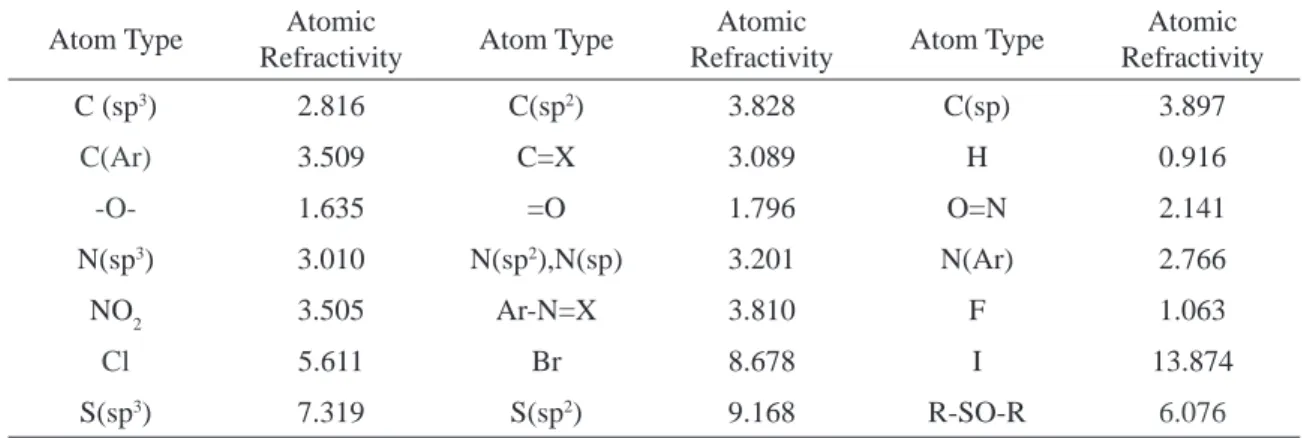
The R state index is also developed from the chemical graph theory. This index is based on the infl uence of dispersive forces of each atom on the other atom in the molecule, modifi ed by mole-cular topology. Crippen et al 16 reported the atomic
refractivity values of the topological environment of each skeleton atom in the molecule.The eva-luation of the individual atomic refractivity value (Calculated by Ghose and Crippen 16) is based on
the idea that the sum of the atomic values (αi)
being related to the molecular value of the molar refractivity:
R (molecule) calc. = ∑ ni αi . (9) Where, ni = No. of atoms ; αi = Atomic refractivity value
Table 5. Atomic refractivity values as calculated by Ghose and Crippen used in the analysis
Atom Type Atomic
Refractivity Atom Type
Atomic
Refractivity Atom Type
Atomic Refractivity
C (sp3) 2.816 C(sp2) 3.828 C(sp) 3.897
C(Ar) 3.509 C=X 3.089 H 0.916
-O- 1.635 =O 1.796 O=N 2.141
N(sp3) 3.010 N(sp2),N(sp) 3.201 N(Ar) 2.766
NO2 3.505 Ar-N=X 3.810 F 1.063
Cl 5.611 Br 8.678 I 13.874
S(sp3) 7.319 S(sp2) 9.168 R-SO-R 6.076
II. RESULTS AND DISCUSSION:
The values of standard heat enthalpy of formation (ΔH f0
) of gases are taken from
litera-ture.17-21 Standard heat enthalpies (ΔH
f 0
) are taken
in kilo calories per mole at atmospheric pressure at 298.15K in gas phase. The values of 1χv , V
w , E
and R are correlated with standard heat enthalpies (ΔH f0
).
The regression analysis reveals that the cor-relations of standard heat enthalpies (ΔH f0) with
the molecular connectivity (1χv ) & van der waals
volume (Vw) show very low level of signifi cance , but with the inclusion of indicator variable (I), i.e, I = 0 for straight chain and I = 1 for branched alkanes, shows high level of signifi cance and are shown by equations (10) & (11).
ΔH f0 = – 9.829 (± 0.175) 1χv – 4.871 (± 0.670) I
– 11.288 (10) N = 44 , r = 0.994 , s = 1.889 , F (2, 41) = 1776.123
ΔH f0 = – 31.724 (± 0.477) V
w – 4.979 (± 0.574)
I– 7.628 (11) N = 45 , r = 0.996 , s = 1.711 , F (2,42) = 2362.53 Both equations show almost 100 % cor-relation . It shows that branching in chains plays an important role in the correlations of the mo-lecular connectivity (1χv) & van der waals volume
(Vw) with the standard heat enthalpies (ΔH f0
) of
the alkanes. In the equation (10) & (11), the F val-ues are signifi cant at 99% level [ F2
42 (0.01) = 5.18
] and are accounting for 98.8% & 99.2% variance (r2 = 0.988 & 0.992) respectively.
The correlations of standard heat enthal-pies (ΔH f0
) with electrotopological state index (E)
and refractotopological state index (R) have been given by equations (12) & (13).
ΔH f0 = – 3.259 (± 0.023)E – 7.573 (12)
N = 45 , r = 0.999 , s = 0.810 , F (1, 43) = 19512.99
ΔH f0 = – 1.033 (± 0.013) R
– 11.114 (13)
N = 46 , r = 0.997 , s = 1.452 , F (1,44) = 6581.835 These equations show the high level of sig-nifi cance. Because, correlation coeffi cients and F value is again at 99% level [ F1
44 (0.01) = 7.31 ]
,99.8% & 99.4%
variance (r2 = 0.998 & 0.994)
high.Stan-dard deviations have minimum variation about the line of regression. All these factors show perfect correlations.
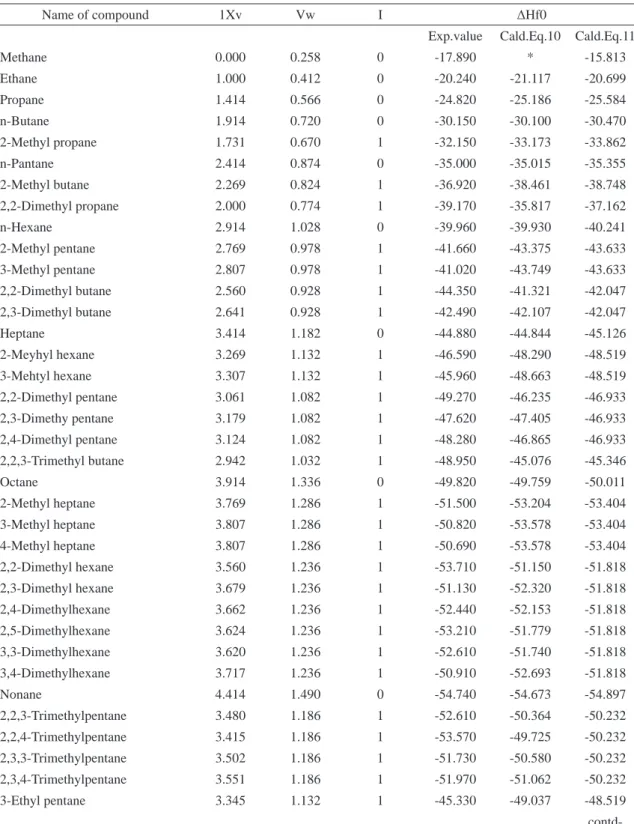
Experimental and theoretical values of standard heat enthalpies of formation (ΔH f0
) of
Table 6. Experimental and theoretical calculated values of ΔHf0 by 1Xv & Vw parameters in alkanes
Name of compound 1Xv Vw I ΔHf0
Exp.value Cald.Eq.10 Cald.Eq.11
Methane 0.000 0.258 0 -17.890 * -15.813
Ethane 1.000 0.412 0 -20.240 -21.117 -20.699
Propane 1.414 0.566 0 -24.820 -25.186 -25.584
n-Butane 1.914 0.720 0 -30.150 -30.100 -30.470
2-Methyl propane 1.731 0.670 1 -32.150 -33.173 -33.862
n-Pantane 2.414 0.874 0 -35.000 -35.015 -35.355
2-Methyl butane 2.269 0.824 1 -36.920 -38.461 -38.748
2,2-Dimethyl propane 2.000 0.774 1 -39.170 -35.817 -37.162
n-Hexane 2.914 1.028 0 -39.960 -39.930 -40.241
2-Methyl pentane 2.769 0.978 1 -41.660 -43.375 -43.633
3-Methyl pentane 2.807 0.978 1 -41.020 -43.749 -43.633
2,2-Dimethyl butane 2.560 0.928 1 -44.350 -41.321 -42.047
2,3-Dimethyl butane 2.641 0.928 1 -42.490 -42.107 -42.047
Heptane 3.414 1.182 0 -44.880 -44.844 -45.126
2-Meyhyl hexane 3.269 1.132 1 -46.590 -48.290 -48.519
3-Mehtyl hexane 3.307 1.132 1 -45.960 -48.663 -48.519
2,2-Dimethyl pentane 3.061 1.082 1 -49.270 -46.235 -46.933
2,3-Dimethy pentane 3.179 1.082 1 -47.620 -47.405 -46.933
2,4-Dimethyl pentane 3.124 1.082 1 -48.280 -46.865 -46.933
2,2,3-Trimethyl butane 2.942 1.032 1 -48.950 -45.076 -45.346
Octane 3.914 1.336 0 -49.820 -49.759 -50.011
2-Methyl heptane 3.769 1.286 1 -51.500 -53.204 -53.404
3-Methyl heptane 3.807 1.286 1 -50.820 -53.578 -53.404
4-Methyl heptane 3.807 1.286 1 -50.690 -53.578 -53.404
2,2-Dimethyl hexane 3.560 1.236 1 -53.710 -51.150 -51.818
2,3-Dimethyl hexane 3.679 1.236 1 -51.130 -52.320 -51.818
2,4-Dimethylhexane 3.662 1.236 1 -52.440 -52.153 -51.818
2,5-Dimethylhexane 3.624 1.236 1 -53.210 -51.779 -51.818
3,3-Dimethylhexane 3.620 1.236 1 -52.610 -51.740 -51.818
3,4-Dimethylhexane 3.717 1.236 1 -50.910 -52.693 -51.818
Nonane 4.414 1.490 0 -54.740 -54.673 -54.897
2,2,3-Trimethylpentane 3.480 1.186 1 -52.610 -50.364 -50.232
2,2,4-Trimethylpentane 3.415 1.186 1 -53.570 -49.725 -50.232
2,3,3-Trimethylpentane 3.502 1.186 1 -51.730 -50.580 -50.232
2,3,4-Trimethylpentane 3.551 1.186 1 -51.970 -51.062 -50.232
3-Ethyl pentane 3.345 1.132 1 -45.330 -49.037 -48.519
contd-3-Methyl-3-ethyl pentane 3.680 1.236 1 -51.380 -52.329 -51.818
2-Methyl-3-ethyl pentane 3.717 1.236 1 -50.480 -52.693 -51.818
Undecane 5.414 1.798 0 -64.600 -64.502 -64.668
Hexadecane 7.914 2.568 0 -89.230 -89.075 -89.095
Nonadecane 9.414 3.030 0 -104.000 -103.818 -103.752
Octadecane 8.914 2.876 0 -99.080 -98.904 -98.866
Pentadecane 7.414 2.414 0 -84.310 -84.16 -84.210
Tetradecane 6.914 2.260 0 -79.380 -79.246 -79.324
Tridecane 6.414 2.106 0 -74.450 -74.331 -74.439
I = 0 for Straight Chain I = 1 for Branched Chain
Table 7. Experimental and theoretical calculated values of ΔHf0 by E and R parameters in alkanes
Name of compound E R ΔHf0
Exp.value Cald.Eq.12 Cald.Eq.13
Methane * 6.478 -17.890 * -17.806
Ethane 4.000 11.125 -20.240 -20.611 -22.606
Propane 5.500 15.771 -24.820 -25.500 -27.405
n-Butane 7.000 20.418 -30.150 -30.389 -32.205
2-Methyl propane 7.333 20.418 -32.150 -31.475 -32.205
n-Pantane 8.500 25.065 -35.000 -35.279 -37.006
2-Methyl butane 8.833 25.065 -36.920 -36.364 -37.006
2,2-Dimethyl propane 9.250 25.065 -39.170 -37.723 -37.006
n-Hexane 10.000 29.712 -39.960 40.168 -41.806
2-Methyl pentane 10.333 29.712 -41.660 -41.253 -41.806
3-Methyl pentane 10.333 29.712 -41.020 -41.253 -41.806
2,2-Dimethyl butane 10.750 29.712 -44.350 -42.612 -41.806
2,3-Dimethyl butane 10.666 29.712 -42.490 -42.338 -41.806
Heptane 11.500 34.359 -44.880 -45.057 -46.606
2-Meyhyl hexane 11.833 34.359 -46.590 -46.142 -46.606
3-Mehtyl hexane 11.833 34.359 -45.960 -46.142 -46.606
2,2-Dimethyl pentane 12.250 34.359 -49.270 -47.501 -46.606
2,3-Dimethy pentane 12.166 34.359 -47.620 -47.228 -46.606
2,4-Dimethyl pentane 12.166 34.359 -48.280 -47.228 -46.606
2,2,3-Trimethyl butane 12.583 34.359 -48.950 -48.587 -46.606
Octane 13.000 39.005 -49.820 -49.946 -51.405
2-Methyl heptane 13.333 39.005 -51.500 -51.031 -51.405
3-Methyl heptane 13.333 39.005 -50.820 -51.031 -51.405
4-Methyl heptane 13.333 39.005 -50.690 -51.031 -51.405
2,2-Dimethyl hexane 13.750 39.005 -53.710 -52.391 -51.405
2,4-Dimethylhexane 13.666 39.005 -52.440 -52.117 -51.405
2,5-Dimethylhexane 13.666 39.005 -53.210 -52.117 -51.405
3,3-Dimethylhexane 13.750 39.005 -52.610 -52.391 -51.405
3,4-Dimethylhexane 13.666 39.005 -50.910 -52.117 -51.405
Nonane 14.500 43.652 -54.740 -54.835 -56.206
2,2,3-Trimethylpentane 14.083 39.005 -52.610 -53.476 -51.405
2,2,4-Trimethylpentane 14.083 39.005 -53.570 -53.476 -51.405
2,3,3-Trimethylpentane 14.083 39.005 -51.730 -53.476 -51.405
2,3,4-Trimethylpentane 13.999 39.005 -51.970 -53.202 -51.405
3-Ethyl pentane 11.833 34.359 -45.330 -46.142 -46.606
3-Methyl-3-ethyl pentane 13.750 39.005 -51.380 -52.391 -51.405
contd-2-Methyl-3-ethyl pentane 13.666 39.005 -50.480 -52.117 -51.405
2,2,3,3-Tetramethylbutane 14.500 39.005 -53.990 -54.835 -51.405
Undecane 17.500 52.946 -64.600 -64.613 -65.806
Hexadecane 25.000 76.180 -89.230 -89.059 -89.806
Nonadecane 29.500 90.120 -104.000 -103.727 -104.206
Octadecane 28.000 85.473 -99.080 -98.838 -99.406
Pentadecane 23.500 71.533 -84.310 -84.170 -85.006
Tetradecane 22.000 66.886 -79.380 -79.281 -80.206
Tridecane 20.500 62.239 -74.450 -74.392 -75.406
[18] and Related Compounds”,Carnegie Press Pittsburgh, Pa., 1953 .
[19] J.G. Aston, “ Some Observations on the Thermodynamics of Hydrocarbons and Related Compounds”, Chem.. Rev., 27 (1940)59-73.
[20] K.S. Pitzer, “ Chemical Equilibria, Free Energies and Heat Contents for gaseous Hydrocarbons”, Chem. Rev., 27 (1940)75-83.
[21] M. Sounders, Jr., C.S. Matthewa and C.O. Hurd, “Entropy and Heat of
[22] Formation of Hydrocarbon Vapors”, Ind. Eng. Chem. ,41 (1949)1048-1056.
[23] F.D. Rossini, “Heats of Formation of Gaseous Hydrocarbons”, Chem. Rev., 27 (1940)1-16.
III CONCLUSION:
Therefore, standard heat enthalpies of for-mation (ΔH f0) of alkanes can be estimated by
equations(10),(11), (12) and (13) simply by calcu-lating molecular connectivity (1χv ) , van der waals
volume (Vw), electrotopological state index (E) and refractotopological state index (R) parame-ters.
IV. REFERENCES:
[1] S. W. Benson and H. Buss , J. Chem. Phy., 29 (1958) 546 – 72.
[2] S. W. Benson , R. R .Cruickshank , D. M. Golden , G. R. Haugen, H. E. O` Neal, A. S. Rodgers, R. J. Shaw and R. Walsh, Chem. Rev., 69 (1969) 279 -321.
[3] M. Luria and S. W. Benson , J. Chem. Eng. Data , 22 (1977) 90 -100.
[4] A.Mercader, E.A.Castro and A.A.Toropov,Int.J.Mol.Sci.2 (2001)121-132.
[5] P.Duchowicz and E.A.Castro.,J.of the Korean Chemical Society 44 (6) (2000).
[6] N.Cohen, J.Phys.Chem. Ref Data, 25 (6) (1995). [7] B.L.Gorsi, G.S.Kalwania and M.Sharma, Indian J,Chem.,Sec.A , 32A(1993) 889.
[8] B.L.Gorsi,G.S.Kalwania and M.Sharma , J.Indian Chem. Soc., 75 (1998) 373.
[9] L.B.Kier and L.H.,Hall (“Molecular Connectivity in Chemistry and Drug Research” Academic Press, New York 1976.
[10] M. Randic, J. Am. Chem. Soc., 97 (1975) 6609. [11] A. Bondi, J. Phy. Chem., 68 (1964) 441.
[12] A. Moriguchi, Chem. Pharm. Bull. (Jpn.), 23 (1975) 247. [13] L. H. Hall , B. Mohnly and L. B. Kier , J. Chem. Inf. Compt. Sc., 1 (1991) 31.
[14] L.H. Hall, B. Mohnly and L.B. Kier,Quant. Struct- Net., Relat, 10(1991) 43 -51.
[15] L. B. Kier and L. H., Hall , Pharmae Res., 7, 8 (1990) 801-807.
[16] A. K. Ghose and G. M. Crippen , J.Chem. Inf. Comput. Sci. 27.1,(1987) 21 -35.