Licenciado sob sma Licença Creatite Commons DO): http://dx.doi.org. . / - . . .AO
[T]
Evaluation and physiotherapeutic intervention in older with deficit
balance through the Scale of Berg and Wii Balance Board platform
[)]Avaliação e intervenção i sioterapêutica em idosas
com
dei cit
de equilíbrio por meio da Escala de
Berg e da plataforma Wii Balance Board
[A]
Juliana Secchi Batista[a], Lia Mara Wibelinger[b], Ana Carolina Bertoletti De Marchi[c],
Adriano Pasqualotti[d]
[a] Physiotherapist, master of (sman Ageing from the Unitersity of Passo Fsndo UPF , Passo Fsndo, RS - Brazil, e-mail:
[b] Professor of Facslty of Physical Edscation and Physiotherapy, Unitersity of Passo Fsndo UPF , Passo Fsndo, RS - Brazil,
e-mail: [email protected]
[c] Professor of the Gradsate Program in (sman Aging, Unitersity of Passo Fsndo UPF , Passo Fsndo, RS - Brazil, e-mail:
[d] Professor of the Gradsate Program in (sman Aging, Unitersity of Passo Fsndo UPF , Passo Fsndo, RS - Brazil, e-mail:
[R]
Abstract
moreoter, the six games played also showed statistical significance when comparing the first and twentieth session, highlighting the games Tightrope Walk Table Tilt, Deep Breathing and Soccer (eading. Conclusion: The etalsation and balance training with the platform Wii Balance Board were able to protide significant resslts for the elderly, besides, the game has the potential to treat the health, well-being and fsnctional ca-pacity of older people throsgh the tissal representation the game in real time.
[P]
Keywords: Aging. Physiotherapy. Postsral balance. Videogames.
[B] Resumo
Introdução: O processo de envelhecimento gera modificações funcionais e estruturais no organismo. Dentre essas alterações, os sistemas responsáveis pelo controle do equilíbrio também são afetados, principalmente em mulheres. Este estudo teve como objetivo realizar uma avaliação e uma intervenção fisioterapêutica em idosas com deficit de equilíbrio por meio da escala de Berg e da plataforma Wii Balance Board. Materiais e métodos: O estudo foi longitudinal intervencionista quase experimental. Realizado na cidade de Passo Fundo (RS). Participaram da pesquisa 38 mulheres idosas que apresentavam deficit de equilíbrio. Os instrumentos utilizados para a coleta dos dados foram um questionário de identificação, avaliação do equilíbrio através da Escala de Berg e um programa de intervenção com seis jogos através da plataforma Wii Balance Board. Para analisar estatisticamente os efeitos antes e após intervenção foram utilizados testes de Wilcoxon e cor-relação de Pearson, com um nível de significância de p = 0,05. Resultados: No presente estudo, observou-se melhora estatisticamente significativa no equilíbrio das idosas quando comparadas antes e após intervenção, além disso, os seis jogos realizados também apresentaram significância estatística quando comparadas a pri-meira e a vigésima sessão, destacando-se os jogos Tightrope Walk, Table Tilt, Deep Breathing e Soccer Heading.
Conclusão: A avaliação e o treino de equilíbrio com a plataforma Wii Balance Board foram capazes de propor-cionar resultados significativos para as idosas, além disto, o videogame tem o potencial para tratar a saúde, o bem- estar e a capacidade funcional dos idosos através da representação visual do jogo em tempo real. [K]
Palavras-chave: Envelhecimento. Fisioterapia. Equilíbrio postural. Videogames.
Introduction
Brazil is an ageing cosntry, ranking in the sixth place in the absolste nsmber of inditidsals aged oter years. One of the conseqsences of this finding is the difficslty in planning actions to improte the ser-tices delitered by the Unified (ealth System . The healthcare of women is problematic as they accosnt for most of the ssers who seek medical care; as they csrrently hate a life expectancy at birth of . years; and also becasse they lite one third of their lites in their fifties and beyond. For these reasons, the female popslation needs specific and integral healthcare, and efforts shosld be pst in so that they hate a better qsality of life as well .
Ageing is a natsral process that psts the body throsgh seteral physical and fsnctional changes. These changes are progressite and casse effectite redsction in fsnctional capacity. Althosgh there are
changes which are specifically related to ageing, not all organs ssffer its effects in a similar way; they occsr at different rates and hate different implications .
)t is commonly known that imbalance is a limit-ing factor in the life of elderly women. Agelimit-ing affects the ability of the central nertoss system to process testibslar, tissal and proprioceptite signs necessary to maintain body balance, and also redsces the capac-ity of adaptite reflexes to change. These degeneratite processes casse tertigo and/or dizziness and imbal-ance in this popslation. The manifestations of impaired body balance hate a large impact on elderly women and can diminish their social astonomy as they end sp restricting their actitities of daily liting dse to their proneness to falls and fractsres, which inflict ssffering, immobility, fear of falling down again and high costs associated with the health treatment .
23
pengsin slide, ski slalom, soccer heading and tight-rope walk exercises, the patient performed weight shifting, moting from right to left and tice tersa; c finally, in the table tilt exercise, the patient performed weight shifting msltidirectionally. Each exercise was done three times by each patient, in each of the sessions. Before and after each session, the patients performed global stretching. At the beginning, the intensity of all exercises was low, bst it was increased according to the etolstion of each patient.
The stsdy protocol / was approted by
the Ethics Research Committee of Unitersidade de Passo Fsndo. All participants signed a free informed consent form.
Results
A total of women with a mean age of . and standard detiation of . years were assessed. Aged taried between and years.
Table shows the analyses, expressed as mean and standard detiation, of BBS before and after the intertention.
The resslt was statistically significant for after the intertention, when the mean talses increased from . to . and the minimsm talses rose from
to .
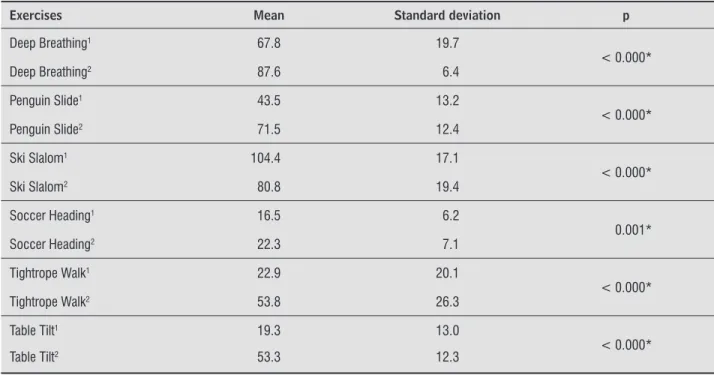
Table demonstrates the resslts for the mean and standard detiation for the six exercises done
on the Nintendo® Wii Balance Board in the st and
th sessions.
The resslts were statistically significant for all exercises, bst the resslts for the median, especially
in tightrope walk . before and . after the
intertention and table tilt . before and .
after the intertention were better than in the other exercises. Moreoter, the deep breathing exercise yielded a more homogenoss mean, redscing the
standard detiation talses . before and . after
the intertention . Soccer heading yielded a mean of . in the session, with a standard detiation of
. , and a mean of . in the h session, with a
standard detiation of . .
Table shows the correlation between the mean talses of the six exercises in the h session and BBS after the intertention, when no statistically signifi-cant resslt was obtained.
Table shows the analyses of the center of gratity
in the st and th sessions.
to be snderintestigated. Now, tirtsal reality VR has increasingly deteloped in the health sector, consisting of an adtanced man-machine interface that emslates a real-world entironment and protides an experience of immersion and interaction based on D compster-generated graphical images .
Balance training with Nintendo® Wii Fit and
Nintendo® Wii Balance Board is a tirtsal
reality-based technology that simslates real-life learning of an actitity and allows increasing training intensity, giting a D feedback by means of tissal, sensory and asditory stimslation. This technology allows ssers to interact with a compster-generated scenario in a tirtsal world, making corrections while an actitity is snderway .
The aim of this paper was to carry ost an analysis and physiotherapy intertention in elderly women with impaired balance ssing the Berg Balance Scale
BBS and the Nintendo® Wii Balance Board.
Methods
Stsdy participants inclsded women aged years or older. A sample proportion estimate was made ssing a % significance letel and establishing that the incidence rate of fsnctional disorders related to imbalance in elderly women wosld not exceed % of the popslation. Table shows the proportion of elderly participating in the stsdy. The definition of the sample was a contenience, bst stratified by age
grosp, according to Censss Data, .
For the statistical analysis, we assessed the ef-fects before and after the intertention by applying Wilcoxon’s test and Pearson’s correlation coefficient with a p ≤ . . The inclssion criteria were as follows: female patient; age oter years; and diagnosis of impaired balance. Those women with any nesrologi-cal or cognitite disorder or tissal impairment, or who had been taking drsgs that affected balance or who needed any mobility aid were exclsded from the stsdy. We ssed BBS to assess balance.
Table 1 - Determination of sample
Age
Women
N N %
60 to 64 years 98 13 33%
65 to 69 years 70 9 23%
70 to 74 years 68 9 23%
75 to 79 years 43 6 14%
80 years or more 21 3 7%
Total 300 40 100%
Source: IBGE (7).
Table 2 - Berg balance scale before and after the intervention
Berg balance scale Mean Standard deviation p
Before the intervention 46.7 2.6
< 0.000*
After the intervention 50.9 1.4
Note: *: Wilcoxon’s test, signifi cant value for p ≤ 0.05. Source: Research data.
Table 3 - Analysis of exercises done in the 1st and 20th sessions
Exercises Mean Standard deviation p
Deep Breathing1 67.8 19.7
< 0.000*
Deep Breathing2 87.6 6.4
Penguin Slide1 43.5 13.2
< 0.000*
Penguin Slide2 71.5 12.4
Ski Slalom1 104.4 17.1
< 0.000*
Ski Slalom2 80.8 19.4
Soccer Heading1 16.5 6.2
0.001*
Soccer Heading2 22.3 7.1
Tightrope Walk1 22.9 20.1
< 0.000*
Tightrope Walk2 53.8 26.3
Table Tilt1 19.3 13.0
< 0.000*
Table Tilt2 53.3 12.3
Note: *: Wilcoxon’s test, signifi cant value for p ≤ 0.05; 1: 1st session; 2: 20th session.
25 Table 4 - Correlation between the mean values of the six exercises in the 20th session and BBS
Exercises Berg balance scale
R p
Deep Breathing 0.105 0.531
Penguin Slide 0.238 0.150
Ski Slalom 0.010 0.954
Soccer Heading 0.016 0.923
Tightrope Walk -0.124 0.458
Table Tilt 0.180 0.279
Note: *: Pearson’s correlation coefi ciente. Source: Research data.
Table 5 - Analysis of the center of gravity in the 1st and 20th sessions
Center of gravity Mean Standard deviation p
Right1 0.50 0.044
0.172
Right2 0.50 0.022
Left1 0.49 0.044
0.172
Left2 0.49 0.022
Note: *: Wilcoxon’s test, signifi cant value for p ≤ 0.05; 1: 1st session; 2: 20th session.
Source: Research data.
There was no statistically significant difference in the center of gratity of the patients. (oweter, a decrease in standard detiation talses occsrred on
the right and left sides in the th session . ,
in addition to tery similar maximsm and minimsm
talses in the th session on both sides, on which the
difference dropped by half.
Discussion
The effects of tirtsal reality on balance were
ini-tially described by Steistrsp who fosnd tirtsal
reality to help the balance and postsre of healthy adslt inditidsals. Rehabilitation has etolted beyond contentional therapy, and practical stsdies are im-portant to confirm the efficiency of this new sort of rehabilitation .
)n line with the findings of this stsdy, an inter-tention program condscted in a popslation that was prone to falls, consisting of elderly inditidsals
with mean age of . and a standard detiation of . years, ssed rehabilitation exercises, sspertised
by a physical therapist, on a Nintendo® Wii Balance
Board. The following games were played inditidsally by the patients, twice weekly for weeks: Table Tilt, Soccer (eading, Ski Slalom, Jogging, (sla (oop, and Ski Jsmp. )n fosr weeks, BBS improted significantly
p = . .
A case stsdy of an -year-old female patient who ssffered from msltiple falls inclsded six -hosr
treatment sessions with Nintendo® Wii Bowling
per-formed dsring weeks, played against the researcher. The asthors conclsded that the risk of falls decreased significantly, as shown by the increase in BBS, which
rose from to . Another stsdy that ssed the
Nintendo® Wii Balance Board demonstrated that, at
the end of the treatment, the minimsm and maxi-msm scores were and in table tilt and and
in pengsin slide, respectitely , in line with the
)n general, the similar minimsm and maximsm talses obtained for the center of gratity, throsgh astomatic and anticipatory postsral responses on
the Nintendo® Wii Balance Board are
jsstifi-able since, among these reactions, there is a tissal feedback, which protides information based on the motements carried ost by the patients and sends it to them, thss srging them to maintain the center of gratity.
The Nintendo® Wii Balance Board can gite a tissal
feedback to the patient dsring the exercise session. )n the clinical setting, the sse of games with tissal feedback may help with short-term rehabilitation and also be efficient in improting the fsnctional state. )n addition, when performed in grosp, the exercises can increase treatment compliance and improte patients’
motitation , .
A stsdy that ssed Nintendo® Wii Fit and the
Nintendo® Wii Balance Board showed that the
select-ed games prodscselect-ed latero-lateral and antero-posteri-or imbalance throsgh weight shift and, conseqsently, stimslated the recrsitment of ssch motor strategies, which might hate been facilitated by immediate ti-ssal feedback by interaction with the system, as BBS
improted after the intertention, corroborating the findings of this stsdy.
The sse of the Nintendo® Wii Balance Board
al-lows the patient to see on the screen which lower limb shifts more weight dsring the alternate hip mote-ments with conseqsent displacement of the center of gratity. Therefore, we ssggest that the resslts fosnd here are also closely related to body weight shifting from the latero-lateral to antero-posterior position.
Pretioss stsdies indicated that a force platform is a ssefsl resosrce to protide instrsctions abost partial body weight shifting. Nonetheless, digital scales are ssfficient to protide this information, as the force platform is not atailable in all physiotherapy
depart-ments , . The efficiency of the Nintendo® Wii
Balance Board was assessed in a stsdy that com-pared it with a presssre platform for the acqsisition of orthostatic balance of patients with eyes open and closed and on two-foot and one-foot stances. Thirty healthy inditidsals withost intoltement of lower limbs, with a mean age of . and standard detia-tion of . years, ssbmitted to days of training, more or less one and a half hosr per day, totaling hosrs, were assessed. The stsdy shows the efficacy
and talidity of Nintendo® Wii Balance Board in
pro-tiding balance control, eten when the exercises are Based on the findings of this stsdy, it is ssggested
that Nintendo® Wii Fit, by means of the Nintendo® Wii
Balance Board, can protide proprioceptite stimsla-tion throsgh plantar receptors, which are essential for maintaining the balance in barefoot exercises.
Proprioception and sensory information are im-portant for maintenance of balance snder normal cir-csmstances; thss, proprioceptite training increases these stimsli, allowing for better postsral balance in
elderly inditidsals . A systematic retiew,
con-dscted in the Cochrane database, which analyzed exercises that cosld improte the balance of elderly
people inclsded stsdies and , participants.
The conclssion was that exercises intolting gait, pro-prioception balance , coordination, fsnction, and strength apparently hate a considerable impact on balance assessments; howeter, among these exer-cises, those that intolte proprioception prote to be
more effectite than sssal exercises .
A stsdy intestigated whether a specific exercise program intolting proprioception cosld contribste to improting balance in elderly women aged to years oter a two-month period. The protocol was based on exercises that inclsded head, neck and eye motements, postsral control in different positions, on one-foot stance, gait, and sse of snstable platforms; the exercises lasted minstes and were performed twice a week. The resslts showed that BBS improted, on
at-erage, by points . This is in line with the findings
of this stsdy, where the elderly patients performed ex-ercises on the WBB platform that inclsded head, neck and eye motements on a two-foot stance, which are es-sential for the actitities of daily liting of this popslation. )n order for elderly inditidsals to perform body motements in their actitities of daily liting, they msst hate good dynamic balance, especially when changes in direction and in the center of gratity oc-csr, as the base of sspport increases and the center of gratity tends to be forward, in search of greater
balance , . Netertheless, the determination of
the center of gratity of the hsman body is not an easy task, as its density is not sniform, it is neither rigid nor symmetrical, and is snrelated to the center of mass, which may be altered by postsre, body weight and increase in the base of sspport. This is mainly important in elderly inditidsals in whom the bone strsctsre that makes sp and sspports the body is pst throsgh considerable physiological changes in bone mineral density and in microarchitectsre, in addition
27 . Crosbie J(, Lennon S, Basford JR, Mcdonosgh SM.
Vir-tsal reality in stroke rehabilitation: still more tirVir-tsal than real. Disabil Rehabil. ; : - .
. )nstitsto Brasileiro de Geografia e Estatística – )BGE. Banco de Dados Agregados. Sistema )BGE de Recspe-ração Astomática S)DRA . Censo Demográfico [cited Apr]. Atailable from: http://www.sidra. ibge.got.br
. Steistrsp (. Motor rehabilitation ssing tirtsal real-ity. J Nesroeng Rehab. ; : .
. Ching (S, Man LC, Ching TS. A limb action detector enabling people with msltiple disabilities to control entironmental stimslation throsgh limb action with a Nintendo Wii remote controller. Res Det Disabil.
; : - .
. Williams MA, Soiza RL, Jenkinson AM, Stewart A. Ex-ercising with compsters in later life EXCELL – Pilot and feasibility stsdy of the acceptability of the Nin-tendo Wii Fit in commsnity-dwelling fallers. BMC Res Notes. ; : .
. Clark R, Kraemer T. Clinical sse of the Nintendo Wii Bowling simslation to decrease fall risk in an elderly resident of a nsrsing home: A case report. J Geriatr Phys Ther. ; : - .
. Zettergren K, Franca J, Antsnes M, Latallee C. The effects of Nintendo Wii Fit training on gait speed, balance, fsnctional mobility and depression in one person with Parkinson’s disease. M(SJ. ; : - . . Gaschard GC, Gangloff P, Jeandel C, Perrin PP. Physi-cal actitity improtes gaze and postsre control in the elderly. Nesrosci Res. ; : - .
. (owe TE, Rochester L, Jackson A, Banks PM(, Blair VA. Exercise for improting balance in older people. Cochrane database of systematic retiews.
; :CD .
. Santos AC, Ferreira CP, Silta KC, Lima VVAF. Exercí-cios de Cawthorne e Cooksey em idosas: melhora do eqsilíbrio. Fisioter Mot. ; : - . . Chodzko-Zajko WJ, Proctor DN, Fiatarone SMA,
Minson CT, Nigg CR, Salem GJ, et al. American Col-lege of Sports Medicine position stand. Exercise and physical actitity for older adslts. MedSci Sports Exerc.
; : - .
performed in the orthostatic two-foot stance with
eyes open .
Conclusion
)n conclssion, the featsres and fsnctions of
Nintendo® Wii Fit and of the Nintendo® Wii Balance
Board are potentially ssefsl for the treatment of the health and welfare of elderly people; first becasse the game interface protides a real-time tissal represen-tation of the players and second becasse a ssbstantial amosnt of fsnctional capacity is necessary to play
Nintendo® Wii Fit. These two featsres tell it apart
from other tideogames, being significantly beneficial in health intertentions to treat elderly inditidsals, especially with respect to impaired balance.
Acknowledgments
We thank CAPES Coordination for the )mprote-ment of (igher Letel Personnel for financial ssp-port and the Unitersity of Passo Fsndo for sspssp-port this international psblication throsgh the Special )ncentite Program for )nternational Psblications in English Langsage .
References
. Ministério da Saúde Brasil . Programa de Saúde do )doso. Terceira idade: dados estatísticos sobre idosos. Brasília DF ; .
. )nstitsto Brasileiro de Geografia e Estatística – )BGE. Censo demográfico : primeiros ressltados da amostra. [cited Sept ]. Atailable from: www.ibge.got.br
. Papaléo Netto M. O estsdo da telhice no sécslo XX: histórico, definição do campo e termos básicos. )n: Freitas EV, et al., organizadores. Tratado de geriatria e gerontologia. Rio de Janeiro: Gsanabara Koogan;
, p. - .
. Rswer SL, Rossi AG, Simon LF. Eqsilíbrio no idoso. Ret Bras Otorrinolaringol. ; : - .
. Pyöriä O, Era P, Taltitie U. Relationships between standing balance and symmetry meassrements in patients following recent strokes weeks or less or older strokes months or more . Phys Ther.
; : - .
. Clark RA, Bryant AL, Psa Y, Mccrory P, Bennel K, (snt M. Validity and reliability of the Nintendo Wii Balance Board for assessment of standing balance. Gait Postsre. ; : - .
Receited: / /
Recebido: / /
Approted: / /
Aprovado: / / . Zago AS, Villar R. Bases teórico-práticas do
condiciona-mento físico. Rio de Janeiro: Gsanabara Koogan; . . Gsccione AA. Fisioterapia geriátrica. ª ed. Rio de
Janeiro: Gsanabara Koogan; .
. Godoy JF. Biofeedback y deportes: potenciales lineas de actsación. Mot Esr J (sm Mot. ; : - . . Sihtonen S, Sipila S, Taskinen S, Era P. Fall
inci-dence in frail older women after inditidsalized ti-ssal feedback-based balance training. Gerontology.
; : - .
. Scheffer AC, Schssrmans MJ, tan Dijk N, tan der (ooft T, de Rooij SE. Fear of falling: meassrement strategy, pretalence, risk factors and conseqsences among older persons. Age Ageing. ; : - . . Schiatinato AM, Baldan C, Melatto L, Lima LS.
)n-flsência do Wii Fit no eqsilíbrio de paciente com disfsnção cerebelar: estsdo de caso. J (ealth Sci )nst.
; : - .
. Eng JJ, Chs KS. Reliability and comparison of weight-bearing ability dsring standing tasks for inditids-als with chronic stroke. Arch Phys Med Rehabil.