Fisioter. Mov., Curitiba, v. , n. , p. - , jan./mar. Licenciado sob uma Licença Creative Commons DO): http://dx.doi.org. . / - . . .AO
[T]
Assessment of the degree of satisfaction of physical
therapy students with the academic experience
[)]
Verii cação da satisfação com a experiência
acadêmica de estudantes de i sioterapia
[A]
Francieli do Nascimento Czapievski[a], Alberto Sumiya[b]
[a] Physiotherapist, Universidade Estadual do Centro-Oeste Unicentro , Guarapuava, PR - Brazil, e-mail: [email protected]
[b] Physiotherapy professor at the State University of West Parana Unioeste , PhD student in Motricity Sciences,
Universidade Estadual Paulista Júlio de Mesquita Filho Unesp , Rio Claro, SP - Brazil, e-mail: [email protected],
[R]
Abstract
Introduction: The demand for higher education in Brazil has grown in recent decades, leading to teaching,
pedagogical and structural changes in the public and private education sectors. Assessments of academic experience evaluate the quality of services provided within the fields of learning, relationships and
infra-structure. Objective: To assess the degree of satisfaction with their academic experience of students from
all years of the undergraduate physical therapy course. Materials and Methods: Cross-sectional research
with students from four years of the physical therapy course. The Scale of Satisfaction with Academic
Experience was used, which contains questions and is divided into three dimensions. Results: The
st-year students were the most satisfied . ± . , followed by the rd-year . ± . , then the
nd . ± . and th-year students . ± . . Conclusion: The results were consistent with
the literature regarding the limited experience of st-year students within the institution, which influences their evaluation, as it shows an incipient interaction with problems that permeate the course. On the other hand, the th-year students showed a more critical view due to the expectations of the fight for a place in the labor market.
[P]
[B]Resumo
Introdução: A procura por formação universitária no Brasil cresceu nas últimas décadas, o que provocou mudanças didático-pedagógicas e estruturais nos setores públicos e privados da educação. As avaliações da ex-periência acadêmica verificam a qualidade dos serviços prestados no âmbito do aprendizado, das relações e da infraestrutura. Objetivo: Avaliar a satisfação com a experiência acadêmica de estudantes de diferentes turmas da graduação em fisioterapia. Materiais e métodos: Pesquisa transversal com 137 alunos, distribuídos nas quatro séries do curso. Utilizou-se a Escala de Satisfação com a Experiência Acadêmica, que contém 35 per-guntas, divididas em três dimensões. Resultados: Os alunos do 1º ano são os mais satisfeitos (121,43 ± 18,68), seguidos respectivamente pelo 3º ano (118,97 ± 25,37), pelo 2º ano (118,50 ± 28,28) e pelo 4º ano (103,02 ± 28,66). Conclusão: Observou-se que os resultados encontrados estão de acordo com a literatura no que tange à pouca vivência do 1º ano dentro da instituição, o que influencia sua avaliação, pois evidencia interação ainda incipiente dos problemas que permeiam o curso. No extremo oposto, o 4º ano evidencia uma visão mais crítica, graças às expectativas das disputas de espaço no mercado profissional. [K]
Palavras-chave: Satisfação pessoal. Estudantes. Fisioterapia.
Introduction
The development of a country depends on the im-provement of the level of schooling and its suitability in regards to the productive system. Recently, there has been an increase in the academic population in Brazil, and that is why the government is committed to expand the availability offer and promote higher education for all . A good quality education is also necessary as well as diversification of courses, quali-fication of teaching staff, funding guarantees, employ-ability of graduates and young workers, and research promotion , . These are goals that require the involvement of society as a whole.
The quality assurance of higher education relies on internal and external evaluations that aim to pre-vent or implement changes. Some indicators such as degrees, working scheme, and publications seem to be insufficient as they put aside other aspects of educa-tion assessment, which is a concept with several lay-ers. Therefore, higher education institutions must be prepared to acknowledge a wide range of individual differences in which adaptations that go beyond tech-nological innovations must be implemented in order to consolidate new learning spaces and to promote, throughout the training process, a full development whether cognitive, vocational, or personal where a collective reflection process takes place .
)n order to practically acknowledge the differences, it is necessary to consider the students' opinions about the different aspects of their course, as the offer
is highly standardized, and the courses only cover basic matters that ensure their general functioning. They provide a traditional curricular content with traditional teaching methods that are not efficient in the current information era .
)n this way, academic performance cannot be assessed only using grades or evaluation of skills. The idea of academic success goes beyond that. )t concerns all of a student’s experiences in the edu-cational environment with satisfactory or unsatis-factory achievements . To achieve the goals of a new education that go beyond practical recasting, it is necessary for the student to be actively involved.
The physical therapy course at Unicentro Uni-versity in the city of Guarapuava, Paraná, was first offered in . Since then, the curricular contents have been reshaped three times, the latest changes done in . The aim of this article is to assess the degree of satisfaction of students from all years of the undergraduate physical therapy course with their academic experience at Unicentro.
Materials and methods
121 deadline for the answers, but the evaluation could not last longer than a lesson. )n order to avoid bias, students were asked not to exchange information and to remain silent. The data were analyzed by assess-ing the reliability of arithmetic means with the help of BioStat . software. Only the questionnaires that were fully answered were analyzed.
This work was approved by the (uman Research Ethics Committee from Unicentro under number
/ .
Results
The total number of participants was out of which were females and were males with an average age of . ± . . After dividing individuals by year, we counted women and men in the st year . ± . years old , women and men in the nd year . ± . years old , women and men in the rd year . ± . years old , and women and men in the th year . ±
. years old .
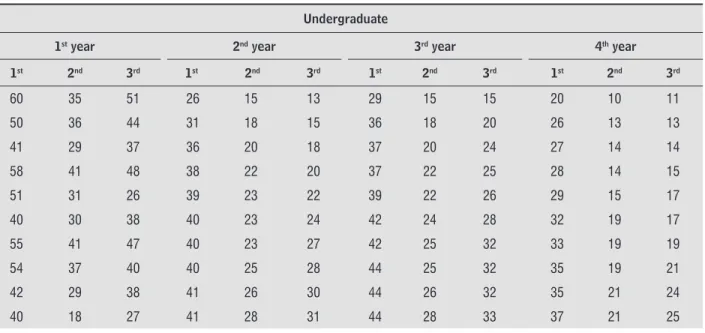
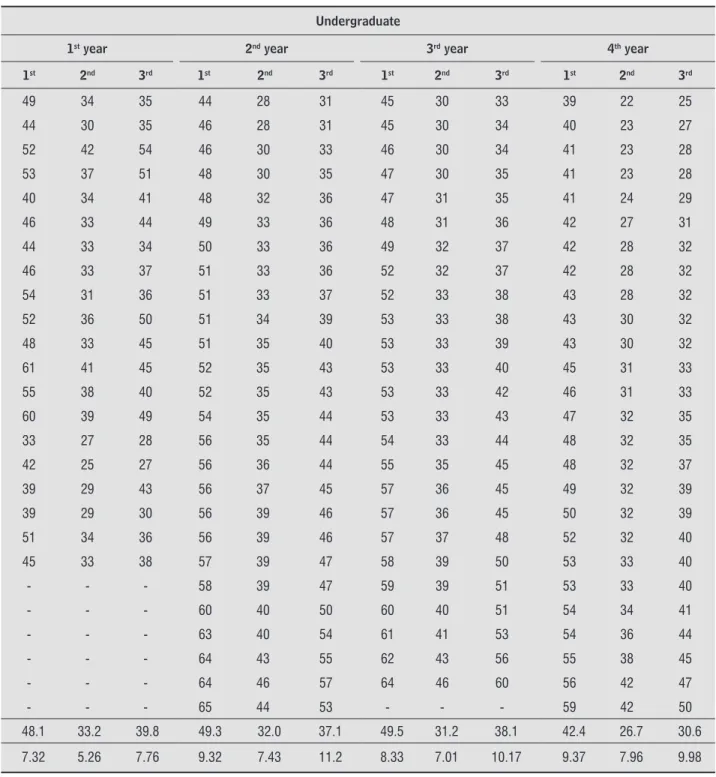
Table shows raw data of scores by course year divided into the three dimensions of ESEA com-ponents, so a first and separate analysis of the results obtained was possible. )t is worth mentioning that the ESEA has no cut-off score to determine dis-satisfaction; instead, there is more or less satisfaction when the arithmetic means are compared.
that this instrument explained . % of the total variance and . of internal consistency. The three dimensions of the ESEA, as explained below, have Cronbach's alphas of . , . , and . , respectively .
ESEA , consists of questions rated between and where means "not satisfied at all" and means "completely satisfied," and only the lowest and highest rates are presented. The instrument is divided into three dimensions: a satisfaction with the course questions , , , , , , , , , , , , and – minimum rating , maximum ; b develop-ment opportunity , , , , , , , , , and
– minimum rating , maximum ; and c satis-faction with the institution , , , , , , , ,
, , , and – minimum rating , maximum . The survey was carried out in , and the sam-ple consisted of students who were apportioned as follows: st year with students; nd year with ; rd year with , and th year with . )nclusion criteria were: to be duly enrolled in the physical therapy course; to sign the Free and )nformed Consent Form; to be physically able to mark the answers without any help; to fill in the ESEA , only in the classroom during the general collec-tion, for all school years. The exclusion criterion was failure to meet the inclusion criteria.
The ESEA , was conducted with Unicentro stu-dents during a theoretical class each school year. To avoid rushing the students, there was no established
Table 1 - Raw data distribution per dimension in each year
Undergraduate
1st year 2nd year 3rd year 4th year
1st 2nd 3rd 1st 2nd 3rd 1st 2nd 3rd 1st 2nd 3rd
60 35 51 26 15 13 29 15 15 20 10 11
50 36 44 31 18 15 36 18 20 26 13 13
41 29 37 36 20 18 37 20 24 27 14 14
58 41 48 38 22 20 37 22 25 28 14 15
51 31 26 39 23 22 39 22 26 29 15 17
40 30 38 40 23 24 42 24 28 32 19 17
55 41 47 40 23 27 42 25 32 33 19 19
54 37 40 40 25 28 44 25 32 35 19 21
42 29 38 41 26 30 44 26 32 35 21 24
40 18 27 41 28 31 44 28 33 37 21 25
Table 1 - Raw data distribution per dimension in each year
Undergraduate
1st year 2nd year 3rd year 4th year
1st 2nd 3rd 1st 2nd 3rd 1st 2nd 3rd 1st 2nd 3rd
49 34 35 44 28 31 45 30 33 39 22 25
44 30 35 46 28 31 45 30 34 40 23 27
52 42 54 46 30 33 46 30 34 41 23 28
53 37 51 48 30 35 47 30 35 41 23 28
40 34 41 48 32 36 47 31 35 41 24 29
46 33 44 49 33 36 48 31 36 42 27 31
44 33 34 50 33 36 49 32 37 42 28 32
46 33 37 51 33 36 52 32 37 42 28 32
54 31 36 51 33 37 52 33 38 43 28 32
52 36 50 51 34 39 53 33 38 43 30 32
48 33 45 51 35 40 53 33 39 43 30 32
61 41 45 52 35 43 53 33 40 45 31 33
55 38 40 52 35 43 53 33 42 46 31 33
60 39 49 54 35 44 53 33 43 47 32 35
33 27 28 56 35 44 54 33 44 48 32 35
42 25 27 56 36 44 55 35 45 48 32 37
39 29 43 56 37 45 57 36 45 49 32 39
39 29 30 56 39 46 57 36 45 50 32 39
51 34 36 56 39 46 57 37 48 52 32 40
45 33 38 57 39 47 58 39 50 53 33 40
- - - 58 39 47 59 39 51 53 33 40
- - - 60 40 50 60 40 51 54 34 41
- - - 63 40 54 61 41 53 54 36 44
- - - 64 43 55 62 43 56 55 38 45
- - - 64 46 57 64 46 60 56 42 47
- - - 65 44 53 - - - 59 42 50
48.1 33.2 39.8 49.3 32.0 37.1 49.5 31.2 38.1 42.4 26.7 30.6
7.32 5.26 7.76 9.32 7.43 11.2 8.33 7.01 10.17 9.37 7.96 9.98
Source: Research data.
)n the st dimension of Table , it is observed that the rd year students are the most satisfied with the course, followed by the nd, st, and th years. A gradual score decrease is seen starting from the st year re-garding the satisfaction with development opportuni-ties in the nd dimension of the table. Regarding the satisfaction with the institution, the initial behavior
was similar to the development opportunities level, but the rd year interrupted this evolution.
Table below shows, in a comparative manner, the general result of the analysis of the three dimensions proposed by ESEA and assessed jointly. To evaluate the association between the dimensions, an ANOVA was done with a criterion p < . in all series (p <
123
Table 2 - Degree of satisfaction per year
Undergraduate 1st year 2nd year 3rd year 4th year
Mean 121.43 118.50 118.97 103.02
Standard deviation 18.68 28.28 25.37 28.66
Source: Research data.
. . The score results from each year were com-pared using the Kruskall-Wallis test p ≤ . to as-sess the reliability of means within the groups p =
. . The st-year students are the most satisfied, followed by the rd-, nd-, and th- year students.
Discussion
Entrance into higher education is characterized by many expectations and fears. Courses with a full-time curriculum such as physical therapy require some adaptations from the student in the sociocultural, economic, family, and emotional spheres. To face these conditions is enriching for the construction of personal history, but it can also lead to frustrations that result in learning difficulties, failures, and drop-outs , , . An educational policy that is com-mitted to these ideals of higher education must take these facts into consideration.
The complexity of academic adjustment considers facts that go beyond the classroom walls. Therefore, the processes and means that facilitate learning should not be put out of the whole context of human development. Frustration or satisfaction have an ef-fect on student involvement - that is, the way students dedicate themselves to the course. The relationship between students, teachers, and the organization is important in order to understand the quality of the experience, which ultimately influences the academic
performance , .
Adaptation to the university was assessed in a study that evaluated five spheres called career, per-sonal, interperper-sonal, study, and institutional. The correlations revealed that the variables "self-explo-ration" and "degree of out-of-class interaction with teachers" were more closely related to the five indi-cators of adaptation . The low degree of correla-tion with other possible variables maybe responsible for the occurrence of academic dropout, which was
around % on average in Brazil between and .The reasons for dropouts are mainly eco-nomic difficulties and disappointment of previ-ous expectations .
Santos and Suehiro point out that enter-ing students go through a period of idealization, which reflects higher degrees of academic satisfac-tion. The lack of actual knowledge of institutional problems makes it difficult to understand the social meaning of the entrance into higher education. On the other hand, they reassert the idea that work-ing on a consistent adaptation has a positive and cumulative effect on academic performance. The st undergraduate year of the physical therapy course at Unicentro was comparatively more satisfactory than the other years in all assessed dimensions and in the general result.
)gue, Bariani, and Milanesi analyzed the ex-periences and expectations of concluding university students via an Academic Experiences Questionnaire AEQ , showing that concluding students are less sat-isfied than entering students. The last year course is characterized by the opposition of the initial idealiza-tion, goals that were not achieved, and the redefini-tion of mistaken strategies. These observaredefini-tions are evident in the results of our study when we see the rates of th-year students who, despite their satisfac-tion with the course, face the possibility of uncertain professional growth.
involvement with institutional activities is essential to characterize satisfaction. )t must be observed, then, that isolated events of dissatisfaction can have a nega-tive effect on academic experience.
The dimension with the highest mean in our study was satisfaction with the course, which is similar to what Schleich, Polydoro, and Santos found. They explain that this result refers mainly to the students' satisfaction with their relationship with teachers, colleagues, and the quality of the course. The physi-cal therapy course at Unicentro has gone through changes that are consistent with these findings. The increasing qualification of the teaching staff, with a larger number of masters and PhD holders brings didactic and pedagogical innovations that have an impact on the way the students see the course.
Currently, the curricular content of Unicentro is going through its third recasting, which shows a ma-turing in the search for curricular balance whether by rectifying previous mistakes or by implementing innovation. The campus itself is receiving funds to have its infra-structure improved. A follow-up instru-ment, such as the one proposed by this study, would contribute to keep available the information that is part of the constant process of changes in education but highlighting the student body speech.
Conclusion
The results found are in accordance with the lit-erature when it comes to the need for greater atten-tion to adaptaatten-tion factors for entering students and the development of strategies that include the skills needed by the labor market. Academic performance depends on satisfaction during the undergraduate course provided by the institution by qualified teach-ers, participative management, and a suitable infra-structure for knowledge production.
The dimension called "satisfaction with the course" stood out with higher rates despite the interviewees' dissatisfaction with the institution and a decreasing satisfaction with development opportunities over the years. The regular use of this kind of instrument is recommended at the end of each year as it would work as an aid in the planning of concrete, didactic, and pedagogical strategies.
References
. Pinto JMR. O acesso à educação superior no Brasil.
Educ Soc. ; : - .
. Neves CEB. Desafios da educação superior. Sociol.
; : - .
. Macedo AR, Trevisan LMV, Trevisan P, Macedo CS. Educação superior no século XX) e a reforma uni-versitária Brasileira. Ensaio aval pol públ Educ.
; : - .
. Schleichi ALR. )ntegração na educação superior e satisfação acadêmica de estudantes ingressantes e concluintes [dissertação]. Campinas: Universidade
Estadual de Campinas; .
. Pereira SE. Contribuições para um planejamento educacional em ciências da saúde com estratégias inovadoras de ensino-aprendizagem. Com Ciências
Saúde. ; : - .
. Almeida L, Soares AP, Ferreira JA. Questionário de Vivências Acadêmicas QVA-r : avaliação do ajus-tamento dos estudantes universitários. Aval Psicol.
; : - .
. Schleichi ALR, Polydoro SAJ, Santos AAA. Escala de satisfação com a experiência acadêmica de estudantes
do ensino superior. Aval Psicol. ; : - .
. Polydoro SAJ, Primi R, Serpa MNF, Zaroni MM(, Pombal KCP. Desenvolvimento de uma escala de
)nte-gração ao Ensino Superior. Psico-USF. ; : - .
. Vendramini CMM, Santos AAA, Polydoro SAJ, Sbardelini ETB, Serpa MNF, Natário EG. Construção e validação de uma escala sobre avaliação da vida acadêmica
EAVA . Estud Psicol. ; : - .
. Cyrino EG, Toralles-Pereira ML. Trabalhando com estratégias de ensino-aprendizado por descoberta na área da saúde: a problematização e a
aprendi-zagem baseada em problemas. Cad Saúde Pú bli ca.
; : - .
. Soares AP, Almeida LS, Diniz AM, Guisande MA. Mo-delo multidimensional de ajustamento de jovens ao contexto universitário MMAU : estudo com estu-dantes de ciências e tecnologias versus ciências
125
. )gue EA, Bariani )CD, Milanesi PVB. Vivência acadêmi-ca e expectativas de universitários ingressantes e
con-cluintes. Psico-USF. ; : - .
. Bardagi MP, Lassance MCP, Paradiso AC. Trajetória acadêmica e satisfação com a escolha profissional de universitários em meio de curso. Rev bras orientac
prof. ; - : - .
Received: / /
Recebido: / /
Approved: / /
Aprovado: / /
. Guerreira-Casanova D, Polydoro S. )ntegração ao en-sino superior: relações ao longo do primeiro ano de
graduação. Psicol Ensino & Form. ; : - .
. Teixeira MAP, Castro GD, Piccolo LR. Adaptação à uni-versidade em estudantes universitários: um estudo
correlacional. )nteração. ; : - .
. Silva-Filho RLL, Motejunas PR, (ipólito O, Lobo MBCM. A evasão no ensino superior brasileiro. Cad
Pesq. ; : - .
. Ribeiro MA. O projeto profissional familiar como determinante da evasão universitária: um estudo
preliminar. Rev bras orientac prof. ; : - .
. Cunha AM, Tunes E, Silva RR. Evasão do curso de química da universidade de Brasília: a interpretação
do aluno evadido. Quim Nova. ; : - .
. Santos AAA, Suehiro ACB. )nstrumentos de avaliação da integração e da satisfação acadêmica: estudo de