Fisioter. Mov., Curitiba, v. , n. , p. - , jan./mar. Licenciado sob uma Licença Creative Commons http://dx.doi.org. . / - . . .AO
[T]
Proposed use of the international classification of functioning,
disability and health to evaluate quality of life after an amputation
[)]Proposta de utilização da classii cação internacional
de funcionalidade, incapacidade e saúde na avaliação
da qualidade de vida de pessoas com amputação
[A]
Andersom Ricardo Fréz[a], Amirah Ali Abdallah[b], Christiane Riedi[c], Janaine Galindo[d], João Afonso Ruaro[e], Simone de Carvalho Ribeiro[f]
[a] Physiotherapist, Master’s Program in (ealth, )nterdisciplinary and Rehabilitation, Universidade Estadual de Campinas
Unicamp , professor at Universidade Estadual do Centro-Oeste Unicentro , Guarapuava, PR - Brazil, e-mail: [email protected]
[b] Physioterapist, graduated from Faculdade Anglo-Americano FAA , Foz do )guaçu, PR - Brazil, e-mail:
[c] Physiotherapist, Master’s Program in Physical Therapy, Universidade Metodista de Piracicaba Unimep , professor at
Universidade Estadual do Centro-Oeste Unicentro , Guarapuava, PR - Brazil, e-mail: [email protected]
[d] Physioterapist, graduated from Faculdade Anglo-Americano FAA , Foz do )guaçu, PR - Brazil, e-mail:
[e] Physioterapist, Post Graduate Program in (ealth Sciences at Universidade Federal do Rio Grande do Norte UFRN ,
professor at Universidade Estadual do Centro-Oeste Unicentro , Guarapuava, PR - Brazil, e-mail: [email protected]
[f] Physioterapist, graduated from Faculdade Anglo-Americano FAA , Foz do )guaçu, PR - Brazil, e-mail:
[R] Abstract
Objective: To quantify the quality of life of people with a lower limb amputation, and to propose a relation-ship between the quality of life and the )nternational Classification of Functioning, Disability and (ealth
Conclusion: People with a lower limb amputation showed a reduced quality of life, which was reflected in scores from a generic questionnaire and their correlation with the )CF.
[P]
Keywords: Amputation. Evaluation. Quality of life.
)nter na tional Classification of functioning, disability and health. [B]
Resumo
Objetivo: Quantificar a qualidade de vida de sujeitos com amputação de membros inferiores e propor uma re-lação entre a qualidade de vida e a Classificação Internacional de Funcionalidade, Incapacidade e Saúde (CIF). Materiais e métodos: Após estudo retrospectivo, por meio de consulta nos cadastros dos usuários, 15 pessoas com amputação enquadraram-se nos critérios de inclusão. Destes foram identificadas as características da amputação, além de avaliar a qualidade de vida por meio do questionário SF-36, correlacionando-as com a CIF. Resultados: Foi possível estabelecer códigos da CIF tanto para os níveis de amputação quanto para a quali-dade de vida por meio dos domínios do questionário SF-36. A correlação entre os descritores quantitativos da CIF com os escores do SF-36 foi considerada alta (r = - 0,9376) e significante (p < 0,0001). Conclusões: A qualidade de vida de sujeitos amputados fica comprometida, fato que pode ser observado tanto na análise de um questionário genérico para avaliação desta variável quanto pela sua correlação com a CIF. [K]
Palavras-chave: Amputação. Avaliação. Qualidade de vida.
Classificação Internacional de funcionalidade, incapacidade e saúde.
Introduction
Quality of life is one of several variables by which scientific studies seek to examine the lives of indi-viduals in relation to their skills and activity levels
. Amputations resulting from traumatic injuries stand out among conditions that negatively influence the quality of life , , . Understanding the impact of disability on the quality of life can be extremely useful in determining the effectiveness of treatment and rehabilitation protocols. Changes in quality of life can be used as an outcome measure of the
reha-bilitation process , which is not simply intended
to favor functional improvement, but also to provide a better quality of life .
After an amputation, it is important for individu-als to undergo an appropriate treatment program, to enable them to perform their activities of daily living ADLs with greater functionality and, possi-bly, achieve a better quality of life . (ealth-related quality of life is one of the most important criteria for rehabilitation because its evaluation facilitates decision-making and adjustments in rehabilitation programs . Rehabilitation can be customized ac-cording to an individual’s needs i.e., acac-cording to factors that negatively influence their quality of life .
A good surgery and subsequent prosthesis use are not sufficient to guarantee that all of an amputee’s quality of life-related needs will be met . Literature
reviews by Silva et al. and Vidal et al. found no
consensus on the domains that should be evaluated by research on quality of life for individuals with lower limb amputation. There are no tools to quantify these subjects’ experiences systematically, and no consensus
on what scales or instruments should be used , .
The use of nonvalidated or nonstandardized instru-ments should be avoided because their use makes it impossible to compare results, jeopardizes the
reliabil-ity of the research, and hinders reproducibilreliabil-ity .
The )nternational Classification of Functioning, Disability, and (ealth )CF has sought to standard-ize the language related to disabilities. The )CF was proposed by the World (ealth Organization W(O to provide a paradigm shift from a biomedical model of rehabilitation and to increase understanding of human functioning. The )CF has become a suitable tool to identify the conditions of functionality, en-vironment, and personal characteristics that affect quality of life. The )CF assists in communication and information exchange, and it allows for different per-spectives to be addressed to suit patients’ individual
health to evaluate quality of life after an amputation 51
Subsequently, subjects signed an informed consent form and responded to questionnaires. We guaran-teed the confidentiality and anonymity of responses. All questionnaires were correctly completed.
The following variables were assessed in the interview by questioning: age, gender, use of pros-thesis, level and cause of amputation, time of am-putation, time of prosthesis use, length of physical therapy, complications, level of dependence in ADLs, and lifestyle.
We assessed quality of life by applying the Brazilian
version of the -)tem Short-Form Survey SF- ,
translated and validated by Ciconelli et al. . )t
con-sists of eight scores, which can be divided into two summary measures: physical and mental health. The first measure includes domains for physical function-ing, physical problems, bodily pain, and general health perception. The second measure includes domains for mental health, emotional problems, social functioning,
and vitality. All scores range from to .
To avoid any pressure on amputees, they were approached and interviewed by previously trained external evaluators who were not affiliated with the CR/CEM. There was no cost to participants.
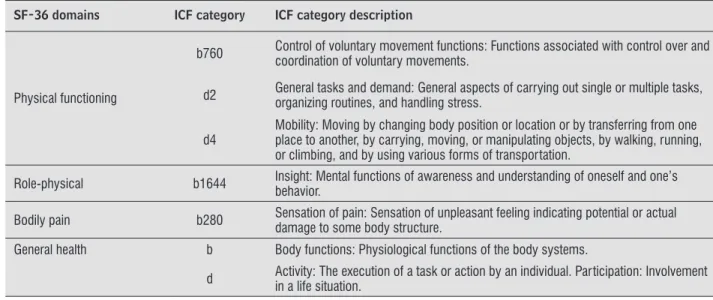
Upon completion of the evaluation, two research-ers, both of whom were trained in handling the )CF and did not participate in the approach and inter-view of subjects, independently selected components and categories of the )CF that could be applied to characterize the domains of the questionnaires. Both came to a consensus on the inclusion or exclusion of components and categories. )f there was disagree-ment, a third researcher was to be asked to resolve the differences; however, this step proved unneces-sary. To establish the score of quality of life and the components and domains of the SF- , we considered the median of responses reported.
To correlate the SF- with the )CF, the subjects were evaluated according to the proposed variables. For all agreed codes, we proposed a qualifier. Whereas the quantitative descriptors of )CF increase
accord-ing to the severity of the problem , scores of the
SF- are higher for subjects with better quality of
life . Because of this inverse relationship, when
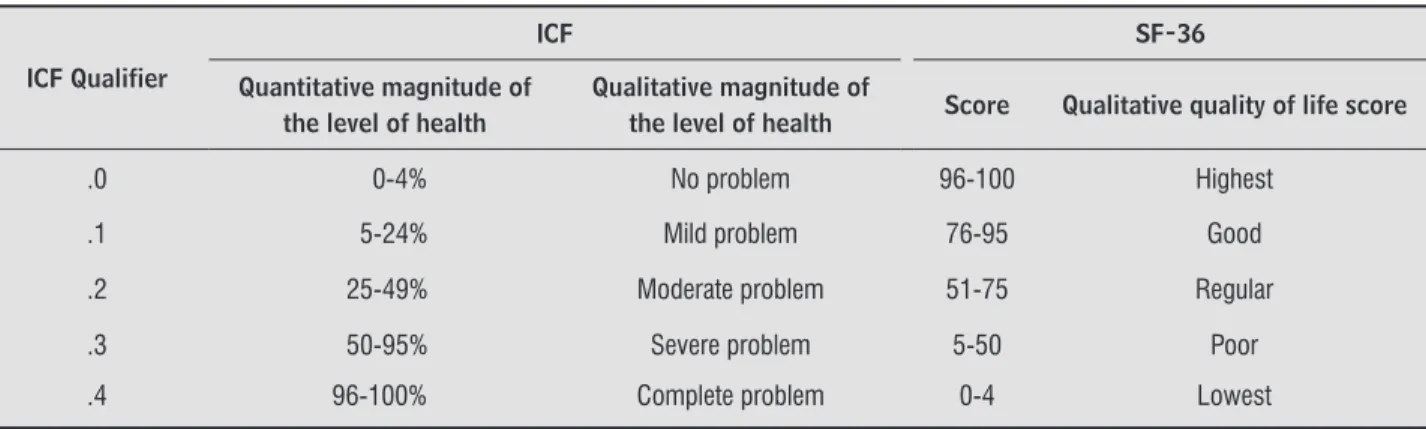
we assigned qualifiers for the )CF items of the SF- , we calculated the difference between the maximum score of the SF- and the ranges of quantitative de-scriptors of the )CF.
For data analysis, we used descriptive statistics with mean, standard deviation SD , and medians. The aims of this study were to describe and
quan-tify the quality of life of individuals with lower limb amputation, and to establish a relationship between quality of life and the )CF.
Material and methods
This research was designed as a cross-sectional study based on a descriptive epidemiological model of subjects with lower limb amputation. The goals were to identify the amputation and quality of life characteristics of these subjects, and to correlate them with the )CF.
To be included in the study, subjects must meet the following criteria: age over years, currently undergoing or previously underwent lower limb am-putation, and currently attending, or previously attended the Centro de Reabilitação of the Centro de Especialidades Médicas CR/CEM in the city of Foz do )guaçu, Brazil. Subject eligibility did not depend on their gender, the level or cause of their amputa-tion, or whether they were prosthetized. Subjects who presented difficulties in verbal or written com-munication, who were clinically diagnosed with any neurological disease, and who did not accept the in-vitation to participate in the study were excluded. The study was initiated after approval by the Ethics Committee of the Faculdade Assis Gurgacz ruling
number / . )t adhered to Brazilian laws and
guidelines concerning research in humans.
Amputees in Foz do )guaçu are referred to the Prosthetics and Orthotics Department at CR/CEM, where they are registered and, after screening and evaluation, are sent for acquisition of assistive de-vices according to their needs. )n September and
October , we began a retrospective study. We
consulted the records of individuals who visited the Prosthetics and Orthotics Department from January
through June . We identified entries,
of which were subjects with lower limb amputa-tions. The others did not fit the inclusion criteria. We successfully contacted of the amputees; however, only agreed to participate.
alcohol, and % were sedentary. We established a relationship between the level of amputation and the )CF categories Table .
The )CF categories were chosen in accordance with the highest level of detail possible to charac-terize the domains of the SF- accurately Table . As the )CF and SF- presented an inverse re-lationship between qualitative descriptors, we subtracted from the maximum score of the SF- median responses, thereby establishing a relation-ship between the qualifiers of the )CF and the SF-
Table .
The correlation coefficient between the me-dian of the )CF qualifiers and SF- scores was
r = - . , demonstrating a high inverse correlation
p < . . Correlations between the SF- and the
)CF qualifiers, as well as the level of quality of life, are shown in Table .
The quality of life was determined for the am-putation level Table , according to the median of responses.
The Spearman test was employed to verify the cor-relation. A p-value < . was considered significant. GraphPad )nstat software was used.
Results
Among the subjects, % were male and
% were female. The mean age was . ± . years. Amputation was due to trauma in subjects % and due to vascular dysfunction in subjects % . The average time since amputation was . ±
. range – years. The average time since
pros-thesis fitting was . ± . range – years;
how-ever, subjects were not prosthetized. All subjects had undergone or were currently in physical therapy,
for a mean period of . ± . range – months.
Of the possible complications after an amputation, phantom pain was cited by %, phantom sensa-tion by %, and stump pain by %. )n terms of life-style, % reported being smokers, % consumed
Table 1 - ICF categories for amputation levels
Amputation level N (%) ICF category ICF category description
Transfemoral 6 (40.0) s7500.327 Structure of thigh, severe impairment, partial absence, distal
Transtibial 8 (53.3) s7501.327 Structure of leg, severe impairment, partial absence, distal
Mid-foot 1 (6.7) s7502.327 Structure of ankle and foot, severe impairment, partial absence, distal
Source: Research data.
Table 2 - Proposed relationship between SF-36 domains and ICF categories
SF-36 domains ICF category ICF category description
Physical functioning
b760 Control of voluntary movement functions: Functions associated with control over and coordination of voluntary movements.
d2 General tasks and demand: General aspects of carrying out single or multiple tasks, organizing routines, and handling stress.
d4
Mobility: Moving by changing body position or location or by transferring from one place to another, by carrying, moving, or manipulating objects, by walking, running, or climbing, and by using various forms of transportation.
Role-physical b1644 Insight: Mental functions of awareness and understanding of oneself and one’s behavior.
Bodily pain b280 Sensation of pain: Sensation of unpleasant feeling indicating potential or actual damage to some body structure.
General health b Body functions: Physiological functions of the body systems.
d Activity: The execution of a task or action by an individual. Participation: Involvement in a life situation.
health to evaluate quality of life after an amputation 53
Table 2 - Proposed relationship between SF-36 domains and ICF categories
SF-36 domains ICF category ICF category description
Vitality
b1300 Energy level: Mental function that produce vigor and stamina.
b4550 General physical endurance: Functions related to the general level of tolerance of physical exercise or stamina.
Social functioning
b122
Global psychosocial functions: General mental functions, as they develop over the life span, required to understand and constructively integrate the mental functions that lead to the formation of the interpersonal skills needed to establish reciprocal social interactions, in terms of both meaning and purpose.
d7
Interpersonal interactions and relationships: Carrying out the actions and tasks required for basic and complex interactions with people (strangers, friends, relatives, family members, and lovers) in a contextually and socially appropriate manner.
Role-emotional b152 Emotional functions: Specifi c mental functions related to the feeling and affective components of the processes of the mind.
Mental health b199 Mental function, unspecifi ed.
Source: Research data.
Table 3 - Relationship between quantitative and qualitative descriptors of the ICF and the scores of the SF-36
ICF Qualifier
ICF SF-36
Quantitative magnitude of the level of health
Qualitative magnitude of
the level of health Score Qualitative quality of life score
.0 0-4% No problem 96-100 Highest
.1 5-24% Mild problem 76-95 Good
.2 25-49% Moderate problem 51-75 Regular
.3 50-95% Severe problem 5-50 Poor
.4 96-100% Complete problem 0-4 Lowest
Source: Research data.
Table 4 - Median values assigned to SF-36 domains and ICF qualifiers, and the correlation between these variables
SF-36 Domains SF-36 Score ICF Qualifier Qualitative descriptor R p-value Physical functioning 50.0 .3 Poor −0.9442 <0.0001
Role-physical 50.0 .3 Poor −0.9990 <0.0001
Bodily pain 80.0 .2 Regular −0.6861 0.047
General health 72.0 .2 Regular −0.9905 <0.0001
Vitality 50.0 .3 Poor −0.8444 <0.0001
Social functioning 87.5 .1 Good −0.9913 <0.0001
Role-emotional 33.3 .3 Poor −1.0000 <0.0001
Mental health 56.0 .2 Regular −0.8581 <0.0001
Source: Research data.
As a result of the lack of uniformity in procedures and evaluation instruments, results from studies with different methodologies cannot be compared or inte-grated with one another, which lowers the efficiency
of rehabilitation processes .
The )CF presents a system of terminology for a uniform international classification to describe the problems associated with health conditions and rel-evant environmental factors, thus providing a com-mon language for professionals involved in
rehabili-tation , . (owever, the )CF does not replace
other forms of assessment, and both interact. Farin
et al. reported that several studies have shown
this interaction through use of existing evaluative instruments in order to describe the congruence be-tween the )CF and the measuring instruments used in rehabilitation.
Use of the )CF model to evaluate quality of life has been proposed in other studies. To evaluate limita-tions in activities and restriclimita-tions in social participa-tion of individuals with osteoarthritis, Pollard et al.
used the SF- questionnaire to establish the relationship between these areas and the )CF, but they did not assign codes for the domains. Associating the proposed creation of the core set to repetitive strain injury and work-related musculoskeletal in-jury, they reported that some domains of the may be related to categories of body functions
b , b , b , b , as well as other
cat-egories of activities and participation d , d ,
d , d , d , d , d , d , d , d
. According to the same authors, tools such as the SF- , the (ealth Assessment Questionnaire (AQ , and the Self-administered Comorbidity Questionnaire SCQ have been suggested by the W(O as a standard composition of core sets. )n the present study, the proposal was not to create a core set, but to use the )CF model and its respective codes, which were cor-related with an already established evaluative tool Discussion
For a successful rehabilitation, it is necessary to have scales or specific questionnaires that are able to quantify the patient after a lower limb amputation, as well as an understanding of the relationships of these scales with the amputee’s quality of life and prosthe-sis use. The lack of studies that deal with quality of life in lower limb amputees underscores the need for
this type of study .
According to Larsson et al. , the quality of
life of amputees is likely to be improved by efforts at rehabilitation that are focused on improving mobil-ity; an increase in physical activity and consequent reduction in physical limitations and dependencies can improve the quality of life. (owever, Amini et al. reported that psychological problems stand out as key influencers of quality of life.
Although the rehabilitation process focuses main-ly on physical functioning, a study using a quality of
life assessment concluded that the rehabilitation
process should include care for issues such as pain, psychosocial issues e.g., body image , as well as ad-aptation to amputation and prosthesis use. Through this global approach, it is possible to increase the quality of life of people with lower limb amputation. )n this research, we used the SF- to evaluate the physical and mental components of the quality of life. The SF- is regarded as a generic tool for assessing quality of life, and it is not specific to subjects with lower limb amputation. (owever, many studies have
used this tool to assess this population , , , .
Furthermore, among the generic tools for as-sessing the quality of life, the SF- is the most used
worldwide , because the use of nonvalidated or
nonstandardized instruments should be avoided because their use makes it impossible to compare results, jeopardizes the reliability of the research,
and hinders reproducibility .
Table 5 - Quality of life according to the level of amputation
Amputation level N (%) SF-36 (median) Qualitative descriptor
s7500.327 6 (40.0) 49 Poor
s7501.327 8 (53.3) 70 Regular
s7502.327 1 (6.7) 35 Poor
health to evaluate quality of life after an amputation 55
References
. Amini R, Shojaee (, (aghani (, Masoomi M, Davarani ((. Physical injuries and quality of life in blind war survivors: a cross-sectional study. Arch )ran Med.
; : - .
. Alonso J, Ferrer M, Gandek B, Ware JE Jr, Aaronson NK, Mosconi P, et al. (ealth-related quality of life associ-ated with chronic conditions in eight countries: re-sults from the )nternational Quality of Life Assessment
)QOLA Project. Qual Life Res. ; : - . . Klute GK, Berge JS, Orendurff MS, Williams RM,
Czerniecki JM. Prosthetic intervention effects on ac-tivity of lower-extremity amputees. Arch Phys Med Rehabil. ; : - .
. Peters EJG, Childs MR, Wunderlich RP, (arkless LB, Armstrong DG, Lavery LA. Functional status of per-sons with diabetes-related lower-extremity amputa-tions. Diabetes Care. ; : - . . Kempen M, Ormel J, Brilman ), Relyveld J. Adaptive
responses among Dutch elderly: the impact of eight chronic medical conditions on health-related quality of life. Am J Public (ealth. ; : - . . Maggi LE, Rocha PVS, Barbosa PMR, Oliveira RA.
Pron-tuário eletrônico para avaliação fisioterapêutica de amputados. Rev Movimenta. ; : - . . Almeida LF, Camargos GV, Corrêa CL. Mudanças
reor-ganizacionais nos córtices somatossensorial e motor em amputados: revisão da literatura. Rev Neurocienc.
; : - .
. Poljak-Guberina R, Živković O, Muljačić A, Guberina M, Bernt-Živković T. The amputees and quality of life. Coll Antropol. ; : - .
. Silva CAG. Masiero D, Chamlian TR. Qualidade de vida em amputados de membros inferiores. Med Reabil.
; : - .
. Vidal ALA, Santos CC, Nishimaru S, Chamlian TR, Masiero D. Avaliação da qualidade de vida em paci-entes amputados de membros inferiores. Med Reabil.
; : - .
. Kageyama ERO, Yogi M, Sera CTN, Yogi LS, Pedrinelli A, Camargo OP. Validação da versão para a língua por-tuguesa do questionário de Medida Funcional para Amputados Functional Measure for Amputees Ques-tionnaire . Fisioter Pesq. ; : - .
to measure quality of life. This approach was used because the core set for people with amputations is
being developed .
Other research has also sought to use the )CF as a basis for comparing instruments for measuring
vari-ables. For example, Monteiro et al. attempted
to validate an instrument DSF- for evaluating
the functional and social performances of individuals with lower limb amputation based on the )CF. Their results proved that the DSF- is a reliable and valid instrument for this population, findings that may be considered analogous to those of the present study.
Results from studies such as Burger’s
rein-force the idea that the )CF should be implemented in the everyday clinical practice of professionals work-ing with patients who need prostheses and/or ortho-sis. The findings of our own study reinforce this idea of using the )CF in clinical practice.
Ultimately, the quality of life is one of the most important factors in the functional recovery process carried out by physiotherapists, including using the )CF to measure progress. The latter use of the )CF was
suggested by the results of Kohler et al. , who
found that the )CF appears to have content validity and sensitivity as a measure of changes in patients after lower limb amputation.
Even with a small sample of subjects with lower limb amputation it was possible to establish a signifi-cant correlation between the )CF and another vali-dated tool for the standardization of nomenclature. (owever, the codes assigned to the )CF classification of amputee subjects and the relationship between the domains of the SF- and the )CF should be consid-ered as dynamic, in keeping with one of the features of the )CF: namely, that the proposed classification should not be regarded as exclusive, but rather as a basis for new proposals.
Conclusions
. Kohler F, Cieza A, Stucki G, Geertzen J, Burger (, Dillon MP, et al. Developing Core Sets for persons following amputation based on the )nternational Classification of Functioning, Disability and (ealth as a way to specify functioning. Prosthet Orthot )nt.
; : - .
. Farin E, Fleitz A, Frey C. Psychometric properties of an international classification of functioning, disability and health )CF -oriented, adaptive questionnaire for the assessment of mobility, self-care and domestic life. J Rehabil Med. ; : – .
. Pollard B, Dixon D, Dieppe P, Johnston M. Measuring the )CF components of impairment, activity limitation and participation restriction: an item analysis using classical test theory and item response theory. (ealth Qual Life Outcomes. ; : .
. Lima MAG, Neves RF, Tironi MOS, Nascimento AMDN, Magalhães FB. Avaliação da funcionalidade dos trabal-hadores com LER/DORT: a construção do Core Set da C)F para LER/DORT. Acta Fisiatr. ; : - . . Monteiro RP, Pfeifer L), Soares ), Santos AD, Sousa N.
Validation of the functional and social performance - DSF- checklist: preliminary study. Disabil Reha-bil. ; : - . doi: . / .
. .
. Burger (. Can the )nternational Classification of Functioning, Disability and (ealth )CF be used in a prosthetics and orthotics outpatient clinic? Prosthet Orthot )nt. ; : - .
. Kohler F, Xu J, Silva-Withmory C, Arockiam J. Feasibil-ity of using a checklist based on the )nternational Clas-sification of Functioning, Disability and (ealth as an outcome measure in individuals following lower limb amputation. Prosthet Orthot )nt. ; : - .
Received: / /
Recebido: / /
Approved: / /
Aprovado: / / . Chamlian TR, Melo ACO. Avaliação funcional em
pacien tes amputados de membros inferiores. Acta Fisiatr. ; : - .
. Organização Mundial da Saúde. C)F: Classificação in-ternacional de funcionalidade, incapacidade e saúde. São Paulo: Edusp; .
. Stucki G, Reinhardt JD, Grimby G, Melvin J. O desen-volvimento da Pesquisa em funcionalidade humana e reabilitação a partir de uma perspectiva abrangente. Acta Fisiatr. ; : - .
. Ciconelli RM, Ferraz MB, Santos W, Meinão ), Quaresma RM. Tradução para o português e validação do questionário genérico de avaliação de qualidade de vida SF- . Rev Bras Reumatol. ; : - . . Correia TS, Tamashiro L(, Chamlian TR, Masiero D. Avaliação da qualidade de vida e independência fun-cional em pacientes amputados de membro inferior. Med Reabil. ; : - .
. Larsson B, Johannesson A, Andersson )(, Atroshi ). The locomotor capabilities index: validity and reliabil-ity of the Swedish version in adults with lower limb amputation. (ealth Qual Life Outcomes. ; : . . Zidarov D, Swaine B, Gauthier-Gagnon C. Quality of
life of persons with lower-limb amputation during rehabilitation and at -month follow-up. Arch Phys Med Rehabil. ; : - .
. van der Schans CP, Geertzen J(, Schoppen T, Dijkstra PU. Prosthetic history, prosthetic charges, and functional outcome of the isolated, traumatic below-knee am-putee. J Pain Symptom Manage. ; : - . . Smith DG, (orn P, Malchow D, Boone DA, Reiber, GE,
(ausen ST Jr. Prosthetic history, prosthetic charges, and functional outcome of the isolated, traumatic below-knee amputee. J Trauma. ; : - . . Røe C, Sveen U, Cieza A, Geyh S, Bautz-(olter R.
Valida-tion of the Brief )CF core set for low back pain from the Norwegian perspective. Eur J Phys Rehabil Med.
; : - .
. Long JS, Pavalko E. Comparing alternative measures of functional limitation. Med Care. ; : - . . Dahl T(. )nternational classification of functioning,