PREVENTION PROGRAM OF USE/ABUSE OF ALCOHOL IN
SCHOOL-AGED ADOLESCENTS: STOP TO THINK
ABSTRACT
Objective: To assess the impact to the intervention program Stop to Think on the prevention of alcohol use/abuse among school-aged adolescents. Methods: It is a quasi-experimental study, with pre- and post-test, 178 participants, 7th grade, experimental group (n = 70) subject to intervention and control group (n = 108) without intervention. The Alcohol knowledge Questionnaire, Alcohol Expectancy Questionnaire, Social Skills Rating System were used. Results: The experimental group showed a positive evolution of knowledge and expectations about alcohol, perception of peer alcohol use and reported consumption (p < .05).
Conclusion: The program proved to be effective in stabilizing alcohol consumption, increasing knowledge, stabilizing the positive expectations, and in the perception of peer alcohol use. Further research should be developed and follow-up should continue to consolidate these findings.
1 Nurse, specialist in Psychiatric Nursing, Master, PhD, Adjunct Professor in the School of Nursing, Researcher of the Research Unit Health Sciences: Nursing - Nursing School
of Coimbra - Coimbra - AC - Portugal. E-mail: [email protected]
2 Nurse, specialist in Psychiatric Nursing, Master, PhD in Education, Coordinator Professor at the School of Nursing, Researcher of the Research Unit Health Sciences: Nursing
- Nursing School of Coimbra - Coimbra - AC - Portugal. E-mail: [email protected]
3 Medicine Degree, Master, PhD and Aggregation in Psychiatry, Graduate Hospital Assistant in Psychiatry Service, Santa Maria Hospital, Invited Auxiliary Professor, Faculty of
Medicine, University of Lisbon - Lisbon - Portugal. E-mail: [email protected]
PESQUISA - INVESTIGACIÓN
Programa de prevenção do uso/abuso de álcool para adolescentes em contexto escolar: parar para pensar
Teresa Maria Mendes Diniz de Andrade Barroso1, Aida Maria de Oliveira Cruz Mendes2, António José Feleciano Barbosa3 Programa de prevención del uso/abuso de alcohol en escolares adolescentes: Parar Para Pensar
Primary Prevention; Alcohol Abuse; Adolescents; School Health.
RESUMO
Objetivo: Avaliar o efeito do programa Parar Para Pensar na prevenção do uso/abuso de bebidas alcoólicas de adolescentes em contexto escolar. Método: Realizou-se estudo quasi-experimental, com pré e pós-teste, com 178 participantes, estudantes no 7º ano escolar; o grupo experimental (n = 70) foi sujeito à intervenção durante um ano, e o grupo de controle (n = 108) não sofreu intervenção. Foram utilizados o Questionário de Conhecimentos Acerca do Álcool; Questionário de caracterização dos consumos; Escala de Expectativas Acerca do álcool e Escala de Aptidões Sociais. Resultados: Constatou-se que os adolescentes submetidos ao programa apresentaram evolução positiva nas seguintes variáveis: frequência do consumo e ocorrência de episódios de embriaguez; e, ainda, melhorou os conhecimentos, as expectativas acerca do álcool e a percepção do consumo pelos pares (p < 05). Conclusão: O programa foi eficaz na estabilização do consumo, no aumento dos conhecimentos, na estabilização das expectativas positivas e na percepção do consumo pelos pares. Sugerem-se novos estudos e manutenção de follow-up para consolidar os resultados encontrados.
Prevenção primária; Abuso de álcool; Adolescentes; Saúde escolar.
RESUMEN
Objetivo: Evaluar el resultado del programa en la prevención del uso/abuso de bebidas alcohólicas en los adolescentes dentro de un contexto escolar. Métodos: Estudio seme-experimental que ha contado con un pretest y un postest, 178 participantes, grupo experimental (n = 70) sujeto a la intervención y un grupo de control (n = 108) que no estuvo sujeto a ninguna intervención. Se utilizó un cuestionario de Conocimientos, Escala de Expectativas Acerca del alcohol y Escala de Aptitudes Sociales. Resultados: Grupo experimental muestra una evolución positiva de los conocimientos, de las expectativas acerca del alcohol, de la percepción del consumo en las parejas y del consumo declarado (p < .05). Conclusión: El programa resultó eficaz en la estabilización del consumo de alcohol, en el aumento de los conocimientos, en la estabilización de las expectativas positivas y en la percepción del consumo en las parejas. Para finalizar, se propone realizar nuevos estudios y continua con el seguimiento para consolidar los resultados encontrados.
Prevención Primaria; Abuso Alcohol; Adolescentes; Salud Escolar.
Palavras-chave: Keywords:
INTRODUCTION
The recognition of the problems associated with al-cohol consumption at an early age has been noted in recent years through studies on health behaviors and lifestyles of children and adolescents. This phenomenon takes contours whose problematic is both complex and upsetting, since it is a crucial stage of development due to their biological, psychological and social vulnerability, with implications for the present and future health of the individual. In particular in what concerns risk behaviors, including unprotected sex, the use of other substances, violence, accidents, among others1,2.
The proportion of young people with harmful and hazardous consumption patterns has grown in the last de-cade2-5. For most individuals, the first consumer
experienc-es tend to occur in the beginning of adolexperienc-escence, in social situations. European studies indicate that 9 out of 10 ado-lescents from 15 to 16 years of age has already consumed alcohol, and that the initiation of alcohol consumption is on average at twelve and a half years5,6, likewise national and
local studies meet these results7,8. On the other hand, the
alcohol is, from all the psychoactive substances, the most commonly used by adolescents and the most commonly used in abuse3,6,7.
The latest recommendations for the reduction of alcohol-related harms, include strategies to reduce sup-ply (control measures) associated with demand reduction strategies, including the development of prevention pro-grams, culturally adapted, and directed to the most vul-nerable groups, in particular adolescents3,9. However, in
Portugal, these programs are incipient in particular in the field of planning, coordination and evaluation.
The studies conducted in this area value the devel-opment of protective factors, including knowledge about alcohol, expectations about alcohol, social skills and per-ceptions about consumption by their peers9-13, whose
con-tributions of the scientific evidence integrate the interven-tion program, Stop To Think, which is presented here.
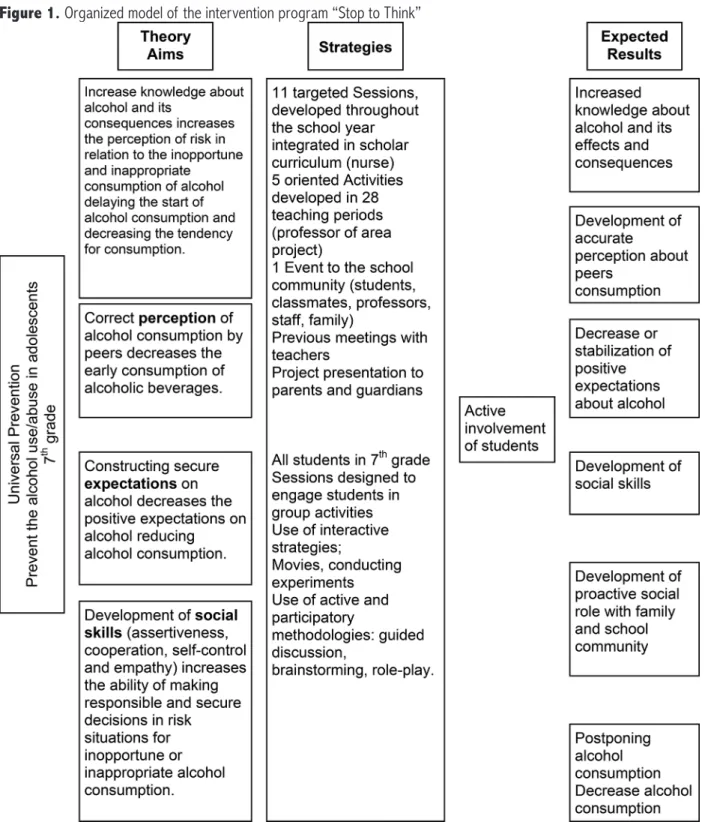
The intervention program "Stop to Think" was built based on the results of a systematic review of literature9,
assessed on the basis of the results of the study of con-textualized evaluation of the alcohol consumption phenom-enon among students of the 3rd cycle8, and integrating also
the suggestions of the experts consulted.
Thus, and according to the social cognitive theo-ry, the psychological factors that determine health behav-iors and the strategies to promote healthy behavbehav-iors (or change) are emphasized, without losing sight that human behavior results from reciprocal and constant interaction of the personal factors, social influences and behaviors.
The integration of all the contributions made pos-sible the construction of the organized model of the inter-vention program "Stop to Think" which is presented below (Figure 1).
Considering the importance and priority to the pre-vention of problems related to the use/abuse of alcohol (U/ AA) especially in adolescents, the aim was to evaluate the effect of the intervention program "Stop to Think" (StT) in the prevention of the use/abuse of alcohol (U/AA) in ado-lescents that attend 7th grade.
METHODOLOGY
Study design: Quasi-experimental, with pre (t0) e post (t1) test with control group.
GE t0X GE t1 GC t0 GE t1
Hypotheses
The adolescents that attend the 7th grade, subject
to the intervention StT present positive developments in knowledge about alcohol; expectations about alcohol, in social skills, in the perception of the peers consume com-paratively with those who are not subject to intervention.
The adolescents that attend the 7th grade, subject
to the intervention StT have a lower proportion (in the evo-lution) of the frequency of consumption of alcoholic bev-erages (wine, beer, spirits and other bevbev-erages as "cham-pagne"), present a lower proportion (in the evolution) of the occurrence of episodes of drunkenness, and begin the experience of alcohol consumption to a lesser extent, com-pared with those who are not subject to the intervention.
Participants
The study was conducted in two schools of Por-tugal, in the urban area of the city of Coimbra. Two in-dependent groups were constituted with participants in the 7th grade, the experimental group (EG), subject to the
intervention program integrated into the school curriculum (StT), and the control group (CG), which was not subject to the intervention.
Figure 1. Organized model of the intervention program “Stop to Think”
The sample was constituted by 178 students at-tending the 7th grade, of both sexes (53.90% feminine and
46.10% masculine) with a median age of 12.12 years (SD = .74).
The study of comparability of the groups, in the ini-tial evaluation, showed no statistically significant differenc-es between the groups, except in knowledge about alcohol, and global expectations about alcohol and as a factor of escape to negative emotional states (dimension III), in which the experimental group was in a more favorable sit-uation. So, we calculated various measures of correlation
between the variables under study and it was conducted a subsequent study of control, using covariates in the statis-tical analysis.
Variables
minutes), performed by the teacher. The interventions were developed with interactive methodologies in classroom context, for which was built a manual that integrates the rational and all procedures related to the interventions.
In addition to the socio demographic variables, the following dependent variables were included: knowledge about alcohol; positive expectations about alcohol; social skills, perception regarding the peer's consumption; char-acterization of consumption.
Instruments
Socio-demographic questionnaire and of consump-tion characterizaconsump-tion; Quesconsump-tionnaire of knowledge about alcohol (QCaA)8, a dichotomous instrument, with 20 items
that assesses the useful knowledge about alcohol; Positive Expectations about alcohol Scale - adolescents version (EEPaA-A/AEQ-A)14, a Likert type scale that assesses four
domains of expectations (Facilitator of the relationship with others, stimulation and tension reduction, Escape negative emotional states and social behavior alteration and sex-ual activation); Questionnaire of Social Skills Assessment (QAAS/SSRS: students version)15 a Likert type scale that
includes four dimensions (Empathy, Cooperation, Assertive-ness, Self-control).
Reliability of the instruments: in the sample, these instruments revealed, in t0 and t1, good reliability, with Cronbach's alpha values higher than 0.75. The dimensions Cooperation, Assertiveness and Self-control of social skills scale are exceptions, as they revealed Cronbach's alphas ranging from 0.58 to 0.64 but with corrected item-total correlation values ranging between 0.2 and 0.6, so no item of the instrument was removed from the analysis.
Procedures
The program was submitted and supported by the General Directorate for Innovation and Curriculum Develop-ment of the Ministry of Education of the Portuguese Govern-ment, edictal dispatch nº 25 995/2005 (2nd series). It was
approved by the External Review Committee of the Health Sciences Research Unit - Nursing; and by the institutions were the study was conducted, and in each phase of the study the ethical principles underlying were met and it was asked a written informed consent to participants and their parents/ guardians. Compensation sessions targeted at students from School B (control) were also developed, as they did not enjoy of the StT intervention program the following year.
The pre-test took place in both groups at the be-ginning of the school year in September. The experimental group was subjected to StT intervention for one academic year and the control group followed the usual program of activities. The post-test took place in the two schools at the end of the school year.
We used different statistical measures, chi-square test to assess differences between groups in the variables in which suits their use; the Kolmogorov-Smirnov (KS) test, to verify the normality of the distributions; the Levene test to check the homogeneity of variances; the t-test for indepen-dent and paired samples and the calculus of repeated mea-sures (General Linear Model - GML Repeated Meamea-sures), to assess the progress of the participants in the experimental and control groups for the intervallic variables under study; Z test for difference between proportions for evaluating the dif-ference in evolution, McNemar's test for assessing evolution in the dichotomous variables under study; and also the Sign test to evaluate the evolution of the ordinal level variables. Considered the statistically significant for p < 0.05.
RESULTS
In summary, in what concerns the differences in the evolution of the groups, we highlight the following results:
The EG presents a significant increase in knowledge about alcohol (p = .000), whereas in the CG there are no differences (p = .630), and the difference is significant in the evolution of knowledge between the groups (p = .002), indicating a positive effect of the StT intervention.
Regarding the expectations about alcohol, on overall and in all its dimensions, as shown in Table 2, the results re-lated to the evolving expectations on the experimental group indicate stabilization and/or reduction, while in the control group there was a statistically significant increase reflecting a negative trend in the CG. The difference in the evolution of the expectations between the groups is significant (p < 0.05), indicating a positive trend towards the stabilization and/or decrease, as a result of the intervention StT.
Regarding Social Skills, the experimental and control groups, evolved in the same direction and there were no statistically significant differences (p > .05).
Also the results for the consume perception by peers show that the experimental group presented stabilization in the perception of frequency and in the occurrence of ep-isodes of drunkenness, while the control group increased significantly the perception of frequency and the perception of consumption by peers (p = 0.023 ) and the perception of the occurrence of drunkenness in peers (p = 0.002). In addition, the difference in the evolution between groups was statistically significant (p < 0.05).
In what concerns the beginning of the experimen-tation of the consumption of alcoholic beverages both groups evolved in the same direction and without statisti-cally significant difference (Z = 0.999; p = .317).
Table 1. Comparison of groups regarding the evolution of knowledge about alcohol
Knowledge about alcohol
Experimental Group (n = 70)
Control Group (n = 108)
Differences between
groups
Mean SD Mean SD
Inicial
Evaluation (t0) 28.50 3.34 27.09 3.43
t= -2.699
p=.008 Final
Evaluation (t1) 31.23 6.40 27.30 4.18
t= - 4.549
p=.000
Evolution
t= 3.659 t= .483 a) F = 10.042
p=.002
p=.630 p=.000
h2 = .054
Power = .883
a) Analysis of repeated measures, considering the difference in the evolution between the experimental and control group
Table 2. Comparison of groups regarding the evolution of expectations about alcohol and in its global dimensions
Facilitator of the relationship with others
Stimulating and tension reduction
factor
Escape to negative emotional states
Change of social behavior and sexual
activation
Global expectations
F = 6.642 F = 12.482 F = 5.551 F = 26.701 F = 16.914
p=.011 p=.001 p=.020 p=.000 p=.000
(Z = 2,312; p = 0,020), and spirits (Z = 3,327; p = 0.000); it also presented stabilization in drunkenness episodes (Z = 1,995; p = 0,004). While in the control group there was a significant increase (p < 0,05). In addition, the results related to the evolution of both groups, experimental and control, indi-cate that the differences are statistically significant (p < 0.05). In what concerns the occurrence of episodes of drunkenness, the control group presented 6 new cases, while the experimental group did not present any new case, without statistically significant differences of evolution within the group. However, in the evaluation of differences in evo-lution between groups, the results show statistically signif-icant differences (Z = 1,995, p = 0,004), in favor of the experimental group.
DISCUSSION
In relation to the knowledge about alcohol, the results indicate that only the adolescents subject to the intervention program StT show a significant increase, sug-gesting its positive effect on the evolution of knowledge. These results are consistent with other studies10,12.
In what concerns expectations about alcohol, the results indicate that adolescents subject to the intervention StT show a positive trend on expectations, specifically on the stabilization of expectations about alcohol as a facilitat-ing factor in the relationship with others (dimension I) and of the expectations as a factor of escape from the negative emotional states (dimension III); and also the decrease of expectations as a stimulating factor and tension reduce (di-mension II) and of the expectations as an factor of change on social behavior and sexual activation (dimension IV); suggesting thus an effect of the intervention program StT in the positive evolution of the expectations about alcohol globally and in its dimensions.
The expectations about alcohol play an important role on the early consumption, increasing and becom-ing more stable with age and therefore more resistant to change14,16,17. So, considering that is during adolescence,
particularly in its early stages, that the majority of individ-uals starts drinking, the efficacy of the StT program should be noted, since in its absence the expectations about alco-hol show a marked increase.
The results concerning expectations as a facilitat-ing factor of the relationship with others, reflect stabiliza-tion of the anticipastabiliza-tion of the positive effects of increased interpersonal power, such as "be" in the group and with persons of the opposite sex and reflect also the stabiliza-tion of expectastabiliza-tions that alcohol promotes positive feelings and favors being comfortable with others, especially to feel sexier, braver and creative. These results may reflect the understanding on the part of the adolescents, who were subject to the program, that the facilitation of interpersonal relationships is not due to the pharmacological effects of alcohol but the result of socio emotional processes them-selves, including the emotional attachment and group affili-ation, which psychophysiological modulation is mediated by the endogenous opioid system.
In the Portuguese sociocultural context, alcohol is an integral part of celebrations and festivities. Very often, the initial consumption experiences occur in the family con-text, especially on festive occasions. Considering that the consumption of alcoholic beverages starts, for most indi-viduals, at very early ages, in a permissive familiar and so-cial context that favors consumption, it becomes necessary to integrate in the prevention programs of alcohol use/ abuse these important predictors of the beginning of al-cohol consumption.
In terms of expectations as a factor of stimulation and tension reduction results are particularly important because some studies have reported the association of expectations as a factor of relaxation and tension reduction with problematic alcohol consumption14,16.
In this context, considering that adolescents are in
dealing with the different events of life, including through the use of maladaptive strategies triggering mechanisms of negative reinforcement.
It is known that alcohol consumption affects brain function and consequently the expression of emotions and behaviors, these in turn are influenced by the expectations and context16,18.
Alcohol acts as a depressor of the central nervous system (CNS) interfering with the operation of neurotrans-mitter systems, enhancing the action of gamma-amino bu-tyric Acid (GABA), a significant inhibitory neurotransmitter and inhibiting the action of glutamate, an important excit-atory neurotransmitter. These actions interfere as a de-pressant of cognitive and motor functioning. However, the alcohol also has effect on the increase of the activity of cer-tain brain areas, namely in the release of endorphins, which induces a transient state of euphoria, and may indeed en-hance the desire to consume alcohol. It can also stimulate the release of dopamine, responsible for the activation of the dopaminergic reward system.
Regarding the expectations as a factor of escape negative emotional states, the results reflect the stabili-zation of the anticipation of physical and psychological changes induced by alcohol that provide leakage or escape the negative situations. Considering that these expectations refer to a domain that could cause problematic behaviors, including the intentional experiences of drunkenness as an escape of the negative emotional states becomes neces-sary to valuate and invest in the development of problem solving skills, especially during adolescence because this is a favorable period for its acquisition.
Finally, with regard to the effect of StT in expec-tations about alcohol as a factor of behavior change and sexual activation, the results suggest a decrease in antic-ipation of positive effects in the modification of social and emotional behavior, including those associated with the "good" humor, sexual stimulation and increased pleasure and disinhibition in several contexts, especially on festive occasions.
It is known that one of alcohol effects on the body (.4 g/l to .6 g/l of alcohol in the blood) is decreased sexual stimulation, and that expectations about alcohol are impli-cated in the increase of sexual stimulation8,15,16.
Regarding social skills, the results presented in the previous chapter, do not show effects of the intervention program StT in any dimension: cooperation, empathy, as-sertiveness and self-control.
representations of self and "objects", from which are part of the alternation of progressive and regressive move-ments, being expectable a certain discontinuity.
This development stage is also characterized by the loss of the "children world", and there are common difficul-ties in sharing and rules breach, attempting to "stretch" the limits that are placed. It implies thereby the rethinking of the adolescence place in parent's dependence and other authority figures such as teachers.
Although the results of this study do not reflect the positive effects of the program on adolescent's social skills, it is considered that this component should integrate use/ abuse of alcohol prevention programs because adoles-cents need to learn to deal with the risk situations.
Regarding the perceptions about habitual consump-tion of alcoholic beverages by peers, the results indicate a positive evolution in the experimental group, converted in the stabilization of the perception of consumption and occurrence of episodes of drunkenness in peers. These re-sults are consistent with some studies in the same domain, stressing the importance of use/abuse of alcohol preven-tive programs that integrate social norms component10,12,13.
In reference to the characteristics related to alco-hol consumption, translated by the experience of alcoalco-hol consumption, frequency of consumption of different alco-holic beverages and episodes of drunkenness, the results indicate a positive evolution reflected in the stabilizing of the frequency of various alcoholic beverages consumption (wine, beer and spirits) and the stabilization of episodes of drunkenness. These results are consistent with those obtained in some studies9,11 that found positive effects of
intervention programs in the frequency of alcohol con-sumption in adolescents.
The evidence does not allow to say that StT had a positive effect on the initial experiences of consumption, because there was an increase in the proportion of adoles-cents in both groups, 18.6% in GE and 25% in GC, whose evolution difference is not significant. However, the increase of the experiments is lower in adolescents subject to StT and can be considered a major clinical-educational effect of the intervention program StT. Similarly, the results of some studies with interventions in this area, also indicate an in-crease in consumption experiences during the intervention period11.
It is known that there is a tendency for individuals to have their first alcohol consumption experience in adoles-cence, given its accessibility and social permissiveness, and therefore is difficult that adolescents reach adulthood with-out having experienced alcohol. In Portugal, the minimum legal age for buying alcohol is 16 years of age for beer and wine and 18 years of age for spirits.
Although the effects of the intervention program
spirits, and wine consumption, with exception for other bev-erages as "champagne". It is often associated with festive occasions, particularly in the family context, in which is usu-al to "toast" with this substance. On the other hand, beer and spirits are considered the drink of choice to consume among adolescents.
The stabilization of the frequency of alcohol con-sumption in adolescents reflects a positive effect of StT. This effect should be noted, since it is expected that alcohol consumption increase throughout life, particularly during adolescence, and also, it is considered that the expected alcohol consumption changes after intervention programs of this nature, are often late9.
Some of the limitations of the study, namely non-random distribution of subjects and the implementation process being developed by the investigator may compro-mise the principle of neutrality. Finally, in what concerns the assessment, despite the intervention has been developed intensively on a weekly basis and over a school year school, the needed follow-up upon completion of the intervention limits the conclusions about its preventive effects. In this sense, it is considered necessary further evaluation in or-der to verify the control and maintenance of the effects.
CONCLUSION
The positive effects of the intervention program on behaviors related to alcohol consumption and adolescents' drunkenness reflect important changes that could have an impact on the current and future development of the ado-lescent, and also be a positive influence in their interaction with others.
Regarding the positive effects of StT in knowledge and expectations about alcohol, and in the perception of consumer experiences by peers it is noted its interference as a mediator of alcohol consumption related behavior and drunkenness in adolescents. In what concerns the in-creased knowledge about alcohol stands out the possibility that it could affect the perception of risk in order to en-hance their protection.
Taking into account the results it is considered that StT as a strategy for Health Education (HL) can be inte-grated in the delivery of community nursing care in uni-versal prevention. It should be pointed out the importance of nurses in the process of planning, implementation and evaluation of intervention programs in the school context.
REFERENCES
1. MacArthur GJ, Smith MC, Melotti R, Heron J, Macleod J, Hick-man M, Kipping R, Campbell R, Lewis G. Patterns of alcohol use and multiple risk behavior by gender during early and late adolescence: the ALSPAC cohort. J. public health. 2012 Mar; 34(suppl 1):20-30.
2. Baumgarten LZ, Gomes VLO, Fonseca AD. Consumo alcoólico entre universitários(as) da área da saúde da Universidade Federal do Rio Grande/RS: subsídios para enfermagem. Esc Anna Nery. 2012 Set; 16(3):530-35.
3. World Health Organization (WHO). WHO Expert Committee on Problems Related to Alcohol Consumption. WHO Technical Report Series. Genéve: WHO, 2007. [em linha]. [citado 2008 jan 14]. Disponível em <http://www.who.int/substance_abuse/expert_ committee_alcohol_trs944.pdf>
4. Anderson P, Baumberg B. Alcohol in Europe: A public heal-th perspective. London: Institute of Alcohol Studies, 2006. [em linha]. [citado 2007 Fev. 14]. Disponível em <http:// ec.europa.eu/health/ph_determinants/life_style/alcohol/do-cuments/alcohol_europe.pdf>.
5. Deutsche Hauptstelle für Suchtfragen e.V. (DHS). Binge Drinking and Europe. Hamm (GER): DHS; 2008.
6. Currie C, Roberts C, Morgan A, Smith R, Settertobulte W, Samdal O, et al. Young people's health in context. Health Behaviour in School-aged Children (HBSC) study: international report from the 2001/2002 survey. Copenhagen (CAN): WHO, 2004. [pe-riodico online]. [citado 2006 set. 10]. Disponível em <http:// www.euro.who.int/__data/assets/pdf_file/0008/110231/ e82923.pdf>.
7. Balsa C. II Inquérito Nacional ao Consumo de Substâncias Psi-coactivas na População Geral - Portugal 2007. Lisboa (POR): CEOS/FCSH/UNL; 2008. [citado 2009 jan. 14]. Disponível em: <http://www.idt.pt/PT/Investigacao/Paginas/EstudosConclui-dos.aspx>.
8. Barroso T, Barbosa A, Mendes A. Análise do fenómeno do consumo de álcool em adolescentes: estudo realizado com adolescentes do 3º ciclo de escolas públicas. Rev. latinoam. enferm. 2009;17(3):347-53.
9. Barroso T, Barbosa A, Mendes A. Programas de prevenção do consumo de álcool em jovens estudantes - Revisão sistemáti-ca. Rev Enf Ref. 2006 Dez; 2(3):33-44.
10. Perkins H. Misperceptions of peer drinking norms in Cana-da: another look at the 'reign of error' and its consequen-ces among college students. Addict Behav. 2007 Nov; 32(11):2645-56.
11. McKay MT, McBride N, Sumnall H, Cole JC. Reducing the harm from adolescent alcohol consumption: results from an adapted version of SHAHRP in Northern Ireland. J Subst Use. 2012 Abr; 17(2):98-121.
12. Moreira MT, Oskrochi R, Foxcroft DR. Personalised Normative Feedback for Preventing Alcohol Misuse in University Students: Solomon Three-Group Randomised Controlled Trial. Plos One. 2012 Set; 7(9):e44120.
13. Barroso T, Barbosa A, Mendes A. Os meus colegas bebem ál-cool? Consumo de álcool e percepção do consumo em adoles-centes - estudo realizado com estudantes do 3º ciclo de esco-las públicas de Coimbra. Psychologica. 2010;2(52):673-86. 14. Barroso T, Mendes A, Barbosa A. Adaptação cultural e
vali-dação da versão portuguesa da Escala de Expectativas acer-ca do Álcool - versão adolescentes. Rev Enf Ref. 2012 Dez; 3(8):17-27.
15. Pedro C, Albuquerque CP. Questionário de avaliação de ap-tidões sociais (SSRS - Versão para Alunos). Psychologica. 2007;(45):87-102.
16. Reich RR, Below MC, Goldman MS. Explicit and implicit mea-sures of expectancy and related alcohol cognitions: a meta--analytic comparison. Psychol. addict. behav. 2010 Mar; 24(1):13-25.
17. Mackillop J, Ryabchenko K, Lisman S. Life skills training ou-tcomes and potential mechanisms in a community imple-mentation: A preliminary investigation. Subst. use misuse. 2006;41(14):1921-35.