Equalization of the Budget Incomes in the
Administrative-Territorial Structures
Nicolae BALALIA
University of Bucureşti [email protected]
Constantin AFANASE
Dunarea de Jos University of Galati [email protected]
Abstract
The research theme is important for the local economy and financial literature on local public finance. It is known that the tax base of the territories is quite uneven and providing quality public services is impossible based on their own sources. The support for less developed local public administration from the financial point of view requires fiscal decentralization and involves financial equalization procedures or other similar measures aimed at eliminating the effect of unequal distribution for potential funding sources. Financial equalization is a group of financial actions made in order to overcome economic and fiscal disparities between territories. The purpose of financial equalization is the additional funding of less developed territories in order to reduce regional disparities.
Key words: financial equalization, fiscal decentralization, inter-budgetary relations, cost-benefit, economic efficiency.
JEL Code: H72, H71,E62.
1. Introduction
This article examines local public incomes and possible conditions of local public incomes equalization with the aim of public services quality improvement. The aim of the article consists in the methodological study of the instruments for the equalization of the local public incomes in the administrative-territorial structures for the elaboration of some effective measures in order to finance local public expenditures and improve public services quality. In this context, I started to analyze the concepts of financial balance and regional disparities, and then to find ways to support financially weaker local authorities in order to reduce regional disparities.
2. Financial balance
Economic and Financial dictionary defines economic balance as a state to which the goods and services market, monetary, capital and labor market as well and the whole national market tends, when demand is equal to the offer or difference between them does not exceed the limits considered normal, minor, unable to generate some serious difficulties. General economic equilibrium analysis can be made starting from its forms of manifestation:
- Material equilibrium of the national economy;
- Employment balance;
- Equilibrium of the values.
number and in terms of structure and level of training. The equilibrium of the values tackles both financial, monetary and foreign exchange stability, each having an independent existence, but also interdependent relationships with the other values and other forms of less value of general equilibrium.
According to the "Dictionary of International Economic Relations," „financial balance at the macroeconomic level is a manifestation of general economic equilibrium, expressing the correlation between a country's overall financial resources and possibilities of purchasing them. At the microeconomic level, the balance is the correlation between financial claims and payment obligations stated in the revenue and expenditure budget. "(Dictionary of International Economics, 1993) Iulian V c rel and staff of the textbook "Public Finance" states that: "The balance of the entire financial system reflects the existing correlation between the financial resources necessary for achieving economic and planned measures, including those meant to meet needs appeared more on the way, on the one hand, and the possibilities of purchasing, on the other hand. "(V c rel, I., and others, 2007) The financial equilibrium can be analyzed at all levels where funds of financial resources are made. Thus, at the macroeconomic level it concerns all financial resources of the society and their destinations, at the mezzo-economic level it concerns the financial resources of a particular sector, branch, administrative-territorial unit and their destinations, while at the micro-economic level it concerns the resources and needs of the public institutions. The analysis of the financial balance can be achieved by using financial plans. These are used to sizing financial resources in determining their destinations, to substantiate the balance, respectively to determine means of how to cover the deficit or means of valorification of excess resources. Public financial plans may take the form of the state budget, state social insurance budget, budgets of territorial administrative units, budget of special funds, public institution budgets, financial balance of the national economy and others. (Preda, Moise, Larisa Elena, 2009: p. 347)
3. Regional disparities
Despite the desire to eliminate regional disparities, from the existing data and analysis can be observed a low degree of financial autonomy of local authorities. Despite their efforts for decentralization up to 2010, despite the local public finance reform acceleration, the disruptions generated by the general economic condition and the lack of steps in achieving sustained financial and administrative reforms at the microeconomic level, significantly decreased the positive effects of the new structural changes. In this context, horizontal imbalance reflects disparities concerning the budgetary revenue of the different types of local administration, analyzed either at the national level or by comparing each county, or at the district level, by comparing the various localities between them. Horizontal imbalance in Romania is of two types:
- Inter-county horizontal imbalance - Intra-county horizontal imbalance.
The first type of horizontal imbalance in resources reflects the disparities between counties on local budgets, either when analyzing own revenues and split shares distributed on the derived basis (collection area) - so before balance, or when analyzing the total local budget revenues - that is, after balancing. Inter-county horizontal imbalance can be measured relatively simply from the assumption that local public services provided by local administrations in different counties must be relatively homogeneous (same types of services). Intra-county horizontal imbalance reflects mainly the disparities between urban and rural or between localities (cities in particular) of different sizes. What is specific to Romania is the difference, sometimes huge between the resources of the main county ( city of residence) and the other communities in the county. Intra-county horizontal imbalance is more difficult to judge and measure. The main reason is that the services provided by local administrations are not homogeneous: in particular cities and municipalities of the county offers a greater range of services than rural settlements: water supply, public transport, subsidies for heating, high school services, and examples could continue. In this context, the imbalance between revenue is relatively easily assessed by measuring the dispersion or the ratio max / min max / median or median / min within a county, but these indicators do not measure very accurately the gap expressed by needs (executed services). An additional indicator, which together with income dispersion measurement can give an accurate picture of intra-county horizontal imbalance, is determining the primary deficit ratio taking into account the following indicators:
Financial needs, including public local administration's total expenditure and debt at the end of the year (billed or invoiced debts);
Primary deficit ratio thus determined shows to what extent revenues generated by local administration (own revenues) or determined in a decisive measure by the local economy (the share split from income tax return) may cover the financial needs of a city for a certain level of the provided public services. Data analysis suggests that most serious are not differences between counties but those within the counties. An analysis of the horizontal structure of local government districts doesn’t need to be made through a forceful homogenization of the counties, or by calculations at the average county level. On the contrary, it has to be made according to the types of local public administrations: municipalities of the county, cities, towns and villages. Only such an analysis is appropriate in highly intra-county horizontal imbalance conditions which are reflected in all counties of Romania. In addition, the number of poor localities from rich counties is high, which it is showed by the low median value of rankings on income of local budget per capita within these counties. "Wealth" within a county is not evenly represented between localities, it is mainly due to several large cities (usually municipalities of the county), which have significantly greater financial resources than other communities in the same county or other cities from the least developed county. "Poverty" of local public administration in Romania is more evenly distributed at national level between the counties: the differences between poor localities, regardless of the level of development of the counties are quite small. In conclusion, the "poverty" of local public administration in Romania is more "democratic." Using the system of derivative-based shared taxes (the share split of income tax return), although it has great advantages, increased differences between urban and rural area.
4. Financial Equalization
Land tax base is the sum of their incomes (excluding local taxes, special means and transfers from other budgets) which remain directly and fully in local budgets, including source deductions from general state revenues collected within the territory. At present, Romania is facing a difficult economic situation which is reflected in local public funds both through the accumulation of low income in the budgets of administrative-territorial units and through the financial dependence of local budgets on the central budget. Financial equalization is a program of financial measures to overcome economic and fiscal disparities between territories. The purpose of financial equalization consists of additional funding to less developed territories in order to provide both quality and quantity public services, comparable to those of developed territories. Therefore, the support of weaker local public administration in terms of financial equalization procedures involve financial or other similar measures that are meant to eliminate the effect of illegal distribution of potential funding sources and financial burdens for those who are supposed to bear them (Manole T. and others, 2003: p. 111.). The support of financially weaker territorial units requires the commissioning of procedures for fair financial allocation or equivalent measures, designed to correct the effects of unequal potential funding resources share and their tasks (Manole T. and others, 2003: p.119).
The Romanian economist Gh. Manolescu says that theoretical and practical arguments confirm tha fact that the re-distribution policy must to be primarily of national competence. Decentralization and financial autonomy of the territories should be considered as complementary measures decided by the community, being financed from own revenues (Gh. Manolescu, 1997: p.290). Stabilization policy can be conducted only at the national level. Even if the country economic imbalances affect in different ways the regions, it is impossible for the stabilization policy to be applied at the regional level. It is true that the region needs to address production and services in its territory, assuming an area opening to the outside environment (T. Manole and others, 2003: p.133).
development, of increasing the economic performance, of improving the social life of citizens and of the entire community by defining and adding local responsibility for local services and social performance necessary for achieving them. (Manole T. and others, 2003: p. 224).
5. EU financial equalization
Regional policy aims to reduce disparities in economic development (Constantin, Luminita, 2004: p. 42) between European regions, most often, by favoring the emergence of conditions needed for the development of new activities rather than through direct support to enterprises. European Charter provides that “The protection of financially weaker local authorities calls for the institution of financial equalization procedures or equivalent measures which are designed to correct the effects of the unequal distribution of potential sources of finance and of the financial burden they must support. Such procedures or measures shall not diminish the discretion local authorities may exercise within their own sphere of responsibility. Local authorities shall be consulted, in an appropriate manner, on the way in which redistributed resources are to be allocated to them”.(European Charter of Local Autonomy, Strasbourg, 15 October 1985, Article 9).
Horizontal imbalances can be diminished through a system of financial redistribution. The European practice uses two systems of financial redistribution:
The system that concerns only local communities. In this case, local communities have relatively high resources and costs (or needs) relatively low, contribute to a fund of financial redistribution out of which will be granted allocations for local communities which have insufficient resources or costs (or needs ) relatively high. In practice, it is hard to believe that they can voluntarily go to this system, because some local authorities will lose a lot, which is why this system should be implemented by the state. This method is unpopular because it clearly highlights that local units will lose (those who must contribute to the redistribution of financial funds), this being applicable mainly to countries like Denmark or Sweden, where there are few cases of vertical imbalance.
The system by which the state provides benefits in different ways. In this case, local communities which have lower resources or bigger costs (or needs) get higher amounts, trying, at the same time to diminish vertical imbalances.
In order not to create inequities in taxes, it is good if the benefits of redistribution come from taxes collected at the national level (otherwise, some local communities will pay taxes to subsidize part of citizens from other local communities). There are also attempts to separate the services provided to local governments on behalf of the state and the rest of the local public services (in Slovakia). In this respect, arises the question of balancing the area of services with the variety of local needs through the adoption of technical standards (professional) of public services according to the multitude of local services. Decentralization is not a simple transfer of services to local governments (regardless of level). Central government functions should be modified by developing its role in regulating functions of information disseminating. In three of four countries, the number of small local administrations is high (the percentage of villages with a population less than 1,000 inhabitants in the Czech Republic is 80%, 68% in Slovakia and 55% in Hungary). The main issues that local government is facing are:
- Providing public services in a fragmented system. It is technically less efficient, and because the small towns have the same functions as the large ones, there are horizontal and vertical leveling applications. However, the argument of the scale economies is valid only for technical services, intensive in terms of capital. Also, the problem is significant, because only a small percentage of the population live in small communities, so most public expenditure (90-95%) are focused in major urban centers. So the forced amalgamation of small local administrations will not lead to large economies but clearly will decrease efficiency in allocation.
will have access to all public services within the remit of local authorities. For this purpose all states have an equalization system - measures that balance the needs of public funding, mechanism used both vertically and horizontally (Manole T. and others, 2006: p. 120).
6. Allocation methods of quota and amounts deducted from certain incomes of the state budget in order to gain financial balance of local budgets in Romania
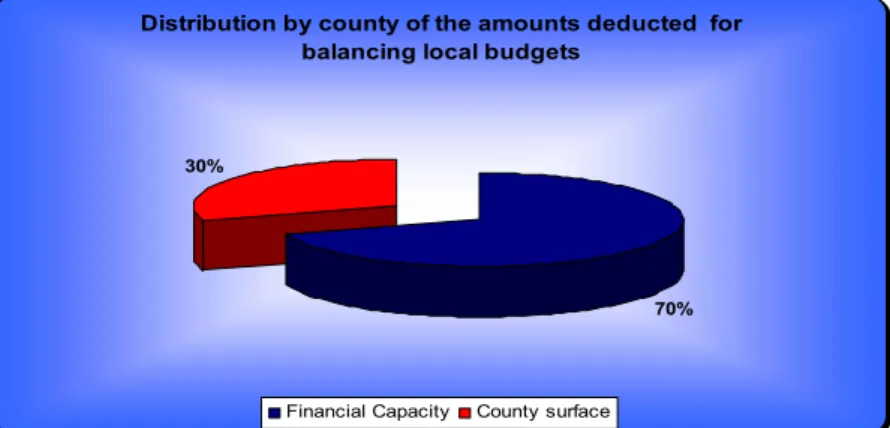
To avoid budget deficits and the approval of balanced local budgets are used inter-budget relations, which represent a mechanism of equalization of administrative-territorial units' budgets’ revenue. [5] Split shares from general state revenues and financial transfers are forms of inter-relationships established by law. By funding public spending and by balancing budgets of administrative-territorial units, through the state budget law are being approved amounts/ split shares deducted from certain incomes of the state budget, namely having a special-purpose, meant for balancing local budgets. The amounts/split shares deducted from certain income to balance the state budget to local budgets will be distributed to counties according to the following criteria: a) the financial capacity determined by the income tax collected per capita, 70%, according to a certain formula:
b) the county area at a rate of 30%.
Distribution by county of the amounts deducted for balancing local budgets
70% 30%
Financial Capacity County surface
Figure 1. Distribution by county of the amounts deducted for balancing local budgets
Deducted amounts/split shares for special purposes shall be allocated according to the law. From the amounts deducted from certain incomes of the state budget for balancing local budgets, approved annually by the state budget law, and from the established quota of 22% share, a share of 27% is allocated to the county's own budget, and the difference is allocated to local budgets of communes, cities and municipalities, as it follows:
80% of the amount is divided into two stages, by decision of the General Direction of the Public Finance Department of the County, according to the following criteria: population, the area inside the administrative-territorial unit and the financial capacity of the administrative unit;
20% of the amount shall be allocated by the County Council’s decision, to support programs of local development, infrastructure projects which require local co-financing. The Decision of the County Board shall be presented to the Public Finances County General Directorate, to the Prefect and the County Local Council.
For the allocation of the amounts deducted from certain incomes of the state budget for balancing local budgets , Public Finances County General Directorates shall:
a) Calculate indicators „average income tax per capita / per administrative-territorial unit” and, respectively, „the average income tax per capita / per whole county”.
b) the calculation resulted according to letter a) will be transmitted, by 31 of May each year, to the Ministry of Administration and Interior;
c) the first step is to allocate the amounts calculated according to para. (3). letter a) only to administrative-territorial units whose tax per average income per capita, charged by the administrative-territorial unit in the previous year are less than the tax per average income per capita received throughout the county in the previous year of calculation, based on the following criteria:
Percent of the population of the administrative-territorial units involved at this stage in the total population of the county, in proportion of 75%;
Criteria for allocation of amounts/ share splits
75% 25%
Percent of the population of the administrative-territorial units
Percent of the surface of the rural unincorporated areas outside administrative-territorial units
Figure 2. Criteria for allocation of amounts/ share splits
Amounts remaining undistributed in the first stage are carried over to the second stage, the amounts remaining undistributed at the first stage are distributed to all local administrative units in the county, depending on their financial capacity. The amounts established for each administrative-territorial after the completion of the two stages of equilibration, but also for the county and municipality of Bucharest, will be diminished with the degree of non-collection by multiplying it with the subunit coefficient, calculated as the ratio between the amount of local taxes, rents and overriding royalties cashed in the previous financial year, ended and the amount of local taxes, rents and overriding royalties planned to be cashed in the previous financial year, ended.
When calculating the degree of non-collection are not taken into account the liabilities in dispute. From 1 January 2009, in order to determine the amounts necessary for balancing local budgets of communes, towns and municipalities will be taken into account the following aspects:
a) the scope of coverage of the operating section of the local budget from its own revenues; b) after quantification of the amounts determined according to letter a) only where it is appropriate, are being proposed sums to provide balance for the local budget section;
c) minimum cost standards for public services for the public; d) minimum quality standards for public services for the public.
e) After making steps set out in points a) - d), in the limit of the amounts which can be provided from the state, are being established amounts which are about to be provided in the development sections of local budgets.
The number of residents in all municipalities of the county is the one statistically released, on 31 December of the year preceding the year of calculation.
Rules on consolidating transfers for the local budgets
Transfers from state budget to local budgets are given for investment financed from external loans and to whose realization the Government contributes as well, according to the law, and are being approved annually in global position through the state budget law. From the state budget, through the budgets of main credit/budget release authorities and also from other budgets may be granted transfers to local budgets for financing of social or development programs, of national interest, at the county or local level.
References
1. Constantin, Lumini a, Integrarea european şi evolu ia dezechilibrelor regionale, Administra ie şi management public, nr. 3, 2004.
2. Manole T., Finan e publice locale: rolul lor în consolidarea autonomiei financiare la nivelul unit ilor administrativ-teritoriale, Epigraf, Chişin u, 2003.
3. Manolescu, Gh., Buget – abordare economic şi financiar , Economica, Bucureşti, 1997. 4. Preda, Moisic , Larisa Elena, Finan e publice, Editura Bibliotheca, Târgovişte, 2009.
5. Profiroiu, Marius şi Alina, Considera ii privind procesul de descentralizare în România, Revista Administra ie şi management public, nr. 7, 2006.