EXPERIMENTAL STUDY ON PROPANE/OXYGEN AND
NATURAL GAS/OXYGEN LAMINAR DIFFUSION FLAMES IN
DILUTING AND PREHEATING CONDITIONS
by
Babak KASHIR, Sadegh TABEJAMAAT*, and Mohammadreza BAIG MOHAMMADI
Aerospace Engineering Department, Amirkabir University of Technology (Tehran Polytechnic), Tehran, Iran
Original scientific paper DOI: 10.2298/TSCI110524122K
In the present study, propane/oxygen and natural gas/oxygen diffusion flames within laminar regime have been investigated experimentally to determine the ef-fects of oxidant preheating and diluting. This research has been divided into two parts. At first, effect of oxygen dilution with nitrogen and carbon dioxide gases has been investigated. In this section, stability and flame configuration variations are studied. Furthermore, it is inferred that combustion of natural gas and propane with pure oxygen can increase flame stability against increasing the fuel jet veloci-ties through increasing burning velocity of the flame as compared with the combus-tion of natural gas or propane with normal air. In the other part, oxidant stream preheating up to 480 K and contemporaneous diluting with nitrogen or carbon di-oxide are investigated and results are compared with non-preheating tests. Pre-heating causes more flame stability with respect to dilution process. Also, due to combustion products temperature rise and also reduction in ignition delay time in preheating, these flames are more stable and also visually more luminous in com-parison with normal temperature flames.
Key words: experimental, diffusion flame, preheating, diluting, natural gas, propane, oxygen
Introduction
In diffusion flames, mixing rate comparing to the reaction rate is slower, so that mix-ing process controls the burnmix-ing rate. In such flames, fuel and oxidizer come together in reaction zone due to molecular and turbulent diffusions. The fuel can be a gaseous fuel jet or a condensed medium (either liquid or solid) and the oxidant may be a liquid or gas stream or environmental air. The distinctive characteristic of a diffusion flame is that the burning rate is determined by the mixing rate [1]. Diffusion flames are very important from the viewpoint of practical and fun-damental research.
Extensive researches have been performed on fuel and oxidizer dilution in diffusion flames [2-6]. Effect of fuel or oxidizer dilution and fuel to oxidant ratio on flame configuration,
temperature, lift-off height and consequently on flame stability and pollution are very signifi-cant and they are very effective tool for controlling flame. Therefore, effects of diluents on structure and stability of axisymmetric lifted laminar diffusion flames have been investigated by Ruanet al. [2]. They found that effect of CO2on flame structure and stability is more than N2. Because, CO2has greater heat capacity and lower transfer rate in comparison with N2. In spite of investigating methane diffusion flame structure for different oxygen percent, they didn’t study the effect of preheating reactants stream. Juddooet al. [3] reported an enhanced maximum tem-perature and combustion products mass fraction due to decreased nitrogen level in mixture on laminar counterflow diffusion flames. Moreover, Ghosal et al. [4] studied theoretically on lift-off and subsequent blowout in laminar diffusion flame. This research despite rendering solu-tion for diffusion flame lift-off height, (because of assuming species diffusion rate constant) could not give reliable results in diluting conditions. Usowicz [5] considered visible region length as ethylene diffusion flame length. In another research that was performed by Sullivanet al. [6], methane-air laminar diffusion flame was considered. They diluted methane with ammo-nia (NH3) and observed that NO2emission level diminished up to 50% in confined use of ammo-nia.
Preheating is one of the other topics in diffusion flames which mainly investigated [7-12]. Oxidizer preheating provides stable flame in expanded range of mixing rates and also brings more uniform thermal characteristics within the combustion chamber. So increases com-bustion efficiency. Preheating is one of the flame stabilizing mechanisms that specially becomes important in lower levels of oxygen in oxidant [7].
The effects of preheated air on laminar co-flow propane diffusion flames under normal and microgravity conditions were studied by Ghaderi Yeganeh [8]. With optical emission spec-troscopy and direct flame photography, CH and C2emission intensity profiles were obtained as 3-D spatial distributions. He reported that 400 degrees increase in air temperature causes a 37.1% decline in flame length. Gupta [9] utilized an industrial burner for preheating and diluting air with N2in methane, propane, acetylene, and hydrogen diffusion flames. They preheated oxi-dizer up to 1100 K and reported a 30% reduction in energy consumption. Christoet al. [10] and Medwellet al. [11] studied co-flow diffusion fuel jet combustion along with a secondary burner combustion products and environmental air. It was concluded that diminishing oxygen concen-tration in oxidant stream from 9% to 3%, reduced gas temperature up to 13%. Kumaret al. [12] investigated the effect of adding H2into composite LPG-H2fuel jet on laminar flame length, gas temperature and NOxemission level. Research was accomplished for non-preheating and pre-heating up to 470 K situations. They realized that adding H2results in flame length reduction. They also observed that preheating air along with adding hydrogen to fuel stream, decreases flame length further than non-diluting state. Moreover, with preheated air, flame length dimin-ishes further in comparison with non-preheating state. Mooreet al. [7] studied the effect of pre-heating reactants in methane-oxygen diffusion flame. They varied temperature in the range of 298-398 K. They showed that increasing temperature diminished residence time due to en-hanced velocity. Therefore stoichiometric mixture formed in upper height and lift-off height rose.
inves-tigated adequately. Hence the present study is focused to investigate the effects of adding nitro-gen or carbon dioxide along with preheating oxidizer on visible flame length and flame structure in propane and natural gas laminar diffusion flames.
Experimental method
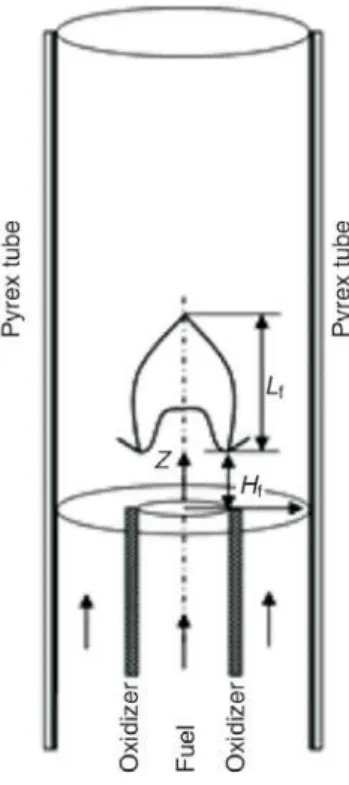
A co-flow burner is used for experiments. Figure 1 shows a schematic of the burner. In this burner, fuel nozzle has 4.8 mm inner diameter which is located in the centerline of a pyrex tube with 11.14 mm inner diameter and 1 meter height. The material of the fuel nozzle is brass with a 0.4 mm thickness. The oxidant stream flows from area between fuel nozzle and pyrex tube and mixes with outlet fuel from nozzle. The axis of pyrex tube and fuel nozzle are placed coaxially. Pyrex tube prohibits environmental air to be involved in combustion. In these experiments, we initiate from pure oxygen and gradually with decreasing oxygen mo-lar percent, nitrogen or carbon dioxide enters into the oxidant stream (dilution process). An electrical heater is used for pre-heating the oxidant stream. The flow rates of the oxidant and the fuels are metered by the calibrated flow meters mounted in their respective feed lines. High quality digital pictures (Power Shot G6 Canon) with high capturing velocity (0.1 ms) are taken for analyzing the flame behavior. In this study, luminous zone length is taken as flame length [8]. Flame length measurement accuracy is a tenth of millimeters. For relying on reported data, the experiments have been carried out for several times. The parameters served for demonstrat-ing flame length (Lf) and lift-off height (Hf) are indicated in fig. 1. The flame stability behavior is studied by increasing the oxidizer dilution percent until the flame begins to blow off. Fuel stream is always in the room temperature (25 ºC). In performing tests, a parameter is defined that shows dilution percent. This parameter is indicated byZ. When the base of the diffusion flame lifts off from the burner tip and remains suspended at a certain distance above the burner, we call this phenomenon lift-off.
Results and discussion
In this study, first the effect of increasing fuel stream velocity while oxidant stream ve-locity is kept constant is studied; and in continuation for each of the fuels four experiments have been accomplished. These experiments are effect of oxygen dilution with N2, effect of oxygen dilution with CO2, effect of preheating and oxygen dilution with N2and effect of preheating and oxygen dilution with CO2, respectively.
In diluting experiments process, the fuel velocity is always 6 cm/s. the oxidizer veloc-ity is selected as equal to the fuel velocveloc-ity. In preheating conditions, the oxidizer stream ature is 480 K and without preheating is equal to the room temperature (298 K). The fuel temper-ature is 298 K in all of the experiments.
Effect of fuel stream velocity
In this section, for investigating the effect of fuel stream velocity in constant oxidant stream velocity; two separated experiments have been done for each fuel. Air and pure oxygen are utilized as oxidants, respectively. In both experiments, the oxidant stream velocity is con-stant and equal to 6 cm/s. the oxidant and the fuel inlet temperatures are both 300 K. Reynolds number varies from 4 to 150 for natural gas (NG) and from 15 to 250 for propane in laminar re-gime confines.
Effect of natural gas fuel velocity
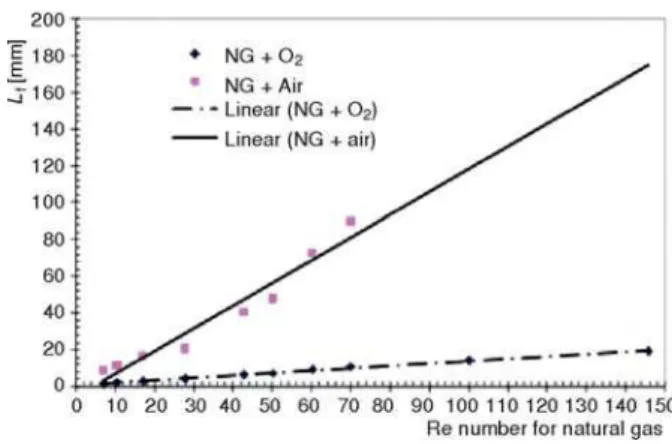
As fig. 2 demonstrates, the flame length is lower in pure oxygen state comparing fuel/normal air combustion. This is due to increase in oxygen concentration in mixing zone and raising oxygen mixing rate with fuel that causes flame length decline. The presence of enough oxygen in com-bustion zone leads the mixing and consequently combustion processes to the fast and complete mixing and reaction in combustion zone. For in-stance, in the combustion of the fuel with pure oxygen, with the imagina-tion of the fuel and the oxidizer streams as parcels, these parcels can meet each other and then create stoichiometric combustible parcels in the nearest parts to the fuel and the oxidizer inlet ports, so that these combustible parcels can burn inten-sively and efficiently inside the lim-ited zone. According to this impression, in air oxidizer situation, lower measure of oxygen in mixing zone makes flame to have further length. It is considered that with increasing the fuel jet velocity, the flames length discrepancy enhances through increasing the fuel measure in con-stant oxidant amount and is predictable. Variations are linear for both oxidants. It is necessary to note that on the basis of eq. (1) [13]:
Zf,L V rj 2
µ
(p )
p 2
D (1)
whereZf,Lis the laminar diffusion flame length,V – the fuel stream velocity,rj– the fuel nozzle radius, andD – the mixing rate. The laminar diffusion flame length has straight proportion with fuel stream velocity and inverse with mixing rate [13]. The fuel stream velocity effect results agreement with theoretical equations shows experiments implementation process veracity. Fur-thermore, as it can be seen in fig. 2, the natural gas/pure oxygen flame is very resistant and stable against increasing trend of inlet velocity of fuel. This is due to this fact that using pure oxygen instead of normal air increases the flame burning velocity and this way it can broaden the flame stability region so that the flame can be stable even at higher velocities as compared to natural gas/normal air flame velocity [14].
Effect of propane fuel velocity
As it is evident in fig. 3, the pro-pane flame length is lower in pure ox-ygen state. The result is more accessi-ble oxygen and consequently rising mixing rate. The propane flame has higher flame length in similar oxidant condition in comparison with natural gas flame. This is due to further car-bon radicals in reaction zone that makes them to traverse further dis-tance to approach their necessary ox-ygen. Regarding constant flow rate of oxidant stream for both natural gas
and propane conditions and more carbon of propane as compared to natural gas, for stoichiometric combustion of propane and normal air/pure oxygen comparing natural gas com-bustion, more oxygen is needed. Achieved results from this section have coincidence with eq. (1) and confirm our experiments implementation process.
Effect of oxygen dilution with N2and CO2
In this part of the study, effect of oxygen dilution is studied. The oxidant stream vol-ume flow rate is chosen 36 l/min. so as to the oxidant stream velocity becomes 6 cm/s.
Dilution including propane as fuel
As it is shown in fig. 4, increasing N2 percent in oxygen enhances the flame length gradually. This is due to diminishing available oxygen for fuel decomposed radicals which causes them to traverse farther distance for perfect mixing. In dilution process, with increasing N2percent, luminos-ity of flame and also combustion products such as carbon dioxides and water vapors decrease. These phe-nomena occur through lack of enough oxygen in combustion zone and also the flame temperature reduction and consequently emission intensity re-duction from carbon radicals and combustion products such as carbon dioxide, water vapor,etc. In high per-cent of dilution, flame lift-off occurs and finally flame blows out. Flame
Figure 3. Propane flame length variations with increasing fuel stream velocity for air and oxygen
blow-out limit in diluting oxygen with N2and with propane as fuel is in 85 molar percent of N2. The flame color follows from radiation of distinct wavelengths that exits during the combustion process. The bluish-white and blue color of the high calorific fuels, like propane, with high oxy-gen concentration is results from chemical reaction of atomic carbon to carbon monoxide and subsequently carbon dioxide during combustion process. The yellow part of the flame follows from the imperfect combustion of the carbon within the fuel. The flame lift-off from the fuel nozzle occurs due to delay in stoichiometric mixture formation. Because dilution diminishes ox-ygen molecular concentration level and consequently it requires more time for mak-ing stoichiometric mixture. As a result, stoichiometric mixture forms in a higher height from the fuel nozzle. Moreover, di-luting diminishes flame maximum tempera-ture. Figure 5 indicates images captured from dilution process of oxygen with CO2 related to propane fuel. In this test, blow-out limit arises in 75 molar percent of CO2. With increasing CO2molar percent in oxi-dant stream, again gradual flame luminosity reduction is observed. As illustrated in prior part, this is due to decrease in flame maxi-mum temperature. In diluting with carbon dioxide blow-out happens in lower percent of diluents in comparison with N2addition method. Since CO2 has higher thermal ca-pacity than N2so that it reduces flame maxi-mum temperature further and makes it more unstable. Consequently flame diluted with CO2blows out earlier.
Dilution including natural gas as fuel
In fig. 6 dilution of oxygen with N2and for natural gas fuel is indicated. The flame blow-out limit in diluting oxygen with N2 and for natural gas as fuel is 79 molar per-cent of dilution. It is discovered that in low percent of dilution, a luminous zone can be seen so that this zone disappears gradually with increasing dilution percent. In high percent of dilution, first, the flame lifts off and subsequently blows out. In lift-off situ-ation the flame color in all of the points be-comes blue and luminous zone decays. Be-cause of lower maximum temperature, natural gas flame lightens less than equiva-lent propane flame,i.e. in the same dilution Figure 5. Effects of diluting oxygen with CO2along
with propane fuel; each point on the figure matches with one of the flames from left to right, respectively
percent, propane flame shines in contrast to natural gas flame. Additionally, lift-off height is greater in natural gas flame. In fig. 7, the effect of oxygen dilution with CO2on natural gas flame has been investigated. In this test, like the other tests at the present study, the dilution causes flame shininess reduction, height enhancement and eventu-ally lift-off and blow-out. Flame blow-out limit for this experiment is in 73 molar per-cent of CO2.
Effect of preheating and diluting oxygen with N2and CO2
In this section of the experiments, effects of oxygen diluting and preheating have been studied. The oxidant stream temperature during mixing with the fuel stream is 480 K. However, the fuel stream has 298 K temperature. For diluting oxygen stream, N2and CO2 streams are used. In this part, the flame length is compared to without preheating section.
Diluting and preheating oxidant stream including propane as fuel
The direct images captured from pro-pane diffusion flame with preheating and diluting oxygen with carbon dioxide are demonstrated in fig. 8. Diluting with CO2 reduces flame shininess and finally with increasing flame dilution percent, lift-off and blow-out occurs. In dilution process, the flame’s height due to reduction in ox-ygen content increases. In this experi-ment, the flame blow-out happens in 77 molar percent of carbon dioxide. Propane preheated flame has higher maximum temperature than natural gas preheated flame which causes more luminosity. Ob-viously, due to this fact that preheated oxidizer brings an additional enthalpy to combustion zone, it can raise combustion products temperature resulting in more luminous flames. Furthermore, because of increasing the flame stability region against increment of the fuel jet velocity in preheated oxidant condition and also raising oxygen radicals’ reactabilities level than non-preheating state, oxidizer preheating delays lift-off time, i. e.
Figure 7. Effects of diluting oxygen with CO2along with natural gas fuel each points on the figure matches with one of the flames from left to right, respectively
lift-off occurs in upper dilution per-cent [15]. However, due to bringing more enthalpy to combustion zone and also reduction in ignition delay time, lift-off height diminishes. Vari-ations of the flame length and lift-off height aggregate as a function of oxy-gen dilution percent with CO2and in two states of with and without oxi-dant preheating have been brought in fig. 8. As it is indicated, with preheat-ing oxidant, flame visible region length decreases. The flame length reduction value for the process along with oxidant preheating than non-preheating state enhances from about 5% for pure oxygen (XCO )
2 =0
to 30% for 70% of dilution (XCO
2=
= 0.7).
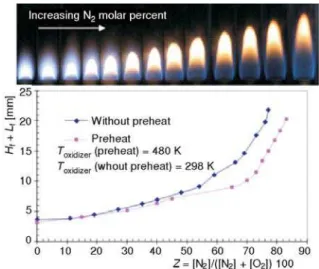
Figure 9 shows direct images taken from propane diffusion flame with preheating and diluting oxygen with N2. As fig. 9 implies, increasing N2 molar percent in oxygen makes flame length greater and eventually brings lift-off and blow-out. Dilution diminishes flame shininess. In this experiment, flame blow-out takes place in 87 molar percent of nitrogen. The rise in temperature of combustion products due to ox-idant preheating causes shininess for preheated flame with respect to not-preheated flame. Com-paring oxygen dilution with N2and for propane fuel in two estates of preheated and
not-pre-heated flame has been performed in fig. 9. As fig. 9 indicates and it is expected, preheating diminishes flame length and stabilizes it in respect of dilution process. This reduction is negligi-ble with respect to flame length in lower percent of dilution. In this way, due to increasing mix-ture reactability and reaction rate, Preheating is one of the stabilizing mechanisms of flame dur-ing dilution procedure. The flame length reduction value for the process along with oxidant preheating than non-preheating state enhances from about 3% for pure oxygen (XN
2= 0) to
20% for 80% of dilution (XN . ).
2= 08
Diluting and preheating oxidant stream including natural gas as fuel
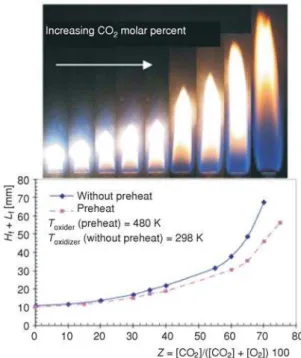
Figure 10 shows pictures of the flame during preheating and diluting oxygen with car-bon dioxide including natural gas as fuel. Like the other preheating states, the oxidant tempera-ture is 480 K. During dilution process, as it is expected, the flame elongates and gradually loses luminosity. This is due to decrease in the flame maximum temperature and oxygen content. Eventually, the flame color becomes thoroughly blue and afterwards lift-off occurs. The flame blow-out limit in this case is 75 molar percent of CO2. Although, the oxidant preheating reduces Figure 9. Comparing flame lift-off and height sum with
lift-off amount, lift-off occurs in upper percent of dilution. Rising oxygen radi-cals’ reactability is the primary reason. Moreover, as it is mentioned before, pre-heated oxidant can broaden flame stability region by regulation of the diluted flame burning speed in combustion zone. For instance, by preheating of incoming viti-ated oxidizer, the reaction rates, ignition delay time and consequently burning ve-locity can be affected so that it can lead to higher burning velocity in a mixed parcel of diluted oxidizer and specific fuel [16]. The flame length reduction value for the process along with oxidant preheating than non-preheating state enhances from about 5% for pure oxygen (XCO )
2 =0 to
20% for 71% of dilution (XCO . )
2 =0 71. In
fig. 10, the effect of oxygen dilution with carbon dioxide including natural gas fuel
and in two states of preheating oxidizer and without preheating oxidizer has been shown. By in-creasing the oxidant stream temperature, combustion completes within a smaller domain and re-sults in a shorter flame size. Natural gas total conclusions are the same as propane. In preheating case, blow-out occurs in 75 molar percent of CO2and without preheating happens in 73 molar percent of CO2.
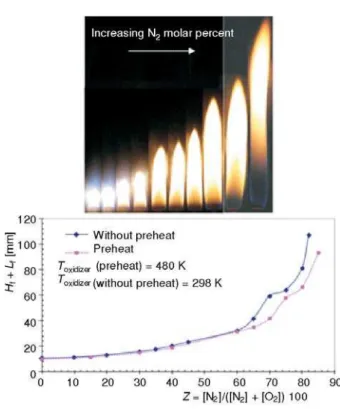
In fig. 11, digital pictures captured from preheating and diluting oxygen with N2and with natural gas fuel are ob-served. Mixture (N2+ O2) temperature is 480 K during integrating into fuel stream. In this case, like the previous cases, preheating diminishes lift-off height sorely. The flame blow-out occurs in 84 molar percent of nitrogen. The flame length reduction value for the pro-cess along with oxidant preheating as against non-preheating state enhances from about 3% for pure oxygen
(XN )
2 =0 to 33% for 73% of dilution
(XN . )
2 =0 73 . In fig. 11, comparing
be-tween preheated flame and normal tem-perature flame for diluting oxygen with N2 has been carried out. With
preheat-ing, blow-out occurs in 84 molar percent of N2and without preheating occurs in
79 molar percent.
Figure 10. Comparing flame lift-off and height sum with dilution percent in diluting oxygen with carbon dioxide and with natural gas fuel in oxidant preheating and non-preheating states
Effect of changing fuel type on preheating and diluting oxygen oxidizer
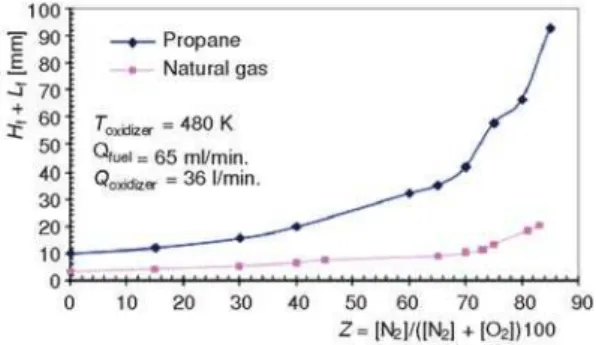
Figure 12 contrasts propane with natural gas in preheating and diluting oxygen oxi-dizer with carbon dioxide. As fig. 12 implies, propane flames are longer and more stable,i.e. blow-out occurs in upper dilution percent. This is through higher order of propane in respect of natural gas and having further car-bon radicals in combustion process. With in-creasing dilution percent, scale of the flame length variations is greater in propane flames than natural gas flames,i.e. dilution, raises discrepancy between natural gas and propane flames length. This matter is related to physical properties of propane as com-pared to natural gas which almost comprises of methane as a prevalent fuel. Regarding combustion characteristics of propane and methane, propane flame has lower auto igni-tion temperature and higher burning veloc-ity in air and consequently wider stabilveloc-ity zone for proper burning [16]. In fig. 13, sim-ilar to previous figure, the effect of replacing fuel type on preheating and diluting oxygen oxidizer with nitrogen has been investi-gated.
Conclusions
In this research investigating the effects of pure oxygen oxidant diluting and preheat-ing on natural gas and propane laminar dif-fusion flames is oriented. In this study, it is inferred that diluting oxidizer with CO2 and N2eventually causes lift-off and blow-out. For diluting oxygen with carbon dioxide this lift-off
occurs in lower percent of dilution. This is due to upper thermal capacity of carbon dioxide. Also, in diluting with propane fuel lift-off takes place in upper molar percent of CO2and N2in
respect of diluting with natural gas fuel. Furthermore, it is understood that with increasing dilu-tion percent, length increase slope is greater in propane flame in comparison with natural gas flames.
From preheating of normal and vitiated oxidizer viewpoint, the following results are extracted. First, oxidizer preheating diminishes visible region length,i.e. increases chemical re-action rates. Secondly, preheated oxidant stabilizes flame against dilution process and lift-off occurs in upper dilution percent. Thirdly, propane flame is so longer than natural gas flame through presence of more carbon radicals that enlarges reaction zone. Also, due to more heat re-lease in propane combustion, these flames are more luminous than their natural gas counter-parts. Moreover, from considering the flame luminosity aspect, it is found that preheated flames Figure 12. Effect of changing fuel type on preheating
and diluting oxygen oxidizer with carbon dioxide
are more luminous than normal temperature flames visually, because of rising flame maximum temperature. Also, preheating oxidizer decreases lift-off height sorely. However, delays it;i.e. lift-off occurs in upper dilution percent.
Nomenclature
Q – volume flow rate, [lmin.–1]
X1 – molar percent ofIin oxidant stream, [–]
Z – dilution percent, [–]
References
[1] Glassman, I., Combustion, Academic Press, New York, USA, 1997
[2] Ruan, J.,et al, Effects of Diluents on Structure and Stability of Axisymmetric Lifted Laminar Diffusion
Flames, 3rdAsian-Pacific Combustion Conference, Seoul, 2001
[3] Juddoo, M., Masri, A. R., Bilger, R. W., The Effects of Oxygen Enrichment on the Structure of Laminar
Diffusion Flames of Methane, 6thAsian-Pacific Combustion Conference, Nagoya, Japan, 2007
[4] Ghosal, S., Vervish, L., Stability Diagram for Lift-off and Blowout of a Round Jet Laminar Diffusion
Flame,Combustion and Flame, 12(2001), 4, pp. 646-655
[5] Usowicz, J. E., An Experimental Study of Flame Lengths and Emissions of Fully-Modulated Diffusion
Flames, M. Sc. thesis, Worcester Polytechnic Institute, Worcester, Mass., USA, 2001
[6] Sullivan, N.,et al, Ammonia Conversion and NOxFormation in Laminar Coflowing Nonpremixed
Meth-ane-Air Flames,Combustion and Flame, 131(2002), 3, pp. 285-295
[7] Moore, J. D., Risha, G. A., Kuo, K. K., Effect of Initial Gaseous Reactant Temperature on Fuel-Rich
Coax-ial Diffusion Flame Stability, Eastern States Section of the Combustion Institute Technical Meeting, Penn-sylvania State University, Old Hain, Penn., USA, 2003
[8] Ghaderi Yeganeh, M., Effects of Preheated Combustion Air on Laminar Coflow Diffusion Flames Under
Normal and Microgravity Conditions, Ph. D. thesis, Maryland University,College Park, Md., USA, 2005
[9] Gupta, A., Flame Characteristics and Challenges with High Temperature Air Combustion,Proceedings,
2000 International Joint Power Generation Conference, Miami Beach, Fla., USA, 2000
[10] Christo, F. C., Dally, B. B., Modeling Turbulent Reacting Jets Issuing into a Hot and Diluted Coflow, Combustion and Flame, 142(2005), 1-2, pp. 117-129
[11] Medwell, P. R., Kalt, A. M., Dally, B. B., Simultaneous Imaging of OH, Formaldehyde, and Temperature
of Turbulent Nonpremixed Jet Flames in a Heated and Diluted Coflow,Combustion and Flame, 148
(2006), 1-2, pp. 48-61
[12] Kumar, P., Mishra, D. P., Experimental Investigating of Laminar LPG- H2Jet Diffusion Flame,
Interna-tional Journal of Hydrogen Energy, 33(2008), 1, pp. 225-231
[13] Kuo, K. K., Principles of Combustion, John Wiley & Sons Press, New York, USA, 1986 [14] Baukal, C. E., Oxygen-Enhanced Combustion, CRC Press, Boca Raton, Fla., USA, 1998
[15] Hasegawa, T., Katsuki, M., The Science and Technology of Combustion in Highly Preheated Air,
Pro-ceedings, 27thSymposium International on Combustion, The Combustion Institute, Pittsburgh, Penn.,
USA, 1998, pp. 3135-3146
[16] Borman, G. L., Ragland, K. W., Combustion Engineering, McGraw-Hill, Singapore, 1998