INTEGRAL REVIEW x June 2008 x Vol. 4, No. 1
When Not to Play Telephone Games
Sara Nora Ross
Abstract: As a powerful way to help understand the behaviors of people and social groupings of all kinds, developmental stage theory attracts attention and use outside of purely academic environments. These uses take the form of written materials and many kinds of interventions. The level of accuracy of developmental theory information generated and used outside of academe demonstrates wide variety. This variety is reflected in materials and interventions. The information used in materials and interventions becomes increasingly distorted as it becomes further removed from original theoretical sources. This has major implications for the ethics and expertise issues that are inherent in applied developmental theory. A classification scheme of information-use behaviors, many of which contribute to distortion processes, is used to code actual cases of creating and disseminating distorted developmental theory information, invoking the metaphor of telephone games. Case evidence indicates that casual, illustrative figures in a 2006 book by Wilber were used by others for various serious and theoretical purposes, and resulted in major distortions of developmental theory. Wilber’s figures represent problematic issues and errors, including distortion of theory, if they are used—as they indeed were—for any purpose more serious than his original purpose. Stemming from those issues and errors, a highly distorted picture of cognitive development and a pseudo-version of Commons and Richards’ Model of Hierarchical Complexity theory emerged, telephone game-like, in the cases discussed. Errors were widely propagated on the internet. Because outside of academe, specialized expertise in developmental theory is difficult to acquire, the sub-field of applied developmental theory requires not only accurate information but also strong communication ethics to govern behaviors of information providers. Such providers need to protect themselves at the same time they protect and inform consumers of their information. This process of knowledge sharing and knowledge building can be shaped by adopting guidelines and a basic operating principle proposed here. Guidelines and principles, without institutionalization, are insufficient support. A new Institute of Applied Developmental Theory could provide the supports, standards, and effectiveness the sub-field of applied developmental theory needs if its power to address 21st century challenges, which sorely need it, is to be realized.
Introduction
Known by different names around the world, the telephone game is one in which the starting player whispers a sentence or phrase to the person next to him or her. That person, and each successive person in the circle or group, whispers the sentence or phrase to the next person, each time like passing a secret no one else should hear. When the secret has made its way around the entire group, the last person to hear it announces the secret aloud for all to hear. Typically, all participants are surprised to hear how different the final version is from the version they heard. This motivates the other participants to report out loud the version they “got.” More differences appear. When originators of the sentence or phrase eventually announce the version they launched, it becomes possible to trace the path of the inevitable distortion.
The telephone game is a metaphor for the distortion process of acquiring first, second, third, or even fourth-hand information when writing or publishing. With respect to this essay, my specific concern is with distortions in developmental stage theory that appear and then re-appear in various written forms. In addition, I concern myself primarily with distortions that can be traced to a book by Ken Wilber, which emerged as a significant source in recent instances when it came to dissemination of both accurate and inaccurate information.
To address that concern, I set three goals for this essay.
- Post an “advisory alert” about the widening propagation of particular errors in representing, describing, and applying developmental stage theory.
- Raise awareness about various sources of errors.
- Contribute constructive solutions to deal with responsibilities to “let the information-users beware” and “let the information-providers beware.”
To accomplish those goals, this essay has the following objectives:
1. Discuss the appeal and the importance of developmental stage theory and why errors and any propagations of errors matter;
2. Describe some sources of errors;
3. Portray a case of telephone game-like information sharing about developmental theory; 4. Point to dynamics and impacts of the game’s distortions;
5. Articulate guidelines for reading and writing to prevent such problems; and 6. Propose some concrete ways forward.
Developmental Stage Theory
Why Accuracy Matters
This means that people recognize the value of developmental theory in general and begin to have ideas about how it can be used to understand themselves, other people, organizations, and larger social groupings. Once we believe we understand something, we may be motivated to develop interventions using it. Interventions may take such forms as education, training, and related materials, or consulting, advising, and even activism. Interventions, by definition, are efforts to impact others. When we aim to impact people’s lives, organizational strategies and sustainability, how issues are addressed, and other social affairs, we tread in the territory of
expertise and ethics. These are two sides of the same coin, and both are serious business. The
governing principle in any kind of serious business is first, do no harm.
How could the use of developmental theory cause any kind of harm? Harm would vary by how theory was used in specific contexts, but some generalizations are possible.
1. An obvious one is that if theory or its related information is taught incorrectly, it will be learned and used by others incorrectly.
2. Another is that if it is incorrectly used to 1(a) assess situations, 1(b) analyze individual, group, or organizational performance, 1(c) be the basis for giving advice on growing edges to develop and changes to make and/or 1(d) design interventions, it can cause confusion, resistance, and/or conflict if such interventions “shoot too high” by introducing inappropriately difficult challenges, expectations, or organizational procedures or structures. These undesired results would be because 2(a) the capacities and possibilities for performance at each stage of development are radically different, 2(b) developmental performance does not change overnight, 2(c) the developmental change process involves different elements at each stage (Commons & Richards, 2002), and 2(d) individuals, groups, and organizations cannot skip stages of developmental performance (Commons, Trudeau, Stein, Richards, & Krause, 1998; this paper by Commons, Trudeau et al. includes a theoretical explication of these and other relevant points).
3. Another general example is if developmental theory-based interventions “shoot too low” in setting expectations because existing performance is inaccurately judged as already at a higher stage. Such a misdiagnosis could lead to false complacency about the nature of challenges that would actually be required to meet stated goals.
The overall message here is that humans and their social groupings are extremely complex and variable, and uses of developmental theory could do harm if they are not based on sturdy foundations.
Issues and Errors in
Integral Spirituality
Figures
If I or other specialists in developmental theory had read Wilber’s (2006) Integral Spirituality,
I expect its errors in representing developmental stage theories would have come to the fore sooner than this, perhaps resulting in correction before further dissemination and repeating it in
his Integral Vision booklet (Wilber, 2007). As it is, I came to this only in the process of figuring
a telephone game. That “originating sentence” had technical errors. One of them in particular has been widely propagated and built upon, as described later in this essay.
Six years before publishing Integral Spirituality, Wilber published Integral Psychology
(2000). In the latter was reflected the significant amount of work he did to produce many developmental stage correlation charts. He clearly had investigated theories and research projects sufficiently to chart them and offer the series of charts as a resource to people.1
Since then, in the two more recent books mentioned above, his representations of “major developmental lines” lack coherence with that earlier work and certain figures contain errors. The first point to make, however, is that the task and purpose of referring to major developmental lines is different from the earlier task and purpose of the extensive charting of individual stage theories. This more recent use of developmental theory is to indicate Wilber’s concept of different lines of development (Wilber, 2006, 2007), and his discussions indicate that purpose. In putting developmental theory to this use, his earlier straightforward approach of identifying an individual theory and its stage categories has largely, though not entirely, been replaced by grouping disparate theories together if they represent to Wilber a particular “line.” This shows up in the form of table-like figures. In Integral Psychology (2006) it is the two full-page Figures 2.4 and 2.5, inserted between full-pages 68 and 69 (in Integral Vision a nearly duplicative representation is Figure 14, pages 112-113). As should become clearer below, I suggest a first source of potential errors is if users assign purpose to such figures beyond the limited one of referring to Wilber’s concept of major developmental lines. I say this for two reasons: (a) there are no sources cited for where the represented development theory information came from, and (b) classifying theories is different from describing, explaining, or applying them.
As the telephone games portrayed later in this essay indicate, the figures have been put to different purposes than just referring to Wilber’s concept of major developmental lines. They became a significant source used by others for classifying, describing, and applying developmental theory. This figures-as-source has errors if it is used for anything but the limited purpose ofreferring to Wilber’s concept of major developmental lines. Because it has been used for other purposes, it seems important to identify issues and errors that already have, or could, continue to propagate through others’ reliance on them. These are outlined below.
Issues
Issue 1. Wilber classifies into one group the author names “Commons/Richards
Piaget/Aurobindo” (Wilber, 2006, Figure 2.4, p. “68a”). A more communicative way to indicate these separate names could be “Commons & Richards; Piaget; and Aurobindo,” to indicate the names are associated with three different developmental frameworks. The group is labeled by Wilber as “cognitive.” There is actually a fourth framework embedded in that group’s representation. This shows up via the overlay of “vision logic” categories, which are Wilber’s
1
(see, for example, the text and aforementioned charts in Wilber, 2000), although Wilber’s name is not included in that “cognitive” group. If people use this classification scheme’s labels to help them describe, explain, or apply developmental theory, the following indicates at least one ramification.
The scheme does not accurately represent the stage category names used by the indicated authors, nor all of their stages, and in some cases, even their stage placements. This is because it conflates three different frameworks for the purpose discussed above of suggesting a developmental line. Thus, the figure’s resulting stage list cannot not fully agree with any of the original authors’ lists of stages and names for them because they used different terms and methods to identify the sometimes different places to “notch the stage measuring stick” they used in describing human behaviors. Wilber’s (2000) charts indicate such differences.
My focus in this issue is on the “cognitive” group for reasons indicated below. However, the general issue pertains to the other “lines” into which he groups multiple authors’ work: those labeled “values” and “self identity.”
Issue 2. It is misleading to classify the developmental framework of Commons & Richards as
only the “cognitive.” Whether referring to their work dating from the 1980’s (e.g., Commons &
Richards, 1984a, 1984b) or their more recent work (e.g., 2002), the work does not represent a
cognitive development framework. As a developmental behavioral framework, it is broader than
that, i.e., it is applicable to every such “line” of development. This broad applicability is because the Model of Hierarchical Complexity (Commons et al., 1998; Commons, Goodheart, Pekker, Dawson, Draney, & Adams, 2007) is a content-free, domain-independent general theory of orders of hierarchical complexity and stages of task performance at such orders, providing universally applicable, mathematical axiom-based measures thereof. “Task” refers to actions performed by machines, neural networks, animals, humans, or larger social groupings (Commons, 2006). Thus, while the theory applies to any activity in the classification commonly called “cognitive,” it is not confined to only that kind of activity: it transcends and includes categories that are based on specific content. In this and other respects, this paradigm is qualitatively different from developmental stage theories based on content even while it describes and measures developmental performance in such content categories as various stage theories are concerned with. I recommend Dawson-Tunik (2006) as an excellent resource for explicating these concepts and citing a range of studies related to them.
Errors
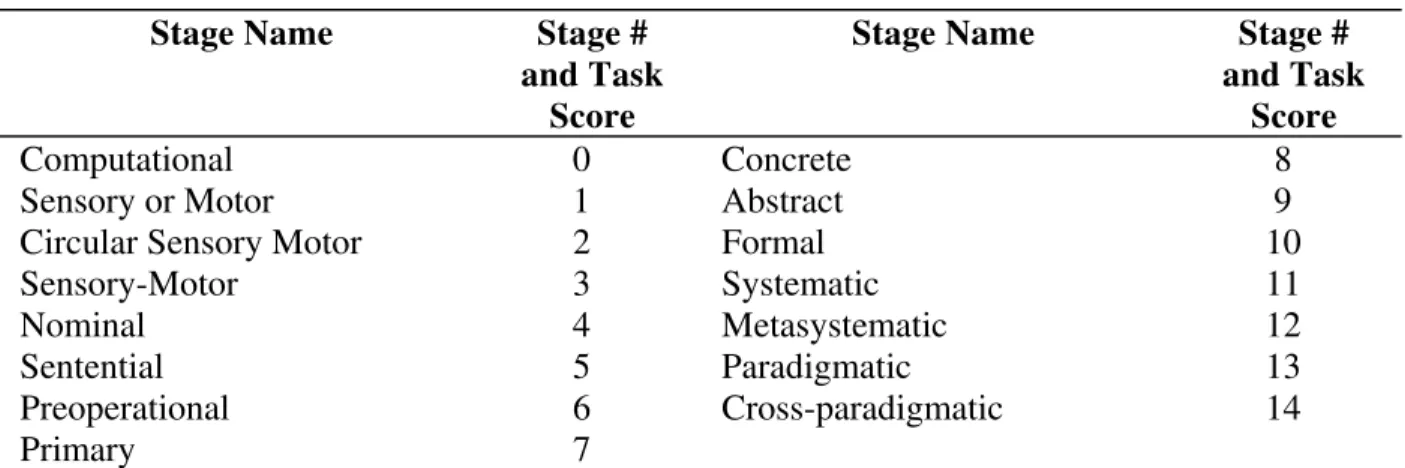
When entering a score into an analysis, the ordinal numbers shown in Table 1 are used. See Commons (2006) for a description of the stages that includes for each stage a generic description of what kinds of tasks are done, how they are done, and the end results of doing them.
Table 1. Stages of Hierarchical Complexity
Stage Name Stage #
and Task Score
Stage Name Stage #
and Task Score
Computational 0 Concrete 8
Sensory or Motor 1 Abstract 9
Circular Sensory Motor 2 Formal 10
Sensory-Motor 3 Systematic 11
Nominal 4 Metasystematic 12
Sentential 5 Paradigmatic 13
Preoperational 6 Cross-paradigmatic 14
Primary 7
Note: Adapted with permission from p. 89 in M. L. Commons (2006), Measuring an approximate g in animals and people. Integral Review: A Transdisciplinary and Transcultural Journal for New Thought, Research and Praxis, 3, 82-99.
To summarize this compound error: in Wilber’s (2006) Figure 2.4, one stage is missing, and the three that follow it are “moved down” to fill its missing place in the stage hierarchy. Along with the conflation of theories and their other stages, this error shows up as a key player in the telephone game problems discussed below.
Possibly relevant to those who use Wilber-unique “vision-logic” terminology, in Integral
Spirituality’s Figure 2.4, (and in Integral Vision’s Figure 14), low vision logic is stage-associated
one stage higher than in Integral Psychology (2000) charts. There could be various explanations. It may be directly related to the Commons & Richards representation error described above, because the vision-logic overlays use the terminology of Commons & Richards. It may be connected with eliminating “middle vision logic” from the more recent figures without making corresponding adjustments. And/or, it may be related to eliminating in these recent figures the use of the “transition” stage category used in structuring the Wilber (2000) charts.
Kegan’s 5th order/stage is represented one stage higher than Kegan (1982, p. 86) situates it; he aligns it with Loevinger’s autonomous stage.
Integral Spirituality’s Figure 2.5 (and Integral Vision’s Figure 14) shows an incorrect
insertion of a “pluralistic” stage as part of Gebser’s framework (see Gebser, 1949/1985). In addition to Gebser, also see Gidley (2007) for discussion of the classification error involved in treating Gebser’s work as if it applied to individuals in the way developmental stage theories do.
Summary
work related to human behavior and social issues. Such work goes beyond strictly academic study to the other worlds of knowledge sharing, practice, and interventions. Accuracy in understanding and using developmental theory matters because its use has impacts on other people, their efforts, their organizations, and even their institutions and societies.
Developmental theory can be used to illustrate or make points that have different purposes. In recent years, Wilber (2006, 2007) used various groupings of developmental theory to illustrate and briefly discuss his concept of major developmental lines. The discussions of such lines were not the focus but rather one aspect within the books in which they appeared. The table-like figures used to support his discussion raise certain issues and represent errors if they are used by
others for any other purpose than Wilber used them, i.e., to illustrate his concept of
developmental lines. The figures in Integral Spirituality were cited in work that used them for a
different purpose. The purpose was theoretical and the work propagated to others. One issue and
one set of errors, above, thus showed up in telephone games portrayed below. Therefore, this section listed the main issues and errors for two purposes: (a) to alert possibly-affected people to them, and (b) to present enough detail to serve as bases for additional points and indicate the content referred tolater when portraying the telephone game dynamics.
Ethics and Expertise
As I wrote more than five years ago (Ross, 2003), outside of those who specialize in it, developmental theory seems susceptible to casual uses and abuses. One way this seems to happen is by believing that if one knows the names of the labels used to designate stages of development in a given theory, and has read some sort of description about the stages, that one knows developmental theory. This can result in mistaken beliefs about how much knowledge is enough and perhaps mistaken assumptions about possessing expertise. If we have mistaken assumptions about our expertise, and have less than we believe, we may generate and share work that may not be reliable enough for others to rely upon.
Without a great deal of support—such as experts to learn from or work with directly and/or some system in place to review, correct, advise about, and otherwise evaluate our performance in describing, explaining, or applying theory—we can risk believing we have knowledge we may not have. When we enter the territory of using our actual or presumed knowledge to impact others’ lives, our ethics and our expertise can be on the line. Specialized expertise is not a costume we would want to don casually to represent ourselves, for example, as educators or advisors. This has a lot to do with communication ethics. In communication ethics, a discipline in its own right, “the value of care is considered of central concern” because “ethics encompasses issues of care and trust, social responsibility and environmental concern and identifies the values necessary to balance the demands of performance today with responsibilities for tomorrow” (Institute of Communication Ethics, 2008, emphasis added).
our work could possibly impact the amount of reliance placed on it by our peers, clients, students, or other users. This is particularly vital when using developmental theory.
Finally, being care-full about readers’ possible interpretations of this section, I emphasize that just because Wilber’s work is the only specific work discussed thus far does not mean that this brief discussion of ethics and expertise singles out him or his work in any particular way. Presenting the range of developmental theory concerns, which involve his work, comes first for the sake of coherent organization to accomplish the essay’s objectives.
Casual or Formal?
From the abstract stage of developmental task performance onward, adults do a very good job of classifying things (Commons et al., 1998). Most classifications evolve casually, e.g., from talking about individual chairs and tables to classifying them as furniture. Once there is a new classification, it engenders further refinements into more classification schemes, e.g., office furniture, living room furniture, dollhouse furniture. It is efficient to classify things. All types of classifying enable us to generalize. When we can generalize, we do not have to show or talk or write about specific examples, but rather, just refer to a class of things that share similar features.
Casual classifications come so easily to most adults that it can be easy to overlook the fact that
other classifications are not casual at all.
Some classifications are formal. This is because they are based on rigorous theoretical and empirical research. Formal classifications are motivated by the need to organize and share knowledge. Thus, they have specific uses and special definitions and concepts. Generally, they are used in formal, not casual, applications. Much of what happens in a society is through applications that grow out of theoretical and empirical research. Such applications can range from teaching, consulting, and publishing to the creation of organizations, services, technologies, and products. This suggests that regardless of their settings, formal applications always have some importance: they mean serious work, intended to inform or otherwise impact those who use them. When people apply and use formal classifications and concepts as if they were casual, confusion can result. Sometimes unintended damage to others can result, too (discussed further below).
Sometimes people who are not experts in a formal academic field develop interests in subjects addressed by that field. Equally possible, experts in one formal academic field may want to work on subjects that call for information from outside their discipline. Sometimes non-experts want to write about their interests in such a subject and share it with others. Sometimes they try to develop their own comparisons of experts’ formal classification schemes. Regardless of different scenarios, subjects of formal study include many formal classification schemes, concepts, and comparisons among them. When non-experts in an area use its formal classifications and concepts, or develop casual comparisons of formal classification schemes, confusion can result. Again, sometimes unintended damage to others can also result.
are even more essential when there is no single authoritative discipline or expert over an application of knowledge.
To summarize and further apply these classification notions, Table 2 suggests the kinds of behaviors that may show up, ranging from classifying, comparing, analyzing, and using. This scheme cannot be all-inclusive of possible variations, nor does it attempt to define criteria. The hope is that the general scheme may raise awareness of different classes of work. This in turn may help people investigate credibility and try to classify their own or others’ work when needed.
Table 2. Classification of Casual and Formal Behaviors
Formal Behaviors Casual Behaviors Casual-Casual
Behaviors F1. Formal classifications and
concepts
F2. Formal uses of formal classifications and concepts F3. Formal comparisons of formal classification schemes F4. Formal analyses of F3 work
C1. Casual uses of F1 formal classifications and concepts C2. Casual comparisons of F1 formal classification schemes C3. Casual uses of F2 work C4. Casual uses of F3 work C5. Casual uses of F4 work
CC1. Casual classifications and concepts
CC2. Casual uses of any C-classes of work
Confused Formal Behaviors
CF. Attempted Formal uses of C or CC classes of work assume they are F classes of work.
Telephone Games with Developmental Theory
Preface: Over the last 60 or so years in the Western world, empirical researchers, along with theorists who do not perform such evidence-based research, have described stage theories of human development in textbooks, trade books, edited collections in books, and peer reviewed journal articles. (Trade books are the type commonly found in bookstores that serve the general public.) Authors use such methods to publish updates to their work when they have new research findings to report, particularly journal articles. Their published work is primary source material. It is primary because it “comes straight from the original horses’ mouths,” as the saying goes. Except for work published in trade book form, it has been critically reviewed by other experts before publication. People who want to be sure they have credible information about developmental theories use up-to-date, first-hand, primary source material generated by such Formal Behaviors as those listed above.
I did not know there was a distortion of developmental theory circulating until we happened to encounter some of its results in written forms. “We” refers to some Integral Review (IR)
member and I received, respectively, one and two different email-broadcasted notices about a new internet-published product; it had different authorship than the earlier manuscript had. The board member read it before I did, and commented on an error evident in it. I then prioritized reading it.
I found it quite curious to see that the same developmental stage-related errors in the earlier manuscript were not only showing up in the publication but more were showing up too. These were used to build a substantive discussion in that product. The product cited its sources of information. I wrote to the source cited in relation to the errors. I pointed out the errors and discussed them in an email. Subsequently, I requested and received the material cited as source information. It was not formally published (e.g., in a journal or book) but, the author told me, it was considered by the author to be in draft form, in the public domain, and free to share. That material cited and used Wilber (2006) figures’ information to organize and describe developmental theory. This use was different from just discussing the concept of major developmental lines, the use to which Wilber put the figures.
Each written product encountered above was of a different genre, and all of them clearly indicated their authors’ expectations for them to be regarded as serious work. In the process of putting pieces together to understand how the same and further errors were showing up in such disparate places, evidence of telephone game dynamics showed up. The spread of distortions is outlined below via Figure 1, using the behavior codes in Table 2 to represent specific behaviors.
These dynamics resulted in circulating incorrect answers, incorrect analyses, or incorrect advice. This dissemination system has caused perhaps-unrecognized confusion and in some cases, actual and potential damage to self (e.g., reputation and cost to correct information) and others (e.g., reliance upon incorrect information in writing, advice-giving, or practice). We did due diligence by advising the authors of the several known casualties of this game. This essay is public due diligence, in case others have been confused or damaged along this path or perhaps by playing some other version of the telephone game with developmental theory.2
Wilber is not responsible for how other people used, or will use, his figures in Integral
Spirituality (or in Integral Vision). Even so, given the diffusion process portrayed in Figure 1,
there is a problem. This is because (a) at least one individual node in the network depicted above used figures from Wilber—which served a limited purpose for Wilber—for much different purposes, based some work on them, and disseminated the work, and (b) others treated that person’s work as serious formal work, made the same and in one case further mistakes when relying on it to describe related theory, and passed the results along to others to use. Note that the further mistakes are not specified here because I believe this discussion is sufficient to accomplish stated objectives while keeping all possible identities anonymous.
2
Figure 1. Depiction of Telephone Games with Developmental Theory
A column in Wilber’s (2006) figure 2.4 ended up being used as if it portrayed cognitive development and Commons & Richards’ developmental framework. The distorted portrayals of cognitive development and Commons & Richards’ work resulted in purposes, descriptions, and applications that were well beyond Wilber’s purpose for the figures. The pseudo-theory that was disseminated (Figure 1) was practically unrecognizable when compared to Commons & Richards’ own formal, empirically-based research and hierarchical complexity theory.
The primary source material of the original authors’ work could have been cited in Wilber’s figures, and/or a disclaimer or other sort of caveat could have accompanied the figures so people would know they should not rely on them for any purpose other than Wilber’s limited purpose for them. If such care had been taken in preparing the figures, perhaps the “originating sentence” in the kick-off game would not have come from his figures at all. Perhaps it would have had Formal Behavior origins and reduced the amount of distortion that is circulating.
an associate and stated source of advice to next person-Æ
Integral Spirituality¸
Figures 2.4 and 2.5, 2006, by Ken Wilber. Publisher: Integral Books
C2*
C3/ CC2
CF* CC2
CF
Additional sources, primary and secondary
* denotes authors did not cite their sources
Connection deduced from duplication of specific errors
Two known promoters’ emailed distributions sent Professional
services website
Paper submitted to Integral Review
TIME
N
U
MBER O
F
PEOPLE
AFFECTED
5 Research net-work & university websites in 3 countries
Internet
Rules of the Reading and Writing Road
I propose some rules of the road to guard against the kind of confusion and damage this case of telephone games illustrates. I recommend these guidelines to those who do not specialize in a particular discipline but wish to use its formal classifications and concepts.
1. Use formal classifications and concepts seriously, befitting the formalities they are. 2. Cite the sources, in writing, of any information you did not personally originate so users
can assess the information’s reliability.
3. Remember that formal classifications and concepts are unwise fodder for playing the telephone game with reading and writing about theoretical matters.
4. Therefore:
a) If you are unsure what the formal classifications actually mean, or how they relate to similar classification schemes, consult the primary source or find an expert in that field to ask.
b) If you do not have formal expertise in the field that produced formal classifications you want to use, ask an expert in that field to review and possibly help you correct your work before you disseminate it.
c) If you rely upon hearsay, casual work, and/or second, third, or fourth-hand sources for any but the most casual of purposes, realize that this is risky behavior that can cost the loss of credibility and other forms of damage to you and to others.
d) If you learn that you have made an error in written or spoken information or advice that you disseminated, do whatever you can to correct the error and get the correction into the hands of those who may have relied upon you.
Concrete Ways Forward
In an ideal world, these rules of the road should apply equally to those who read and use information and those who produce information. Taken as a whole, they convey the “value of care.” This encompasses both the responsibilities to “let the information-users beware” and to “let the information-providers beware.” If left at that, one could walk away with an individualist impression that this is just about taking responsibility for one’s own actions. But it is about far more than that, as the following perspectives indicate.
A. Users without expertise in a subject do not have the background to judge the accuracy of information supplied by others on that subject.
B. Providers of information have two responsibilities: (a) to ensure their work is accurate by using standard documentation methods (e.g., citing sources) and obtaining adequate review by competent persons or processes, and (b) to transparently communicate to users the degree of rigor in the preparation and peer review processes applied to a given work.
B1. If providers of information perform both responsibilities, they address the needs of less-qualified consumers to judge the work as reliable. This coordinates the two systems: (A) users’ needs and their gaps in expertise to judge quality without supportive information, and (B) information providers’ responsibilities for quality, review, and transparent communications.
The foregoing metasystem can be summarized as an integral principle, as follows.
Neither users nor providers of information should rely upon only their own judgment. Each role (user and provider) is responsible to protect itself and others from harm in the course of information exchanges and uses. When implemented, (a) systems for ensuring accuracy and (b) communications about the systems for assuring accuracy, together can reduce the frequency and impacts of users and providers acting like independent agents in an interdependent world of information exchange.
If such a principle were adopted as a Standard Operating Principle (SOP), the SOP would go beyond current, traditional systems, both formal and casual. As it implies, we need new systems
to augment traditional ones and accommodate realities of internet-based 21st century information
flows. I believe this argument holds true if we see merit in implementing such a principle for our own and the greater good. To implement it, however, means developing a new kind of system or systems.
I propose we open discussion about developing an institutionalized approach, a new system, to help accelerate developmental theory’s impacts in the 21st century. Such a new system could be a solutions-based way forward, one that respects such realities as this essay highlights:
1. The need for expanded and reliable applications of developmental theory by non-experts; 2. The current accountability and communication gaps among people who want to do good
work but cannot specialize in developmental theory;
3. The variety of forms and classes of work that developmental theory applications may span; 4. The need for faster tracks to get non-academic work evaluated by competent experts; 5. The need for language consistency in communicating about the levels of rigor employed in
work preparation and in evaluative reviews;
6. Perhaps some “good housekeeping seals of approval” to apply to various forms taken by non-academic work with developmental theory.
Ultimately, I believe this is about is developing the mechanisms to support the growing sub-field of applied developmental theory. As a starting point to consider such mechanisms, Integral
Review will open a public forum for discussion of needs identified here and elsewhere.3 Ideally,
it will attract people who are interested to roll up their sleeves to contribute in a variety of ways toward discriminating the range of needs, and conceiving and designing an institutionalized approach to address such needs, including those outlined above. Forum participants could be anyone with an interest, e.g., current or emerging practitioners, academics and other theorists and researchers, or end-users of developmental applications.
3
Reflecting on all of the above, I believe the time has come for an Institute for Applied
Developmental Theory. I think this idea is worth pursuing and operationalizing. It could be
designed to respond to and grow with needs and contexts that are already arising and becoming evident in such organic, unpredictable fashions as this essay portrays. And, at the same time, it could respond to additional needs in fields of endeavor not yet benefiting from insights and applications available from using development theory
Conclusion
Although the catalyst for this essay was the use of information about developmental theory, it applies to all information that relates to or originates in serious theoretical work. I hope that discriminating among the classifications of written work and providing a scheme to organize them proves to be a useful reference. Most of all, I hope the take-away message is that consumers, users, and providers of information all have responsibilities to self and others when information is, or could be perceived to be, anything but casual. When we hold in mind the perspectives and especially the assumptions of others who may use information we generate, we are more likely to follow the rules of the road and attempt to implement integral principles as standard operating principles. One is proposed above; additional principles are possible. May such items inform, support, and motivate us to take the necessary steps to ensure accuracy and credibility for the benefit, not detriment, of all those coming in contact with our work.
As a pragmatist, I do not believe such urgings will have any meaningful impact unless there is an institutionalized method to realize them. To realize them, we need to concretely support people in their endeavors with developmental theory. To concretely, accurately, and effectively support people means putting in place a system to do so.
Creating new systems with high credibility is hard work that requires developing partnerships and human and financial resources. So be it. Let us do what is necessary to help ensure that reliable uses of developmental theory are brought into the 21st century applications that so sorely need them. If we rise to meet this challenge, we will see more developmental theory effectively
applied, which is what these telephones games have been trying to do, after all. I propose that
institutionalizing the sub-field of applied developmental theory is a better “game” to play with developmental theory, with better odds than telephone games, yes?
References
Commons, M. L. (2006). Measuring an approximate g in animals and people. Integral Review: A
Transdisciplinary and Transcultural Journal for New Thought, Research and Praxis, 3,
82-99.
Commons, M. L., Goodheart, E. A., Pekker, A., Dawson, T. L., Draney, K., & Adams, K. M. (2007). Using Rasch scaled stage scores to validate orders of hierarchical complexity of balance beam task sequences. In E. V. Smith, Jr. & R. M. Smith (Eds.), Rasch measurement:
Commons, M. L., & Richards, F. A. (1984a). A general model of stage theory. In M. L. Commons, F. A. Richards, & C. Armon (Eds.), Beyond formal operations: Vol. 1. Late
adolescent and adult cognitive development (pp. 120–140). New York: Praeger.
Commons, M. L., & Richards, F. A. (1984b). Applying the General Model of Hierarchical Complexity. In M. L. Commons, F. A. Richards, & C. Armon (Eds.), Beyond formal
operations: Vol. 1. Late adolescent and adult cognitive development (pp. 141–157). New
York: Praeger.
Commons, M. L. & Richards, F. A. (2002). Organizing components into combinations: How stage transition works. Journal of Adult Development, 9(3), 159-177. Also available at http://dareassociation.org.
Commons, M. L., Richards, F. A., & Kuhn, D. (1982). Systematic and metasystematic reasoning: A case for levels of reasoning beyond Piaget's stage of formal operations. Child Development 53, 1058-1069. Also available at http://dareassociation.org.
Commons, M. L., Trudeau, E. J., Stein, S. A., Richards, F. A., & Krause, S. R. (1998). The existence of developmental stages as shown by the hierarchical complexity of tasks.
Developmental Review8(3), 237-278. Also available at http://dareassociation.org.
Dawson-Tunik, T. L. (2006). The meaning and measurement of conceptual development in adulthood. In C. Hoare (Ed.), Handbook of adult development and learning (pp. 433- 454). New York: Oxford University Press.
Gebser, J. (1985). The ever-present origin. (N. Barstad, Trans.). Athens, OH: Ohio University Press. (Original publication 1949)
Gidley, J. (2007). The evolution of consciousness as a planetary imperative: An integration of integral views. Integral Review: A Transdisciplinary and Transcultural Journal for New
Thought, Research and Praxis,5, 4-226. http://integral-review.org
Inglis, J. (2008). How then do we choose to live?: Facing the climate crisis and seeking “the meta response.” Integral Review: A Transdisciplinary and Transcultural Journal for New
Thought, Research and Praxis, 4(1), 100-107. http://integral-review.org.
Institute of Communications Ethics. (2008). Mission. Retrieved 26 May 2008, from http://www.communicationethics.net/values/index.php?nav=mission.
Kegan, R. (1982). The evolving self. Cambridge, MA: Harvard University Press.
Murray, T. (2006). Collaborative knowledge building and integral theory: On perspectives, uncertainty, and mutual regard. Integral Review: A Transdisciplinary and Transcultural
Journal for New Thought, Research and Praxis, 2, 210-268. http://integral-review.org
Ross, S. N. (2003). A "letter" of intervention and invitation to Ken, Don, and the integral
community. Unpublished manuscript. Available from [email protected] or at
http://www.integralworld.net/ross.html.
Stein, Z. (2007). Modeling the demands of interdisciplinarity: Toward a framework for evaluating interdisciplinary endeavors. Integral Review: A Transdisciplinary and
Transcultural Journal for New Thought, Research and Praxis, 4, 91-107.
Torbert, B. & Associates. (2004). Action inquiry: The secret of timely and transforming
leadership. San Francisco: Berrett-Koehler.
Wilber, K. W. (2000). Integral psychology: Consciousness, spirit, psychology, therapy. In The
collected works of Ken Wilber, Vol. 4, (pp. 425-717). Boston: Shambhala.
Wilber, K. W. (2006). Integral spirituality: A startling new role for religion in the modern and
Wilber, K. W. (2007). The integral vision: A very short introduction to the revolutionary integral
approach to life, God, the universe, and everything. Boston: Shambhala.
Sara Nora Ross, Ph.D., holds an interdisciplinary doctorate in Psychology and Political
Development. As a developmentalist, researcher, theorist, and practitioner, she specializes in investigating and applying knowledge of universal patterns to analyze and address real-world problems in their detailed and developmental complexity. She is the founder and president of
ARINA (www.global-arina.org), which is the 501(c)(3) organizational home of The Integral