RHIZOBACTERIA OF POPULUS DELTOIDES
Sandeep Bisht1, Piyush Pandey1*, Anchal Sood1, Shivesh Sharma1, N. S. Bisht2
1
Department of Microbiology, S.B.S (P.G.) Institute of Biomedical Sciences and Research, Balawala, Dehradun, Uttarakhand,
India; 2 Department of Botany, H.N.B. Garhwal University, Pauri Campus, Pauri, Uttarakhand, India.
Submitted: December 29, 2009; Returned to authors for corrections: February 01, 2010; Approved: April 26, 2010.
ABSTRACT
Several naphthalene and anthracene degrading bacteria were isolated from rhizosphere of Populus
deltoides, which were growing in non-contaminated soil. Among these, four isolates, i.e. Kurthia sp.,
Micrococcus varians, Deinococcus radiodurans and Bacillus circulans utilized chrysene, benzene, toluene
and xylene, in addition to anthracene and naphthalene. Kurthia sp and B. circulans showed positive
chemotactic response for naphthalene and anthracene. The mean growth rate constant (K) of isolates were
found to increase with successive increase in substrate concentration (0.5 to 1.0 mg/50ml). B. circulans
SBA12 and Kurthia SBA4 degraded 87.5% and 86.6% of anthracene while, Kurthia sp. SBA4, B.
circulans SBA12, and M. varians SBA8 degraded 85.3 %, 95.8 % and 86.8 % of naphthalene respectively
after 6 days of incubation as determined by HPLC analysis.
Key words: Biodegradation; Chemotaxis; Anthracene; Naphthalene
INTRODUCTION
Soil is a valuable resource as it regulates biogeochemical
cycles, filters and remediates pollutants and enables food
production (4). Presence of polyaromatic hydrocarbons (PAH)
in soil has considerable toxicological concern because of their
toxigenic, mutagenic and carcinogenic properties (17). PAH
are produced during fossil fuel combustion, waste incineration
or as by-products of industrial processes including coal
gasification, production of aluminum/iron/steel, petroleum
refining, and component of wood preservatives, smoke houses
and wood stoves (28). The possible fate of PAH in the
environment include chemical oxidation, bioaccumulation and
adsorption to soil particles, but the principal process for
removal of PAH is thought to be microbial transformation and
degradation (8). Biological treatment is well known to be
feasible and effective than chemical treatment because
microorganisms directly degrade contaminants rather than
merely transferring them from one medium to another and
employ metabolic degradation pathways that can terminate
with benign waste products (e.g. carbon dioxide and water).
Also, microbes derive energy necessary to degrade
contaminants from the catabolic degradation of contaminants
themselves. Because of all these properties, microbes are used
in situ to minimize disturbance of the pollutants from
contaminated site (11).
Considerable attention has been focused on the potential
of microorganisms to remediate soils contaminated with
persistent organic pollutants (3). Since PAH are hydrophobic
compounds with low solubility in water, they have a tendency
to bind with organic matter or soil, limiting their availability to
microorganisms. Despite these properties, many bacterial
strains have been isolated for their ability to transform, degrade
and utilize PAH as a source of carbon and energy (15).
Bacterial growth in PAH contaminated soils is dominated by
the low bioavailability and often long-term persistence of these
compounds (26). Significant bacterial communities with ability
to degrade PAH in soil play a critical role in biodegradation in
spite of their low bioavailability. Microorganisms inoculated
into PAH-contaminated soil environments must find and
mobilize PAH before degradation and hence motility and
chemotaxis are thought to be desired properties (35).
Since associative interactions of plants and
microorganisms have come into existence as a result of
co-evolution, the use of this interaction for bioremediation of soil
holds immense possibilities. When a suitable rhizospheric
strain is introduced together with a suitable plant, it settles on
the root along with indigenous population, thereby enhancing
the bioremediation process. In addition, such efficiently
root-colonizing, pollutant-degrading bacteria exploit the growing
root system and hence this acts as an injection system to spread
the bacteria through soil. Therefore, the present work was
designed to study the biodegradation ability of PAH by
rhizospheric bacteria isolated from the rhizosphere of Populus
deltoides growing in non contaminated site in Garhwal
Himalayas, India. Populus was selected as it has several
advantages for the purpose of rhizoremediation, including rapid
growth rate (3 to 5 m/year). In addition, they have extended
roots which can reach to the water table; therefore, they have
the capacity to treat the contaminant with the saturated zone
(34).
MATERIALS AND METHODS
Soil samples were collected from the rhizosphere of
Populus deltoides growing in Garhwal region, India (between
30°17’N and 30°24’N Latitude., 78.0°E and 78°6’E longitude)
from the depths 0-30 cm using an ethanol-disinfected shovel.
Root hairs were carefully collected, loose soil was removed by
shaking, and then the roots with tightly bound rhizosphere soil
were stored in sterile plastic bags. Samples were collected in
triplicates and stored at 4° C prior to microbiological analysis.
Soil samples (1.0 g) or fine roots with attached rhizosphere soil
were suspended in 100ml sterile water and kept in incubatory
shaker (120 rpm) at 27o C for 24 h. Following standing for 30
min, serial dilutions of the suspension were prepared in double
distilled sterile water up to dilution 10-6. Total culturable
heterotrophs including aerobic PAH degrader were grown by
spray plate technique (13) using minimal salt basal medium
(MSB) which consisted of 0.7g NH4NO3; 0.1g K2HPO4; 0.1g
KH2PO4; 0.05g MgSO4.7H2O; 0.013g CaCl2.2H2O; 0.0013g
FeSO4.7H2O; 2 % agar per 100ml of de-ionized water. Liquid
hydrocarbon when used as substrate was provided in vapour
phase (21) until mentioned otherwise.
Chemotaxis response of various isolates for PAH was
determined by drop assay method (7). Bacterial cells in
logarithmic phase of growth were harvested from 40ml of
nutrient broth and resuspended in 12 ml of chemotaxis buffer
(100 mM potassium phosphate [pH 7.0], 20 mM EDTA) to an
optical density at 600nm (OD600 ) of approximately 0.7. A
small amount of a test attractant i.e. anthracene or naphthalene
was added to the center of a Petridish. Formation of a ring of
turbidity near the center of the Petridish was recorded as
positive chemotactic response. Succinate was utilized as chemo
attractant in positive control.
Growth profile of isolates in anthracene or naphthalene
amended medium was determined. MSB was supplemented
with different concentrations (0.5, 0.8 and 1.0 mg/50ml) of
anthracene or naphthalene. The medium was sterilized and
inoculated with the test organism and incubated at 27° C (160
rev/min). Positive control was experimented in parallel
comprising dextrose (2 %) as sole source of carbon. Growth
was assessed by measuring OD600 after time interval of 3 h.
Mean growth rate (K) was calculated by formula given as:
Where K is mean growth rate constant, Zt is final growth
at time t, Z0 is initial growth at time 0 and T is difference in
time. The data were subjected to analysis of variance, and
means compared using t -test statistics.
Residual amount of anthracene and naphthalene was
determined by high performance liquid chromatography
(HPLC) analysis in culture medium for quantitative estimation
of PAH degradation. Cultures of isolates were separately taken
in 250-ml Erlenmeyer flasks containing 50 ml of minimal broth
amended with 0.075 mM aliquot of naphthalene or anthracene,
dissolved in ethyl acetate. Ethyl acetate was evaporated before
adding other components of medium. Medium with evaporated
ethyl acetate, devoid of hydrocarbons served as negative
control and showed no growth. The cultures were incubated at
150 rpm for 6 days in the dark at 27°C. The contents of each
flask were extracted separately using diethyl ether (99.5%) in a
separating funnel by intermittent shaking. The extracted upper
organic layer containing residual PAH was filtered through
sodium sorbate to remove excess water. Filtered samples were
evaporated to dryness at elevated temperature (50-60 °C) in hot
air oven and resuspended in 5ml of methanol (31). The
residues were analyzed by HPLC (Shimadzu equipped with
UV –Vis detector operating at 254 nm). Separation was carried
out with a reverse phase 5 µ m C-18 column (250x 4.6mm).
Isocratic mobile phase was acetonitrile and water (70:30, v/v)
with a flow rate of 1.3 ml/min. Anthracene and naphthalene
standard was also analyzed under the same conditions and
residual amount of PAH was estimated by calibration curve.
RESULTS AND DISCUSSION
Sixteen strains with ability to utilize naphthalene and
anthracene were isolated from rhizosphere of Populus
deltoides, growing in non contaminated soil. Among these,
four isolates were found to utilize both anthracene and
naphthalene as sole source of carbon. These strains were
identified as Kurthia sp. SBA4, Micrococcus varians SBA8,
Deinococcus radiodurans SBA6 and Bacillus circulans
SBA12. Kuthia sp. SBA4 and D. radiodurans SBA6 tolerated
wide range of NaCl concentration (2.5 to 10%) while, D.
radiodurans SBA6 and B. circulans SBA12 were able to grow
in the pH range of 5.0 to 11. These strains were assessed for
their potential to utilize chrysene, benzene, toluene or xylene as
sole source of carbon. Kurthia sp. SBA4 and D. radiodurans
SBA12 utilized all the hydrocarbons used in the study (Table
1).
Table 1. Growth test on different liquid and solid hydrocarbon
S. no Strains Anta Napb Benc Told Xyle Chrf
1 SBA4
+++
+++
+++
+
+ +++2 SBA8
+++
+++
+++
+
– +++3 SBA6
+++
+++
++–
+ +++4 SBA12 +++ +++
+++
+
++
+++a Anthracene, b Naphthalene, c Benzene, dToluene, e Xylene, f Chrysene
+++ Excellent growth; ++ Moderate growth; + Weak growth; – No growth
These isolates were checked for their chemotaxis activity
against naphthalene and anthracene. For both anthracene and
naphthalene, a positive chemotactic response was observed as
formation of closed ring surrounding but not touching the test
attractant in Kurthia sp. SBA4 and B. circulans SBA12, thus
indicating valuable effect of chemotaxis on biodegradation
activity. The response was similar to succinate used as positive
control in contrast in negative control no ring was formed.
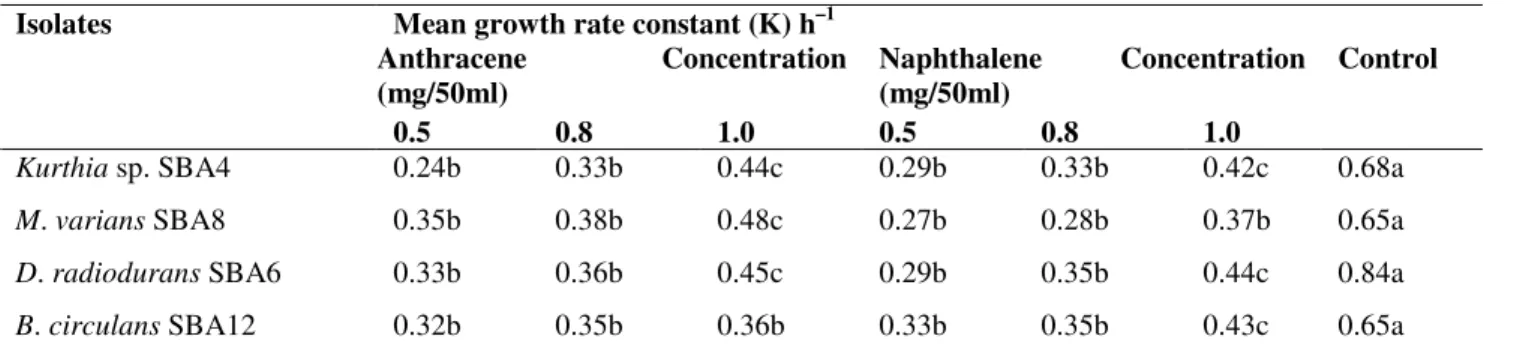
There was successive increase in mean growth rate
constant (K) of all the isolates with respective increase in
concentration of substrate. The K value of Kurthia sp. SBA4,
M. varians SBA8, D. radiodurans SBA6, B. circulans SBA12
in medium amended with anthracene (1 mg/50ml) was
obtained as 0.44, 0.48, 0.45 and 0.36 h-1 respectively, which
was relatively higher than other concentrations tested. Similar
Kurthia sp. SBA4, M. varians SBA8, D. radiodurans SBA6
and B. circulans SBA12 had K value of 0.42, 0.37, 0.44 and
0.43 h-1 respectively in exponential phase. The mean growth
rate of all the isolates was relatively higher in glucose amended
medium where it was 0.68, 0.65, 0.84 and 0.65 h-1 for Kurthia
sp. SBA4, M. varians SBA8, D. radiodurans SBA6 and B.
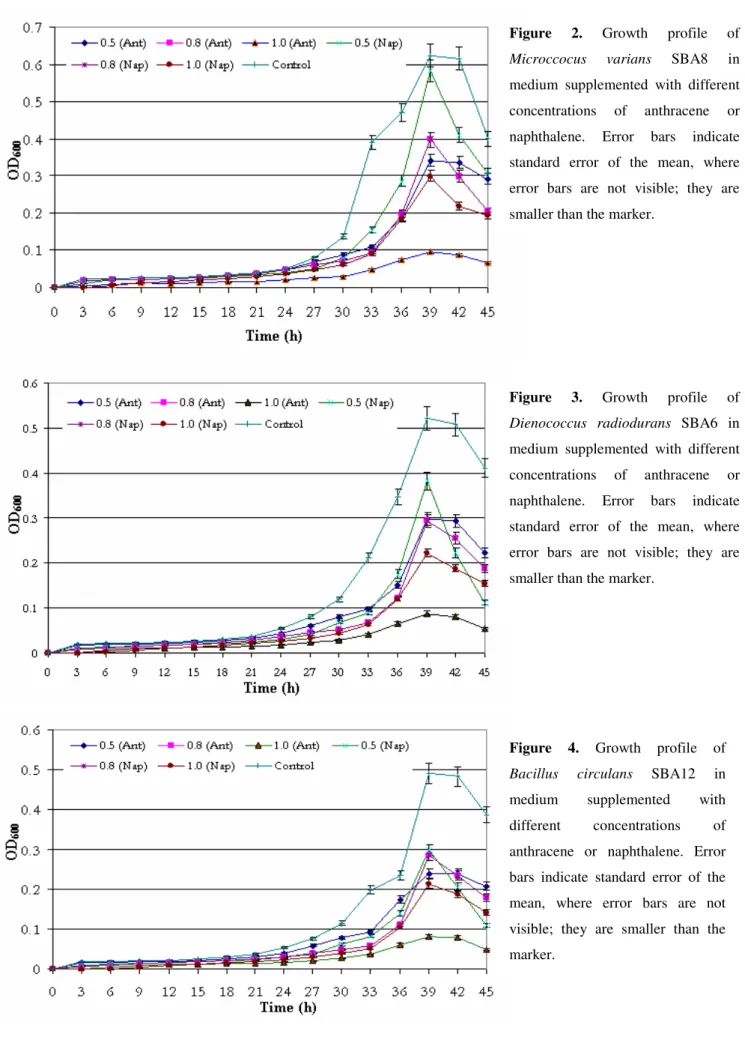
circulans SBA12 as shown (Table 2). The growth profile of all
the isolates at varying concentration of naphthalene and
anthracene with respect to control are given in Fig. 1- 4. It was
invariably observed that the growth profiles of all the isolates
at 0.8 mg/50ml of naphthalene and anthracene were almost
similar, which resulted in overlapping of respective graphs
(Fig. 1-4).
HPLC analysis of neutral exract from PAH amended
culture medium revealed the presence of several metabolites
that were eluted at different retention time period ranging from
2.5 to 14 minutes. However, the residual concenteration of
anthracene or naphthalene was determined by calculating the
peak area relative to standard with pure anthracene and
naphthalene with retention time of 6.933 min and 4.039 min
respectively. All the four isolates were found to substantially
reduce PAH concentration in medium as estimated by HPLC
analysis. Kurthia sp. SBA4, M. varians SBA8, D. radiodurans
SBA6 and B. circulans SBA12 resulted in 86.6%, 86.6%,
81.8% and 87.5% degradation of anthracene (Fig. 5) while
85.3%, 86.8%, 27.8% and 95.8% decrease in naphthalene
concenteration (Fig. 6) was observed respectively by these
isolates after 6 days.
Table 2. Mean growth rate constant of isolates at varying concentration of substrate
Mean growth rate constant (K) h–1 Anthracene Concentration (mg/50ml)
Naphthalene Concentration (mg/50ml)
Isolates
0.5 0.8 1.0 0.5 0.8 1.0
Control
Kurthia sp. SBA4 0.24b 0.33b 0.44c 0.29b 0.33b 0.42c 0.68a
M. varians SBA8 0.35b 0.38b 0.48c 0.27b 0.28b 0.37b 0.65a
D. radiodurans SBA6 0.33b 0.36b 0.45c 0.29b 0.35b 0.44c 0.84a
B. circulans SBA12 0.32b 0.35b 0.36b 0.33b 0.35b 0.43c 0.65a
*Values followed by different letters in row were significantly different (P<0.05), using t test statistic.
Figure 1. Growth profile of Kurthia
sp.SBA4 in medium supplemented
with different concentrations of
anthracene or naphthalene. Error bars
indicate standard error of the mean,
where error bars are not visible; they
Figure 2. Growth profile of
Microccocus varians SBA8 in
medium supplemented with different
concentrations of anthracene or
naphthalene. Error bars indicate
standard error of the mean, where
error bars are not visible; they are
smaller than the marker.
Figure 3. Growth profile of
Dienococcus radiodurans SBA6 in
medium supplemented with different
concentrations of anthracene or
naphthalene. Error bars indicate
standard error of the mean, where
error bars are not visible; they are
smaller than the marker.
Figure 4. Growth profile of
Bacillus circulans SBA12 in
medium supplemented with
different concentrations of
anthracene or naphthalene. Error
bars indicate standard error of the
mean, where error bars are not
visible; they are smaller than the
*Napthalene in methanol solvent
*Anthracene in methanol solvent
Kurthia sp. SBA4, M. varians SBA8, D. radiodurans
SBA6 and B. circulans SBA12 were isolated from the
rhizosphere of Populus deltoides with ability to utilize PAH i.e.
anthracene and naphthalene along with broad substrate range to
utilize other hydrocarbons. These bacteria were isolated from
host plant growing in non contaminated soils. Earlier also,
Heinonsalo et al. (9) isolated petroleum hydrocarbon degrading
bacteria from non-contaminated lignin rich forest humus soils.
In the present study, M. varians SBA8 and D. radiodurans
SBA6 were unable to grow on xylene and toluene
supplemented medium respectively. The reason might be
membrane toxicity and / or absence of necessary enzyme for
utilization of these hydrocarbons. As suggested earlier that
lipophilic hydrocarbons accumulate in the membrane lipid
bilayer, affecting the structural and functional properties of
these membranes. The resulting accumulation of hydrocarbon
Figure 5. Degradation of naphthalene by rhizospheric
isolates from Populus
deltoides estimated by
HPLC analysis. Error bars
indicate standard error of the
mean.
Figure 6. Degradation of anthracene by rhizospheric
isolates from Populus
deltoides estimated by
HPLC analysis. Error bars
indicate standard error of the
molecules leads to membrane loss of integrity, increase in
permeability to protons and consequently, dissipation of the
proton motive force and impairment of intracellular pH
homeostasis (30).
The findings of this study revealed that rhizosphere of
Populus deltoides is associated with increased numbers of PAH
degrading bacteria, in spite of absence of these hydrocarbons in
situ. Several isolates were capable of utilizing broad range of
hydrocarbons thereby making them suitable candidates for
rhizoremediation. Similarly, Austrian pine (P. nigra) and
willow (S. caprea) trees have been identified as
rhizoremediation candidates because of their association with
increased numbers of poly chlorinated benzene degraders in the
root zone (16). Earlier, isolates from Populus sp. (poplar) and
Salix sp. (willow) rhizosphere have been used successfully for
rhizoremediation of PHC contaminated soils probably due to
introduction of oxygen into deeper soil layers through
specialized root vessels and aerenchyma (37).
In fact, PAH degrading organisms and higher degradation
rates have been detected in the bulk soil collected from planted
treatments than in the bulk soil collected from unplanted
treatments in rhizoremediation studies (18, 29). These findings
are promising indications that certain trees may positively
affect the number of degrading microorganisms in a large
volume of soil, beyond the immediate vicinity of the roots
traditionally defined as the rhizosphere. In accordance to the
fact, P. deltoides was used in present study as an ideal habitat
for degrading organisms, because its rhizosphere provides
controlled conditions for symbiotic growth of microorganisms
adapted for roots. In fact, its roots provide excellent attachment
locations, steady redox conditions, and a steady food supply of
exudates consisting of organic acids, enzymes, amino acids,
and complex carbohydrates (1). Further, presence of high
levels of phenolic compounds in root exudates is known (6) to
induce bacterial degradation pathways (27). In this study, four
PAH degrading isolates was identified as Kurthia sp. SBA4, M.
varians SBA8, D. radiodurans SBA6and B. circulans SBA12.
Earlier also, Micrococcus varians (22) and certain Bacillus
species (10) have been identified for PAH degradation,
however reports on PAH degradation by rhizospheric
Deinococcus spp. and Kurthia spp. are not well documented.
Pertaining to the fact that all four were rhizosphere isolates
with PAH degrading abilities, their potential may be exploited
for bioremediation as also previously described by coating the
rhizobacteria on Barmultra seeds or seedlings (14). In fact, the
rhizosphere is a nutrient-rich environment when compared with
bulk soil; therefore, it can function as a nutrient source for
rhizosphere bacteria during rhizoremediation, making them
metabolically more active.
In present study Kurthia sp. SBA4 and B. circulans
SBA12 exhibited positive chemotactic response for anthracene
and naphthalene. Chemotaxis has been reported to play an
important role in enhancing biodegradation as it increases
bioavailability of pollutants to bacteria (23). This ability of
motile bacteria provides the advantage to locate compounds
such as anthracene and naphthalene that support growth of
microorganisms. Chemotactic cells would be especially
efficient at sensing and swimming towards chemicals that are
present at point sources, for example, absorbed to the soil
particles, in ground water or within slowly moving pollutants
plumes. In this way chemotactic bacteria overcome
mass-transfer limitations that impede bioremediation processes (24).
Grimm and Harwood (7) reported that naphthalene and its
degradation pathway intermediate, salicylate, influence
behavioral responses in two naphthalene-degrading motile
bacteria, P. putida G7 and Pseudomonas sp. strain NCIB
9816-4. As a matter of fact, the relation between chemotaxis and
biodegradation is well established, as a Ralstonia strain was
reported earlier to be chemotactic towards different nitro
aromatic compounds (NAC) which were subsequently
degraded completely by this organism (25). Though,
chemotactically active PAH degrading bacteria are known to
be present in contaminated soil (7), Kurthia sp. SBA4 and B.
circulans SBA12 were isolates from non contaminated Populus
rhizosphere.
Maximum growth rate of bacterial isolates was recorded
when glucose was used as sole source of carbon during growth
when anthracene or naphthalene was provided as carbon
source. However, successive increase was resulted in increased
growth rate of four isolates with substrate concentration (up to
1mg/50ml). This further confirmed that anthracene and
naphthalene concentration are significant in growth physiology
of the isolates and may also act as limiting nutrients in
rhizosphere. Though, it was evident that the substrate
concentration only affect the multiplication rate of organisms
while the growth profile remained unaffected with successive
increased in PAH concentration. Earlier, Juhasz et al. (12) have
studied the effect of PAH on growth of Burkholderia cepacia,
where growth was evaluated by visual monitoring, while in the
present study mean growth rate (K) was determined at various
concentration of PAH. However, in present work, the K values
of isolates increased with the increasing substrate
concentration, but the biomass decreased with respective
increasing concentrations of anthracene or naphthalene. This
might be attributed to membrane toxicity of PAH substrates at
higher concentrations (30). Nawana et al. (22) studied the
growth of Acinetobacter anitratus on chrysene in culture
medium for 35 days by total viable count method.
The quantitative estimation of residual amount of PAH in
culture medium suggested that more than 85 % of anthracene
was degraded by all the four isolates. Similarly, appreciable
amount of naphthalene was also removed by the isolates except
D. radiodurans SBA6. Interestingly, more than 95 % of
naphthalene was removed by B. circulans SBA12 which
reflects it’s excellent bioremediation potential. Earlier also, 92
% and 90 % removal of anthracene and phenanthrene from cell
suspension has been reported with Mycobacterium sp. strain
PYR-1 respectively, after 14 days (19). However in the present
study similar quantities were removed within 6 days only.
Earlier, degradation of PAH in liquid mediumby Pseudomonas
sp. strain 8909N (20) and Mycobacterium sp. strain LB501T
(36), have been reported, associated with formation of biofilm
on substrate.
Conclusively, isolates Kurthia sp. SBA4, M. varians
SBA8, D. radiodurans SBA6 and B. circulans SBA12 have
ability to degrade PAH. The study describes the selection of
plant-microbe pair to degrade different organic pollutant for
bioremediation. The initial results of this study suggest that the
isolates Kurthia sp. SBA4, Micrococcus varians SBA8,
Deinococcus radiodurans SBA6and Bacillus circulans SBA12
have promising characteristics for rhizoremediation of PAH
using Populus rhizosphere as inoculation system in soil.
Further work is required to assess the potential of this
‘plant-microbe pair’ in contaminated sites.
ACKNOWLEDGEMENT
The authors are grateful to G. B. Pant Institute of
Himalayan Environment and Development, Ministry of
Environment and Forest, Govt. of India for financial support.
The authors are also thankful to Ozone Pharmaceuticals Pvt.
Ltd., Haryana, India for HPLC analysis. Involvement and
concern of Dr. Anita Pandey, GBPHIED, Kosi, Almora, India,
is greatly acknowledged.
REFERENCES
1. Aprill, W.; Sims, R.C. (1990). Evaluation of the use of prairie grasses for stimulating polycyclic aromatic hydrocarbon treatment in soil. Chemos. 20, 253–265.
2. Belimov, A.A.; Safronova, V.I.; Mimura, T. (2002). Response of spring rape (Brassica napus var. oleifera L.) to inoculation with PGPR containing ACC deaminase depends on nutrient status of plants. Can. J Microbiol. 48, 189-199.
3. Borgardt, A.H; Hemmingsons, B.B. (1992). Enumeration of Phenanthrene degrading bacteria by an overlayer techique and its use in evaluation of petrloeum contaminated sites. App Env Microbiol.58, 2579 – 2583.
4. Borneman, J; Austin-Philip, S; Triplett, E.W. (1996). Method development to assess microbial diversity in soil. Bio. cent.
5. Barnard, E.L. (1994). The nursery to field carryover and post outplanting impact of M. phaseolina on loblolly pine on a cutover forest site in North Central Florida. Tree Planter’s Notes. 45, 68–71
6. Fletcher, J.S.; Hedge, R.S. (1995). Release of phenols by perennial plant roots and their potential importance in bioremediation. Env. Toxicol Chem. 31, 3009–3016.
7. Grimm, A.C.; Harwood C.S. (1997). Chemotaxis of Pseudomonas sp. to the polyaromatic hydrocarbon naphthalene. Appl. Env. Microbiol. 63, 4111- 4115.
(1975). Oxidation of carcinogens benzo [a] pyrene and dibenz [a,h] anthracene to dihydrols by a bacterium. Sci. 189, 295-297.
8. Heinonsalo, J.; Jorgensen, K.S.; Haahtela, K; Sen, R. (2000). Effects of Pinus sylvestris root growth and mycorrhizosphere development on bacterial carbon source utilization and hydrocarbon oxidation in forest and petroleum contaminated soils. Can. J. Microbiol. 46(5), 451–464. 9. Ilori, M.O.N.; Amund, D.L. (2000). Degradation of anthracene by
bacteria isolated from oil polluted tropical soils. Z. Naturforsch. 55, 890-897.
10. Johnsen, A.R.; Wick, L.Y.; Harms, H. (2005). Principles of microbial PAH-degradation in soil. Env. Poll. 133, 71–84.
11. Juhasz, A.L.; Britz, M.L.; Stanley, G.A. (1997). Degradation of fluoranthene, pyrene, benz[a]anthracene and dibenz [a,h]anthracene by Burkholderia cepacia.J. App. Microbiol. 83, 189–198.
12. Kiyohara, H.; Sugiyama, M.; Mondello, F.J.; Gison, D.T.; Yano, K. (1983). Plasmid involvement in the degradation of polycyclic hydrocarbons by a Beijerinckia species. BBRC. 111, 939-945.
13. Kuiper, I.; Bloemberg, G.V.; Lugtenberg, B.J.J. ( 2001). Selection of a Plant-Bacterium Pair as a novel tool for Rhizostimulation of Polycyclic Aromatic Hydrocarbon-Degrading Bacteria. Ameri. Phytopathol. Soc. 14, 1197-1205.
14. Lee, P.H.; Ong, S.K.; Golchin, J.; Nelson, G.l. (2001). Use of solvent to enhance PAH degradation of col-tar contaminated soils. Wat. Res. 35, 3941- 3945.
15. Leigh, M.B.; Prouzova, P.; Mackova, M.; Macek, T.; Nagle, D.P.; Fletcher, J.S. (2006). Polychlorinated Biphenyl (PCB)-Degrading Bacteria Associated with Trees in a PCB-Contaminated Site. Appl. Env. Microbiol.. 72, 2331–2342
16. Mersch-Sundermann, V.; Mochayedi, S.; Kevekordes, S. (1992). Genotoxicity of polycyclic aromatic hydrocarbons in Escherichia coli PQ37. Mut. Res. 278, 1-9.
17. Miya, R.K.; Firestone, M.K. (2000). Phenanthrene-degrader community dynamics in rhizosphere soil from a common annual grass. J. Env. Qual. 29, 584–592.
18. Moody, J.D.; Freeman, J.P.; Doerge, D.R.; Cerniglia, C.E. (2001). Degradation of Phenanthrene and Anthracene by Cell Suspensions of Mycobacterium sp. Strain PYR-1. Appl. Env. Microbiol. 1476–1483 19. Mulder, H.; Breure, A.D.; van Honschooten, M.; Grotenhuis, J.T.C.;
Van Andel, J.G.; Rulkens, W.H. (1998). Effect of biofilm formation by Pseudomonas 8909N on the bioavailability of solid naphthalene. Appl. Microbiol. Biotechnol. 50, 277–283.
20. Na, K.S.; Kuroda, A.; Takiguchi, N.; Ikeda, T.; Ohtake, H.; Kato, J. (2005). Isolation and characterization of benzene tolerant Rhodococcus opacus strains. J. Biosci. Bioeng. 99, 378–382.
21. Nwanna, I.E.M.; George, G.O.; Olusoji, I.M. (2006). Growth study on chrysene degraders isolated from polycyclic aromatic hydrocarbon
polluted soils in Nigeria. Af. J. Biotechnol. 5, 823-828.
22. Pandey, G.; Jain, R.K. (2002). Bacterial chemotaxis toward environmental pollutants: role in bioremediation. Appl. Env. Microbiol. 68, 5789–5795.
23. Parales, R.E.; Ditty, J.Y.; Harwood, C.S. (2000). Toulene degrading bacteria are chemotactic towards the enviormental pollutants Benzene, Toluene and Trichloroethylene. Appl. Env. Microbiol. 66,4098-4104. 24. Samanta, S.K.; Bhushan, B.; Chauhan, A.; Jain, R.K. (2000).
Chemotaxis of a Ralstonia sp. SJ98 toward different nitroaromatic compounds and their degradation. Biochem. Biophys. Res. Comm. 269, 117–123.
25. Semple, K.T.; Doick, K.J.; Jones, K.C.; Burauel, P.; Craven, A.; Harms, H. (2004). Defining bioavailability and bioaccessibility of contaminated soil and sediment is complicated. Env. Sci. Technol. 38, 228–231. 26. Shurtliff, M.M.; Parkin, G.F.; Weathers, L.J.; Gibson, D.T. (1996).
Biotransformation of trichloroethylene by a phenol-induced mixed culture. J. Env. Eng. 122, 581–589.
27. Shuttleworth, K.L.; Cerniglia, C.E. (1995). Environmental aspects of PAH biodegradation. Appl. Biochem. Biotechnol. 54, 291-302.
28. Siciliano, S.D.; Germida, J.J.; Banks, K.; Greer, C.W. (2003). Changes in microbial community composition and function during a polyaromatic hydrocarbon phytoremediation field trial. Appl. Env. Microbiol. 69, 483– 489.
29. Sikkema, J.; Bont, J.A.; Poolman, B. (1995). Mechanisms of membrane toxicity of hydrocarbons. Microbiology Reviews 59(2), 201-222. 30. Singh, S.; Canda, R.; Patel, D.K.; Rai, V. (2007). Isolation and
characterization of novel Serratia marcescens (AY927692) for pentachlorophenol degradation from pulp and paper mil waste. W. J. Microbiol. Biotechnol. 23, 1747-1754.
31. Subba Rao, N.S. (1982). In: Advances in agriculture microbiology; Oxford and IBHPublication Co. 229-305.
34. Shields, M.S.; Francesconi, S.C. (1996). Molecular techniques in bioremediation,
p. 341–390. In R. L. Crawford and D. L. Crawford (ed.), Bioremediation: principles and applications. Cambridge University Press, Cambridge, United Kingdom.
35. Turnbull, G.A.; Morgan, J.A.W.; Whipps, J.M.; Saunders, J.R. (2001). The role of motility in the in vitro attachment of Pseudomonas putida PaW8 to wheat roots. FEMS Microbial Ecol. 35, 57–65.
36. Wick, L.Y.; Colangelo, T.; Harms, H. (2001). Kinetics of mass transfer limited bacterial growth on solid PAHs. Env. Sci. Technol. 35, 354–361. 37. Zalesny, Jr.R.S.; Bauer, E.O.; Hall, R.B.; Zalesny, J.A.; Kunzman, J.;