CHARACTERIZATION OF PYRENE UTILIZING BACILLUS SPP. FROM CRUDE OIL CONTAMINATED SOIL
Purnima Khanna1, Dinesh Goyal1*, Sunil Khanna2
1
Department of Biotechnology & Environmental Sciences, Thapar University, Bhadson Road, Patiala – 147 004, Punjab, India; 2 Professor, Biotechnology & Bioinformatics, NIIT University, Neemrana, Rajasthan, India.
Submitted: October 30, 2010; Returned to authors for corrections: July 04, 2011; Approved: January 16, 2012.
ABSTRACT
Pyrene, a high molecular weight polycyclic aromatic hydrocarbon (PAH), is a priority pollutant present in
soil contaminated with crude oil, coal-tar and complex PAHs. Bacterial consortium CON-3 developed from
crude oil contaminated soil of Patiala, Punjab (India) cometabolized 50 µg ml-1 pyrene in the presence of
glucose (0.5 %; w/v) at 30 C, as determined by reverse-phase high performance liquid chromatography
(HPLC). Bacillus sp. PK-12, Bacillus sp. PK-13 and Bacillus sp. PK-14 from CON-3, identified by 16S
rRNA gene sequence analysis, were able to cometabolize 64 %, 55 % and 53 % of pyrene in 35 days,
respectively. With the increase in glucose concentration to 1.0 % (w/v) in growth medium isolates PK-12,
PK-13 and PK-14 showed 19 - 46 % uptake of 50 µg ml-1 pyrene in 4 days, respectively. Uptake of pyrene was correlated with growth and biosurfactant activity, which is suggestive of the potential role of members
of Bacillus genera in pyrene mobilization and its uptake.
Key words: Pyrene, Bacillus; crude oil contaminated soil, high performance liquid chromatography (HPLC)
INTRODUCTION
A variety of polycyclic aromatic hydrocarbons (PAHs) are
formed as a result of anthropogenic activities such as
incomplete combustion of coal, oil, gas and wood (13), use of
creosote as wood preservatives (34), generation of wastes from
petrochemical industries (14), oil refining (43) and coal
gasification plants (17). PAHs e.g. anthracene, phenanthrene
and pyrene have been identified as biohazardous chemicals by
different State and Central Pollution Control Boards due to
their toxic, carcinogenic and tetragenic effects on living
systems (23). Physico-chemical properties of PAHs such as
low water solubility, high adsorption coefficient and high
stability of the complex aromatic ring structure limit the
application of conventional remediation techniques (16, 26). In
situ bioremediation is an attractive process due to its cost
effectiveness, versatility and the benefit of pollutant
mineralization to carbon dioxide and water (12). Bacterial
degradation of petroleum and xenobiotic aromatic hydrocarbon
contaminants in natural ecosystems may result from catabolism
by individual strains such as Mycobacterium (9; 13), Bacillus,
Pseudomonas (10), Aeromonas, Beijerinckia, Flavobacterium,
Nocardia, Corynebacterium, Burkholderia (7), Paracoccus
(43), Stenotrophomonas (4) and Sphingomonas (29, 37) or
from combined metabolism by mixed communities called
‘consortia’ (4, 16, 24).
The metabolic pathways, enzymatic reactions, and genetic
control of the catabolism of lower-molecular-weight (LMW)
PAHs (naphthalene, phenanthrene, and anthracene) have been
well documented (9, 12, 13). However a low rate of bacterial
degradation of higher-molecular-weight (HMW) PAHs
(pyrene, and benzo[a]pyrene) has been reported which is
attributed to their inability to degrade chemicals that are
insoluble in water. The aqueous solubility of PAHs decreases
almost logarithmically with increasing molecular mass,
therefore HMW PAHs ranging in size from four to seven rings
are of special environmental concern (17). Some
hydrocarbon-degrading bacteria respond to these non soluble carbon sources
by producing surface-active compounds (10, 22) which help to
pseudo-solubilize the hydrocarbons (32) and promote their
bioavailability in the environment (6, 35).
Pyrene, a model compound for HMW PAH degradation
studies, is commonly found in Indian soils contaminated with
crude oil, coal tar and other complex mixtures of PAHs (10,
27). It has a chemical structure found in several carcinogenic
PAHs and is included in the list of 129 ‘Priority Pollutants’
compiled by the U.S. Environmental Protection Agency (12,
14). Pyrene degradation at the metabolic, genomic and
proteomic level by actinomycetes group of bacteria has been
documented (18; 19 and references therein). However,
information about the prevalence of PAH-catabolic
nonactinomycetes bacterial genotypes (3, 23, 33) in
PAH-contaminated Indian soils is meagre and according to Habe and
Omori (12) there may still be many unidentified
PAH-degrading bacteria. The aim of the present study was to isolate
an aerobic, mesophilic bacterial consortium and its
monoculture bacterial isolates from crude oil-contaminated soil
with ability to grow in aqueous medium and utilize pyrene.
MATERIALS AND METHODS
Development of bacterial consortium
Crude oil contaminated soil samples were collected from a
refinery located in Patiala (Punjab), India. Ten gram of soil was
added to 100 ml Bushnell-Haas (BH) liquid medium containing
1 % (v/v) crude oil (Bombay High, India) and shaken on a
rotary shaker (120 rpm) at 30 oC. After 3 weeks of incubation the mixed culture (CON-3) of crude oil utilizing
microorganisms was obtained. For selective enrichment 10 ml
of the consortium was grown in 100 ml BH medium
supplemented with 0.5 % (v/v) crude oil and 10 µg ml-1 pyrene (Merck - Schuchardt, Germany) as carbon sources with orbital
shaking (120 rpm) at 30 oC. BH medium (Himedia labs, India) was composed of (g L-1 of deionized water): MgSO4.7H2O, 0.2;
CaCl2.2H2O, 0.02; KH2PO4, 1; K2HPO4, 1; NH4NO3.6H2O, 1
and FeCl3, 0.05; pH 7.0 + 0.2 (39). The medium was sterilized
by autoclaving at 121 oC for 20 min in all tests in vitro and pyrene dissolved in acetone solvent (5 %; w/v stock solution)
was aseptically added to the media flasks followed by shaking
on a rotary shaker (120 rpm) at 30 oC for 12 hrs before
inoculation to allow acetone evaporation as described by Vila
et al. (41). After 4 weeks of incubation, 10 ml of enriched
CON-3 culture was transferred into another flask containing
100 ml fresh sterile BH medium with 0.4 % (v/v) crude oil, 0.2
% (w/v) glucose and 20 µg ml-1 pyrene and incubated. Glucose was added to increase the biomass level of enriched culture
(38). Every 4 weeks, in fresh 100 ml BH medium, the
concentration of crude oil was decreased in steps of 0.1 % (v/v)
upto 0.2 % while the concentration of glucose was increased in
steps of 0.1 % (w/v) upto 0.5 %. A total of five gradual
enrichments of pyrene in steps of 10 µg ml-1 upto 50 µg ml-1 were carried out to develop the HMW-aromatic hydrocarbon
degradation phenotype and to selectively enrich the
pyrene-utilizing bacterial isolates in consortium.
Isolation of pyrene utilizing bacterial isolates
The finally developed bacterial consortium CON-3 was
serially diluted in 0.85 % (w/v) saline (NaCl) solution and
plated on pyrene coated BH agar plates containing 0.25 %
Pyrene coating of BH agar plates was done according to
Kiyohara et al. (20) by uniformly spreading 0.1 ml of pyrene
stock solution over the surface of the media plate. The acetone
immediately vaporized at ambient temperature and a white,
thin layer of pyrene remained on the entire surface.
Morphologically different, discrete bacterial colonies were
picked, purified by repetitive streaking on the same medium
(16) and Luria-Bertani (LB) agar medium (24) and evaluated
for growth on 25, 50 and 75 µg ml-1 pyrene in 100 ml BH
medium containing glucose in 250-ml capacity flasks with
orbital shaking (120 rpm) at 30 oC for 30 days. Glucose was provided at 0.25 %, 0.5 % and 0.75 % (w/v), respectively.
Growth was measured spectrophotometrically (Hitachi model
U-2900, Japan) at 600 nm. Pyrene utilization efficiency was
determined by high performance liquid chromatography
(HPLC) analysis.
Molecular characterization by 16S ribosomal RNA gene analysis
The phylogenetic affiliation of bacterial isolates with
maximum pyrene utilization efficiency greater than 50 % was
determined. Genomic DNA was extracted by modified boiling
lysis method of Krivobok et al. (21). Briefly, bacterial pellet
from 2 ml monoculture (cells harvested in eppendorf tube by
centrifugation at 10,000 x g, 15 min) was suspended in 0.1 ml
of 0.22 µm filter-sterilized milli-Q water (Millipore, Germany)
by vigorous vortexing. The bacterial cells were lysed by
incubating the cell suspension in water bath set at 95 oC for 10 minutes followed by immediate chilling to 5 oC. Cell debris was pelleted down by centrifugation at 10,000 x g for 15 min.
The supernatant (2 µl) containing genomic DNA (~ 10 ng) was
used along with Taq DNA polymerase (1 unit reaction-1), 4 deoxyribonucleoside triphosphates (200 µM each), MgCl2 (1.5
mM final concentration; MBI Fermentas Life sciences, USA)
and universal bacterial primers E8F (E. coli position 8-27,
5’-AGA GTT TGA TCC TGG CTC AG-3’; 25) and E1492R (E.
coli position 1492-1513, 5’-GGT TAC CTT GTT ACG ACT
T-3’; 42) (0.5 µM each; Qiagen Operon GmBH, Germany) to
amplify the 16S rRNA gene in a PCR thermal cycler
(GeneAmp 9700, Applied Biosystems). The template DNA
in the reaction mixture underwent initial denaturation at 92 oC for 2 min and 10 sec followed by 36 cyclic episodes of
denaturation (92 oC for 1 min and 10 sec), renaturation (48 oC for 30 sec) and extension (72 oC for 2 min and 10 sec). Final extension occurred at 72 oC for 6 min and 10 sec. The PCR product was visualized on 0.8 % agarose gel, ligated with
pGEM-T Easy vector (Promega, Wisconsin, USA) and
sequenced by Bangalore Genei Pvt Ltd, Bangalore, India.
Sequence analysis and nucleotide identity (similarity) search
was performed with BLAST program (1) using the nucleic acid
sequences deposited in multiple databases like National Centre
for Biotechnology Information (NCBI) GenBank database and
Ribosomal Database Project release 10 (RDP X).
The 16S rRNA gene sequences obtained in present study
have been deposited with the NCBI GenBank database under
accession numbers EU685814 to EU685816. Bacterial isolates
Bacillus sp. PK-12 and Bacillus sp. PK-14 have been deposited
at Microbial Type Culture Collection library at IMTECH,
Chandigarh (India) with MTCC number 1002 and 1003
respectively.
Pyrene uptake studies
Pyrene uptake by bacterial consortium: The capacity of the developed consortium CON-3 to uptake pyrene was
evaluated in BH medium (100 ml) containing 50 µg ml-1 of pyrene with and without 0.5 % (w/v) glucose in triplicate flasks
with orbital shaking (120 rpm) at 30 oC for 30 days. In another experiment the effect of media optimization on rate of pyrene
uptake and absolute / optional requirement of glucose for
pyrene metabolism by consortium CON-3 was studied in BH
medium (100 ml) supplemented with 50 µg ml-1 pyrene at
interval of 10 days for 30 consecutive days at 30 oC in presence of either 0.5 % glucose, 2 ml of trace elements stock solution
and 0.1 ml of trace vitamins stock solution (TEV), or 1.0 %
glucose. Trace element 50 X stock solution (40) contained (mg
CoCl2, 1; CaCl2.2H2O, 1; ZnSO4, 0.1; CuSO4.5H2O, 0.1;
AlK(SO4), 0.1; H3BO3, 0.1 and Na2MoO4, 0.1 and was
autoclaved. Trace vitamins 1000 X stock solution (28)
contained (mg ml-1): Pyridoxine HCl, 10; Thiamine HCl, 5; Riboflavin, 5; Nicotinic acid, 5; Calcium pentothenate, 5; DL--Lipoic acid, 5; Biotin, 2 and Folic acid, 1 (Himedia labs,
India), was filter-sterilized and stored at 4 oC. Batch cultures of CON-3 consortium and uninoculated media (control) flasks
were withdrawn at 10 day interval, solvent extracted and
quantified by HPLC for pyrene utilization.
Time course uptake of pyrene by bacterial isolates:
Time course studies were conducted for determining utilization
percentage of pyrene by monoculture isolates. For each
bacterial isolate, a batch of sixteen flasks containing BH
medium (100 ml) with 50 µg ml-1 pyrene, 0.5 % (w/v) glucose and 5 % culture inoculum was incubated at 30 oC with orbital shaking (120 rpm). One culture flask was withdrawn at zero
time (control) to determine initial pyrene concentration.
Another flask containing the same amount of pyrene but
uninoculated was used as control to determine abiotic losses.
Culture flasks (in triplicate) from each batch were withdrawn
every 7th day upto 35 days, solvent-extracted and quantified by HPLC.
Effect of glucose concentration on pyrene uptake by bacterial isolates: Glucose concentration in 100 ml BH medium was increased from 0.5 to 1 % (w/v) and the pyrene
metabolized (utilized) by the selected bacteria was determined
after every 24 hr interval. Total protein content in culture (mg
ml-1) was estimated using biuret method of Itzhaki and Gil (15) and glucose utilization (%) was determined by 3,
5-Dinitrosalicylic acid (DNS) assay as given by Plummer (30).
Biosurfactant activity: Standard emulsification assay / index of Barkay et al. (2) and Jacques et al. (16) was followed
to monitor biosurfactant activity of bacterial isolates with
maximum pyrene utilization efficiency greater than 50 %. The
isolates were grown in duplicate flasks containing BH medium
(100 ml) with 50 µg ml-1 pyrene plus 1.0 % (w/v) glucose and
incubated at 30 oC for 4 days with orbital shaking (120 rpm). From one flask withdrew a 5 ml aliquot of the culture
supernatant (cells were removed by centrifugation at 10,000 x g
for 30 min, at 4 oC) and mixed with 2 % (v/v) Mobil oil (Racer 2T, HP Corporation Ltd., Mumbai) in a glass tube (150 × 18
mm) by vortexing for 1 min (16). The tubes were rested for 10
min and then the degree of dispersion of mobil oil and stability
of the emulsion were measured spectrophotometrically at 550
nm (2) against a blank of uninoculated medium with 2 % mobil
oil. Contents of the duplicate flasks were estimated for pyrene
uptake by HPLC.
Estimation of pyrene by HPLC:Residual concentration of pyrene was determined by liquid-liquid extraction of
residual pyrene from BH - glucose medium (inoculated with
culture or noninoculated control) followed by
spectrophotometric and reverse phase HPLC (PerkinElmer)
analysis. The growing culture was acidified to pH 2.0 with 6 N
HCl (13; 16) and extracted thrice with 50 ml hexane solvent
(Merck; purity > 99.8 %). The extracted material was dried in
fume-hood, resuspended in 5 ml acetonitrile and measured
spectrophotometrically at 254 nm for pyrene (5). Extraction
efficiency was found to be 87 % + 3 %. Spectrophotometric
results were confirmed by quantifying the amount of pyrene in
a reversed phase high-performance liquid chromatograph using
C18column (33 x 4.6 mm). A linear gradient of 50 - 95 %
methanol in MQ-water was developed over 20 min at a flow
rate of 1 ml min-1. A 0.02 ml aliquot of acetonitrile extract was injected. Pyrene was identified by comparing characteristic
absorption spectra (at 254 nm) and retention times to authentic
pyrene, using a PerkinElmer diode array detector with data
display, and analyzed using PerkinElmer Total Chrome Ver 6.0
software.
RESULTS AND DISCUSSION
Boonchan et al. (4), Johnsen et al. (17), Jacques et al. (16)
possess multiple metabolic capacities that increase the
efficiency of the bioremediation process. In present study
bacterial consortium CON-3 was developed from refinery
waste contaminated soil by selective enrichment technique, by
providing pyrene as co-carbon source in the concentration
range 10 - 50 µg ml-1 in five successive transfers over a period of five months. The finally developed CON-3 consortium
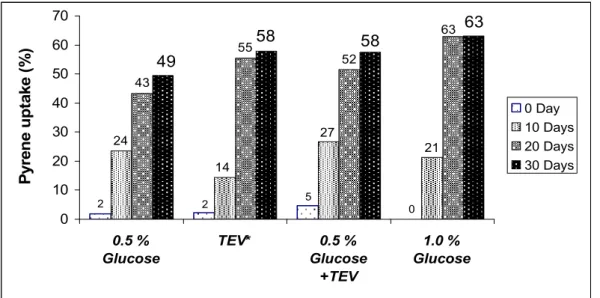
showed 49 % removal of 50 µg ml-1 pyrene from BH mineral salt medium containing 0.5 % (w/v) glucose during 30 days of
growth (Fig 1). Utilization of pyrene by bacterial consortium
CON-3 could be due to the synergistic effect of various
bacterial isolates (4) or the consortium might contain
predominantly certain class of bacteria that have wide range of
substrate specificity (34). The capability of CON-3 consortium
to remove pyrene was quite different from those of
PAH-degrading consortia enriched by Jacques et al. (16) and Lin and
Cai (24) from petrochemical sludge landfarming site and
mangrove sediment samples which degraded 22 and 92 % of
pyrene in mineral medium, after 30 and 21 days of incubation,
respectively.
Minerals and vitamins are required for the enhanced
growth and activity of bacteria (26). Addition of trace elements
and vitamins (TEV) in basal medium stimulated pyrene uptake
by CON-3 in 30 days to 58 %, both in the absence and
presence of 0.5 % (w/v) glucose (Fig. 1). When glucose
concentration was doubled to 1.0 % (w/v) it stimulated the
pyrene uptake to 63 %. This result favoured the requirement of
glucose for maximum uptake of pyrene from basal BH
medium. According to Cerniglia, (8) pyrene cannot be utilized
as a sole carbon and energy source, so a growth substrate must
be supplied to initiate growth of the microorganisms and to
induce the production of catabolic enzymes. Therefore the
growth of CON-3 consortium in BH medium in presence of
pyrene is cometabolic in nature. Churchill et al. (9) and
Boonchan et al. (4) also reported cometabolic reaction in
Pseudomonas, Acinetobacter, Nocardia, Bacillus, Mycococcus,
Methylosinus and Arthrobacter bacterial species. De-Sisto et
al. (11) grew bacteria on waste electrical transformer oil in
basal medium supplemented with 1 % yeast peptone glucose.
Das and Mukherjee (10) observed enhancement of pyrene
utilization and bacterial growth in medium containing 0.01 %
glucose.
2 2 5 0
24
21 27
14 55
63 52
43 49
58 58 63
0 10 20 30 40 50 60 70
0.5 % Glucose
TEV* 0.5 % Glucose
+TEV
1.0 % Glucose
Py
re
n
e
u
p
ta
k
e
(
%
)
0 Day 10 Days 20 Days 30 Days
Figure 1. Pyrene uptake by bacterial consortium CON-3 in BH medium supplemented with 50 µg ml-1 pyrene at 10, 20 and 30 days
interval at 30 oC.
Ten bacterial isolates (PK-12 to PK-21) were obtained
from the selectively enriched bacterial consortium CON-3. In
the initial screening it was observed that no isolate was capable
of utilizing pyrene as sole carbon source. All isolates utilized
pyrene as a co metabolite and removed 6 – 98 % of 25 µg ml-1 pyrene in presence of 0.25 % (w/v) glucose after 30 days of
incubation (Table 1). Five isolates 12, 13, 14,
PK-15 and PK-16 showing more than 50 % uptake of pyrene as 98
%, 61 %, 55 %, 54 % and 51 %, respectively, were further
exposed to higher concentrations of pyrene in BH plus glucose
medium. It was found that 75 µg ml-1 pyrene concentration inhibited the growth of all five isolates; however 50 µg ml-1 pyrene could support good growth in presence of 0.5 % and 1
% (w/v) glucose respectively. Therefore extent of pyrene
uptake by bacterial isolates decreased with increasing
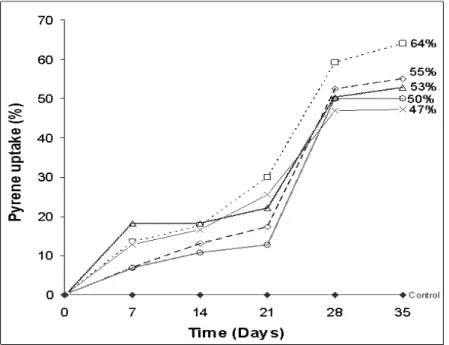
concentrations of pyrene. In a 35 day time-course study it was
observed that bacterial isolates PK-12, PK-13, PK-14, PK-15
and PK-16 cometabolized 50 µg ml-1 pyrene (in presence of 0.5 %; w/v glucose) by 18, 13, 18, 11 and 17 %, respectively, after
14 days of incubation which increased to 59, 53, 50, 50 and 47
%, respectively, as compared to negligible change in abiotic
control after 28 days (Fig 2). Thereafter pyrene uptake for two
bacterial isolates PK-15 and PK-16 remained stable till 35
days, while for three isolates PK-12, PK-13 and PK-14 it
(uptake) increased upto 64, 55 and 53 %, respectively (Fig 2).
Results demonstrate that maximum uptake of pyrene by
isolates occurred between 14 and 28 days of growth. Lin and
Cai (24) also observed 66 % and 34 % utilization of 50 µg ml-1 pyrene by Bacillus cereus and B. megaterium, respectively, in
three weeks.
Table 1. Pyrene (25 mg l-1) uptake efficiency of bacterial isolates from CON-3 consortium, in presence of 0.25 % (w/v)
glucose at 30 oC in 30 days.
Bacterial isolates Pyrene uptake (%)
PK12 98 PK13 61 PK14 55 PK15 54 PK16 51 PK17 8 PK18 16 PK19 6 PK20 17 PK21 10
Figure 2. Pyrene (50 µg ml-1) uptake by bacterial
isolates PK-12 (- - □ - -), PK-13 (- - - -), PK-14
(- -- -), PK-15 (……) and PK-16 ( ), from
CON-3 consortium, in presence of 0.5 % (w/v)
Molecular characterization of three maximum pyrene
utilizing bacterial isolates by analysis of approx. 1500 bp long
16S rRNA gene sequence and similarity searches revealed
isolates PK-12, PK-13 and PK-14 belonged to the genus
Bacillus (Table 2). The Bacillus strain PK-12 was genetically
very close to type strain B. pumilus (T) FO-036b (99 %
identity). Isolate PK-13 was most homologous to the type
specie B. flexus (T) IFO-15715 and isolate PK-14 clustered
nearest with the type strain B. firmus (T) IAM-12464 (both 98
% identity). Members of the genus Bacillus have been used in
past studies for PAH biodegradation (10; 16; 24, 39). Toledo et
al. (39) have majorly attributed Bacillus strains with the
property to colonize environments contaminated with PAHs.
They isolated eight B. pumilus strains from waste crude oil
capable of growth on naphthalene, phenanthrene or pyrene as
sole carbon source. B. flexus is not reported to be involved in
the degradation of any polycyclic aromatic hydrocarbons till
date. Mohamed et al. (27) have isolated B. firmus as bacterial
degraders of petroleum hydrocarbons from contaminated soils
in Kuwait. All the low molecular weight (LMW) PAH
dioxygenase genes were in gram-negative bacteria, while the
high molecular weight (HMW) PAH dioxygenase genes were
in gram-positive strains was suggested by Habe and Omori
(12). Our findings are in agreement as the three pyrene
utilizing isolates, Bacillus spp. PK-12, PK-13 and PK-14,
isolated from CON-3 consortium belong to gram-positive
category.
Table 2. Nucleotide identity (BLAST search output) of bacterial isolates 16S rRNA gene sequence to sequences deposited in the GenBank database.
Bacterial isolate
(GenBank Accession No.) NCBI match (Accession no) Nucleotide identity (%)
PK-12
(EU685814) Bacillus pumilus (T) FO-036b (AF234854) 99 %
PK-13
(EU685815) Bacillus flexus (T) IFO-15715 (AB021185) 98 %
PK-14
(EU685816) Bacillus firmus (T) IAM-12464 (D16268) 98 %
Pyrene uptake (PU) by the selected bacteria Bacillus spp.
PK-12, PK-13 and PK-14 in presence of glucose and its
correlation with total protein in basal growth medium was
studied (Fig. 3). In time course study (Fig. 2) Bacillus spp.
PK-12, PK-13 and PK-14 showed 14, 7 and 18 % uptake of 50 µg
ml-1 pyrene respectively, from BH medium containing 0.5 % (w/v) glucose in 7 days. When glucose concentration in BH
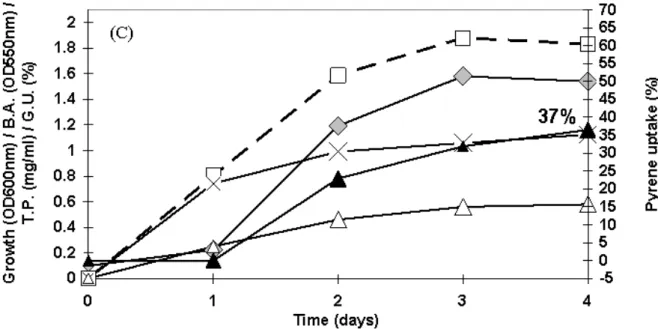
medium was doubled to 1.0 % (w/v) Bacillus spp. 12,
PK-13 and PK-14 showed increased and rapid cometabolic uptake
of pyrene which was 46, 19 and 37 % respectively, in 4 days
(Fig 3). Tao et al. (37) also observed enhanced cell growth of
Sphingomonas sp. GY2B on 100 µg ml-1 phenanthrene upon addition of glucose at concentration 0.001 to 0.02 % in
minimal medium. However glucose concentration greater than
0.05 % inhibited the bacterial growth. In contrast we have
found that glucose concentration, as high as 1.0 % (w/v)
exerted a positive and stimulatory effect on pyrene utilization,
by CON-3 consortium and its three member isolates. A
corresponding increase in total culture protein was also
observed. Trend in total protein produced in four days of
growth was similar to percent pyrene uptake (Fig. 3). Total
protein content estimated was maximum for Bacillus sp.PK-12
and minimum for Bacillus sp. PK-13.
Bacillus sp. are capable of using numerous carbohydrates,
but glucose is the most preferred carbon source according to
Stulke and Hillen (36) and it often represses the expression and
activity of catabolic systems that enable the utilization of
glucose supplementation stimulates pyrene metabolism.
Glucose is believed to act as an inducer and co-source of
carbon, energy and reducing power for microbes that leads to
substantial increase in bacterial biomass with a corresponding
increase in metabolic activities (10). Das and Mukherjee (10)
have shown 48 % utilization of 2500 µg ml-1 pyrene as sole carbon source by B. subtilis DM-04 in 4 days of growth at 55
o
C incubation temperature. In present study Bacillus sp.PK-12
was able to cometabolize 46 % of 50 µg ml-1 pyrene as a co-carbon source in same time interval of 4 days but at 30 oC, which is optimum for lab-scale and in situ bioremediation
applications.
It is known that microorganisms growing on hydrocarbons
frequently produce biopolymers with emulsifying (6) or
surfactant activity (39) so as to improve their ability to utilize
these compounds (31). In this study, emulsification assays were
carried out to know the capacity of the genetically identified,
pyrene utilizing bacteria to produce biosurfactant activity (BA).
The supernatants of exponentially growing cultures of Bacillus
spp. PK-12, PK-13 and PK-14 were evaluated for residual
glucose concentration and biosurfactant activity by their ability
to emulsify mobil oil at 24 hour interval (Fig. 3). Almost half
of the 1.0 % (w/v) glucose provided in the growth medium was
utilized by Bacillus sp. PK-14 (Fig. 3C) at the end of 4 days,
while Bacillus spp. PK-12 (Fig. 3A) and PK-13 (Fig. 3B)
consumed less glucose. Interestingly the trend for biosurfactant
activity was also similar with maximum biosurfactant activity
(1.5 units) for Bacillus sp. PK-14 (Fig. 3C) followed by
Bacillus sp.PK-12 (1.1 units; Fig. 3A) and least for Bacillus
sp. PK-13 (0.7 units; Fig. 3B) after 4 days of incubation. It was
further observed that in Bacillus sp. PK-14 pyrene uptake
occurred during exponential phase of growth and biosurfactant
activity (Fig 3 C), while in Bacillus spp. PK-12 and PK-13
(Fig. 3A and B, respectively) major uptake of pyrene was
observed during the stationary phase in the culture medium.
At the end of the biosurfactant assay, emulsification of
mobil oil resulted from the presence of biosurfactant activity in
the culture medium. And this may be the reason that
biosurfactant activity corresponded to the change in pyrene
concentration in four days. Our proposed assay for
biosurfactant activity is quite practical and convenient to use,
since it permits preliminary prediction of production of
extracellular biopolymers with biosurfactant or bioemulsifier
activities by bacteria on the basis of a simple and rapid test.
Jacques et al. (16) have used a similar emulsification index for
diesel oil to estimate surfactant activity produced by bacterial
and fungal isolates capable of utilizing a variety of PAHs. In
another report Barkey et al. (2) tested for emulsifying activity
of alasan preparations of Acinetobacter radioresistens KA53
by measuring emulsion formation spectrophotometrically at
600 nm.
The dynamics of glucose utilization and biosurfactant
activity in the cultures were consistent with that of pyrene
concentration change, indicating that the pyrene uptake by the
bacterial isolates PK-12, PK-13 and PK-14 may be correlated
with biosurfactant activity. In present study pyrene uptake by
Bacillus sp. PK-14 occurred during the log phase of growth
and biosurfactant activity. Glucose utilization and biosurfactant
activity of Bacillus sp. PK-14 were highest among the three
isolates. Therefore, it may be said that the uptake of pyrene is
logarithmically associated with biosurfactant activity in
Bacillus sp. PK-14. In contrast Bacillus sp. PK-12 displayed
1.4 times less biosurfactant activity and 1.2 times more pyrene
uptake during stationary phase of growth. Correspondingly
glucose utilization was also 1.6 times less. This result suggests
that biosurfactant activity of Bacillus sp. PK-12 was more
efficient than Bacillus sp. PK-14 in mobilizing pyrene uptake
from growth medium. It has also been found by Das and
Mukherjee (10) that the biosurfactant secreted by B. subtilis
DM-04 was more efficient than P. aeruginosa strains in
enhancing the solubility of pyrene in aqueous media resulting
in a higher uptake and utilization of pyrene by the former
bacteria. They also formulated the hypothesis that a minor
and M strains may result in a large variation of the emulsification
property and specificity.
There is little literature on uptake of pyrene by Bacillus
species and its link to biosurfactant activity and glucose
utilization. Different members of same genera showing different
pyrene uptake capabilities in this study may be related to the
biosurfactant activities and glucose utilization ability of respective
bacterial species. The present study showing increased pyrene
uptake and enhanced emulsification capacities of the bacterial
isolates Bacillus sp. PK-12 and Bacillus sp. PK-14 indicates that
these bacteria can be used for biotreatment and bioaugmentation of
Figure 3. Pyrene (50 µg ml-1) uptake, ( ▲ ), Biosurfactant activity (B.A; ), Total protein (T.P.; x ), Glucose utilization
(G.U.; ) and growth (- - □ - -) profile of bacteria Bacillus spp. (A) PK-12, (B) PK-13 and (C) PK-14 in presence of 1.0 % (w/v)
glucose at 30 oC.
CONCLUSION
PAHs occur at relatively high concentrations in crude
oil-contaminated soils and sediments (14), so there is an increasing
need in the use of PAH-acclimatized microbial consortia and
monoculture isolates for the bioremediation of PAHs in the
environment. The present study shows 3 different bacteria
isolated from the same bacterial consortium (CON-3) from
crude oil-contaminated soil and belonging to the same Bacillus
genera, but they show different pyrene uptake, biosurfactant
activity and glucose utilization profiles. Bacillus spp. PK-12,
PK-13 and PK-14 exhibited 46 %, 19 % and 37 % cometabolic
uptake of 50 µg ml-1 pyrene in presence of 1.0 % (w/v) glucose in 4 days. High glucose utilization (0.4 – 0.6 %) and enhanced
biosurfactant activities (OD550nm > 1.0) of bacterial isolates Bacillus spp. PK-12 and PK-14 may be related to their
enhanced pyrene uptake and subsequent utilization abilities.
Therefore, soils contaminated with crude oil from refinery
wastes, serve as an abode for pyrene metabolizing bacterial
microorganisms. Increased pyrene uptake and enhanced
emulsification capacities of the soil bacteria Bacillus spp.
PK-12 and PK-14 in the present study indicates that these bacteria
can be used for biotreatment and bioaugmentation of soils
contaminated with PAHs.
ACKNOWLEDGEMENTS
The authors are thankful to the Director, Thapar
University and Department of Biotechnology & Environmental
Sciences, STEP and TIFAC-CORE, Thapar University, Patiala,
Punjab (India) for providing infrastructural facilities and to
Department of Biotechnology, Govt. of India for financial
support to carry out this work.
REFERENCES
Enhancement of solubilization and biodegradation of polyaromatic hydrocarbons by the bioemulsifier alasan. Appl. Environ. Microbiol. 65, 2697–2702.
3. Basu, A.; Apte, S.K.; Phale, P.S. (2006). Preferential utilization of aromatic compounds over glucose by Pseudomonas putida CSV86.
Appl. Environ. Microbiol. 72, 2226-30.
4. Boonchan, S.; Britz, M.L.; Stanley, G.A. (2000). Degradation and mineralization of high-molecular-weight polycyclic aromatic hydrocarbons by defined fungal bacterial cocultures. Appl. Environ. Microbiol. 66, 1017-1019.
5. Bugg, T.; Foght, J.M.; Pickard, M.A.; Gray, M.R. (2000). Uptake and active efflux of polycyclic aromatic hydrocarbons by Pseudomonas fluorescens LP6a. Appl. Environ. Microbiol. 66, 5387–5392.
6. Cameotra, S.; Bollag, J.M. (2003). Biosurfactant-enhanced bioremediation of polycyclic aromatic hydrocarbons. Crit. Rev. Env. Sci. Technol. 33(2), 111-126.
7. Cerniglia, C.E. (1984). Microbial metabolism of polycyclic aromatic hydrocarbons. Adv. Appl. Microbiol. 30, 31–71.
8. Cerniglia, C. E. (1992). Biodegradation of polycyclic aromatic hydrocarbons. Biodegradation. 3, 351–368.
9. Churchill, S.A.; Harper, J.P.; Churchill, P.F. (1999). Isolation and characterization of a Mycobacterium species capable of degrading three- and four-ring aromatic and aliphatic hydrocarbons. Appl. Environ. Microbiol. 65, 549–552.
10. Das, K.; Mukherjee, A.K. (2007). Differential utilization of pyrene as the sole source of carbon by Bacillus subtilis and Pseudomonas aeruginosa
strains: role of biosurfactants in enhancing bioavailability. J Appl. Microbiol. 102, 195-203.
11. De-Sisto, A.; Fusella, E.; Urbina, H.; Leyn, V.; Naranjo, L. (2008). Molecular Characterization of Bacteria Isolated from Waste Electrical Transformer Oil. Moscow University Chemistry Bulletin. 63, 120–125. 12. Habe, H.; Omori, T. (2003). Genetics of polycyclic aromatic
hydrocarbon metabolism in diverse aerobic bacteria. Biosci. Biotechnol. Biochem. 67, 225–243.
13. Heitkamp, M.A.; Franklin, W.; Cerniglia, C.E. (1988). Microbial metabolism of polycyclic aromatic hydrocarbons: isolation and characterization of a pyrene-degrading bacterium. Appl. Environ. Microbiol. 54, 2549–2555.
14. Irwin, R.J.; VanMouwerik, M.; Stevens, L.; Seese, M.D.; Basham, W. (1997). Environmental contaminants encyclopedia, National Park Service; Water Resources Division, Fort Collins, Colorado.
15. Itzhaki, R.F.; Gil, D.M. (1964). A micro-biuret method for estimating proteins. Anal. Biochem. 9, 401–410.
16. Jacques, R.J.S.; Okeke; B.C.; Bento, F.M.; Peralba, M.C.R.; Camargo, F.A.O. (2007). Characterization of a polycyclic aromatic hydrocarbon-degrading microbial consortium from a petrochemical sludge
landfarming site. Biorem. J. 11, 1-11.
17. Johnsen, A.R.; Wick, L.Y.; Harms, H. (2005). Principles of microbial PAH-degradation in soil. Environ. Pollut. 133, 71–84.
18. Kanaly, R.A.; Harayama, S. (2000). Minireview: Biodegradation of high-molecular-weight polycyclic aromatic hydrocarbons by bacteria. J. Bacteriol. 182, 2059-2067.
19. Kim, S.J.; Kweon, O.; Jones, R.C.; Freeman, J.P.; Edmondson, R.D.; Cerniglia, C.E. (2007). Complete and integrated pyrene degradation pathway in Mycobacterium vanbaalenii PYR-1 based on systems biology. J. Bacteriol. 189, 464–472.
20. Kiyohara, H.; Nagao, K.; Yana, K. (1982). Rapid screen for bacteria degrading water-insoluble, solid hydrocarbons on agar plates. Appl. Environ. Microbiol. 43, 454–457.
21. Krivobok, S.; Kuony, S.; Meyer, C.; Louwagie, M.; Willison, J.C.; Jouanneau, Y. (2003). Identification of pyrene-induced proteins in
Mycobacterium sp. strain 6PY1: evidence for two ring-hydroxylating dioxygenases. J. Bacteriol. 185, 3828–3841.
22. Kumar, G.; Singla, R.; Kumar, R. (2010). Plasmid Associated Anthracene Degradation by Pseudomonas sp. Isolated from Filling Station Site. Nature and Science. 8, 89-94.
23. Kumar M.; Leon V.; Materano A. D. S.; Ilzins O. A.; Galindo-Castro, I.; Fuenmayor S. L. (2006). Polycyclic Aromatic Hydrocarbon Degradation by Biosurfactant-Producing Pseudomonas sp. IR1. Z. Naturforsch. 61, 203-212.
24. Lin, Y.; Cai, L. (2008). PAH-degrading microbial consortium and its pyrene-degrading plasmids from mangrove sediment samples in Huian, China. Mar. Pollut. Bull. 57, 703–706.
25. Martinez-Murcia, A.J.; Acinas, S.G.; Rodriguez-Valera, F. (1995). Evaluation of prokaryotic diversity by restrictase digestion of 16S rDNA directly amplified from hypersaline environments. FEMS Microbiol. Ecol. 17, 247– 255.
26. Mellor, E.; Landin, P.; O'Donovan, C.; Connor, D. (1996). The Microbiology of In Situ Bioremediation. Groundwater Pollution Primer CE 4594: Soil and Groundwater Pollution Civil Engineering Dept, Virginia Tech. Available at: http://www.cee.vt.edu/ewr/environmental/ teach/gwprimer/biorem/index.html. Accessed 25 April 2010
27. Mohamed, M.E.; Al-Dousary, M.; Hamzaha, R.Y.; Fuchs, G. (2006). Isolation and characterization of indigenous thermophilic bacteria active in natural attenuation of bio-hazardous petrochemical pollutants. Intl. Biodet. Biodeg. 58, 213-223.
28. Pfennig, N. (1978). Rhodocyclus purpureus gen. nov. and a ring-shaped, vitamin B12-requiring member of the family Rhodospirillaceae. Intl. Syst. Bacteriol. 28, 283–288.
30. Plummer, D.T. (1988). An introduction to practical Biochemistry, 3rd Edn. Tata Mc Graw Hill Publishing Co., Ltd. New Delhi.
31. Ron, E.Z.; Rosenberg, E. (2002). Biosurfactants and bioremediation.
Curr. Opin. Biotechnol. 13, 249–252.
32. Rosenberg, E.; Ron, E.Z. (1999). High and low-molecular-mass microbial surfactants. Applied Microbial and Biotechnol. 52, 154–162. 33. Sarma, P.M.; Bhattacharya, D.; Krishnan, S.; Lal, B. (2004). Degradation
of polycyclic aromatic hydrocarbons by a newly discovered enteric bacterium Leclercia adecarboxylata. Appl. Environ. Microbiol. 70, 3163-3166.
34. Stringfellow, W.T.; Aitken, M.D., (1995). Competitive metabolism of naphthalene, methylnaphthalenes and fluorene by phenanthrene degrading Pseudomonas. Appl. Environ. Microbiol. 61, 357–362. 35. Stucki, G.; Alexander, M. (1987). Role of dissolution rate and solubility
in Biodegradation of aromatic compounds. Appl. Environ. Microbiol. 53, No. 2, 292-297.
36. Stulke, J.; Hillen, W. (2000). Regulation of carbon catabolism in Bacillus
species. Annu. Rev. Microbiol. 54, 849-80.
37. Tao, X.Q.; Lu, G.N.; Dang, Z.; Yang, C.; Yi, X.Y. (2007). A phenanthrene-degrading strain Sphingomonas sp. GY2B isolated from contaminated soils. Process Biochem. 42, 401–408.
38. Tian, L.; Ma, P.; Zhong, J.J. (2003). Impact of the presence of salicylate
or glucose on enzyme activity and phenanthrene degradation by
Pseudomonas mendocina. Process Biochem. 38, 1125–32.
39. Toledo, F.L.; Calvo, C.; Rodelas, B.; lez-Lopez, G.J. (2006). Selection and identification of bacteria isolated from waste crude oil with polycyclic aromatic hydrocarbons removal capacities. Syst. Appl. Microbiol. 29, 244–252.
40. Van Hamme, J.D.V.; Odumeru, J.A.; Ward, O.P. (2000). Community dynamics of a mixed-bacterial culture growing on petroleum hydrocarbons in batch culture. Can. J. Microbiol. 46, 441–450.
41. Vila, J.; Lopez, Z.; Sabate, J.; Minguillon, C.; Solanas, A.M.; Grifoll, M. (2001). Identification of a novel metabolite in the degradation of pyrene by Mycobacterium sp. strain AP1: actions of the isolate on two- and three-ring polycyclic aromatic hydrocarbons. Appl. Environ. Microbiol. 67, 5497–5505.
42. Widada, J.; Nojiri, H.; Kasuga, K.; Yoshida, T.; Habe, H.; Omori, T. (2002). Molecular detection and diversity of polycyclic aromatic hydrocarbon-degrading bacteria isolated from geographically diverse sites. Appl. Environ. Microbiol. 58, 202–209.
43. Zhang, H.J.; Kallimanis, A.J.; Koukkou, A.I.J.; Drainas, C.L. (2004). Isolation and characterization of novel bacteria degrading polycyclic aromatic hydrocarbons from polluted Greek soils. Appl. Microbial Biotechnol. 65, 124–131.