Liliana C. Tomé
Dissertation presented to obtain the Ph.D degree in
Engineering and Technology Sciences, Chemical Engineering
Instituto de Tecnologia Química e Biológica António Xavier | Universidade Nova de Lisboa
Oeiras
December, 2014
Development of new membranes
based on ionic liquid materials
for gas separation
Liliana Sofia Carvalho Tomé
Dissertation presented to obtain the Ph.D degree in
Engineering and Technology Sciences, Chemical Engineering
Instituto de Tecnologia Química e Biológica António Xavier | Universidade Nova de Lisboaii Title
Development of new membranes based on ionic liquid materials for gas separation
Dissertation presented to obtain the Ph.D degree in Engineering Sciences and Technology
– Chemical Engineering
Cover Image
Design by Luís Morgado
Author
Liliana Sofia Carvalho Tomé
Molecular Thermodynamics Laboratory
Instituto de Tecnologia Química e Biológica António Xavier Universidade Nova de Lisboa
Av. da República
Estação Agronómica Nacional 2780-157 Oeiras
Portugal
Second Edition, January 2015 Copyright © 2015 by Liliana C. Tomé All rights reserved
iii
I declare that the work presented in this thesis, except where otherwise stated, is based on my own research. The work was mainly performed in the Molecular Thermodynamics Laboratory of the Instituto de Tecnologia Química e Biológica António Xavier, Universidade Nova de Lisboa, between June 2011 and December 2014, and supervised by Doctor Isabel Marrucho (ITQB-UNL) and Doctor Carmen Freire (CICECO-UA). Part of the results was attained during visiting periods to Macromolecular and Lignocellulosic Group, CICECO, Department of Chemistry, University of Aveiro, and to the Institute for Polymer Materials (POLYMAT), University of the Basque Country, Donostia-San Sebastian, Spain.
v
Ao meu Pai…
“Entre sorrisos, lágrimas ou saudades.
Feliz ou com o coração apertado. Continuo, sempre que preciso, a juntar a minha à tua voz.
A força não sou só eu,
vii
“O valor das coisas não está no tempo que elas duram, mas na intensidade com que acontecem. Por isso, existem momentos inesquecíveis,
coisas inexplicáceis e pesssoas incomparáveis”
Fernando Pessoa
Às minhas orientadoras, Doutora Isabel Marrucho e Doutora Carmen Freire, pela orientação científica e conhecimentos transmitidos, pelo apoio e compreensão, mas principalmente por terem acreditado sempre em mim e no meu trabalho mesmo quando eu ainda não acreditava!
À Isa, porque por vezes criam-se ligações especiais que são “inexplicáveis”… mais do que uma mãe científica, um exemplo admirável e inspirador de força e perseverança, uma amiga… Obrigada por me ouvir, por aturar os meus humores negros, por segurar a minha corda, mas acima de tudo obrigada por nunca ter desistido de me convencer a ter coragem de seguir o meu coração e intuição. Guardo com carinho e para sempre todos os conselhos, partilhas e momentos de cumplicidade! “The Force will be with you. Always.”
A todos os meus colegas do ITQB que de alguma forma me acompanharam e fizeram sentir bem no dia a dia, mas principalmente àqueles que se tornaram amigos para a vida. Ao Filipe “suppaslice” com o seu coração de ouro, mais que um amigo, um verdadeiro “brother in arms”, obrigada por teres estado sempre presente! Ao gang, das noitadas a trabalhar no lab, dos jantares de frango assado do Continente e dos conselhos científicos altamente secretos (Helga, Rui, Filipe e David), obrigada por todo o vosso apoio, força e amizade incondicional. À Filipa que partiu cedo em busca da sua aventura, mas que deixou a sua marca e muitas saudades. À Catarina e à Andreia, as duas carcaças preferidas, obrigada por todas as nossas pausas para café, pelas parvoíces e descontração, mas sobretudo pelo incentivo e preocupação! Bem… acho que nunca tantas asneiras foram ditas dentro do ITQB como quando a malta que está, já passou, ou vai passando pelo lab do 7º se junta, mas para mim foi excelente!
Agradeço também todas as oportunidades que tive de viajar, conhecer outras pessoas e lugares, de viver momentos que muito contribuíram para o meu crescimento a nível profissional e pessoal…
viii
Country, and mostly for his support, technical and scientific contribution during the development of this research work.
À Susana, por todo o carinho e apoio em San Sebastian, pelas sandes gordurosas, pelas caminhadas no centro, pelos tinhos e batatas bravas. Aos meus camaradas (aos Colombianos, ao Italiano e à Ana), pelas noitades e fins de semana exceptionais. À Luísa e à Carla D., que apesar de estarem já ali do outro lado, os melhores momentos foram partilhados ao mais alto nível além fronteiras!
À malta que conheci em Aveiro, afinal foi lá que tudo começou... Ao Ricardinho, à Gi, à Vera, à Joana, à Belinda, à Carla, à Eliane, ao “party animal” (Nuno) e outros, agradeço a ajuda, o apoio e os momentos fantásticos de maluqueira!
Em particular e porque as amizades às vezes são como as estrelas, não as vemos, mas temos a certeza que estão lá… Ao meu Xuxu (Ana Caço), pelo colinho e mimos mesmo que fossem à distância de um click, pelos almoços repletos de batatas fritas, muita cumplicidade e animação! À Mónica, pela ligação indestrutível que criámos, pelos laços fortes que se sentem a 2000 Km de distância… À Sóninha, por ter feito da sua casa o meu porto de abrigo, por ter proporcionado tantos convívios e reencontros do grupo magnífico, pela partilha de alegrias e tristezas sempre acompanhadas de beirão com limão!
A todos os meus outros amigos, aqui nem me atrevo a citar nomes, aos de longa data e aos mais recentes, agradeço simplesmente porque um dia os nossos
caminhos se cruzaram… Obrigada por todos os momentos memoráveis e por me
compreenderem sempre que vos troquei pelo computador ou a bancada do lab!
Ao meu “tudo” (Arlindo), por celebrar comigo as minhas vitórias, por me abraçar nos momentos difíceis, mas especialmente por compreender a minha falta de sorrisos e sobretudo as minhas ausências. Enfim… por fazeres parte da minha
vida… por me mostrares que o mais importante é amar, ser amada e viver feliz!
Um agradecimento muito especial à minha família - mãe, mana, mano, cunhado, sobrinha - pelo apoio contínuo, por compreenderem as longas ausências e faltas de dedicação, por me terem ajudado a crescer e a viver da melhor forma, por terem sempre confiado e acreditado em mim mesmo naqueles momentos que sentimos que a Força nos tinha abandonado… sem vocês nunca teria conseguido!
A todos os “incomparáveis” que me acompanharam
ix
Members of the Jury
President Dr. Miguel Nuno Sepúlveda G. Teixeira, Cathedratic
Professor at Instituto de Tecnologia Química e Biológica António Xavier, Universidade Nova de Lisboa, Portugal
Thesis Supervisors Dr. Isabel Maria Delgado Jana Marrucho Ferreira,
Coordinater Researcher at Instituto de Tecnologia Química e Biológica António Xavier, Universidade Nova de Lisboa, Portugal (supervisor).
Dr. Carmen Sofia Rocha Freire, Principal Researcher at
Centro de Materiais Cerâmicos e Compósitos,
Departamento de Química, Universidade de Aveiro, Portugal (co-supervisior).
Thesis Examiners Dr. João Paulo Serejo Goulão Crespo, Cathedratic Professor
at Departamento de Química, Faculdade de Ciências e Tecnologia, Universidade Nova de Lisboa, Portugal.
Dr. Adélio Miguel Magalhães Mendes, Cathedratic Professor at Departamento de Engenharia Química, Faculdade de Engenharia, Universidade do Porto, Portugal.
Dr. Armando Jorge Domingues Silvestre, Associate Professor with agregation at Departamento de Química, Universidade de Aveiro, Portugal.
xi
Contents
Development of new membranes based on
ionic liquid materials for gas separation
Abstract... xvii
Resumo ... xv
Publications ... xii
Thesis Layout ... xxi
Thesis Guidelines ... xxv
Chapter 1 ... 1
Chapter 2 ... 61
Chapter 3 ... 85
Part I ... 87
Part II ... 133
Chapter 4 ... 187
Chapter 5 ... 219
Chapter 6 ... 245
Chapter 7 ... 275
Chapter 8 ... 311
xiii
Abstract
In the field of energy, natural gas is an essential bridge to a clean, low carbon, renewable energy era. However, natural gas processing and transportation regulation require the removal of contaminant compounds such as carbon dioxide (CO2). Regarding clean air, the increasing atmospheric concentrations of
greenhouse gases, specifically CO2, is of particular concern. Therefore, new
cost-effective, high performance technologies for carbon capture have been researched and the design of materials with the ability to efficiently separate CO2
from other gases is of vital importance.
Taking into account the extremely broad range of chemical and structural possibilities of ionic liquid (IL) chemistry, and the undeniable engineering and economical advantages of membrane technology, this thesis explores the use of IL-based materials to prepare membranes not only for the selective separation of CO2 from CH4 and N2 (Chapter 2 to 7), but also for olefin/paraffin separation
(Chapter 8). The data presented throughout these chapters clearly show that the endless combination of cations and anions or the incorporation of specific chemical groups allow the development of new membranes for more efficient and sustainable gas separation processes.
xv
Resumo
No campo da energia, o gás natural apresenta-se como uma ponte essencial para uma nova era de energias limpas, renováveis e com baixo teor em carbono. No entanto, processamento e transporte do gás natural requerem a remoção de contaminantes, como por exemplo o CO2. No que diz respeito ao ar puro, a
aumento da concentração de gases de estufa, especificamente CO2, na atmosfera
encorajaram a investigação de novas tecnologias de captura de CO2, eficientes e
simultaneamente baratas, assim como o desenvolvimento de materiais com a capacidade de separar eficientemente o CO2 de outros gases.
Tendo em conta as propriedades únicas dos liquidos iónicos e uma vez que as tecnologias de separação baseadas em membranas apresentam vantagens inegáveis, quer do ponto de vista da engenharia, quer do ponto de vista económico, esta tese explora a utilização de materiais à base de liquidos iónicos para preparar membranas não só para a separação selectiva de CO2 (Capítulo 2 a
7), mas também para separação de olefinas/parafinas (Capítulo 8). Os dados apresentados ao longo destes capítulos mostram claramente que a combinação apropriada de catiões e aniões ou a incorporação de grupos químicos específicos permitem o desenvolvimento de novos processos para membranas de separação de gás mais eficientes e sustentáveis.
xvii
Publications
Thesis publications (8)
L.C. Tomé, M. Isik, C.S.R. Freire, D. Mecerreyes, I.M. Marrucho, Novel
pyrrolidinium-based polymeric ionic liquids with cyano counter-anions: high performance membrane materials for post-combustion CO2 separation, submitted
manuscript, 2015.
L.C. Tomé, A.S.L. Gouveia, C.S.R. Freire, D. Mecerreyes, I.M. Marrucho, Polymeric
ionic liquid-based membranes: influence of polycation variation on gas transport and CO2 separation performance, submitted manuscript, 2015.
L.C. Tomé, C. Florindo, C.S.R. Freire, L.P.N. Rebelo, I.M. Marrucho, Playing with ionic liquid mixtures to design engineered CO2 separation membranes, Phys.
Chem. Chem. Phys. (2014), 16, 17172-17182.
L.C. Tomé, D. Mecerreyes, C.S.R. Freire, L.P.N. Rebelo, I.M. Marrucho, Polymeric
ionic liquid membranes containing IL-Ag+ for ethylene/ethane separation via olefin-facilitated transport, J. Mater. Chem. A (2014), 2, 5631-5639. (cover)
L.C. Tomé, D.J.S. Patinha, R. Ferreira, H. Garcia, C.S. Pereira, C.S.R. Freire, L.P.N. Rebelo, I.M. Marrucho, Cholinium-based supported ionic liquid membranes: a sustainable route for carbon dioxide separation, ChemSusChem (2014), 7, 110-113.
L.C. Tomé, M.A. Aboudzadeh, L.P.N. Rebelo, C.S.R. Freire, D. Mecerreyes, I.M.
Marrucho, Polymeric ionic liquids with mixtures of counter-anions: a new straighforward strategy for designing pyrrolidinium-based CO2 separation
membranes, J. Mater. Chem. A (2013), 1, 10403-10411.
L.C. Tomé, D.J.S. Patinha, C.S.R. Freire, L.P.N. Rebelo, I.M. Marrucho, CO2
separation applying ionic liquid mixtures: the effect of mixing different anions on gas permeation through supported ionic liquid membranes, RSC Adv. (2013), 3, 12220-12229.
L.C. Tomé, D. Mecerreyes, C.S.R. Freire, L.P.N. Rebelo, I.M. Marrucho,
Pyrrolidium-based polymeric ionic liquid materials: New perspectives for CO2
xviii Other publications (17)
L.C. Tomé,N.H.C.S. Silva, H.R. Soares, A.S. Coroadinha, P. Sadocco, I.M. Marrucho,
C.S.R. Freire, Bioactive transparent composite films based on polysaccharides and cholinium carboxylate ionic liquids, submitted manuscript, 2015.
D.J.S. Patinha, L.C. Tomé, H. Garcia, R. Ferreira, C.S. Pereira, L.P.N. Rebelo, I.M. Marrucho, The role of water in cholinium carboxylate ionic liquid’s aqueous solutions, J. Chem. Thermodynamics. (2015), DOI: 10.1016/j.jct.2014.12.020.
L.C. Tomé, T. Mourão, C. Florindo, L.P.N. Rebelo, I.M. Marrucho, Understanding
the role of cholinium carboxylate ionic liquids in PEG-based aqueous biphasic systems, ACS Sustain. Chem. Eng. (2014), 2, 2426-2434.
M. Isik, R. Gracia, L. Kollnus, L.C. Tomé, I.M. Marrucho, D. Mecerreyes, Cholinium Lactate Methacrylate: Ionic liquid Monomer for Cellulose Composites and Biocompatible Ion Gels, Macromol. Symp. (2014), 342, 21-24.
A.B. Pereiro, L.C. Tomé, S. Martinho, L.P.N. Rebelo, I.M. Marrucho, Gas permation properties of fluorinated ionic liquids, Ind.Eng. Chem. Res. (2013), 52, 4994-5001. M. Isik, R. Gracia, L. Kollnus, L.C. Tomé, I.M. Marrucho, D. Mecerreyes, Cholinium-based poly(ionic liquid)s: synthesis, characterization, and application as biocompatible ion gels and cellulose coatings, ACS Macro Lett. (2013), 2, 975-979.
L.C. Tomé, S.C.M. Fernandes, I.M. Marrucho, D.S. Perez, P. Sadocco, A.J.D.
Silvestre, C.P. Neto, I.M. Marrucho, C.S.R. Freire, The role of nanocelllulose fibers, starch and chitosan on multipolysaccharide based films, Cellulose (2013), 20, 1807-1818.
L.C. Tomé, C.M.B. Gonçalves, H. Garcia, L. Brandão, A.M. Mendes, I.M. Marrucho,
Effect of natural and synthetic antioxidants incorporation on the gas permeation properties of poly(lactic acid) films, J. Food Eng. (2013), 116, 562-571.
S. Shahriari, L.C. Tomé, J.M.M. Araújo, L.P.N. Rebelo, J.A.P. Coutinho, I.M. Marrucho, M.G. Freire, Aqueous biphasic systems: a benign route using cholinium-based ionic liquids, RSC Adv. (2013),3, 1835-1843.
xix
A.M.A. Dias, S. Marceneiro, M.E.M. Braga, J.F.J. Coelho, A.G.M. Ferreira, P.N. Simões, H.I.M. Veiga, L.C.Tomé, I.M. Marrucho, J.M.S.S. Esperança, A.A. Matias, C.M.M. Duarte, L.P.N. Rebelo, H.C. de Sousa, Phosphonium-based ionic liquids as polymeric modifiers and their influence on the properties of biomedical grade poly(vinyl chloride), Acta Biomater. (2012), 8, 1366-1379.
L.C. Tomé, M.G. Freire, L.P.N. Rebelo, A.J.D. Silvestre, C.P. Neto, I.M. Marrucho, C.S.R. Freire, Surface hydrophobization of bacterial and vegetable cellulose fibers using ionic liquids as solvent media and catalysts. Green Chem. (2011), 13, 2464-2470.
L.C. Tomé, R.J.B. Pinto, E. Trovatti, C.S.R. Freire, A.J.D. Silvestre, C.P. Neto, A. Gandini, Transparent bionacomposites with improved properties prepared from acetylated bacterial cellulose and poly(lactic acid) through a simple approach.
Green Chem. (2011), 13, 419 - 427.
C.M.B. Gonçalves, L.C. Tomé, J.A.P. Coutinho, I.M. Marrucho, Addition of α -Tocopherol on Poly(lactic acid): Thermal, Mechanical and Sorption Properties. J.
Appl. Polym. Sci. (2011), 119, 2468-2475.
L.C. Tomé, C.M.B. Gonçalves, M. Boaventura, L. Brandão, A.M. Mendes, A.J.D. Silvestre, C.P. Neto, A. Gandini, C.S.R. Freire, I.M. Marrucho, Preparation and evaluation of the barrier properties of cellophane membranes modified with fatty acids. Carbohyd. Polym. (2011), 83, 836-842.
L.C.Tomé, L. Brandão, A.M. Mendes, A.J.D. Silvestre, C.P. Neto, A. Gandini, C.S.R. Freire, I.M. Marrucho, Preparation and characterization of bacterial cellulose membranes with tailored surface and barrier properties. Cellulose (2010), 17, 1203-1211.
xxi
Thesis Layout
Chapter 1 – Introduction
An overview of the background and general concepts which fall within the scope of this thesis will be presented.
Chapter 2 – Cholinium-based supported ionic liquid membranes: a
sustainable route for CO2 separation
Aiming at full sustainability of CO2 separation processes, membranes based on environmental-friendly cholinium carboxylate ionic liquids were successfully prepared.
Chapter 3 – Playing with ionic liquid mixtures to design engineered
membranes for CO2 separation
xxii
Thesis Layout
Chapter 4 – Polymeric ionic liquid membranes: influence of
polycation variation
With the intent of fully explore the influence of polycation functionality, membranes based on cationic PILs containing in their backbones the most important ionic liquid cations were prepared and their gas permeation properties presented.
Chapter 5 – Pyrrolidinium-based polymeric ionic liquid materials
for CO2 separation
The feasibility of using pyrrolidinium-based materials to prepare CO2 separation membranes is addressed. Membranes within the whole range of compositions, from pure polymer to pure ionic liquid, encompassing PIL–IL composites, were evaluated.
Chapter 6 – Polymeric ionic liquids with mixtures of counter-anions
for CO2 separation
xxiii
Thesis Layout
Chapter 7 – Pyrrolidinium-based polymeric ionic liquids with cyano
counter-anions for CO2 separation
The synthesis of novel pyrrolidinium-based PILs containing different cyano-functionalized anions is described. The potential of the prepared composite membranes for highly efficient post-combustion CO2 separation is shown.
Chapter 8 – Polymeric ionic liquid membranes containing IL–Ag+ for
ethylene/ethane separation
The use of PILs as alternative polymer matrices to prepare membranes for ethylene/ethane separation is addressed. PIL–IL–Ag+ membranes were successfully prepared and their ethane and ethylene permeation properties discussed.
Chapter 9 – Concluding Remarks & Outlook
xxv
Thesis Guidelines
This thesis is divided into nine chapters. Chapter 1 introduces the context and motivation, general concepts on CO2 separation technologies, as well as a revision
of the state of the art focusing on the use of ionic liquid-based materials for CO2
separation. Although this chapter contains essential information for understanding the subsequent chapters enclosed in this thesis, it does not aim at providing a comprehensive revision of all the subjects herein presented.
The subsequent chapters are entirely based on scientific articles and focus on designing membranes for CO2 separation via two different straightforward
approaches: the first makes use of supported ionic liquid membranes (Chapter 2 and 3) for the selective separation of CO2 from CH4 and N2, while the second takes
advantage of solid composite membranes not only for CO2 separation(Chapter 4
to 7) but also for olefin/paraffin separation (solely and completely described in Chapter 8).
Bearing in mind that this is an article-based thesis, each chapter includes a review of the pertinent the state of the art, describes the materials and methods used, presents and discusses the results and draws the main conclusions of that particular work. Also, this thesis does not contain general list of figures and/or symbols since figure captions, symbols and abbreviations are carefully identified and described in each chapter.
xxvi
whole also provides interesting analogies between ionic liquids and polymeric ionic liquids, considering that the first can be used as a tool for the estimation of the permeation properties of specific anions or functional groups. Since this thesis presents the first evaluation for the membranes prepared during this PhD work, only gas permeation experiments using pure gases were performed.
Chapter 1
Introduction
1. The context ... 3 2. CO2 capture/separation technologies ... 5
2.1. Solvent absorption ... 6
2.2. Adsorption with porous solids ... 7
2.3. Cryogenic distillation ... 8
2.4. Membrane technology ... 8
3. Gas transport through dense membranes ... 11
3.1. Permeability, diffusivity and solubility ... 12
3.2. Selectivity ... 14
3.3. Separation performance ... 14
4. Ionic Liquids (ILs) ... 15
4.1. Alternative solvents for CO2 absorption processes ... 17
4.2. Emerging materials for CO2 separation membranes ... 19
5. Polymeric Ionic Liquids (PILs) ... 22
5.1. PILs as CO2 sorbents ... 24
5.2. PIL-based membranes for CO2 separation ... 24
(i) Neat PIL membranes ... 26
(ii) PIL–IL composites ... 30
(iii) PIL copolymer membranes ... 35
(iv) PIL–IL–zeolite mixed matrix membranes ... 39
Sections 5 and 6 contain parts of the following author’s publication: L.C. Tomé
and I.M. Marrucho, Poly(ionic liquid)s: Designing CO2 separation membranes,
3
This chapter describes in detail the context and motivation of the present thesis,
the background and general concepts, and the progressive development of the
state of the art of ionic liquid (IL)-based materials as new alternatives for CO2
separation membranes, in particular for flue gas separation (CO2/N2) and natural
gas purification (CO2/CH4). Finally, the objectives and the structure of the present
thesis are presented.
1. The context
Climate change and renewable energy are two of the most important societal
challenges that our world faces today.1 The search for new environmentally
acceptable solutions is being urged by governments through the implementation
of stricter legislation and the development of new collaborative research
programs.
In the field of energy, natural gas stands today as an essential bridge to a
clean, low carbon, renewable energy era. In order to maintain and expand the
availability of this clean burning and efficient fuel source, natural gas processing
regulations require the removal of contaminants such as H2S and CO2 since they
not only reduce the heating value of the methane gas streams in power plants,
but also cause corrosion in pipes and equipment.2 On the other hand, the
increasing atmospheric concentrations of greenhouse gases, specifically CO2, is of
particular concern due to the resulting significant environmental risks which are
largely associated to unpredictable climate changes. From 1975 to 2013 the CO2
concentration in the atmosphere has monotonically increased from 277 to 395
ppm.3 Actually, billions of tons of annual CO2 emissions are a direct sub-product of
fossil fuel combustion (i.e. petroleum, coal, and natural gas) for generation of
energy and heat.4
There are a number of means to reduce the CO2 emissions to the
4
replacing current fossil fuel-based energies by more environmentally benign
sources (renewable energy), and Carbon Capture and Storage (CCS). Despite the
extensive research efforts on the use of energy from renewable sources, currently
fossil fuels are the major source of energy and are predicted to remain in this
position for at least the next couple of decades. Thus, as the transition to more
sustainable energy processes progresses, there is a great interest in the
development of highly efficient technologies to curb CO2 emissions of the current
energy sources. In this context, CCS is a viable strategy that provides a short-term
solution to lessen climate change until renewable energy technologies mature.5
CCS is a relatively new term that is usually applied to describe processes for
capturing anthropogenic CO2 from large point sources, with the prototypical
target being large coal-fired power plants. Therefore, processes and materials to
capture and concentrate CO2 from these point sources are needed, followed by
compression, transport and permanent storage, for example, in underground
geological formations, depleted oil fields and gas formation, or in deep saline
aquifers.6 However, several technical challenges must be overcome to make CCS
practical and cost effective, including the development of materials that enable
the efficiently separation of CO2, the design of appropriated CCS processes that
can be integrated into existing power generation infrastructures, and safe
methods for sequestering CO2.7 All of these key needs have prompted the
chemical science and engineering communities to develop and provide novel,
practical solutions to global carbon management.
Although various components of the CCS process chain are technologically
mature and available,8 the existing methods for CO2 separation are highly energy
intensive and can drastically increase the energy requirements of a plant by 25 –
40%.9 Since the energy input for materials regeneration and the capital cost of
specific equipments are the most significantly contributors to the overall cost of
5
researched and consequently the design of materials with the ability to efficiently
separate CO2 from other gases is of vital importance.
Nowadays, many challenges are being faced in order to achieve improved
processes and materials. Nonetheless, enhancing the CO2 separation efficiency of
a material has enormous potential for lowering the cost of CO2 capture systems in
a near-term and represents one of the foremost challenges.11
2. CO2 capture/separation technologies
Three CO2 separation processes hold the promise for the reduction CO2 emissions,
namely CO2 removal in natural gas sweetening (CO2/CH4), CO2 recovery from
power plant flue streams (CO2/N2), and CO2 separation from fuel gas (syngas) in
hydrogen production (CO2/H2). These industrial processes emit CO2 streams with
distinct compositions and consequently the CO2 separation from light gases (e.g.
CH4, N2, and H2) is a key technical, economical and environmental challenge.
In post-combustion capture from flue gas, the major obstacle is the lower
pressure of the flue gas (ca. 100 kPa). Additionally, the CO2 concentration is also
low (roughly 15%) and the capture requires its separation from a high volume
stream of flue gas containing other component gases, predominantly N2.12 Raw
natural gas varies substantially in composition depending on the source (75% -
90% of CH4) and the reserves are typically contaminated with undesirable
impurities, such as CO2. The removal of CO2 would increase not only the energy
density of natural gas making its storage and transportation more efficient, but
also its conversion to hydrogen fuel.2 An efficient CO2 separation from other
natural gas components at high pressures is required.13 Regarding CO2 separation
from fuel gas (output from gasification and water-gas shift reactors), it occurs
under high pressures (> 2000 KPa) and temperatures (> 473 K) conditions, where
6
The most relevant technologies currently used to separate CO2 from a gas
stream are solvent-based chemical absorption, adsorption with porous solids,
cryogenic distillation and membranes.16-20
2.1. Solvent absorption
Solvent absorption (Figure 1) with amines is undoubtedly the most efficient
technology.21 Some of the commonly used solvents are: primary amines such as
monoethanolamine (MEA), 2-amino-2-methyl-1-propanol (AMP); secondary
amines such as diethanolamine (DEA); and tertiary amines such as
methyldiethanolamine (MDEA).10 Despite their advantages, such as high reactivity
and good absorption capacity, the use of amines is of environmental and
economical concern due to their corrosive nature, volatility and high energy
demand for regeneration.4, 17, 20
7
2.2. Adsorption with porous solids
Adsorption processes with porous solids (Figure 2) is an advantageous technology
compared to solvent-based absorption, since it presents easy operation, rapid
rate, low corrosion, and low energy demand for regeneration. There are different
methods to regenerate the solid adsorbents after the CO2 capture, namely
vacuum and pressure swing adsorption (VSA and PSA), temperature swing
adsorption (TSA), and electric swing adsorption (ESA).23 Aluminosilicates,
titanosilicates, molecular sieves and activated carbons are examples of typical
commercial CO2 selective adsorbents.18 Moreover, metal organic frameworks and
zeolites have been proposed and investigated as possible advanced sorbents for
CO2 separation.24-26 Despite the progresses achieved in their preparation,
additional research about how to improve their stability, to reduce their cost and
other technological parameters is still need before their industrial application. The
best adsorbents should have high CO2 capacity and selectivity, fast
adsorption/desorption kinetics, good mechanical properties and high thermal and
chemical stability, as well as low costs of synthesis.8, 23
8
2.3. Cryogenic distillation
Cryogenic distillation is a technique that is based on cooling and condensation
(Figure 3). It has been used in liquid separation for a long time. This technology is
hypothetical very useful for CO2 separation since no chemical absorbents are
required to obtain high purity gases, but the high energy requirements make it
less desirable for most gas separation applications.16 Cryogenic distillation is more
suitable when the gas streams contain high CO2 concentrations and has being
implemented for oxygen production in oxy-fuel combustion.10
Figure 3| Schematic representation of CO2 separation by cryogenic distillation. 22
2.4. Membrane technology
Membranes separate gases based on the differences in physical and/or chemical
interactions between the different gases and the membrane material, which allow
for some components to pass preferentially through the membrane (Figure 4).
9
to their engineering and economical advantages. In fact, the inherent simplicity of
membranes can bring many advantages compared to other conventional
separation technologies, namely the small scale of the equipment, reduced
environmental impact, ease of incorporation into existing processes, low energy
consumption and operating costs.27
Figure 4| Schematic representation of CO2 separation by membrane technology. 22
In the past few decades, membrane technology has been attracting rising
interest and the fast progress in the field enabled the current use of
membrane-based systems on an industrial scale for different gas separations.28 In particular,
great effort is being put on the development of gas separation membrane
materials for applications such as N2 separation from air, CO2 from natural gas,
CO2 from post-combustion flue gases, and hydrogen from various refinery and
petrochemical process streams.12, 13, 28-30 Nevertheless, to fully compete with
well-established separation processes, membranes with high permeability and
selectivity to specific gases, good thermal/chemical resistance and sufficient
10
processes, need to be developed.28 If improved membrane materials could be
obtained, this technology would grow faster and be used more widely not only in
the existing applications, but also in many others new applications.30 The search
for better membranes has prompted a huge effort by many research groups and a
broad range of different membrane materials have been investigated.
Depending on the material, membranes are usually classified as inorganic
(ceramic, metallic, carbon molecular sieves, silica, zeolites, metal organic
frameworks),31 organic (polymeric membranes),32 or inorganic-organic composite
membranes (Mixed Matrix Membranes).33
Although inorganic membranes comprise important properties for CO2
separation such as high selectivity and great thermal and chemical stability, they
have high brittleness and their fabrication is very complex and requires high
costs.31, 34, 35 Alternatively, the advantages of polymeric membranes namely
mechanical properties, low cost, synthetic feasibility, and large-scale production,32
make them more attractive materials compared to inorganic membranes for gas
separation.28, 30, 32 Polymeric membranes are classified as rubbery or glassy
depending on the value of their glass transition temperatures relative to working
temperature. Rubbery polymers display higher gas permeability than glassy
polymers, but their gas selectivities are generally lower. Glassy polymers such as
cellulose acetate, polyamides, polyarylates, polycarbonates, polysulfones or
polyimides have dominated the industrial CO2 separation applications due to their
good selectivities and mechanical properties.32 Furthermore, Mixed Matrix
Membranes (MMMs) is a quite recent route to enhance the properties of
polymeric membranes. Their structure consists of an inorganic material, in the
form of micro- or nano-fillers, incorporated into a polymeric matrix. These
membranes attempt to combine the advantages of polymeric and inorganic
materials, namely the desirable mechanical properties and economical processing
11
sieving materials.33 In principle, MMMs possess an economic advantage over
inorganic membranes and they offer enhanced thermal and mechanical
properties for aggressive environments, which can be a way to stabilize polymeric
membranes. However, their cost and difficulties for large scale manufacture, as
well as the elimination of interfacial defects between the organic matrix and the
inorganic fillers have remained important challenges that need to be overcome
before their commercial application.28
Despite the synthesis and evaluation of several hundreds of new materials,
more than 90% of current commercial membranes are from fewer than ten
membrane materials, most of which have been used for decades.30 Even though
polymeric membranes have achieved important success and are currently the
focus of commercialization because of their easier manufacture, large
improvements in CO2 separation efficiencies require novel materials with
enhanced performances. Thus, research targeted at developing new materials has
been undertaken and currently the goal is to design attractive membrane
structures that exhibit both higher CO2 selectivity and permeability.28, 30, 32
Bearing in mind all the above mentioned aspects, and considering that ILs are
a unique tunable platform for designing alternative materials, the focus of the
present thesis is to explore the potential of this class of ionic materials to
fabricate highly effective membranes for energy-efficient CO2 separation.
3. Gas transport through dense membranes
The principal property of membranes used in gas separation applications is their
ability to control the permeation of different species. In gas separation processes
through nonporous or dense membranes, the feed gas mixture is driven by a
difference in concentration or pressure across the membrane, which works as a
semi-permeable barrier that restricts the movement of some gas molecules while
12
terminology presented below illustrate the general principles and basic concepts
used to describe gas transport, as well as to evaluate the membrane material
performance.
Figure 5| Schematic representation of the gas transport mechanism through dense membranes.
3.1. Permeability, diffusivity and solubility
It is generally accepted that gas transport through a dense polymeric film or liquid
membrane occurs according to the solution-diffusion mass transfer mechanism,
where the permeability coefficient or permeability (P), a measure of the membrane’s ability to permeate gas, is the product of the diffusion coefficient or diffusivity (D) and the solubility coefficient or solubility (S) as follows:36
D
S
P
(1)Two basic assumptions underlie the solution-diffusion mechanism. The first is that
gases on either side of the membrane are in equilibrium with the membrane
material at the interface. The second is that the concentration and pressure
13
gradient of dissolved permeant species within the membrane.36 As it is
schematically represented in Figure 5, the solution-diffusion mechanism is
described by three steps: (1) gas sorption on the upstream side of the membrane,
(2) diffusion of the absorbed species through the membrane driven by the
concentration gradient (partial pressure difference), and (3) gas desorption on the
downstream side of the membrane.27 Consequently, permeability depends on
both thermodynamic factors such as condensability of the gas specie and its
interaction with membrane, and kinetic factors that are mainly governed by the
size of the permeant specie, membrane material segmental mobility and
packaging, fractional free volume or other structural features that permit
permeant diffusion.32
Permeability (P) is defined as the steady-state gas flux (J) through a membrane under a transmembrane pressure drop (∆p = p2 – p1) and normalized to the unit thickness of the membrane:37
Δp J
P (2)
where p2is the upstream pressure, p1 is the downstream pressure and
is the membrane thickness. Gas permeabilityis often expressed in Barrer:cmHg s cm cm (STP) cm 10 Barrer 1 2 3 10 (3)
Diffusivity is an indication of the gas mobility through the membrane material
and is usually expressed in cm2 s–1.
Solubility (cm3 (STP) cm–3 cmHg–1), is a thermodynamic parameter which
reflects the concentration of gas molecules dissolved in the membrane when
equilibrated at a given gas pressure and temperature, as shown in Equation (4).38
While solubility depends mainly on gas molecule condensability (as characterized,
14
vaporization, etc.), the gas-material interactions and membrane morphological
features, such as crystallinity, can also influence gas solubility.37
p C
S (4)
3.2. Selectivity
Another import parameter of a membrane is its ability to separate two gases.
Membranes have different permeabilities for different gases, and the faster
permeation of some gases relative to others provides the selectivity basis for
using dense membranes in gas separation. The ideal permeability selectivity (or
ideal separation factor), also commonly called permselectivity, αi/j,, is a measure
of how well a membrane discerns one gas from another and can be determined
dividing the permeability of the more permeable specie i by the permeability of the less permeable specie j.39 Permselectivity can also be expressed as the product of the diffusivity selectivity and the solubility selectivity as follows:
j i j i j i j i S S D D P P / (5)
Likewise permeability, the permselectivity is a material property of the membrane
that is independent of its thickness.
3.3. Separation performance
The materials used to make the membrane are crucial to a specific gas separation
performance. Membranes for gas separation preferably have both high
permeability for a specific component of the gas mixture and high permselectivity.
Higher permeability decreases the membrane area needed to treat a given
amount of gas, hence decreasing the capital cost of the process, while higher
15
relationship exists between these two parameters, as polymer membranes that
are more permeable are generally less selective and vice versa.40-42 In 1991,
Robeson graphically quantified this concept and showed that such tradeoff
relationship can be described by the existence of an upper bound in the log-log
plot of permselectivity versus permeability of the more permeable gas.43 Due to
the large amount of data available since 1991, revised upper bounds for several
gas pairs were published in 2008.44 Robeson described the correlation as:
n B A A k
P
/ (6)where PA is the permeability of the fast gas, A/B is the permselectivity, and n is the slope of the upper bound of the noted relationship. Bellow this line, virtually
all the data points exist.44 The upper bound relationship is an empirical correlation
based on large amounts of experimental results, but a theoretical analysis
performed by Freeman39 yielded good agreement with the observed empirical
results. In fact, a new concept called “upper bound” has emerged in the literature and currently this type of plot, also known as “Robeson plot”, are widely used to evaluate the performance of membranes given a particular gas separation,
illustrating the progress in membrane science for gas separation applications.
4. Ionic Liquids (ILs)
The first publication describing an IL is over 100 years ago, in 1914 by Paul
Walden, who observed the special physical properties of ethylammonium
nitrate.45 Albeit this discovery of a new class of materials did not draw much
interest at the time, ILs have gained a substantial growth and renewed interest
over the last 20 years, particularly from 1995 onwards. Accordingly to the
commonly accepted definition, ILs are salts entirely composed of ions (organic
cations and either organic or inorganic anions), which have melting points below
16
order to differentiate ILs from traditional salts which melt at much higher
temperatures (e.g. sodium chloride melts at 801 ○C). The considerable lower melting temperatures of ILs outcome not only from the low intermolecular
interactions and poor packing efficiency of their asymmetrical ions but also from
the delocalization of their charges.
Apart from their broad definition as compounds, ILs comprise an exceptional
combination of intrinsic properties such as negligible volatility,47 thermal
stability,48 low flammability (with some rare exceptions),49 and high ion
conductivity.50 However, their most important feature of is perhaps their
tunability. This fact makes them absolutely unique and incomparable to other
organic solvents, and currently most of their success stems from this property.
The family of ILs is very broad since are many known and potential new cations
and anions. Theoretical, there are millions of possible cation and anion
combinations, though only ca. 300 ILs are commercially available.46 The most commonly found cations and anions are presented in Figure 6.
17
While ILs have been advantageously used in chemical synthesis and
catalysis,51, 52 their use as novel functional materials for a huge number of
different applications,53-60 including for gas separation processes,61-65 has also
been playing a vital role in their wide disseminations. So far, in the context of gas
separation, CO2 capture/separation has been the most successful and widely
studied application due to the fact that the quadrupole moment of the CO2
molecules interacts with the electrical charges of the ILs. It is important to
emphasize here that the most important features of ILs within the CO2 separation
context are not only their remarkable CO2 solubility and selectivity over other light
gases, but also the ability to tailor many of their physical and chemical properties
as well as their CO2 affinity by combining different cations and anions or by adding
functional groups.
Despite the fact that ILs are generally more expensive than common solvents,
detailed engineering design taking into account their unique properties could
reveal unforeseen process benefits and improvements that offset their costs.
4.1. Alternative solvents for CO2 absorption processes
It has been suggested that the use of ILs as alternative solvents would have many
advantages over conventional amine-based CO2 absorption.8 In addition to a
potential lower energy demand for regeneration, ILs also have negligible vapor
pressure, which reduce the environmental concerns regarding their use as
solvents in CO2 absorption processes when compared to amines.
A great deal of effort has been put on the experimental determination and
theoretical understanding of gas solubilities in ILs.65-69 For example, the CO2
solubilities in several commonly used ILs have been carefully studied and some
general trends were observed.70-75 The influence of different functional groups,
such as alkyl, ether, hydroxyl, nitrile and fluorine, on the gas solubility properties
18
cation alkyl side length increases the CO2 solubility, likely by increasing the
available volume for CO2 molecules due to a decrease in cation-anion
interactions.74, 75 Also, it was observed that the anions of ILs have a stronger
influence on CO2 solubility,62, 65 and that the CO2 molecules have a larger affinity
for anion versus cation associations.71 The anion effect on CO2 solubility was also investigated through molecular dynamics,70 and the anion-CO2 interactions were
shown to be the strongest solvation forces present. The
bis(trifluoromethylsulfonyl)imide ([NTf2]–) anion generally exhibits the best CO2
selectivity and have high overall CO2 solubility.62, 65 Fluorination of the cation
and/or the suitable choice of the anion can effectively improve the CO2 solubility
in conventional ILs, but at this stage they still cannot compete with the current
technology due their lower CO2 capacities. In view of that, task-specific ILs for
chemisorption have also been developed.
In contrast to conventional ILs, which mostly use physical absorption to
capture CO2 into the spaces between ions, task-specific ILs are designed to
additionally have chemisorption by introducing suitable moieties (like amines) to
chemically bond the CO2 and increase the overall absorption capacity. Bates et al.81 proposed a task-specific IL consisting of an imidazolium cation with a primary amine moiety covalently tethered for CO2 capture and studied the reaction
mechanism. The incorporation of amines groups into either the cation or the
anion generally provides strong complexation with CO2 molecules, allowing for
chemisorption at the stoichiometric ratio of 2:1 (IL : CO2). Unfortunately, these ILs
generally have low thermal stabilities and higher viscosities than conventional
ILs,82 and consequently different functionalization strategies have been recently
explored.83-85 The high diversity of task specific ILs studied up to now is clearly
seen throughout the several studies available in literature. The most recent works
focus on ILs containing basic anions, such as carboxylates,86-89 amino acids,90, 91
19
synthetic flexibility of ILs allows for the design of a broad range of different
solvents with high CO2 capacities, the cost and the stability of these ILs also
become important considerations. Thus, additional research should be carried out
on this topic in order to improve their competition with the traditional solvents.
4.2. Emerging materials for CO2 separation membranes
Ionic liquids can be used in various morphologies and configurations as
membranes. The simplest approach is as supported ionic liquid membranes
(SILMs), where the desired IL is immobilized into the pores of a solid polymer
membrane by capillary forces (Figure 7).94 SILMs are considered a very attractive
approach compared to bulk-fluid ILs since much smaller amount of IL is needed.
On the other hand, their negligible vapor pressure eliminates one of the problems
associated with traditional liquid membranes, namely liquid volatility.95
Figure 7| Schematic representation of a supported ionic liquid membrane (SILM).
A broad diversity of ILs has already been used to develop SILM systems.
Several authors have investigated the effect of the IL structure, covering diverse
cations, such as imidazolium,96-114 pyrrolidinium,113, 115, 116 phosphonium,117-120
pyridinium,74, 116 ammonium,121-123 or thiazolium,124, 125 combined with halogens,
fluorinated anions, sulfonates, carboxylates, amino acids, and cyano-containing
anions. In line to what was found for bulk-fluid ILs, the results obtained using
SILMs showed that the anions usually have stronger influence than cations on the
20
indicated that cyano-containing anions promote not only increased CO2
permeabilities, but also enhanced CO2/CH4 and CO2/N2 selectivities when
compared to the [NTf2]– anion.106
Other studies, mainly focused on imidazolium-based ILs, explored different
structural variations of the cation in order to enhance the CO2 selectivity of SILMs.
Carlisle et al. demonstrated that the introduction of a nitrile group in the imidazolium cation improves the CO2/N2 selectivity.78 Bara et al. functionalized imidazolium-based ILs with oligo(ethylene glycol) and they observed that the
CO2/N2 and CO2/CH4 solubility selectivities of these ILs are higher than those of
their corresponding alkyl analogues.126 The same authors also found that
fluoroalkyl groups attached to the imidazolium cation can enhance the CO2
permeability relative to CH4, whereas the fluoroalkyl interactions with N2 reduce
the CO2/N2 permselectivity.127 Furthermore, SILMs using task-specific ILs with
amines groups either in the cation or anion for facilitated CO2 transport were also
proposed.128-132 Most of the representative successes and failures to improve the
separation performance of SILMs via functionalization and facilitated transport in
the context of CO2/CH4 and CO2/N2 were summarized and discussed by Scovazzo.94
It is worthy to note that SILMs have shown good CO2 separation
performances, with permeabilities/permselectivities that are consistently close or
above the 2008 Robeson upper bounds for CO2/CH4 and CO2/N2,94 meaning that
SILMs are highly competitive with polymer membranes. Nevertheless, the
industrial application of SILMs is limited due to their inadequate long-term
stability since they are susceptible to failure if the pressure differential across the
membrane is high enough to push out the IL phase from the pores of the
membrane support. Actually, SILM stability is still an open issue as different
behaviors have been found depending on the nature of both the IL and the
21
In order to overcome the limitation inherent to SILMs, research has been
carried out on the fabrication of CO2 separation membranes using ILs through
three different approaches, namely: (i) polymer–IL composite membranes, (ii)
gelled IL membranes and (iii) polymerized IL–based membranes.
The first approach has explored the blending of ILs with polymers to make
homogeneous composite membranes.136-143 Although these composite materials
have shown enhanced mechanical strength and favorable gas transport
properties, a limiting working pressure difference across the membrane was also
observed. Given that the IL is entrapped in the tight spaces between the polymer
chains, there is no chemical bonds tethering the IL to the polymer, and
consequently high pressure differentials compress the membrane and can cast
out the IL.
The second approach to design membranes making use of ILs is the
formation of gelled structures using either low-molecular weight gelators or
compatible macromolecules.144-151 Gelled IL membranes have improved
mechanical properties and exhibit higher burst pressures compared to SILMs,
while the solubility characteristics remain very similar to those of ILs. Gelation is a
suitable method for preparing pseudo-solid membranes with gas transport
properties close to pure ILs and polymer-like mechanical stability. However, the
CO2 permeance of the gelled IL membranes prepared so far is limited by their
thickness, and thus the use of a support reduces their CO2 separation efficiency.
Alternatively, and considering that ILs present a unique platform for
monomer design, where functional groups can be easily introduced for a specific
application, the third and most promising way to take advantage of ILs for CO2
separation and simultaneously overcome the inherent disadvantages of the
previous two approaches is to polymerize IL monomers and prepare solid polymer
membranes.95 Taking into consideration that the majority of the research work
22
separation membranes, the progress and scientific results obtained using this
approach are thoroughly revised in the next section.
5. Polymeric Ionic Liquids (PILs)
Polymeric ionic liquids or poly(ionic liquid)s, are a subclass of polyelectrolytes that
comprise IL species connected through a polymeric backbone to form a
macromolecular architecture.152-155 Some of the remarkable IL features,
particularly the unique tunability of their physical and chemical properties, are
incorporated into the polymer, opening the door to the creation of a new
platform for the development of advanced polymeric materials.
The concept behind the definition of PILs is solely based on how they are
generated by the (formal) polymerization of an IL monomer in which one or more
polymerizable units are incorporated (Figure 8 (a)).155 The polymerizable group of
an IL monomer can be located either on the cation or the anion, depending on the
desired polymeric architecture. In addition, IL monomers with two polymerizable
units can be used to build up more complex PIL networks (Figure 8(b)).154
The development of PILs has been following the initial trends of ILs, where
counter-anions containing halides or fluorine atoms and polycations cations
bearing imidazolium,156-158 pyridinium,159 piperidinium,160 pyrrolidinium,160, 161 or
ammonium moieties,159 were the first to be synthesized by conventional free
radical polymerization of IL monomers or via chemical modification of existing
polymers. A few years ago, when the first comprehensive reviews on PILs came
out,152-154 these polymers most prominent applications dealt with their
conductivity and self assembly properties as ionic conductors in electrochemical
devices,162-164 dispersants and stabilizers,165-168 sensitive materials,169, 170 or
precursors for carbon materials.171, 172 Nowadays, PILs are being researched in
terms of the tunability of their affinity properties and recent applications across
23
purification membranes,173, 174 analytical chemistry,175 thermoresponsive
materials,176 energy,177 and for bio-related applications.178 This shift in interests is
mainly due to the development of newly original PIL chemical structures, where
the recent advances in the preparation of PILs by controlled/living radical
polymerization techniques,155 as well as the introduction of new types of cations
and anions from the IL area,178-181 are broadening the access to precisely designed
IL species within a polymer matrix for each specific purpose.
24
5.1. PILs as CO2 sorbents
Although pioneering studies anticipated the use of PILs as advanced polymer
electrolytes,182-185 a number of studies have been carried out to investigate CO2
sorption in PILs.186-196
In 2005, Radosz and coworkers first reported the study of CO2 absorption by
imidazolium-based PILs combining tetrafluoroborate [BF4]– or
hexaflourophosphate [PF6]– anions and showed that those materials exhibit even
higher CO2 absorption capacity and faster absorption/desorption rates than the
corresponding ILs.186, 187 Later, the same group demonstrated that
ammonium-based PILs have higher CO2 sorption capacity than the imidazolium-ammonium-based ones.188
It was also observed that the CO2 sorption properties of pyrrolidinium-based PILs
are significantly affected by the nature of the counter-anion.193
More recently, a series of PILs based on polyurethane, a versatile and
low-cost material, were synthesized and their CO2 sorption behavior was evaluated
under different pressures.197 In view of the fact that better CO2 sorption
performances were obtained compared to other PILs described in literature, this
work highlighted that the presence of nitrogenated and polyether structures
allied to the imidazolium ring in the PIL backbone might be promising for CO2
capture.197
5.2. PIL-based membranes for CO2 separation
As a versatile and tunable platform for designing a broad range of different
polymer chemical structures, PILs are emerging as alternative materials to
improve existing membrane-based CO2 separation processes. Noble’s group first
established their potential with CO2/CH4 and CO2/N2 permeability selectivities on
par or greater than those observed for conventional SILMs.198-201 Even though PILs
25
both gas permeability and diffusivity when compared to those of their IL
analogues in SILMs. To this end, different strategies have been investigated for
designing robust PIL-based membranes with improved performances (Figure 9).
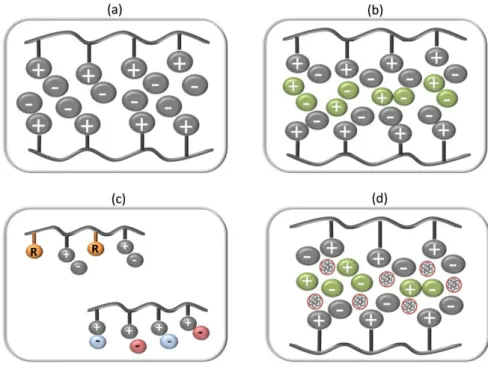
Figure 9| Schematic illustration of (a) neat PIL membrane (b) PIL–IL composite membrane, (c) PIL copolymer membranes, (d) PIL–IL–zeolite mixed matrix membrane.
The following subsections cover the advances on the design of PIL-based
membranes for CO2 separation, in particular for flue gas separation (CO2/N2) and
natural gas purification (CO2/CH4). The evaluation of gas permeation properties,
as well as CO2 separation performances obtained during the progressive
development of these membranes will be here discussed. As illustrated in Figure
9, four different strategies will be highlighted: (i) neat PIL membranes having
different functional groups attached to their imidazolium-based backbones,198-204
(ii) the blending of free ILs with PILs to form homogeneous composite
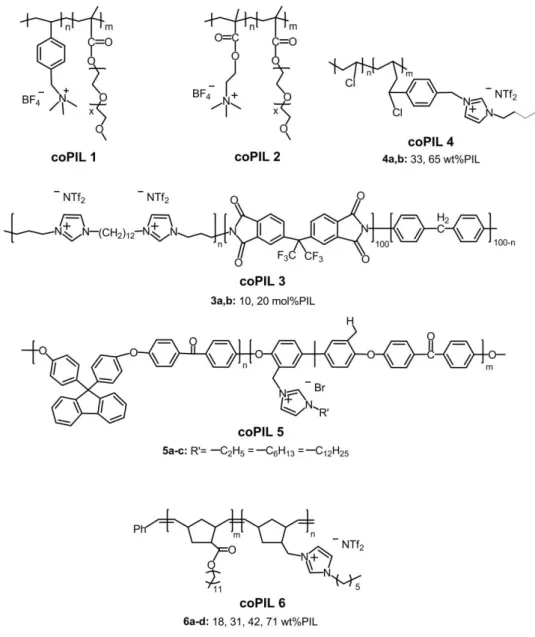
26
and chain packing for increasing the gas permeability and mechanical stability of
the membranes,173, 210-213 and (iv)the incorporation of zeolites into PILs to form
mixed matrix membranes.214-216
(i) Neat PIL membranes
The potential performance of PILs as gas separation membranes was initially
addressed in 2006 by Camper et al.198 Using CO2, CH4 and N2 solubility data and taking into account the solution-diffusion mass transfer mechanism,
permeabilities of immobilized ILs were predicted by lowering the gas diffusion
coefficients by subsequent orders of magnitude, in a trial and error manner. The
authors postulated that if solubility remains the same, the performance of those
hypothetical stabilized IL membranes would be promising for CO2 separations.198
The best way to “make those membranes come true” was to use polymerizable IL monomers to prepare neat PIL membranes (Figure 9(a)). The radical
chain-addition polymerization of IL monomers combining a polymerizable group is the
most commonly used route to prepare PILs, which can be easily converted into
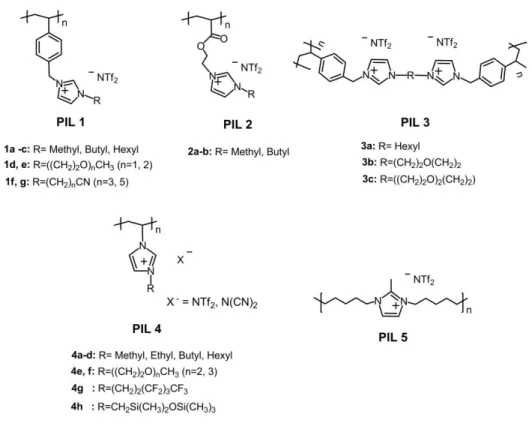
dense polymer membranes. The chemical structures of the neat PILs synthesized
so far to prepare CO2 separation membranes are shown in Figure 10. Among the
PILs used, all comprising imidazolium cation moieties in their polymeric
backbones, the most studied combine the [NTf2]– as counter-anion.
The first neat PIL membranes for CO2 separation were presented by Noble’s
group.199 Five PILs featuring alkyl-imidazolium cations tethered to a polystyrene
(PIL 1a-c) or polyacrylate backbone (PIL 2a,b) were synthesized by UV
polymerization using a photo-initiator and a cross-linking agent, and subsequently
the CO2, CH4 and N2 permeation properties of the prepared neat PIL membranes
were evaluated. The chemical structure of the polymer backbone had little effect
on the gas permeation properties of the membranes, whereas both the
27
the alkyl chain length attached to the imidazolium polycation.199 For instance, the
CO2 permeability increased from 9 to 32 Barrer as the alkyl group was lengthened
from methyl to hexyl in the styrene-based systems (PIL 1a-c), but their
permselectivities for CO2/N2 decreased from 32 to 28, and for CO2/CH4 from 39 to
17.199 The CO2 separation performances of this first generation of neat PIL
membranes are shown in the form of Robeson plots in Figure 11.
Figure 10| Chemical structures of cationic PILs that have been evaluated as CO2 separation membranes.
In order to improve the CO2 separation performance of these membranes,
Noble and co-workers proposed a second generation of functionalized
imidazolium-based PILs containing polar groups, namely oligo(ethylene glycol) (PIL
1d,e) or alkyl-terminated nitrile (PIL 1f,g).200 The inclusion of pendant nitrile
28
oligo(ethylene glycol) units exhibited CO2 permeabilities (16 – 22 Barrer) that
were on par with their alkyl analogues (9 – 32 Barrer).200 As it can be seen in
Figure 11, these functionalized PILs (PIL 1d,e and PIL 1f,g) generally have
improved CO2/N2 (37 to 44) and CO2/CH4 (29 to 37) permselectivities when
compared to those with alkyl chain substituents (PIL 1a-c).200
Figure 11| CO2 separation performance of the neat PIL membranes plotted on (a) CO2/N2 and (b) CO2/CH4 Robeson plots. Data from References
198-204