Sandfly
Lutzomyia longipalpis
in a Cutaneous Leishmaniasis
Focus in Central Colombia
Yolanda López
+, Lisardo Osorio, Gilberto Alvarez, Jaime Rojas*,
Fernando Jiménez*, Carmen Gómez*, Cristina Ferro**
Grupo de Entomología, Laboratorio Departamental de Salud Pública, Dirección Seccional de Salud de Antioquia, Carrera 51A No 62-42, Medellín, Colombia *Servicio Seccional de Salud de Antioquia (Hospitales de Puerto
Triunfo y Rionegro) **Laboratorio de Entomología, Instituto Nacional de Salud, Avenida el Dorado con Carrera 50, Santafé de Bogotá, Colombia
Lutzomyia longipalpis, 15 other species of the genus Lutzomyia, and one species of Brumptomyia were collected in an endemic focus of cutaneous leishmaniasis in a river canyon 450 m above sea-level, in Rio Claro, Antioquia, Colombia. The presence of Lu. longipalpis is associated with the destruction of the primary forest and the development of new farmland and rural settlement in this region. The compo-sition of species identified a different habitat forLu. longipalpis in Colombia. Lu. yuilli and Lu. longipalpis were predominant (68.26%) followed by Lu. trapidoi, Lu.hartmani, Lu. triramula, Lu. panamensis, Lu. gomezi.
Key words: Lutzomyia longipalpis - sand fly - ecology - leishmaniasis - Colombia
Lutzomyia longipalpis (Lutz & Neiva) is the main vector of Leishmania (L.) chagasi, the aetiologic agent of American visceral leishmaniasis (Ward 1985, Shaw & Lainson 1987, Momen et al. 1987, Grimaldi et al. 1989, Cupolillo et al. 1994, Tesh 1995). This sand fly has a wide geographi-cal distribution in the New World, occurring in tropical areas from Mexico to Argentina (Ward 1985, Young & Duncan 1994). It has been found in a variety of habitats, from arid areas with rock and xerophytic vegetation to moist, lush forest in the Amazon River Basin (Zeledon et al. 1974, Lainson et al. 1990). A common feature of this sand fly is its propensity to move into the peridomestic environment, particularly in rural and suburban communities where domestic animals and their shelters are present (Lainson 1989).
Recent reports from foci of American cutane-ous leishmaniasis in a mountaincutane-ous region of the State of Ceará, Brazil (Queiroz et al. 1991) and in a periurban site near Rio de Janeiro, Brazil (Rangel et al. 1990) agree with Lainson (1989) and Tesh (1995) that, the neotropics ecologic and demo-graphic changes have led to conditions which now support large populations of the vector Lu. longipalpis. As a consequence, visceral leishmaniasis occurs now in many regions where it was not found previously. From a public health
perspective, this is one of the most important emerging parasitic diseases (Tesh 1995).
In Colombia, the geographic distribution of visceral leishmaniasis and Lu. longipalpis coincide in the upper and middle Magdalena River Valley, with endemic foci in Huila, Tolima, Cundinamarca and Santander, and has been associated with arid and semi-arid zones, at elevations under 1000 m at sea level, characterized by scarce vegetation and small gallery forests (Corredor et al. 1990). Other sand flies species, Lu. trinidadensis (Newstead), Lu. cayenensis (Floch & Abonnec), Lu. atroclavata (Knob) are common in this habitat (Ferro et al. 1995). Despite its ecological similarities with the foci of the Magdalena River Valley, Lu. longipalpis has to date not been collected in the northern focus of Colombia. Lu. evansi (Nuñez-Tovar) has been implicated as an alternative vector of visceral leishmaniasis there (Travi et al. 1990) (Fig. 1).
We report here the results of sand fly collec-tions, carried out in an endemic focus of cutane-ous leishmaniasis, which contained Lu. longipalpis. The composition of species identified habitat dif-ferences for Lu. longipalpis in Colombia. More-over, this was an unexpected finding because no cases of visceral leishmaniasis have been reported in this area.
MATERIALS AND METHODS
Study area - All sand fly collections were made between September 4-5, 1991 in La Mulata and El Refugio (5o 53' N, 74o 39' W), in the municipality of San Luis, Departament of Antioquia, Colombia. Both sites are part of the Rio Claro Valley (Fig. 2).
+Corresponding author. Fax: 211-15.99
Fig. 1: map of Colombia showing focus of visceral leishmaniasis (G = Guajira, C = Córdoba, S = Sucre, Cu = Cundinamarca, Sa = Santander, T = Tolima, H = Huila).
Fig. 2: location of Rio Claro region in department of Antioquia, Colombia.
cling La Mulata are covered by small patches of forest and agricultural crops, including manioc, pineapple and cocoa. The nine houses in the com-munity are constructed with wooden plank walls that provide easy access to bloodsucking insects. El Refugio Natural Forest Reserve, 440 m el-evation, is located on the left bank of the River Claro. It consists of approximatly 2 km2 of pri-mary tropical forest vegetation, and large rocks with calcareous surfaces lie along the valley floor (Pérez 1989). A tourist lodge, “El Refugio”, has been built inside the forest. One family resides at the lodge year-round; animals consist of small coop of chickens.
The precipitation of The Rio Claro Valley from 1987 to 1989 consists of heavy rainfall from Au-gust to November, followed by a decrease rainfall from December to March. Another peak in pre-cipitation occurs from April to June followed by short dry season during July. The average rain-fall was 4,483 mm/year, ranging from 3,621 mm during 1987 to 5,896 mm in 1989. For the period from 1986 to 1989, the mean temperature and rela-tive humidity were 25.6oC (range 18.9o-34.6oC) and 89% (range 83-95%), respectively (Bernal et al. 1989).
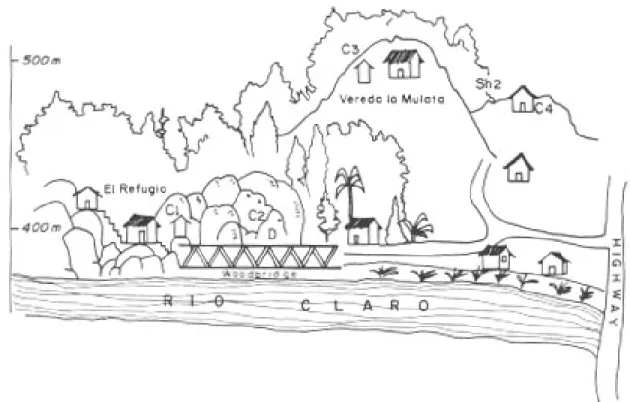
Collection methods and sites - Sand flies were collected at night, from September 4-5 1991, us-ing CDC light traps, Shannon traps, one hamster-baited Disney trap and human bait. Representa-tive sites associated with peridomestic and extradomestic habitats were selected for sampling. Peridomestic habitats - In "El Refugio" a CDC trap was placed in the chicken house, at a distance of 5 m from the wooden lodge (Fig. 3, site C1). In La Mulata two CDC traps and two Shannon were placed in locations within 5 m of two houses (Fig. 3, sites C3, C4).
Extradomestic habitats - A CDC trap and a Disney trap were placed in the forest near an out-crop of rocks, at distance of 400 m from the wooden lodge (Fig. 3, site C2). The CDC and the Disney traps were placed at a height of 1.0 m and 0.2 m, respectively, and operated between 18:00-06:00 hr. A Shannon trap was used between 18:00-21:00 hr. In peridomestic and extradomestic habitats sand fly collections using human bait were carried out between 18:00-21:00 hr.
Captured sand flies were put in vials contain-ing 70% ethanol. All samples were subsequently transported to the Entomology Section of the Labo-ratory of Public Health of Medellín for species identification and mounting. Sand flies were iden-tified to species, using characters described by Young (1979). Lu. longipalpis males possessed pale tergal abdominal spots on segment III and IV as described by Ward et al. (1983).
The Rio Claro valley is classified as humid tropi-cal forest (Espinal et al. 1978), although in the last 10 years the region has been modify by the mas-sive destruction of the forest, rapid human popula-tion growth, and the concomitant development of new farmland and rural settlements.
encir-Fig. 3: scheme of trap location in the study. Sites C1, C2, C3 and C4.
TABLE
Phlebotominae collected according to trapping method, habitat and species in El Refugio and in La Mulata September 4-5, 1991
Method of Human bait CDC Light Shannon Disney
capture trap trap trap
Habitat Peri Extra Peri Extra Peri Extra Extra
Species F M F M F M F M F M F M F M Total
Lu. longipalpis - - - - 83 53 3 - 3 - - - 142
Lu. yuilli 1 - 15 - 84 3 2 - 11 1 17 10 - - 144
Lu. trapidoi 1 - 2 - 14 1 3 - 3 - 7 - - - 31
Lu. hartmani 1 - 20 1 - 6 1 - 1 - 1 - - - 31
Lu. triramula - - - - 8 5 8 - 1 - 1 2 - - 25
Lu. panamensis - - 3 - 4 1 3 - 4 1 1 - - - 17
Lu. gomezi 2 - 2 - 1 2 - - 1 - 1 - - - 9
Lu. saulensis - - - - 1 - 4 - - - 1 - - - 6
Lu. sordelli - - - - 2 - - - 1 - - - 3
Lu. trinidadensis - - - - 1 - 1 - 1 - - - 3
Lu. ovallesi - - - 1 - - - 1
Lu. carpenteri - - - - 1 - - - 1
Lu. vespertilionis - - - 1 1
Lu. caprina - - - 1 - - - 1
Subg. Psathyromyia - - - 1 - - - 1
Subg. Pressatia - - - 1 - - - 1
B. galindoi - - - 1 1 - - - 2
Total 5 - 42 1 199 72 28 1 25 2 31 12 - 1 419
RESULTS
A total of 419 sand flies were collected in this survey, including 16 species of the genus Lutzomyia and 1 species of the genus Brumptomyia. Lu. longipalpis (33.89%) and Lu. yuilli (Young & Por-ter) (34.37%) were the most abundant species (Table). More females than males were captured for Lu. longipalpis, Lu. yuilli, Lu. trapidoi (Fairchild & Hertig) and Lu. hartmanni (Fairchild & Hertig). Lu. longipalpis males were the most abundant.
Peridomestic habitat - Fourteen Lutzomyia spe-cies were colected. CDC ligh traps yielded mainly Lu. longipalpis and Lu. yuilli, while the Shannon trap yielded mainly Lu. yuilli (Table).
Extradomestic habitat - The CDC light trap and the Shannon trap yielded more species than other methods. Lu. yuilli was the most abundant in the Shannon trap and Lu. panamensis (Shannon)from the CDC light trap. Lu. yuilli and Lu. trapidoi were the two most abundant species collected with hu-man bait. The Disney trap caught no sand flies (Table).
DISCUSSION
The ecological and demographical changes in Latin America have enhanced conditions for the successful colonization of Lu. longipalpis in re-gions where it had not been reported previously (Lainson 1989, Tesh 1995). Mark-realease-recap-ture studies of Lu. longipalpis shown it capable of moving 800-1000 m distances over short period of time. Also, they seem to move readily among cattle corrals at intermediate distances, suggesting that they are searching for food, mates or resting sites (Morrison et al. 1993). If available food de-termines the flight range of sandflies, as postulated by Alexander (1987), rural settlements along middle Magdalena Valley will move Lu. longipalpis into the peridomestic environment. It is probable that this sand fly at present has a con-tinuous distribution through the upper and middle Magdalena Valley but collections have only been carried out where cases of visceral leishmaniasis have been reported.
It has been suggested that Lu. longipalpis popu-lations represent a species complex (Ward et al. 1983, Lanzaro et al. 1993). Its members have been found in a variety of habitats (Lainson et al. 1990). The presence of this sand fly in Rio Claro may be due however to its invasin of the forest in associa-tion with man and his domestic animals rather than the existence of a native Lu. longipalpis popula-tion in forest environment.
Visceral leishmaniasis has not till now been reported in La Mulata and El Refugio, but from
the standpoint of public health, the presence of its vector suggests a transmision risk of this disease within all the upper and middle Magdalena Val-ley, from Huila to canyon river in Rio Claro, Antioquia.
The trapping efficiency of CDC and Shannon traps is of practical importance in short term stud-ies such as the present one for sampling of sand fly species, as is human bait for the anthropophilic species (Table). In this study, human bait collec-tion in peridomestic and extradomestic habitats were negative for Lu. longipalpis, although Lu. hartmanni, Lu. trapidoi and Lu. yuilli were caught relatively abundantly in the extradomestic habitat. Lu. hartmanni and Lu. trapidoi have been incrimi-nated as vectors of L. panamensis and L. colombiensis respectively in Colombia (Young et al. 1987, Kreutzer et al. 1991). A few specimens of Lu. panamensis and Lu. gomezi (Nitzulescu) were also captured in this study. Both species are suspected as vectors of L. panamensis.
Further studies on the biochemical systematics and genetics try and genetics of Lu. longipalpis populations are needed to establish the bounderies of species differences within this complex, as well as its relationship to other associated Lutzomyia species in the environment of the Magdalena Val-ley.
ACKNOWLEDGEMENTS
To Dr Amy Morrison, Dr Leonard Munstermann and Claribell Hernandez for their kind revision of the manu-script and valuable suggestions.
REFERENCES
Alexander JB 1987. Dispersal of phlebotomine sand flies (Diptera:Psychodidae) in a Colombian coffee plan-tation. J Med Entomol24: 552-558.
Bernal GH, Montealegre E, Rangel E, Sabogal NA 1989. Estudio sobre el régimen de la precipitación en Colombia. Instituto Colombiano de Hidrología, Meteorología y Adecuación de Tierras (HIMAT). Bogotá, Colombia, 49 pp.
Cupolillo E, Grimaldi G, Momen H 1994. A general classification of New World Leishmania using nu-merical zymotaxonomy. Am J TropMed Hyg50: 296-311.
Corredor A, Kreutzer R, Tesh R, Boshell J, Palau MT, Cáceres E, Duque S, Peláez D, Rodríguez G, Nicholls S, Hernández C, Morales A, Ferro de Carrasquilla C 1990. Distribution and etiology of leishmaniasis in Colombia. Am J Trop Med Hyg 42: 206-214. Espinal S 1978. Zonas de vida o formaciones vegetales
de Colombia. Memoria explicativa sobre el mapa ecológico. Instituto Geográfico “Agustín Codazzi” (IGAC), 238 pp.
(Diptera: Psychodidae) at an endemic focus of vis-ceral leishmaniasis in Colombia. J Med Entomol32: 527-537.
Grimaldi G, Tesh R, McMahon-Pratt D 1989. A review of geographic distribution and epidemiology of leishmaniasis in the new world. Am J Trop Med Hyg41: 687-725.
Kreutzer RD, Corredor A, Grimaldi G, Grogl M, Rowton ED, Young DG, Morales A, McMahon-Pratt D, Guzmán H, Tesh RB 1991.Characterization of
Leishmania colombiensis sp.n. Kinetoplastida: Trypanosomatidae), a new parasite infecting hu-mans, animals, and phlebotomine sand flies in Co-lombia and Panama. Am J Trop Med Hyg44: 662-675.
Lainson R 1989. Demographic changes and their influ-ence on the epidemiology of the American leishmaniases, p. 85-106. In MW Service,
Demography and Vector-Borne Diseases. CRC Press, Boca Raton, FL.
Lainson R, Dye C, Shaw JJ, Macdonald DW, Courtenay O, Souza AA, Silveira FT 1990. Amazonian vis-ceral leishmaniasis - Distribution of the vector
Lutzomyia longipalpis (Lutz & Neiva) in relation to the fox Cerdocyon thous (Linn.). The efficiency of this reservoir host as a source of infection. Mem Inst Oswaldo Cruz85: 135-137.
Lanzaro GC, Ostrovska K, Herrero MV, Lawyer PG, Warburg A 1993. Lutzomyia longipalpis is a spe-cies complex: genetic divergence and interspecific hybrid sterility among three populations. Am J Trop Med Hyg48: 839-847.
Momen H, Grimaldi G Jr, Deane LM 1987. Leishmania infantum, the aetiologic agent of American visceral leishmaniasis (AVL). Mem Inst Oswaldo Cruz82: 447-448.
Morrison AC, Ferro C, Morales A, Tesh RB, Wilson ML 1993. Dispersal of the sand Lutzomyia longipalpis (Diptera: Psychodidae) at an endemic focus of visceral leishmaniasis in Colombia. J Med Entomol30: 427-435.
Pérez E 1989. Algunas características comportamentales y reproductivas del pájaro aceitero Steathormis caripiensis (Guácharo) en cuevas de la regiónde Puerto Triunfo. Thesis, Universidad de Antioquia, Medellín, Colombia, 70 pp.
Queiroz RG, Vasconcelos AW, Vasconcelos AB, Sousa RN, Alencar JE, David JR 1991. Phlebotomine sand fly Diptera:Psychodidae) fauna survey in an Ameri-can cutaneous leishmaniasis (ACL) focus in Baturite, Ceará State, Northeast Brazil. Parassitologia 33
(Suppl. 1): 159-167.
Rangel EF, Azevedo ACR, Andrade CA, Souza NA, Wermelinger ED 1990. Studies on sandfly fauna (Diptera: Psychodidae) in a foci of cutaneous leishmaniasis in Mesquita, Rio de Janeiro State, Bra-zil. Mem Inst Oswaldo Cruz85: 39-54.
Shaw JJ, Lainson R 1987. Ecology and epidemiology: New World, p.291-363. In W Peters & R Killick-Kendrick, The Leishmaniases in Biology and Medi-cine, Vol 1, Academic Press, New York.
Tesh RB 1995. Control of zoonotic visceral leishma-niasis: Is it time to change strategies? Am J Trop Med Hyg 52: 287-292.
Travi Bl, Vélez ID, Brutus L, Segura I, Jaramillo CD, Montoya J1990. Lutzomyia evansi, an alternate vec-tor of Leishmania chagasi in a Colombian focus of visceral leishmaniasis. Trans SocTrop Med Hyg84: 676-677.
Ward RD, Ribeiro AL, Ready PD, Murtagh A 1983. Reproductive isolation between different forms of
Lutzomyia longipalpis (Lutz & Neiva), (Diptera: Psychodidae), the vector of Leishmania donovani chagasi Cunha & Chagas and its significance to kala-azar distribution in South America. Mem Inst Oswaldo Cruz78: 269-280.
Ward RD 1985. Vector biology and control, p. 199-212. In KP Chang & R Bray, Leishmaniasis. Elsevier Sci-ence Publishers, Amsterdam, New York & Oxford. Ward RD 1990. Some aspects of the biology of phlebotominae sandfly vectors, p.91-126. In RD Ward, Advances in disease vector research. Vol. 6. Springer-Verlag, New York.
Young DG 1979. A review of the bloodsucking psychodid flies of Colombia (Diptera: Phlebotominae and Sycoracinae). Tech. Bull. 806, Agric Exp Station, IFAS, Univ. Florida, Gainsville, FL.
Young DG, Morales A, Kreutzer RD, Alexander JB, Corredor A, Tesh RB, Ferro de Carrasquilla C, Rodríguez C 1987. Isolations of Leishmania braziliensis (Kinetoplastida: Trypanosomatidae) from cryopreserved Colombian sand flies (Diptera: Psychodidae). J Med Ent 24: 587-589.
Young DG, Duncan MA 1994. Guide to the identifica-tion and geographic distribuidentifica-tion of Lutzomyia sand flies in Mexico, the West Indies, Central and South America (Diptera: Psychodidae). Mem Amer Entomol Inst54: 1-881.