Submitted29 April 2016 Accepted 16 February 2017 Published28 March 2017 Corresponding author Jacques Derek Charlwood, [email protected]
Academic editor Erika Braga
Additional Information and Declarations can be found on page 19
DOI10.7717/peerj.3099
Copyright 2017 Charlwood
Distributed under
Creative Commons CC-BY 4.0
OPEN ACCESS
Some like it hot: a differential response
to changing temperatures by the malaria
vectors
Anopheles funestus
and
An.
gambiae
s.l.
Jacques Derek Charlwood
Instituto de Higiene e Medicina Tropical, IHMT, Universidade Nova de Lisboa, UNL, Rua da Junqueira, Global Health and Tropical Medicine, GHTM, Lisbon, Portugal
MOZDAN (Mozambican-Danish Rural Malaria Initiative), Morrumbene, Inhambane Province, Mozambique Centre for Health Research and Development, University of Copenhagen, Copenhagen, Denmark
National Institute of Health, Maputo, Mozambique
ABSTRACT
Background. With the possible implications of global warming, the effect of temper-ature on the dynamics of malaria vectors in Africa has become a subject of increasing interest. Information from the field is, however, relatively sparse. We describe the effect of ambient temperature over a five-year period on the dynamics ofAn. funestus andAn. gambiae s.l., collected from a single village in southern Mozambique where temperatures varied from a night-time minimum of 6◦C in the cool season to a daytime maximum of 35◦C in the hot season.
Results. Mean daily air temperatures varied from 34◦C to 20◦C and soil temperatures varied from 26 ◦C to 12◦C. Diurnal variation was greatest in the cooler months of the year and were greater in air temperatures than soil temperatures. During the study 301, 705 femaleAn. funestuswere collected in 6,043 light-trap collections, 161, 466 in 7,397 exit collections and 16, 995 in 1,315 resting collections. The equivalent numbers forAn. gambiaes.l. are 72,475 in light-traps, 33, 868 in exit collections and 5,333 from indoor resting collections. Numbers of mosquito were greatest in the warmer months. Numbers ofAn. gambiaes.l. went through a one hundredfold change (from a mean of 0.14 mosquitoes a night to 14) whereas numbers ofAn. funestusmerely doubled (from a mean of 20 to 40 a night). The highest environmental correlations and mosquito numbers were between mean air temperature (r2=0.52 forAn. funestusand 0.77 for
An. gambiaes.l.). Numbers of mosquito collected were not related to rainfall with lags of up to four weeks. Numbers of both gravid and unfedAn. gambiaecomplex females in exit collections continued to increase at all temperatures recorded but gravid females ofAn. funestusdecreased at temperatures above 28◦C. Overall the numbers of gravid and unfedAn. funestuscollected in exit collections were not correlated (p=0.07). For an unknown reason the number ofAn. gambiae s.l. fell below monitoring thresholds during the study.
SubjectsEcology, Entomology, Epidemiology, Global Health, Infectious Diseases
Keywords Anopheles gambiaes.l., Temperature,Anopheles funestus, Population dynamics, Rainfall, Mozambique, Light-trap, Exit collection, Gravid, Unfed
INTRODUCTION
Temperature is a major driving force in insect populations. In the laboratory the species that are almost entirely responsible for malaria transmission in Sub-Saharan Africa, the freshwater members of the Anopheles gambiae complex (An. gambiae, An. coluzzi andAn. arabiensis) andAnopheles funestus,respond differently to different temperature regimes. Larval development rates forAn. arabiensispeak within the temperature range of 22–32◦C with survival rates also highest at 32◦C, whilst an optimal temperature for larval development ofAn. gambiaeis between 28 and 32◦C but survival rate to adulthood is highest between 22–26◦C (Bayoh & Lindsay, 2003,Christiansen-Jucht et al., 2014). This reflects the higher temperature tolerance ofAn. arabiensiscompared toAn. gambiae(Kirby & Lindsay, 2004) which itself may be responsible for the extended distribution of the former species into hotter and drier environments in Africa.Anopheles funestus, on the other hand, has a single optimum temperature of 25◦C for development with substantial declines in survival either side of this (Christiansen-Jucht et al., 2014).Le Sueur & Sharp (1991)concluded that the effect of temperature onAn. merus(another member of theAn. gambiae complex) was greatest during metamorphisis in the pupal stage, as didHeuval van den (1963)forAedes aegypti. Temperature-related metabolism during metamorphosis was affected by available energy reserves (gathered during larval development) (Le Sueur & Sharp, 1991). At higher temperatures reserves are lower than at lower temperatures, hence emerging adults are smaller. In the laboratory none of theAn. gambiae complex orAn funestussurvived as larvae or pupae at temperatures above 35◦C. In the field, however, larvae and pupae ofAn. gambiae s.l. (probablyAn. arabiensis) have been found in pools at temperatures of 40.5–41.8◦C (Holstein, 1952, quoted inGillies & De Mellion, 1968).
The differential response to temperature in the laboratory reflects the different kinds of water in which larval development takes place in the field. Thus, although immature forms of theAn. gambiaecomplex may occur in a great variety of water bodies, the most characteristic are the ‘shallow open sun-lit pools with which every field worker in Africa is familiar’ (Gillies & De Mellion, 1968). Immatures ofAn. funestus are generally found in more permanent, shaded, water bodies with emergent vegetation that are cooler than exposed puddles.
In contrast to the larvae, adults of bothAn. gambiae s.l. andAn. funestus, experience similar microclimates due to their predominantly endophilic behaviour. Temperature influences the time it takes for egg development following a blood-meal but may also have subtler effects. For example,An. funestusdelays returning to feed following oviposition at temperatures above 26.5◦C, but at lower temperatures females re-feed shortly after egg laying (Gillies & Wilkes, 1963). Ironically, the extra time spent in returning to feed at higher temperatures is compensated for by it taking two rather than three days for the mosquito to complete egg development, so that the duration of the complete gonotrophic cycle is three days at all temperatures (Gillies & Wilkes, 1963).
The effect of temperature on the larval stages is manifest in the emergent population (Beck-Johnson et al., 2013). Newly emerged insects can be distinguished from the mature population by their abdominal and gonotrophic state. Newly emerged males have un-rotated terminalia (Charlwood, 2011) whilst females have undeveloped ovaries and constitute the unfed portion of the resting or exiting population from houses (Gillies & Wilkes, 1965;Charlwood, Thompson & Madsen, 2003). The relative proportions of engorged to gravid females at different temperatures also provides information on the duration of egg development in mature insects.
Surprisingly, there remains a lack of comprehensive data on the effects of temperature and other environmental factors on mosquito population dynamics in the wild. Possible effects of temperature on mosquitoes in the field are most easily observed in areas with a wide variation in both daily and seasonal temperatures. Wild mosquito populations are, however, notoriously unpredictable and short-term, chaotic, fluctuations are common. Long-term observations can assist in reducing the ‘noise’ in such data. Here we describe the effect of ambient temperature, and other environmental parameters, over a five-year period, on the dynamics of newly emerged and matureAn. funestusandAn. gambiae s.l. Insects were collected from a single village in southern Mozambique where temperatures varied from a night-time minimum of 6◦C in the cool season (10.5◦C below the lower limit of 16.5◦C for larval activity, (Jepson, Moutia & Courtis, 1947)) to a daytime maximum of 35◦C in the hot season.
METHODS
Description of study site
Furvela
Linga Linga Morrumbene
Bay
Beula
To Maxixe To Morrumbene
EN 1
N
Figure 1 Google Earth image of Furvela Village.Furvela Village and its environ cGoogle Earth; Image 2016 cCNES/ Astrium. Note the location of Linga Linga where information on the malaria and mosquitoes is also available (Charlwood et al., 2013;Charlwood et al., 2015).
Houses in the village are generally made with cani¸cowalls and palm thatch roofs. Although most houses don’t have windows the majority have aca.15 cm gap between the roof and walls at either end of the house. Doors and doorframes are also generally badly fitting; hence mosquitoes can easily enter these houses. Other styles of house include those with corrugated iron sheets for the roof and those made of concrete blocks (which do have windows). Houses are built either in family compounds of three to six houses or as relatively evenly spaced individual homes.
At the start of the study houses were mapped with handheld Global Positioning Units (Garmin etrex), numbered and the manner of construction and size noted (Files S3and S4). A census was taken and residents were informed about the purpose of the study and consent concerning the possibility of future mosquito collections obtained. The initial study area was expanded in the second year of the study and mapping was also repeated in 2007.
Mosquito Collection Light-traps
list. In addition, a number of houses known to have high densities of mosquitoes were used as sentinel sites. Collections were made in 764 houses on the Furvela river side of the village and 214 on the Inhnanombe side of the village. Eleven houses were used for sentinel collections; each being sampled for more than 100 nights.
Exit collection
From 2003 to 2007 mosquitoes were also collected exiting houses at dusk (Charlwood, 2011). The door of the house was left open and covered with a white mosquito-netting curtain. Mosquitoes were manually aspirated off the curtain as they attempted to leave.
See:https://www.youtube.com/watch?v=SL8FeIuY1GM.
Most of the houses used for the exit collections were on the Furvela side of the village. The young men and women who did the work, and who lived in dispersed locations collected from their own or nearby houses. Altogether collections were made from 501 houses some of which also acted as sentinel sites.
Resting collection
Resting collections, using a torch and an aspirator, were performed on the Furvela side of the village, on anad hoc basis on 163 days, from a total of 132 houses (mean number of 3.9 collections per house) where mosquito nets were not in use, and, initially, outdoors.
Mosquito processing
CollectedAnopheleswere separated into species or species group, according to the keys of
Gillies & De Mellion (1968)andGillies & Coetzee (1987)and sexed. Females were further separated into unfed, part-fed, engorged, semi-gravid and gravid categories. A number of theAn. gambiaes.l. were identified to species by PCR. DNA extraction was performed individually following the protocols ofCollins et al. (1988)and the species identified using the protocols of Scott, Brogdonw & Collins (1993). A small number ofAn. funestuswere also identified by PCR using the protocols ofKoekemoer et al. (2002).
Meteorology
Temperature, insolation and windspeed measurement
Long term temperature data recorded at Vilanculos, a town∼200 km north of Furvela, were also obtained (long-term data available fromhttp://www.tutiempo.net).
Rainfall data
Rainfall data was available from the town of Maxixe, 20 km to the south of Furvela. Since the distribution of rainfall is important (20 mm falling on seven consecutive days in a week is likely to have a different effect than 140 mm falling on a single day) a modified measure of rainfall was used to estimate effects:
• Modified weekly rain=(Rain (mm) * #rain days)/7
• Thus 140 mm on a single day is equivalent to (140∗1)/7=20 • And 140 mm with rain every day is equivalent to (140∗7)/7=140.
The daily, weekly and monthly records of rainfall over the period 2000–2010 are available atFile S6(Rainfall data).
Analysis
Data were entered into, and analyzed with, Excel (File S6). Unfed mosquitoes from light-trap collections represent all age groups. Unfed mosquitoes from exit collection are, however, almost entirely newly emerged ones (Charlwood, 2011), whilst gravid females have taken at least one blood meal sufficient to develop eggs, and will also include infectious ones. The weekly Williams mean (log10 (n+1)) of these three groups ofAn. funestus
andAn. gambiae s.l. were compared to mean, maximum and minimum temperatures, temperature difference, insolation and wind speed, measured in Furvela, and modified rainfall measured in Maxixe.
The relationship between mosquito numbers and environmental factors was examined using bivariate correlations, and Pearson’s correlation coefficient (2-tailedPvalue≤0.05 significance). Least squares multiple linear regression (with climatic factors as independent variables) was also undertaken using the Excel add-in StatPlus. The most parsimonious model was determined by subtraction of least important variables.
Ethics
The study was conducted under the aegis of the joint Instituto Nacional de Saúde (INS)— DBL Centre for Health Research and Development project ‘Turning houses into traps for mosquitoes’, which obtained ethical clearance from the National Bioethics Committee of Mozambique on 2 April 2001 (ref: 056/CNBS/01). Householders were informed about the purpose of the collections. Verbal consent was obtained when collections were initiated.
RESULTS
Environmental variables
10 15 20 25 30 35 40
05-‐Oct 02-‐Feb 01-‐Jun 29-‐Sep 27-‐Jan
Temp
eratu
re (
oC
)
Date
Soil temperature Air temperature
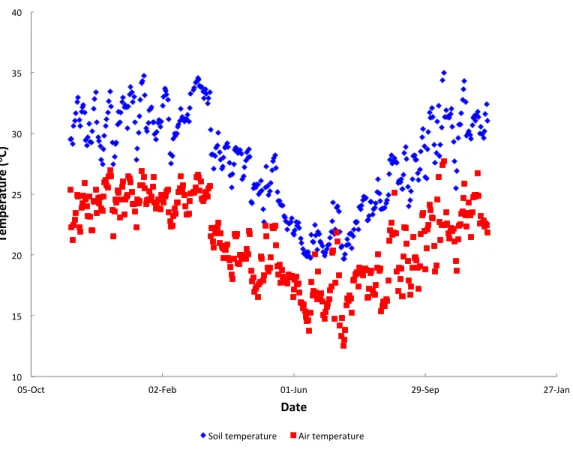
Figure 2 Annual temperature variation.Mean daily soil and air temperatures recorded by the Delta log-ger in Furvela village.
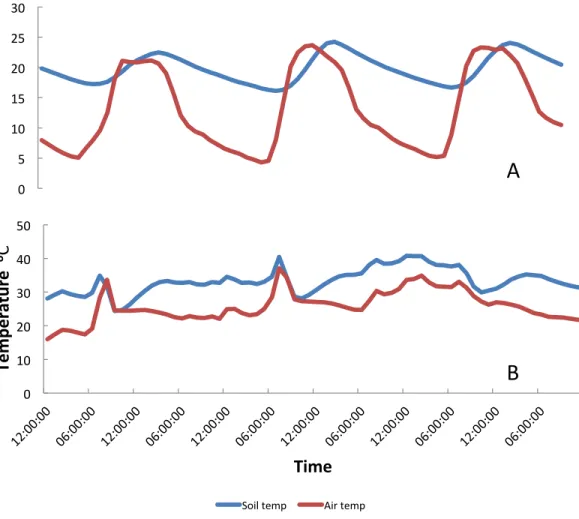
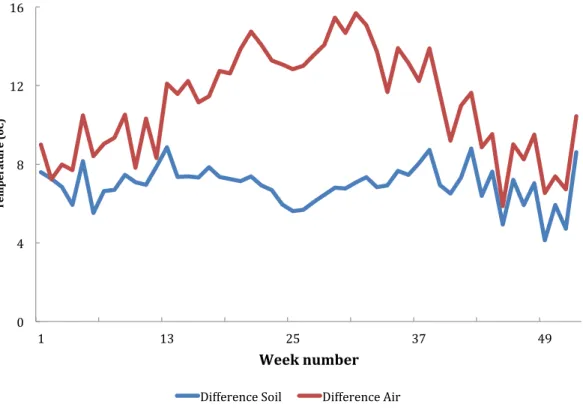
hot seasons.Figure 3Ashows the diurnal pattern recorded on the three coolest nights of the year (16–18th July) and 3B the three warmest (14–16th October). Overall at the higher temperatures daily variation (difference between maximuim and minimum temperature) was less than it was at the cooler temperatures (Fig. 4). At a mean of 23.7◦C the variation in air temperatures was 5.9 degrees and at 18.1 ◦C was 15.7 degrees. Variation is soil temperature was lower than air temperatures being 4.1 degrees at 30.3◦C and 8.9 degrees at 28.2◦C.
Except for the mornings mean soil temperatures were consistently circa 5◦C warmer than air temperatures. Mean amounts of insolation showed a similar pattern to temperature.
Mosquito data
Twenty-six (86%) of 30 males and 331 (81.3%) of the 407 females from an unselected sample of theAn. gambiae complex identified by PCR from 2002 and 2004 comprised An. gambiae, the other species being 4 male and 67 (16.5%) femaleAn. arabiensisand nine (2.2%) femaleAn. merus(Table 1). There was no statistical difference in the ratio ofAn. gambiae andAn. arabiensisaccording to method of collection (light-trap, exit collection or resting collection) (File S8).
0" 5" 10" 15" 20" 25" 30"
0" 10" 20" 30" 40" 50"
Temp
eratu
re))
o
C"
Time)
Soil"temp" Air"temp"
A"
B"
Figure 3 Daily variation in temperature during (A) the coolest months of the year and (B) the warmest months of the year, Furvela, Mozambique
Table 1 PCR identifications of members of theAn. gambiaecomplex collected from light-traps, Furvela Village, Mozambique.
Year 2002 2003 2004 Total
Species N % N % N % N %
A. arabiensis 16 27.1 35 23.3 20 8.8 71 16.2
A. gambiae 43 72.9 108 72.0 206 90.4 357 81.7
A. merus 0 0.0 7 4.7 2 0.9 9 2.1
Total per year 59 100.0 150 100.0 228 100.0 437 100.0
An. funestus. Seventy-one females of theAn. funestusgroup were identified by PCR (Fil S9, courtesy of A. Szlanski). All wereAn. funestus. Given that this is the endophilic member of the species group, and that it was endophilic behavior that was studied, it is assumed that this was the only member of the species group present in our collections.
0 4 8 12 16
1 13 25 37 49
Temperature (oC)
Week number
Difference Soil Difference Air
Figure 4 Difference between maximum and minimum air and soil temperature recorded from Furvela village, Mozambique, by ISO week number.
resting collections (File S10—Raw data). Outdoor resting collections failed to produce any mosquitoes. Other anopheline species collected in light traps included 5776Anopheles tenebrosus, 725Anopheles letabensis, 22Anopheles rufipes, fiveAnopheles squamosus, and a singleAnopheles pharoensis. A further 219An. tenebrosusand fiveAn. rufipeswere collected exiting houses.
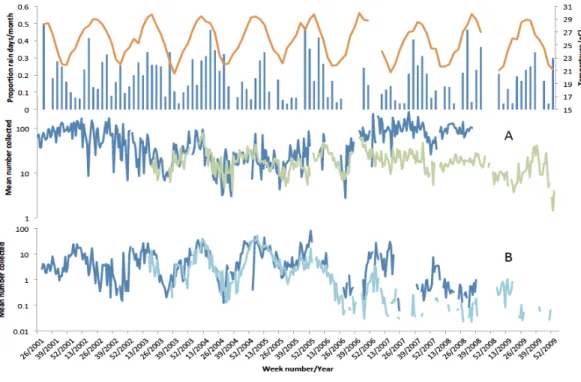
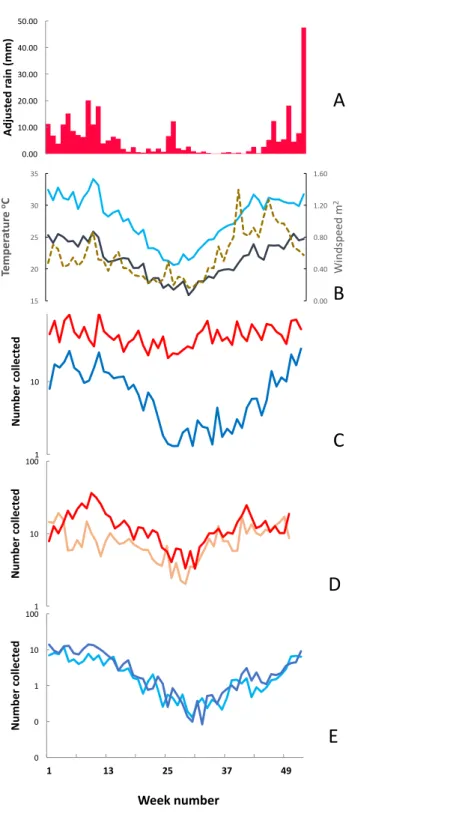
Figure 5shows the weekly mean numbers collected per house per night ofAn. funestus andAn. gambiae s.l. in light traps and exit collections over the course of the study in conjunction with temperatures recorded at Vilanculos and modified rainfall from Maxixe. Over the three years when both light trapping and exit collections were simultaneously undertaken (2003–2006) mean numbers ofAn. funestus per house, per method, were similar. In 2007 a cordon sanitaire of long lasting insecticide nets (LLIN’s) was established around the Furvela River valley (JD Charlwood, 2007, unpublished data) and numbers in exit collections decreased relative to numbers in light-traps. Numbers ofAn. gambiae s.l. in exit and light-trap were also similar. Over the course of the project, however,An. gambiae s.l. disappeared from both light-trap and exit collection collections. Given the possible effect of thecordon sanitaireon numbers collected further analysis is confined to the years 2001–2006 (when 5,090 light-trap, 4,461 exit and 1,315 resting collections were performed).
Figure 5 Temperature, rainfall and number of mosquitoes collected in Furvela.Upper graph—Rainfall (measured in Maxixe) (Blue histogram), air temperature (measured in Vilanculos) (orange line) (A) mean numbers of unfed Anopheles funestus form light-traps (blue line) and in exit collections (green line) (B) mean numbers of unfed Anopheles gambiae collected from light-traps (Dark blue line) and in exit collec-tions (light blue line) from Furvela village, 2001–2009. Note the log scale.
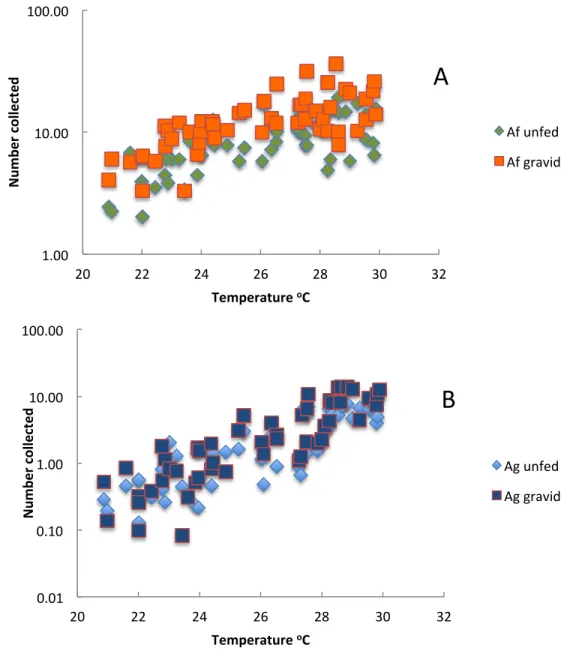
numbers of unfed and gravid insects by species from exit collections by ISO week in the years 2001–2006. Unfed insects in exit collections comprised the newly emerged portion of the population. Gravid insects represent the gonotrophically active (mature) population. The proportion of that population that they represent depends on the duration of oogenesis following a blood meal. At warmer temperatures development takes two days and so the gravid sample represents half of the mature population whereas at cooler temperatures development may take three days and so the gravid sample will only represent one third of the mature population. The whole of the newly emerged population, on the other hand, is sampled every day.
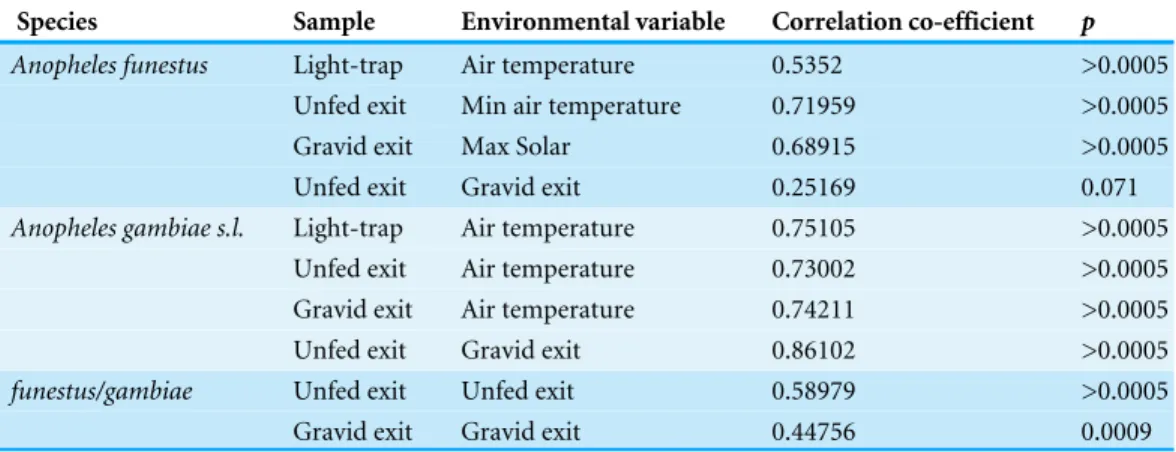
The maximum Pearson correlation co-efficients between mosquito numbers and individual environmental parameters are shown in Table 2. Table 2 also gives the correlation co-efficients between the different mosquito groups. The highest environmental correlations and mosquito numbers were between temperature and all collections ofAn. gambiae s.l. (seeFile S11for the other possible correlations). Adding a lag of up to four weeks to the light-trap data from either species did not improve the Pearson correlation co-efficient between rainfall and numbers (Table 3) Correlation co-efficients were always lower in comparisons involvingAn. funestus.
0.00 10.00 20.00 30.00 40.00 50.00 Adjus te d r a in ( m m ) 1 10 100 Num be r colle ct e d 0 0 1 10 100
1 13 25 37 49
Num be r colle ct e d Week number 1 10 100 Num be r colle ct e d 0.00 0.40 0.80 1.20 1.60 15 20 25 30 35 Wi n d sp eed m 2 Te m p e ra tu re oC
A
B
C
D
E
Figure 6 Weekly mean adjusted rain, soil temperature, air temperature, windspeed and mosquito numbers.Environmental parameters and mosquito numbers by ISO week, Furvela, Mozambique. (A) mean weekly adjusted rain in millimetres (measured in Maxixe), (B) Light blue line —mean soil temper-ature (in degrees Centigrade); Black solid line Mean air tempertemper-ature (in degrees centigrade); dotted line —mean wind-speed (in metres per second), (C) Mean number ofAnopheles funestus(red line) andAn.
gambiaes.l. (blue line) collected from light traps, (D) Mean number of unfed (pink line) and gravid (red
Table 2 Correlation coefficients between mosquitoes and climate.Correlation coefficients between weekly mean numbers of mosquitoes according to the collection method and the highest correlation co-efficient by environmental variable, Furvela, Mozambique 2003–2006.
Species Sample Environmental variable Correlation co-efficient p
Anopheles funestus Light-trap Air temperature 0.5352 >0.0005
Unfed exit Min air temperature 0.71959 >0.0005
Gravid exit Max Solar 0.68915 >0.0005
Unfed exit Gravid exit 0.25169 0.071
Anopheles gambiae s.l. Light-trap Air temperature 0.75105 >0.0005
Unfed exit Air temperature 0.73002 >0.0005 Gravid exit Air temperature 0.74211 >0.0005
Unfed exit Gravid exit 0.86102 >0.0005
funestus/gambiae Unfed exit Unfed exit 0.58979 >0.0005
Gravid exit Gravid exit 0.44756 0.0009
Table 3 Correlation between mosquitoes and rainfall.Pearson correlation co-efficients between adjusted rainfall and numbers ofAn. gambiaes.l. andAn. funestuscollected in light traps at lags of 0–4 weeks.
Lag (weeks) An. gambiaes.l. An. funestus
0 0.671 0.245
1 0.435 0.285
2 0.517 0.275
3 0.358 0.150
4 0.379 0.248
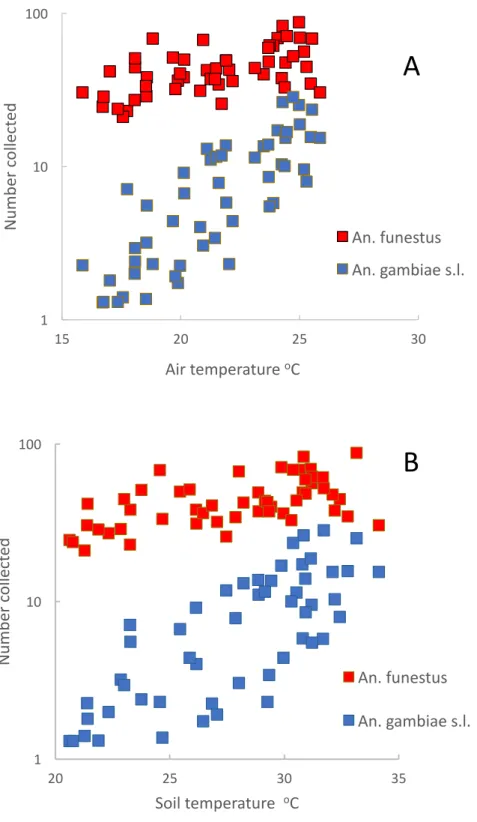
species increased significantly as temperatures increased, numbers ofAn. gambiaes.l. went through a one hundredfold change (from a mean of 0.14 mosquitoes a night to 14) whereas numbers ofAn. funestusmerely doubled (from a mean of 20 to 40 a night).
1 10 100
15 20 25 30
Nu
m
b
er
co
ll
ec
ted
Air temperature oC
An. funestus
An. gambiae s.l.
1 10 100
20 25 30 35
Nu
m
b
er
co
ll
ec
ted
Soil temperature oC
An. funestus
An. gambiae s.l.
A
B
1.00 10.00 100.00
20 22 24 26 28 30 32
Num
be
r c
olle
cte
d
Temperature oC
Af unfed
Af gravid
0.01 0.10 1.00 10.00 100.00
20 22 24 26 28 30 32
Num
be
r c
olle
cte
d
Temperature oC
Ag unfed
Ag gravid
B
A
Figure 8 The relationship between the mean number of (A)Anopheles funestusand (B)An. gambiae
s.l. in exit collections and soil temperature Furvela, Mozambique.
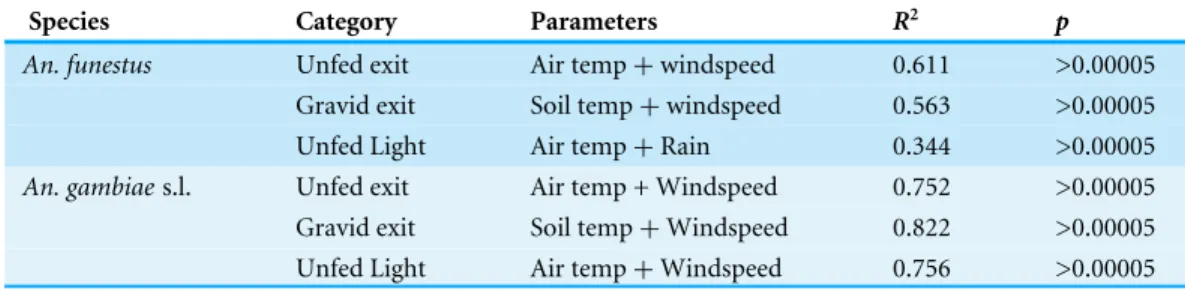
The best models for each species and each category of mosquito are given inTable 4. Adjusted rainfall was only included in one model. The models explained more of the variation inAn. gambiae s.l. than they did forAn. funestusalthough the environmental parameter used in the models, with the exception of the best model forAn. funestusand An. gambiae s.l. in light-traps, were the same. The explanatory values (the adjustedR2) were all higher for theAn. gambiaes.l. than for theAn. funestus.
Table 4 Models and mosquito numbers.Environmental regression models for the different categories of female mosquito collected, Furvela, 2001–1007.
Species Category Parameters R2 p
An. funestus Unfed exit Air temp+windspeed 0.611 >0.00005
Gravid exit Soil temp+windspeed 0.563 >0.00005 Unfed Light Air temp+Rain 0.344 >0.00005
An. gambiaes.l. Unfed exit Air temp + Windspeed 0.752 >0.00005
Gravid exit Soil temp+Windspeed 0.822 >0.00005 Unfed Light Air temp+Windspeed 0.756 >0.00005
Notes.
The equations for the different models are listed below:
LogAn. funestusLight-trap=+0.9178−0.445*log rain+0.0342*Air temp. LogAn. gambiaes.l. Light-trap= −1.419 + 0.117*Air temp−0.392*Windspeed. ExitAn. funesusunfed= −0.100 + 0.044*Air temp + 0.156*Windspeed ExitAn. funestusgravid= −0.099+0.0456*Soil temp−0.111*Windspeed. ExitAn. gambiaes.l. unfed= −1.629 + 0.1097*Air temp−0.446*Windspeed ExitAn. gambiaes.l. gravid= −2.05+0.10869 Soil temp−0.734*Windspeed.
20 22 24 26 28 30
0.00 0.25 0.50 0.75 1.00
Jan Feb Mar Apr May Jun Jul Aug Sep Oct Nov Dec
Te
m
p
e
ra
tu
re
(
o
C
)
Pr
o
po
rtio
n gr
a
vid
Month
Proportion funestus gravid Proprtion gambiae gravid Mean temp
Figure 9 Proportion ofAnopheles funestusandAn. gambiaes.l. indoor resting that were gravid at the time of collection and mean temperature, Furvela Mozambique.
during the cooler months of the year (May–August). In other words, oogenesis was taking longer at the lower temperatures.
semi-gravid and gravid. This implies that it was taking not just three but four days to complete gonotrophic development.
DISCUSSION
With the possible implications of Global Warming, the effect of temperature and other environmental parameters on the dynamics of malaria vectors in Africa is an area of increasing interest. The temperature in Furvela fluctuates between the minimum and optimum temperature for mosquito development, hence over the linear part of the reaction norm. Temperature was the most important environmental parameter, of those measured, determining mosquito numbers in the village. Although a more in depth assessment would probably improve the interpretation of the results, even in the straightforward analysis presented here mean daily temperatures from either air or soil sensors explained 70% and 35% of the density changes observed inAn. gambiaes.l. and An. funestusrespectively (Table 2). As expected, given its rapid developmental time, rates of increase were substantially higher in theAn. gambiae s.l. compared to theAn. funestus. Sporozoite rates were also highest during the warmer months of the year (File S12). The combined effect on the entomological infection rate (EIR) and malaria morbidity in the village will be examined elsewhere.
The population dynamics of An. funestuson the peninsula of Linga Linga across the Morrumbene Bay (Fig. 1) is determined by rainfall (Charlwood et al., 2013). The absence of a relationship between rainfall and mosquito numbers, particularly theAn. gambiaes.l., in Furvela is surprising. It may be due to the sandy soil in the village which means that rain is rapidly absorbed and the puddles are rare or absent. At the same time breeding conditions for theAn. funestusin the valley remain reasonably constant due to the irrigation practices of the local farmers and even major storms have only a temporary effect on the dynamics of the mosquito (Charlwood & Braganca, 2012).
The ratio of gravid to unfed mosquitoes in exit collections depends on a number of factors, in particular house construction. The two sets of females enter the house at different times (unfed newly emerged insects entering at dawn to rest and, soon-to-be-gravid, host seeking females, to feed throughout the night). They use different cues (visual contrast and odour) and enter through different routes (open doors and eaves) (Gillies, 1988). Thus, houses that may allow access for one group are not necessarily suitable for the other. In addition to house effects, the proportion of egg development time spent inside houses (which is presumed to be 100%, at least forAn. funestus), the survival rate per oviposition cycle and the duration of oogenesis, can all affect the unfed/gravid ratio. Should any of these factors change with temperature then the overall ratio will also change with temperature. The absence of change, as occurred with the An. gambiae s.l. implies that these factors remained constant, or compensated exactly, over the observed range of temperatures.
in the hot season than temperatures recorded outside. Nevertheless, more sophisticated measurement would only improve models forAn. gambiaeby a maximum of 30% and for An. funestusby 47% (and would imply that other factors, such as humidity, were of lesser importance).
Unlike An. funestusboth newly emerged and gravid An. gambiae s.l. increased in a similar fashion through the whole range of temperatures experienced in Furvela. There was no apparent effect of increasing temperatures on survival and the proportion of gravid to unfed insects remained more or less constant at all temperatures. The unfed/gravid ratio of the more commonAn. funestusdid, however, change with temperature. As temperatures increase above 26.5◦C a higher proportion of gravidAn. funestusis to be expected in exit collections since the duration of oogenesis is reduced from three to two days (Gillies & De Mellion, 1968). At the temperatures recorded in July it might take three or more days, as evidenced in the resting collections and formerly described by Gillies and WilkesGillies and Wilkes (1963)andGillies and Wilkes (1965). At the higher temperatures exit collections would therefore be expected to sample one half of the mature population (the other half being the semi-gravid insects that may move from one resting site to another, but in the absence of disturbance, do not leave the house) but at cooler temperatures only one third, or even less, of the population. At the higher temperatures, however, the proportion of gravid insects in the exit collections decreased, such that overall there was no significant relationship between the numbers of gravid and unfed insects in exit collections. This either means that that survival between emergence and maturity (i.e., becoming gravid) decreases at cooler temperatures or that post-teneral insects have a higher mortality at higher temperatures. Both sets of insects leave houses at the same time (Charlwood, 2011), hence sampling efficiency for the two groups should be the same.
A reduced survival among post-teneral adult An. funestusat the higher temperatures is possible as described from the laboratory (Christiansen-Jucht et al., 2015). High temperatures, independent of humidity, can have a lethal effect because as body temperature increases, metabolism and respiration increase up to a critical thermal limit, and there is a loss of integration between protein stability and metabolic processes that leads to death. Anopheles gambiae s.l. are larger thanAn. funestus.Volume to surface ratios differ and this may influence the ability of the adult insects to survive higher temperatures. Larger mosquitoes have a smaller surface to volume ratio and larger water reserves, which would allow them to offset the respiratory and cuticular water loss.
With one exception, windspeed was the only environmental parameter, other than temperature, included any model. Together they explained up to 82% of theAn. gambiae changes and 61% of theAn. funestus. The exception wasAn. funestusin light traps in which adjusted rain was included. Although still significant, this model had the lowest explanatory value (34%) of all the models.
maximum and minimum temperatures) were greatest in the cooler months. In the cool season the observed patterns in soil and air temperature were similar to shaded and open water as determined byHaddow (1943). In the warmer months’ fluctuations in temperature were less than at lower temperatures. Fluctuations around low mean temperatures can speed up rate processes, whereas fluctuations around high mean temperatures can slow them down (Paaijmans et al., 2010). Thus, theAn. gambiae s.l. were well suited to the temperature regimes experienced in Furvela.
Unfortunately, the species composition of the resting or exiting An. gambiae s.l. compared to those entering the house is not known. Nevertheless, the proportion of gravid insects in resting catches varied in a similar fashion to that seen among theAn. funestus. It is also possible that the different members of theAn. gambiaecomplex behaved differently or disappeared from the study area at different rates. Nevertheless, all members of the complex did apparently disappear during the study so that, perhaps it was not just a specific species that was affected but was a complex wide problem.Meyrowitsch et al. (2011)were unable to determine the cause of the decline ofAn. gambiaes.l. in the Tanga region of Tanzania, three thousand kilometers to the north of Furvela. In the Kilifi area of Kenya population decline ofAn. gambiae, shown by a reduction in genetic diversity in the mosquito, was attributed to the introduction of LLIN’s (O’Loughlin et al., 2016). The decline in Furvela started before the introduction of any control measures and although the introduction of LLIN’s may have exacerbated the problem for the mosquito it may not have been the cause of the decline in the first place. The decline also paralleled that observed in malaria in the Rufiji basin (Ishengoma et al., 2013). That similar declines appeared to occur over a 3,000 km stretch of coastline indicates that a climatic factor was responsible.
CONCLUSION
Temperature is a major driving force in the dynamics of bothAn. funestusandAn. gambiae s.l. in Furvela. Whilst gravidAn. funestusappeared to be negatively affected by the highest temperatures encountered increasing temperatures were favorable for theAn. gambiaes.l. which went through hundredfold changes in densities as a result. As average temperatures increase due to Global Warming areas whereAn. gambiae is the vector, if there remains sufficient water available for larval development, will be at heightened risk of malaria transmission.
ACKNOWLEDGEMENTS
ADDITIONAL INFORMATION AND DECLARATIONS
Funding
This work was funded by the Danish Bilharziasis Laboratory, Denmark. The funders had no role in study design, data collection and analysis, decision to publish, or preparation of the manuscript.
Grant Disclosures
The following grant information was disclosed by the author: Danish Bilharziasis Laboratory, Denmark.
Competing Interests
The author declares there are no competing interests.
Author Contributions
• Jacques Derek Charlwood conceived and designed the experiments, performed the experiments, analyzed the data, wrote the paper, prepared figures and/or tables, reviewed drafts of the paper.
Human Ethics
The following information was supplied relating to ethical approvals (i.e., approving body and any reference numbers):
Ethical clearance from the National Bioethics Committee of Mozambique on 2 April 2001 (ref: 056/CNBS/01). Householders were informed about the purpose of the collections. Verbal consent was obtained when collections were initiated.
Data Availability
The following information was supplied regarding data availability: The raw data has been supplied as aSupplemental Dataset.
Supplemental Information
Supplemental information for this article can be found online athttp://dx.doi.org/10.7717/ peerj.3099#supplemental-information.
REFERENCES
Bayoh MN, Lindsay SW. 2003.Effect of temperature on the development of the aquatic stages ofAnopheles gambiaesensu stricto (Diptera: Culicidae).Bulletin of Entomolog-ical Research93:375–381.
Charlwood JD. 2011.Studies on the biology of maleAnopheles gambiaeGiles and Anopheles funestusGiles from southern Mozambique.Journal of Vector Ecology
36:382–394DOI 10.1111/j.1948-7134.2011.00179.x.
Charlwood JD, Braganca M. 2012.The effect of rainstorms on adultAnopheles funestus behavior and survival.Journal of Vector Ecology37:1–5
DOI 10.1111/j.1948-7134.2012.00194.x.
Charlwood JD, Cuamba N, Tomás EVE, Briët OJT. 2013.Living on the edge: a longitu-dinal study ofAnopheles funestusin an isolated area of Mozambique.Malaria Journal
12: Article 208DOI 10.1186/1475-2875-12-208.
Charlwood JD, Thompson R, Madsen H. 2003.Swarming and mating inAnopheles funestusfrom southern Mozambique.Malaria Journal2: Article 3
DOI 10.1186/1475-2875-2-3.
Charlwood JD, Tomás EVE, Bragan¸ca M, Cuamba N, Alifrangis M, Stanton M. 2015.
Malaria prevalence and incidence in an isolated, meso-endemic area of Mozambique. PeerJ 3:e1370DOI 10.7717/peerj.1370.
Christiansen-Jucht CD, Parham PE, Saddler A, Koella JC, Basáñez M-G. 2014. Tem-perature during larval development and adult maintenance influences the survival of Anopheles gambiaes.s.Parasites & Vectors7: Article 489
DOI 10.1186/s13071-014-0489-3.
Christiansen-Jucht CD, Parham PE, Saddler A, Koella JC, Basáñez M-G. 2015.Larval and adult environmental temperatures influence the adult reproductive traits of Anopheles gambiaes.s.Parasites & Vectors8: Article 456
DOI 10.1186/s13071-015-1053-5.
Collins FH, Petrarca V, Mpofu S, Brandling-Bennett AD, Were JB, Rasmussen MO, Finnerty V. 1988.Comparison of DNA probe and cytogenetic methods for identifying field collectedAnopheles gambiaecomplex mosquitoes.American Journal of Tropical Medicine & Hygiene39:545–550.
Gillies MT. 1988. Anopheline mosquitoes: vector behavior and bionomics. In: Wersdor-fer WH, McGregor I, eds.Malaria, principles and practice of malariology, Chapter 16. Edinburgh: Churchill Livingstone.
Gillies MT, Coetzee M. 1987.A supplement to the anophelinae of Africa South of the Sahara (Afrotropical Region) Publication no. 55. Johannesburg: South African Institute for Medical Research.
Gillies MT, De Mellion B. 1968.The anophelinae of Africa South of the Sahara (Ethiopian Zoogeographical Region), 2nd Publication no. 54 edn.. Johannesburg: South African Institute for Medical Research.
Gillies MT, Wilkes TJ. 1963.Observations on nulliparous and parous rates in a popula-tion ofAnopheles funestusin East Africa.Annals of Tropical Medicine and Parasitology
57:204–213DOI 10.1080/00034983.1963.11686175.
Haddow AJ. 1943.Measurements of temperature and light in artificial ponds with reference to the larval habitat ofAnopheles (Myzomyia) gambiaeGiles, andA. (M.) funestusGiles.Bulletin of Entomological Research34:89–93
DOI 10.1017/S0007485300023609.
Heuval van den MJ. 1963.The effect of rearing temperature on the wing length, thorax length, leg length and ovariole number of the adult mosquito,Aedes acgyptii(L.). Transactions of the Royal Entomological Society of London115:197–216.
Holstein M. 1952.Biologie d’Anopheles gambiae. No 9. Monograph Series World Health Organization, 176pp.
Ishengoma DA, Mmbando BP, Segeja MD, Alifrangis M, Lemnge MM, Bygbjerg IC. 2013.Declining burden of malaria over two decades in a rural community of Muheza District, north-eastern Tanzania.Malaria Journal12: Article 338 DOI 10.1186/1475-2875-12-338.
Jepson WF, Moutia A, Courtis C. 1947.The malaria problem in Mauritius: the bio-nomics of Mauritian anophelines.Bulletin of Entomological Research38:177–208 DOI 10.1017/S0007485300030273.
Kampango A, Bragan¸ca M, De Sousa B, Charlwood JD. 2013.Netting barriers to prevent mosquito entry into houses in southern Mozambique: a pilot study.Malaria Journal
12: Article 99DOI 10.1186/1475-2875-12-99.
Kirby MJ, Lindsay SW. 2004.Responses of adult mosquitoes of two sibling species, Anopheles arabiensisandAn. gambiaes.s. (Diptera: Culicidae), to high temperatures. Bulletin of Entomological Research94:441–448.
Koekemoer LL, Kamau L, Hunt RH, Coetzee M. 2002.A cocktail polymerase reaction assay to identify members of theAnopheles funestus(Diptera: Culicidae) group. American Journal of Tropical Medicine and Hygiene66:804–811.
Le Sueur, Sharp BL. 1991.Temperature-dependent variation inAnopheles meruslarval head capsule width and adult wing length: implications for anopheline taxonomy. Medical and Veterinary Entomology5:55–62
DOI 10.1111/j.1365-2915.1991.tb00521.x.
Lyons CL, Coetzee M, Chown SL. 2013.Stable and fluctuating temperature effects on the development rate and survival of two malaria vectors,Anopheles arabiensisand Anopheles funestus.Parasites & Vectors6: Article 104DOI 10.1186/1756-3305-6-104.
Meyrowitsch DW, Pedersen EM, Alifrangis M, Scheike TH, Malecela MN, Magesa SM, Derua YA, Rwegoshora RT, Michael E, Simonsen PE. 2011.Is the current decline in malaria burden in sub-Saharan Africa due to a decrease in vector population? Malaria Journal10: Article 188DOI 10.1186/1475-2875-10-188.
O’Loughlin SM, Magesa SM, Mbogo C, Mosha F, Midega J, Burt A. 2016.Genomic signatures of population decline in the malaria mosquitoAnopheles gambiae.Malaria Journal 15: Article 182DOI 10.1186/s12936-016-1214-9.
Proceedings of the National Academy of Science of the United States of America
107:15135–15139DOI 10.1073/pnas.1006422107.
Scott JA, Brogdonw G, Collins FH. 1993.Identification of single specimens of the Anopheles gambiaecomplex by the polymerase chain reaction.American Journal of Tropical Medicine and Hygiene49:520–529.