Ebru KÜÇÜKYILMAZ(a)
Selcuk SAVAS(a)
Gokhan SAYGILI(b)
Banu UYSAL(b)
(a)Izmir Katip Celebi University, Faculty of
Dentistry, Department of Pediatric Dentistry, Izmir, Turkey.
(b)Izmir Katip Celebi University, Faculty of
Dentistry, Department of Endodontic, Izmir, Turkey.
Assessment of apically extruded debris
and irrigant produced by different
nickel-titanium instrument systems
Abstract:The aim of this study was to evaluate the preparation time and the amounts of apically extruded debris and irrigant using different nickel-titanium instrumentation systems. Forty-ive extracted single-rooted mandibular premolar teeth were selected and divided into three groups. The root canals were instrumented according to the manufacturers’
instructions, using a reciprocating single-ile system, a single-ile rotary system and a multiple-ile rotary system. Bidistilled water was used as the irrigant solution. The apically extruded debris and irrigant were collected into preweighed Eppendorf tubes. The amounts of extruded debris and irrigant were assessed with a precision micro-balance. The Eppendorf tubes were incubated at 37°C for 15 days. After the incubation period, they were weighed again to assess the debris extrusion. The time required to prepare the canals was also recorded. The results were statistically analyzed using MANOVA and Bonferroni’s adjustment. Considering the apically extruded
debris and irrigant, there were no statistically signiicant differences among
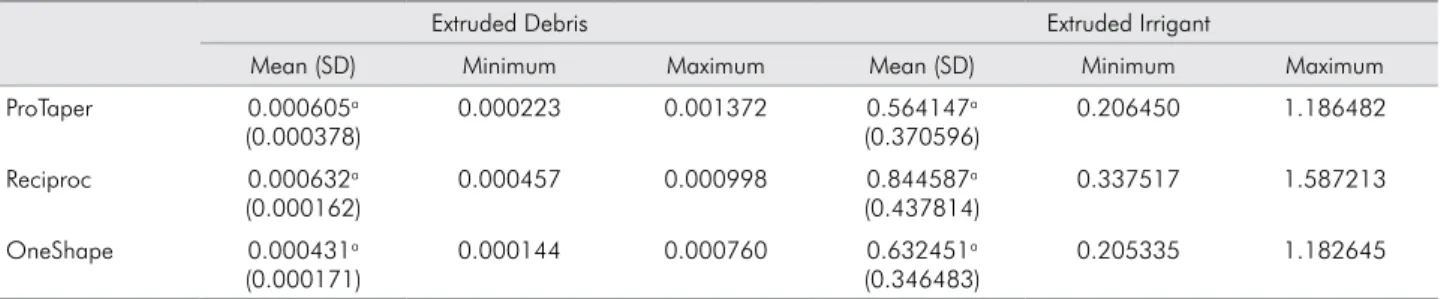
the groups (p > 0.05). The Reciproc group produced the highest debris (0.000632 ± 0.000162 gr) and irrigant (0.844587 ± 0.437814 ml) extrusion values. While the least extruded debris was observed with OneShape (0,000431 ± 0,000171 gr), the least extruded irrigant was observed with ProTaper system (0.564147 ± 0.370596 ml). Instrumentation was faster using the Reciproc than the other two instruments (70.27 ±13.38 s) (p < 0.05). All of the instrumentation systems used in this study produced apical debris and
irrigant extrusion. The reciprocating single-ile system tended to produce
more debris and irrigant extrusion, compared with the rotary systems.
Considering the preparation time, the single-ile systems appeared to be
advantageous due to their working time.
Keywords: Dental Instruments /Instrumentation; Root Canal Irrigants; Root Canal Preparation.
Introduction
Root canal preparation is an important step in endodontic treatment, and it plays a key role in treatment success. During chemo-mechanical preparation of root canals, necrotic debris, pulp remnants, microorganisms, dentin chips and irrigants can be extruded into the apical region.1,2 These
substances can lead to inlammation, lare-ups or healing delays.3
Numerous studies have evaluated the extrusion of intracanal materials
through the periapical region. A common inding has been that all instrumentation
Declaration of Interests: The authors certify that they have no commercial or associative interest that represents a conflict of interest in connection with the manuscript.
Corresponding Author:
Ebru Küçükyilmaz
E-mail: [email protected]
DOI: 10.1590/1807-3107BOR-2015.vol29.0002
Submitted: May 25, 2014
techniques produce apical extrusion to a certain extent.4,5,6,7
However, the amount of apical extrusion can vary according to the technique used.6,7,8,9 It is generally accepted
that instrumentation techniques that incorporate rotational action generate less debris than push-pull instrumentation, and the crown-down technique has been associated with the least amount of debris extrusion, compared
with techniques involving a linear iling motion. Thus, engine-driven rotary systems have tended to extrude less debris than hand techniques.5,9,10
Most nickel-titanium instrumentsusing torque control devices work with different instrumentation techniques, such as rotational or reciprocal action. There are different
designs available, with some having variations in lute
depth, different tapers, or cross-sections and others having radial lands.6,11 Single-ile nickel-titanium Reciproc
systems and OneShape systems, which can prepare the entire root canal with only one instrument, were recently
introduced. The Reciproc iles are composed of M-Wire nickel-titanium, which offers increased lexibility. The
reciprocating movement of the instrument reduces the risk of cyclic fatigue.11,12 In contrast, OneShape iles
employ traditional continuous rotation. They have a triangle-shaped cutting edge and two additional cutting edges, in the apical and coronal parts, as well as a cross-section that progressively changes from 3 to 2 cutting edges between the apical and coronal parts. This design offers optimal cutting action.12
To the best of our knowledge, although there have been similar studies in the literature, no studies have compared the extrusion of both apical debris and irrigation solution
by reciprocating and rotary single-ile systems to the
extrusion by other preparation systems. The aim of this study was to evaluate the preparation time and the amount of apically extruded debris and irrigant using two new
single-ile systems, OneShape and Reciproc, compared
with the rotary full-sequence ProTaper (Dentsply Maillefer, Ballaigues, Switzerland) system.
Methodology
The present study was approved by the Research Ethics Committee of the Izmir Katip Celebi University, under report no. 2014/60. In this study, 45 freshly extracted human mandibular premolar teeth with mature apices and straight root canals (< 5º according to the Schneider method) were selected.13 The teeth
were cleaned of external debris and soft-tissue remnants and were stored in saline solution. All of the teeth were analyzed with cone beam computed tomography (CBCT) (Newtom 5G, Verona, Italy) to ensure that they had single canals, as well as to assess the canal curve. Only single-rooted teeth with a single and round-shaped canal and a single apical foramen
were included in the study. Teeth with calciication
and internal resorption were excluded.
Forty-ive teeth were classiied into three groups:
1. Group 1: ProTaper instruments (Dentsply Maillefer, Ballaigues, Switzerland) were used according to the manufacturer’s instructions as follows: S1, S2, F1 (20.07), and F2 (25.08) (n = 15); 2. Group 2: A R25 Reciproc ile (VDW, Munich,
Germany), size 25 at the tip and having a taper
of 0.08 over the irst 3 mm, was used according
to the manufacturer’s instructions with recipro-cal action (n = 15);
3. Group 3: A OneShape ile (Micro-Mega, Cedex, Besançon, France), size 25 at the tip and having a taper of 0.06, was used according to the manufac-turer’s instructions with rotational motion (n = 15). To standardize the working length of the specimens, all of the teeth were shortened to 15 mm by a high-speed hand piece burr. The working length of each
tooth was determined by inserting a size 15 K-ile
(Dentsply Maillefer, Ballaigues, Switzerland) into the
canal until the tip of the ile was minimally visible
at the apical foramen. The working length was then set as 1 mm less than that of the canal length.
In this study, an experimental model was used, as described by Myers and Montgomery.14 Before starting
the experiment, the initial weights of empty Eppendorf tubes (the stoppers of the tubes were not separated) were measured with a 10-6 g precision electronic balance
(Sartorius Cubis, Gottingen, Germany). One hundred sequential weights were obtained for each tube, using the Sarto Connect Version computer program, version 3.5 (Sartorius Cubis, Gottingen, Germany), which was specially designed to record one measurement per second. The mean value was calculated for each tube and was recorded as the precise weight. A hole was created in the
middle of the removable stoppers that were used to ix the
teeth, and each tooth was then inserted into the hole. The
hermetic seal. A 25-G needle was placed alongside the stopper to balance the air pressure inside and outside the tubes. After polymerization of the acrylic resin, to avoid any leakage, a second sealing was applied. The
Eppendorf tubes were itted into the glass vials used to
hold the tubes during the instrumentation, to ensure that there was no contact with the tubes.
To avoid variation and to eliminate biases, the cleaning, shaping, and irrigation of all of the samples were completed by the same trained operator. Bidistilled water was used as the irrigant solution. In each sample, a total of 4 mL of bidistilled water was used as the irrigation solution between the
iles (Group 1) and between the pecking sequences
(Groups 2 and 3). A 25-G irrigation needle was placed in the canal without resistance but not deeper than the predetermined working length minus 1 mm.
After the instrumentation was complete, the stopper, needle, and tooth were separated from the tubes. The debris adhering to the root surface were collected by washing the root with 1 mL of bidistilled water in the tube. Each Eppendorf tube was weighed to determine the amount of debris and irrigant extruded to the periapical area. The tubes were then stored in an incubator at 37ºC for 15 days to evaporate the moisture before weighing the dry debris. The weight was calculated by a second examiner, who was blinded to the group assignment. The Eppendorf tubes were weighed using the same analytical balance to obtain
the inal weight of the tubes, including the extruded
debris. One hundred consecutive weights were obtained for each tube. The weight of the empty tube was subtracted from the weight of the tube containing debris, and the dry weight of the extruded debris was calculated for each tube.
The total preparation time, including total active instrumentation, instrument changes within the
sequence, cleaning of the lutes of the instruments
and irrigation, was recorded.
Statistical Analysis
Before beginning the study, a power analysis was performed with G*Power software, version 3.0.10 (Franz Faul-Christian Albrechts Universität, Kiel, Germany), to estimate the sample size. A power analysis was performed, based on the effects
obtained from a prior pilot study with 5 specimens in each group. The analysis indicated that a total of 45 specimens could achieve 88.6% statistical power
at an α = 0.05 signiicance level.
The amounts of extruded irrigant and debris and the preparation times were analyzed using the SPSS computer program, version 20.0 (IBM SPSS, Chicago, USA). The dependent variable across groups was examined in terms of assuming the existence of normality by performing the Shapiro-Wilk test and Levene’s test for constant homogeneous variances. The test indicated that the variables across groups completely met the underlying assumption of parametric tests. Accordingly, the data were analyzed statistically using MANOVA and post-hoc Bonferroni
adjustment at a signiicance level of p < 0.05.
Results
For apical extrusion of debris and irrigant, although
no statistically signiicant differences were obtained
between the groups (p > 0.05), Reciproc extruded more debris and irrigant compared with the other two instruments. While the least extruded debris was observed with OneShape, the east extruded irrigant was observed with ProTaper system. The mean values and standard deviations for all of the groups are presented in Table 1.
Considering the preparation time, while there
was no signiicant difference between the Reciproc
and the OneShape groups (p > 0.05), there were statistically significant differences between the other groups (p < 0.05). The minimum preparation
time was recorded with the Reciproc iles. The mean
values and standard deviations for all of the groups are presented in Table 2.
Discussion
Over the years, apical extrusion of intracanal materials has been investigated in many studies because of its clinical relevance.4,5,6,7,15,16 Apical extrusion
of intracanal materials can delay periapical healing
and cause inlammation and postoperative pain.3
The present study revealed that all of the instrumentation systems caused apical extrusion of debris and irrigants. The results were consistent with previous studies, which demonstrated that no method could completely prevent debris extrusion.14,16,17,18
Also, the results of the present study showed no
signiicant differences in the amounts of debris and irrigant extruded between the single-ile systems
and the full-sequence rotary system. However, the
reciprocating single-ile system extruded more debris
than the rotary instrument. This observation was in
agreement with previous indings that rotary systems
were associated with less debris extrusion than reciprocating systems.11,18 The obtained differences
between the instruments might have been caused by the preparation technique, the different tapers and the cross-sectional design of the instruments. While Reciproc has an S-shaped, cross-sectional design with sharp cutting edges,11 OneShape is characterized by a
changing triangular cross-section,12 and ProTaper is
characterized by a triangular or modiied triangular
cross-section.16,19 It can be speculated that the larger
taper of Reciproc at the tip compared with the other instruments and the reciprocal working motion might explain the greater amount of debris extrusion caused by this system. However, based on the available literature, it was not possible to determine whether
it was the reciprocal motion that was responsible for the increased risk of debris extrusion. Further studies using standardized apical tapers are required to answer this question.
Wh ile the ProTaper system requires four instruments to prepare the root canal to a size of 25, the Reciproc and OneShape systems can complete root preparation with only one instrument. Thus,
the single-ile systems were faster than the multiple-ile system, and the difference was statistically
significant. This finding was consistent with
previous studies in which the use of single-ile
systems reduced the working time, compared to
using a multi-ile rotary system.17,20
In previous studies, different techniques were used to measure the apically extruded debris and irrigant.14,21,22 In the current study, the generally accepted
method of Myers and Montgomery,14 which is more
standardized and repeatable than other methods,11,12
was used to collect the intracanal materials.
Many factors can affect the amount of extruded intracanal material. These factors include the instrumentation method, the instrument type and size, the size and length of the canal, the preparation endpoint, the apical stop preparation used, and the type and the amount of irrigant used.4,6,11,23 In
the present study, to minimize the effects of the aforementioned factors, standard conditions (other than the instrumentation system used) were created for all of the groups. The teeth were imaged using
CBCT to ensure that they had single canals and oriices,
and only single-rooted teeth with straight canals were used in this study to eliminate any possible variables. Before the instrumentation procedure, all of the teeth were decoronated to eliminate any possible
Table 1. Amount of Apically Extruded Debris (gram) and Irrigant (milliliter) after Use of the Different Instruments.
Extruded Debris Extruded Irrigant
Mean (SD) Minimum Maximum Mean (SD) Minimum Maximum
ProTaper 0.000605a
(0.000378)
0.000223 0.001372 0.564147a
(0.370596)
0.206450 1.186482
Reciproc 0.000632a
(0.000162)
0.000457 0.000998 0.844587a
(0.437814)
0.337517 1.587213
OneShape 0.000431a
(0.000171)
0.000144 0.000760 0.632451a
(0.346483)
0.205335 1.182645
SD: Standard deviation
The letters indicate significantly different groups (p < 0.05).
Table 2. Preparation Time with the Different Instruments (second).
Preparation Time Mean ± SD Minimum Maximum
ProTaper 135.40a ± 31.91 96 195
Reciproc 70.27b ± 13.38 53 93
OneShape 83.53b ± 21.18 45 123
variables associated with the working length of each tooth that might manifest as differences in debris extrusion. The working length for all of the specimens was 1 mm shorter than the root length. Studies have
shown that signiicantly more debris extrusion occurs
when the instrumentation is performed at the canal length than when the instrumentation is performed at 1 mm short of the canal length.14,24
In the current study, the type and quantity of the irrigants used were the same. Bidistilled water was used as an irrigation solution to avoid any possible weight increase due to crystallization of sodium hypochlorite.11,25 The amount of irrigation solution
was kept constant in all of the groups, to decrease variables during the irrigation process.
There have been a number of studies in the literature on the amount of apically extruded dry debris.8,9,10,11,14,15,16,17 During chemo-mechanical
preparation of root canals, irrigation solutions, as well as intracanal debris, can be accidentally extruded into the periapical area. These two components were responsible for post-operative flare-ups.26
Therefore, the present study focused on the extrusion of intracanal irrigants, in addition to solid debris.
It must be emphasized that the results of this study cannot be directly extrapolated to the clinical situation. Under clinical conditions, periapical tissues and bone serve as natural barriers against the apical extrusion of debris and irrigants.27 The present study was a
laboratory investigation, and different results might be achieved with in vivo studies or in a clinical situation.
Conclusion
All of the instrumentation systems used in the present study produced apical extrusion of intracanal debris and irrigation solution.
Considering the preparation time, the single-ile
systems used in the study appeared to be advantageous due to their working time.
Considering the amounts of apically extruded debris
and irrigant, the single ile rotary instrumentation system,
with the relatively small amounts of apically extruded debris and irrigant and short preparation time, might be preferable and should be investigated in clinical use.
1. Siqueira Junior JF, Rocas IN, Paiva SS, Guimaraes-Pinto T, Magalhaes KM, Lima KC. Bacteriologic investigation of the effects of sodium hypochlorite and chlorhexidine during the endodontic treatment of teeth with apical periodontitis. Oral Surg Oral Med Oral Pathol Oral Radiol Endod. 2007 Jul;104(1):122-30.
2. Seltzer S, Naidorf IJ. Flare-ups in Endodontics I. Etiological factors. J Endod. 1985 Nov;11(11):472-8.
3. Siqueira Junior JF. Microbial causes of endodontic flare-ups. Int Endod J. 2003 Jul;36(7):453-63.
4. Reddy SA, Hicks ML. Apical extrusion of debris using two hand and two rotary instrumentation techniques. J Endod. 1998 Mar;24(3):180-3.
5. Ferraz CC, Gomes NV, Gomes BP, Zaia AA, Teixeira FB, Souza-Filho FJ. Apical extrusion of debris and irrigants using two hand and three engine-driven instrumentation techniques. Int Endod J. 2001 Jul;34(5):354-8.
6. Albrecht LJ, Baumgartner JC, Marshall JG. Evaluation of apical debris removal using various sizes and tapers of ProFile GT files. J Endod. 2004 Jun;30(6):425-8.
7. Adl A, Sahebi S, Moazami F, Niknam M. Comparison of apical debris extrusion using a conventional and two rotary techniques. Iran Endod J. 2009 Fall;4(4):135-8.
8. Al-Omari MA, Dummer PM. Canal blockage and debris extrusion with eight preparation techniques. J Endod. 1995 Mar;21(3):154-8.
9. Azar NG, Ebrahimi G. Apically-extruded debris using the ProTaper system. Aust Endod J. 2005 Apr;31(1):21-3. 10. Bidar M, Rastegar AF, Ghaziani P, Namazikhah MS.
Evaluation of apically extruded debris in conventional and rotary instrumentation techniques. J Calif Dent Assoc. 2004 Sep;32(9):665-71.
11. Bürklein S, Benten S, Schäfer E. Quantitative evaluation of apically extruded debris with different single-file systems: Reciproc, F360, and OneShape versus Mtwo. Int Endod J. 2014 May;47(5):405-9. DOI: 10.1111/iej.12161. Epub 2013 Jul 26. 12. Liu R, Hou BX, Wesselink PR, Wu MK, Shemesh H. The
incidence of root microcracks caused by 3 different single-file systems versus the ProTaper system. J Endod. 2013 Aug;39(8):1054-6.
13. Schneider SW. A comparison of canal preparations in straight and curved root canals. Oral Surg Oral Med Oral Pathol. 1971 Aug;32(2):271-5.
14. Myers GL, Montgomery S. A comparison of weights of debris extruded apically by conventional filling and Canal Master techniques. J Endod. 1991 Jun;17(6):275-9.
15. Elmsallati EA, Wadachi R, Suda H. Extrusion of debris after use of rotary nickel-titanium files with different pitch: A pilot study. Aust Endod J. 2009 Aug;35(2):65-9
16. Beeson TJ, Hartwell GR, Thornton JD, Gunsolley JC, Comparison of debris extruded apically in straight canals: conventional filling versus Profile 04 Taper series 29. J Endod. 1998 Jan;24(1):18-22. 17. Tanalp J, Kaptan F, Sert S, Kayahan B, Bayirli G. Quantitative
evaluation of the amount of apically extruded debris using 3 different rotary instrumentation systems. Oral Surg Oral Med Oral Pathol Oral Radiol Endod. 2006 Feb;101(2):250-7 18. Altundasar E, Nagas E, Uyanik O, Serper A. Debris and
irrigant extrusion potential of 2 rotary systems and irrigation needles. Oral Surg Oral Med Oral Pathol Oral Radiol Endod. 2011 Oct;112(4):e31-5.
19. Koçak S, Koçak MM, Sağlam BC, Türker SA, Sağsen B, Er Ö. Apical extrusion of debris using self-adjusting file, reciprocating single file and 2 rotary instrumentation systems. J Endod. 2013 Oct;39(10):1278-80.
20. Bürklein S, Hinschitza K, Dammaschke T, Schäfer E. Shaping ability and cleaning effectiveness of two single file systems in severely curved root canals of extracted teeth: Reciproc and Waveone versus Mtwo and ProTaper. Int Endod J. 2012 May;45(5):449-61.
21. Fairbourn DR, McWalter GM, Montgomery S. The effect of four preparation techniques on the amount of apically extruded debris. J Endod. 1987 Mar;13(3):102-8
22. McKendry DJ. Comparison of balanced forces, endosonic and step-back filing instrumentation techniques: quantification of extruded apical debris. J Endod. 1990 Jan;16(1):24-7. 23. Tinaz AC, Alacam T, Uzun O, Maden M, Kayaoglu G. The
effect of disruption of apical constriction on periapical extrusion. J Endod. 2005 Jul;31(7):533-5.
24. Logani A, Shah N. Apically extruded debris with three contemporary NiTi instrumentation systems: an ex-vivo comparative study. Indian J Dent Res. 2008 Jul-Sep;19(3):182-185.
25. Bürklein S, Schäfer E. Apically extruded debris with reciprocating single-file and full-sequence rotary instrumentation systems. J Endod. 2012 Jun;38(6):850-2. 26. Nair PN. On the causes of persistent apical periodontitis: a
review. Int Endod J. 2006 Apr;39(4):249-81.