Original article (full paper)
Sport Sciences scientiic journals in
Chile (1929-2014): bibliography,
characteristics, quality
Mikel Pérez-Gutiérrez Roberto Iván Lagos-Hernández Universidad Autónoma de Chile, Temuco, Chile
Abstract––To date, several studies about sport sciences in Chile have been developed, but any of them has
been focused on its scientiic journals. Thus, the aim of the present study was to prepare a bibliography of the sport sciences scientiic journals published in Chile until 2014 and describe their characteristics and quality. All journals dedicated to sport sciences and published in Chile until 2014 were included, registering their bibliographic information, characteristics and quality. Twelve journals published from 1912 to 2014 were discovered, six of them
currently edited. Most of them were published by universities in the metropolitan region with a biannual frequency, did not include address information of editorial committee’s members, used a non blind review process for submitted articles and were not indexed in any database. In conclusion, these journals should improve their formal aspects and characteristics for increasing their visibility and quality.
Keywords: history, periodicals, visibility
Resumo––“As revistas cientíicas de ciências do esporte no Chile (1912-2014): bibliograia, características, qualidade.” Até agora, têm se desenvolvido vários estudos sobre ciências do desporto no Chile, mas nenhum deles relativos a
suas revistas cientíicas. Portanto, o objetivo desta pesquisa foi o de preparar uma bibliograia das revistas cientíicas de ciências do esporte publicada no Chile até 2014 e descrever suas características e qualidade. Sendo assim foram consultadas todas as revistas da área publicadas no Chile até 2014, registrando suas informações bibliográicas, características e qualidade. Foram encontradas 12 revistas publicadas no período 1912–2014, seis de elas presentes na atualidade. A maioria foi publicada por universidades na região metropolitana a cada seis meses, não incluindo membros do conselho editorial, usaram um processo de revisão de artigos não cegos e não estavam indexados. Em conclusão, estas revistas devem adaptar os seus aspectos formais e características para aumentar a sua visibilidade e indexação.
Palavras-chave: história, revistas, visibilidade
Resumen––“Revistas cientíicas de ciencias del deporte en Chile (1912-2014): bibliografía, características, calidad.” Hasta el momento se han desarrollado varios estudios relativos a las ciencias del deporte en Chile, pero ninguno de ellos sobre sus revistas cientíicas. Por eso, el objetivo de la presente investigación fue preparar una bibliografía de las revistas cientíicas de ciencias del deporte publicadas en Chile hasta el año 2014 y describir sus características y calidad. Para ello, se consultaron todas las revistas del área publicadas en Chile hasta el año 2014, registrando su información bibliográica, características y calidad. Se encontraron 12 revistas publicadas entre 1912 y 2014, seis de ellas vigentes. La mayoría fueron publicadas por universidades en la región metropolitana con una periodicidad semestral, no incluyeron la ailiación de los miembros del consejo editor, utilizaron un proceso de revisión de artículos no ciego y no estaban indexadas. En conclusión, estas revistas deberían mejorar sus aspectos formales y características para aumentar su visibilidad e indexación.
Palabras claves: historia, revistas, visibilidad
Introduction
Sport sciences is a growing ield of knowledge in Chile, relected
on the amount of degrees offered by higher education institutions
(CNED, 2014; Ipsos Public Affairs, 2010; MINEDUC, 2015a)
and the increasing number of academics, articles (Andrade,
López, Ramírez-Campillo, Beltrán, & Rodríguez, 2013), events (Clínica MEDS, 2014; Educarchile, 2014; Ramírez Campillo, 2014; s.a., 2014; UPLA, 2014) and scientiic journals (Revista Observatorio del Deporte, 2015).
as well as for the social, academic and professional
legitimi-zation of this ield (Olivera Betrán, 2007, 2011). Due to this
relevance, several studies have been developed for analysing
sport sciences journals’ history (Williams, Hardy, & Mutrie, 2008), productivity (Arbinaga Ibarzábal, Aragón Domínguez, & Tejedor Benítez, 2010; López Moreno & Velasco Martín, 2004), contents (Dogliotti, 2014; Perrino Peña, 2014), access
(Job, Mattos, & Clipes Ferreira, 2013), management (Fernandez
Vaz, Quintão de Almeida, & Bassani, 2014; Gomes de Barros, Rombaldi, Terra Borges, & Florindo, 2014; Moreira, 2014; Tani, 2014) or quality and visibility (Devís Devís, Antolín Jimeno, Villamón, Moreno Doña, & Valenciano Valcárcel, 2003; Valenciano Valcárcel, Devís Devís, & Villamón, 2008b; Valenciano Valcárcel, Villamón, & Devís Devís, 2008; Villamón, Devís Devís, Valencia-Peris, & Valenciano Valcárcel, 2007; Villamón, Devís Devís, & Valenciano Valcárcel, 2005) to name a few. Moreover, scientiic journals are both important for
the spreading of knowledge and the assessment of academics’ research activity, being their quality, indexation and impact on
the scientiic community a relection of the maturity of a certain ield of study (Martín Sempere, 2001).
In relation to sport sciences in Chile, there have been developed several works regarding the history of Physical Education (Cornejo Améstica, Matus Castillo, & Vargas Contreras, 2011; Martínez Fernández, 2012), the General
Ofice of Sports and Recreation (Muñoz Funck, 2001), Chilean
sport (Marín, 2007; Modiano, 1997), the analysis of physical
education curriculum and policy (Moreno-Doña & Gamboa Jiménez, 2014; Moreno Doña, Gamboa Jiménez, & Poblete Gálvez, 2014) or even a bibliometric and content analysis of
the journal titled Educación Física-Chile (Pérez-Gutiérrez
& Gutiérrez-García, 2015; Poblete Gálvez, Moreno Doña, & Rivera García, 2014).
However, no studies have been carried out in relation to the history of the scientiic sport sciences journals published
in Chile and their characteristics, although this information is relevant for discovering those publications that contributed to the spreading of sport sciences research as well as helps editors and authors to improve their journals’ quality and choose the journal for publishing their works respectively (Valenciano
Valcárcel, Devís Devís, & Villamón, 2008a). Therefore, the
aim of the present study was to prepare a bibliography of the
sport sciences scientiic journals published in Chile until 2014
and describe their characteristics and quality.
Methodology
All scientiic journals dedicated to sport sciences and pub
-lished in Chile until 2014 were included. Scientiic character and sport sciences terms were deined in accordance to Devís
Devís et al. (2003) recommendations. In this way, those jour-nals used by scholars to disseminate their works are considered
scientiic. Journals including in their title the words “sport,” “physical activity,” “physical education” or other related to
sport were included. Moreover, the journal must be published in Chile.
The online catalogues of Chilean National Library and
university libraries were consulted for information retrieval
about sport sciences scientiic journals. Scielo and Latindex
databases were also checked for discovering indexed journals. A provisional bibliography was elaborated and sent to the different directors of sport sciences degree in Chile for checking it and
reporting some undiscovered journal. New journals were not
reported in this phase.
Then, all journals’ issues were consulted, most of them in
the Chilean National Library as well as in the library of the
Department of Physical Education, Sports and Recreation at
the Universidad Metropolitana de Ciencias de la Educación for being the irst university in Chile preparing physical edu
-cation teachers (Cofré Ilufi, 1986; Rubilar Solis, 2012). Other
university libraries such as those of Universidad de la Frontera, Universidad de Playa Ancha and Universidad Central were also visited for consulting their journals. If possible, journal’s webpage was consulted for downloading the full text of its articles and/or issues.
Then, journal’s bibliographic information (title, ISSN,
director, editor, place of publication, life span, frequency of publication and issues) was registered in Excel 2013 program.
Moreover, journals were classiied and adapted to the ive sectors deined by the Frascati manual (OECD, 2002).
In relation to journal’s quality, Devís Devís et al. (2003) work was followed. Thus, three indicators were selected for the journal content’s quality such as the existence of the Editorial Committee,
the appearance of afiliation information of Editorial Committee’s
members and the explanation of manuscript selection process. Finally, for the analysis of journal’s visibility, two indicators were checked such as journal’s indexation and the type of online access offered. This information was extracted from the last published issue of each journal for depicting its current situation, similar to other related works (Devís Devís et al., 2003; Valenciano Valcárcel, Devís Devís, et al., 2008a; Valenciano Valcárcel,
Villamón, et al., 2008; Villamón et al., 2007).
Results and discussion
This chapter has been divided in three sections for present-ing the bibliographic information of the sport sciences
scien-tiic journals published in Chile, complementary information
about their characteristics and journals’ quality respectively, together with their discussion.
Bibliographic information of the sport sciences
scientiic journals
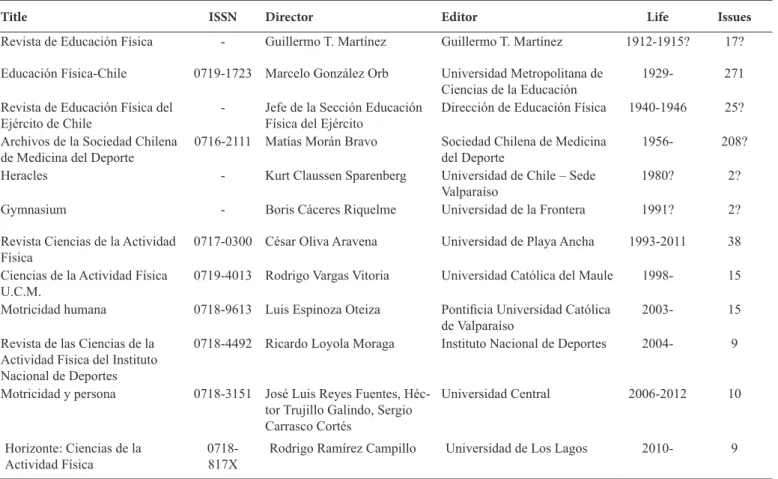
After data mining, twelve sport sciences scientiic journals were discovered from 1912 to 2014. Their main bibliographic in
-formation, such as title, ISSN, director, editor, life span and number
of published issues, is chronologically presented on Table 1. The
“?” character was used for indicating no reliable information due to all journal’s issues could not be accessed. The “-” character was
Table 1. Bibliography of sport sciences scientiic journals in Chile and their main characteristics.
Title ISSN Director Editor Life Issues
Revista de Educación Física - Guillermo T. Martínez Guillermo T. Martínez 1912-1915? 17?
Educación Física-Chile 0719-1723 Marcelo González Orb Universidad Metropolitana de
Ciencias de la Educación 1929- 271 Revista de Educación Física del
Ejército de Chile
- Jefe de la Sección Educación Física del Ejército
Dirección de Educación Física 1940-1946 25?
Archivos de la Sociedad Chilena de Medicina del Deporte
0716-2111 Matías Morán Bravo Sociedad Chilena de Medicina del Deporte
1956- 208?
Heracles - Kurt Claussen Sparenberg Universidad de Chile – Sede
Valparaíso
1980? 2?
Gymnasium - Boris Cáceres Riquelme Universidad de la Frontera 1991? 2?
Revista Ciencias de la Actividad Física
0717-0300 César Oliva Aravena Universidad de Playa Ancha 1993-2011 38
Ciencias de la Actividad Física U.C.M.
0719-4013 Rodrigo Vargas Vitoria Universidad Católica del Maule 1998- 15
Motricidad humana 0718-9613 Luis Espinoza Oteiza Pontiicia Universidad Católica de Valparaíso
2003- 15
Revista de las Ciencias de la Actividad Física del Instituto Nacional de Deportes
0718-4492 Ricardo Loyola Moraga Instituto Nacional de Deportes 2004- 9
Motricidad y persona 0718-3151 José Luis Reyes Fuentes, Héc -tor Trujillo Galindo, Sergio Carrasco Cortés
Universidad Central 2006-2012 10
Horizonte: Ciencias de la Actividad Física
0718-817X
Rodrigo Ramírez Campillo Universidad de Los Lagos 2010- 9
As shown, the appearance of these publications is spread along time. While eight journals were published from 1912 to the end of the 20th century, four journals have appeared during
the 21st century depicting an increasing development of this
ield. Moreover, six journals are currently published, including
Educación Física-Chile and Archivos de la Sociedad Chilena de Medicina del Deporte as the oldest ones. On the other hand, Heracles and Gymnasium were briely published, appearing only two issues respectively. It should be also noted that two
journals have recently inished their publication after several
years of life such as those edited by Universidad de Playa Ancha and Universidad Central. A brief explanation about the history, aim and publishing characteristics of each journal are chronologically presented in the following.
The irst sport sciences scientiic journal was titled Revista de Educación Física and appeared in 1912 due to the efforts
of Guillermo T. Martínez. No afiliation was included in the
journal but its editor in chief was full professor in the Instituto
Nacional de Chile, so this journal should be supported, to some
extent, by this educational institution which is the oldest one in
Chile (Instituto Nacional General José Miguel Carrera, 2015). Its irst editorial stated its aim was to become a mean for the spreading of the intellectuals’ scientiic and practical advance -ments (s.a., 1912).
Revista de Educación Física was monthly published but
sev-eral interruptions occurred along time because of its editor’s ield
trip abroad (Martínez, 1915). It included articles, reports, news
and information about the physical education activities devel-oped in Chile as well as its syllabus and regulations, informing professionals, teachers and academics. In this was, it became an important publication for the dissemination and strengthening of physical education in that period. Moreover, Joaquín Cabezas, the later director of the School of Physical Education Teachers and editor in chief of Educación Física-Chile, also collaborat-ed with this journal. This fact should have probably triggercollaborat-ed the later publication of Educación Física-Chile as a mean for continuing with the promotion of sport sciences.
Thus, Educación Física-Chile irstly appeared in 1929 pub
-lished jointly by the Physical Education General Ofice and the
School of Physical Education Teachers from the Universidad de Chile. Its editor in chief, Joaquín Cabezas García, was re-sponsible for both creating the school and the journal, driving physical education to the university level and spreading sport sciences research in Chile. The history of the journal has been studied by several authors (Croxatto, 1986; Guarda Etcheverry, 2006; Poblete Gálvez et al., 2014; Salas, 1989), including a bib -liometric approach (Pérez-Gutiérrez & Gutiérrez-García, 2015). Its history can be divided in four different periods according to
its four different titles along time. Thus, it was irstly entitled
Educación Física and published from 1929 to 1931. After two
Garretón & Martínez, 1985; Huneeus, 1988) and the instau
-ration of a military government in 1973 were relected on the
organization and management of this journal and its editorial committee (Agüero, 1985; Rubilar Solis, 2012), disappearing
from 1970 to 1973. One year later, the journal was published
again, being titled Educación Física-Chile.
From its beginning, Educación Física-Chile was strongly oriented to the dissemination of physical education and culture
events, facts and scientiic advancements, publishing along its
history more than 250 printed issues and from 2011 onwards in
digital format. However, it has been experiencing a decrease in
the amount of published articles from the decade of the 1990s and several management changes during the last three years (three different editors in chief), holding a marginal position nowadays (Pérez-Gutiérrez & Gutiérrez-García, 2015).
In 1940, the Chilean Army by means of the National Ofice
of Physical Education and Shot, started editing the journal titled Revista de Educación Física del Ejército de Chile, being its director the journal’s editor in chief. Although the issues
pub-lished from 1940 to 1944 could not be consulted, the National
Library of Chile registered the existence of those issues and the
numbering of volumes and issues it with this date. Moreover, 1944 journal’s editorial stated the bureaucratic and structure changes happened within the National Ofice had interrupted the publication of the journal (s.a., 1944). From 1944 onwards, Horacio Arancibia Laso, as director of the National Ofice, guided the journal until 1946 when it inally disappeared. It
was published every two months. The journal aimed to show and teach all about physical culture in general and to become a reference source for instructors, including new and interesting
studies and topics in relation to it (s.a., 1944).
The Chilean Army’s journal was divided in different sec-tions for including articles, interviews, and information about competitions, courses or sport reports. A total of 25 issues were discovered, compiling important information about the development of physical activities in both the Army and Chile. This journal together with Educación Física-Chile were the only publications presenting and publishing the sports culture
and the scientiic advancements at that time, being both of them
reference sources for studying sports development and context
during the irst half of the 20th century.
The Sociedad Chilena de Medicina del Deporte
(SOCHMEDEP, Chilean Society of Sports Medicine) was
created in 1955 and one year later its own publication appeared under the title of Archivos de la Sociedad Chilena de Medicina del Deporte, being the oldest of its speciality in Latin America
(SOCHMEDEP, 2015). Several editors have directed this jour -nal for more than half a century, being Matías Moran Bravo its current editor in chief. During most of the time, the journal was published every four months, but from 2006 onwards, it has annually appeared. The scope of the journal was clearly focused on sports medicine and physiology and its aim was to present
the activities developed by the SOCHMEDEP (s.a., 1956), but
other topics have been also included such as sports psychology,
anthropometrics or training (Rubilar Bernal, 2014).
At the beginning, this journal used to include information about the events and activities carried out in the Society together
with the results derived from its researches, but later scientiic
articles were only presented in its contents. More than 200 issues have been published in print format, and society’s webpage includes the history, past presidents and some of the article’s titles. Yet, it has not been indexed in any database.
Heracles was a publication from the Department of Physical Education, Sports and Recreation of the Universidad de Chile, located in Valparaíso campus (V Region). After the university
reform occurred in 1981 in Chile (Ministerio de Educación
Pública, 1980a, 1980b), this university was renamed to
Universidad de Playa Ancha. It was irstly published in 1980
and Kurt Claussen Sparenberg was its editor in chief. It declared a biannual frequency of publication but only two issues have been discovered.
Spreading the activities developed at the university and becoming a specialized media were the journal’s aims. For that purpose, six sections were included within Heracles, such as sports technique, biographies, essays, miscellany, recreation and others. Despite the academics’ desire for publishing this journal, it disappeared in 1981 probably due to the university reform happened in that year that involved the regionalization of the Universidad de Chile.
The Department of Physical Education at the Universidad de La Frontera (IX Region) published the journal titled Gymnasium in 1991, being Boris Cáceres Riquelme its editor in chief. Its aim was to present new information about sport activities and foster reader’s interest about the contents presented. In this way, Gymnasium included scientiic and technical articles, essays about sport and physical activities and a miscellaneous section presenting advices for practicing physical activity and sport as well as concepts and information about the department’s events.
In 1993 appeared the journal titled Revista Ciencias de la Actividad Física within the Physical Education Faculty of the
Universidad de Playa Ancha (V Region), being Cesar Oliva
Aravena its editor in chief from the beginning. This journal was
biannually published until 2012 when it inally disappeared. According to the irst issue’s presentation, the journal aimed to
contribute to the critical review of the knowledge production about physical activity sciences (Maurer Fürst, 1993). Moreover, it intended to show the several approaches around sport sciences
to the scientiic community and to establish exchange processes
with other national and foreign journals. But it also stated that the journal was born for solving some problems such as the scarce of information about sport sciences published in Spanish and the
lim-ited scientiic research developed in Chile (Maurer Fürst, 1993).
(2003-2010) and physical activity and sport sciences degree (2010-2012) respectively. These bulletins were not included in the present study due to their contents.
In 1998, the Physical Education Department of the
Universidad Católica del Maule (VII Region) started publishing
the journal titled Ciencias de la Actividad Física U.C.M. From 2006 onwards, Rodrigo Vargas Vitoria has been its editor in chief, leading the journal from its print to digital format and from annual to biannual frequency. The journal was aimed to
become a way for exchanging scientiic information among
physical activity professionals and trainers, sport coaches and other people interested in physical activity sciences in general (Montecinos Espinoza, 1998; s.a., 2013).
Along its history, the journal has published 17 issues with two issues per year in digital format from 2013 onwards. Its webpage (http://www.faced.ucm.cl/revief/) offers the possibility for fully downloading these issues, subscribe to the journal as well as con-tact and journal’s information. Moreover, the journal is indexed
in Latindex catalogue and EBSCO Host Research Databases. In 2003 the Pontiicia Universidad Católica de Valparaíso (V
Region) started the publication of the journal titled Motricidad humana with a biannual frequency. After several organizational changes, Fernando Rodríguez Rodríguez is currently its editor.
Those changes have not only inluenced the journal’s organic
structure but the contents, sections and format. Thus, it was
irstly published in print format from 2003 to 2008, and then
has been changed to digital format. The aims of Motricidad humana during its irst period were to become a link between
Pontiicia Universidad Católica de Valparaíso’s academics and
other sport sciences professors as well as to inform about the
development of sport sciences (Espinoza Oteiza, 2003). During
the second period, the journal has been mainly focused on the
spreading of scientiic research developed in physical education, human movement sciences and related ields for contributing
to the discussion and development of these areas (s.a., 2015). It has published 21 issues during its history, only interrupted
in 2005. During the irst period, the journal was divided in three sections dedicated to pedagogical strategies, scientiic research -es and information about university’s events. Then, it was clearly
oriented to a more scientiic approach including both original
articles, practical experiences and abstracts of the dissertations presented in the Physical Education School. The development
towards a scientiic-oriented journal has been inally achieved
through its indexation in Dialnet, Latindex directory and
Euro-American Scientiic Journals Improving Program.
The most important institution regarding sport in Chile, the
Instituto Nacional de Deportes (National Institute of Sports)
started publishing the journal entitled Revista de Ciencias de la Actividad Física y Deportes in 2004, and then it changed its name to Revista de las Ciencias de la Actividad Física del Instituto Nacional de Deportes in 2007. An editorial committee has guided this journal from its beginning, publishing it annu-ally except for 2006. Although no explanations were offered in the 2007 editorial about this appearance break, it should be
noted that during the irst period the journal did not include an ISSN, so the break possibly occurred for adjusting the journal
to formal requirements.
The aim of the journal was stated in its irst editorial, de -claring that the journal would be a way for national and
inter-nationally disseminating the Instituto Nacional de Deportes’
ability for developing and promoting the Physical Activity and
Sport Sciences (Velasco Rodríguez, 2004). During its ten years
of history, it has published nine issues in printed version for its spreading along the main libraries and sport institutions in Chile. The issues pertaining to the current period can be fully
downloaded from the Instituto Nacional de Deportes’ webpage
(http://www.ind.cl/). Moreover, the journal has been indexed in Dialnet and Latindex catalogue.
Motricidad y persona began its publication in 2006 under the patronage of the Universidad Central. An editorial committee
composed by José Luis Reyes Fuentes, Héctor Trujillo Galindo
and Sergio Carrasco Cortés has managed the journal. Although it intended to be biannually published, the frequency could not be maintained in 2007, 2009, 2011 and 2012, in which only one issue appeared. The aim of Motricidad y Persona was three-fold: foster the scholar dialogue regarding human movement,
spread of the scientiic research in this area, and systematize the
diversity of approaches around human movement sciences for achieving a consensus (s.a., 2006). In this way, it was mainly focused in human motricity sciences, accepting national and international contributions about this topic.
Although the journal has its own webpage (http://www.
ucentral.cl/revista-motricidad-y-persona/prontus_ucen-tral2012/2012-01-03/164025.html), only its history, scope, organization and contact information is presented. It was only edited in printed version, publishing ten issues. Although the journal was indexed in Dialnet and Latindex directory, no more issues appeared from 2012 onwards.
Finally, Horizonte: Ciencias de la Actividad Física irstly appeared in September 2010, published by the Department of Physical Activity Sciences of the Universidad de Los Lagos,
located in Osorno (X Region). Rodrigo Ramírez Campillo
has been its editor from the beginning, keeping a biannual frequency. Horizonte pretended to become a mutual link between its publishing Department and the Physical Activity
and Sport Sciences scientiic community, including the re -search carried out within the Universidad de Los Lagos as
well as national and foreign contributions (Negrón Molina,
2010). Thus, its aim was to create a place for contributing and promoting the research, together with the creation, spread, update, discussion and knowledge exchange in relation to the different areas and topics of physical activity sciences (Ramírez Campillo, 2011).
Horizonte is presented in printed and online versions, and
its nine volumes appeared until 2014 can be download from its
webpage (http://revistahorizonte.ulagos.cl/). It has not been yet indexed in any database, limiting the spreading and impact of its articles and journal’s visibility.
Characteristics of the sport sciences scientiic journals
were biannually published while only the Revista de Educación Física was monthly edited.
Table 2. Frequency of publication of sport sciences scientiic journals in Chile.
Journals Annual Biannual Bimonthly Monthly
n 3 7 1 1
% 25.00 58.33 8.33 8.33
The number of journal’s issues is strongly related to the amount of articles submitted and accepted for publication. A large amount of articles usually represents a high frequen-cy of publication. Therefore, the non-existence of three- or four-monthly journals is indicating a slow pace of productivity in sport sciences research in Chile.
As shown in Table 3, most of the journals (77,27%) have been edited in Central Chile (Metropolitan and V Regions), while three journals have been published in other regions such as Maule, Araucanía and Los Lagos. But it should be noted that
Santiago and Valparaíso concentrate the 40.6% and 10.1% of Chilean people (INE, 2014) and 60% of the universities have located their headquarters in Santiago de Chile (MINEDUC,
2015b), so journals are distributed in accordance with these demographic data.
Table 3. Place of publication of sport sciences scientiic journals in Chile.
Jour-nals
Metro-politan Region
V Region
(Valparaí-so)
VII Region (Maule)
IX Region
(Arau-canía)
X Region (Los Lagos)
n 6 3 1 1 1
% 50 27.27 9.09 9.09 9.09
The distribution of journals according to their publisher presents the kind of institutions supporting the development and spreading of sport sciences research in Chile (see Table
4). Universities were the main institutions editing scientiic
journals with the 66.67% of total publications. In comparison
with the sport sciences scientiic journals published in Spain,
they were mainly edited by professional associations together with universities, collecting both institutions approximately 68% of them (Devís Devís et al., 2003; Villamón et al., 2007).
Table 4. Publishers of sport sciences scientiic journals in Chile.
Journals Professional
associations Universities Government Particular
n 1 8 2 1
% 8.33 66.67 16.67 8.33
But it is also interesting to point out the role played by the government for supporting the dissemination of sport sciences research. Thus, it has edited two journals in different periods of time, such as Revista de Educación Física del Ejército de Chile
during 1940-1946 and Revista de las Ciencias de la Actividad Física del Instituto Nacional de Deportes from 2004 onwards.
Among the powers conferred to the National Institute of Sports,
created in 2001 by the passing of the 19712 sports law, was to carry out strategies for spreading values, ideas and knowledge about physical activity and sport. In this way, the government was not only promoting and supporting physical and sporting activities but also disseminating the knowledge about them.
For that purpose, it created its own scientiic journal, which
has become an important mean for presenting the Institute’s
researches (Velasco Rodríguez, 2004) as well as those developed
by other academics.
Quality analysis of the sport sciences scientiic journals
The existence of journal’s editorial committee and the in-formation provided about its members is presented in Table 5. Most of the journals (75%) included an editorial committee for assessing the received manuscripts but a 58.33% of them did not indicate their members’ address. This information is important for assessing the journal’s institutional opening (Valenciano
Valcárcel, Villamón, et al., 2008) and the creation of networks and bonds with external academics. Moreover, the existence of an editorial committee is related to journal content’s quality because it evaluates the relevance and quality of the submitted articles.
Table 5. Editorial committee and institution of its members.
Journals
Editorial Committee
Institution of Editorial Committee’s members
Yes No
No-one
Almost anyone
Almost everyone
Every-one
n 9 3 7 0 0 5
% 75.00 25.00 58.33 0 0 41.67
Therefore, editorial committee and the address information of their members should be included in all journals for improv-ing the selection of the submitted manuscripts and determinimprov-ing the opening of this process and the journal’s networks.
However, a clearer indicator of journal content’s quality is
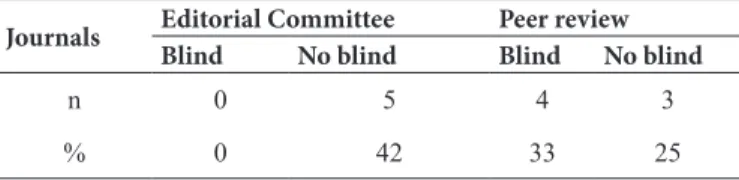
the manuscript selection process. Table 6 shows the amount of journals distributed according to their kind of article selection process. Peer review process was used by seven journals, four of
them with a blind process. On the other hand, the editorial com
-mittee carried out the article selection process in ive journals. It
should be highlighted the blind peer review process is the main
method for evaluating scientiic articles (Smith, 2006; Weller,
2002) and achieving journal’s quality (Camí, 1997; Giménez
Toledo & Román Román, 2001; McNutt, Evans, Fletcher, &
Table 6. Manuscript selection process in sport sciences scientiic jour -nals in Chile.
Journals Editorial Committee Peer review Blind No blind Blind No blind
n 0 5 4 3
% 0 42 33 25
Finally, journal’s visibility is considered an indicator of its quality since its main aim is the spreading of knowledge and
research among scholars and scientiic community (Valenciano
Valcárcel et al., 2008). In this way, journal’s indexation is related
to its fulilment of different format and content criteria deined by databases. Despite the signiicance of this indicator, seven
journals were not included in any database (Table 7). Because of the relevance and impact of internet in present society for accessing information, more and more journals are published online, partially or completely. As shown in Table 7, three jour-nals were edited in print and online respectively, while two were printed but also presented a webpage for consulting information about them. In addition, three journals were published both in print and online. In this way, sport sciences journals published in Chile have been adapting to digital format for making more ac-cessible their information and improving their articles’ visibility.
Table 7. Visibility of sport sciences scientiic journals in Chile.
Jour-nals
Databases Publishing process
Yes No Print Print and web
Print and abstract online
Print and online
On-line
n 5 7 4 2 0 3 3
% 41.67 58.33 33.33 16.67 0 25 25
In comparison with the studies related to Spanish sport sciences journals, the results are quite similar in quality but not in quantity. Thus, Devís Devís et al. (2003) found 26 Spanish sport sciences journals in 2000 that increased to 32 periodicals
in 2007 (Villamón et al., 2007), while the present study collected 12 journals, six of them currently published. Both Spanish and Chilean sport sciences journals are in the same situation since the information about authors’ address, indexation and peer review process are their weaknesses.
Thus, sport sciences journals published in Chile should be adapted to formal requirements demanded by databases for improving their visibility, and possibly the amount of submitted
articles (Villamón et al., 2005). The non-existence of Chilean sport sciences journals indexed in Scielo, or other internation-al databases such as Web of Science or Scopus, reduces their attractiveness, causing Chilean academics tend to submit their articles in foreign journals for achieving recognition, improving their scholar assessment and competing for research projects
(Devís-Devís, Villamón, & Valenciano Valcárcel, 2014; Tani, 2014; Valenciano Valcárcel, Devís Devís, et al., 2008b). This
situation should be solved for strengthening sport sciences ield in Chile, since journals contribute to the deinition of this ield
and establish quality criteria for the development and spreading
of research (Tani, 2014). Therefore, they should irstly attempt
to adapt to Scielo’s formal requirements since it is the main
national database supported by the National Committee of Scientiic and Technological Research in Chile (CONICYT).
This will also facilitate the improvement of sport sciences
sci-entiic journals because they could apply to the governmental funds created for that purpose (CONICYT, 2015).
Conclusion
The present study showed twelve sport sciences scientiic journals published in Chile from 1912 to 2014, six of them currently published. All of them aimed to spread the scientiic
advancements related to sport sciences along time, but their scope, contents and life span were different.
Regarding their characteristics, they have been biannually published in the metropolitan region by universities mainly, due to the centralization of people and universities in Santiago de
Chile. However, professional associations and the government
have also developed some initiatives for supporting the sport sciences research dissemination.
According to their content quality and visibility, improve-ments should be carried out for adapting them to databases’ formal requirements. Particularly, address information of all editorial members, blind peer review process for submitted articles and digital edition with online full text access should be adopted for achieving their indexation in main databases and increasing their visibility. These improvements are important for strengthening sport sciences research, journals and academics in Chile.
Future researches should be focused on the bibliometric
analysis of sport sciences scientiic journals for showing the
main topics, subjects, authors, institutions and countries rep-resented on them. Content analysis should be also developed for presenting the physical education and sports ideological orientation along time in Chile, represented on these journals.
References
Agüero, F. (1985). La reforma en la Universidad de Chile. Santiago: Ediciones Sur.
Andrade, D.C., López, B.A., Ramírez-Campillo, R., Beltrán, A.R., & Rodríguez, R.P. (2013). Bibliometric analysis of South American research in sports science from 1970 to 2012. Motriz, 19, 783-791. doi: http://dx.doi.org/10.1590/S1980-65742013000400017 Arbinaga Ibarzábal, F., Aragón Domínguez, J.D., & Tejedor Benítez,
R. (2010). Análisis bibliométrico de la Revista de Psicología del Deporte (1992-2009) (Bibliometric analysis of the Revista de Psicología del Deporte (1992-2009)). Revista de psicología del deporte, 19, 231-245.
Camí, J. (1997). Impactolatría: diagnóstico y tratamiento (Impactlatry: diagnosis and treatment). Medicina Clínica, 109(13), 515-524.
Congress of Sports Medicine (SOCHMEDEP)). Retrieved 27/05/2015, from http://www.meds.cl/noticias-y-actualidad/detal-le/meds-presente-en-59-congreso-medicina-deportiva-2014-soch -medep
CNED, Consejo Nacional de Educación (2014). Elige carrera (Choose course). Retrieved 29/09/2014, from http://www.eligecarrera.cl/ Index.aspx
Cofré Ilufi, M. (1986). El DEFDER y sus 80 años: el Instituto Superior de Educación Física y Técnica, hoy Departamento de Educación Física, Deportes y Recreación (DEFDER ant its 80 years: the Superior Instititute of Physical and Technical Education, today Physical Education, Sports and Recreation Department). Educación Física-Chile, LVII(208), 12-15.
CONICYT, Comisión Nacional de Investigación Científica y Tecnológica (2015). Concurso fondo de publicación de revistas cientíicas chilenas 2014 (Competition funds for publication of chilean scientiic journals 20014). Retrieved 27/05/2015, from http://www.conicyt.cl/informacioncientiica/2014/06/25/concur -so-fondo-de-publicacion-de-revistas-cientiicas-chilenas-2014/ Cornejo Améstica, M., Matus Castillo, C., & Vargas Contreras, C.
(2011). La Educación Física en Chile: una aproximación históri -ca (The Physi-cal Edu-cation in Chile: an histori-cal approach).
Lecturas: Educación isica y deportes, 16(161).
Croxatto, H. (1986). La revista “Educación Física, Chile” (The journal “Educación Física, Chile”). Educación Física-Chile, LVII(208), 11. Devís-Devís, J., Villamón, M., & Valenciano Valcárcel, J. (2014). Revistas iberoamericanas de Educación Física/Ciencias del Deporte presentes en Web of Science: evaluación y desafíos (Latinamerican journals of Physical Education/Sport Sciences included in the Web of Science: assessment and challenges). Revista Brasileira de Ciências do Esporte, 36, 723-732. doi: http://dx.doi.org/10.1016/j. rbce.2014.11.004
Devís Devís, J., Antolín Jimeno, L., Villamón, M., Moreno Doña, A., & Valenciano Valcárcel, J. (2003). Las revistas cientíico-técnicas españolas de las ciencias de la Actividad Física y el Deporte: in -ventario y análisis de la calidad de contenido y difusión (Spanish scientiic-technical journals about Physical Activity and Sport Sciences: bibliography and quality analysis of content and disemi-nation). Revista española de documentación cientíica, 26, 177-190. Dogliotti, P. (2014). Acerca de la “Cultura Física” en la revista Uruguay-Sport: Archivos de la CNEF, Uruguay (1918−1926) (About the “Physical Culture” within the journal Uruguay-Sport: Archives of CNEF, Uruguay (1918−1926)). Revista Brasileira de Ciências do Esporte, 36, 608-616. doi: http://dx.doi. org/10.1590/2179-325520143630001
Educarchile (2014). II Congreso Cientíico Internacional de Educación Física, “La Actividad Física y Calidad de Vida” (II International Scientiic Congress in Physical Education, “Physical Activity and Quality of Life”). Retrieved 27/05/2015, from http://www. educarchile.cl/ech/pro/app/detalle?ID=75286
Espinoza Oteiza, L. (2003). Editorial: al comienzo del camino (Editorial: at the beginning of the path). Motricidad humana, 1(1), 3.
Fernandez Vaz, A., Quintão de Almeida, F., & Bassani, J.J. (2014). Revista Brasileira de Ciências do Esporte: diiculdades, desaios e dilemas da editoração cientíica (Revista Brasileira de Ciências do Esporte: dificulties, challenges and dilemmas of the scientiic
publication). Revista Brasileira de Ciências do Esporte, 36, 752-758. doi: http://dx.doi.org/10.1016/j.rbce.2014.11.008
Garretón, M.A., & Martínez, J. (1985). Universidades chilenas: histo-ria, reforma e intervención (Chilean universities: history, reform and control) . Santiago: SUR.
Giménez Toledo, E., & Román Román, A. (2001). Elementos de calidad que deben estar presentes en las revistas cientíicas convencionales y/o electrónicas. Modelos de evaluación (Quality elements that must be presented in the printed and/or electronic scientiic jour -nals. Assessment designs). In A. R. Román (Ed.), La edición de
revistas cientíicas. Guía de buenos usos (The edition of scientiic
journals. Good uses handbook) (pp. 51-66). Madrid: Centro de Información y Documentación Cientíica.
Gomes de Barros, M.V., Rombaldi, A.J., Terra Borges, T., & Florindo, A.A. (2014). Revista Brasileira de Atividade Física & Saúde: ex-periências e processos editoriais (Revista Brasileira de Atividade Física & Saúde: editorial experiences and processes). Revista Brasileira de Ciências do Esporte, 36, 746-751. doi: http://dx.doi.
org/10.1016/j.rbce.2014.11.007
Guarda Etcheverry, S. (2006). Historia de la Revista de Educación Física (History of the Revista de Educación Física). Educación física Chile(265), 41-45.
Huneeus, C. (1988). La reforma universitaria: veinte años después (The university reform: twenty years later). Santiago: Corporación
de Promoción Universitaria.
INE, Instituto Nacional de Estadísticas (2014). Compendio estadís-tico (Statistical compendium). Santiago: Instituto Nacional de
Estadísticas.
Instituto Nacional General José Miguel Carrera. (2015). Presentación (Presentation). Retrieved 06/04/2015, from http://institutonacio -nal.cl/el-instituto/presentacion/
Ipsos Public Affairs. (2010). Análisis de mallas curriculares de las entidades de educación superior en el área de la actividad física y el deporte (Analysis of the syllabus of the higher education institutions in the physical activity and sports ield). Retrieved from Instituto Nacional de Deportes website: http://www.ind.cl/ estudios-e-investigacion/investigaciones/Documents/2012/anali-sis_mallas_curriculares.pdf
Job, I., Mattos, A.M., & Clipes Ferreira, A.G. (2013). Analíse do acceso aos artigos de uma revista eletronica através dos logs (Articles in an Eletronic Journal: Analysis of Access Through the Logs). Revista Brasileira de Ciências do Esporte, 35, 359-371.
López Moreno, A., & Velasco Martín, A. (2004). Breve análisis de la producción científica de la revista Archivos de medicina del deporte: periodo 1984-2002 (Short analysis of the scien -tific production in Archivos de Medicina del Deporte: years 1984 to 2002). Archivos de medicina del deporte: revista de la Federación Española de Medicina del Deporte y de la Confederación Iberoamericana de Medicina del Deporte(100), 93.
Marín, E. (comp.). (2007). Historia del deporte chileno: entre la ilusión y la pasión (History of the Chilean sport: among excitement and passion). Santiago: Comisión Bicentenario.
Martín Sempere, M.J. (2001). Papel de las revistas cientíicas en la transferencia de conocimientos (Role of the scientiic journals for the knowledge transfer). In A. R. Román (Ed.), La edición de
journals. Good uses handbook) (pp. 7-10). Madrid: Centro de Información y Documentación Cientíica.
Martínez Fernández, F. (2012). Prácticas y discursos: la formación de la Educación Física en Chile. 1889-1920 (Practices and speeches: the formation of Physical Education in Chile. 1889-1920). Lecturas:
Educación isica y deportes, 17(171), 1.
Martínez, G.T. (1915). De nuevo en el frente (At the front again).
Revista de Educación Física, III(1), 1.
Maurer Fürst, A. (1993). Presentación (Presentation). Revista Ciencias de la Actividad Física, 1, 3.
McNutt, R.A., Evans, A.T., Fletcher, R.H., & Fletcher, S.W. (1990). The effects of blinding on the quality of peer review. A random-ized trial. The Journal of the American Medical Association, 263, 1371-1376.
MINEDUC, Ministerio de Educación (2015a). Buscador de carreras (Course search engine). Retrieved 06/04/2015, from http://mi -futuro.cl/index.php/donde-y-que-estudiar/buscador-de-carreras MINEDUC, Ministerio de Educación (2015b). Buscador de in
-stituciones (Institution search engine). Retrieved 26/05/2015, from http://www.mifuturo.cl/index.php/donde-y-que-estudiar/ buscador-de-instituciones
Ministerio de Educación Pública (1980a). Fija Normas sobre Universidades. Decreto con Fuerza de Ley N° 1 de 30 de diciembre de 1980 (Enactment of universiy regulations. Government decree
N° 1 published December 30, 1980).
Ministerio de Educación Pública (1980b). Fija Normas sobre Universidades. Decreto con Fuerza de Ley N° 2 de 30 de diciembre de 1980. (Enactment of universiy regulations. Government decree N° 2 published December 30, 1980).
Modiano, P. (1997). Historia del deporte chileno: orígenes y transfor-maciones, 1850-1950 (History of the Chilean sport: origins and transformations, 1850-1950). Santiago: DIGEDER.
Montecinos Espinoza, R. (1998). Presentación (Presentation). Ciencias de la Actividad Física U.C.M., 1, 5.
Moreira, A. (2014). A busca continuada pela qualidade, visibilidade, interatividade e popularização do conhecimento: o caso da Revista Brasileira de Educação Física e Esporte (The continued seeking for quality, visibility, interactivity and popularization of knowledge: the case of Brazilian Journal of Physical Education and Sport).
Revista Brasileira de Ciências do Esporte, 36(4), 759-764. doi:
http://dx.doi.org/10.1016/j.rbce.2014.11.009
Moreno-Doña, A., & Gamboa Jiménez, R. (2014). Dictadura Chilena y Sistema Escolar: “a otros dieron de verdad esa cosa llamada educación” (Chilean dictatorship and School system: “education: that thing that was given to others”). Educar em Revista, 51, 51-66. Moreno Doña, A., Gamboa Jiménez, R., & Poblete Gálvez, C.A. (2014). La Educación Física en Chile: análisis crítico de la documentación ministerial (Physical Education in Chile: Critical Analysis about Ministerial Documentation). Revista Brasileira de Ciências do Esporte, 36, 411-427.
Muñoz Funck, C. (2001). Historia de la Dirección General de Deportes y Recreación: las políticas estatales de fomento al deporte.
DIGEDER 1948-2001 (History of the General Ofice of Sports
And Recreation: public policies of sports promotion. DIGEDER 1948-2001). Santiago: Instituto Nacional de Deportes.
Negrón Molina, M. (2010). Editorial (Editorial). Horizonte: Ciencias de la Actividad Física, 1, 3.
OECD, Organisation for Economic Co-operation and Development (2002). Frascati Manual. Proposed standard practice for sur-veys on research and experimental development. Paris: OECD
Publications Service.
Olivera Betrán, J. (2007). La punta del iceberg (The tip of the iceberg).
Apunts. Educación Física y Deportes, 90, 3-4.
Olivera Betrán, J. (2011). Aproximación a una clasiicación y cate -gorización de las revistas cientíicas españolas de Ciencias de la Actividad Física y el Deporte (Approach to a Classiication and Categorisation of Spanish Physical Activity and Sports Science Scientiic Journals). Apunts. Educación Física y Deportes, 3, 4-11.
doi: 10.5672/apunts.2014-0983.es.(2011/3).105.00
Pérez-Gutiérrez, M., & Gutiérrez-García, C. (2015). Historia de la revista Educación Física-Chile: aproximación bibliométrica (1929-2013) (History of the journal Educación Física-Chile: a bibliometric approach (1929-2013)). Movimento: revista da escola de educacao física da UFRGS, (en prensa).
Perrino Peña, M. (2014). Análisis bibliométrico, temático e ideológico de la revista de estudios deportivos Citius, Altius, Fortius (1959-1976) (Bibliometric, thematic and ideological analysis of the sport studies journal Citius, Altius, Fortius (1959-1976)). León: Universidad de León.
Poblete Gálvez, C.A., Moreno Doña, A., & Rivera García, E. (2014). Educación Física en Chile: Una historia de la disciplina en los es -critos de la primera publicación oicial del Instituto de Educación Física de la Universidad de Chile (1934-1962) (Physical Education in Chile: One Tells the History of the Discipline in the Writings of the First Oficial Publication of Physical Education Institute of the University of Chile (1934-1962)). Estudios Pedagógicos, XL(2), 265-282.
Ramírez Campillo, R. (2011). Información para autores (Information for authors). Horizonte: Ciencias de la Actividad Física, 2, 75. Ramírez Campillo, R. (2014). Proceedings I Congreso Anual del
Departamento Ciencias de la Actividad Física de la Universidad de Los Lagos (Proceedings of the I Annual Congress of the Physical Activity Sciences Department at the Universidad de Los Lagos).
Horizonte, 5, 8-31.
Revista Observatorio del Deporte, Universidad de Los Lagos (2015). Presentación (Presentation). Retrieved 28/04/2015, from http:// www.revistaobservatoriodeldeporte.cl/observatoriodeldeporte.html Rubilar Bernal, C.A. (2014). Análisis bibliométrico e interpretación
sociocultural de la literatura cientíica de las Ciencias de la
Actividad Física y el Deporte publicada durante el periodo del gobierno militar en Chile (1973-1990) (Bibliometric analysis
and sociociltural interpretation of the scientiic literature about
Physical Activity and Sport Sciences published during the mili-tary government in Chile (1973-1990)). (Tesis para optar al grado de Licenciado en Educación), Universidad Autónoma de Chile, Facultad de Educación, Temuco.
Rubilar Solis, L. (2012). Universidad Metropolitana de Ciencias de la Educación (Ex-Pedagógico), 1989-2010 (Universidad Metropolitana de Ciencias de la Educación (Ex-Pedagógico), 1989-2010). s.l.: Publicaciones UMCE.
s.a. (1912). Nuestros propósitos (Our purposes). Revista de Educación Física, 1(1), 1-2.
s.a. (1956). Editorial (Editorial). Archivos de la Sociedad Chilena de Medicina del Deporte, 1, 1.
s.a. (2006). Propósitos (Purposes). Motricidad y Persona, 1, 3. s.a. (2013). Sobre nosotros (About us). Retrieved 14/05/2015, from
http://www.faced.ucm.cl/revief/
s.a. (2014). Reunión anual RAFA (Red de Actividad Física para Las Américas) 2014 (RAFA annual meeting (Physical Activity for Las Américas Network). Retrieved 27/05/2015, from http://www. rafapana.org/index.php/es/noticias/378-reunion-anual-rafa-2014 s.a. (2015). Sobre la revista (About the Journal). Motricidad
huma-na. Retrieved 14/05/2015, from http://www.revistamotricidad.
com/?page_id=254
Salas, R. (1989). 60 años de una revista: Educación Física, Chile (60 years of a journal: Educación Física, Chile). Educación Física-Chile, LX(218), 4-8.
Smith, R. (2006). Peer review: a lawed process at the heart of science and journals. Journal of the Royal Society of Medicine, 99(4),
178-182. doi: 10.1258/jrsm.99.4.178
SOCHMEDEP, Sociedad Chilena de Medicina del Deporte (2015). Revista SOCHMEDEP (SOCHMEDEP Journal). Retrieved 14/05/2015, from http://sochmedep.cl/revista-sochmedep/ Tani, G. (2014). Editoração de periódicos em Educação Física/Ciências
do Esporte: dificuldades e desafios (Publication of Physical Education/Sport Sciences periodicals: dificulties and challenges).
Revista Brasileira de Ciências do Esporte, 36(4), 715-722. doi:
http://dx.doi.org/10.1016/j.rbce.2014.11.003
UPLA, Universidad de Playa Ancha (2014). I Congreso Internacional de Ciencias de la Actividad Física y del Deporte: postgrado e investigación (I International Congress of Physical Activity and Sport Sciences: postgraduate and research). Retrieved 27/05/2015, from http://www.upla.cl/congresoactividadisica/
Valenciano Valcárcel, J., Devís Devís, J., & Villamón, M. (2008a). Análisis comparativo de la calidad de las revistas cientíico-técni -cas españolas de Ciencias de la Actividad Física y el Deporte (2000-2005) (Comparative quality analysis of the Spanish scientif-ic-technical periodicals about Physical Activity and Sport Sciences (2000-2005). Information Research, 13(1).
Valenciano Valcárcel, J., Devís Devís, J., & Villamón, M. (2008b). Revistas cientíicas y evaluación de la actividad investigadora en las Ciencias de la Actividad Física y el Deporte (Scientiic journals and research evaluation in Physical Activity and Sport Sciences).
Apunts: Educación física y deportes, 94, 7-13.
Valenciano Valcárcel, J., Villamón, M., & Devís Devís, J. (2008). Evaluación y clasiicación de las revistas cientíico-técnicas es -pañolas de Ciencias de la Actividad Física y el Deporte (Assessment and classification of Spanish scientific-technical journals of Physical Activity and Sport Sciences). Revista española de
docu-mentación cientíica, 31, 396-412.
Velasco Rodríguez, E. (2004). Editorial (Editorial). Revista de Ciencias de la Actividad Física y Deportes, 1, 5.
Villamón, M., Devís Devís, J., Valencia-Peris, A., & Valenciano Valcárcel, J. (2007). Características y difusión de las revistas científ -ico-técnicas españolas de ciencias de la actividad física y el deporte (Dissemination and characteristics of Spanish physical activity and sport sciences scientiic and technical journals). El profesional de la información, 16, 605-616. doi: 10.3145/epi.2007.nov.07
Villamón, M., Devís Devís, J., & Valenciano Valcárcel, J. (2005). Análisis de la visibilidad de las revistas cientíico-técnicas españo -las de ciencias de la actividad física y el Deporte (Visibility analysis of of Spanish physical activity and sport sciences scientiic and technical journals). Revista de psicología del deporte, 14, 253-267. Weller, A.C. (2002). Editorial peer review: its strenghts and weak-nesses. Medford, NJ: American Society for Information Science
and Technology.
Williams, A.M., Hardy, L., & Mutrie, N. (2008). Twenty-five years of psychology in the Journal of Sports Sciences: A his-torical overview. Journal of Sports Sciences, 26, 401-412. doi:
10.1080/02640410701765631
Authors’ note
Corresponding autor
Mikel Pérez-Gutiérrez
Facultad de Educación, Universidad Autónoma de Chile
Avda. Alemania 01090, Temuco, IX Región de la Araucanía, Chile Phone: 0056 452895122
Email: [email protected]
Acknowledgements
The present study is included within the Research Project titled “Análisis bibliométrico e interpretación sociocultural de la produc -ción cientíico-técnica en el ámbito de las Ciencias de la Actividad Física y del Deporte en Chile” and funded by CONICYT, FONDE -CYT Iniciación 2013, Project n° 11130187. We acknowledge review-ers: Miguel Villamón Herrera ([email protected]), Universidad de Valencia, España; Alberto Moreno Doña (alberto.moreno@ucv. cl), Pontiicia Universidad Católica de Valparaíso, Chile; Carolina Alejandra Poblete Gálvez ([email protected]), Universi-dad de Santiago de Chile, Chile; Miguel Ángel Cornejo Améstica ([email protected]), Universidad de Concepción, Chile
Manuscript received on July 7, 2015 Manuscript accepted on November 18, 2015