Maiza Claudia Vilela Hipólito
I, Valéria Aparecida Masson
II,
Maria Inês Monteiro
III, Gustavo Luis Gutierrez
II
Universidade Estadual de Campinas, Physical Education College, Postgraduate
Program in Physical Education. Campinas, São Paulo, Brazil.
II
Universidade Paulista, Americana College. Campinas, São Paulo, Brazil.
IIIUniversidade Estadual de Campinas, Nursing College. Campinas, São Paulo, Brazil.
How to cite this article:
Hipólito MCV, Masson VA, Monteiro MI, Gutierrez GL. Quality of working life: assessment of intervention studies. Rev Bras Enferm [Internet]. 2017;70(1):178-86. DOI: http://dx.doi.org/10.1590/0034-7167-2015-0069
Submission: 12-21-2015 Approval:08-19-2016
ABSTRACT
Objective:to analyze the production of knowledge about interventions on quality of working life. Method: integrative review
study. The following databases were used for study selection: SciELO, Medline and PubMed. Results: the sample included 25
national and international articles that described programs and methods to acquire healthy habits at the workplace and attenuate
its mental demands. Conclusion: by observing the number of businesses throughout the world, a low number of programs
addressing workers’ health and well-being can be found, and the establishment of effi cient policies at institutions could improve this situation.
Descriptors: Intervention Studies; Quality of Life; Work; Health Promotion; Review.
RESUMO
Objetivo: analisar a produção de conhecimento sobre intervenções em qualidade de vida no trabalho. Método: estudo de
revisão integrativa. Para seleção dos estudos, utilizou-se as bases de dados: SciELO, Medline e PubMed. Resultados: a amostra
incluiu 25 artigos nacionais e internacionais que descreveram programas e maneiras de adquirir hábitos saudáveis no ambiente
laboral e amenizar as demandas mentais decorrentes do mesmo. Conclusão: diante da quantidade de empresas em todo o
mundo, verifi ca-se número inexpressivo de programas voltados para a saúde e bem-estar dos trabalhadores, e a implantação de políticas efi cientes nas instituições poderia minimizar tal situação.
Descritores: Estudos de Intervenção; Qualidade de Vida; Trabalho; Promoção da Saúde; Revisão.
RESUMEN
Objetivo:analizar la producción de conocimiento sobre intervenciones en calidad de vida en el trabajo. Método: estudio de
revisión integrativa. Para la selección de los estudios, se utilizaron las bases de datos: SciELO, Medline y PubMed. Resultados: la
muestra incluyó 25 artículos nacionales e internacionales que describieron programas y maneras de adquirir hábitos saludables
en el ambiente laboral y amenizar las demandas mentales resultantes del mismo. Conclusión: frente a la cantidad de empresas
en todo el mundo, se verifi ca un número inexpresivo de programas direccionados a la salud y bienestar de los trabajadores, y la implantación de políticas efi cientes en las instituciones podría minimizar dicha situación.
Descriptores: Estudios de Intervención; Calidad de Vida; Trabajo; Promoción de la Salud; Revisión.
Quality of working life: assessment of intervention studies
Qualidade de vida no trabalho: avaliação de estudos de intervenção
Calidad de vida en el trabajo: evaluación de estudios de intervención
REVIEW
INTRODUCTION
The understanding of the term quality of life (QoL) is multidisciplinary and recent, and its limits and concepts are in the process of being defined; thus, definitions of the term
are common, but not always in agreement(1). For the World
Health Organization (WHO), QoL is defined as “individu-als’ perceptions of their position in life in the context of the culture and value system where they live, and in relation to their goals, expectations, standards and concerns. It is a broad ranging concept, incorporating in a complex way a person’s physical health, psychological state, level of in-dependence, social relationships, personal beliefs and
rela-tionship to salient features of the environment”(2).
It is understood that QoL, by presenting various forms and aspects, is present in a variety of dimensions to verify aspects of individuals and of the collectivity. Regarding the workplace, there is the concept of quality of working life (QoWL), which is a comprehensive understanding of qual-ity of life at the workplace, including aspects of well-being, guarantee of health, physical, mental and social safety and training for conducting tasks safely and with good use of personal energy. The construction of QoWL begins when businesses and individuals are perceived as a whole, pro-moting workers’ well-being and safety with the aim of guar-anteeing higher productivity, work quality and higher
satis-faction with family and personal life(5).
Studies on QoWL were conducted in many countries, such as China, where the authors found that migrant work-ers had low QoL when compared to the general population. Thus, a health education intervention was conducted in the community, with improvements in QoL observed at the end
of the study, with resulting improvements in work quality(6).
In Brazil, at an agricultural product market in the city of Campinas, state of São Paulo, a study on work conditions, health aspects and work capacity was conducted with young workers, with the aim of promoting health at the workplace. Health promotion activities were conducted, such as educa-tional groups, distribution of pamphlets, exhibition of post-ers at the market based on the population’s health educa-tion and awareness of the adopeduca-tion of healthy life habits. Results analyzed demonstrated the need for interventions at the workplace, in order to maintain work capacity and, with
this, reduce the researched population’s fatigue(7).
In a research developed in the pacific Midwest, the au-thors explored factors that motivated the implementation of intervention actions to promote health at the workplace in small- and medium-size businesses, motivated by three ob-jectives: reduction of healthcare costs, addressing human relations and improvement of productivity. The conclusion was that health professionals must encourage health
promo-tion at the workplace(8).
A study conducted with primary health workers in Brazil found an association between adverse psychosocial work conditions and poor QoWL for workers, thus demanding intersectoral actions for health and QoWL promotion,
con-sidering the adverse psychosocial work conditions(9).
This evidences the importance of workplace interven-tions for attenuating the difficulties involved in work activi-ties and promoting individuals’ health. Considering the evi-dence, the following guiding question was created: “How do workplace interventions interfere in workers’ health?”
Thus, the proposed objective is to identify and analyze knowledge production regarding interventions conducted at the workplace that address QoWL.
METHOD
An integrative literature review study(10) was conducted
from August to October, 2014, in the SciELO, Medline and PubMed databases, with the aim of identifying studies re-lated to QoL, QoWL and intervention.
An integrative literature reviews is a more extensive re-view method, because it allows the inclusion of theoreti-cal and empiritheoreti-cal literature, as well as studies with varying methodological approaches (quantitative and qualitative). Studies included in the review are systematically analyzed according to their objectives, materials and methods, en-abling readers to examine preexisting knowledge regarding
the theme investigated(11).
For better systematization, these stages were followed: definition of the guiding question (problem) and research objectives; establishment of inclusion and exclusion criteria for publications (sample selection); searches in literature; analysis and categorization of studies; presentation and dis-cussion of results(10).
Indexed articles were searched in the Scielo, Medline and Pubmed databases, using the health sciences
descrip-tors (decs.bvs.br) “Intervention studies”, Quality of life” and
“Health Promotion”, which were integrated with the logical
Boolean operator “and”, published from 01/01/2005 until
12/31/2014, in Portuguese and English.
Inclusion criteria were: studies that addressed QoWL, QoWL interventions, as well as health promotion at the workplace. Articles which were not published in full were excluded.
To facilitate selection, categorization of information and study analysis, a script was developed with the following items: author, country, year, location, phenomenon re-searched, population and result. The first articles were se-lected by reading their titles and abstracts. Secondly, the articles in full were thoroughly read and the information obtained was presented as charts and analyzed, with three subthemes related to QoWL interventions: physical activi-ties and health care, mental demands of work (stress, inter-personal relations, psychological risks) and work capacity and disease prevention.
RESULTS
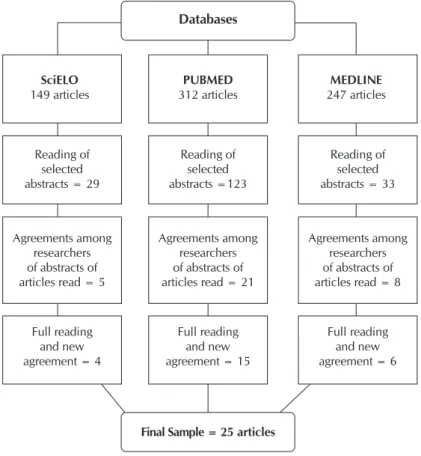
Eventually, 25 articles remained, which constituted the study sample, considering exclusion criteria (Figure 1) and articles that included authors, countries, objec-tives, population and main results regard-ing: physical activities and health care (Chart 1); mental demands of work (sleep, interpersonal relations, stress, psychologi-cal state) (Chart 2); and work capacity and disease prevention (Chart 3).
Regarding the methodology employed, two studies used the qualitative approach, 16 used the quantitative approach, five used systematic reviews, one used critical review and another used bibliographical review. As for study location, four inter-national studies were conducted in the Netherlands, three in Australia and one in each of the following countries: Canada, United Kingdom, Germany, New Zea-land, FinZea-land, Turkey and Spain. Among Brazilian studies, five were conducted in the state of São Paulo, two in Rio Grande do Sul and one in each of the following states: Paraná, Minas Gerais, Espírito San-to, Goiás, Rio de Janeiro and the Federal District, all of them published in the pe-riod from 2005 until 2014.
Chart 1 – Description of articles on physical activities and health care, according to author, country, population, objective, study method and main results, Campinas, São Paulo, Brazil, 2014
Author/ country Population Objective Study method Main results
Grande, 2013(12)
Brazil
190 workers To analyze determinant
factors of quality of life after three months of health promotion program for workers.
Experimental study: randomized clinical trial
When comparing national data to this study’s data for all self-referred chronic diseases, significant statistical differences were observed for hypertension, asthma and thyropathies (p < 0.0001). Practice of physical activities for aesthetic reasons has a negative influence on the perception of quality of life.
Johnston, 2014(13)
Australia
640 office workers
To investigate if the introduction of ergonomics and exercise into the workplace could diminish cervical pain.
Quantitative Protocol. Results will be disclosed after 12
months of intervention.
Mansi, 2013(14)
New Zealand
60 workers To investigate if a walking
program with use of a pedometer could improve health quality for meat processing workers
Quantitative The study was collected at three times, and
results have not been disclosed yet.
Cheema, 2013(15)
Australia
37 office workers
To determine if a Hatha
Yoga programcould improve
physiological stress and health.
Quantitative The yoga intervention significantly increased
lumbar and hip mobility (p < 0.001), and analyses revealed that those who had a high adherence to yoga had their anxiety state reduced (p = 0.02) and tended to have improved muscle resistance (p = 0.07).
Figure 1 – Diagram representation of article searches in databases, Campinas, São Paulo, Brazil, 2014
Final Sample = 25 articles SciELO
149 articles
PUBMED
312 articles
Reading of selected abstracts = 29
Reading of selected abstracts =123
MEDLINE
247 articles
Reading of selected abstracts = 33
Agreements among researchers of abstracts of articles read = 5
Agreements among researchers of abstracts of articles read = 21
Agreements among researchers of abstracts of articles read = 8
Full reading and new agreement = 4
Full reading and new agreement = 15
Full reading and new agreement = 6
Databases
Author/ country Population Objective Study method Main results
Rutanen, 2014(16)
Finland
123 women during menopause
To assess the effects of physical exercise on work capacity and daily effort.
Quantitative Increase in mental resources and decrease
in physical effort were significantly higher for the intervention group than for the control group (p < 0.05).
Vilsteren, 2012(17)
Netherlands Workers To investigate the effectiveness of an
intervention program at the workplace for workers with rheumatoid arthritis.
Quantitative Results have not been disclosed yet.
Morgan, 2012(18)
Australia 110 obese individuals To evaluate the impact of a weight loss program at the
workplace
Quantitative Weight loss and improvements in quality of
life, productivity, absenteeism and lesions for male workers.
Esmaeilzadeh, 2014(19) Turkey
400 computer
workers To investigate the effects of ergonomic interventions in
work-related upper extremity musculoskeletal symptoms (WUEMSS).
Quantitative In the intervention group, body posture
(p < 0.001) and workstation layout (p = 0.002) improved within 6 months. Intensity (p < 0.001), duration (p < 0.001), and frequency (p = 0.009) of WUEMSS significantly decreased for the intervention group when compared to the control group. Functional, (p = 0.001) physical, (p < 0.001) mental, (p = 0.035) and health states related to quality of life significantly improved in comparison to controls.
Santos, 2011(20)
Brazil 101 office workers To assess the impact of a prevention program for
work-related musculoskeletal disorders (WMSD) on quality of life for two groups.
Quantitative The intervention group received specific
counseling for WMSD prevention, whereas the control group received sanitary education. There were no statistically significant differences between groups (p > 0.05).
Cloostermans,
2014(21)
Netherlands
To verify in literature the effects of interventions for elderly workers related to retirement, work capacity and productivity.
Systematic review
Programs ranged from individual programs to workplace programs. Due to insufficient evidence, it was not possible to verify the interventions’ positive effects.
Harris, 2011(22)
United Kingdom
To assess the effectiveness and cost-effectiveness of e-learning interventions for changes in dietary behavior.
Systematic review
E-learning devices produced no significant changes in dietary behavior.
Chart 1 (concluded)
Chart 2 – Description of articles on mental demands of work (Sleep, interpersonal relations, stress, psychological state), according to author, country, population, objective, study method and main results. Campinas, São Paulo, Brazil, 2014
Author/country Population Objective Study method Main results
Pereira, 2010(23)
Brazil
Orchestral musicians
To verify the frequency of poor sleep quality
Quantitative Dimensions most frequently associated
with sleep quality were ability to perform daily activities, (p = 0.003) work (p = 0.004), pain, discomfort (p = 0.006), satisfaction with personal relationships (p = 0.007) and ability to enjoy life (p = 0.008). The physical domain in quality of life analysis was the one with the highest explanatory power for sleep quality (34%).
Author/country Population Objective Study method Main results
Barroso, 2013(24)
Brazil
24 community health workers (CHW)
To assess the existence of burnout syndrome and the quality of life of CHW.
Quantitative The perception that emotional
state interferes in work presented a significant correlation with total score in the burnout scale (p < 0.005) and environmental aspects of quality of life (p < 0.001).
Silva, 2013(25)
Brazil
284 workers of the electricity sector
To investigate the influence of quality of life and well-being dimensions on work; physical and security conditions, and relations.
Quantitative Opportunities for use and
development of their own
competences were the main positive predictors for the three indicators considered. In the process of factor validation of the Organizational Dimensions Scale for Quality of Life and Well-Being at Work, Bartlett’s sphericity test was significant (p < 0.001).
Oliveira, 2012(26)
Brazil
19 students To analyze work conditions of
college professors in the health field and their implications on health and quality of life.
Qualitative Absence of leisure with consequent
sleep disorders, favoring psychic diseases; excessive work; significant changes in work organization, negatively influencing health and quality of life.
Membrive, 2011(27)
Spain
203 climacteric women
To determine the association between professional activity and quality of life perceived by climacteric women.
Quantitative Quality of life perceived by women
during perimenopause who worked in the education field was higher than that of women working in the health field (p = 0.004).
Daubermann, 2012(28)
Brazil Eight nurses To learn the concepts and experiences of nurses on
quality of working life.
Qualitative Broad concepts on quality of life and
quality of working life were observed. The nurses were generally satisfied in those regards.
Padilha, 2009(29)
Brazil To analyze work precariousness factors in
relation to workers’ quality of working life.
Critical review Quality of working life policies
adopted in the businesses minimized work precariousness, but not the problem’s structural causes.
Pomaki, 2011(30)
Canada To verify evidence on incapacity prevention
interventions at the work place for workers with mental health problems.
Systematic
Review Access to treatment and interventions in the workplace could benefit workers with mental health problems.
Chart 2 (concluded)
Chart 3 – Description of articles on work capacity and disease prevention, according to author, country, population, objec-tive, study method and main results, Campinas, São Paulo, Brazil, 2014
Author/country Population Objective Study method Main results
Costa, 2012(31)
Brazil 100 production line workers (34 men
and 66 women)
To comparatively assess quality of life and work capacity of indus-trial workers.
Quantitative Young men obtained higher scores
for work capacity (p = 0.016), whereas women aged 30 - 39 pre-sented the worst values for quality of life (p = 0.027), especially for the domains social relations and environment.
Author/country Population Objective Study method Main results
Biallas, 2015(32)
Germany 75 individuals (55 men and 20 women)
of a medium-size company
To analyze the effects of health promotion at the workplace on work capacity and health related to quality of working life.
Quantitative Promoting exercise in the context of
occupational health promotion had a positive effect on quality of life and work capacity for workers.
Pizolato, 2013(33)
Brazil 70 instructors To investigate the impact of educational voice interventions
on quality of life and voice for instructors.
Quantitative Higher control and general scores
in the quality of life instrument after preventive intervention.
Reinhardt, 2009(34)
Brazil To search literature for situations that might hinder disease
preven-tion and other activities aimed at improving workers’ health in the health sector.
Bibliographical
review Intervention programs with no theoretical basis; failure to assess intervention effectiveness; health surveillance restricted to diseases and specific harms; lack of commit-ment from managecommit-ment; communi-cation gaps.
Groeneveld,
2010(35)
Netherlands
To summarize evidence for an effect of interventions segmented by lifestyle at the workplace ad-dressing the main biological risk factors for cardiovascular disease.
Systematic review
Effectiveness of lifestyle-based interventions at the workplace on body fat and for populations under risk of cardiovascular disease and body weight.
Rongen, 2012(36)
Netherlands To study the effectiveness of health promotion programs at the
workplace.
Systematic
review Partially determined by characteris-tics of intervention and analysis.
DISCUSSION
Seeking better understanding of analysis and discussion, data were grouped according to the following subthemes: physical activities and health care, mental demands of work (sleep, interpersonal relations, stress, psychological state) and work capacity and disease prevention.
Physical activities and health care
In this theme, 11 studies conducted in a variety of countries were found. These studies pointed to physical activities and health care as methods for QoWL intervention.
The use of physical activities for health promotion and consequent QoWL improvement was verified through re-search conducted in Finland with women during menopause, observing an increase in mental resources and decrease in
physical effort(16). In the state of Paraná, Brazil, a study sought
to investigate determinant factors for QoL after three months of a workers’ health promotion program carried out through physical activities at the workplace and counseling. It was concluded that factors that interfered on QoWL were: practice of physical activity with aesthetic objectives, physical condi-tion, smoking, physical activity for medical reasons, time
sit-ting down, family life, sleep quality and income(12).
Studies point to use of a variety of activities for
improv-ing QoWL. Exercises for body posture improvement(13),
walk-ing(14), and HathaYoga (15). Hatha Yoga was mentioned in a
study conducted in Australia as a method to improve
flexibil-ity, anxiety and workers’ musculoskeletal development(15).
Obesity is a serious public health problem with worldwide
prevalence(37). This emphasizes the importance of
introduc-ing programs aimed at weight loss, with the objective of improving workers’ health, productivity and self-esteem. Re-search conducted in Australia sought to conduct intervention through sessions of education, physical activity for overweight and obese men at an aluminum company, observing that in
14 weeks, there was an average loss of 4.4 kg(18).
Confirming previous research, in the interior of the state of São Paulo, Brazil, a program was established with the same aims of the research conducted in Australia, but with the intro-duction of healthy foods in the company’s restaurant, so that workers would acquire healthy habits and apply them outside
the work environment(38).
Healthy habits acquired through correct information at the work environment will enable workers to feel more energetic, healthy and that the company worries about their well-being.
Mental demands of work (sleep, interpersonal relations, stress, psychological state)
After reading their articles, eight studies stood out. They mentioned mental demands of work, such as sleep, interper-sonal relations, stress and psychological state.
Study conducted in the state of Rio Grande do Sul, Brazil, aimed to identify the frequency of low quality sleep and QoL
perception in a group of orchestral musicians. It demonstrated high frequency of low quality sleep, thus demanding
interven-tion that makes it possible to improve this situainterven-tion(23).
Con-firming the study conducted in the state of Rio Grande do Sul, a study conducted in the state of Espírito Santo identified sleep
disorders favoring psychic diseases in university professors(26).
Another study was conducted with workers of the electric-ity sector in six Brazilian states. It aimed to investigate the influence of QoL dimensions and well-being at the workplace (wages and benefits; opportunities for use and development of their own competences; physical and safety conditions at the workplace; relationship and communication between supervisors and workers; interpersonal relations with work colleagues) on their indicators (affective organizational com-mitment, work satisfaction, positive affection toward work), evidencing that opportunities for use and development of their own competences were the main positive predictors for
the three indicators considered.(25).
A critical review carried out in the interior of the state of São Paulo analyzed work precariousness factors in relation to QoWL, mentioning that work is a “game of strengths” con-trolled by the interests of employers and that QoWL policies adopted in companies could momentarily alleviate some
symptoms, but not the structural causes of the problems(29).
Stressful factors at the workplace, lack/inadequate material, human and environmental resources, as well as the estab-lished work process were evidenced in research with primary care nurses in the interior of the state of São Paulo, Brazil. However, generally, research subjects claimed to be satisfied
regarding their QoWL(28).
Work capacity and disease prevention
In this theme, six studies conducted in different coun-tries addressing work capacity and disease prevention were identified.
Work capacity is an important indicator of functional aging and worker safety, because it involves aspects related to physi-cal health, psychosocial well-being, individual competence
as well as work conditions and organization(39). Research
conducted in the interior of the state of São Paulo sought to compare QoL and work capacity in industrial workers, ob-serving that young men had the highest scores for work ca-pacity, whereas women aged 30 - 39 presented the worst QoL scores(31).
In Germany, a study verified the effects of health promotion through physical activities at the workplace on work capacity and health related to the QoL of workers at a medium-sized company. It was found that encouraging exercise in the con-text of occupational health promotion had a positive effect on QoL and work capacity of workers, thus, it is beneficial both
for individuals and companies(32).
Considering these studies, it can be concluded that pro-grams for occupational health promotion aim to improve lifestyles and, consequently, health, work capacity and work productivity(36).
Nonetheless, there are situations than can hamper inter-ventions for accident and disease prevention or workers’
health promotion, such as: intervention programs without good theoretical bases; inadequate evaluation of intervention effectiveness; health surveillance restricted to diseases and specific harms; management’s lack of commitment to inter-ventions; communication gaps; lack of workers’ participation and control over the workplace; and programs and
interven-tions based exclusively on changes in workers’ behavior(34).
Regarding interventions aimed at preventing pathologies, a study conducted in Finland demonstrated that interventions
segmented by lifestyle
(
to increase physical activity and/ordiet improvement) at the workplace, considering the main risk factors for cardiovascular disease, benefited the population at
risk, with a decrease in body weight(35).
An intervention study in the interior of the state of São Pau-lo, Brazil, with instructors, aimed to apply an instrument for vocal QoL assessment before beginning a prevention program for voice disorders, with vocal training exercises and instruc-tions about vocal hygiene habits. After three months of activi-ties, the questionnaire was applied again resulting in higher control and general scores for vocal QoL after the preventive intervention(33).
The introduction of flexible work hours can be beneficial for health. In the United Kingdom, a study sought to assess the effects (benefits and drawbacks) of this kind of work on physi-cal, mental and general health, as well as the collaborators’
well-being, observing that it has a positive effect on health(40).
A limitation of this study is the number of review articles and clinical trials, with few publications resulting from pro-grams focused on workers’ quality of life in comparison to the large number of existing companies. We believe that nurses who work in corporative institutions can establish and monitor programs focused on QoWL, with the aim of offering health for workers.
CONCLUSION
The research enabled the identification of some aspects that have been affecting the researched theme, and scientific evidence from QoWL interventions point to the importance of assertive interventions at the workplace.
In relation to workplace interventions focused on encour-aging physical activities and health care, it was found that physical activities, body posture improvement exercises, walks, Hatha Yoga, workplace exercises, and programs aimed at reducing body weight improve health, self-esteem, and pro-ductivity, offering benefits for workers’ health.
Mental demands of work, such as low quality sleep and an inadequate work environment, can be improved through specific interventions that foster health and well-being.
Interventions focused on work capacity promotion and dis-ease prevention have beneficial effects for workers when they are planned, established and evaluated.
REFERENCES
1. Almeida MAB, Gutierrez GL, Marques R. Qualidade de
vida: definição, conceitos e interfaces com outras áreas de pesquisa. São Paulo: Escola de Artes, Ciências e Hu-manidades-EACH/USP; 2012.
2. OMS. Promoción de la salud. Glossario. Genebra: OMS;
1998.
3. Zubaran C. The application of the drug user quality of life
scale (DUQOL) in Australia. Health Qual Life Outcomes [Internet]. 2012[cited 2015 Aug 18];10:31. Available from: http://www.hqlo.com/content/10/1/31.
4. Almeida MAB, Gutierrez GL. Qualidade de vida:
discus-sões contemporâneas. In: Vilarta R, Gutierrez GL, Mon-teiro MI. Qualidade de vida: evolução dos conceitos e práticas no século XXI. Campinas: IPES editorial; 2010.
5. Aquino AS, Fernandes ACP. Quality of life and work. J Health
Sci Inst [Internet]. 2013[cited 2015 Jun 15];31:1. Available from: http://www.unip.br/comunicacao/publicacoes/ics/edi coes/2013/01_janmar/V31_n1_2013_p53a58.pdf.
6. Zhu C, Geng Q, Yang H, Chen L, Fu X, Jiang W. Quality
of life in China rural-to-urban female migrant factory work-ers: a before-and-after study. Health Qual Life Outcomes [Internet]. 2013[cited 2014 Aug 14];11:123. Available from: http://www.hqlo.com/content/11/1/123
7. Masson VA, Monteiro MI, Vedovato TG. [Workers of CEASA:
factors associated with fatigue and work ability]. Rev Bras Enferm [Internet]. 2015[cited 2015 Sep 15];68(3):401-7. Available from: http://www.scielo.br/pdf/reben/v68n3/003 4-7167-reben-68-03-0460.pdf Portuguese.
8. Witt LB, Olsen D, Ablah, E. Motivating factors for small and
midsized businesses to implement worksite health promo-tion. Saúde Promot Pract [Internet]. 2013[cited 2014 Aug 15];14(6):876-84. Available from: http://www.ncbi.nlm.nih. gov/pubmed/23345340
9. Teles MA, et al. Psychosocial work conditions and quality of
life among primary health care employees: a cross sectional study. Health Qual Life Outcomes [Internet]. 2014[cited 2015 Jun 23];12:72. Available from: http://www.hqlo.com/ content/12/1/72
10. Mendes KDS, Silveira RCCP, Galvão CM. [Integrative litera-ture review: a research method to incorporate evidence in health care and nursing]. Texto Contexto Enferm [Internet]. 2008[cited 2014 Jan 22];17(4):758-64. Available from: http://www.scielo.br/pdf/tce/v17n4/18.pdf Portuguese.
11. Pompeo DA, Rossi LA, Galvão CM. [Integrative literature review: the initial step in the validation process of nurs-ing diagnoses]. Acta Paulista Enferm [Internet]. 2009[cited 2015 Aug 18];22(4):434-8. Available from: http://www. scielo.br/pdf/ape/v22n4/a14v22n4.pdf Portuguese.
12. Grande AJ, Silva V, Manzatto L, Rocha TBX, Martins GC, Vile-la Jr GB. [Determinants of quality if life at workpVile-lace: cluster-randomized controlled trial]. Rev Bras Med Esporte [Internet]. 2013[cited 2015 Aug 18];19:5. Available from: http://www. scielo.br/pdf/rbme/v19n5/en_a15v19n5.pdf Portuguese.
13. Johnston V, et al. A workplace exercise versus health
promotion intervention to prevent and reduce the eco-nomic and personal burden of non-specific neck pain in office personnel: protocol of a cluster-randomised con-trolled trial. J Physiother [Internet]. 2014[cited 2014 Aug 23];60(4):233. Available from: http://www.ncbi.nlm.nih.gov/ pubmed/25306220
14. Mansi S, Milosavljevic S, Tumilty S, Hendrick P, Baxter GD. Use of pedometer-driven walking to promote physical activ-ity and improve health-related qualactiv-ity of life among meat processing workers: a feasibility trial. Health Qual Life Out-comes [Internet]. 2013[cited 2014 Sep 16];11:185. Available from: http://www.hqlo.com/content/11/1/185
15. Cheema BS, Houridis A, Busch L, Raschke-Cheema V, Mel-ville GW, Marshall PW, et al. Effect of an office worksite-based yoga program on heart rate variability: outcomes of a randomized controlled trial. BMC Complement Altern Med [Internet]. 2013[cited 2014 Aug 27];13(82). Available from: http://www.biomedcentral.com/1472-6882/13/82
16. Rutanen R, Nygard CH, Moilanen J, Mikkola T, Raitanen J, Tomas E, et al. Effect of physical exercise on work ability and daily strain in symptomatic menopausal women: a randomized controlled trial. Work [Internet]. 2014[cited 2014 Sep 27];47(2):281-6. Available from: http://www. ncbi.nlm.nih.gov/pubmed/23324726
17. Vilsteren MV, Boot CRL, Steenbeek R, Schaardenburg DV, Alexandre E Voskuyl AE, Anema JR. An interven-tion program with the aim to improve and maintain work productivity for workers with rheumatoid arthritis: design of a randomized controlled trial and cost-effectiveness study. BMC Public Health [Internet]. 2012[cited 2014 Oct 12];12(496). Available from: http://www.biomedcentral. com/1471-2458/12/496
18. Morgan PJ, Collins CE, Plotnikoff RC, Cook AT, Berthon B, Mitchell S, et al. The impact of a workplace-based weight loss program on work-related outcomes in overweight male shift workers. J Occup Environ Med [Internet]. 2012[cited 2015 Aug 27];54(2):122-7. Available from: http://www.ncbi.nlm. nih.gov/pubmed/22269987
19. Esmaeilzadeh S, Ozcan E, Capan N. Effects of ergonomic intervention on work-related upper extremity musculo-skeletal disorders among computer workers: a random-ized controlled trial. Int Arch Occup Environ Health [In-ternet]. 2014[cited 2014 Aug 27];87(1):73-83. Available from: http://www.ncbi.nlm.nih.gov/pubmed/23263694 20. Santos AC, Bredemeier M, Rosa KF, Amantéa VA, Xavier
RM. Impact on the quality of life of an educational program for the prevention of work-related musculoskeletal disor-ders: a randomized controlled trial. BMC Public Health [Internet]. 2011[cited 2014 Aug 27];11(60). Available from: http://www.biomedcentral.com/1471-2458/11/60
22. Harris J, et al. Adaptive e-learning to improve dietary be-haviour: a systematic review and cost-effectiveness analy-sis. Health Technol Assess [Internet]. 2011[cited 2014 Sep 23];15(37):1-160. Available from: http://www.journalslib rary.nihr.ac.uk/hta/volume-15/issue-37
23. Pereira EF, Teixeira CS, Kothe F, Merino EAD, Daronco LSE. [Sleep quality and quality of life perception in orchestra musicians]. Rev Psiquiatr Clín [Internet]. 2010[cited 2014 Aug 17];37(2). Available from: http://www.scielo.br/pdf/rpc/ v37n2/a03v37n2.pdf Portuguese.
24. Barroso SM, Guerra ARP. [Burnout and quality of life in health comunitary agents of Caetanópolis (MG)]. Cad Saúde Colet [Internet]. 2013[cited 2014 Aug 17];21(3)338-45. Avail-able from: http://www.scielo.br/pdf/cadsc/v21n3/v21n3a16. pdf Portuguese.
25. Silva CA, Ferreira MC. [Dimensions and indicators of qual-ity of life and well-being at work]. Psic Teor Pesq [Internet]. 2013[cited 2014 Oct 23];29(3):331-9. Available from: http:// www.scielo.br/pdf/ptp/v29n3/v29n3a11.pdf Portuguese. 26. Oliveira ERA, Garcia AL, Gomes MJ, Bittar TO, Pereira AC.
[Gender and perceived quality of life: research with profes-sors from the health are]a. Ciênc Saúde Colet [Internet]. 2012[cited 2015 Aug 22];17(3):74-7. Available from: http:// www.scielo.br/pdf/csc/v17n3/v17n3a21.pdf Portuguese. 27. Membrive JM, Granero-Molina J, Salmerón MJS,
Fernán-dez-Sola C, López CMR, Carreño TP. Quality of life in perimenopausal women working in the health and educa-tional system. Rev Latino-Am Enferm [Internet]. 2011[cit-ed 2014 Act 12];19(6)14:21. Available from: http://www. scielo.br/pdf/rlae/v19n6/06.pdf
28. Daubermann DC, Tonete VLP. [Quality of work life of nurses in primary health care]. Acta Paul Enferm [Internet]. 2012[ci-ted 2014 Aug 23];25(2):277-83. Available from: http://www. scielo.br/pdf/ape/v25n2/a19v25n2.pdf Portuguese.
29. Padilha V. [Quality of work life in a setting of precarious-ness: a delusional panacea]. Trab Educ Saúde [Internet]. 2009[cited 2014 Oct 02];7(3):549-63. Available from: http://www.scielo.br/pdf/tes/v7n3/09.pdf Portuguese. 30. Pomaki G, Franco RL, Murray E, Khushrushahi N, Lampinen
TM. Workplace-based work disability prevention interven-tions for workers with common mental health condiinterven-tions: a review of the literature. J Occup Rehabil [Internet]. 2012[cit-ed 2014 Oct 15];22(2):182-95. Available from: http://link. springer.com/article/10.1007/s10926-011-9338-9
31. Costa CSN, Freitas EG, Mendonça LCS, Alem MER; Cou-ry HJCG. Work ability and quality of life of Brazilian in-dustrial workers. Ciênc Saúde Colet [Internet]. 2012[cited
2014 Oct 15];17(6):1635-42. Available from: http://www. scielo.br/pdf/csc/v17n6/v17n6a26.pdf Portuguese.
32. Biallas B. Analysis of workplace health promotion and its effect on work ability and health-related quality of life in a medium-sized business. Europe PMC [Internet]. 2015 [cited 2014 Oct 12];77(5):357-61. Available from: http:// europepmc.org/abstract/med/24810235.
33. Pizolato RA, Rehder MI, Meneghim MC, Ambrosano GM, Mialhe FL, Pereira AC. Impact on quality of life in teachers after educational actions for prevention of voice disorders: a longitudinal study. Health Qual Life Outcomes [Internet]. 2013[cited 2015 Oct 12];11(28). Available from: https://hqlo. biomedcentral.com/articles/10.1186/1477-7525-11-28 34. Reinhardt EL, Fisher FM. [Barriers to interventions aimed
at promoting the health of health care workers in Brazil]. Rev Panam Salud Publica [Internet]. 2009[cited 2015 Aug 27];25(5):411-7. Available from: http://www.scielosp.org/ pdf/rpsp/v25n5/05.pdf Portuguese.
35. Groeneveld IF, Proper KI, Van Der Beek AJ, Hildebrandt VH, Van Mechelen W. Lifestyle-focused interventions at the work-place to reduce the risk of cardiovascular disease - a systemat-ic review. Scand J Work Environ Health [Internet]. 2010[cited 2014 Sep 10];36(3):202-15. Available from: http://www.jstor. org/stable/40967848?seq=1#page_scan_tab_contents
36. Rongen A, Robroek SJ, Van Lenthe FJ, Burdorf A. Workplace health promotion: a meta-analysis of effectiveness. Am J Prev Med [Internet]. 2013[cited 2014 Aug 26];44(4):406-15. Avail-able from: http://www.ajpmonline.org/article/S0749-3797 (13)00012-3/abstract
37. Ogden CL, Yanovski SZ, Carroll MD, Flegal KM. The epi-demiology of obesity. Gastroenterology [Internet]. 2007[cited 2015 Aug 08];132:2087-102. Available from: http://www. sciencedirect.com/science/article/pii/S0016508507005793
38. Krabenhoft C. Intervenção em qualidade de vida com foco na obesidade e sobrepeso dos funcionários de uma indústria metalúrgica de médio porte. In: Vilarta R, Gu-tierrez GL. Qualidade de vida em propostas de interven-ção corporativa. Campinas: Ipes Editorial; 2007.
39. Martinez MC, Latorre MRDO, Fischer FM. [Work ability: a literature review]. Ciênc Saúde Colet [Internet]. 2010[cit-ed 2015 Jul 25];15(suppl1):1553-61. Available from: http://www.scielo.br/pdf/csc/v15s1/067.pdf Portuguese.