Rev Bras Anestesiol. 2013;63(1):159-162
Offi cial Publication of the Brazilian Society of Anesthesiology www.sba.com.br/rba/index.asp
REVISTA
BRASILEIRA DE
ANESTESIOLOGIA
Anesthetic Management of a Patient with Brugada Syndrome -
the Use of Sugammadex in Major Abdominal Surgery
LETTER TO THE EDITOR
ISSN/$ - see front metter © 2013 Sociedade Brasileira de Anestesiologia. Published by Elsevier Editora Ltda. All rights reserved.
Dear Editor,
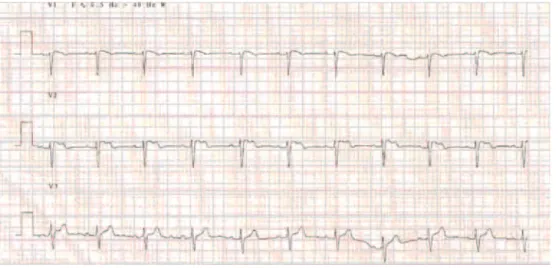
Brugada Syndrome (BS) is a rare genetic condition affecting ionic channels of the heart, predisposing patients to poten-tially fatal ventricular arrhythmias. It generally manifests during young adulthood, more frequently in males. Typical ECG pattern shows ST-segment elevation followed by a negative T wave in right pre-cordial leads, in the absence of structural heart disease. Three patterns can be recognized: 1) coved; 2) saddleback and 3) coved or saddleback with ST < 1 mm. These can co-exist and ECG may be temporarily normal. Diagnosis is made in the presence of ECG pattern type 1 and reinforced by clinical criteria like syncope, nocturnal agonal respiration, palpitations or dizziness, documented ventricular fi brillation/tachycardia and family history of BS or sudden cardiac death (SCD). Provocative tests can be made with sodium channel blockers. Cardiac defi brillator (ICD) implantation is recommended for all symptomatic patients and for those who, though asymptomatic, present inducible VT/VF during electrophysiologic study (EPS). Quinidine can be used safely as anti-arrhythmic agent when ICD implanta-tion is not possible 1.
Case Report
A 67-yr-old male was diagnosed with colon cancer and scheduled for a sub-total colectomy. Six years before, he had an ICD (VVIR) implanted after asymptomatic type I Brugada syndrome was diagnosed based on typical ECG pattern, easily inducible VT on EPS. Before surgery, ICD was externally disabled to prevent inadequate activation by monopolar cautery; from then on an external defi brilla-tor being permanently available. After premedication with midazolam (1mg), an epidural thoracic catheter was placed. Induction was achieved with fentanyl (0.02 mg.kg-1) and
propofol (2 mg.kg-1). Orotracheal intubation was performed
uneventfully after neuromuscular blockade with rocuronium (0.6 mg.kg-1). Anesthesia was maintained with sevofl urane,
rocuronium and epidural fentanyl. Monitorization included
5-lead ECG and ST trend analysis, invasive arterial blood pressure, peripheral arterial oxygen saturation, end tidal CO2, esophageal temperature, BIS, neuromuscular blockade and urine output. No dysrhythmia or ST-segment elevations were noted during the entire procedure, which lasted ap-proximately 2 hours. Neuromuscular blockade was reversed with sugammadex (2 mg.kg-1) and the patient extubated
without incidents. Analgesia was provided with epidural ropivacaine and morphine. In the post anesthetic care unit, ICD was re-activated. After 6 days the patient was discharged home, with no adverse events being reported.
Discussion
In BS patients, several pharmacological and physiological factors can initiate malignant arrhythmias, including medi-cations routinely used in anaesthetic practice, electrolyte disturbances, temperature variations, physiologic stress and increased vagal activity, all of which must be kept in the mind of the anesthetist managing these patients 2,3.
On this subject, recommendations are sparse and lim-ited by confl icting results found in literature, probably due to inter individual variability, medication associations and doses and physiologic circumstances 4.Propofol has been
as-sociated with the development of ventricular arrhythmias in prolonged infusions, suggesting a possible similar mechanism to that responsible for arrhythmogenesis in propofol infusion syndrome, rather than with bolus dosing for induction 5. Local
160 R. Conde and M. Pereira
muscle. Regarding volatile anesthetics, preference is given to sevofl urane as it provides a better stability of QT interval. Though it has been safely used 6, neostigmine is best avoided
in the reversal of neuromuscular blockade as it may augment ST segment elevation 7.
In this case we preferred to use sugammadex, a γ-cyclodextrine with a lipophylic center that encapsulates rocuronium (and vecuronium) molecules forming water solu-ble complexes that then are excreted in urine. Thereby, rapid and effective reversal of neuromuscular blockade is achieved, decreasing the risk of residual paralysis, particularly relevant in the case of major abdominal surgery, avoiding the side effects associated with neostigmine and anti-muscarinic agents, notably signifi cant in BS patients.
Conclusions
BS is a rare though potentially fatal condition. Threatening arrhythmias can be triggered by several factors often present during surgical procedures, putting patient safety at stake. Most importantly, in the anesthetic management of BS pa-tients, the decision of using each drug must be made after extensive consideration and in controlled conditions, avoiding other factors that are known to have the potential to induce arrhythmias like electrolyte and temperature disturbances, maintaining a close monitoring on hemodynamic status of the patient and being prepared to readily interfere if such events occur. Regarding the reversal of neuromuscular blockade, suggamadex presents as a safer option in BS patients, granting the desired goal while avoiding undesirable cardiovascular and autonomic effects.
Rita Conde 1, Marta Pereira 2
1. Residency, 2. Anesthesiology Expert Anaesthesiology and Pain Treatment Department, Centro Hospitalar de Trás-os-Montes e Alto Douro, Portugal
References
1. Benito B, Brugada J, Brugada R et al. – Brugada Syndrome. Rev Esp Cardiol,2009;62(11):1297-1315.
2. Carey SM, Hocking G. – Brugada Syndrome - a review of the implications for the anaesthetist. Anaesth Intensive Care, 2011;39:571-577.
3. Kloesel B, Ackerman MJ, Sprung J et al. – Anesthetic management of patients with Brugada syndrome: a case series and literature review. Can J Anesth 2011;58:824-836.
4. Postema PG, Wolpert C, Amin AS et al. – Drugs and Brugada syndrome patients: review of the literature, recommendations and an up-to-date website. Heart Rhythm, 2009;6(9):1335-1341.
5. Yap YG, Behr ER, Camm AJ – Drug induced Brugada syndrome. Europace, 2009;11:989-994.
6. Hayashida H, Miyauchi Y – Anaesthetic management in patients with high-risk Brugada syndrome. Br J of Anaesth, 2006;97(1):118-119.
7. Edge CJ, Blackman DJ, Gupta K et al. – General anesthesia in a patient with Brugada syndrome. Br J of Anaesth, 2002;89:788-791.