Carlos Henrique Silva Pedrazas(a) Mario Newton Leitão de Azevedo(b) Sandra Regina Torres(c)
(a) DDS; (b)PhD, Associate Professor – Department of Internal Medicine, University Hospital, Federal University of Rio de Janeiro (UFRJ), Rio de Janeiro, RJ, Brazil.
(c) PhD, Associate Professor, Department of Oral Pathology and Diagnosis, Dental School, Federal University of Rio de Janeiro (UFRJ), Rio de Janeiro, RJ, Brazil.
Corresponding author:
Sandra Regina Torres
Rua Almirante Gomes Pereira, 130 - apto. 202 - Urca
Rio de Janeiro - RJ - Brazil CEP: 22291-170
E-mail: [email protected]
Received for publication on Mar 19, 2010 Accepted for publication on Apr 26, 2010
Oral events related to low-dose
methotrexate in rheumatoid arthritis
patients
Abstract: Low-dose methotrexate (MTX) is frequently used for patients with rheumatoid arthritis (RA). High doses of MTX frequently produce side effects. The aim of this study was to explore oral complications of low-dose MTX therapy in a population of RA patients. This is a cross-sectional study in which oral examination was performed on a popula-tion of RA patients. Patients undergoing MTX therapy (5-20 mg weekly) for at least six months were included in the study group, and RA patients being treated under another regimen were used as controls. The frequen-cy of oral lesions was compared between groups. The chi-square test was used to compare frequencies. Relative risk (RR) and its conidence inter-val (CI) were established. Signiicance level was set at 0.05. Twenty-eight RA patients on a low-dose MTX regimen and 21 controls were enrolled in the study. Oral lesions were found in 22 patients (78.6%) undergo-ing MTX therapy, and in 5 patients (23.8%) undergoundergo-ing other therapies (p < 0.001). There were no signiicant differences regarding age, gender or dosage. The most common oral events observed in patients in the MTX group were ulcerative/erosive lesions (60.7%) and candidiasis (10.7%). Patients in the control group presented lower prevalence of the same le-sions (p < 0.001). The RR for developing oral lele-sions was 11.73 (CI 2.57 – 58.98), with low-dose MTX therapy. In conclusion, the prevalence of oral mucosa lesions in RA patients receiving low doses of MTX therapy is higher than in RA patients not receiving the drug.
Descriptors: Methotrexate; Arthritis, rheumatoid; Oral manifestations; Mucositis.
Introduction
Rheumatoid arthritis (RA) is the most common rheumatic disease, and low-dose methotrexate (MTX) is used extensively as a second line therapy in the treatment of RA. High doses of MTX are used for treat-ing hematological malignant neoplasms, and may produce many adverse events such as hepatotoxicity, pneumonitis, opportunistic infections, and the development of certain types of malignancies.1-3 Oral mucosa
may be frequently affected by high doses of MTX, but few clinical trials have reported oral mucosa impairments in patients taking low doses of MTX.2,4-8
from oncology studies.9 This drug is used in low
doses in the treatment of rheumatic diseases, but it still may produce side effects such as dizziness, nau-sea, diarrhea, cough, headache, skin rash, malaise and mouth ulcers.2,8
Oral and intestinal epithelial cells are sensitive to the effects of MTX and may be frequently affected by mucositis.1,10 Erythematous, erosive and
ulcer-ative oral lesions may be a consequence of MTX therapy.2,4-8 The aim of this cross-sectional study
was to compare the indings regarding oral events of RA patients taking a low-dose MTX regimen with those of RA patients not taking MTX.
Material and Methods
Patient populationAll patients assigned to this transversal study were being treated at the Rheumatology Clinic of the University Hospital, Federal University of Rio de Janeiro. Men and woman, at least 18 years old and with active RA, were eligible for the study. Pa-tients were diagnosed with RA as deined under the revised criteria of the American Rheumatism Asso-ciation.11 To be included in the study group, patients
must have been undergoing low-dose methotrex-ate therapy (5 to 20 mg weekly) for least 6 months, without interruption. Patients being treated under another RA therapy regimen were included in the control group. Patients who did not meet the RA criteria deinition, and those undergoing MTX ther-apy for less than six months, were excluded from the present study. The study was approved by the in-stitutional ethics committee. Fully informed consent was obtained from each patient.
Clinical assessment
From April to June 2005, an oral examination was performed on each subject at the Rheumatol-ogy Clinic by a stomatologist using a halogen light source. Demographic status and clinical data were obtained from medical records.
Statistical analysis
Sample size was calculated using Epi-Info 6.0 (Centers for Disease Control and Prevention, Atlan-ta, GA, USA), based on a pilot study. The chi-square
test was used to compare frequencies. Student’s t
-test was used to compare measured data. Statistical analysis was performed with SPSS 10.0 (SPSS Inc., Chicago, IL, USA). Alpha error level was set at 0.05. Additionally, relative risk for developing oral events to MTX was calculated using Epi-Info 6.0,and its conidence intervals were expressed with limits of 95%.
Results
Sixty-ive RA patients were examined. Sixteen patients were excluded for using MTX for less than six months, twenty-eight RA patients taking low doses of MTX (5-20 mg/week) were included in the study group, and twenty-one patients with RA being treated with drugs other than MTX were used as controls. The demographic and clinical data of RA patients from the two groups are shown in Table 1.
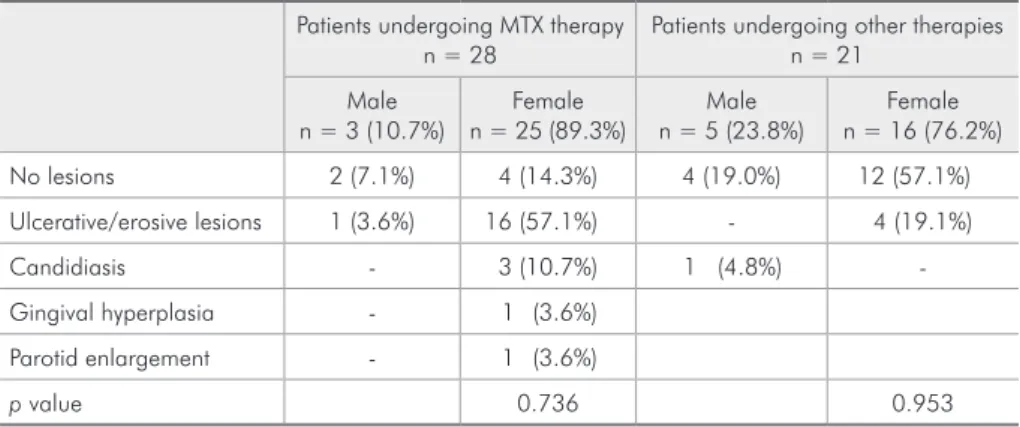
Two patients using MTX experienced nausea and headache. Oral lesions were observed in 22 pa-tients (78.6%) in the MTX group and in 5 papa-tients (23.8%) undergoing regimens involving other thera-pies (p < 0.001) (Table 2). Moreover, the relative risk for developing oral lesions as an adverse effect with low-dose MTX therapy was 11.73 (conidence interval: 2.57-58.98).
The most common oral lesions in both groups were ulcerative/erosive lesions (60.7% in patients undergoing MTX therapy and 19.1% in patients undergoing other therapies). The most frequent sites were the alveolar mucosa (35.1%) and the tongue (21.6%), followed by the palate (18.9%), buccal mu-cosa (13.5%), gingival mumu-cosa (8.1%) and the loor of the mouth (2.7%). Erythematous candidiasis oc-curred in 10.7% of patients taking MTX, while one patient (4.8%) not taking MTX presented pseudo-membranous candidiasis. The patient with parotid enlargement did not show other clinical or laborato-rial evidence for Sjögren’s syndrome.
one of them presented erythematous candidiasis.
Discussion
The population of patients with rheumatic ar-thritis and undergoing low-dose MTX therapy, who
participated in this study, presented high relative risk (11.73; CI: 2.57-58.98) for developing oral events. The RA patients under MTX therapy presented sig-niicantly higher prevalence of oral lesions than RA patients using other drugs. These data may suggest
Patients undergoing MTX therapy
n = 28
Patients undergoing other therapies
n = 21
p value*
Gender
• Male 3 (10.7%) 5 (23.8%)
0.220
• Female 25 (89.3%) 16 (76.2%)
Age
• Mean ± Standard Deviation 53 ± 11 55 ± 14
0.295
• Range 33 – 78 32 – 81
Ethnicity
• White 9 (32.1%) 9 (42.9%) 0.446
• Non-white 19 (67.9%) 12 (57.1%) 0.213
Comorbidities
• Hypertension 10 (35.7%) 4 (19.0%) 0.206
• Sjögren’s syndrome 1 (3.5%) - 0.386
• Other comorbidities 8 (28.6%) 8 (38.1%) 0.486
Medications
• Corticoid 26 (92.8%) 17 (80.9%) 0.213
• NSAID 13 (46.4%) 9 (42.9%) 0.806
• DMARD (other than MTX) 9 (32.1%) 8 (38.1%) 0.668
• Folic acid 25 (89.3%) 2 (9.5%) < 0.001
• Other medications 25 (89.3%) 16 (76.2%) 0.414
NSAID = nonsteroidal anti-inflammatory drug; DMARD = disease-modifying antirheumatic drug; MTX = methotrexate.
*Student’s t-test was performed for evaluation of age, and the chi-square test for the other variables.
Table 1 - Demographic and clinical characteristics of the 49 patients with rheumatoid arthritis in the study.
Patients undergoing MTX therapy n = 28
Patients undergoing other therapies n = 21
Male n = 3 (10.7%)
Female n = 25 (89.3%)
Male n = 5 (23.8%)
Female n = 16 (76.2%)
No lesions 2 (7.1%) 4 (14.3%) 4 (19.0%) 12 (57.1%)
Ulcerative/erosive lesions 1 (3.6%) 16 (57.1%) - 4 (19.1%)
Candidiasis - 3 (10.7%) 1 (4.8%)
-Gingival hyperplasia - 1 (3.6%)
Parotid enlargement - 1 (3.6%)
p value 0.736 0.953
The result of the chi-square test for the difference in the frequency of lesion development between groups was p < 0.0001.
that low-dose MTX therapy induces impairments in oral mucosa, and are consistent with other stud-ies that have also reported higher prevalence of oral events in RA patients undergoing MTX therapy.2,4-8
Rheumatoid arthritis patients not being treated with MTX also presented oral lesions. However, the prevalence of oral lesions in the control group (23.9%) is consistent with the prevalence of oral le-sions in the Brazilian population.12 The oral
candidi-asis found in patients of both groups may be due to the use of imunossupressive drugs13 or to lower
sali-vary low rates that usually affect RA patients.14,15
Regarding some peculiarities observed in some of the patients, there was a parotid enlargement found in one RA patient taking MTX, which might be a marker of salivary gland dysfunction and/or an early sign of secondary Sjögren’s syndrome. This pa-tient did not show evidence for Sjögren’s syndrome in laboratory tests. The gingival hyperplasia found in one patient may be due to cyclosporin therapy.16
The present study did not ind correlation of oral lesions with age or with MTX dosage, in RA pa-tients taking low-dose MTX. These indings are in agreement with those of Hoekstra et al.,6 who
stud-ied 411 RA patients in a randomized placebo-con-trolled trial. However, they did ind a correlation be-tween gender and side effects, which was not found in the present study. In a review study of MTX in-tolerance in the elderly, Drosos17 reported that aging
does not seem to predispose RA patients undergoing low-dose MTX treatment to adverse events.
Kremer et al.2 described MTX dose-related oral
ulcers in RA patients in a double blind, randomized, placebo-controlled study for further evaluation of treatment with etanercept and MTX. However, Ru-perto et al.3 studied the safety and eficacy of
differ-ent low doses of pardiffer-enteral MTX, and reported no relationship between the prevalence of oral lesions and the different doses.
It is noticeable that side effects from low-dose MTX treatment may occur also in the gastrointes-tinal mucosa. The sensitivity of the gastrointesgastrointes-tinal epithelium may be due to greater accumulation and persistence of MTX in the cells of the intestinal mu-cosa.9,17 The scope of the present study was limited
to oral mucosa alterations.
In an effort to explain the appearance of oral lesions related to MTX use, the mechanism of ac-tion was researched. The methotrexate mechanism involves many pathways, resulting in inhibition of inlammatory markers;18 also, in an increase of
adenosine, which is associated with several anti-inlammatory and immunosuppressive effects.19 A
potential mechanism by which MTX may diminish inlammation of the joint is by reducing cytokine production. It reduces the levels of polyamines accu-mulated in the synovium of RA patients, and of the antigen-stimulated T-cell proliferation. However, the most important mechanism may be related to an increase in the adenosine A2A receptor, a potent in-hibitor of neutrophil leukotriene synthesis,19,20 which
acts by inhibiting interleukin (IL) 12 and tumor ne-crosis factor alpha (TNF-a).21 Low-dose MTX used
by RA patients mimics non-steroidal anti-inlam-matory drugs or cyclo-oxygenase-2-selective drugs. However, there is no clear explanation for the de-velopment of the oral lesions with low-dose MTX.22
Oral toxicity produced by high doses of chemother-apy drugs involves a complex mechanism with gene up-regulation and liberation of nuclear factor-κβ, TNF-a, IL-1β, IL-6, among other mediators, with consequent apoptosis and tissue damage.23
Studies have reported that folic acid may play a protective role when associated with MTX ther-apy.2,6,17,24 In fact, the three patients in the present
study that were not taking folic acid as a comple-ment to MTX therapy presented oral ulcerative/ erosive lesions. The administration of folic acid, in doses of 1 to 5 mg per day, helped to prevent the toxicity of MTX without interfering with the anti-inlammatory eficacy of the drug.19,20 MTX acts as
a folate antagonist, and most of the adverse effects of MTX are related to the antifolate activity which may mimic symptoms of folate deiciency.17 Folates
are involved in the synthesis of purines, and disrup-tion of purine metabolism leads to an increase in extracellular adenosine by the increase of adenosine receptors.24 It is possible that high concentrations of
adenosine and related compounds may be directly toxic.24
polymorphism has been implicated as a predictive factor for MTX toxicity.25 Hematopoietic cell
trans-plant recipient patients, carrying some genotypes, should be considered to be at greater risk for devel-oping oral mucositis.26,27 Further studies are needed
to clarify the role of the genetic polymorphism the-ory.
Studies analyzing oral lesions, related to different doses and routes of administration of MTX, must be performed in order to understand the natural history of the oral manifestations related to the use of MTX. Furthermore, laboratory indings must be considered to exclude haematinic deiciencies such
as eosinophil counts, vitamin B12, iron and folate levels in the blood. In addition, clinical trials focus-ing on the prophylaxis of oral events resultfocus-ing from MTX must be conducted. In practice, healthcare professionals must be aware of monitoring for oral events in RA patients taking MTX.
Conclusion
The prevalence of oral mucosa lesions in RA pa-tients being treated with low-dose MTX therapy is higher than in RA patients not taking the drug. Cli-nicians must be aware not to misdiagnose the oral lesions caused by low-dose MTX use.
References
1. Goodman TA, Polisson RP. Methotrexate: adverse reac-tions and major toxicities. Rheum Dis Clin North Am. 1994 May;20(2):513-28.
2. Kremer JM, Weinblatt ME, Bankhurst AD, Bulpitt KJ, Fleischmann RM, Jackson CG, et al. Etanercept added to background methotrexate therapy in patients with rheu-matoid arthritis: continued observations. Arthritis Rheum. 2003 Jun;48(6):1493-9.
3. Ruperto N, Murray KJ, Gerloni V, Wulffraat N, de Oliveira SK, Falcini, F et al. A randomized trial of parenteral metho-trexate comparing an intermediate dose with a higher dose in children with juvenile idiopathic arthritis who failed to respond to standard doses of methotrexate. Arthritis Rheum. 2004 Jul;50(7):2191-201.
4. Bailey KM, McDonagh JE, Prieur AM. Systemic juvenile idiopathic arthritis presenting in a young child with long term disability as an adolescent. Ann Rheum Dis. 2004 Dec;63(12):1544-8.
5. Carpenter EH, Plant MJ, Hassell AB, Shadforth MF, Fisher J, Clarke S, et al. Management of oral complications of disease-modifying drugs in rheumatoid arthritis. Br J Rheumatol. 1997 Apr;36(4):473-8.
6. Hoekstra M, van E de AE, Haagsma CJ, van de Laar MA, Huizinga TW, Kruijsen MW, et al. Factors associated with tox-icity, final dose, and efficacy of methotrexate in patients with rheumatoid arthritis. Ann Rheum Dis. 2003 May;62(5):423-6.
7. Strand V, Cohen S, Schiff M, Weaver A, Fleischmann R, Cannon G, et al. Treatment of active rheumatoid arthritis with leflunomide compared with placebo and methotrexate. Leflunomide Rheumatoid Arthritis Investigators Group. Arch Intern Med. 1999 Nov;159(21):2542-50.
8. Yazici Y, Sokka T, Kautiainen H, Swearingen C, Kulman I, Pincus T. Long term safety of methotrexate in routine clinical care: discontinuation is unusual and rarely the result of
labo-ratory abnormalities. Ann Rheum Dis. 2005 Feb;64(2):207-11.
9. Kremer JM. Toward a better understanding of methotrexate. Arthritis Rheum. 2004 May;50(5):1370-82.
10. Chu EA, Allegra C. Antifolates. In: Chabner BA, Longo DL, editors. Cancer Chemotherapy and Biotherapy. 2nd ed. Phila-delphia: Lippincot-Raven; 1996. p. 109-47.
11. Arnett FC, Edworthy SM, Bloch DA, McShane DJ, Fries JF, Cooper NS, et al. The American Rheumatism Association 1987 Revised criteria for the classification of rheumatoid ar-thritis. Arthritis Rheum. 1988 Mar;31(3):315-24.
12. Torres SR. [Positive balance for the prevention campaingn in stomathology]. J ABORJ. 2003 Nov;60(1):24-5. Portu-guese.
13. Ellepola AN, Samaranayake LP. Inhalational and topi-cal steroids, and oral candidosis: a mini review. Oral Dis. 2001 Jul;7(4):211-6.
14. Russell SL , Reisine S. Investigation of xerostomia in patients with rheumatoid arthritis. J Am Dent Assoc. 1998 Jun;129(6):733-9.
15. Torres SR, Paulo MT, Ruela SF, Corrêa FC, Oliveira TM, Uemoto L, et al. Análise quantitativa do fluxo salivar em pacientes com artrite reumatóide [resumo Pa280]. Braz Oral Res. 2004;18 Suppl:145.
16. Ramalho VL, Ramalho HJ, Cipullo JP, Burdmann EA. [Ci-closporine A-induced gingival hyperplasia]. Rev Assoc Med Bras. 2003 Apr-Jun;49(2):210-3. Portuguese.
17. Drosos A. Methotrexate intolerance in elderly patients with rheumatoid arthritis: what are the alternatives? Drugs Aging. 2003 Oct;20(10):723-36.
19. Cronstein BN. Molecular therapeutics. Methotrexate and its mechanism of action. Arthritis Rheum. 1996 Dec;39(12):1951-60.
20. Chan ES, Cronstein BN. Molecular action of methotrexate in inflammatory diseases. Arthritis Res. 2002 Mar;4(4):266-73.
21. Hasko G, Kuhel DG, Chen JF, Schwarzschild MA, Deitch EA, Mabley JG, et al. Adenosine inhibits IL-12 and TNF-[alpha] production via adenosine A2a receptor-dependent and inde-pendent mechanisms. FASEB J. 2000 Oct;14(13):2065-74. 22. Tack DA, Rogers III RS. Oral Drug Reactions. Dermatol Ther.
2002 Sep;15(3):236-50.
23. Sonis ST, Elting LS, Keefe D, Peterson DE, Schubert M, Hau-er-Jensen M, et al. Perspectives on cancer therapy-induced mucosal injury: pathogenesis, measurement, epidemiology, and consequences for patients. Cancer. 2004 May;100 (9 Suppl):1995-2025.
24. Griffith SM, Fisher J, Clarke S, Montgomery B, Jones PW, Saklatvala J, et al. Do patients with rheumatoid arthritis es-tablished on methotrexate and folic acid 5 mg daily need to continue folic acid supplements long term? Rheumatology (Oxford). 2000 Oct;39(10):1102-9.
25. Berkun Y, Levartovsky D, Rubinow A, Orbach H, Aamar S, Grenader T, et al. Methotrexate related adverse effects in patients with rheumatoid arthritis are associated with the A1298C polymorphism of the MTHFR gene. Ann Rheum Dis. 2004 Oct;63(10):1227-31.
26. Robien K, Schubert MM, Bruemmer B, Lloid ME, Potter JD, Ulrich CM. Predictors of oral mucositis in patients receiving hematopoietic cell transplants for chronic myelogenous leu-kemia. J Clin Oncol. 2004 Apr;22(7):1268-75.