An Experimental Investigation on Application of Al
2O
3Nanoparticles as Lubricant Additive in VCRS
Dr. K.Dilip Kumar
1,T.Ayyappa
21Associate Professor: Department of Mechanical Engineering, LBRCE ,Mylavaram, 2
M.Tech Student : Department of Mechanical Engineering, LBRCE,Mylavaram,
ABSTRACT
In this work, the Al2O3 nano-oil is proposed as a promising lubricant to enhance the performance of vapour compression refrigerator compressor. The stability of Al2O3 nanoparticles in the oil is investigated experimentally. It was confirmed that the nanoparticles steadily suspended in the mineral oil at a stationary condition for long period of time. The application of the nano-oil with specific concentrations of 1.5%, 1.7% and 1.9 %( by mass fraction) were added in the compressor oil. The VCRS performance with the nanoparticles was then investigated using energy consumption tests. The result shows the COP of system were improved by 19.14%, 21.6% & 11.22%, respectively, when the nano-oil was used instead of pure oil.
Keywords:
VCRS, COP, PAG OilI.
INTRODUCTION
Nanofluids are a relatively new class of fluids which consist of a base fluid with nano-sized particles (1–100 nm) suspended within them. These particles, generally a metal or metal oxide, increase conduction and convection coefficients, allowing for more heat transfer out of the coolant. Serrano et al. [1] provided excellent examples of nanometer in comparison with millimeter and micrometer to understand clearly. In the past few decades, rapid advances in nanotechnology have lead to emerging of new generation of heat transfer fluids called
‘‘nanofluids’’. Nanofluids are defined as suspension of nanoparticles in a base fluid. Some typical nanofluids are ethylene glycol based copper nanofluids; water based copper oxide nanofluids, etc. Nanofluids are dilute suspensions of functionalized nanoparticles composite materials developed about a decade ago with the specific aim of increasing the thermal conductivity of heat transfer fluids, which have now evolved into a promising nano technological area. Such thermal nanofluids for heat transfer applications represent a class of its own difference from conventional colloids for other applications. Compared to conventional solid–liquid suspensions for heat transfer intensifications, nanofluids possess the following advantages
High specific surface area and therefore more heat transfer surface between particles and fluids.
High dispersion stability with predominant Brownian motion of particles.
Reduced pumping power as compared to pure liquid to achieve equivalent heat transfer intensification.
Reduced particle clogging as compared to conventional slurries, thus promoting system miniaturization.
Adjustable properties, including thermal conductivity and surface wettability, by varying particle concentrations to suit different applications.
Recently scientists used nanoparticles in refrigeration systems because of its remarkable improvement in thermo-physical, and heat transfer capabilities to enhance the efficiency and reliability of refrigeration and air conditioning system. Elcock
[2] found that TiO2 nanoparticles can be used as additives to enhance the solubility of the mineral oil with the hydrofluorocarbon (HFC) refrigerant. Authors also reported that refrigeration systems using a mixture of HFC134a and mineral oil with TiO2 nanoparticles appear to give better performance by returning more lubricant oil to the compressor with similar performance to systems using HFC134a and POE oil. Hindawi [3] carried out an experimental study on the boiling heat transfer characteristics of R22 refrigerant with Al2O3 nanoparticles and found that the nanoparticles enhanced the refrigerant heat transfer characteristics with reduced bubble sizes.
Thermal conductivity of nanoparticles used in refrigerants Different concentrations of nanoparticles of CuO, Al2O3, SiO2 , diamond, CNT, TiO2 were used in base refrigerants such as R11, R113, R123, R134a, and 141b as found in the available literatures.
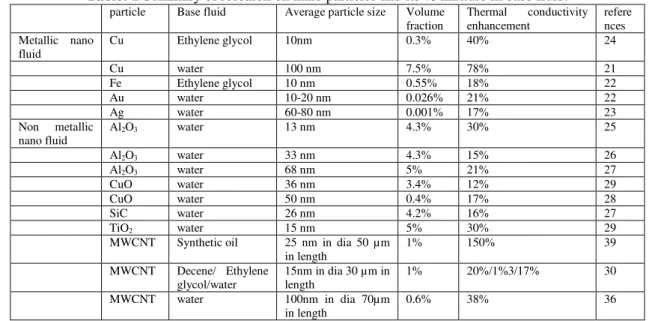
Table: 1 Summary of research on nano particles and its % mixture in base fluid.
particle Base fluid Average particle size Volume fraction
Thermal conductivity enhancement
refere nces Metallic nano
fluid
Cu Ethylene glycol 10nm 0.3% 40% 24
Cu water 100 nm 7.5% 78% 21
Fe Ethylene glycol 10 nm 0.55% 18% 22
Au water 10-20 nm 0.026% 21% 22
Ag water 60-80 nm 0.001% 17% 23
Non metallic nano fluid
Al2O3 water 13 nm 4.3% 30% 25
Al2O3 water 33 nm 4.3% 15% 26
Al2O3 water 68 nm 5% 21% 27
CuO water 36 nm 3.4% 12% 29
CuO water 50 nm 0.4% 17% 28
SiC water 26 nm 4.2% 16% 27
TiO2 water 15 nm 5% 30% 29
MWCNT Synthetic oil 25 nm in dia 50 µm in length
1% 150% 39
MWCNT Decene/ Ethylene glycol/water
15nm in dia 30 µm in length
1% 20%/1%3/17% 30
MWCNT water 100nm in dia 70µm in length
0.6% 38% 36
Table : 2 Summary of research on nano particles and refrigerants
Year Investigator refrigerant Nanoparticles Size of nano particles
% volume concentrations
prformance
2007 19 R123,R134a Carbon nano tubes
20nm*1µm 1 Heat transfer coefficient enhance up to 36.6% 2009 20 R141b TiO2 21 nm 0.01%,0.03%,0.05% Nucleated heat transfer
deteriorated with increasing particle concentration 2009 31 R113 CuO 40 nm 0.15-1.5% Max enhancement of heat
transfer is 26% 2009 34 R134a CuO 30 nm 0.5%,0.1%,0.2%
2009 35 R113 CuO 40 nm 0.01%,0.2%,0.5% Frictional pressure drop increased by 28%
2009 36 R134a CuO 30 nm 0.5% Enhancement of heat transfer coefficient 50%-275% 2010 33 R113 diamond 10 nm 0-0.05% Nucleate pool boiling heat
transfer coefficient raises 63.4%
2006 37 R134a TiO2 - - reduction in energy
consumption by 7.4.3% 2010 32 R134a CuO - - Heat transfer coefficient
increased by 100%
38 NH3/H20 Al2O3/CNT - 0.06%/0.008% Heat transfer rate was
20%higher than those without nano particles
II.
EXPERIMENTAL SET UP
A. Components
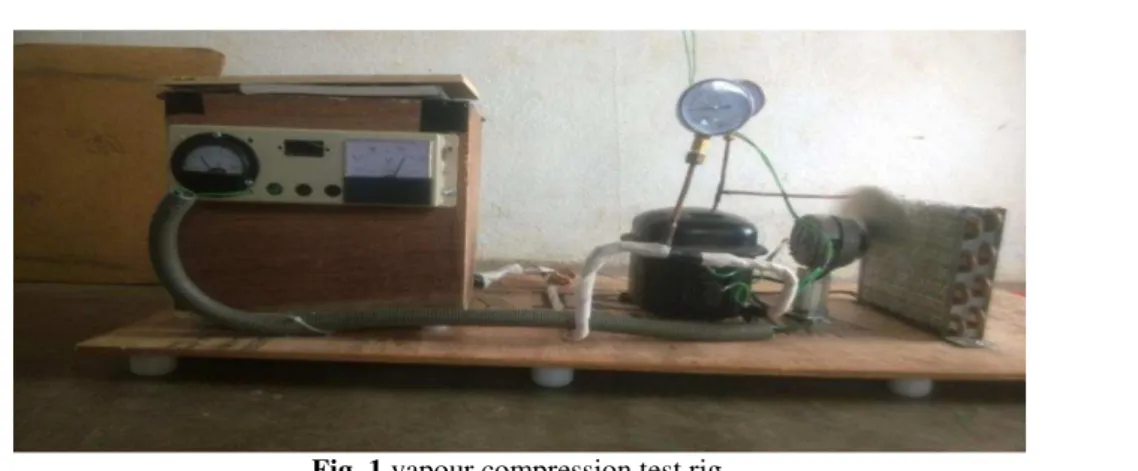
The vapour compression refrigeration system test rig consist of a compressor unit, condenser, evaporator, cooling chamber,
Fig .1 vapour compression test rig
Table 3 Refrigeration system specifications
Capacity 500 watt at rated at test condition Refrigerant R-134a
Compressor Hermitically sealed Condenser Forced convective air cooled Condenser fan motor Inductive type
Dryer/filter Dry all make Expansion device Capillary tube
B. Instrumentation
The temperatures at different parts of the experimental setup are measured using resistance thermocouples. Six resistance thermocouples were used for the experimentation. The suction pressure and discharge pressure at compressor are measured with the help of pressure gauges. The power consumption of the system was measures by a energy meter. A digital energy meter is also connected with the experimental setup.
III.
EXPERIMENTAL PROCEDURE
3.1 Preparation of nano- Refrigerant
Nanoparticles of Al2O3 2are added to the refrigeration system by adding them to the lubricant in the compressor of the system. The
preparation and stability of this lubricant and nanoparticle mixture is very important. The lubricant oil, a type commonly used in refrigeration and air-conditioning systems was poly alkylene glycol (PAG). This oil is selected owing to its common usage and superior quality. The nanoparticles of Al2O3 in the range 40-50 nm were mixed with PAG to synthesize nanolubricant in a recommended method for nanofluid. PAG oil was used as supplied by supplied without further purification. The nano particles of Al2O3 and PAG mixture was prepared with the aid of magnetic stirrer for 2 hrs. The mixture is then further kept vibrated with an ultrasonic homogenizer for half an hour to fully separate the nanoparticles and to prevent any clustering of particles in the mixture to obtain proper homogenization. No surfactant is added in this work as there may be any influence in reduction of thermal conductivity and performance.
3.2 Nano- Refrigerant Concentration Nano-Refrigerant with 0.2% concentration of Al2O3 in the refrigerant R134a is prepared and tested in the setup.
Table 4 measurement equipment
Refrigerant flow measurement Rotameter
Pressure indicators Pressure gauges 2 no provaided Energy meter 3200imp/kwh
Evaporator for refrigeration test rig Immersed tube type,direct expansion coil Temperature indication Digital led
Insulation for water tank Puf
Supply 230volts,50hzs,single phase
Fig 2: After Mixing of Nano particles in lubricant oil(PAG oil)
3.3. Charging of set up
gm. into the system. Every time the system was allowed to stabilize for 15 min.
IV. PERFORMANCE TEST
The system was charged with refrigerant (R 134) and a POE oil with different concentration using a charging line attached to the system. The temperature data were noted continuously, and the readings were taken an interval of 15 min. It was ensured that a constant temperature and humidity prevails in the surrounding space, when the experimental readings were taken. The experiment involved the measurement of the temperature T1-T6 of compressor, condenser, expansion valve, evaporator and inlet –outlet of water temperature. The power consumption rate of the compressor was determined by noting the time taken by the digital energy meter for 10 pulses. Using these data, the heat transfer rate at the evaporator cabin and the power consumption rate in the compressor were
calculated using the standard expressions as follows.
4.1 Factors affecting Refrigeration System
The important factors affect the performance of refrigeration system are Refrigeration effect, Coefficient of Performance (COP) and Energy factor(EF).
a) Refrigeration effect q= Heat removal / mass flow rate or refrigerant---(1)
b) Coefficient of Performance COP = Heat Removal / Work Input--- (2)
c) Energy Factor EF = Cooling capacity / Power consumption---(3)
work done by compressor(wc)
wc = (3600*10) / (EMC*T).---(4)
Actual co efficient of performance (C.O.P) ACT
(C.O.P) ACT = (refrigerant effect) / (work done by compressor)---(5)
V. RESULT &DISCUSSION
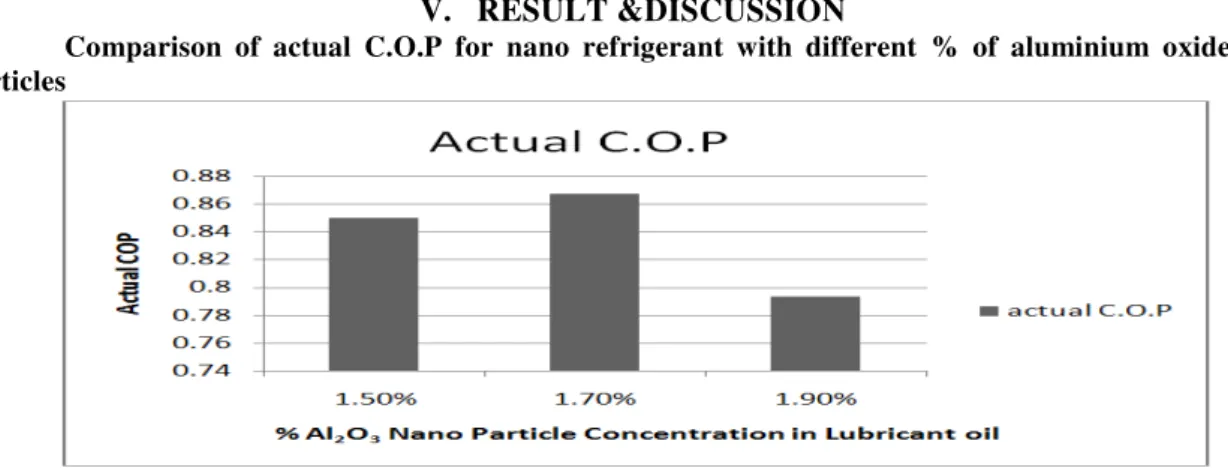
5.1 Comparison of actual C.O.P for nano refrigerant with different % of aluminium oxide nano particles
Graph 1: Actual COP Vs % Al2O3 nano particle concentration
From above Graph 1 we conclude that as the nanoparticles concentration in POE oil increases up to certain concentration, 1.7% of mass fraction of nano particles gives the optimum result. Table below shows the all values:
Table 5: Actual C.O.P Vs Al2O3 nano particle concentration
% Al2O3 nano
particle concentration
Actual C.O.P
1.5 0.8495
1.7 0.8672
1.9 0.793
5.2. Graph of refrigerant effect rate for different % of aluminium oxide nano particles
Above Graph 2 shows the 1.7% of aluminum nano particles increases refrigerant effect after that there is declination of refrigerating effect. Table IV below shows the all values
Table 6 Refrigerating effect/min Vs % Al2O3 nano particle concentration
Al2O3 nano particle concentration Refrigerating effect/min
1.5 11.74
1.7 11.96
1.9 10.86
5.3.Graph of theoretical C.O.P for nano refrigerant with different % of aluminium oxide nano particles
Graph 3: Theoretical C.O.P Vs % Al2O3 nano particle concentration
From the above Graph 3 theoretical C.O.P of the system becomes maximum at 1.7% of mass concentration due to increase in refrigerating effect
Table 7 Theoretical C.O.P Vs % Al2O3 nano particle concentration
% Al2O3 nano particle
concentration
Theoretical C.O.P
1.5 3.51
1.7 3.67
1.9 3.196
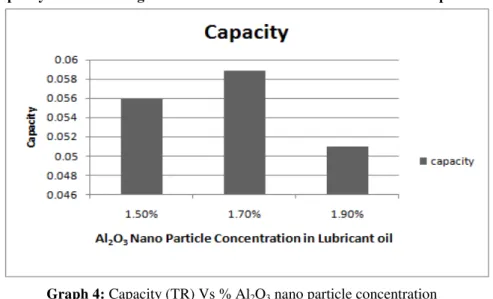
5.4. Graph of capacity for nano refrigerant with different % aluminium oxide nano particles
S
Graph 4: Capacity (TR) Vs % Al2O3 nano particle concentration
From the above Graph4 we can get the optimum capacity at 1.7% concentration.
Table 8 Capacity Vs % Al2O3 nano particle concentration
% Al2O3 nano particle concentration Capacity(TR)
1.5 0.059
1.7 0.059
1.9 0.051
VI. CONCLUSION
Nano-particles are fed into the compressor and various performance parameters are recorded and concluded from the above graphs
1. The thermal conductivities of nano refrigerants are higher than traditional refrigerants. It was also observed that increased thermal conductivity of nano refrigerants is comparable with the increased thermal conductivities of other nanofluids.
2. From the experimental investigations Actual COP is increased upto 21.6% at 1.7%.mass concentration. After that it decreases so optimum percentage is 1.7% of Al2O3 for given 0.06 TR system.
3. Refrigerant effect in evaporator is increased up to 21.6% due to more heat transfer surface area provided by Nano particles after the mixing with magnetic stirrer.
4. Theoretical COP and mass flow rate of refrigerant increased by 15% and 20% respectively due to decrease in Viscosity of refrigerant.
5. The Discharge pressure increases with time and attains a maximum value and then decreases.
6. The Maximum discharge pressure is obtained for charge mass of 150gm.
7. The suction pressure decreases initially and then increases with time.
8. Suction pressure is found to be less for a charge mass of 150gm.
9. Nanofluids stability and its production cost are
major factors that hinder the
commercialization of nanofluids. By solving these challenges, it is expected that nanofluids can make substantial impact as coolant in heat exchanging devices.
REFERENCES
[1]. Serrano E, Rus G, Martı´nez JG. Nanotechnology for sustainable energy. Renewable and Sustainable Energy Reviews 2009;13(9):2373–84.
[2]. Elcock D. Potential impacts of
nanotechnology on energy transmission applications refrigerant effect rate for different % of aluminium oxide nano particles
[3]. Hindawi, Special issue on heat transfer in nanofluids; 2009.
[4]. S heng-shan Bi et al. Application of nanoparticles in domestic refrigerators. Applied refrigerant effect rate for different % of aluminium oxide nano particles [5]. Eed Abdel-Hafez Abdel-Hadi et al .Heat
Transfer Analysis of Vapor Compression
System Using Nano Cuo-R134a.
International Conference on Advanced Materials Engineering,
[6]. K.henderson. Flow-boiling heat transfer of R-134a-based nanofluids in a horizontal tube.
[7]. Shengshan Bi et al. Performance of a domestic refrigerator using TiO2-R600a nano- refrigerant as working fluid. Energy Conversion and Management 52 (2011) pp-733– 737.
[8]. Pawel K. P., Jeffrey A.E. and David G.C., (2005) Nanofluids for thermal transport. Materials Today, pp. 36-44
[9]. D. Sendil Kumar, Dr. R. Elansezhian, ( Sep.-Oct. 2012) Experimental Study on Al2O3- R134a Nano Refrigerant in Refrigeration System, International Journal of Modern Engineering Research (IJMER) Vol. 2, Issue. 5, pp-3927-3929 [10]. R. Krishna Sabareesh Application of TiO2
nanoparticles as a lubricant-additive for vapour compression refrigeration systems -An experimental investigation.
[11]. Reji kumar.R and Sridhar.K, (Apr 2013) Heat transfer enhancement in domestic refrigerator using nanorefrigerant as working fluid, Int. J. Comp.Eng. Res., 3(4).
[12]. T. Coumaressin and K. Palaniradja. Performance Analysis of a Refrigeration System Using Nano Fluid. International
Journal of Advanced Mechanical
Engineering, ISSN 2250-3234 Volume 4, Number 4 (2014), pp. 459-470.
[13]. X. Wang, X. Xu, and S. U. S. Choi. Thermal conductivity of nanoparticle fluid
mixture. J.Thermophys. Heat
Transf.,13(4):474–480, 1999.
[14]. P. Keblinski Mechanisms of heat flow in suspensions of nanosized particles (nanofluids). Int. J. Heat Mass Transf., 45(4):855– 863, 2002.
[15]. D. Kumar, H. Patel, V. Kumar, T. Sundararajan, T. Pradeep, and S. K. Das. Model for Heat Conduction in Nanofluids. Phys. Rev. Lett., 93(14): 4316, 2004. [16]. Y. Xuan and Q. Li. Investigation on
convective heat transfer and flow features of Heat Conduction in Nanofluids. Phys. Rev. Lett., 93(14): 4316, 2004.
[17]. H. Zhu, C. Zhang, S. Liu, Y. Tang, and Y. Yin. Effects of nanoparticle clustering and alignment on thermal conductivities of Fe3O4 aqueous nanofluids. Appl. Phys. Lett., 89(2):23123, 2006
and lubricating oils in refrigeration systems.
[19]. Park KJ, Jung DS. Boiling heat transfer enhancement with carbon nanotubes for refrigerants used in building air conditioning. Energy and Buildings 2007; 39(9):1061–4.
[20]. Trisaksri V, Wongwises S. Nucleate pool boiling heat transfer of TiO2–R141b nanofluids. International Journal of Heat and Mass Transfer 2009;52(5– 6):1582–8. [21]. Xuan Y, Li Q. Heat transfer enhancement of nanofluids. International Journal of Heat and Fluid Flow 2000;21:58–64. [22]. Hong TK, Yang HS, Choi CJ. Study of the
enhanced thermal conductivity of Fe nanofluids. Journal of Applied Physics 2005;97(6).
[23]. Patel HE, Das SK, Sundararajan T. Thermal conductivities of naked and monolayer protected metal nanoparticle based nanofluids: Manifestation of anomalous enhancement and chemical effects. Applied Physics Letters 2003; 83(14):2931–3.
[24]. Choi SUS, Yu W, Hull JR, Zhang ZG, Lockwood FE. Nanofluids for vehicle
thermal management. Society of
Automotive Engineers 2001-01-1706; 2001 . pp. 139–144.
[25]. Masuda H. Alteration of thermal conductivity and viscosity of liquid by dispersing ultra-fine particles (dispersion of y-A12O3, SiO2, and TiO2 ultrafine particles). Netsu Bussei 1993;4:227–33. [26]. Lee S. Measuring thermal conductivity of
fluids containing oxide nanoparticles.
ASME Journal of Heat Transfer
1999;121(2):280–9.
[27]. Xie H. Thermal conductivity enhancement of suspensions containing nanosized alumna particles. Journal of Applied Physics 2002;91:4568–72.
[28]. Zhou LP, Wang BX. Experimental research on the thermophysical properties of nanoparticle suspensions using the quasi-steady method. Annual Proceedings of Chinese Engineering Thermophysics 2002;889–92.
[29]. Murshed SMS, Leong KC, Yang C. Enhanced thermal conductivity of TiO2– water based nanofluids. International
Journal of Thermal Sciences
2005;44(4):367–73.
[30]. Xie H. Nanofluids containing multiwalled carbon nanotubes and their enhanced thermal properties. Journal of Applied Physics 2003;94(8):4967–71.
[31]. Hao P, Guoliang D, Weiting J, Haitao H, Yifeng G. Heat transfer characteristics of refrigerant-based nanofluid flow boiling inside a horizontal smooth tube. International Journal of Refrigeration 2009;32:1259–70. [32] Fu L, Wang R, Cong W, Li Q, Wu Y. Experiment study on performance of refrigerator using
nano-particle additive. Journal of Xi’an Jiaotong
University 2008;42:852–4.
[32]. Hao P, Guoliang D, Haitao H, Weiting J, Dawei Z, Kaijiang W. Nucleate pool boiling heat transfer characteristics of refrigerant/oil mixture with diamond nanoparticles. International Journal of refrigeration 2010;33:347–58.
[33]. Kedzierski MA. Effect of CuO
nanoparticle concentration on
R134a/lubricant pool-boiling heat transfer. Journal of Heat Transfer 2009;131(4):p7. [34]. Peng H, Ding G, Jiang W, Hu H, Gao Y.
Heat transfer characteristics of refrigerant-based nanofluid flow boiling inside a horizontal smooth tube. International Journal of Refrigeration 2009;32:1259–70. [35]. Kedzierski MA, Gong M. Effect of CuO
nanolubricant on R134a pool boiling heat transfer with extensive measurement and analysis details. USA: NISTIR 7336, National Institute of Standards and Technology; 2007.
[36]. Bi S, Shi L. Experimental investigation of a refrigerator with a nano-refrigerant Qinghua Daxue Xuebao. Journal of Tsinghua University 2007;47(11):2002–5. [37]. Jin KL, Junemo K, Hiki H, Yong TK. The effects of nanoparticles on absorption heat and mass transfer performance in NH3/H2O binary nanofluids. International Journal of Refrigeration 2010;33:269–75. [38]. Choi SUS, Zhang ZG, Yu W, Lockwood