Managing Socio-technical Change in Indian Automobile Industry –
A Survey
*Dr. Rajiv Kumar Garg
ABSTRACT
Management of change has assumed a great deal of importance in Indian automobile industry. Managing change is posing a big challenge to Indian firms in the wake of globalization and liberalization. Successful change demands that all major areas of an organization are kept in focus concurrently. These areas are technology, structure, systems, people and culture. It is seen that all these areas are interwoven and cannot be emphasized upon in isolation. This paper presents the current status of socio-technical change in Indian automobile industry. The study has been made through survey in Indian automobile companies using a specially designed questionnaire.
Introduction
The study of change and its management has been the greatest themes in the social sciences. Many social science disciplines have developed theoretical literature and empirical findings about the birth, development, transformation, decay, and decline of human and natural systems. The development theories of change in the organization studies have been faced with the hurdle of scholarly quality and practical relevance (Pettigrew, 1987). In this paper, it is emphasized that for successful organizational change,
* Professor, Department of Industrial Engineering, Dr B R Ambedkar National Institute of Technology, Jalandhar 144011 Punjab (India)
changes in various areas like technology, structure, systems, people and culture are needed. The paper also contains findings of a survey of managing socio-technical change in Indian automobile industry.
Change Management
According to Prosci (2002), “change management represents the processes, tools and techniques to manage the people-side of business change to achieve the required business outcomes, and also to realize that business changes can be met effectively within the social infrastructure of the workplace”. This definition has been commonly used among practitioners and end-users.
Van (1986) has considered ‘technology change’ for making organizational change. He has treated ‘people’ for the development and implementation of technological change in an organization. Duck (1993) has felt the need to take people into confidence while making change in an organization. The author has emphasized the change paradoxes and mentioned that “trust is hardest to develop and achieve when you need it most” in a change programme.
(matured) organization. Change is made by empowered employees who act as leaders at all levels of the organization (Beatty and Ulrich, 1996)
Areas of Change Management
Areas of organizational change have been related to its dynamics and effects of time, process, discontinuity, and context. Socio-technical change management cannot be merely limited to technological changes like replacement of machines, equipments, instruments and practicing new manufacturing processes. However, it has been commonly aimed to make the processes and products more effective in an organization. Managing change has comprised of various interconnected and interdependent areas (Garg and Singh, 2002). All of these areas needs to be considered concurrently for successful organizational change. These areas are described as under:
i. Technology: Technology is concerned with design and layout of production facilities, type and mix of machines and equipments, product mix, flow of data and sharing of information, inventing new materials, automation, etc.
ii. Organizational systems: This area is concerned with working practices related to production, maintenance, marketing, sales, information technology, material procurement, inspection, quality, etc. on the one hand and their interconnection on the other.
iii.Organizational structure: The area includes hierarchical levels, cadres, span of control, manpower utilization, administration, communication, integration, coordination, learning, etc.
iv.People: This area is related to management attitude, vision, objectives, resistance to change, motivation, developing skills, coordination, mindset
of individual, and impact of group dynamics on change process.
v.Culture: Culture includes flexibility, work environment, team spirit, group behavior, management commitment, belongingness, leadership etc. in an organization.
For managing socio-technical change in an organization, ‘change agent’ facilitates all the essential events and also intervenes whenever feels so. An important aspect of the change process is ‘change target’. Target includes vision, objectives, knowledge, values, beliefs, assumptions and emotions. Corporate education programme can help the people in reducing resistance to change. Through these techniques, an organization can get success as per expectation.
Survey on Managing Socio-technical Change in Indian Automobile Industry
A survey has been performed to assess the current status of socio-technical change management in Indian automobile industry. Survey has been conducted using a specially designed questionnaire containing multiple-choice questions (Garg, 2005). The steps involved in the survey are:
a.Design of a suitable questionnaire, its pretesting and conducting survey
been framed and four alternatives have been provided for giving response.
To ensure its relevance and effectiveness, the questionnaire has been pretested on a representative sample of industry. Units covered are manufacturing one or more types of vehicles like cars, light commercial vehicles (LCVs), tractors, farm machinery, scooters, motorcycles, mopeds etc. or are engaged in manufacturing of auto-components. A total of 252 industrial enterprises were selected for the survey.
A total of 83 firms out of selected 252 responded to the questionnaire. The response to the survey has been presented in Table 1.
Findings of the Survey
Some questions in section A and almost all questions in section B have a scale of 1-4. The score of 4 was assigned to the best choice, 3 to the second best, 2 to the next in order and 1 to the lowest choice. Findings from the survey have been categorized into two categories:
i. Determining the status of various aspects of change management
ii. Categorization of companies into various classes such as very good, good, fair and poor from change management point of view
a. Status of Various Aspects
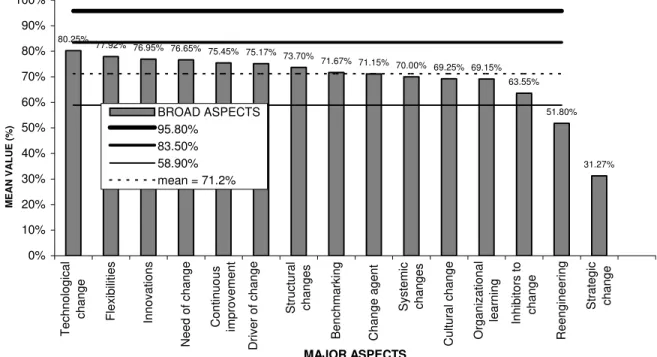
Using the score obtained from the response, average values of the major aspects of change management have been calculated and categorized as shown in Table 2.
Very good: Score above (mean+SD): 83.5% and above
Good: Score between (mean) and (mean+SD): 71.2 to 83.4%
Fair: Score between mean and (mean-SD):58.9 to 71.1%
Poor: Score below (mean-SD): Below 58.9%
No one amongst major aspects has fallen in ‘very good’ category as shown in Table 2. With a score of 3.21 (80.25%) on a scale of 4, technological change has the highest score among all major aspects and falls in the ‘good’ range. This has been followed by other aspects as mentioned in Table 2. It can be concluded that automobile industry has felt a need of change and has initiated the change process, mostly in a systemic way. Figure 1 gives an at-a-glance picture of the comparative standing of each major aspect.
b. Classification of Companies
To classify the companies based upon the status of major areas of change, the relevant questions from the whole questionnaire have been separately listed and tabulated, and their scores have been compiled under the following heads:
i. Technological change ii. Systemic change iii. Structural change iv. People change v. Cultural change vi. Flexibility
vii. Reengineering viii. Innovativeness ix. Entrepreneurship x. Organizational learning
As a result, companies have been classified into various categories as shown in Table 3.
> x+a V.Good x to x+a Good
x-a to x Fair
< x-a Poor
Table 3 shows the percentage of companies falling into various categories of change management in various heads (major areas). From this table, it is clear that status of technological change is comparatively good and very good in 53% firms whereas only 33% lie in fair range. Similarly, status of all other major areas of change management in various ranges is depicted in Table 3, and also illustrated in Figure 2.
Conclusion
From the survey, it is clear that Indian automobile has made efforts to manage socio-technical change. Changes have been made in various areas of change management like technology, systems, structure, people and culture. As a result, various notable changes have been made in various organizations. But still there is wide scope for further change. The industry has to strive hard to be innovative, technologically superior as well as working-culture conscious. The continuous pace with world-class technology, supportive systems, restructuring and cultural modifications
will help the organizations to change successfully.
References
1. Beatty, R. W., and Ulrich, D. O. (1996), “Re-engineering the Mature Organization”, IEEE Engineering Management Review, Fall 1996, 60-69. 2. Duck, J. D. (1993), Managing Change: The Art of Balancing”, Harward Business review, 71(6), 109-118. 3. Garg, R. K., and Singh, T. P. (2002),
“Managing Change for Competitiveness”, Global Journal of
Flexible Systems Management, 3(4), 13-22.
4. Garg, R. K (2005), “Managing Socio-technical Change for Competitiveness in Indian Automobile Industry”, Ph.D. Thesis, Thapar Institute of Engineering and Technology (Deemed University) Patiala, 2005, 68-70.
5. Pettigrew, A. M. (1987), “Context and Action in the Transformation of the Firm”, Journal of Management Studies, Vol 24, 649-670.
6. Prosci (2000), www.prosci.com
7. Van (1986), “Central Problems in the Management of Innovation”,
Management Science, 32(5), 590-607. 8. Van de Ven, and Poole (1995),
“Explaining Development and Change in Organizations”, Academy of Management Review, Vol 20, 510-540.
Table 1
Response to the survey
Type of organization
Number of organizations
Response ratio in percent (%)
Questionnaire sent to
Response given by
Total selected organizations 252 83 33%
Automobile manufacturers 52 18 35%
Table 2
Status of major aspects of change in Indian automobile industry
S.No Major aspects of change management
Mean value of average score of various aspects
Mean value in terms of percentage = 100* Mean value/ 4
Category
1 Technological change 3.21 80.25% Good
2 Flexibilities 3.117 77.92% Good
3 Innovations 3.078 76.95% Good
4 Need of change 3.066 76.65% Good
5 Continuous improvement 3.018 75.45% Good
6 Driver of change 3.007 75.17% Good
7 Structural changes 2.948 73.70% Good
8 Benchmarking 2.867 71.67% Good
9 Change agent 2.846 71.15% Fair
10 Systemic changes 2.8 70.00% Fair
11 Cultural change 2.77 69.25% Fair
12 Organizational learning 2.766 69.15% Fair 13 Inhibitors to change 2.542 63.55% Fair
14 Reengineering - 51.8% Poor
15 Strategic change 1.251 31.27% Poor
Mean value 71.20%
Standard deviation
(S D) 0.123
Table 3
Status of organizations in change management
S.No. Major Areas % Organizations in various categories V.Good Good Fair Poor
1 Technological change 16% 37% 33% 14%
2 Systemic change 18% 34% 31% 17%
3 Structural change 14% 34% 41% 11%
4 People change 16% 34% 37% 13%
5 Culture change 20% 22% 43% 14%
6 Flexibility 17% 27% 42% 14%
7 Reengineering 19% 53% 9% 19%
8 Innovativeness 23% 33% 33% 12%
9 Entrepreneurship 17% 33% 31% 19%
10 Organizational learning 18% 37% 28% 17%
Figure 1: Status of broad aspects of change management
Figure 2: Status of organizations in change management 80.25%
77.92% 76.95% 76.65% 75.45% 75.17% 73.70%
71.67% 71.15% 70.00% 69.25% 69.15% 63.55%
51.80%
31.27%
0% 10% 20% 30% 40% 50% 60% 70% 80% 90% 100%
Technological
change Flexibilities Inn
o
va
tio
n
s
Need of
change
Cont
inuous
improvement
Driver of
change
S
truct
ural
changes
B
e
nchmarking
Change agent
Systemic changes
Cult
ural change
O
rganizat
ional
learning Inh
ib
ito
rs to
change
Reengineering
Str
a
te
g
ic
change
MAJOR ASPECTS
MEAN VALUE (%)
BROAD ASPECTS
95.80% 83.50% 58.90% mean = 71.2%
0% 10% 20% 30% 40% 50% 60% 70% 80% 90%
Technological
change
S
yst
emic change
S
truct
ural
change
P
eople change
Cult
ure change Flexibility
Reengineering Innovat
iveness
E
n
trepreneurship Organizat
ional
learning
O
v
erall change
management
MAJOR AREAS OF CHANGE MANAGEMENT
PERCENT OF RESPONSE