ISSN 0104-6632 Printed in Brazil
www.abeq.org.br/bjche
Vol. 34, No. 01, pp. 241 - 251, January - March, 2017 dx.doi.org/10.1590/0104-6632.20170341s20150094
*To whom correspondence should be addressed
Brazilian Journal
of Chemical
Engineering
EFFECTS OF NANOPARTICLES AND
SURFACTANT CHARGE GROUPS ON THE
PROPERTIES OF VES GEL
G. Chauhan, K. Ojha
*and A. Baruah
Indian Institute of Technology (Indian School of Mines), Dhanbad, Jharkhand, 826004, India. E-mail: [email protected]
(Submitted: February 17, 2015 ; Revised: September 23, 2015 ; Accepted: November 1, 2015)
Abstract - Application of viscoelastic surfactant (VES) fluids in hydraulic fracturing is still in the development stage, though shear thinning behavior and water solubility are the two important characteristics behind increasing interest in their use in fracturing jobs. Effects of ionic characteristics and the concentration of different surfactants on the rheological properties of VES fluid have been investigated in detail in the present study for a number of surfactant systems. Phase behavior of the system was studied and the gel region was identified. Effects of alkali on the viscosity, thermal stability, and miscibility (in water) of the developed gel were also investigated. Dynamic rheological study was carried out to determine the storage modulus and loss modulus. This study shows that mixed anionic-anionic system gives improved rheology compared to single anionic and mixed anionic-zwitterionic surfactant systems.
Keywords: Hydraulic Fracturing; Viscoelastic gel; Surfactant based fluids; Rheology; Nanoparticles.
INTRODUCTION
Use of surfactants in various applications is almost as old as human civilization. They find wide applica-tion in industry because of their remarkable ability to influence the properties of surfaces and interfaces. Surfactants are applied at all stages in the petroleum recovery and processing units, starting from well drilling, hydraulic fracturing, EOR to other produc-tion operaproduc-tions. Surfactants generally form aggre-gates, i.e., micelles, where the hydrophobic tails form the core of the aggregate and the hydrophilic heads are in contact with the surrounding liquid when dissolved in an aqueous phase. Aggregates may be formed in different shapes: spherical or cy-lindrical micelles or lipid bilayers. The shape of the aggregates depends on the chemical structure of the surfactants, namely the balance in size between hy-drophilic head and hydrophobic tail. Thus, variation
in the head and tail groups will change the entire characteristics of the material formed with surfac-tants and other chemicals.
242 G. Chauhan, K. Ojha and A. Baruah
Homme, 2007). Use of Viscoelastic Surfactant based gels in fracturing fluids is a relatively new phenome-non, which uses surfactants in combination with inorganic salts or other surfactants to create ordered structures, resulting in increased viscosity and elas-ticity (Jennings, 1996; Armstrong et al., 1996). Vis-coelastic surfactants are very small molecules with a molecular size 5,000 times smaller than guar mole-cules. They consist of a hydrophilic head group and a long hydrophobic tail (Yuan et al., 2012). They form elongated micellar aggregates in the presence of brine. Above a certain critical surfactant concentra-tion, the micellar structures entangle and form a mesh-like structures. Depending on the size and shapes of the surfactants, ionic charges and the coun-ter ions, ordered structures start to form, which in-creases viscosity and elasticity. The reverse mecha-nism is true for breaking these systems. The struc-tures can be disrupted by adding an other surfactant, ionic additives and hydrocarbons from the formation, mutual solvents or other solvents or can be diluted by additional formation water as the surfactant con-centration eventually falls to a level at which insuffi-cient numbers of micelles are present to entangle and viscosity is lost (Dantas et al., 2006).
When micelles are disassociated by shear energy, the rheological behavior of VES fluids is similar to water, or nearly Newtonian; yet viscosity and elastic behavior recover when the disrupting energy is re-moved. VES requires less energy to pump than that required by conventional polymer fluids, effectively reducing wellsite pump-horsepower requirements (Nasr-El-Din et al., 2003; Khair et al., 2011).
Viscoelastic surfactant based gels can be obtained from microemulsified systems composed of aqueous phase, oil phase, surfactant and cosurfactant which are thermodynamically stable, iso-tropic and macro-scopically homogenous dispersions of two immisci-ble fluids stabilized with either surfactant molecules alone or mixed with a cosurfactant (Yuan et al., 2012). Winsor’s classification is used to study the phase diagram (Dantas et al., 2003a; Dantas et al., 2003b). The phase regions were obtained as Winsor I (O/W): A microemulsion phase in equilibrium with an excess organic phase, Winsor II (W/O): A micro-emulsion phase in equilibrium with an excess aque-ous phase, Winsor III (bicontinaque-ous or middle phase microemulsion): A three phase system where the microemulsion is in equilibrium with both excess organic and aqueous phases, and Winsor IV (homo-geneous): a macroscopically homogenous system only consisting of a microemulsion phase (Dantas et al., 2003; Dantas et al., 2006; Mehta and Kaur, 2011;
Thampi et al., 2014). High viscoelastic properties with wormlike micellar growth have been reported in anionic and mixed-surfactant systems consisting of anionic−anionic, cationic-anionic and ionic− zwitteri-onic surfactants (Angelescu et al., 2003; Koehler et al., 2000; Tanford, 1972).
In some of our previous studies on designing of new surfactant-based hydraulic fracturing fluid, a microemulsion gel domain region was identified for an anionic surfactant (SDS) and isoamyl alcohol as cosurfactant at a cosurfactant-to-surfactant (C/S) ra-tio of 0.5 (Bajpai et al., 2010), and for sodium oleate as surfactant and two branched alcohols, 2-methyl butan-2-ol, 3-methyl butan-1-ol as cosurfactant (Thampi et al., 2014). The results of the rheologi-cal, proppant suspension and thermal study of the gel were found to be suitable for CBM, clay rock stimulation.
Also, in our previous study, a comparative rheo-logical study on the VES-based gels prepared from single surfactant (anionic, SDS) and mixed-surfactant (zwitterionic,CAPB, and anionic, SDS) systems was performed to evaluate the performances of the different surfactant system gels (Baruah et al., 2014). In the present study, we report a rheological study on the mixed VES-based gels prepared from two anionic mixed surfactants (SDS and ALS) as a function of surfactant type, surfactant concentration, temperature, alkali concentration, and addition of nanoparticles and we have compared this with single surfactant SDS studies and anionic and zwitterionic SDS+CAPB by reference to our previous studies (Baruah et al., 2014).
MATERIALS AND METHODS Materials
di-Brazilian Journal of Chemical Engineering Vol. 34, No. 01, pp. 241 - 251, January - March, 2017
oxide (SiO2) nanoparticles with an average particles size of 15 nm and purity of 99.5% were obtained from SRL Pvt. Ltd., Mumbai, India. All chemicals used were of high purity and hence used as received.
Methods
Preparation of the Pseudo-Ternary Phase Diagram
Determination of the gel region in the phase dia-gram is important to identify the appropriate compo-sition for the gel with the most suitable properties. The pseudo-ternary phase diagram was constructed using a water titration method at fixed temperature (25˚±1C). For easy representation, the two constitu-ents, namely, surfactant and cosurfactant are kept in a fixed proportion, forming a “pseudoconstituent”. The phase diagram was plotted with a cosurfactant to surfactant (C/S) ratio of 1:2 by weight. This ratio can be varied for further studies. For the mixed surfac-tant system, the ratio of ALS to SLS was fixed at 1:2 by weight. The ratio of oil to the mixture of surfac-tant and cosurfacsurfac-tant was varied from 1:9 to 9:1 by weight. The preparation of the phase diagram and surfactant based gel were described in Baruah et al., 2014.
Rheological Measurements
Viscosities of gels were measured at variable shear rate and temperature. A Parr Physica US 200 rheometer (Anton Parr, Graz, Austria) with cone-and-plate geometry (50 mm cone diameter and a cone angle of 2°) maintained at a distance of 500 μm was used for measuring the viscosities of samples. The test temperature was varied from 30 to 80 °C for VES samples. At constant set temperature, the shear rate was varied from 1 to 1000s-1 for all the tests. A modular compact rheometer, MCR-302 (Anton Paar, Austria), was used for frequency sweep measure-ments and again cone-and-plate geometry main-tained at a gap size of 500 μm was used for testing VES samples. The cone (CP 50-1/Q1) had a diameter of 50 mm and a cone angle of 1°.
Miscibility Tests
To get an estimation of breaking characteristics of the prepared VES gel samples, miscibility tests were performed. Kinematic viscosity of the solution was determined using a Cannon Fenske viscometer with different orifice diameters as required (25, 50, 150, 200, and 300 mm). The test was carried out in pres-ence of distilled water by mixing the gel with water
at different proportions. The reduction in viscosity was reported as kinematic viscosity (centistokes, cSt), then converted to absolute viscosities (centipoises, cP). The gel-to-water ratio was fixed at 1:3, 1:2, 1:1, 2:1, and 3:1. The test temperatures were varied from 30 to 60 °C.
RESULTS AND DISCUSSION
Phase Studies of Quaternary Systems with (ALS + SDS) as Mixed Surfactant System
The phase diagram of the quaternary system, with distilled water as the aqueous phase, iso-amyl alco-hol as the co-surfactant and pine oil as the organic phase with the mixed surfactant system (ALS+SLS), is shown in Figure 1, at a cosurfactant to surfactant (C/S) ratio of 0.50. A solid-liquid biphasic (SL) re-gion exists, along with a semi-transparent solution at higher concentration of surfactant. A three-phase (3E) region exists near a water-rich region at lower surfactant concentration. In the 3E region, a milky emulsion phase lies in between a thin oil layer (above) and water phase (bottom). Also a milky emulsion with excess water, i.e., a two-phase (2E) region, exists. A milky liquid - single emulsion (1E) phase exists near the oil-rich corner. A microemul-sion phase (WIV) exists, which is a transparent sin-gle isotropic liquid. The range of formation of a mi-croemulsion zone depends on the physicochemical properties of the oil, aqueous phases, surfactant type, presence of a very low surface tension at the oil−water interface and high fluid interfacial film of surfactant and last, association and penetration of oil molecules in the interfacial surfactant film (Rajib and Bidyut, 2005; Hou, 1987). This area corresponds to an area of mutual solubility in both the systems consisting of mixed-surfactant/co-surfactant/pine oil/ water and it occurs in the water-rich domain. A clear and viscous microemulsion (GEL) region exists near this region. Also a viscous, white fluid (WV) region exists near this GEL region. This clear and viscous gel region is our area of interest for the preparation of viscoelastic surfactant based fracturing fluid.
For the accomplishment of the rheological study, two points were chosen in the gel region:
Point 1: 21.33 wt % surfactant, where ALS is 7.11 and SLS is 14.22, 10.6 wt % cosurfactant, 22.66 wt % oil, and 51 wt % water, i.e., 32% C/S at a con-stant water to oil ratio of 3:1.
244 G. Chauhan, K. Ojha and A. Baruah
22.66 wt % oil, and 51 wt % water, i.e., 34% C/S at a constant water to oil ratio of 3:1.
0.00 0.25 0.50 0.75 1.00
0.00
0.25
0.50
0.75
1.00
0.00 0.25 0.50 0.75 1.00
S u
rfa cta
nt Wa
ter
Oil
SL
1E 2E
3E GEL
WIV
W V
W V
C/S=0.5
Figure 1: Pseudo-ternary phase diagram for Sodium Lauryl Sulfate+ Ammonium Lauryl Sulfate/isoamyl alcohol/pine oil/water system.
Steady Shear Rheology of VES Gels
Figures 2-5 present the values of viscosity for dif-ferent surfactant (ALS+SLS) based viscoelastic gels at 32 and 34%C/S concentration with 0.05% NaOH and 0.1% NaOH. Figures 2 and 3 present the effect of addition of NaOH on 34% C/S ALS+SLS at 30 and 80 ºC respectively. For the shear rate range be-tween 1 to 1000 s-1, 34% C/S ALS+SLS with 0.1% NaOH always presented higher value of viscosity than 34% C/S ALS+SLS at 0.05 and 0% NaOH. Raising the pH of VES fluids by addition of alkali, i.e., sodium hydroxide (Figure 2) results in viscosity enhancement for any test temperature between 30 to 70 ºC. This is due to the fact that addition of NaOH (counter ions) to the solution decreases the electro-static repulsive forces between surfactant molecules in a micelle and also decreases the spontaneous cur-vature of the aggregates, thus promoting micelle growth (Hoffmann et al., 1982; Pal 1998; Acharya, 2007). As a result, long, flexible anionic wormlike micelles with higher relaxation time and zero shear viscosity are formed in the solution, which resembles a polymer solution of high viscoelasticity (Thampi et al., 2014; Baruah et al., 2014).
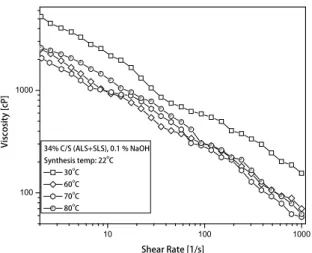
Figure 4 presents the variation of viscosity with shear rate (1-1000s-1) for 34% C/S (ALS+SLS) with 0.1% NaOH within the shear rate range of 1 to 1000 s-1 at temperatures of 30, 60, 70 and 80 ºC. From the figure it is clear that the viscosity decreases with increase in temperature and shear rate up to 60 ºC and beyond this temperature the viscosity increases. The former behavior is due to the fact that the
aggre-gates formed move away from each other and a con-tinuous decrease in viscosity is observed. At the temperatures beyond 60 ºC, viscosity increases be-cause of increased surfactant-water interactions, and hence, more surfactant penetrates into the aqueous phase, increasing the micelle volume and resulting in increased viscosity (Dantas et al., 2003; Yang et al., 2015). But at increased temperature above 70 ºC (Figure 3), addition of alkali forbids this enhanced surfactant-water interaction effect because addition of counter ions resulted in decreased electrostatic repulsion between surfactant molecules. Therefore, at 80 ºC temperature, 34% ALS+SLS with 0% NaOH presented a higher value of viscosity than the VES fluids in the presence of alkali.
10 100 1000
100 1000 10000
Figure 2: Effect of alkali (NaOH) on SBG: 34%C/S (ALS+ SLS) at 30 ºC.
10 100 1000
100 1000 10000
Figure 3: Effect of alkali (NaOH) on SBG 34%C/S (ALS+ SLS) at 80 ºC.
Brazilian Journal of Chemical Engineering Vol. 34, No. 01, pp. 241 - 251, January - March, 2017
10 100 1000
100 1000
Figure 4: Variation of SBG i.e. 34% C/S ALS+SLS with Shear Rate at different temperature for 0.1% NaOH concentration.
30 40 50 60 70 80
10 100 1000
Figure 5: Comparison of SBG of 32% and 34% C/S ALS+SLS at 100 s-1 Shear Rate for 0%, 0.05% and 0.1% NaOH concentrations.
32% C/S. This is because increased surfactant con-centration enhances the growth and entanglement of worm-like micelles, i.e., Micellar Aggregation Num-ber (N) increases at higher surfactant concentration and N decreases with increase in temperature (Pal, 1998). It can be observed from Figures 2 to 5 that the apparent viscosity decreases with increasing shear rate for all temperatures, indicating the shear thin-ning nature of the fluids. The reduction in viscosity is due to breaking of a network of wormlike micelles as the micelles align themselves in the direction of shear, which occurs even in the presence of alkali at increased temperature. Yet viscosity and elastic be-havior are recovered once the disrupting energy is removed. In particular, the molecular thermodynamic theory describes this ionic/ionic interaction and
mi-cellar growth as it occurs due to the modification of the apparent surface per headgroup and screening of the electrostatic repulsion between the headgroups. The proper balance between the different contribu-tions to the free energy of micellization can result in maximization of the aggregation number for particu-lar compositions (Pal, 1998; Grillo, 2014).
246 G. Chauhan, K. Ojha and A. Baruah
Table 1: Viscosity (cP) values at 100 s-1 shear rate for 32% C/S SLS, 30% C/S (SLS+CAPB) and for 32% C/S
(ALS+SLS) with reference from Baruah et al. (2014).
Temp, ºC 32%C/S SLS 30%C/S(CAPB+SLS) 32%C/S(ALS+SLS)
0% NaOH 0.1% NaOH 0% NaOH 0.1% NaOH 0% NaOH 0.1% NaOH
30 142 290 240 360 190 355 40 60 240 190 310 170 290 50 48 190 140 275 110 270 60 35 160 110 220 90 180
Effect of addition of Nanoparticles
In VES fluids, nanotechnology application is used for maintaining viscosity at high temperatures and controlling fluid loss without damaging the for-mation. For this study, 500 ppm inorganic silicon dioxide (SiO2) nanoparticles were selected, which displayed unique surface morphology and reactivity. Viscosity is the measure of a fluid’s resistance to gradual deformation by tensile or shear stress. More resistance to viscosity loss with an increase in tem-perature is a qualitative analysis of thermal stability which had been used as a parameter for thermal sta-bility by many authors like Crews and Huang (2008), Tamas et al. (2014), Baruah et al. (2014) etc. 34% C/S (ALS+SLS) with 0.1% NaOH and 500 ppm SiO2 nanoparticles exhibited higher resistance to high temperatures and shear rate by maintaining a higher value of viscosity; thus, they can be considered to be more thermally stable than 34% C/S (ALS+SLS) + 0.1% NaOH without nanoparticles.These nanometer-scale particles react with VES micelles by chemi-sorptions and surface charge attraction to stabilize fluid viscosity at high temperatures and produce a pseudofilter cake of viscous VES fluid that signifi-cantly reduces the fluid loss rate. In other words, a high density 3D-network of worm-like micelles is obtained, which makes the micelles more thermally resistant to higher temperature (Crews and Huang, 2008). The increase in thermal stability by addition of SiO2 nanoparticles can be observed in Figure 6. When nanoparticles are added to the VES solution, they will associate or create intramicellar “pseudo-crosslinking”, giving a much stronger dynamic mi-celle network (Huang and Crews, 2008). Also, addi-tion of nanoparticles leads to the formaaddi-tion of mi-celle-particle junctions that effectively join two or more micelles (Crews and Huang, 2008).
The temperature increase leads to microdrop mo-bility intensification, which influences the activation energy of the system. This viscosity-temperature re-lationship can be explained by Arrhenius type equa-tions applied to the cumulative effect described by the shear stress (Tamas et al., 2014).
. RTEa A e
where Ea is the viscous flow activation energy (J mol-1); R is the universal gas constant, having a value of 8.314 J.K-1 mol-1; T is the absolute temperature and A represents a material constant (Pa s) (Hassan
et al., 1998).
30 40 50 60 70 80
100 200 300 400 500 600 700 800 900 1000
Temperature (°C)
Figure 6: Effect of addition of 500 ppm SiO2 nano-particles to 34% C/S ALS+SLS with 0.1% NaOH for different temperatures at 100 s-1 shear rate.
Brazilian Journal of Chemical Engineering Vol. 34, No. 01, pp. 241 - 251, January - March, 2017
Table 3 gives the ANOVA results for linear plots for both the gels. The significance value of 0.020 (<0.05) for 34% ALS+SLS+ 0.1% NaOH with 500 ppm SiO2 nanoparticles supports the linear relation-ship between ln ƞ and (1/T), while the significance value of 0.055 (>0.05) for 34% ALS+SLS+ 0.1% NaOH means there is some deviation from a linear relationship.
0.00300 0.00305 0.00310 0.00315 0.00320 0.00325 0.00330 5.0
5.2 5.4 5.6 5.8 6.0 6.2 6.4 6.6 6.8
Figure 7: Plot of ln ƞ vs 1/T for 34% C/S ALS+SLS and 34% C/S ALS+SLS + 500 ppm SiO2 at 0.1% NaOH for 303-330K temperature range.
Table 2: Table for Coefficients of Arrhenius linear plot with their standard error and significance value for 34% C/S ALS+SLS+0.1% NaOH with 0 and 500 ppm SiO2.
34% C/S ALS+SLS+0.1%NaOH
Unstandardized Coefficients
Significance
B Std. Error
For 0 ppm SiO2
Slope 4013.143 981.004 0.055
Intercept -7.050 3.090 0.150
For 500 ppm SiO2
Slope 4706.724 675.213 0.020
Intercept -8.857 2.127 0.053
Table 3: ANOVA table for linear plots for 34% C/S ALS+SLS+0.1% NaOH with 0 and 500 ppm SiO2.
34% C/S ALS+SLS+0.1% NaOH
Sum of Squares
Degree of Freedom
Mean Square
Significan ce 1. For 0 ppm SiO2
Regression 0.790 1 0.790 0.055
Residual 0.094 2 0.047
Total 0.885 3
2. For 500 ppm SiO2
Regression 1.087 1 1.087 0.020
Residua 0.045 2 0.022
Total 1.132 3
Values of the activation energy were calculated using the slope value [Ea/RT] of the linear plot, as
shown in Figure 7 and results are tabulated in Table 4. The mean value and standard deviation of the activa-tion energies for both the samples are presented in Table 4, which showed that the nanoparticle-induced mixed surfactant system had a higher value of the activation energy (39.131 kJ/mol) compared to the surfactant system without nanoparticles (33.365 kJ/mol). This high value points to higher thermal stability of nanofluids and the presence of a 3-D network of micelles involving stronger interactions between macromolecular aggregates than are present in other fluids (Dantas et al., 2003b).
Table 4: Activation energy values for different samples in the temperature range of 303-333K.
S.No Sample Mean Value of the
Activation Energy, E (kJ/mol)
Std. Deviation
2 34% C/S ALS+SLS, 0.1%
NaOH 33.365
0.471
4
34% C/S ALS+SLS, 0.1% NaOH + 500 ppm nano particle
39.131
0.327
Shear Stress vs. Shear Rate
Figure 8 shows the variation of the shear stress (τ, Pa) as a function of the shear rate (γ, s−1) for 34% C/S ALS+SLS with 0 ppm and 500 ppm SiO2 nano-particles. The fluid is basically a non-Newtonian fluid and the shape of the flow curves is represented by a power-law equation:
n k
248 G. Chauhan, K. Ojha and A. Baruah
0 200 400 600 800 1000
0 20 40 60 80 100 120
She
a
r S
tre
ss
[P
a]
Shear Rate [1/s]
Figure 8: Variation of shear stress vs. shear rate for 34% SLS+ALS with and without nanoparticles.
To test the difference between theoretical and ex-perimental power law parameters, the t-test was per-formed and the results are tabulated in Table 7. The Levene test for ‘k’ and ‘n’ was performed to deter-mine the quality variances and significance values. It
can be observed from the table that the significance value is equal to 0.000 which is less than p=0.05, i.e., the assumption of equality of variances for the t-test is violated. Therefore, “Equal variances not as-sumed” t-statistics is considered in the Table 7. Since the significance values of the power law parameters “n” and “ k” for both the samples are greater than 0.05 [0.360 (n1), 0.620(k1), 0.681(n2) and 0.146(k2)], the power law model is validated by all the experi-mental data.
Dynamic Oscillatory Measurements
Dynamic Oscillatory experiments measure the linear viscoelastic response of materials and are known to be the most valuable probes of gel or net-work structure. Steady shear measurements accurately represent the process conditions and oscillatory meas-urements are necessary for an insight into the numbers of network crosslinks. Linear Viscoelastic measure-ments can be used to determine the crosslink density of the gel, the kinetics of gel formation and shear degradation of the gel structure (Goel et al., 2002).
Table 5: Values of k and n for different SBG.
S.No Sample Value of flow behavior index, n Value of consistency index, k
Mean value Std. deviation Theoretical value
Mean value Std. deviation Theoretical value
1. 34% C/S ALS+SLS 0.508 0.346 0.437 1.965 3.062 1.627
2. 34% C/S ALS+SLS + 500 ppm SiO2 0.490 0.414 0.526 4.237 3.858 3.023
Table 6: Coefficient table with standard error and significance value for 34% C/S ALS+SLS+0.1% NaOH with 0 and 500 ppm SiO2.
34% C/S ALS+SLS+0.1% NaOH Unstandardized Coefficients Significance
B Std. Error
For 0 ppm SiO2
n1 0.437 0.036 0.000
k1 1.628 0.236 0.000
For 500 ppm SiO2
n2 0.526 0.040 0.000
k2 3.023 0.490 0.000
Table 7: Independent t-test for Power law parameters of 34% C/S ALS+SLS +0.1% NaOH with 0 and 500 ppm SiO2 nanoparticles.
Sample Parameter
Levene's Test for Equality of Variances
t-test for Equality of Means
Significance Degree of
freedom
Significance (2-tailed)
34% C/S ALS+SLS +0.1% NaOH
n1 Equal Variances Assumed
Equal Variances not Assumed 0.000
47 20.000
0.283 0.360 k1
Equal Variances Assumed
Equal Variances not Assumed 0.000
47 20.000
0.562 0.620 34% C/S ALS+SLS +0.1%
NaOH+500 ppm SiO2
n2 Equal Variances Assumed
Equal Variances not Assumed 0.000
47 20
0.660 0.681 k2
Equal Variances Assumed
Equal Variances not Assumed 0.000
47 20.000
Brazilian Journal of Chemical Engineering Vol. 34, No. 01, pp. 241 - 251, January - March, 2017
Figures 9-10 show the variation of the storage modulus [G (ω)] and loss modulus [G (ω)] with re-spect to frequency from 1 to 100 s−1 at 40 ºC. Oscil-latory shear measurements were made for 34% C/S ALS+SLS system, and for the effect of addition of nanoparticles on the same.
For all samples, the storage modulus, G( ), and the loss modulus, G( ), were almost independent of the angular frequency range since the curves are al-most parallel to the x-axis, which show basically the gel nature. The storage modulus always maintained a higher value than the loss modulus, indicating the viscoelastic nature of the fluid where elasticity is dominant.
The nanoparticle-induced mixed surfactant sys-tem exhibited higher values of G( ) and G( ) as compared to the gel without nanoparticles. The pres-ence of nanoparticles leads to stronger interactions between the macromolecular aggregates and a 3-D network of worm-like micelles is formed in the fluid.
The frequency where G( ) =G( ) (crossover point) is referred to as the relaxation time of the net-work. In both the samples, no crossover of G( ) and G( ) was observed within the frequency range under investigation (1−100 s−1). This means that the crossover point must have been below 1 s-1, indicat-ing good capacity of the fluid to suspend the parti-cles, because the lower the crossover frequency, the higher the particle suspension capability (Gaillard et
al., 2013). Also, recent studies have shown that fluids having a minimum viscosity value of 25 cP (at 100 s-1) and elastic modulus of 2 Pa are good enough to suspend proppant for hydraulic fracturing (Thampi et al., 2014). In the present case, both the samples had an elastic modulus value much higher than 2 Pa and viscosities above 100 cP.
Miscibility Test
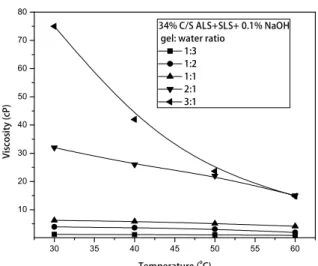
The breaking characteristic of fracturing fluid was examined by carrying out miscibility tests for VES fluids in the presence of water. The viscosity of gel-water mixtures at different proportions is pre-sented in Figures 10 and 11 as a function of tempera-ture. The results show that the highly viscous gel is completely miscible with water and breaks into a low viscous liquid. This occurs as the worm-like micelles break into non-viscous, more spherical micelles, which can no longer form a network (Nasr-El-Din et al., 2003). Also by adding water to the gel, the sur-factant concentration eventually falls to a level at which insufficient numbers of micelles are present to entangle and the viscosity decreases. Higher viscosi-ty values were obtained at 2:1 and 3:1 ratios, which indicate that the gel is broken to a lesser extent, but presented a low viscosity at increased temperature. The nanoparticle-induced mixtures also behave simi-larly. These results clearly indicate that VES fluid does not need any breaker for cleaning of the for-mation after fracturing.
20 40 60 80 100
100 1000
250 G. Chauhan, K. Ojha and A. Baruah
30 35 40 45 50 55 60
10 20 30 40 50 60 70 80
Figure 10: Variation of the viscosity with tem-perature for different gel –water ratios for 34%C/S ALS+SLS+0.1% NaOH.
30 35 40 45 50 55 60
0 5 10 15 20 25 30 35 40 45 50 55 60 65 70 75 80 85 90 95 100
Figure 11: Variation of the viscosity with tem-perature for different gel –water ratios for 34%C/S ALS+SLS+0.1% NaOH + 500 ppm SiO2 nano-particles.
CONCLUSIONS
In the present work, surfactant-based gels (VES) were synthesized with anionic surfactants, i.e., am-monium lauryl sulfate (ALS) and sodium lauryl sul-fate (SLS). The rheology of the prepared gels shows shear thinning behavior with a prominent viscoelas-tic nature. Elasviscoelas-ticity is predominant, which helps the proppant carrying capacity. Addition of NaOH im-proves the viscosity of the gel to a certain extent because of an increase in the micelle population in the basic medium. It could also be concluded from the results that a mixture of ALS and SLS provides a better gel system with higher viscosity compared to
the individual surfactants. The VES gel also shows good miscibility in all proportions with water, thus nullifying the probability of formation of damage without the aid of any breaker. This prepared gel is thermally stable up to 70 ºC and can be effectively used to fracture low temperature reservoirs like CBM.
ACKNOWLEDGMENTS
The authors thank the Council of Scientific and Industrial Research, India, for financial assistant [CSIR Project 22 (0625)/13/EMR-II] and the De-partment of Petroleum Engineering, Indian School of Mines, Dhanbad, India.
REFERENCES
Acharya, D., Varade, D. and Aramaki, K., Effect of temperature on the rheology of wormlike micelles in a mixed surfactant system. Journal of Colloid and Interface Science, 315-330-336 (2007). Angelescu, D., Khan, A. and Caldararu, H.,
Viscoe-lastic properties of sodium dodecyl sulfate with aluminum salt in aqueous solution. Langmuir, 19(22), 9155-9161 (2003).
Armstrong, K., Roger, C., Navarette, R. and Nelson, E., Advanced fracturing fluids improve well eco-nomics. Oil field Review, 7, 43 (1996).
Bajpai, P., Singh, J. P., Mandal, A. and Ojha, K., The synthesis and characterization of a clean hydro-fracturing fluid. J. Pet. Sci. Technol., 28(17), 1750-1760 (2010).
Baruah, A., Chauhan, G., Ojha, K. and Pathak, A., Phase behavior and thermodynamic and rheologi-cal properties of single- (SDS) and mixed-surfactant (SDS + CAPB)-based fluids with 3‑
methylbutan-1-ol as the cosurfactant and pine oil as the organic phase. Industrial Engineering and Chemical Research, 53(51), 19765-19774 (2014). DOI: 10.1021/ie500987y
Carter, K. E., Hakala, A., Hammack, R. W., Hydrau-lic fracturing and organic compounds-uses. Dis-posal and Challenges. SPE 165692 (2013). Crews, J. B. and Huang, T., Performance
enhance-ment of viscoelastic surfactant stimulation fluids with nanoparticles. SPE 113533 (2008).
Brazilian Journal of Chemical Engineering Vol. 34, No. 01, pp. 241 - 251, January - March, 2017
Dantas, T., Santanna, V. C., Dantas Neto, A. A., Bar-ros Neto, E. L. and Alencar Moura, M. C. P., Rheological properties of a new surfactant-based fracturing gel. Colloids and Surfaces, A, Physico-chem. Eng. Aspects, 225, 129-135 (2003b). Dantas, T. N. C., Santanna, V. C., Neto, A. A. D.,
Curbelo, F. D. S., Garnica, A. I. C., Methodology to break test for surfactant-basedfracturing gel. J. Pet. Sci. Eng., 50(34), 293-298 (2006).
Gaillard, N., Thomas, A., Favero, C., Novel associa-tive acrylamide-based polymers for proppant transport in hydraulic fracturing fluids. SPE 164072 (2013). DOI 10.2118/164072-MS
Goel, N., Shah, S. N., Grady, B. P., Correlating vis-coelastic measurements of fracturing fluid to par-ticles suspension and solids transport. J. Pet. Sci. Eng., 35(1-2), 59-81 (2002).
Grillo, I. and Penfold, J., Self-assembly of mixed anionic and nonionic surfactants in aqueous solu-tion. Langmuir, 27(12), 7453-7463 (2011). DOI: 10.1021/la200874g
Hassan, P. A., Candau, S. J., Kern, F., Manohar, C., Rheology ofwormlike micelles with varying hy-drophobicity of the counter ion. Langmuir, 14(21), 6025-6029 (1998).
Hoffmann, H., Platz, G., Rehage, H., Schorr, W., The influence of the salt concentration on the aggrega-tion behavior of viscoelastic detergents. Adv. Col-loid Interface Sci., 17(1), 275-298 (1982).
Hoffman, H., Viscoelastic Surfactant Solutions. Chapter 1, p. 10, ACS Symposium Series (1994). Hou, M., Hou, J. and Shah, D., Effect of the molecu-lar structure of the interface and continuous phase on solubilzation of water in water/oil micro-emuslions. Langmuir, 3, 1086-1096 (1987). DOI 10.1021/la00078a036
Huang, T. and Crews, J. B., Nanotechnology applica-tions in viscoelastic-surfactant stimulation fluids. SPE Prod. Oper, 23(4), 512-517, SPE 107728 (2008).
Jennings, A., fracturing fluids – then and now. SPE 36166 (1996).
Kesavan, S., Homme, R., Rheology of guar and HPG crosslinked by Borate. Macromolecules, 25, 2026-2032 (1992).
Khair, E. M. M., Shicheng, Z., Shanbo, M., Mei, Z., Performance and application of new anionic D3F-AS05 viscoelastic fracturing fluid. J. Pet. Sci. Eng., 78(1), 131-138 (2011). DOI: 10.1016/j.petrol. 2011.05.011
Koehler, R. D., Raghavan, S. R., Kaler, E. W., Mi-crostructure and dynamics of wormlike micellar solutions formed by mixing cationic and anionic surfactants. J. Phys. Chem., B, 104(47), 11035-11044 (2000).
Mehta, S. and Kaur, G., Microemulsions: Thermo-dynamic and Dynamic Properties. Department of Chemistry and Centre of Advanced Studies in Chemistry, Prof. Mizutani Tadashi (Ed.), InTech (2011).
Nasr-El-Din, H. A., Samuel, E., Samuel, M., Appli-cation of a newclass of surfactant in stimulation treatments. SPE 84898 (2003). DOI: 10.2118/84898 -MS
Pal, R., Rheology of drag-reducing surfactant solu-tions. ASME, 245, 155-130 (1998).
Prud’homme, R. K., Chu, A. and Kramer, J., Rheo-logical Characterization of Fracturing Fluids. Princeton University (1984).
Rajib, K. M., Bidyut, K. P., Physicochemical investi-gations of microemulsification of eucalyptus oil and water using mixed surfactants (AOT + Brij-35) and butanol. J. Colloid Interface Sci., 283(2), 565-577 (2005).
Samuel, M., Card, R. J., Nelson, E. B., Brown, E., Vinod, P. S., Polymer-free fluid for hydraulic fracturing. SPE, 38622 (1997).
Tanford, C., Micelle Shape and Size. Journal of Physical Chemistry, 76(21), 1078 (1972). DOI: 10.1021/j100665a018
Tamas, A., Vincze, M. and Padure, M., Rheological properties of some surfactant-based fracturing fluids. Int. Journal of Engineering Research and Applications, 4(2), 95-101 (2014).
Thampi, N., Ojha, K., Nair, U., Effect of branched alcohols on phase behavior and physicochemical properties of Winsor IV microemulsions. J. Sur-fact Deterg., 17, 371381 (2014).
Yuan, Z., Qin, M., Chen, X., Liu, C., Li, H., Hao, J., Phase behavior, rheological property, and trans-mutation of vesicles in fluorocarbon and hydro-carbon surfactant mixtures. Langmuir, 28(25), 9355-9364(2012).
Yang, J., Cui, W., Lu, Y., Guan, B., Qiu, X., Liu, P., Instant gel formation of viscoelastic surfactant fracturing fluids by diluting through lamellar liquid crystal. Journal of Petroleum Science and Engineering, 125 (2015) 90-94 (2015).