“Formulation and evaluation of starch
acetate matrix tablets in combination with
surfactants for controlled release”
Mahesh Kumar Vishwanadha*, B. Shravan Kumar, Rajasri. Ch., Mounika.G,Ramya.D, Saikrupa.B.,
Department of Pharmaceutical Sciences, Vaageswari Institute of Pharmaceutical Sciences, Beside LMD Police Station, Ramakrishna Colony, Karimnagar, Telangana.-505001, India.
Email: [email protected]
+91 9666776902
Abstract
In the present study, an attempt has been made to evaluate starch acetate in combination with surfactant for the controlled release profile of drug from matrix system. Ibuprofen was used as a model drug to evaluate its release characteristics from different matrices. Starch acetate was synthesized, characterized and then employed in the matrix tablets as a hydrophobic polymer in different ratios in combination with SLS. Formulated tablets were characterized for parameters like thickness, weight variation, drug content uniformity, hardness, friability and in-vitro release rate profile and the release data were analysed as per various kinetic models. From the data it was found that the release was following first order kinetics for all the formulationsexcept F8 release profile of which followed zero order and the mechanism of release was found to be Non-fickian diffusion for all the formulations.
Keywords: Controlled release, Matrix tablet, Ibuprofen, Starch acetate, Sodium Lauryl Sulphate.
Introduction
Among various approaches for the preparation of drug embedded, matrix tablets is one of the least complicated approaches for obtaining controlled release and is widely used in Industry. Polymers and release retarding materials used as matrix formers in matrix tablets play a vital role in controlling the drug release from the tablets. Though a variety of polymeric materials are available to serve as release retarding matrix materials, there is a continued need to develop new, safe and effective release retarding matrix materials for controlled release tablets. Modified starches have been used for various pharmaceutical purposes such as fillers, superdisintegrants and matrix formers in capsules and tablet formulations. One of the important modifications of starch is acetylated starch. Starch acetate is reportedto have excellent bond forming ability and suitable for coating and controlled release applications but desired release profile was not sufficiently proved. The present research work is intended to derive stable controlled release polymer in combination with suitable quantity of surfactant, both in combination effect drug release from tablet. Much of the literature on starch acetate and its industrial applications are patented, the details of which are not known. Ibuprofen is a NSAID used as model drug. Matrix tablets of Ibuprofen were formulated employing starch acetate as a hydrophobic polymer and in combinations with SLS in different proportions of drug and polymer and the tablets were evaluated for drug release kinetics and mechanism. Use of hydrophobic polymers alone strongly resists the release. Hence SLS must be included in the matrix system along with a hydrophobic matrix for developing sustained release dosage forms. The objective of the present study was to synthesize and characterize starch acetate to develop sustained release matrix formulations of Ibuprofen and to examine the effects of both Starch acetate and SLS on in-vitro drug release. In the present study Ibuprofen matrix tablets were prepared by using Starch acetate as hydrophobic polymer and Sodium lauryl sulphate as the surfactant which reduces interfacial tension between polymer partials and dissolution medium to study the release kinetics and to find out the effects of all the polymers and their combinations.
Materials and methods
Materials:
Ibuprofen and SLS were supplied by Yarrow Chemical products, Starch acetate was synthesized in the laboratory by using potato starch, acetic anhydride and NaOH solution,Lactose was supplied by Finar Chemicals Ltd., Ahmadabad. Magnesium stearate and Talc were also supplied by Loba Chemie Pvt. Ltd., Mumbai.
Methods:
Preparation of matrix tablets:
were mixed using mortar and pestle for uniform drug distribution. Then the granulating agent was added to the above mixture in order to form a damp mass which was then passed through sieve no.12. The obtained granules were dried at 60°C in a hot air oven and passed through sieve no.16. To the obtained granules Talc and Magnesium stearate were added and finally compressed into tablets weighing 350 mg each, using a tablet punching machine.
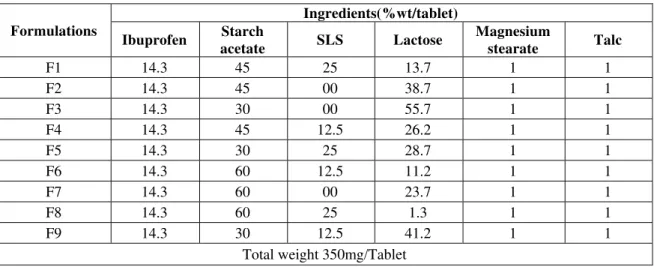
Table 1: Formulations of Ibuprofen matrix tablets
Formulations
Ingredients(%wt/tablet)
Ibuprofen Starch
acetate SLS Lactose
Magnesium
stearate Talc
F1 14.3 45 25 13.7 1 1
F2 14.3 45 00 38.7 1 1
F3 14.3 30 00 55.7 1 1
F4 14.3 45 12.5 26.2 1 1
F5 14.3 30 25 28.7 1 1
F6 14.3 60 12.5 11.2 1 1
F7 14.3 60 00 23.7 1 1
F8 14.3 60 25 1.3 1 1
F9 14.3 30 12.5 41.2 1 1
Total weight 350mg/Tablet
Evaluation of granules:
1. Bulk Density: Apparent bulk density was determined by placing 25g of weighed granules in a graduated cylinder. Carefully level the powder without compacting and read the unsettled volume (V). Apparent bulk density was calculated in gm/ml by using the formula
Bulk density=Weight of the powder/bulk volume
2. Tapped Density: 25g of granules were weighed accurately and transferred into a100 ml graduated cylinder of tap density tester which was operated for fixed number of taps until the powder bed has reached a minimum. The tapped volume (V) was measured and tapped density was calculated using the formula
Tapped density = Weight of the powder/Tapped volume
3. Angle of Repose: Angle of repose was determined by using funnel method. The granules were taken in the funnel. Height of the funnel was adjusted in such a way the tip of the funnel just touched the apex of the heap. Granules were allowed to flow through the funnel freely onto the surface. Diameter of the powder cone was measured and angle of repose was calculated using the following formula
Angle of Repose= 2h/D
4. Carr’s Index: Compressibility index of the granules was determined by Carr’s compressibility index. It is a simple test to evaluate the BD and TD of the granules and the rate at which they are packed down. The formula for Carr’s index is as below:
Carr’s index (%) = [(TD-BD)*100]/TD
5. Hausner’s ratio: Hausner’s ratio is a number that is correlated to the flowability of the powder.
Hausner’s ratio=TD/BD
Evaluation of Tablets:
Thickness: Thickness of the tablets was determined by using vernier calipers.
Weight Variation Test: To study weight variation, 20 tablets of each formulation were weighed using an electronic balance and the test was performed according to the official method.
Hardness: Hardness of the tablets was determined using a hardness testing apparatus (Monsanto Type). A tablet hardness of about 5-6 kg/cm2 is considered adequate for mechanical stability.
Friability: The friability of the tablets was measured in a Roche Friabilator. Tablets of a known weight (W0) or a sample of tablets are dedusted in a drum for a fixed time (100 revolutions) and weighed (W) again. Percentage friability was calculated from the loss in weight as given in equation below. The weight loss should not be more than 1%w/w
Drug content (Assay): Ten tablets were finely powdered and an amount equivalentto 50 mg of Ibuprofen wasaccurately weighed and transferred to a100 ml volumetric flask and extracted withphosphate buffer (pH 7.4). The mixturewas then filtered to remove the undissolvedparticles and 1 ml of the filtratewas suitably diluted and analyzed forIbuprofen content at 222 nm using double beam UV/Visible spectrophotometer.
Compatibility studies: The compatibility studies were performed to analyze the drug interactions with the polymers. From the results it is clear that there are no positive interactions between the drug and the polymer. This was further confirmed by the IR spectra of pure drug, polymers and drug and polymers alone and combinations.
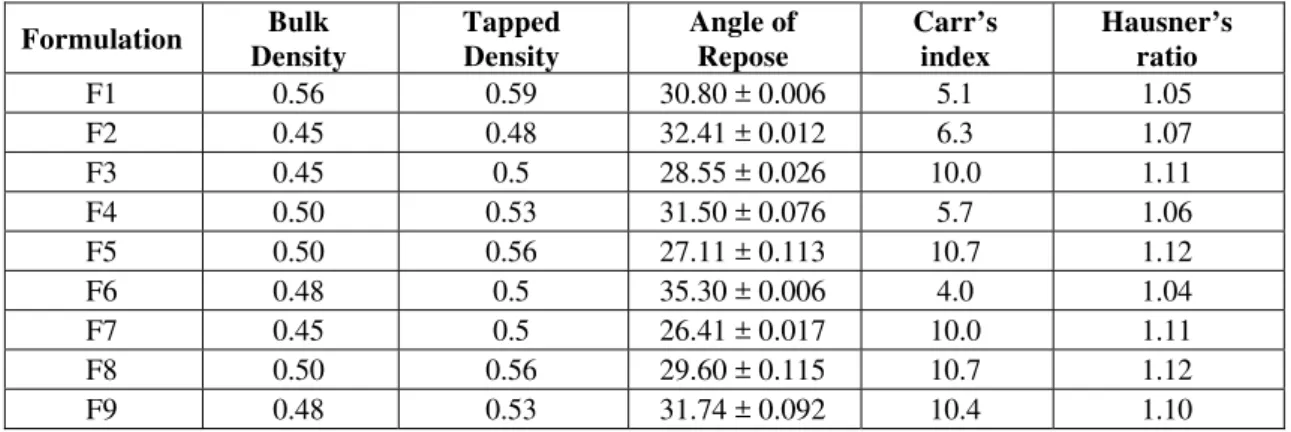
Table 2: Evaluation of granules
Formulation Bulk Density
Tapped Density
Angle of Repose
Carr’s index
Hausner’s ratio
F1 0.56 0.59 30.80 ± 0.006 5.1 1.05
F2 0.45 0.48 32.41 ± 0.012 6.3 1.07
F3 0.45 0.5 28.55 ± 0.026 10.0 1.11
F4 0.50 0.53 31.50 ± 0.076 5.7 1.06
F5 0.50 0.56 27.11 ± 0.113 10.7 1.12
F6 0.48 0.5 35.30 ± 0.006 4.0 1.04
F7 0.45 0.5 26.41 ± 0.017 10.0 1.11
F8 0.50 0.56 29.60 ± 0.115 10.7 1.12
F9 0.48 0.53 31.74 ± 0.092 10.4 1.10
In-vitro drug release study:
Release ofIbuprofen was determined using USP (XXI) Eight stage dissolution rate test apparatus I (Lab India®) at 100 rpm. The dissolution rate was studied using 900ml of pH 1.2 buffer for first 1.5hrs followed by phosphate buffer (pH7.4) for the remaining hours. The temperature was maintained at 37±0.5°C. Samples of 5ml each were withdrawn at different time intervals i.e., 0.5, 1, 1.5, 3, 4, 5 up to 24 hours and replaced with an equal amount of fresh medium. Samples were suitably diluted and analyzed for Ibuprofen content using double beam UV-Visible spectrophotometer (Shimadzu, Japan) at 222nm.
Table 3: Evaluation of Tablets
Formulation Thickness (mm)
Weight Variation
Hardness (kg/cm2)
Friability (%)
%Drug content F1 5.70 ± 0.400 349.9±1.24 4.4 ± 1.11 0.87±0.22 98.19±0.09 F2 5.75 ± 0.403 350±0.88 6.8 ± 1.60 1.01±0.09 99.09±0.02 F3 6.50 ± 0.387 349.7±1 3.8 ± 0.75 0.58±0.24 97.29±0.17 F4 6.30 ± 0.510 350.09±1.32 4.0 ± 0.81 0.93±0.12 99.09±0.33 F5 6.30 ± 0.400 350.9±1.7 4.0 ± 0.77 1.1±0.18 99.54±0.23 F6 6.75 ± 0.403 350.73±2.28 4.1 ± 1.22 0.88±0.11 99.09±0.52 F7 6.85 ± 0.391 350.25±0.87 4.1 ± 0.65 1.1±0.25 98.64±0.05 F8 7.10 ± 0.374 349.75±1.02 4.3 ± 0.64 0.29±0.31 95.49±0.03 F9 6.95 ± 0.415 350.69±2.13 4.2± 1.18 0.97±0.13 97.29±0.16
Results and discussion
Interpre To know zero-orde regressio it indicat 0.986sho
etation of dru wthe mechanis er,and Higuch on values of al
tes that they own in the tab
Fig 1
Fig 2
Fig 3
ug releaseMec sm of drug re hi’s plots an ll the formulat followedfirst ble no. 5. So,
1: In-vitro drug re
2: In-vitro drug re
3: In-vitro drug re
chanism by k elease from th nd Peppas eq
tions except F t-order releas , it shows tha
elease profiles of
elease profiles of
elease profiles of
kinetic models he formulation quations.The v F8 were found
se kinetics. F atformulations
matrix tablets (F
matrix tablets (F
matrix tablets (F
s:
ns, the data w values of R2 d to bemore in Formulation F s employing h
1-F3)
4-F6)
7-F9)
were treatedac can beobser first order tha F8 followed z higher percen
ccording to fi rved in Tabl an in zero ord zero order ki ntage Starch a
irst order, e 5. The derrelease,
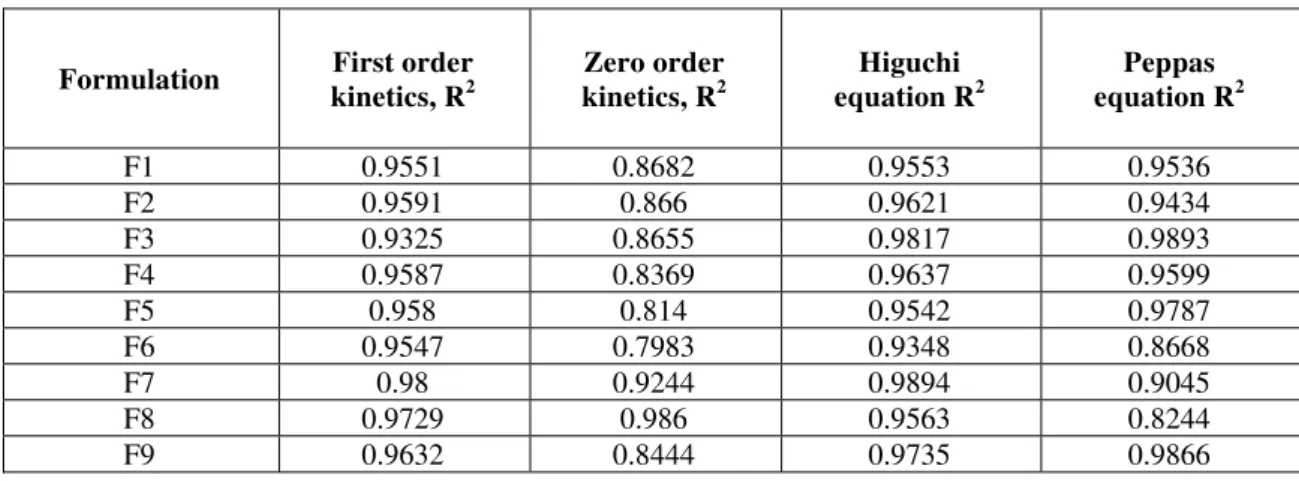
ahydrophobic polymer showed first orderrelease kinetics, whereas formulationsemploying 12:5 ratio of starch acetate and SLS,followed zero-orderkinetics. The regression values of all theformulations in Higuchi equation were foundto be > 0.93 indicating that the drugrelease from these tablets was diffusioncontrolled. When the release data wereanalyzed as per Peppas equation, therelease exponent 'n' was in the range 0.58 with all the matrix tablets indicating non-fickian (anomalous) diffusion.
Table 5: Release kinetics of Ibuprofen from the matrix tablets.
Formulation First order kinetics, R2
Zero order kinetics, R2
Higuchi equation R2
Peppas equation R2
F1 0.9551 0.8682 0.9553 0.9536
F2 0.9591 0.866 0.9621 0.9434
F3 0.9325 0.8655 0.9817 0.9893
F4 0.9587 0.8369 0.9637 0.9599
F5 0.958 0.814 0.9542 0.9787
F6 0.9547 0.7983 0.9348 0.8668
F7 0.98 0.9244 0.9894 0.9045
F8 0.9729 0.986 0.9563 0.8244
F9 0.9632 0.8444 0.9735 0.9866
Conclusion
Starch acetate with a degree ofsubstitution of above 2.0 could besynthesized by acetylation of potato starchwith acetic anhydride.Ibuprofen matrix tabletswere prepared using starch acetate and in combination with SLS, by wet granulationmethod.All the tablets were evaluated and theresults obtained were said to be within thepharmacopoeial limits.The starch acetate alone could produce a24hrs of drug release but the % drugrelease was not sufficient to produce therequired activity i.e., the % drug release isless than 90%. So, in the present work,combinations of starch acetate withSLS are formulated toproduce more than 90% drug release for24 hours and also to sustain the drugrelease for 24hrs which cannot be achievedby hydrophilic polymers alone. In this experiment, combination of starch acetate andSLS (F8) produced 91.53%drug release in 24 hrs.The drug release kinetics show that theformulations employing high percentage Starch acetate of showedfirst-order drug release whereas othersshowed zero-order release pattern. Plots ofper cent released versus square root oftime were found to be linear with all thematrix tablets prepared indicating that thedrug release from these tablets was diffusion controlled. The ‘n’ values inPeppas equation indicate that all theformulations showed Non-Fickiandiffusion mechanism.Hence, it can be concluded that starchacetate is a good matrix former and incombination with optimum quantity of surfactant, itcan be formulated as matrix tablets toproduce sustained release of Ibuprofen for 24 hours.
Acknowledgement
We are thankful to the Management and Principal Vaageswari Institute of Pharmaceutical Sciences for their kind support and necessary support to carry out this research work.
References
[1] M. K. Kohke, H. R. Chuech and C. J. Rhodes. Comparison of Disintegrant and Binder Activity of Three Corn Starch Products, Drug Dev. Ind. Pharm, 18 (20): 2207–2223 (1992).
[2] K. P. R. Chowdary, K. V. V. Suresh Babu. Dissolution, Bioavailability and Ulcerogenic Studies on Solid Dispersions of Indomethacin in Water Soluble Cellulose Polymers, Drug Dev. Ind. Pharm, 20 (5): 799–813 (1994).
[3] M. Tarvainen, R. Sumwen, S. Peltonen, P. Tiihonen and P. Paroneni. Starch acetate-A novel film-forming polymer for pharmaceutical coatings, J. Pharm. Sci, 91:282–289 (2002).
[4] O. Korhonen, P. Raatikainen, P. Harjunen, J. Nakari, E. Suihko, S. Peltonen, M. Vidgren and P. Paronen. Starch acetates- multifunctional direct compression excipients. Pharm. Res, 17:1138–1143 (2000).
[5] E. Cid, F. Mella, L. Lucchini, M. Carcamo, J. Monasterio. Plasma concentrations and bioavailability of Propranolol by oral, rectal and intravenous administration in man, Biopharm. Drug. Dispos, 7: 559-566 (1986).
[6] T. Walle, E. C. Conradi, U. K. Walle, T. C. Fagan, T. E. Gaffney. Thepredictable relationship between plasma levels and dose during chronic propranolol therapy, Clin. Pharmacol. Ther. 24: 668-677 (1978).
[7] J. Liu, F. Zhang, J. W. McGinity. Properties of lipophilic matrix tablets containing phenyl propanilamine hydrochloride prepared by hot-melt extrusion. Eur. J. Pharm. Biopharm, 52: 181-190 (2001).
[8] R. Garg. Pre-formulation: A need for dosage form design, pharmainfo.net, 2008, vol.6.
[9] British Pharmacopoeia, Vol. 2. Her Majesty’s stationary office, London, England. 2000, pp. 266-268.
[10] L. Lachman, A. Liberman, J. L. Kanig. The theory and practice of industrial Pharmacy, 4th edition, Varghese publishing house, Bombay.1991, pp.67-68.
[11] U. S. Pharmacopoeia, 2008, Vol 3, 3116.
[12] T. Higuchi. Mechanism of sustainedaction medication. Theoretical analysis of rate of release of solid drugs dispersed in solid matrices, J. Pharm. Sci. 52: 1145-1149 (1963).