Vol. 6, No. 4, 2003 Degradation Studies on Plasticized PVC Films Submited to Gamma Radiation 497
Materials Research, Vol. 6, No. 4, 497-500, 2003. © 2003
*e-mail: [email protected]
Trabalho apresentado no XV CBECIMAT, Natal - RN, Novembro de 2002.
Degradation Studies on Plasticized PVC Films
Submited to Gamma Radiation
Glória Maria Vinhasa*, Rosa Maria Souto-Maiorb, Camila Maria Lapac, Yêda Medeiros Bastos de Almeidad
a,b
Departamento de Química Fundamental, UFPE Cidade Universitária, 50740-540 Recife - PE, Brazil
c,d
Departamento de Engenharia Química,UFPE Cidade Universitária, 50740-540 Recife - PE, Brazil
Received: February 5, 2003; Revised: June 30, 2003
Poly (vinyl chloride), PVC, is a rigid polymer and for several of its applications must be compounded with plasticizing agents. The plasticizers minimize the dipolar interactions, which exist between the polymer’s chains, promoting their mobility. In this work we studied the proper-ties of PVC/plasticizer systems submitted to different doses of gamma radiation. We have used four commercial plasticizers amongt them di(2-ethylhexyl) phthalate, DEHP, which is present in a great number of commercial applications. The PVC/plasticizer systems have been studied as films made by the solvent evaporation technique. Irradiated and non-irradiated films have been characterized by viscosimetric analysis, mechanical essays and infrared spectroscopy. The results have shown that the rigid, non plasticized, PVC film presented the greatest degradation index, while among the plasticized films the one which presented the larger degradation index due to chain scission was the DEHP plasticized PVC.
Keywords: PVC, gamma radiation, degradation, plasticizer, DEHP
1. Introduction
Poly (vinyl chloride), PVC, has a polyhalogenated chain with chlorine atoms covalently linked to atoms of carbon, providing thus many points of dipolar interaction along its chain which give rise to strong interchain interactions and consequent rigidity of the polymeric material. Plasticizing additives break interchain dipole interaction providing a material with mobility and flexibility characteristics of a
polymer with less interchain interaction1. PVC compounded
with plasticizers has many applications among them
medi-cal devices, packaging material and children’s products2.
Many of the applications require sterilization by gamma radiation.
When polymeric materials are submitted to gamma ra-diation changes are observed on their molecular structure, mainly chain scission which leads to reduction on molar mass, and reticulation which increases molar mass and re-duces solubility3. These molecular alterations lead to changes on mechanical properties of the material.
In this paper we present a study of the properties of PVC/plasticizer systems submitted to different doses of
gamma radiation. PVC wascompounded with four
commer-cial plasticizers: DEHP di(2-ethylhexyl)phthalate), DIBP (diisobutyl phthalate), TOTM (tris(2-ethylhexyl)trimellitate), and viernol, a polymeric plasticizer.
2. Experimental
2.1. Materials
PVC, in pellets, was obtained from Tiletron®, and DEHP, DIBP, TOTM and viernol were obtained from CIBA
- GEYGY®. Tetrahydronfuran, THF, of analytical grade was
purchased from VETEC and used with no further treatment.
2.2. Methods
PVC films were prepared by solvent evaporation of so-lutions 75%:25% by weight of PVC and plasticizer. The conditions for the preparation of uniform films were
498 Vinhas et al. Materials Research Differently compounded PVC films were exposed to
gamma radiation from a 60Co source with a dose rate of
5.87 kGy/h and doses of 10, 25 and 60 kGy. Both exposed and non-exposed films, were analyzed by IR spectroscopy and viscosimetry, and submitted to mechanical testing.
Viscosimetric analyses were carried on an Ostwald-Fenske viscosimeter, where the draining time of THF solu-tions was measured at the constant temperature of 25 °C. Molecular weights were calculated through the following equations:
ηred = (t – to)/to Reducted viscosity (1)
η
esp=ηred.C Specific viscosity (2)
Schulz – Blaschke equation (3)
[η] = KMva Mark-Howink-Sakurada equation (4)
where t = solvent’s draining time (THF), t0 = polymeric so-lution’s draining time, C = polymeric soso-lution’s
concentra-tion (g/dl), KSB = Schulz-Blaschke’s constant and a,
K = constants obtained from the literature5.
In order to obtain the Schulz-Blaschke constant (KSB),
THF solutions (0.8; 0.4; 0.2; 0.1 g/dl) of non-irradiated PVC/plasticizer films were used. Draining time of irradi-ated samples was measured in solutions of 0.2 g/dl.
The viscosimetric molecular weight was related to the degradative process by the Degradation Index, DI, calcu-lated through Eq. 5:
DI (5)
where Mv and Mvi are the viscosimetric molecular weight
of the non-irradiated and irradiated samples, respectively6. Mechanical tests were done in a Universal Trial Ma-chine Testometric Micro 350 in accordance to ASTM D-882 in the following conditions: claw velocity: 100 mm/min; initial claw distance: 30 mm; sample width: 15.2 mm.
Fourier transform infrared analyses were done in a Brucker IFS66 spectrofotometer on KBr pellets. The spec-trum of each film sample irradiated at 10 kGy was meas-ured and the film was further irradiated at 25 kGy before another spectrum of the same film was taken, a third spec-trum was then taken after irradiation of the film at 60 kGy. Evaluation of changes in band intensity from spectrum to spectrum was then done.
3. Results and Discussion
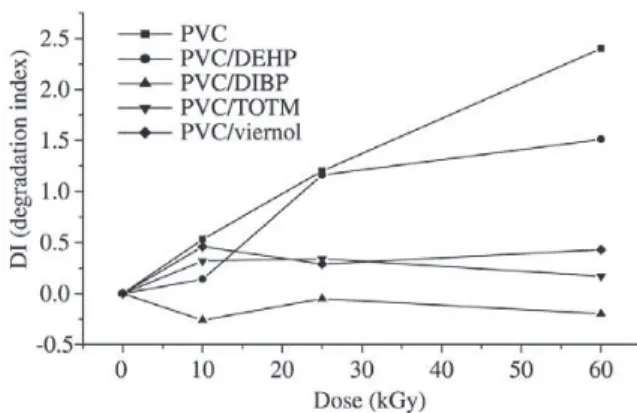
Figure 1 presents the results of the degradation index
(Eq. 5) for PVC and PVC/plasticizer systems as a function of the radiation doses to which they have been submitted. These results show that non plasticized PVC as well as the plasticized systems PVC/DEHP, PVC/TOTM and PVC/viernol have suffered degradation by chain scission upon irradiation. The system PVC/DEHP presented the high-est index of degradation, while PVC/TOTM and PVC/viernol systems presented less degradation than PVC/DEHP suffering both the highest degradation upon ir-radiation at 10 kGy. The system PVC/DIBP on the other hand has not suffered scission of the polymer’s chains at any irradiation dosage. PVC’s molecular weight decrease associated to exposition to degradative sources has been observed and reported in the literature7.
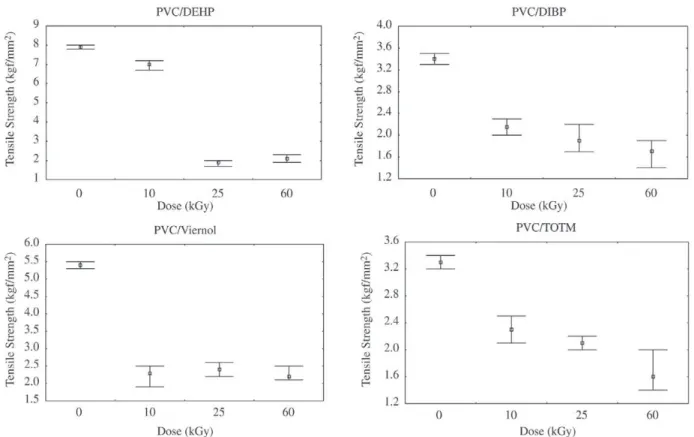
Results on measurements of tensile strength of plasti-cized PVC films before and after irradiation, presented in Fig. 2, revealed a decrease on tensile strength upon irradia-tion which is proporirradia-tional to radiairradia-tion dose. Films of PVC/DEHP presented a sharp decrease on tensile strength when irradiated at 25 kGy, which is the dosage used for sterelization of comercial products based on the PVC/DEHP composition. For the PVC/viernol films a sharp decrease on tensile strength was observed after irradiation even at 10 kGy. Non irradiated films of PVC/DIBP and PVC/TOTM presented smaller tensile strength than the other two sys-tems studied, and both sufferred relatively large losses on tensile strength upon irradiation.
Results on measurements of elongation of plasticized PVC films before and after irradiation presented in Fig. 3 revealed a decrease on elongation at break upon irradia-tion. The PVC/DEHP films had a sharp reduction (74%) on elongation at break already upon irradiation at the low-est dosage, 10 kGy, used in our study. Films of PVC/ TOTM, PVC/DIBP and PVC/viernol presented gradual reduction on elongation at break as the radiation dose was increased.
Vol. 6, No. 4, 2003 Degradation Studies on Plasticized PVC Films Submited to Gamma Radiation 499
Figure 2. Tensile strength of PVC/Plasticizer irradiated and non irradiated films as a function of radiation dose.
500 Vinhas et al. Materials Research
The irradiated PVC films darken and lose transparency. Darkening is proportional to the radiation dose8 and is ex-plained by the formation of double bonds along the chain in a process known as the zipper effect9, illustrated in Fig. 4.
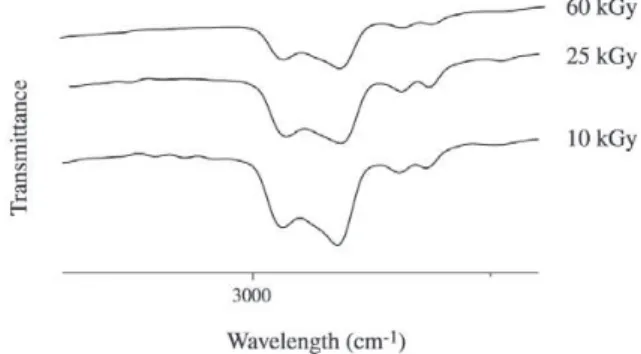
Our results of infrared spectroscopic analysis of the films have shown a decrease in the intensity of the bands attrib-uted to the C-H methylene stretching, appearing at 2912 and 2970 cm-1, an evidence of the loss of methylene protons which agrees with the formation of double bonds. In Fig. 5 we present the infrared spectra of non plasticized PVC irra-diated consecutively at different doses.
4. Conclusion
Plasticized poly (vinyl chloride) films as well as the non plasticized film degrade when exposed to gamma radiation. Both chain scission and double bond formation have been observed. As a consequence of degradation we have ob-served a decrease on tensile strength and elongation at break of the PVC/Plasticizer films.
Figure 4. Formation of insaturations at PVC chain by the “zipper” effect.
Figure 5. Infrared spectra of non plasticized PVC film that was sequencially irradiated at 10, 25 and 60 kGy, in the region be-tween 3200 and 2700 cm-1.
Among the irradiated plasticized poly (vinyl chloride), the PVC/DEHP film have shown the highest degradation due to chain scission, particularly when exposed to the dose of 25 kGy which is the sterilization dosage, used for medi-cal and pharmaceutimedi-cal devices and packaging materials.
Acknowledgements
The authors thank Prof. Elmo Silvano Araújo, DEN-UFPE, for providing the equipment for viscosimetric analysis, and Dr. Selma Loureiro Guedes, IPEN-CNEN/SP, for films irradiation. CAPES and CNPq financial support are gratefully acknowledged.
References
1. Verceze, A.V. Master’s Dissertation, University of
Campinas, SP, Brazil, 1996.
2. Freitas, V. Aplicações do PVC, PVC on line- Instituto do PVC, São Paulo, 2002.
3. Yagoubi, N.; Baillet, A.; Pellerin, F.; Ferrier, D. Beam
Interactions with Materials and Atoms, v. 105, p. 340-344, 1995.
4. Neto, B.; Searminio, B.; Bruns, R.E. Planejamento e
Otimização de Experimentos, 2nd ed., UNICAMP, SP,
Brasil, 1995.
5. Brandrup, J.; Immerggut, E.H. Polymer Handbook, John
Wiley & Sons, USA, 1989.
6. Aquino, K.A.S.; Master’s Dissertation, Federal
Univer-sity of Pernambuco, PE, Brazil, 2000.
7. Genova-Dimitrova, P. Polymer Degradation and
Stabil-ity, v. 33, p. 355-365, 1991.
8. Vinhas, G.M.; Lapa, C.M.; Almeida, Y.M.B.; Souto Maior,
R.M. Anais do 60 CBPol / IX INTERNATIONAL
MACROMOLECULAR COLLOQUIUM, Gramado, RS, p. 707-709, 2001.
9. Gökçel, H.I.; Balköse, D.; Köktürk, European Polymer