DOI: http://dx.doi.org/10.1590/1516-1439.343514
Materials Research. 2015; 18(Suppl 2): 39-42 © 2015
*e-mail: [email protected]
1. Introduction
β-titanium alloys with low elastic modulus have been studied for biomedical applications, however, it is dificult to combine low modulus with high mechanical strength. Usually, to obtain a good combination of low modulus with high strength, β titanium alloys are heat treated and quenched from the β-phase ield, cold worked and then aged. In general, the size, stoichiometry and volume fraction of the precipitated phases depend on the aging temperature and time1,2. Two types of precipitates are reported to be present, α and ω phases3. Furthermore, a reined α phase leads to
higher strength in these alloys4.
Zhou & Niinomi2 have studied the microstructures and
mechanical properties of a Ti-50Ta alloy for biomedical applications and showed that the lowest aging temperature led to iner α precipitates. Usually, lower aging temperature leads to higher strength for the same aging time5.
Wang et al.3 have studied the effect of aging conditions
on the microstructure and hardness of a Ti-10V-2Fe-3Al alloy heat treated at different temperatures (260-600 °C) from 8 to 48 h and showed that the highest hardness values were obtained after aging at 400 °C due to the precipitation of very ine α phase.
The mechanical performance of Ti alloys can be estimated by considering the strength (or hardness) to Young’s modulus ratio. This parameter (hardness/Young’s modulus) is employed by some authors1,2,6 to measure the performance of biomaterials for use as a bone substitute.
Gabriel et al.6, in the development of a metastable beta
Ti-12Mo-13Nb alloy with molybdenum equivalent (Moeq) of
15.4, have studied the effect of thermomechanical processing on the mechanical properties of this alloy. The alloy was aged at 500 and 600 °C for 10 min, 4h and 24h and presented a modulus in the range of 73-111 GPa. The optimised microhardness to the Young’s modulus ratio was achieved after aging at 500 °C for 24 h due to a bimodal α-phase size distribution in the β-Ti matrix.
Considering the strategic character of Nb, for which Brazil is the largest producer, a new β-Nb rich alloy was studied, with molybdenum equivalent (Moeq) of 15.4, as in the
case of Ti-12Mo-13Nb alloy. The new alloy, of composition Ti-10Mo-20Nb alloy, is attractive for the present purpose due to its low modulus (~74 GPa) when compared with commercially Ti-6Al-4V alloy, however, it presents low hardness7. Thus, the focus of this work was to evaluate
processing conditions (swaging + aging treatments) in order
Control of the Microhardness to Young Modulus Ratio by Mechanical
Processing of a Ti-10Mo-20Nb Alloy
Sinara Borborema Gabriela,b,c*, Mônica Costa Rezendea, Luiz Henrique de Almeidaa,
Carlos Angelo Nunesd, Jean Dillee, Glória de Almeida Soaresa
aDepartamento de Engenharia Metalúrgica e de Materiais, Universidade Federal do Rio de Janeiro - UFRJ,
CP 68505, CEP 21945-970, Rio de Janeiro, RJ, Brazil
bCentro Universitário de Volta Redonda - UniFOA, Avenida Paulo Erlei Alves Abrantes, 1325,
Três Poços, CEP 27240-560, Volta Redonda, RJ, Brazil
cUniversidade do Estado do Rio de Janeiro - UERJ, Rodovia Presidente Dutra, Km 298,
CEP 27537-000, Resende, RJ, Brazil
dDepartamento de Engenharia de Materiais, Universidade de São Paulo - USP, CP 116,
CEP 12600-970, Lorena, SP, Brazil
eChemical e Materials Department, Université Libre de Bruxelles, Avenida Franklin Roosevelt, 50,
CP 194/03, Brussels, Belgium
Received: October 29, 2014; Revised: June 16, 2015
β-metastable titanium alloys with high strength to Young’s modulus ratio have been developed by different authors aiming their use as biomaterials for hard tissue replacement. However, it is not easy to combine low elastic modulus with high mechanical strength. In this work, a β-Ti alloy (Ti-10Mo-20Nb) was produced by arc-melting, then homogenized, cold swaged and aged in order to obtain ine α-Ti precipitates in a β-Ti matrix. The microstructures were characterized by transmission electron microscopy and X-ray diffraction. Mechanical properties characterization was based on Vickers microhardness tests and Young’s modulus measurements. The cold swaged material subjected to an ageing treatment at 500 °C for 4 h showed the highest hardness/ Young’s modulus ratio, associated to very ine α phase precipitates in a β-Ti matrix.
Gabriel et al.
40 Materials Research
to obtain a good combination between hardness and elastic modulus for the Ti-10Mo-20Nb alloy
2. Material and Methods
Two Ti-10Mo-20Nb (wt%) ingots (35 g each) were prepared from commercially pure Ti, Mo, and Nb by arc melting under high purity argon gas with a non-consumable tungsten electrode on a water-cooled copper hearth. The ingots with approximately 50 mm in length were then remelted ive times to improve chemical homogeneity. The ingots were then machined to a cylindrical shape of 9 mm diameter and approximately 45 mm in length, and encapsulated in quartz tubes under high purity argon gas. These samples were heat-treated (solutioning) at 1000 °C for 24 h and quenched in water using the procedure described by Gabriel et al.6.
The ingots were then cold swaged to 4.40 mm inal diameter and approximately 200 mm in length (78% area reduction) using 10 area reduction steps. This condition is named here as as-forged. Samples of the as-forged material were aged at 500 and 600 °C for 10 min, 4 h, and 24 h and then quenched in water. Figure 1 shows a schematic diagram of the experimental procedure.
The characterisation of phases was performed using X-ray diffraction (XRD) operated at 40 kV and 30 mA with CuKα radiation (λ = 1.5418 Å). The phases were identiied through comparison with simulated diffractograms using the Powder cell8 program, inserting data from the α (hcp structure,
a = b = 2.9503 Å and c = 4.6810 Å), ω (hcp structure, a = b = 4.60 Å and c = 2.82 Å) and β-Ti (bcc structure, a = 3.3112 Å) phases as the space groups, lattice parameters, and atomic positions9.
The microstructure of the alloy in different conditions was investigated by transmission electron microscopy (TEM) operated at 200 kV. Thin foils were prepared by twin-jet electropolishing in a solution containing (60 mL) HClO4,
(590 mL) methanol, and (350 mL) ether monobutylethylene at 35 V and –20 °C.
Vickerss microhardness values were determined using a load of 100 gf for 30 seconds. The hardness value of a given sample is the average of ten individual measurements. Young’s modulus values were determined by a instrumented indentation technique. Three sets of nine indentations (3 × 3) were made using a Berkovich tip (three-sided pyramid) with an applied load of 400 mN corresponding to one complete loading–unloading cycle with a peak hold time of 15 seconds. The Young’s modulus value is the average of 27 measurements. The hardness and Young’s modulus of commercially pure titanium (cp Ti) grade 2 and Ti-6Al-4V wrought annealed alloy were also determined for comparison.
3. Results and Discussion
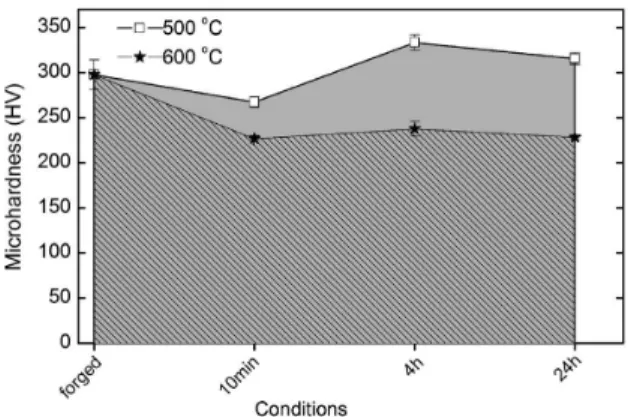
Figure 2 shows the hardness values of the alloy after different processing conditions. The curves show typical behaviour from precipitation hardening mechanism. The sample aged at 500 °C for 4 h exhibited the maximum hardness. When the ageing temperature was increased from 500 to 600 °C, a continuous decrease in hardness was observed because the precipitation kinetics led to an over-aged condition.
For this reason, only the samples aged at 500 °C were characterised by XRD and TEM and had their Young’s modulus values determined.
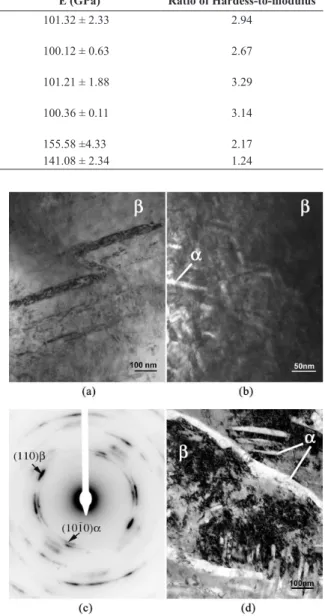
The Young’s modulus values of the Ti-10Mo-20Nb alloy in the as-forged and aged (500 °C) conditions are given in Table 1, noting no signiicant difference in the values. This fact can be possibly justiied considering differences in terms of degree of microstructural recovery and α-phase precipitation in the different alloys (variations in volume fraction and chemical composition of phases (α and β)).
Table 1 also shows hardness and hardness to Young’s modulus ratio of the Ti-10Mo-20Nb alloy after the different processing conditions: as-forged and aged at 500 °C. Data for cp Ti and Ti-6Al-4V alloy are also included. The higher hardness to the Young’s modulus ratio was found for the sample aged at 500 °C for 4h, which correspond to the maximum strength as show in Figure 2. This value (3.29) is higher than those obtained for the Ti-6Al-4V alloy (2.17) and cp Ti (1.24).
Figure 3 shows the XRD patterns (highlighting the peaks near the background) of the as-forged and aged samples at
Figure 1. Schematic diagram of the experimental procedure.
Figure 2. Microhardness of the Ti-10Mo-20Nb alloy after different
Control of the Microhardness to Young Modulus Ratio by Mechanical Processing of a Ti-10Mo-20Nb Alloy
2015; 18(Suppl 2) 41
500 °C. The β single phase can be identiied in the as-forged alloy; however, relections from the α-phase in the β matrix were also identiied in all the aged samples. Moreover, longer ageing time led to higher intensity α peaks.
Figure 4 a-d shows TEM results of the Ti-10Mo-20Nb alloy aged at 500 °C for 10 min, 4 h, and 24 h. Electron diffraction data (Figure 4c) shows α + β phases. Ageing for 4 h increases the quantity of thin α particles in the β matrix, while after 24 h, coarse particles of the α phase are observed together with ine α phase precipitates, featuring a bimodal α-phase size distribution. The same was observed for the Ti-12Mo-13Nb alloy with the same molybdenum equivalent (Moeq) of 15.4[6].
4. Conclusion
Among the different processing conditions, the as-forged material subjected to ageing at 500 °C for 4 h showed the highest hardness/ Young’s modulus ratio, associated to a microstructure formed by very ine α phase precipitates in a β-Ti phase matrix. The microhardness to the Young’s modulus ratio of the present alloy is considerably higher than those of commercially available Ti-6Al-4V alloy and cp Ti.
Acknowledgements
This work was supported by CNPq, FAPERJ and CAPES.
Table 1. Mechanical properties of typical biomaterials and the Ti-10Mo-20Nb alloy.
Alloy H (HV) E (GPa) Ratio of Hardess-to-modulus
Ti-10Mo-20Nb
As forged 297.69 ± 16.22 101.32 ± 2.33 2.94
Ti-10Mo-20Nb
Aged (500 °C/10 min) 267.36 ± 5.82 100.12 ± 0.63 2.67
Ti-10Mo-20Nb
Aged (500 °C/4 h) 333.28 ± 8.96 101.21 ± 1.88 3.29
Ti-10Mo-20Nb
Aged (500 °C/24 h) 315.37 ± 6.70 100.36 ± 0.11 3.14
Ti-6Al-4V 337.31 ± 15.81 155.58 ±4.33 2.17
Ti (cp) 174.89 ± 8.93 141.08 ± 2.34 1.24
Figure 3. X-ray diffraction patterns of Ti-10Mo-20Nb alloy
(a) as-forged; (b) aged at 500 °C /10 min; (c) aged at 500 °C/4 h and (d) aged at 500 °C/24 h.
Figure 4. TEM data from the Ti-10Mo-20Nb alloy: (a) bright-ield
Gabriel et al.
42 Materials Research
References
1. Matsumoto H, Watanabe S and Hanada S. Microstructures and mechanical properties of metastable βTiNbSn alloys cold rolled
and heat treated. Journal of Alloys and Compounds. 2007; 439(1-2):146-155. http://dx.doi.org/10.1016/j.jallcom.2006.08.267.
2. Zhou Y and Niinomi M. Microstructures and mechanical properties of Ti-50 mass%Ta alloy for biomedical applications.
Journal of Alloys and Compounds. 2008; 466(1-2):535-542.
http://dx.doi.org/10.1016/j.jallcom.2007.11.090.
3. Wang B, Liu Z, Gao Y, Zhang S and Wang X. Microstructural evolution during aging of Ti-10V-2Fe-3Al titanium alloy.
Journal of University of Science and Technology Beijing. 2007; 14(4):335-340. http://dx.doi.org/10.1016/S1005-8850(07)60066-8.
4. Raghunathan SL, Stapleton AM, Dashwood RJ, Jackson M and Dye D. Micromechanics of Ti-10V-2Fe-3Al: in situ synchrotron characterization and modeling. Acta Materialia. 2007; 55(20):6861-6872. http://dx.doi.org/10.1016/j.actamat.2007.08.049.
5. Zhou YL, Niinomi M and Akahori T. Decomposition of martensite α′’ during aging treatments and resulting mechanical properties
of Ti-Ta alloys. Materials Science and Engineering A. 2004; 384(1-2):92-101. http://dx.doi.org/10.1016/j.msea.2004.05.084.
6. Gabriel SB, Almeida LH, Nunes CA, Dille J and Soares GA. Maximisation of the ratio of microhardness to the Young’s modulus of Ti-12Mo-13Nb alloy through microstructure changes. Materials Science and Engineering C. 2013; 33(6):3319-3324. http://dx.doi.org/10.1016/j.msec.2013.04.015. PMid:23706216.
7. Gabriel SB. Processamento e caracterização de ligas ti-Mo-Nb para aplicações biomédicas. [Thesis]. Rio de Janeiro: COPPE/
UFRJ; 2008.
8. Kraus W and Nolze G. Powder cell: a program for the representation and manipulation of crystal structures and calculation of the resulting X-ray powder patterns. Journal of Applied Crystallography. 1996; 29(3):301-303. http://dx.doi. org/10.1107/S0021889895014920.
9. Villars P and Calvert LD. Pearson’s handbook of crystallographic data for intermetallic phases. 2nd ed. Ohio: ASM International;