DOI: http://dx.doi.org/10.1590/1516-1439.333814
Materials Research. 2015; 18(Suppl 2): 13-16 © 2015
*e-mail: [email protected]
1. Introduction
Phosphate glasses are extensively studied and used for several technological applications because of speciic physical and chemical properties when compared to other classical glass formers such as silicate, germanate or borate glasses. Phosphate glasses exhibit small liquidus viscosity, softening temperatures, large UV transparency and high solubility for other glass modiiers or intermediaries such as alcaline, rare earth or transition metal compounds1-5. Particularly, metaphosphate formers such as sodium polyphosphate NaPO3 are known to be able to dissolve very large amounts of transition metal oxides because of the insertion of MOx polyhedra inside the linear phosphate chains, resulting in higher network connectivities and thus higher viscosities and thermal stabilities against devitriication6,7. On the other hand, amorphous materials containing high contents of transition metal oxides are of great interest because of the improvement of rare earth ions luminescence when compared to the transition metal free material8-10. These properties are further enhanced when nanocrystals of the metal oxide are precipitated in the amorphous host since rare earth ions tend to migrate to the crystalline phase of higher refractive index and lower phonon energy. Such materials were largely investigated in silica prepared by sol-gel and containing transition metal oxide such as TiO2, ZrO2, HfO2, Nb2O5 or Ta2O5[11-15]. However, the sol-gel methodology also
presents some intrinsic limitations related with the drying process. For example, complete elimination of OH groups and obtaining of large pieces are hardly achieved. For this reason, incorporation of large amounts of transition metal oxide in other glass formers obtained by melt-quenching and preparation of glass-ceramics from these precursor glasses is of great interest to overcome the sol-gel dificulties.
In this work, we investigated the glass formation in the binary system KPO3-Nb2O5 with increasing niobium oxide contents. Thermal characterizations were performed by DSC to determine characteristic temperatures and thermal stability against devitriication as a function of composition. The most Nb2O5-concentrated glass sample was annealed at the crystallization temperatures Tc1 and Tc2 observed from thermal analysis and the resulting crystalline phases were identiied by X-ray diffraction. These results allowed identifying this glass composition as a good candidate for transition metal oxide precipitation and preparation of optical glass-ceramics.
2. Experimental Part
Investigated compositions were prepared from the starting compounds KH2PO4 99% from Aldrich and Nb2O5 99.9% from Aldrich. The starting powders were weighted using an analytical balance and grinded in an agate
Thermal, Structural and Crystallization Study of Niobium Potassium Phosphate Glasses
Clarissa Luiza Justino de Limaa, Brenno Pastenaa, Rachel Prado Russo Delorenzo Nardia,
José Tadeu Gouvêa Juniora, Jefferson Luis Ferrarib, Fábia Castro Cassanjesa, Gael Poiriera*
aInstituto de Ciência e Tecnologia, Universidade Federal de Alfenas – UNIFAL,
Campus de Poços de Caldas, Rodovia José Aurélio Vilela, 11999, Cidade Universitária, CEP 37715-400, Poços de Caldas, MG, Brazil
bDepartamento de Ciências Naturais, Universidade Federal de São João Del Rei, Campus Dom Bosco,
Praça Dom Helvécio, 74, CEP 36301-160, São João Del Rei, MG, Brazil
Received: September 26, 2014; Revised: April 4, 2015
New glass compositions were investigated in the binary system KPO3-Nb2O5. The glass forming domain was determined by melt-quenching of the starting nominal compositions and it has been experimentally observed that glass samples can be obtained between the molar compositions 95KPO3-5Nb2O5 and 50KPO3-50Nb2O5. Chemically stable compositions from 80KPO3-20Nb2O5 to 50KPO3-50Nb2O5 were characterized by DSC for determination of characteristic temperatures Tg, Tx, Tp and Tf. Glass transition temperatures strongly increase with Nb2O5 content whereas thermal stability against devitriication progressively decreases. Thermal data were used to suggest a structural model in which NbOx polyhedra are inserted inside the phosphate chains of PO4 units. For higher Nb2O5 contents, NbOx units progressively link together to form amorphous NbOx clusters, responsible for the yellow color and lower thermal stability against devitriication. For the composition 50KPO3-50Nb2O5, it has been found that the irst crystallization peak is related with precipitation of hexagonal Nb2O5 in the glass matrix whereas the high temperature exothermic peak is due to both phase transition of hexagonal niobium oxide to monoclinic niobium oxide and precipitation of niobium potassium phosphate K2Nb6P4O26.
Lima et al.
14 Materials Research
mortar before melting in a platinum crucible at 1100°C for 1 hour. The melts were poured in a steel mold preheated around 500°C and annealed at this temperature for 4 hour before cooling to room temperature inside the furnace. These glass samples were then cut and polished. DSC curves were obtained on bulk glass samples of 50mg in Pt/Rh covered crucibles between 200°C and 1100ºC at 10°C/min under N2 atmosphere. These thermal analyzes were obtained using a DSC/TG calorimeter STA 449 F3 Jupiter from Netzsch. X-ray diffraction measurements were performed on powder samples using a Rigaku Ultima IV diffractometer working at 40KV and 30mA between 10° and 70° in continuous mode of 0.02°/s. The crystalline phases were identiied according to X-ray powder diffraction patterns (PDF ile)16.
3. Results and Discussion
Binary compositions were melted and quenched in the binary system KPO3-Nb2O5 in order to determine the glass forming domain for this system. Potassium metaphosphate doesn´t vitrify alone but forms a white non-transparent ceramic under melt quenching. Adding 5% of Nb2O5 is enough for sample vitriication. Transparent glass samples could be prepared for Nb2O5 contents ranging from 5 mol% to 50 mol%, which correspond to a P/Nb ratio from 9.5 to 0.5. However, KPO3 rich samples (95% and 90%) are extremely hygroscopic and not stable under room atmosphere for more than a few minutes. For this reason, these glass compositions were not used for further characterizations.
The glass compositions selected for thermal characterizations are resumed in Table 1 and presented in Figure 1. Transparent, homogeneous and chemically stable glasses were obtained from 20 mol% to 50 mol% of Nb2O5 and a progressive yellowish-orange color appears for the most niobium oxide concentrated samples KNb40 and KNb50. For these compositions, the P/Nb ratio is 0.75 and 0.5 respectively, which means that the glass network is built up with more niobium than phosphorus atoms. Then, it should be expected that niobium oxide rich domains are formed in the glass from clustering of NbOx units (probably NbO6). It is known that several transition metal oxides tend to form non-stoichiometric oxygen-deicient compounds to reach a lower free energy. The charge balance is maintained by reduction of some transition metal ions17,18. In our case, It is expected that these niobium rich glass samples contain some reduced Nb4+ in amorphous NbO
x clusters, resulting in visible absorption from internal electronic d-d transitions.
DSC curves presented in Figure 2 for samples KNb20, KNb30, KNb40 and KNb50 were analyzed to extract characteristic temperatures and thermal stability against devitriication in function of the composition (Table 1). The irst important result obtained from these curves is the
clear increase of glass transition temperatures with increasing Nb2O5 content. High Tg values are commonly related with high vitreous network connectivities and strong chemical bonds. For our niobium potassium phosphate samples, increasing Nb2O5 contents result in a progressive phosphorus substitution with niobium ions in the glass network. Phosphorus atoms are four-fold coordinated in phosphate compounds with one of the P-O bonds being a double terminal bond. At the best, only three P-O bonds are able to connect phosphate tetrahedra through P-O-P bridging bonds19. In metaphosphate structures, linear phosphate chains are formed since only two P-O bonds are connecting the phosphate units. On the other hand, niobium ions usually exhibit high coordination number in oxide compounds, being the octahedral coordination the most common one20. Then, niobium oxide polyhedra inserted inside the linear metaphosphate structures cross-link the covalent chains to form a three-dimensional network with a much higher connectivity and a resulting higher viscosity.
Another structural information extracted from the DSC analysis is related with the thermal stability against devitriication estimated using the parameter Tx-Tg. In fact, sample KNb20 doesn´t suffer any devitriication between
Table 1. Molar compositions and characteristic temperatures of glass samples.
Sample Molar composition (%) Tg (°C) Tx (°C) Tp (°C) Tf (°C) Tx-Tg (°C)
KNb20 80KPO3-20Nb2O5 500 - - -
-KNb30 70KPO3-30Nb2O5 580 780 840 940 200
KNb40 60KPO3-40Nb2O5 690 870 930 1040 180
KNb50 50KPO3-50Nb2O5 710 780 790 1060 60
Figure 1. Glass samples prepared in the binary system KPO3-Nb2O5. (Source: authors)
Figure 2. DSC curves of the glass samples KNb20, KNb30, KNb40
Thermal, Structural and Crystallization Study of Niobium Potassium Phosphate Glasses
2015; 18(Suppl 2) 15
Tg at 508°C and 1100°C suggesting a very stable glass network. For this composition, the P/Nb ratio is 2 and the glass network is built up with two phosphorus atoms for one niobium atom. Considering that all niobium ions are inserted inside the phosphate chains through P-O-Nb bridging bonds and that the niobium distribution is homogeneous along the covalent network, this P/Nb ratio is consistent with the formation of a three-dimensional network in which one NbOx polyhedron is present between two PO4 tetrahedra (PO4-PO4-NbOx-PO4-PO4). Then, it can be understood that all PO4 tetrahedra are bonded to another phosphate unit and a niobium oxide unit, promoting a very high thermal stability against devitriication.
Particularly, sample KNb50 presents two distinct crystallization peaks centered at 796°C and 900°C and a low thermal stability with Tx-Tg=62°C. For compositions containing more than 20 mol% of Nb2O5, the P/Nb ratio is lower than 2, suggesting that some PO4 tetrahedra should be bonded to more than one NbOx polyhedron. Since the thermal stability of phosphate glasses is strongly related with the presence of P-O-P bonds, i.e. bridging bonds between PO4 tetrahedra, it can be understood that these Nb2O5 concentrated glass samples are less thermally stable and have a higher tendency for devitriication. In addition, the structural model proposed earlier in this work allows to suggest precipitation of a niobium phosphate crystalline phase since niobium oxide structural units are randomly inserted in the phosphate network. For P/Nb ratio lower than 1 (Nb2O5 contents higher than 33 mol%), it is also assumed that NbOx units link together through Nb-O-Nb bridging bonds and form niobium oxide rich domains in the glass network. These clusters should induce Nb2O5 precipitation since only limited atomic diffusion is required for crystallization of these amorphous niobium oxide domains. Particularly, it is suspected that niobium oxide precipitation could be responsible for the irst crystallization event detected in sample KNb50.
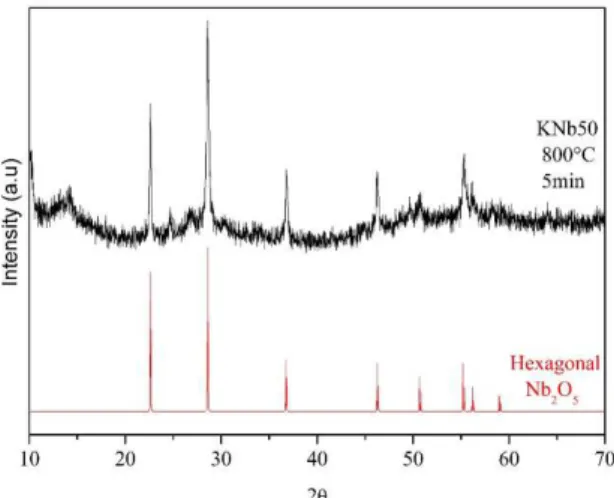
For these reasons, a careful crystallization study was performed on this sample. Heat-treatments were applied at the irst crystallization temperature (800°C) for a short time (5min) in order to induce precipitation of the irst phase without the second one. Another heat-treatment was also performed at the second crystallization temperature of 900°C for 1 hour to ensure complete precipitation of both phases. X-ray diffraction pattern of sample KNb50 heat-treated at 800°C is shown in Figure 3 and the diffraction peaks identiied for this sample were attributed to hexagonal niobium oxide (PDF n°28-317) with cell parameters a=3.607Å and c=3.925Å. No other diffraction peaks are present but a residual diffraction halo is also identiied, suggesting that this sample is a glass-ceramic containing hexagonal niobium oxide. Diffraction pattern of sample KNb50 heat-treated at 900°C is presented in Figure 4 and exhibit a large number of diffraction peaks between 10° and 70°. The irst non-expected result is that diffraction peaks related with hexagonal Nb2O5 are not observed for this sample. Diffraction peaks identiication performed using Crystallographica Search Match attributed better this pattern to the presence of both monoclinic Nb2O5 with cell parameters a=7.348Å, b=8.962Å, c=13.65Å and β=115.5° (PDF n° 19-864) and
orthorhombic niobium potassium phosphate K3Nb6P4O26 with cell parameters a=14.748Å, b=31.58Å and c=9.386Å. Then, it must be assumed that hexagonal niobium oxide experiments a crystalline phase transformation to the monoclinic phase and that the overall remaining glass composition also precipitates as K3Nb6P4O26. It is acceptable to suggest that both events (phase transformation and crystallization) take place around 900°C since the exothermic peak identiied at this temperature is asymmetric and is probably built up from several distinct events. This crystallization study performed on sample KNb50 supports previous assumptions that NbOx clusters are formed inside the glass network and decrease the glass stability against devitriication, acting as crystallization nuclei for hexagonal niobium oxide precipitation. Only NbOx units forming these clusters precipitate at 800°C whereas other NbOx inserted inside the phosphate network remain in the vitreous phase. For that reason, at higher temperatures this remaining amorphous phase also crystallizes, forming niobium potassium phosphate K3Nb6P4O26.
These results obtained on sample KNb50 are very promising for transparent glass-ceramics containing the
Figure 3. X-ray diffraction patterns of sample KNb50 heat-treated
at 800°C for 5min and hexagonal Nb2O5. (Source: authors)
Figure 4. X-ray diffraction patterns of sample KNb50 heat-treated at
Lima et al.
16 Materials Research
Nb2O5 crystalline phase since it has been shown that hexagonal Nb2O5 can be precipitated in the glassy matrix under suitable heat-treatments. These glass-ceramics can ind interesting optical applications when doped with rare-earth luminescent trivalent ions.
4. Conclusion
The glass forming region has been investigated for the irst time in the binary system KPO3-Nb2O5 and transparent glasses can be obtained by melt-quenching for Nb2O5 contents ranging from 5 mol% to 50 mol%. DSC measurements of the chemically stable compositions against moisture ranging from 20 mol% to 50 mol% pointed out that the glass composition containing 20 mol% of Nb2O5 is the most stable against devitriication.. High niobium oxide contents induce lower thermal stabilities and appearance of crystallization events above Tg. Heat-treatment of sample KNb50 at the irst crystallization temperature of 800°C
for 5min induces the precipitation of hexagonal Nb2O5 in the vitreous material whereas heat-treatment at the second crystallization temperature of 900°C for 1 hour results in a crystalline phase transformation of hexagonal niobium oxide to monoclinic niobium oxide together with precipitation of the whole remaining vitreous phase to form niobium potassium phosphate K3Nb6P4O26. The ability of the glass KNb50 to precipitate hexagonal niobium oxide in the glass matrix opens interesting potential applications for luminescent materials since transparent rare-earth doped glass-ceramics could be prepared from this composition. Such results, already reported in silica-based materials obtained by sol-gel were identiied for the irst time in melt-quenched glass samples.
Acknowledgements
The authors would like to thank brazilian funding agencies FAPEMIG, FINEP, CNPq and CAPES for inancial support and UNIFAL-MG for the laboratory structure.
References
1. Sales BC. Phosphate glasses. Materials Research Society Bulletin. 1987; 12(5):32-35.
2. Bih L, Allali N, Yacoubi A, Nadiri A, Boudlich D, Haddad M, et al. Thermal, physical and spectroscopic investigations of P2O5-A(2)MoO(4)-A(2)O (A=Li, Na) glasses. Journal of Physics and Chemistry of Glasses. 1999; 40(4):229-234. 3. Brow RK and Tallant DR. Structural design of sealing glasses.
Journal of Non-Crystalline Solids. 1997; 222:396-406. http:// dx.doi.org/10.1016/S0022-3093(97)90142-3.
4. Lee SW and Lee JH. Raman spectra od aluminosilicate glasses.
Journal of Physics and Chemistry of Glasses. 1995; 36:127-130. 5. Peng YB and Day DE. High thermal expansion phosphate
glasses. Glass Technology. 1991; 32:166-173.
6. Poirier G, Poulain M, Messaddeq Y and Ribeiro SJL. New tungstate fluorophosphate glasses. Journal of Non-Crystalline Solids. 2005; 351(4):293-298. http://dx.doi.org/10.1016/j. jnoncrysol.2004.11.017.
7. Poirier G, Messaddeq Y, Ribeiro SJL and Poulain M. Structural
study of tungstate fluorophosphate glasses by Raman and X-ray
absorption spectroscopy. Journal of Solid State Chemistry. 2005; 178(5):1533. http://dx.doi.org/10.1016/j.jssc.2004.10.032. 8. Righini GC, Pelli S, Ferrari M, Armellini C, Zampedri L,
Tosello C, et al. Er-doped silica-based waveguides prepared by different techniques: RF-sputtering, sol-gel and ion-exchange.
Optical and Quantum Electronics. 2002; 34(12):1151-1166. http://dx.doi.org/10.1023/A:1021338906917.
9. Gonçalves RR, Guimarães JJ, Ferrari JL, Maia LJQ and Ribeiro SJL. Active planar waveguides based on sol–gel Er3+-doped SiO2–ZrO2 for photonic applications: Morphological, structural and optical properties. Journal of Non-Crystalline Solids. 2008; 354(42-44):4846-4851. http://dx.doi.org/10.1016/j. jnoncrysol.2008.05.055.
10. Bunzli JCG and Elisseva SV. Basics of lanthanide photophysics. In: Pekka Hänninen HH, editor. Lanthanide luminescence: photophysical, analytical and biological aspects. Heidelberg: Springer-Verlag; 2011. v. 7. p. 1-45.
11. Zampedri L, Ferrari M, Armellini C, Visintainer F, Tosello C, Ronchin S, et al. Erbium-activated silica-titania planar
waveguides. Journal of Sol-Gel Science and Technology. 2003; 26(1-3):1033-1036. http://dx.doi.org/10.1023/A:1020734018629. 12. Gonçalves RR, Messaddeq Y, Chiasera A, Jestin Y, Ferrari
M and Ribeiro SJL. Erbium-activated silica–zirconia planar waveguides prepared by sol–gel route. Thin Solid Films. 2008; 516(10):3094-3097. http://dx.doi.org/10.1016/j.tsf.2007.07.183. 13. Zampedri L, Righini GC, Portales H, Pelli S, Nunzi Conti G,
Montagna M, et al. Sol–gel-derived Er-activated SiO2–HfO2
planar waveguides for 1.5μm application. Journal of Non-Crystalline Solids. 2004; 345-346:580-584. http://dx.doi. org/10.1016/j.jnoncrysol.2004.08.088.
14. Kościelska B and Winiarski A. Structural investigations of
nitrided Nb2O5 and Nb2O5–SiO2 sol–gel derived films. Journal of Non-Crystalline Solids. 2008; 354(35-39):4349-4353. http:// dx.doi.org/10.1016/j.jnoncrysol.2008.06.049.
15. Ferrari JL, Lima KO, Maia LJQ and Gonçalves RR. Sol-gel preparation of near-infrared broadband emitting Er3+-doped SiO2-Ta2O5 nanocomposite films. Thin Solid Films. 2010; 519(4):1319-1324. http://dx.doi.org/10.1016/j.tsf.2010.09.035. 16 International Centre for Diffraction Data - ICDD, Joint Committee
of Powder Diffraction Standards-JCPDS. Powder Diffraction File. ICDD; 2000.
17. Poirier G, Messaddeq Y, Ribeiro SJL and Poulain M. Structural
study of tungstate fluorophosphate glasses by Raman and X-ray
absorption spectroscopy. Journal of Solid State Chemistry. 2005; 178(5):1533-1538. http://dx.doi.org/10.1016/j.jssc.2004.10.032.
18. Poirier G, Ottoboni FS, Cassanjes FC, Remonte A, Messaddeq Y and Ribeiro SJL. Redox behavior of molybdenum and tungsten in phosphate glasses. Journal of Physical Chemistry B. 2008; 112(15):4481-4487. http://dx.doi.org/10.1021/jp711709r. PMid:18358031.
19. Nelson BN and Exarhos GJ. Vibrational spectroscopy of cation-site interactions in phosphate glasses. The Journal of Chemical Physics. 1979; 71(7):2739. http://dx.doi.org/10.1063/1.438679. 20. Saddeek YB, Shaaban ER, Abdel-Rahim FM and Mahmoud