© 2013 Elsevier Editora Ltda. All rights reserved.
www.ramb.org.br ARTIGOS
ARTIGOS ORIGINAIS _____________Qualidade da informação da internet disponível para pacientes em páginas em português ___________________________________________________________645 Acesso a informações de saúde na internet: uma questão de saúde pública? ______650 Maus-tratos contra a criança e o adolescente no Estado de São Paulo, 2009_______659 Obesidade e hipertensão arterial em escolares de Santa Cruz do Sul – RS, Brasil ___666 Bone mineral density in postmenopausal women with and without breast cancer ___673 Prevalence and factors associated with thoracic alterations in infants born prematurely __________________________________________________679 Análise espacial de óbitos por acidentes de trânsito, antes e após a Lei Seca, nas microrregiões do estado de São Paulo ___________________________________685 Sobrevida e complicações em idosos com doenças neurológicas em nutrição enteral ______________________________________________________691 Infliximab reduces cardiac output in rheumatoid arthritis patients without heart failure ______________________________________________________698 Análise dos resultados maternos e fetais dos procedimentos invasivos genéticos fetais: um estudo exploratório em Hospital Universitário _______________703 Frequência dos tipos de cefaleia no centro de atendimento terciário do Hospital das Clínicas da Universidade Federal de Minas Gerais __________________709 ARTIGO DE REVISÃO ______________Influência das variáveis nutricionais e da obesidade sobre a saúde e o metabolismo __714
Conclusão: como exibir a cereja do bolo 633
PONTO DE VISTA
Os paradoxos da medicina contemporânea 634
IMAGEM EM MEDICINAObstrução duodenal maligna: tratamento endoscópico paliativo utilizando prótese metálica autoexpansível 636 Gossypiboma 638
Hérnia de disco cervical no adulto: tratamento cirúrgico 639
ACREDITAÇÃOAtualização em perda auditiva: diagnóstico radiológico 644
•
•
•
www.ramb.org.br
Revista da
ASSOCIAÇÃO MÉDICA BRASILEIRA
Review article
Breast cancer during pregnancy and chemotherapy:
a
systematic review
q
Denise Leite Maia Monteiro
a,b,*, Alexandre José Baptista Trajano
b,c,
Daniela Contage Siccardi Menezes
c,d, Norma Luiza Machado Silveira
b,
Alessandra Caputo Magalhães
d,e, Fatima Regina Dias de Miranda
b,c,
Barbara Caldas
baCentro Universitário Serra dos Órgãos, Teresópolis, RJ, Brazil
bMedical School, Universidade do Estado do Rio de Janeiro, Rio de Janeiro, RJ, Brazil
cMedical School, Universidade do Grande Rio, Rio de Janeiro, RJ, Brazil
dPerinatal Nucleus, Universidade do Estado do Rio de Janeiro, Rio de Janeiro, RJ, Brazil
eMedical School, Universidade Gama Filho, Rio de Janeiro, RJ, Brazil
A RT I C L E I N F O
Article history:
Received 13 August 2012 Accepted 15 October 2012
Keywords:
Breast cancer Pregnancy Chemotherapy
q
Study conducted at Universidade do Estado do Rio de Janeiro, Rio de Janeiro, RJ, Brazil
* Corresponding author at: Núcleo Perinatal da UERJ (Universidade do Estado do Rio de Janeiro), Rua Prof. Manoel de Abreu, 500, Vila Isabel, Rio de Janeiro, RJ, 20550‑170, Brazil
E‑mail: [email protected] (D.L.M. Monteiro)
A B S T R A C T
This study aimed to establish the safety of chemotherapy use in pregnant women with breast cancer, and to find possible effects in the fetus. A search of MEDLINE/PubMed, LILACS, SciELO, Cochrane, UpToDate, and Google Scholar databases was performed to identify publications., 86 articles published from 2001 to 2012 were retrieved and evaluated by two readers in accordance predetermined exclusion and inclusion criteria; 39 articles were selected . All the chemotherapy drugs used to treat breast cancer during pregnancy belonged to class D, and consisted of 5‑fluorouracil (F), doxorubicin (A) or epirubicin (E) and cyclophosphamide (C), or the combination doxorubicin and cyclophosphamide (AC), a safe regimen when used after the first trimester of pregnancy. Few studies evaluated the use of taxanes (T), such as docetaxel (D) and paclitaxel (P), with no increase in the occurrence of fetal defects and other maternal complications when used in the second and third trimesters of pregnancy. The use of trastuzumab in pregnant women is associated with oligohydramnios and anhydramnios; thus, it is not recommended during pregnancy. As almost all studies were observational and retrospective, new prospective studies on the subject are needed.
Introduction
Breast cancer is defined as associated with pregnancy when it is diagnosed during pregnancy, breastfeeding, or within the first year after birth. It is a challenging setting with a delicate management, whose treatment often generates problems and distress for the pregnant woman, her family, and health care professionals involved due to the dilemma created between the optimum therapy for the mother and well‑being of the fetus. Delaying the treatment, with protection of the fetus in mind,
may impair maternal health.1‑3
Breast cancer incidence may rise in coming years due to the secular trend of lower parity and first birth delay, brought about by changes in the lifestyle of modern women. Studies indicate that the incidence of pregnancy associated with breast cancer ranges from 1:3,000 to 1:10,000 pregnancies; the disease is mostly diagnosed in an advanced stage and has a
worse prognosis than in non‑pregnant women.1,4,5 In Sweden,
an increase was observed between 1963 and 2002 from 16 to 37.4 per 100,000 births, that is, an absolute frequency of
1,161 cases of breast cancer associated with pregnancy.6
The goal of treating pregnant women with breast cancer is the same pursued for non‑pregnant women: local control of the disease and prevention of systemic metastases. However, the treatment mode needs to be carefully evaluated in view
of the potential adverse effects on the fetus.1 Surgery seems
to be reasonably safe, and is the ultimate treatment for breast carcinoma in pregnant women. The surgery risks during pregnancy include miscarriage and preterm birth, with no
increased risk of congenital defects.4,5
Radiation therapy should be delayed whenever possible until the postpartum period. Most pregnant women with breast cancer are candidates for systemic chemotherapy. Recent evidence suggests that several agents used in breast cancer treatment present a good safety profile, particularly when they
are started after the first trimester of pregnancy, resulting in
live births and low morbidity.2,3,5,7,8
This study aims to identify in the scientific literature evidence related to chemotherapy safety in pregnant women with breast cancer, and to find possible effects for the mother and the fetus.
Methods
A wide literature review was performed, searching digital databases. Publications in MEDLINE/PubMed were identified through the following search strategy: (“Breast Neoplasms” [MeSH] AND “Pregnancy Complications, Neoplastic” [MeSH] AND (“Drug Therapy” [MeSH] OR “Chemotherapy, Adjuvant” [MeSH]) AND (“humans” [MeSH Terms]) AND (“women” [MeSH Terms] OR “female” [MeSH Terms]); 76 articles were retrieved. For the LILACS, SciELO, Cochrane, and Google Scholar researches, the following keywords were used:
breast neoplasms, pregnancy, chemotherapy, câncer de
mama, gravidez, and quimioterapia; 10 additional articles were retrieved.
No randomized studies were retrieved, probably due to the low prevalence of the disease during pregnancy, which led to the inclusion of descriptive studies, since almost all articles retrieved were retrospective studies, case reports, and case series. Overall, the search resulted in 86 articles published between 2001 and 2012. The articles were evaluated by two readers who applied predefined exclusion and inclusion criteria, resulting in a final selection of 27 articles. The following inclusion criteria were considered: 1) pregnant patients; 2) patients had breast cancer; 3) the study addressed chemotherapy as treatment for breast cancer during preg‑ nancy; 4) the article was written in English, Portuguese, Spanish, or French; 5) the study described systemic effects of chemotherapy on mother and fetus.
Câncer de mama na gravidez e quimioterapia: revisão sistemática
R E S U M O
O objetivo do estudo é estabelecer a segurança do uso da quimioterapia na gestante portadora de câncer de mama e verificar as possíveis intercorrências no feto. Para identificação de publicações foi realizada pesquisa bibliográfica nas bases de dados: MEDLINE/PubMed, LILACS, SciELO, Cochrane, Uptodate e Google acadêmico. A busca totalizou 86 artigos publicados de 2001 a 2012, que foram avaliados por dois revisores obedecendo aos critérios de exclusão e inclusão pré‑estabelecidos, sendo selecionados 39 artigos para a elaboração deste estudo. Todos os quimioterápicos utilizados no tratamento do câncer de mama na gravidez pertencem à categoria D, consistindo no uso de 5‑fluorouracil (F), doxorrubicina (A) ou epirrubicina (E) e ciclofosfamida (C) ou na combinação de doxorrubicina e ciclofosfamida (AC), método seguro quando utilizado após o primeiro trimestre da gestação. Poucos estudos avaliaram o uso de taxanos (T) como docetaxel (D) e paclitaxel (P), não sendo demonstrado aumento da ocorrência de malformações fetais e outras complicações maternas quando utilizados no segundo e terceiro trimestres da gestação. O uso do trastuzumabe em gestantes encontra‑se associado à oligodramnia e adramnia, não sendo recomendado na gravidez. Em função da quase totalidade dos estudos serem observacionais e retrospectivos, torna‑se necessário a confecção de novos estudos prospectivos sobre o tema.
© 2013 Elsevier Editora Ltda. Todos os direitos reservados.
Palavras-chave:
Studies published before 2001, those whose complete text was not available, and those that evaluated puerperal patients solely, addressed other treatments for pregnant women with breast cancer, evaluated non‑pregnant patients, were written in foreign languages other than those mentioned, or assessed fertility and the possibility of pregnancy after chemotherapy were excluded. 12 other references were used to assist in elaborating the introduction and the discussion of results.
Figure 1 details the selection of articles used to make this study.
Results
The most often used chemotherapy regimen during the second or third trimester of pregnancy consists of 5‑fluorouracil (F), doxorubicin (A) or epirubicin (E) and cyclophosphamide (C), or of the combination doxorubicin and cyclophosphamide (AC), all of which are considered class D in pregnancy.
Of the articles that met the selection criteria for this study, 12 addressed the use of these drugs; those chemotherapy regimens had the highest number of related studies. Epirubicin is the structural analog of doxorubicin, and has the advantage of causing less heart toxicity. Chemotherapy use in the first trimester is associated with malformations in 10% to 20% of fetuses, including micrognathia, hand and foot defects, and
ventriculomegaly;9,10 however, it has been shown to be safe
after that period (Table 1).
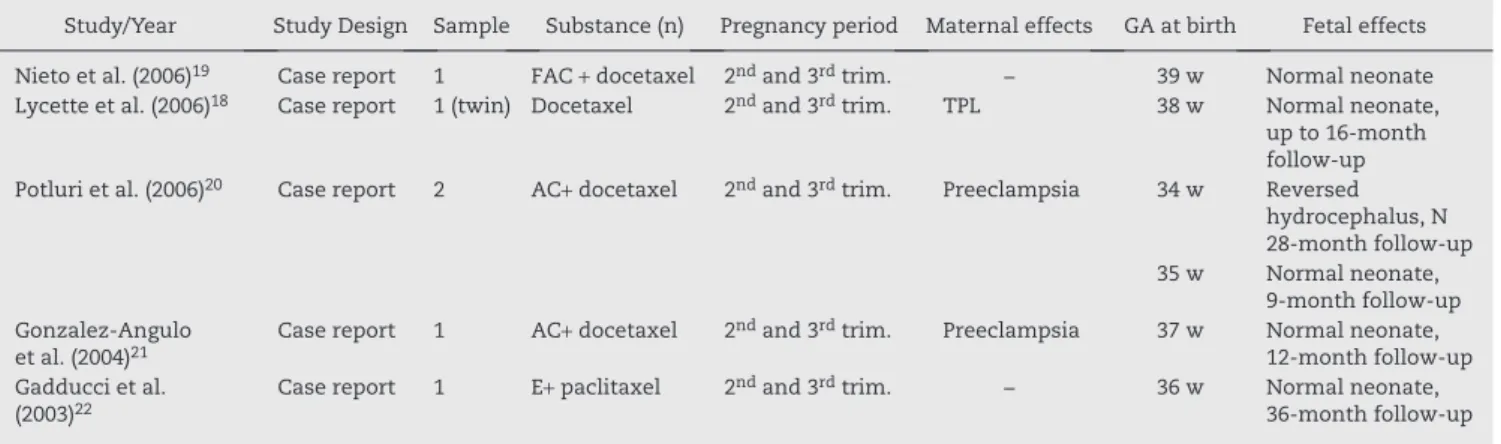
No data are available regarding the optimum dosage in regimens containing anthracyclines during pregnancy, whether or not associated with taxanes. The use of taxanes (T), such as docetaxel (D) and paclitaxel (P), was reported in five studies, and they appear to offer a limited risk to both mother and fetus, but their safety is poorly documented. Paclitaxel pharmacokinetics were studied in a case of twin pregnancy,
with low fetal exposition to the drug.18
In the studies reviewed, no significant differences in maternal and perinatal results were identified with these drugs (Table 2).
Published data regarding trastuzumab use in pregnant women with breast cancer are included in ten case reports. In four, trastuzumab was used in association with other
drugs, such as tamoxifen, docetaxel, and vinorelbine.23‑26 The
other six reports used transtuzumab alone. The time in the pregnancy when the drug was used varied among the studies.
The available evidence in these reports strongly suggests that the use of trastuzumab leads to reduced amniotic fluid volume, since in eight of ten studies oligohydramnios or anhydramnios was observed. In only one of the reports the amniotic fluid was found to be normal after discontinuation of
the drug;27 fetal death occurred in three of them (Table 3).23,28,29
Discussion
Most pregnant women with breast cancer are candidates for chemotherapy. Due to the serious consequences for maternal health when treatment is delayed, pregnancy should not be
considered a deterrent to appropriate therapy.1,2,3,33 Overall,
these patients can be treated in accordance with the guidelines set for the treatment in non‑pregnant women. However, it is important to stress that almost all chemotherapy drugs used belong to class D, that is, they are potentially harmful for the developing fetus, but the requirements of treatment can warrant their use.
The informed consent is essential in approaching the case. The patient and her family should be informed of the therapeutic options and respective risks, and the treatment decision should be made together. Although pregnancy termination may be considered after the diagnosis of breast cancer, there is no evidence that it is necessary in order to
improve maternal‑fetal prognosis.33 The approach must be
individualized, mainly as a consequence of the gestational age and the patient’s clinical condition.
The 27 studies selected in this review were observational. Most (25/27) were case reports or case series. This type of study is particularly used in infrequently seen clinical settings, such as breast cancer during pregnancy. They are applied to document uncommon medical events and can represent the first evidence to identify new conditions or adverse effects, e.g., teratogenic effects on the fetus in mothers undergoing
chemotherapy during pregnancy.34 The low incidence of this
condition prevents other study designs that might generate better‑quality scientific evidence, such as interventional studies/trials. Thus, the current review is limited by the quality of the studies included, due to a lack of more robust studies on the subject.
The therapy regimen most often used by pregnant women with breast cancer includes the anthracyclines epirubicin and doxorubicin, combined with cyclophosphamide and 5‑fluorouracil (Table 1). This therapeutic regimen was used in 12 of the studies included in this review, describing 124 cases. Of these, only 4 cases underwent chemotherapy in the first
trimester: there was one case of miscarriage3 and 2 cases of
malformed neonates.9,10 There is also a report on one case with
normal neonate after chemotherapy in all three trimesters
of pregnancy.16 Despite the impossibility of a causative
association between chemotherapy treatment in the first trimester and the malformations found, there is a consensus on avoiding its use during this period. New studies to assure the safety of using these drugs in early pregnancy are needed.
such as fertility, cognition, and heart function disorders, the cases presented in this study did not have complications and presented evidences of normal development throughout the study period. These infants’ follow‑up ranged from 2 to 157 months. The authors concluded that using the FAC regimen during the second and third trimesters of pregnancy
is safe and well‑tolerated.5 Another study of 26 cases, with a
follow‑up for up to 84 months also did not evidence remote
adverse effects.7
Regarding taxanes use, there are not many literature reports describing their use in pregnant women with breast
cancer. Taxanes are a group of antineoplastic drugs with antimitotic activity that appear to improve the prognosis for women with breast cancer, particularly those having node
involvement.35 Animal studies demonstrate that these drugs
may cause fetal demise and intrauterine growth restriction, in
addition to conditions related to ossification.20 However, none
of the five case reports selected in this review demonstrated neonate involvement from medication use in the second and third trimesters (Table 2). One report on a fetus with hydrocephalus spontaneously reversed after birth. It is important to highlight, however, that the use of docetaxel
Study/Year Study Design Sample Substance (n)
Pregnancy period
Maternal effects
GA at birth
Fetal effects
Leyder et al. (2011)9 Case report 1 FEC
FMC
1st trim.
2nd trim.
− 19 w Micrognathia/hand and foot defects Logue (2009)11 Case report 1 FAC 3rd trim. − 37 w Normal neonate
Sharma et al. (2009)12 Case report 1 FEC 3rd trim. Leucopenia 36 w Normal neonate
Azim et al. (2008)7 Cohort 26 E (23) 2nd trim. − ±35 w Normal neonates
A (3)
Hahn et al. (2006)5 Cohort 57 FAC 2nd and
3rd trim.
− ±37 w 97% normal neonates (1 Down syndrome, 1 clubfoot, 1 ureteral reflux) Skrablin et al. (2005)13 Case report 1 AC 2nd trim. − 37 w Normal neonate
Ring et al. (2005)3 Case series 28 A (16) 2nd trim. 1 miscarriage 37 w Normal neonates
FMC (12)
Mathelin et al. (2005)14 Case report 2 FA 2nd trim. − 37 w Normal neonates
Kerr (2005)15 Case report 1 AC 2nd trim. − 31 w Normal neonate
Paskulin et al. (2005)10 Case report 1 FAC 1st trim. − 38 w Ventriculomegaly, high
palate, microcephaly, syndactyly, deficient growth and development Andreadis et al.
(2004)16
Case report 1 FEC‑1st trim./
associated with RT/AZ/TX
1st, 2nd,
and 3rd trim.
Anemia hyperemesis
35 w Normal neonate
Kuerer (2002)17 Case report 4 FAC 3rd trim. − 36 w Normal neonates
1st trim., 1st trimester of pregnancy; 2nd trim., 2nd trimester of pregnancy; 3rd trim, third trimester of pregnancy; A, doxorubin;
AC, doxorubicin + cyclophosphamide; AZ, zolendronic acid; C, cyclophosphamide; E, epirubicin; F, 5‑fluorouracil; RT, radiation therapy (28 Gy); TX, tamoxifeno.
Table 1 − Evaluation of maternal and fetal effects of using 5‑fluorouracil, doxorubicin or epirubicin, and cyclophosphamide.
A total of 86 articles were identified by electronic media
32 articles excluded for their abstract
54 articles remained and were later evaluated
by two readers
11 review articles and 1 textbook
27 articles excluded by inclusion and exclusion criteria
39 articles selected
by this patient occurred from 26 weeks of pregnancy and, by
this time, hydrocephalus had already been diagnosed.20 One
patient with a twin pregnancy had contractions at the second docetaxel cycle, and nifedipino was used in subsequent cycles. The pregnancy proceeded uneventfully, and a C‑section was
performed at 38 weeks.18
A systematic literature review conducted in 2010 evidenced a favorable toxicity profile for taxanes during the second and third trimesters of pregnancy. However, as pregnancy induces pharmacokinetic changes, the conclusion was that taxane
efficacy is limited, thus suggesting that new studies assessing the pharmacokinetics, as well as placental crossing, are needed to confirm the safety profile in pregnant women with breast
cancer.36
Trastuzumab is a monoclonal antibody targeting the human epidermal growth factor receptor 2 (HER2). When this receptor is highly expressed, it leads to increased cell growth and proliferation, thus indicating that the breast tumor is more aggressive. Treatment with trastuzumab showed better outcomes
and survival in the treatment of HER2‑positive breast tumors.37
Study/Year Study Design
Sample Substance (n)
Pregnancy period
Maternal effects
GA at birth
Fetal effects
Beale et al. (2009)23 Case report 1 (twin) Trastuzumab +
tamoxifeno
1st and
2nd trim.
Oligohydramnios PL and PROM
32 w Kidney injury – 1st twin death at
age of three months Azim et al. (2009)30 Case report 1 Trastuzumab Preconcep.
and 1st trim.
None 39 w N development within fourteen months Pant et al. (2008)31 Case report 1 Trastuzumab 1st and
2nd trim.
Oligohydramnios 32 w N development within five years Weber & Schaefer
(2008)28
Case report 1 Trastuzumab 1st and
2nd trim.
Oligohydramnios PA
27 w < kidney perfusion, death at the age of four months Bader et al. (2007)24 Case report 1 Trastuzumab +
paclitaxel
2nd and
3rd trim.
Oligohydramnios Reduced fetal renal function
32 w Neonatal sepsis, transient respiratory failure
Witzel et al. (2008)29 Case report 1 Trastuzumab 2nd and
3rd trim.
Oligohydramnios and vaginal bleeding
28 w Respiratory failure, capillary fragility, and neonatal death Sekar et al. (2007)25 Case report 1 Trastuzumab
and docetaxel
2nd and
3rd trim.
Reversed oligohydramnios
36 w
IUGR Shrim et al. (2007)32 Case report 1 Trastuzumab 1st and
2nd trim.
Reversed heart failure
37 w Transient tachypnea, N development within two months Fanale et al. (2005)26 Case report 1 Trastuzumab
and Vironelbine
2nd and
3rd trim.
Oligohydramnios 34w N development within six months Watson et al. (2005)27 Case report 1 Trastuzumab 1st and
2nd trim.
Reversed
oligohydramnios after drug withdrawal
37 w N development within six months
1st trim., 1st trimester of pregnancy; 2nd trim., 2nd trimester of pregnancy; 3rd trim, third trimester of pregnancy; IUGR, intrauterine growth
restriction; N, normal; PA, placental abruption; PL, premature labor; PROM, premature rupture of membranes.
Table 3 − Evaluation of effects of trastuzumab use on the mother and the fetus.
Study/Year Study Design Sample Substance (n) Pregnancy period Maternal effects GA at birth Fetal effects
Nieto et al. (2006)19 Case report 1 FAC + docetaxel 2nd and 3rd trim. − 39 w Normal neonate
Lycette et al. (2006)18 Case report 1 (twin) Docetaxel 2nd and 3rd trim. TPL 38 w Normal neonate,
up to 16‑month follow‑up Potluri et al. (2006)20 Case report 2 AC+ docetaxel 2nd and 3rd trim. Preeclampsia 34 w Reversed
hydrocephalus, N 28‑month follow‑up 35 w Normal neonate,
9‑month follow‑up Gonzalez‑Angulo
et al. (2004)21
Case report 1 AC+ docetaxel 2nd and 3rd trim. Preeclampsia 37 w Normal neonate,
12‑month follow‑up Gadducci et al.
(2003)22
Case report 1 E+ paclitaxel 2nd and 3rd trim. − 36 w Normal neonate,
36‑month follow‑up
The studies in pregnant women with breast cancer demonstrated an association with oligohydramnios or anhydramnios. One hypothesis to explain this reduced fluid volume is trastuzumab’s secondary effect on the fetal renal epithelium, where epidermal growth factor receptors are
highly expressed, and are blocked by this drug,30,31 leading
to a decreased fetal urinary output, which was evidenced by empty fetal bladder visualization in the presence of
echografically‑normal kidneys.. Pant et al.31 suggested that this
oligohydramnios might be secondary to an altered expression of vascular endothelial growth factor (VEGF), which regulates amniotic fluid production and reabsorption by changing fetal membrane permeability.
Regarding the neonatal course, six cases of admission to
a neonatal unit were observed.23,24,28,29,32 Irreversible kidney
failure with demise of the first twin,23 respiratory failure
and capillary fragility with neonatal death29, and decreased
kidney perfusion with death at the age of four months
were reported.28 Other cases were successfully managed,
with further normal development.26,27,30‑32 Trastuzumab
administration is associated with cardiotoxicity, with reduced
ventricular ejection fraction.38 Only one case of reversible heart
failure was reported in the review.32 However, information on
maternal heart evaluation is found only in two other studies
describing normal maternal echocardiograms.27,30
Thus, data regarding trastuzumab use in pregnancy are limited to few case reports, impairing conclusions. There were no malformation reports, although unfavorable neonatal outcomes have occurred. It is important to stress the prevalent observation of oligohydramnios, making thorough monitoring of the amniotic fluid volume, a fetal kidney function marker and a fetal well‑being indicator, a mandatory measure in cases where the drug is an option. Likewise, maternal heart condition should be monitored due to the known cardiotoxicity of trastuzumab. Thus, trastuzumab use during pregnancy,
especially extended use, is not encouraged,38 and should be
restricted to cases where treatment benefits for the mother outweigh pulmonary hypoplasia, skeletal abnormalities,
kidney injury, and neonatal death risks.23,27,29,36
When planning the therapy for pregnant women, delivery is scheduled within two or three weeks after the last chemo‑ therapy cycle, in order to avoid maternal and/or fetal neutro‑
penia, and thus reducing the risk of complications.5
The selection of a chemotherapy regimen to treat metastatic disease is extremely controversial, and experts prefer to use anthracyclic drugs. Evidence shows that anthracycline use is safe in the second and third trimesters of pregnancy, with evidence level 2B (Oxford Level of Evidence [LOE] 2B). Given the lack of scientific evidence, recommendations of new cytotoxic drugs during pregnancy, such as taxanes, are not
the consensu (LOE 5),8 and trastuzumab use should also be
avoided.23,25,27,29,31,36
The prospect of a future pregnancy is important for young women with breast cancer. Studies show that pregnancy occurrence in women with previous breast cancer history after successful management has no significant impact on survival. A metanalysis including 1,244 women who conceived after breast cancer treatment and 18,145 controls confirmed these results and suggested that pregnancy after breast cancer may
have a protective effect, with a reduction of death risk by 42%
(OR = 0.42), compared with the group that did not conceive
after cancer treatment.39
Conversely, there are cases of patients with breast cancer that conceive during chemotherapy with potentially teratogenic drugs. This demonstrates the importance of contraception in women of reproductive age requiring chemotherapy, through an intrauterine device, barrier methods, or combined non‑hormonal methods.
Recommendations
1. Chemotherapy in pregnant women with breast cancer should not be delayed, and additional care should be taken to protect the fetus.
2. Chemotherapy can be safely administered during the second and third trimesters with minimal risk to the fetus. 3. Regimens based on anthracycline use should be preferred. 4. Chemotherapy should be avoided within three or four
weeks from delivery in order to prevent neonatal transient myelosuppression.
5. Trasutuzumab use is not recommended during pregnancy, due to the risk of oligohydramnios, anhydramnios, fetal pulmonary hypoplasia, skeletal and developmental abnormalities, and fetal demise.
Conflict of interest
All authors declare to have no conflict of interest.
R E F E R E N C E S
1. Loibl S, von Minckwitz G, Gwyn K, Ellis P, Blohmer JU, Schlegelberger B, et al. Breast carcinoma during pregnancy. International recommendations from an expert meeting. Cancer. 2006;106:237‑46.
2. Woo JC, Yu T, Hurd TC. Breast cancer in pregnancy: a literature review. Arch Surg. 2003;138:91‑8.
3. Ring AE, Smith IE, Jones A, Shannon C
,
Galani E,
Ellis PA.
Chemotherapy for breast cancer during pregnancy: an 18‑year experience from five London teaching hospitals. J Clin Oncol. 2005;23:4192‑7.4. Keinan‑Boker L, Lerner‑Geva L, Kaufman B, Meirow D. Preg‑ nancy‑associated breast cancer. Isr Med Assoc J. 2008;10:722‑7. 5. Hahn KM, Johnson PH, Gordon N. Treatment of pregnant
breast cancer patients and outcomes of children exposed to chemotherapy in utero. Cancer. 2006;107:1219‑26.
6. Andersson TM, Johansson AL, Hsieh CC, Cnattingius S, Lambe M. Increasing incidence of pregnancy‑associated breast cancer in Sweden. Obstet Gynecol. 2009;114:568‑72.
7. Azim HA Jr, Peccatori FA, Scarfone G, Acaia B, Rossi P, Cascio R, et al. Anthracyclines for gestational breast cancer: course and outcome of pregnancy. Ann Oncol. 2008;19:1511‑2.
8. Loibl S, Ring A, von Minckwitz G. Breast cancer during preg‑ nancy: a prospective and retrospective European registry (GBG‑20/BIG02‑03). Eur J Cancer Suppl. 2008;6:68.
to cyclophosphamide, epirubicin and 5‑fluorouracil during the first trimester of pregnancy. Gynecol Obstet Invest. 2011;71:141‑4.
10. Paskulin GA, Zen PRG, Pinto LLC, Rosa R, Graziadio C. Combined chemotherapy and teratogenicity. 2005. Birth Defects Res. (Part A) 2005;73:634‑7.
11. Logue K. Pregnancy‑associated breast cancer. Clin J Oncol Nurs. 2009; 13:25‑7.
12. Sharma JB, Pushparaj M, Kumar S, Roy KK, Raina V, Malhotra N. Successful pregnancy outcome with 5‑fluorouracil, epirubicin, cyclophospamide chemotherapy, and hemostatic radiotherapy with abdominal shielding for metastatic invasive intraductal breast carcinoma. Arch Gynecol Obstet. 2009;279:415‑7. 13. Skrablin S, Banovic V. Adriamycin and cyclophosphamide
chemotherapy in advanced breast cancer in pregnancy. Eur J Obstet Gynecol Reprod Biol. 2007;133:247‑53.
14. Mathelin C, Annane K, Dufour P, Liegeois P, Bergeral JP. Chemo‑ therapy for breast cancer during pregnancy. Eur J Obstet Gynecol Reprod Biol. 2005;123:260‑2.
15. Kerr JR. Neonatal effects of breast cancer chemotherapy administered during pregnancy. Pharmacotherapy. 2005;25: 438‑41.
16. Andreadis C, Charalampidou M, Diamantopoulos N, Chouchos N, Mouratidou D. Combined chemotherapy and radiotherapy during conception and first two trimesters of gestation in a woman with metastatic breast cancer. Gynecol Oncol. 2004;95:252‑5.
17. Kuerer HM, Gwyn K, Ames FC, Theriault RL. Conservative surgery and chemotherapy for breast carcinoma during pregnancy. Surgery. 2002;131:108‑10.
18. Lycette JL, Dul CL, Munar M, Belle D, Chui SY, Koop DR, et al. Effect of pregnancy on the pharmacokinetics of paclitaxel: a case report. Clin Breast Cancer. 2006;7:342‑4.
19. Nieto Y, Santisteban M, Aramendia JM, Fernandez‑Hidalgo O, Garcia‑Manero M, López G. Docetaxel administered during pregnancy for inflammatory breast carcinoma. Clin Breast Cancer. 2006;6:533‑4.
20. Potluri V, Lewis D, Burton GV. Chemotherapy with taxanes in breast cancer during pregnancy: case report and review of the literature. Clin Breast Cancer. 2006; 7:167‑70.
21. Gonzalez‑Angulo AM, Walters RS, Carpenter RJJ, Ross MI, Perkins GH, Gwyn K, et al. Paclitaxel chemotherapy in a pregnant patient with bilateral breast cancer. Clin Breast Cancer. 2004;5:317‑9.
22. Gadducci A, Cosio S, Fanucchi A, Nardini V, Roncella M, Conte PF, et al. Chemotherapy with epirubicin and paclitaxel for breast cancer during pregnancy: case report and review of the literature. Anticancer Res. 2003;23(6D):5225‑9.
23. Beale JMA, Tuohy J, McDowell,SJ. Herceptin (trastuzumab) therapy in a twin pregnancy with associated oligohydramnios. Am J Obst Gynecol. 2009;201:e13‑e14.
24. Bader AA, Schlembach D, Tamussino KF, Pristauz G, Petru E. Anhydramnios associated with administration of trastuzumab and paclitaxel for metastatic breast cancer during pregnancy. Lancet Oncol. 2007;8(1):79‑81.
25. Sekar R, Stone PR. Trastuzumab use for metastatic breast cancer in pregnancy. Obstet Gynecol. 2007; 110(2 Pt 2):507‑10. 26. Fanale MA, Uyei AR, Theriault RL, Adam K, Thompson RA.
Treatment of metastatic breast cancer with trastuzumab and vinorelbine during pregnancy. Clin Breast Cancer. 2005;6:354‑6. 27. Watson WJ. Herceptin (trastuzumab) therapy during preg‑ nancy: association with reversible anhydramnios. Obstet Gynecol. 2005;105:642‑3.
28. Weber‑Schoendorfer C, Schaefer C. Trastuzumab exposure during pregnancy. Reprod Toxicol 2008;25:390‑1.
29. Witzel ID, Mueller V, Harps E, Jaenicke F, Wit M. Trastuzumab in pregnancy associated with poor fetal outcome. Ann Oncol. 2008;19:191‑2.
30. Azim HA, Peccatori FA, Liptrott SJ, Catania C, Goldhirsch A. Breast cancer and pregnancy: how safe is trastuzumab?. Clin Oncol. 2009;6:367‑70.
31. Pant S, Landon MB, Blumenfeld M, Farrar W, Shapiro CL. Treatment of breast cancer with trastuzumab during preg‑ nancy. J Clin Oncol. 2008;26:1567‑9.
32. Shrim A, Garcia‑Bournissen F, Maxwell C, Farine D, Koren G. Favorable pregnancy outcome following trastuzumab (herceptin) use during pregnancy ‑ case report and updated literature review. Reprod Toxicol. 2007;23:611‑3.
33. Yip CH, Taib NA, Abdullah MM, Wahid I. Breast cancer in pregnancy: our experience with six patients in the university hospital, Kuala Lumpur. Med J Malay. 2000;55:308‑10.
34. Hennekens CH, Buring JE. Epidemiology in medicine. Descrip‑ tive studies. Chapter 5. New York: Little Brown and Company; 1987. p.101‑31.
35. Early Breast Cancer Trialists’ Collaborative Group (EBCTCG), 2012. Comparisons between different polychemotherapy regimens for early breast cancer: meta‑analyses of long‑term outcome among 100000 women in 123 randomized trials. Lancet. 2012;379:432‑44.
36. Mir O, Berveiller P, Goffinet F, Treluyer JM, Serreau R, Goldwasser F, et al. Taxanes for breast cancer during pregnancy: a systematic review. Ann Oncol. 2010;21:425‑33.
37. Romond EH, Perez EA, Bryant J, Suman VJ, Geyer CE Jr, Davidson NE, et al. Trastuzumab plus adjuvant chermotherapy for operable HER2 positive breast cancer. N Engl J Med. 2005;353: 1673‑84.
38. Perez EA. Cardiac toxicity of ErbB2‑targeted therapies: what do we know? Clin Breast Cancer. 2008;8(Suppl 3):S114‑S120. 39. Azim HA Jr, Santoro L, Pavlidis N, Gelber S, Kroman N, Azim H,