Profile of prescribers and prescription of antibiotics in upper
respiratory infections in Pediatrics
Perfil de prescritores e prescrição de antimicrobianos nas infecções das vias aéreas superiores em Pediatria
Perfil de prescriptores y prescripción de antimicrobianos en las infecciones de vías aéreas superiores en Pediatría
Maria Carolina P. da Rocha1, Fernando de Sá Del Fiol2, Fábio Miranda Junqueira1, José Inácio P. da Rocha3, Silvio Barberato-Filho4,
Rodrigo Crespo Barreiros5
Instituição: Programa de Pós-Graduação em Ciências Farmacêuticas, Universidade de Sorocaba (Uniso), Sorocaba, SP, Brasil
1Mestre em Ciências Farmacêuticas pela Uniso; Auxiliar de Ensino do Departamento de Medicina da Faculdade de Ciências Médicas e da Saúde da Pontifícia Universidade Católica de São Paulo (PUC-SP), Sorocaba, SP, Brasil
2Pós-Doutor em Farmacologia pela Universidade Estadual de Campinas (Unicamp); Docente do Programa de Mestrado em Ciências Farmacêuticas da Uniso, Sorocaba, SP, Brasil
3Mestre na Área de Clínica/Pediatria pelo Centro de Ciências Médicas e Biológicas da PUC-SP; Professor-Assistente Mestre do Departamento de Medicina da Faculdade de Ciências Médicas e da Saúde da PUC-SP, Sorocaba, SP, Brasil
4Doutor em Fármaco e Medicamentos pela Universidade de São Paulo (USP); Docente do Programa de Mestrado em Ciências Farmacêuticas da Uniso, Sorocaba, SP, Brasil
5Doutor em Pediatria pela Universidade Estadual Paulista Júlio de Mesquita Filho (Unesp); Professor-Assistente e Doutor do Departamento de Medicina da Faculdade de Ciências Médicas e da Saúde da PUC-SP, Sorocaba, SP, Brasil
ABSTRACT
Objective: To describe the profile of physicians that care for children in Brazilian public and private health systems, and to verify how antimicrobials for upper respiratory airway infections are prescribed.
Methods: Physicians in some cities of the state of São Paulo (Southeast Brazil) received an explanatory letter by mail or at the Primary Health Care Units about the research and a form with questions concerning: time of graduation, medical residency, workload and workplace, how they update their medical knowledge, factors considered when prescrib-ing antimicrobials, and clinical cases on upper respiratory infections. Personal information was related to the answers of the clinical cases. For statistical analysis, the Z and Tukey-Kramer tests were applied, being significant p<0.05.
Results: The sample included 170 prescribers, out of whom 87% had medical residence in Pediatrics,75% worked for the Public Health System, and 71% worked more than 40 hours per week. Physicians who graduated in the past ten years emphasized the pharmaceutical industry as a way
of keeping themselves updated in comparison to the ones who had been graduated for more than 30 years; 33% of the public health system physicians cared for more than five patients per hour. Regarding clinical cases, the correct answers averaged 87%. Consulting medical entities as a way of continuous medical education was associated with correct answers, while using materials from the pharmaceutical industry was associated with the incorrect ones (p<0.05). There was a clear trend towards decreasing the quality of the prescription as the number of patients per hour increased.
Conclusions: Efficient education and improvement of work load could reduce the prescription of antibiotics for upper airway infections in children.
Key-words: upper airway infections; pediatrics; anti-bacterial agents; prescription.
RESUMO
Objetivo: Traçar um perfil dos médicos que atendem crianças nos sistemas público (Sistema Único de Saúde) e
Endereço para correspondência: Maria Carolina P. da Rocha
Rua Gustavo Teixeira, 159, apto. 21 – Mangal CEP 18040-323 – Sorocaba/SP
E-mail: [email protected]
Conflito de interesses: nada a declarar
privado de saúde e verificar como são prescritos antimicro-bianos nas infecções das vias aéreas superiores.
Métodos: Médicos de algumas cidades do interior do Estado de São Paulo receberam via correio ou nas Unidades Básicas de Saúde uma carta explicativa sobre a pesquisa e o questionário, com perguntas sobre: tempo de graduação, residência médica, carga horária e local de trabalho, forma de atualização, fatores que consideram ao prescrever antimicrobianos e casos clínicos sobre as infecções das vias aéreas superiores. Os dados pessoais dos médicos foram relacionados com as respostas aos casos clínicos. Para análise estatística, foram aplicados os testes Z e de Tukey-Kramer, sendo p<0,05 significante.
Resultados: A amostra foi composta por 170 prescritores: 86,5% possuíam residência em Pediatria, 75% trabalhavam no Sistema Único de Saúde e 71% tinham carga horária supe-rior a 40 horas semanais. Os formados há menos de dez anos valorizaram mais os laboratórios farmacêuticos como forma de atualização do que os graduados há mais de 30 anos; 33% dos médicos do Sistema Único de Saúde atendem mais de cinco pacientes por hora. A média de acerto nos casos clínicos foi de 87%. O uso das entidades médicas como forma de atualização foi associado a respostas corretas, enquanto o uso de materiais de laboratório estava ligado a respostas incorretas (p<0,05). Houve clara tendência de diminuição dos acertos conforme o número de pacientes atendidos por hora aumentava.
Conclusões: Educação adequada sobre o tema e melhora nas condições de trabalho podem ser eficientes para reduzir a prescrição de antibióticos para infecções das vias aéreas superiores em crianças.
Palavras-chave: infecções das vias aéreas superiores; pediatria; agentes antibacterianos; prescrição.
RESUMEN
Objetivo: Esbozar un perfil de los médicos que atienden a niños en el sistema público (SUS) y privado de salud y ve-rificar cómo se prescriben antimicrobianos en las infecciones de vías aéreas superiores (IVAS).
Métodos: Los médicos de algunas ciudades del interior de la Provincia de São Paulo recibieron por correo o en las Unidades Básicas de Salud una carta explicativa sobre la in-vestigación y cuestionario con preguntas sobre: hace cuánto tiempo se ha graduado, internado, carga horaria y local de trabajo, forma de actualización, factores que tienen en cuenta al prescribir antimicrobianos y casos clínicos sobre IVAS. Los datos personales de los médicos fueron relacionados a las respuestas a los casos clínicos. Para el análisis estadístico,
se aplicó la prueba Z y prueba de Tukey-Kramer, siendo significante p<0,05.
Resultados: La muestra fue de 170 prescriptores: 86,5% realizaron internado en pediatría, 75% trabajaban en el SUS y 70,8% tenían carga horaria superior a 40 horas semanales. Los que se graduaron hace menos de 10 años valorizaron más los laboratorios farmacéuticos como forma de actualización que los graduados hace más de 30 años; el 33% de los mé-dicos del SUS atienden a más de cinco pacientes por hora. El promedio de acierto en los casos clínicos fue de 86,6%. El uso de las entidades médicas como forma de actualización fue asociado a respuestas correctas, mientras que el uso de materiales de laboratorio, a respuestas incorrectas (p<0,05). Hubo clara tendencia a la reducción de los aciertos conforme aumentaba el número de pacientes atendidos por hora.
Conclusiones: Educación adecuada sobre el tema y me-jora en las condiciones de trabajo pueden ser eficientes para reducir la prescripción de antibióticos en IVAS.
Palabras clave: infecciones respiratorias; infecciones de las vías aéreas superiores; pediatría; agentes antibacterianos; prescripción.
Introduction
Respiratory infections are the greatest cause of visits to primary healthcare providers. Pediatric patients attend more consultations and are prescribed more antibiotics for these conditions than any other age group(1-4).
Children catch between six and eight viral infections every year. It is estimated that 5-13% will progress to secondary bacterial infections, and otitis and rhinosinusitis are the most common complications. The most common pathogens causing these infections are Streptococcus pneumoniae, nontyp-able Haemophilus inluenzae and Moraxella catarrhalis, which, as they multiply, progress from colonists of the airways to agents of infection(5,6).
A study conducted at two Primary Care Health Centers (PCHCs) in the city of Sorocaba, SP, found that the age group most often given antibiotics is from zero to ten years. Within this group, 71% of the sample had been given an antibiotic at least once during the previous 6 months and the mean num-ber of prescriptions per year was four, which is well above international references, in which the recommendation is 0.52 utilizations/year/child. A signiicant proportion of the antibiotic prescriptions (20.3%) were for infections for which indications are debatable and 36% of these children had no fever(14).
In view of what has been explained above, this study was conducted in order to trace the proile of physicians who treat children on the Brazilian National Health Service (SUS - Sistema Único de Saúde) and for a Healthcare Insurance Cooperative in provincial cities in the Brazilian state of São Paulo, to assess how these physicians prescribe antibiotics for upper airway infections (UAI) and to describe these prescribers’ level of knowledge about the most-often used antibiotics and protocols for management of the most common airway infections.
Methods
This was a cross-sectional study that employed a data-collection form covering the subjects of interest which was self-administered by the prescribers. The study was ap-proved in advance by the Research Ethics Committee at the Universidade de Sorocaba and received authorization from the Sorocaba municipal council.
The study sample included both physicians from the SUS and from the private healthcare system. The study population comprised all physicians registered as pediatricians with a Healthcare Cooperative (Unimed) in the following provincial cities in São Paulo state: Sorocaba, Bauru, Piracicaba, São José do Rio Preto, Santos, Ribeirão Preto, Campinas, Araçatuba, Barretos, Franca, Presidente Prudente, São Carlos and Jundiaí (1,275 people) and all of the pediatricians and Family Health Strategy physicians who worked at the Sorocaba municipal council’s PCHC or Walk-in Centers at the time of the study (137 people). The inclusion criteria were seeing at least ten children per week and completion of the questionnaire in full.
Prescribers were sent an envelope containing the following items: a covering letter describing the study, two copies of a free and informed consent form, the questionnaire and two stamped (for those who were mailed the pack) and sealable envelopes, one for returning the signed free and informed consent form and the other for returning the completed ques-tionnaire, in order to guarantee conidentiality. Physicians working for the Brazilian National Health Service returned
their envelopes containing their questionnaires and signed consent forms to the directors of their health centers and the physicians working for the Healthcare Cooperative were requested to send their envelopes back by mail.
The instrument, a copy of which can be obtained from the corresponding author, was designed with reference to similar studies conducted previously (15-18) and to applicable recom-mendations (3,5-13). Certain items consist of a statement and a scale from 1 to 5 on which the prescribers indicated their degree of agreement, with 1 corresponding to disagreement and 5 to total agreement. The instrument was tested and validated in advance by administration to 15 prescribers, who then suggested alterations to improve it.
Binary data (e.g. Yes/No answers) were analyzed using the Z test and data with three or more variables were subjected to analysis of variance followed by the Tukey-Kramer test, with a signiicance level of 5%.
A prescription quality indicator was developed to assess antibi-otic prescription. The indicator was calculated from the answers to a series of technical questions based on the applicable recom-mendations (3,5-13). The questions used were as follows:
• What are the antibiotics of choice and the durations of treatment for hypothetical cases of: acute otitis media, bacterial tonsillitis, acute sinusitis and pneumonia (see Table 1) – 1 point for each correct answer.
• Should antibiotics be used or not for four hypothetical cases of the common cold (see Table 2) – 1 point for each correct answer.
• Do you prescribe wide-spectrum antibiotics (e.g. ixed dose combinations including beta-lactamase inhibitors or second or third generation cephalosporins) for patients who have never been treated – 1 point if the answer is no. • To what extent would the following factors inluence your
Table 1 - Questions on clinical use of antibiotics and response frequencies
What would your choice of medication, dosage and length of treatment be in the following situations? Question 1. First episode of acute otitis media in a 2-year-old child?
Amoxycillin + Clavulanate 75mg/kg/day for 10 days 6.5%
Cefaclor 40mg/kg/day for 10 days 2.9%
Amoxycillin 50mg/kg/day for 7 to 10 days* 87%
Sulfamethoxazole + Trimethoprim 40mg/kg/day for 7 days 2.3%
Ceftriaxone 50mg/kg/day IM for 5 days 0.6%
Question 2. Six-year-old child with third episode of bacterial tonsillitis in a 5-month period?
Sulfamethoxazole + Trimethoprim 40mg/kg/day for 7 days 0%
Amoxycillin 50mg/kg/day for 7 days 3.5%
Benzathine penicillin 600,000 UI IM in a single dose* 49%
Azithromycin 10mg/kg/day for 3 days 9.4%
Amoxycillin 50mg/kg/day for 10 days* 35%
Question 3. First episode of bacterial sinusitis in a 6-year-old child?
Amoxycillin + clavulanate 50mg/kg/day for 10 to 14 days 17.6%
Ceftriaxone 50mg/kg/day IM for 5 days 0%
Cefaclor 40mg/kg/day for 10 to 14 days 4.7%
Amoxycillin 50mg/kg/day for 10 to 14 days* 75.2%
Sulfamethoxazole + Trimethoprim 40mg/kg/day for 14 days 1.7%
Question 4. First episode of pneumonia in a 4-year-old child, RR:50, no intercostal retraction?
Admit to hospital, Ceftriaxone 100mg/kg/day for 7 to 10 days 2.9%
Admit to hospital, Crystalline penicillin 200,000 U EV for 7-10 days 25.2%
Amoxycillin 50mg/kg/day – 10 days, reassess in 48h* 58.2%
Amoxycillin + clavulanate 50mg/kg/day for 10 days 10%
Sulfamethoxazole + Trimethoprim 40mg/kg/day 10 days, reassess in 48h* 0.6%
IM: intramuscular; UI: International Units; EV: endovenous; RR: Respiratory ratio; *Correct responses and percentage of correct responses
Table 2 - Frequencies of antibiotic use in cases suggestive of the common cold
Would you prescribe antibiotics in the following situations? Yes (%) No (%)*
Case 1: Two-year-old, previously healthy child with a temperature of 38°C lasting 1 day and
rhinorrhea, iddling with right ear. The tympanic membrane is slightly pink and retracted with
reduced motility. Liquid cannot be seen.
10.0 90.0
Case 2: A 3-year-old girl with intense coughing for 5 days, mild fever for 3 days from onset. On
examination she is irritated, her respiratory rate is normal, her lungs are clean and she is coughing. 5.0 95.0
Case 3: A two-and-a-half-year-old child with bilateral nasal discharge for 5 days, mild fever and
intermittent coughing. Physical examination unremarkable other than purulent nasal drainage. 62.4 37.6
Case 4: A four-year-old child with a painful throat, coryza, bilateral hyperemia of the eyes and intermittent fever for 3 days (38 to 39°C). Physical examination reveals intense hypertrophy and hyperemia of the tonsils.
42.1 57.9
*Correct responses and percentages of correct answers
the questions right, were considered to have average scores. Those who scored more than 91.6% of the maximum pos-sible were deined as above average and those who scored less than 81.6% were considered below average.
Results
One hundred and thirty-seven packs were delivered to physicians working for the Sorocaba municipal council
and 60 (43.8%) of them were returned. One thousand, two hundred and seventy-ive packs were mailed, 41 were unde-liverable and 110 were returned (8.9%). The entire sample comprised the responses of 170 prescribers.
The majority of the sample (75%) predominantly worked for the SUS (more than 50% of working hours). With regard to working hours, 43% worked 40 to 60 hours, 22% worked 60 to 80 hours and 5.8% worked more than 80 hours per week. When asked how they kept themselves up to date, more than half (53%) of the professionals interviewed responded that they took part in conferences at least once a year, while 18% only took part once every 4 years or more. Journals were considered the most important source of up to date information, with a score of 3.58 (range: 1–5) and pharma-ceutical laboratory representatives were considered the least important source, scoring 1.83. Physicians qualiied for less than 10 years considered material provided by laboratories to be more important than did those qualiied for more than 30 years (1.52 vs. 2.36, respectively; p<0.05).
The mean time physicians reported spending on medical consultations for UAI cases was 17.3 minutes, varying from 4 to 60 minutes. A little over half (51%) of the physicians saw three to four patients per hour. When the number of patients seen per hour on the SUS was compared with the number seen in the private sector, the difference was signiicant (p=0.001). On the SUS, 33.0% of physicians reported seeing ive or more patients per hour, whereas in the private healthcare sector the igure did not pass 3%. With regard to physical examination and work up for children with UAI, pulmonary auscultation was indicated in 99.4% of cases, oroscopy in 99.3% and otoscopy in 93%. The physicians reported requesting a chest X-ray in 15% of children with UAI, radiography of the sinuses in 11% and full blood test in 10%, without signiicant differences between the public and privates sectors or on the basis of time since qualiication or presence or absence of medical residency.
The factors reported as interfering with antibiotic pre-scriptions were as follows (the numbers in brackets are the mean impact scores, min 1, max 5): general condition (4.4); disease duration (4.1); presence of underlying diseases (4.0); presence of repeat infection (3.3) and socioeconomic status of patient (2.4). In this study, 17.7% of the physicians stated they would be concerned about the possibility of a patient for whom antibiotics were not prescribed seeking a second opinion and that opinion being different. When the sample was stratiied by time since graduation, recently qualiied physicians were more concerned about this possibility than the remainder of the sample (47.4 versus 86.0%; p<0.05). A majority of the physicians (52%) believed that they could reduce antibiotic prescriptions without risking the patient in less than 10% of cases, 38 of them believed (22%) they could reduce prescribing by 10 to 20% and 27 (15%) re-sponded above 40%. Physicians who predominantly worked for the SUS were more likely to change prescribing patterns depending on where they were working than were those predominantly working in the private sector (48.0 versus 21.0%; p=0.0032). The reasons given were: cost of medica-tions (82%), reassessment would not be possible in a given setting (58%) and patients being at greater risk of worsening as a function of where the physicians were working (56%).
Tables 1 and 2 list the hypothetical cases the physicians were faced with, the response choices provided (with the correct choice in bold type) and, in the last column, the percentage of the sample that chose each response.
According to the prescription quality index, 32.9% of the physicians had a below-average correct response rate, 28.2% prescribed in line with the average and 38.8% were
60%
50%
40%
30%
20%
10%
1 to 2 3 to 4 5 to 6 7 to 8
Above Average
Below Average
Average Linear (Below)
42.1% 36.8% 21.1% 38.6% 27.3% 34.1% 34.2% 24.4% 41.5% 50% 50%
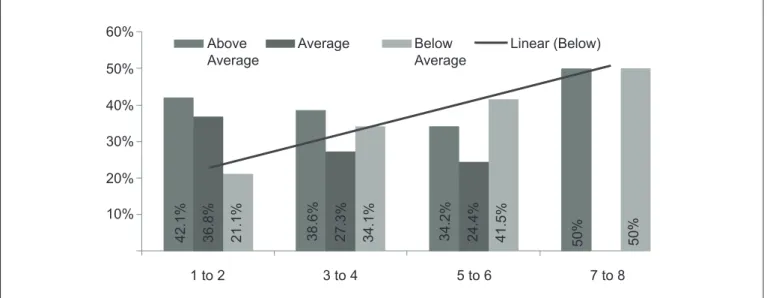
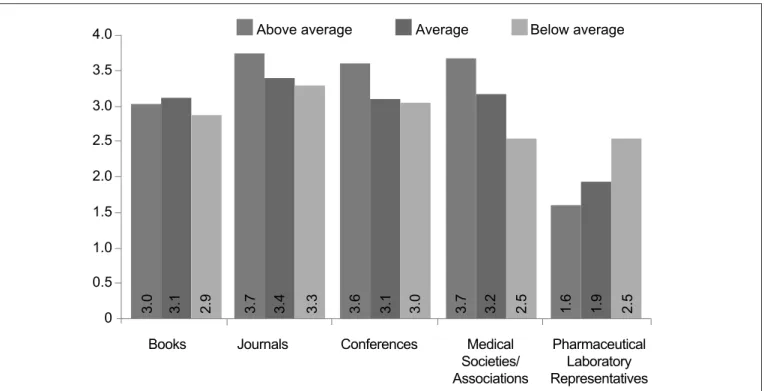
above average. Prescription quality was not associated with time qualiied as a physician, presence or absence of medical residency or predominant working sector (SUS or private). There was a clear trend for prescription quality to reduce as the number of consultations per hour increased (Figure 1), although without statistical signiicance (p=0.051). Figure 2 illustrates how prescription quality increases as the impor-tance given to medical associations and societies increases and reduces as the importance given to pharmaceutical laboratory representatives increases (p<0.05).
The physicians provided the following suggestions for reducing antibiotic prescribing for UAI: invest in education of both population and physicians (53%), improve health professionals’ working conditions (39%), control the sale of antibiotics (10% [controls have been introduced since the study was conducted]), use common sense (6.4%), improve the socioeconomic conditions of the population (2.9%), in-crease availability of vaccines (1.7%) and antibiotics (1.1%) on the SUS and increase the number of pediatricians caring for children (0.6%).
Discussion
The overall proile of the sample studied here was simi-lar to that investigated in a study conducted by Fiocruz in
conjunction with the Brazilian Society of Pediatrics (SBP - Sociedade Brasileira de Pediatria) in 1996(19). The majority of physicians had completed a pediatrics residency (86.5 versus 75% in the SBP study) and had very long working weeks. Research conducted by the Federal Medical Council (Conselho Federal de Medicina) demonstrated that the mean working week in the state of São Paulo was 52 hours and almost one third of professionals were working more than 60 hours per week(20). This is an extremely heavy workload, especially if compared with the national standard, since Article 58 of Brazil’s integrated employment legislation recommends a 44-hour working week. In the sample described here, at least 27.8% of the physicians analyzed worked more than 60 hours per week. Working too many hours can have a negative impact on the quality of both medical consultations and prescriptions, very often leading to patient dissatisfaction (21).
The number of patients seen per hour was also elevated; around one third of physicians working for the SUS were seeing more than ive patients per hour. Within the SUS, excessive demand for medical services, an insuficient num-ber of pediatricians and inadequate working conditions all contribute to this situation(21). In the private sector, the low fees paid by health insurers mean that pediatricians are seeing ever more patients in shorter spaces of time in order
0 0.5 1.0 1.5 2.0 2.5 3.0 3.5 4.0
Books Journals Conferences Medical
Societies/ Associations
Pharmaceutical Laboratory Representatives
Above average Average Below average
3.0 3.1 2.9 3.7 3.4 3.3 3.6 3.1 3.0 3.7 3.2 2.5 1.6 1.9 2.5
to earn their target incomes(21). According to the new code of medical ethics published recently by the São Paulo state medical board (CREMESP - Conselho Regional de Medicina do Estado de São Paulo), institutions cannot predeine the duration of medical consultations, since it is the physi-cian’s right to “[...] decide the length of time dedicated to each patient under all circumstances, taking into account their own experience and professional qualiications, while avoiding harm to patients due to excessive responsibilities or number of consultations”(22).
In addition to excessive working hours and patient loads, this study also detected excessive use of work-up tests. Of particular note were X-rays of the sinuses, which are not needed to conirm a diagnosis of sinusitis in the under-sixes and are of debatable worth in patients older than this(5); chest X-rays, which neither the World Health Organization nor the Brazilian Ministry of Health consider a basic requirement for a diagnosis of pneumonia and which have even less to recom-mend them when faced with upper airway symptoms(23); and full blood tests which are not recommended and do not aid in differential diagnosis of viral or bacterial etiology in UAI(3,5-13).
Another worrying inding was the importance accorded to information provided by laboratories as a source of ongoing medical education, although the longer the physicians had been qualiied the less importance they gave it. Concerned with the inluence the pharmaceutical industry has on medi -cal prescriptions, in 2010 the CREMESP conducted research to analyze the relationships between physicians and the drug and medical equipment industries. The study found that 93% of physicians in São Paulo state accept giveaways and benefits from drug and medical equipment companies and 80% receive visits from industry representatives (ap-proximately eight per month). Among the physicians who received visits, 48% tended to prescribe according to the laboratory representatives’ recommendations and 33% knew of or had witnessed cases of the industry putting pressure on physicians or some type of partnership considered inap-propriate(22). The opinion of CREMESP, which was stated in the same study, is that sometimes the relationship between physicians and the industry exceeds ethical boundaries and that possible reasons for this include poor medical training that means newly-qualiied physicians are vulnerable to industry pressure; insuficient time available for ongoing studies after graduating from medical school; and the high cost of courses, symposia and conferences(22).
When the physicians’ antibiotic prescribing was as-sessed using hypothetical clinical cases, the rate of correct
antibiotic choice was higher when the patients’ diagnosis was provided (Table 2). It is notable that more than 20% of physicians would use a combination including a beta-lactamase inhibitor or second-generation cephalosporin for a irst episode of bacterial sinusitis in a six-year-old child, even though this is not a recommended course of action(5). It is also of note that just 58.2% of the prescribers chose the Ministry of Health’s recommended conduct(23) for a case of pneumonia in a four-year-old child with no respiratory discomfort, which is oral antibiotic and later reassessment. Many of them chose hospital admission, although they did choose the correct antibiotic.
When physicians were asked whether antibiotics were needed or not in a selection of clinical cases, their errors increased. All were cases of the common cold (3,7). Two situ-ations caused the largest number of problems. The irst de-scribed a case of mucopurulent rhinitis (Case 3) and although this is not obligatorily a sign of bacterial infection, many of them chose to prescribe an antibiotic. A similar inding was described in Virginia, in the United States, where 71% of physicians would immediately prescribe antibiotics for a 10-month old infant with green-colored mucopurulent nasal secretions (5,13). The second case that caused problems (case 4) was a child with hyperemia of the oropharynx associated with lu symptoms and insidious onset. These symptoms do not suggest a bacterial infection(24). Despite this, 46.1% chose to use an antibiotic. This is why oropharynx swabs are now recommended for conirmation of a bacterial pharyngo-tonsillitis diagnosis(13,24), although they are still rarely taken in clinical practice in Brazil.
This sample proved to be a population of physicians working long hours, seeing large numbers of patients per hour and suffering from a certain dificulty in accessing quality ongoing education, particularly those qualiied most recently. Medical consultations for UAI cases are quick and lead to a high number of laboratory test requests. These physicians found it hard to differentiate between viral and bacterial etiology in UAI cases clinically, particularly in the cases with mucopurulent rhinitis and hyperemia of the oropharynx, with the result that they prescribed antibiotics unnecessarily, including ones with wide spectra of action.
studies assessing the eficacy of measures that can be taken to reduce prescribing of antibiotics for UAI. Education of both parents and health professionals, educational videos playing in emergency service waiting rooms and information lealets can all be effective(1,25-27).
The response rate from the Healthcare Cooperative phy-sicians was very low (8.9%) and reasonable from the SUS physicians in the city where the study was conducted (45%). It had been expected that the response rate to the mailed packs would have been better than this, since similar studies conducted in the United States and Canada achieved rates of 43 to 64%(15,17,18). Those studies included external stimuli to increase questionnaire response, such as telephone calls
encouraging participation(18), the offer of antibiotic manu-als for those who responded (15) and even a U$5.00 coffee voucher(17), none of which were employed in this study for ethical reasons. There is no doubt that the low response rate is a limitation of this study, since it is possible that selection was biased towards people interested in the subject and they may be different from those who did not take part, meaning that future studies with better sampling power are needed to validate the results described here.
On the basis of the results of this study, it is concluded that: ongoing medical education, education of the public and improved working conditions for physicians are measures that can contribute to achieving more rational antibiotic use.
References
1. Francis NA, Butler CC, Hood K, Simpson S, Wood F, Nuttall J. Effect of using an interactive booklet about childhood respiratory tract infections in primary care consultations on reconsulting and antibiotic prescribing: a cluster randomised controlled trial. BMJ 2009;339:b2885.
2. Moro ML, Marchi M, Gagliotti C, Di Mario S,Resi D. “Progetto Bambini A Antibiotici [Proba]” Regional Group.Why do paediatricians prescribe antibiotics? Results of an Italian regional project. BMC Pediatr 2009;9:69.
3. Nyquist AC, Gonzales R, Steiner JF, Sande MA. Antibiotic prescribing for children with colds, upper respiratory tract infections, and bronchitis. JAMA 1998;279:875-7.
4. Finkelstein JA, Huang SS, Kleinman K, Rifas-Shiman SL, Stille CJ, Daniel J
et al. Impact of a 16-community trial to promote judicious antibiotic use in
Massachusetts. Pediatrics 2008;121:e15-23.
5. American Academy of Pediatrics. Subcommittee on Management of Sinusitis on Quality Improvement. Clinical practice guideline: management of sinusitis. Pediatrics 2001;108:798-808.
6. American Academy of Pediatrics. Subcommittee on Management of Acute Otitis Media. Diagnosis and management of acute otitis media. Pediatrics 2004;113:1451-65.
7. O’Brien KL, Dowell SF, Schwartz B, Marcy SM, Phillips WR, Gerber MA. Cough illness/bronchitis - principles of judicious use of antimicrobial agents. Pediatrics 1998;101:178-81.
8. Nascimento-Carvalho CM. Outpatient antibiotic therapy as a predisposing factor for bacterial resistance: a rational approach to airway infections. J Pediatr (Rio J) 2006;82 (Suppl 5):S146-52.
9. Doan Q, Enarson P, Kissoon N, Klassen TP, Johnson D. Rapid viral diagnosis for acute febrile respiratory illness in children in the Emergency Department. Cochrane Rev 2010;5:709-51.
10. Health Protection Agency [homepage on the Internet]. Management of infection guidance for primary care for consultation and local adaptation. British Infection Association [cited 2010 Jun 12]. Available from: http://www.hpa.org.uk/webc/ HPAwebFile/HPAweb_C/1279888711402
11. Saffer M, Lubianca Neto JF, Ramos BD, Montovani JC, Nóbrega M, Alcântara LJ
et al [homepage on the Internet]. Otite média aguda: diagnóstico e tratamento
propostos para a realidade brasileira [cited 2010 Jun 12]. Available from: http:// www.sbp.com.br/sbpciencia/show_item.cfm?id_categoria=5&tipo=I 12. Spurling GK, Del Mar CB, Dooley L, Foxlee R. Delayed antibiotics for
respiratory infections. Cochrane Database Syst Rev 2007;CD004417. 13. Yagupsky P. Selection of antibiotic-resistant pathogens in the community.
Pediatr Infect Dis J 2006;25:974-6.
14. Del Fiol Fde S, Lopes LC, Toledo MI, Barberato-Filho S. Prescription patterns and antibiotic use in community-based infections. Rev Soc Bras Med Trop 2010;43:68-72. 15. Paluck E, Katzenstein D, Frankish CJ, Herbert CP, Milner R, Speert D et al.
Prescribing practices and attitudes toward giving children antibiotics. Can Fam Physician 2001;47:521-7.
16. Simpson SA, Wood F, Butler CC. General practioners’ perceptions of antimicrobial resistance: a qualitative study. J Antimicrob Chemother 2007;59:292-6.
17. Stille CJ, Rifas-Shiman SL, Kleinman K, Kotch JB, Finkelstein JA. Physician responses to a community-level trial promoting judicious antibiotic use. Ann Fam Med 2008;6:206-12.
18. Watson RL, Dowell SF, Jayaraman M, Keyserling H, Kolczak M, Schwartz B. Antimicrobial use for pediatric upper respiratory infections: reported practice, actual practice, and parent beliefs. Pediatrics 1999;104:1251-7.
19. Sociedade Brasileira de Pediatria, Fiocruz [homepage on the Internet].
Pesquisa peril dos pediatras do Brasil – resultados preliminares [cited
2010 Jun 12]. Available from: http://www.sbp.com.br/show_item2.cfm?id_ categoria=52&id_detalhe=618&tipo_detalhe=S
20. Conselho Regional de Medicina do Estado de São Paulo [homepage on the Internet]. Pesquisa Inédita do Cremesp [cited 2010 Jun 7]. Available from: http://www.cremesp.org.br/pdfs/pesquisa.pdf
21. Gusson TC, Lopes JC. Pediatrics in the 21st century: a specialty in danger. Rev Paul Pediatr 2010;28:115-20.
22. Conselho Regional de Medicina do Estado de São Paulo [homepage on the Internet]. Novo Código de Ética Médica. São Paulo: CREMESP; 2009 [cited 2010 Jun 26]. Available from: http://www.cremesp.org.br/library/modulos/ publicacoes/pdf/codigo_etica_novo_2010.pdf
23. Sarria E, Fischer GB, Lima JA, Menna Barreto SS, Flôres JA, Sukiennik R. Interobserver agreement in the radiological diagnosis of lower respiratory tract infections in children. J Pediatr (Rio J) 2003;79:497-503.
24. Cardoso DM, Sabino HM, Gilio AE, Machado BM, Lotufo JP, Passadore LF et al. Streptococcal pharyngitis: comparison between the clinical and microbiological diagnosis. Pediatria (São Paulo) 2009;31:94-9.
25. Enriquez-Puga A, Baker R, Paul S, Villoro-Valdes R. Effect of educational outreach on general practice prescribing of antibiotics and antidepressants: a two-year randomised controlled trial. Scand J Prim Health Care 2009;27:195-201. 26. Arnold SR, Straus SE. Interventions to improve antibiotic prescribing practices
in ambulatory care. Cochrane Database Syst Rev 2010;CD003539. 27. Wheeler JG, Fair M, Simpson PM, Rowlands LA, Aitken ME, Jacobs RF. Impact