Sequential Pattern Mining Using Formal language Tools
Sunil Joshi1, Dr. R. S. Jadon2 and Dr. R. C. Jain3
1
Department of Computer Applications, Samrat Ashok Technological Institute Vidisha, India
2
Department of Computer Applications, Madhav Institute of Technology and Science Gwalior, India
3
Department of Computer Applications, Samrat Ashok Technological Institute Vidisha, India
Abstract
In present scenario almost every system and working is computerized and hence all information and data are being stored in Computers. Huge collections of data are emerging. Retrieval of untouched, hidden and important information from this huge data is quite tedious work. Data Mining is a great technological solution which extracts untouched, hidden and important information from vast databases to investigate noteworthy knowledge in the data warehouse. An important problem in data mining is to discover patterns in various fields like medical science, world wide web, telecommunication etc. In the field of Data Mining, Sequential pattern mining is one of the method in which we retrieve hidden pattern linked with instant or other sequences. In sequential pattern mining we extract those sequential patterns whose support count are greater than or equal to given minimum support threshold value. In current scenario users are interested in only specific and interesting pattern instead of entire probable sequential pattern. To control the exploration space users can use many heuristics which can be represented as constraints. Many algorithms have been developed in the fields of constraint mining which generate patterns as per user expectation. In the present work we will be exploring and enhancing the regular expression constraints .Regular expression is one of the constraint and number of algorithm developed for sequential pattern mining which uses regular expression as a constraint. Some constraints are neither regular nor context free like cross-serial pattern anbmcndm used in Swiss German Data. We cannot construct equivalent deterministic finite automata (DFA) or Push down automata (PDA) for such type of patterns. We have proposed a new algorithm PMFLT (Pattern Mining using Formal Language Tools) for sequential pattern mining using formal language tools as constraints. The proposed algorithm finds only user specific frequent sequence in efficient optimized way as compared to other existing algorithm. Our experimental results clearly show
that proposed algorithm is quite enhanced and improved and generates optimum frequent sequences as per user expectation. Keywords: Sequential Pattern Mining, Regular Expressions, Context Free Grammars, Formal Language Tools, Deterministic Finite Automata, Push Down Automata, Turing Machine.
1. Introduction
In present scenario almost every system and working is computerized and hence all information and data are being stored in Computers. The capacity of data storage is increasing tremendously. In the present Hi-tech age the amount of data is also increasing in line with data storage capacity. Retrieval of untouched, hidden and important information from this huge data is quite tedious work [1]. Data Mining is a great technological solution which extracts untouched, hidden and important information from vast databases to investigate noteworthy knowledge in the data warehouse [2]. An important problem in data mining is to discover patterns in various fields like medical science, world wide web, telecommunication etc.
algorithms is to improve performance and effectiveness. In current scenario users are interested in only specific and interesting pattern instead of entire probable sequential pattern [10]. In this type of Data mining number of rules are generated from specific data which are in thousand or more and most of them are not correlated and not useful to us [11]. To control the exploration space users have many heuristics which can be represented as constraints. Many algorithms have been developed in the fields of constraint mining which generate patterns as per user expectation [11, 12]. Various types of constraints are suggested in literature like: knowledge type constraint, data constraint, interesting constraint, rule constraint, item constraint, regular expression constraint etc [2, 13]. In the present work we will be exploring and enhancing the regular expression constraints.
Regular expression is one of the constraints and there are number of algorithms in sequential pattern mining which uses regular expression as a constraint [14, 15, 16]. Some constraints are not regular and we can not construct equivalent deterministic finite automata (DFA) for such type of pattern like anbn. Recently a new work for sequential pattern mining has been developed which uses context free grammar as a constraint and develops push down automata (PDA) instead of DFA [17]. Still there are some other constraints like cross-serial pattern anbmcndm which are neither regular nor context free [18].
We propose a new theoretical framework for sequential pattern mining using formal language tools. We propose a new algorithm PMFLT (Pattern Mining using Formal Language Tools) for sequential pattern mining using formal language tools as constraints. The proposed algorithm finds only user specific frequent sequence in efficient optimized way as compared to other existing algorithm. We first recognize category of constraint pattern as per formal language classification and then develop equivalent machine which satisfies sequences as per user constraint and determines frequent sequence whose support count is greater than minimum support value. Our experimental results clearly show that proposed algorithm is quite enhanced and improved and generates optimum frequent sequences as per user expectation. The Paper is organized as- In section 2 we discuss basic concept of sequential patter mining. In section 3 we discuss the working and characteristics of existing sequential pattern mining algorithms which uses regular expression constraints and context free grammar constraints. We also discuss some issues and challenges of the existing algorithms. In section 4 we discuss the formal languages tools and their classification. In section 5 we present the new algorithm framework for sequential pattern mining using formal language tools and discuss its
illustration. In section 6 we analyze the performance of proposed algorithm. In section 7 we present the conclusion.
2. Basic Concept
The primary goal of Sequential Pattern Mining algorithms is to determining frequent sequences in the given database. Algorithms for this problem are mined sequentially where dataset are ordered like in the field of bioinformatics example of sequences are amino-acids and nucleotide sequences. The problem was first introduced by Agrawal and Srikant, where the basic concepts involved in pattern detection were established [4]. In the past years, several sequential pattern mining algorithms were proposed, but not all assume the same conditions. The use of some constraints has a great impact on their design and efficiency [17, 19, 20].
Some basic definitions are needed, in order to formally introduce the problem [1, 2]:
Items: - An itemset is a non-empty subset of elements from a given set C, the item collection is known as items.
Sequence- A sequence is a list of item sets in sorted order. A sequence called maximal if it is not enclosed in any other sequence. K items sequence is called a k-sequence. The length of the sequence S is number of elements and it is denoted by |s|.
Support–The ratio of the number of existing frequent sequence (F) and the number of possible sequences(S) is the database density (p) and it is calculated by p=F/S.
Frequent Sequence- Given D as database of sequences, and a few user-specified minimum support threshold σ and constraint K. A sequence is frequent if it is satisfying the constraint and support at least σ.
3. Related Work
described by CFG. Most existing literatures for searching regular expression are usually done by converting the regular expression into a deterministic finite automaton [26, 27, 28, 29].
Throughout the last two decade, lot of people have implemented and compared several algorithms that try to solve the sequential Pattern Mining problem as efficiently as possible. Out of these several algorithms which has made a significant contribution to improve the efficiency of sequential pattern mining using regular expression constraints some are SPIRIT [14], PrefixGrowth [12], RE-Hackle [21], MILPRIT [15], SMA [16]. Regular expression generates type-3 language or regular language which is the type of formal language classification. Most of the work developed in this type-3 language category of formal language classification.
SPIRIT [14] is very popular and well known algorithm which generates pattern as per constraints given by user in the form of regular expression. It is apriori like algorithm and its working is similar to GSP [14]. It generates candidates and satisfies by regular expression constraints. It does not require any complex data structure or graph [9]. It is based on BFS which uses horizontal representation of database [28].
PrefixGrowth [11] is a pattern-growth method, like PrefixSpan that generate only those sequences which satisfies the constraint R and according to the constraint sequences that are prefixes of valid sequences.
RE-Hackle algorithm (Regular Expression Highly Adaptative Constrained Local Extractor) [21] is a highly adaptive algorithm, which represents tree structure of regular expression. An Abstract Syntax Tree which encodes the structure of the canonical form of a RE-constraint is called Hackle-tree. Each intermediated node represent operator and leaf node contain sequences which are atomic. These atomic sequences are assembled by the union, concatenations, and Keene closures to structure the first RE-constraint.
MILPRIT (Mining Interval Logic Patterns with Regular expressions constraints) [15, 22] is intended to mine first order temporal patterns, where time is represented by intervals, and regular expression constraints are used to confine the search space. It also belongs to the apriori class.
Recently SMA [16] proposed new algorithm which uses regular expression as a constraint and develops new Petri Net type automata. It generates only those sequences which are satisfied by Automata and whose support count are greater than or equal to minimum support threshold value. First algorithm based on the SMA: SMA-1P. This algorithm simply passes through the SMA every sequence in the input database, producing all the valid patterns, whose frequency is then counted. Second method based on frequency pruning. The method is named SMA-FC, and it
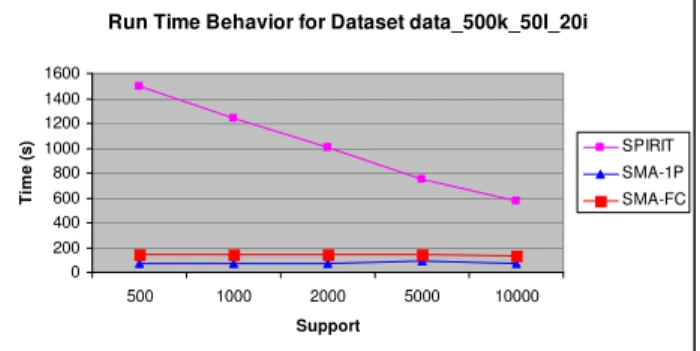
performs a number of scans of the database equals to the number of states of the given regular expression. To evaluate the effectiveness of the SMA over SPIRIT, we perform experiment with synthetic dataset data_500K-50l_20I. The C++ implementations of both algorithms and dataset are downloaded from link given in article [16].The runtime behavior of both algorithms are shown in figure 1.
Run Time Behavior for Dataset data_500k_50l_20i
0 200 400 600 800 1000 1200 1400 1600
500 1000 2000 5000 10000
Support
Ti
m
e
(
s
) SPIRIT
SMA-1P SMA-FC
Fig. 1 The Run Time of SMA is compared with that of SPIRIT
We performed experiment on two available approaches of SMA one is SMA-1P (One Pass) and other is SMA-FC (Full Check). We Compare the result of SMA with SPIRIT (V) over Regular Expression A*B (B/C) D*E. It is clear that SMA is faster than SPIRIT algorithm and also generates less number of frequent sequences. SMA is fastest and efficient method for sequential pattern mining using Regular expression constraints [16]. If pattern is A*B(B/C)D* E and Transaction T=ACDBFAAEBCFDDE then SMA generate 18 frequent
sequences. The program outputs are shown in Figure 2 in terms of frequent sequences.
Sequence Mining Automata (SMA) has lot of advantages over SPIRIT and it is proved by above experiments. If pattern is AnB(B/C)DnE then out of 18 sequences which are shown in Figure 2 then only three sequences satisfy this constraint and they are AABCDDE, ABBDE, ABCDE. This type of constraints is context free constraints and we can not construct the Deterministic Finite Automata for such type of expression and at this point method failed because Deterministic Finite Automata cannot count the occurrences of each character. Recently some authors pointed the same type of problem in their research work for Customer Bill Payment pattern problem [17]. Antunes developed a new algorithm SpiCFLComplete which uses context free grammar as a constraint and develops push down automata instead of deterministic finite automata for accepting such types of constraints. His algorithm approach is similar to apriori approach and author claims that substitution of regular expression constraint to context free grammar constraints does not affect the performance [17]. This is very powerful and beneficial because we know that context free languages are more powerful then regular.
Still we have another problem, suppose constraint is AnB(B/C)DnEn then only two sequences satisfy constraint and they are ABBDE and ABCDE. The sequence AABCDDE is frequent but not interested because users are interested in only those sequences in which number of A is equal to Number of D as well as number of E. This is another category of constraint and it is not regular as well as context free so we can not construct DFA or PDA to accept such types of constraints.
Number of algorithms has been developed for sequential pattern mining using regular expression and context free grammar constraint discussed above. But some constraints are neither regular nor context free. We have number of motivational examples like an example given by Shieber [18] from Swiss German and similar phenomena occurs in Dutch. Stuart shieber [18] pointed two facts case-marking and cross-serial order pattern of Swiss German data in his article. He shows in his example cross-serial dependencies Pattern like AnBmCnDm and prove that it is not context free. We know that the languages which are not context free cannot make push down automata for such language. Jackson [30, 31] also emphasizes on cross-agreement pattern like AnBmCnDm for RNA/DNA. He introduces -calculus and open new research trends in bioinformatics and linguistics fields. English language is not regular [32] as well as context free. It has unlimited number of nested dependencies and it contains mirror image properties. If language has limitless crossing dependencies then it not context free. Cross-serial dependencies is present in Dutch [33].Dutch structure is similar to copy-language and it is not context-free which is shown in Table I.
Table 1: Example of New Constraints
Language Structure Pattern Class
German AnBmCmDn Context Free
Dutch AnBmCnDm Not Context-Free Swiss German AnBmCnDm Not Context-Free
Formal language or natural language data consists of symbols and strings which is the set of symbols. There is a need to retrieve pattern from such type of language and this type of problem will be very useful in various fields like bioinformatics, data mining etc [34]. A verb sequence of each of the sequence comes after the noun for same length in Swiss German data. They follow AnBnCn and AnBmCnDm which is not context free but is mildly context sensitive. This cross-serial pattern AnBmCnDm is also used for generating pattern for Kambi and Non-Kambi Kolam [35]. Nested embedding pattern and multiple crossing dependencies is also used in phonological words [36]. This is the motivation to explore all other categories of patterns and hence we move to higher level of Chomsky classification because such types of patterns belong to that category. Hence we develop a new framework for sequential pattern mining using formal language tools. Now we discuss formal language tools and their classification in next section.
4. Formal Language Tools
Formal language or natural language data consist of symbols and strings which is the set of symbol. Formal language is a set of words in particular pattern. Words are made by symbols collectively one after other without space. The word combination according to grammatical rules creates syntax or pattern [37]. Our work is based on uses of Formal languages tools as constraints in sequential pattern mining.
Formal Grammar is formally represented by 4-Tuple G= (V, T, P, S), Where V is the set of non-terminals or variable, T is the set of constants/input/terminals, S is the start symbol of the grammar; P is the set of production rule of the form αβ , α(VUT)+ , β (VUT)* , α contains at least one variable.
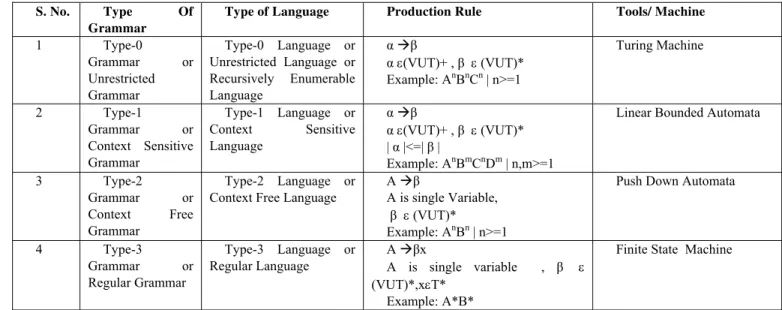
Table 2: Chomsky Classification with Equivalent Machines
Chomsky classifies formal language into four categories on the basis of production rules [32]. Now we discuss these categories with related work in context of pattern mining as follows
Type-3 or Regular Language Machine works on that grammar is known as finite automata, so if we want to apply regular expression constraint then we need to develop finite automata, pass each sequence on that automata, if automata accept it then we count occurrence of sequence, if occurrence of sequence exceed support count then it is frequent. This concept used in various algorithms like SPIRIT, MIPLPRIT, SMA etc [14, 15, 16].
Type-2 or Context Free Language Context free language or Context free grammar belong to type-2 category and machine works on that grammar is known as push down automata , so if we want to apply context free grammar constraint then we need to develop push down automata. Context free languages are more expressive than regular language .i.e. anbn is not regular but it is context free. Antunes [17] developed a new methodology and algorithm which uses the context free grammar constraints.
Still we have another two categories of language which are more expressive than previous two languages.
Type-1 or Context Sensitive Language Machine works on that grammar is known as linear bounded automata or Turing machine. Context sensitive languages are more expressive then Context Free i.e. anbncn is not context free but it is context sensitive.
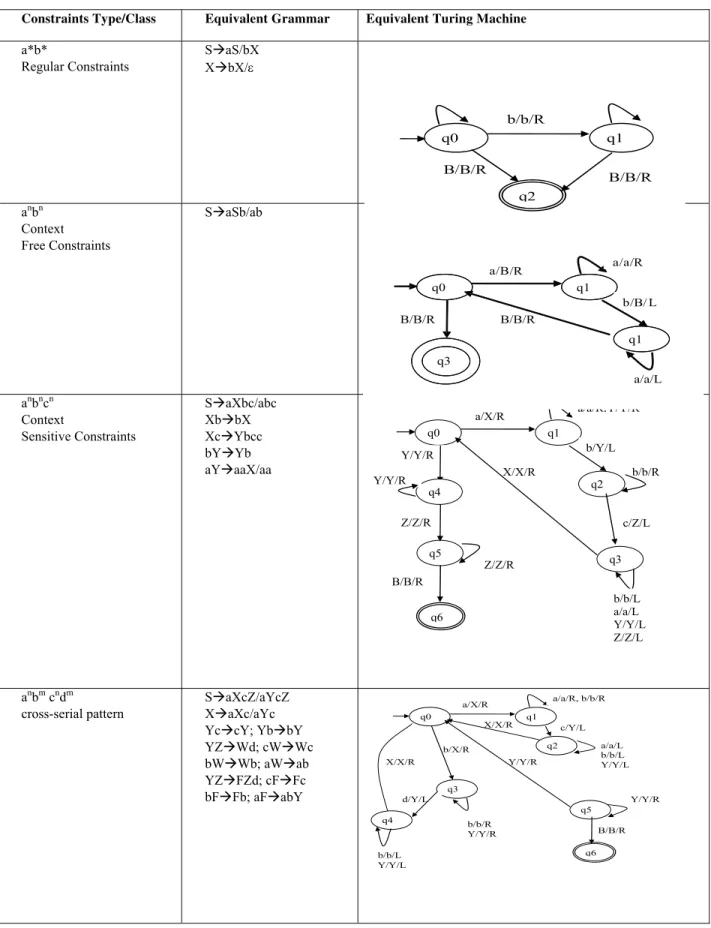
Type-0 Language or Type -0 Grammar – Unrestricted grammar or unrestricted language, Machine works on that grammar is known as Turing machine [38]. Unrestricted languages are more expressive than context free. The Turing machine is the formal language tools or machine of unrestricted grammar or type-0 grammar. Type-0 Language is the super set of all type-1 CSL, Type-2 CFL and Type-3 RL. So it is very popular and strong tools for accepting pattern strings of any class. It was developed by Alan Matheson Turing in the year 1936[38]. The languages accepted by Turing machine are called unrestricted language or recursive enumerable. We can construct Turing machine for all types of constraints [39]. Table 3 shows different types of constraints with grammar and their equivalent Turing machine Transition Diagram.
5. Pattern Mining using Formal Language
Tools (PMFLT): A NEW Algorithm
The discussion of previous section motivates us to use formal language tools as a constraint in sequential pattern mining algorithm. In this section, we present new algorithm for Sequential Pattern Mining using formal language tools which first recognize constraint category from formal language classification and then generate equivalent machine to accept such type of constraints and determine frequent sequences in optimized way. Now we discuss its methodology in subsequent section.
S. No. Type Of
Grammar
Type of Language Production Rule Tools/ Machine
1 Type-0 Grammar or Unrestricted
Grammar
Type-0 Language or Unrestricted Language or Recursively Enumerable Language
α β
α(VUT)+ , β (VUT)* Example: AnBnCn | n>=1
Turing Machine
2 Type-1 Grammar or Context Sensitive Grammar
Type-1 Language or Context Sensitive Language
α β
α(VUT)+ , β (VUT)* | α |<=| β |
Example: AnBmCnDm | n,m>=1
Linear Bounded Automata
3 Type-2 Grammar or Context Free Grammar
Type-2 Language or Context Free Language
A β
A is single Variable, β (VUT)*
Example: AnBn | n>=1
Push Down Automata
4 Type-3 Grammar or Regular Grammar
Type-3 Language or Regular Language
A βx
A is single variable , β (VUT)*,xT*
Example: A*B*
Table 3: Constraints Types and its Equivalent Turing Machines
Constraints Type/Class Equivalent Grammar Equivalent Turing Machine
a*b*
Regular Constraints
SaS/bX XbX/
anbn Context Free Constraints
SaSb/ab
anbncn Context
Sensitive Constraints
SaXbc/abc XbbX XcYbcc bYYb aYaaX/aa
q0 q1
q6
b/Y/L a/X/R a/a/R,Y/Y/R
Y/Y/R
q2
X/X/R b/b/R
q4
q5 Y/Y/R
Z/Z/R
Z/Z/R
B/B/R
q3
b/b/L a/a/L Y/Y/L Z/Z/L
c/Z/L
anbm cndm cross-serial pattern
SaXcZ/aYcZ XaXc/aYc YccY; YbbY YZWd; cWWc bWWb; aWab YZFZd; cFFc bFFb; aFabY
q0
c/Y/L a/X/R a/a/R, b/b/R
b/X/R q2
X/X/R
a/a/L b/b/L Y/Y/L
q3
q4 X/X/R
d/Y/L
b/b/R Y/Y/R
q5
Y/Y/R q1
Y/Y/R
q6 B/B/R
b/b/L Y/Y/L
q0 q1
q2
B/B/R b/b/R
B/B/R
q0 q1
b/B/ L a/B/R a/a/R
B/B/R
q1 B/B/R
5.1 The Proposed Methodology
The Proposed Algorithm works on entire database. The Algorithm requires three types of Input Parameter Database, Minimum Support and Constraint. Firstly algorithm calls the Procedure MFLT (Algorithm for equivalent machine using formal Language tools) and pass given constraints. The Procedure MFLT recognizes the category of constraint and constructs the equivalent machine. If recognition is not possible or rigid then by default construct Turing machine for given constraint because Turing machine accept all types of constraint and language.
We have used Turing machine in our research work. After this the algorithm reads each transaction one by one and generates sequence with the help of equivalent machine and store in sequence list with their frequency. At last it reads sequence from sequence list one by one and prints only those sequences whose support counter are greater than or equal to minimum support threshold value. This approach is very easy and generates frequent sequence in optimized way without candidate generation and does not require any complex graph or data structure. Our objective is to generate a sequence which satisfies given constraint and their support counts are greater than or equal to minimum support. The pseudo code of the proposed algorithm PMFLT is shown in figure 3.
Fig. 3 Proposed Algorithm PMFLT Pseudo Code Algorithm PMFLT (Pattern Mining Using Formal Language Tools)
Input: D Database, ∂ minimum Support, C Constraint
Output: Sequence S Language L(C) and Support(S) >=∂ minimum Support
Algorithm:-
// recognize Constraint’s category from formal language Classification and construct equivalent machine I. M=MFLT(C)
II. for all T Database D do
III. Generate Sequence Sm(T) satisfied by Machine M
IV. for all s Sm(T) do
V. if s is not in SL then SL [s].counter=1 else SL [s].counter= SL [s].counter + 1
VI. for all f SL do
VII. if SL [f].count >=∂ then print f
Procedure MFLT (Algorithm for equivalent machine using Formal Language Tools)
Input Parameter: Constraint C
Return Parameter: Equivalent machine M to accept Language of C // Check the category of constraint C from Formal Language Classification
1. Switch Case Formal_ Language_ Category (C) 2. Case ‘Type-3 Regular Language’
Construct Deterministic Finite Automata Ac to Accept Language of C
return Ac
3. Case ‘Type-2 Context Free Language’
Construct Push Down Automata Pc to Accept Language of C
return Pc
4. Case ‘Type-1 Context Sensitive Language’
Construct Turing Machine Tcto Accept Language of C
return Tc
5. Case ‘Type-0 Unrestricted Language’
Construct Turing Machine Tcto Accept Language of C
return Tc
// if Recognition is not possible and complex // then return Turing machine
Case Default
Construct Turing Machine Tcto Accept Language of C
q0 q1
q6
c/Y/R b/b/R
a/a/R
b/b/R
q2 X/X/R
c/c/R q4
q5 Y/Y/R
d/d/R
Z/Z/R B/B/R
q3
d/d/L c/c/L a/a/L
d/d/R q1
a/X/R Y/Y/R
q3
e/Z/L 5.2 Explanation of Algorithm with Example
Consider Transaction T=AABCCDE and given constraint is anbcnden | n>=1. We know that given constraint is not regular or not context free so we can construct Turing machine for such types of constraints. Figure 4 presented Turing Machine for given constraint.
Fig. 4 Turing machine equivalent to Constraint anbcnden | n>=1
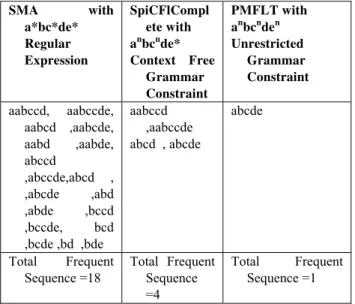
Now we use Transaction T=AABCCDE on given constraint and Run different algorithm. Table 4 presented frequent sequences generated from SMA with Regular Expression Constraint a*bc*de*, SpiCFLComplete with Context Free Grammar Constraint anbcnde*, PMFLT anbcnden.
Table 4: Comparison of the frequent sequences found In PMFLT with SMA and SpiCFLComplete
SMA with a*bc*de*
Regular Expression
SpiCFlCompl ete with anbcnde* Context Free
Grammar Constraint
PMFLT with anbcnden Unrestricted
Grammar Constraint
aabccd, aabccde, aabcd ,aabcde, aabd ,aabde, abccd
,abccde,abcd , ,abcde ,abd ,abde ,bccd ,bccde, bcd ,bcde ,bd ,bde
aabccd ,aabccde abcd , abcde
abcde
Total Frequent Sequence =18
Total Frequent Sequence =4
Total Frequent Sequence =1
We note that new proposed algorithm PMFLT generates optimized frequent sequences because it generates only those sequences that are satisfied by constraint. The constraint given in above problem is anbcnden in which number of a, b and c are equal. Only one sequence abcde satisfies it.
6. Performance Analysis
Our objective is not scalability even our objective is to find sequence in optimized way as per given constraint. To perform study we used constraint anbcnden and synthetic dataset data_500k_50l_20i downloaded from link given in article [16]. All experiments were performed on an Intel® Pentium® 4 CPU, 2.26 GHz and 1 GB of RAM computer on Windows XP Operating System. The Object Oriented implementation of SMA was downloaded from link given in his article [16]. We generate frequent sequences from SMA using equivalent regular expression of given constraint and then analyze generated sequence as per context free grammar constraint used in SpiCFLComplete algorithm and unrestricted constraint used in proposed algorithm PMFLT. The testing results of experiments are showed in Figure 5. In the Graph X axis represent Support value and Y axis represent Number of frequent Sequences.
It is clear that proposed algorithm work well. Our main objective is just optimization of frequent sequence generation not scalability. It is clear that most of the part of execution time is utilized in counting the support of sequence. So if candidates are already optimized then execution time is also optimized. That’s why we have not analyzed the run time analysis because we have already compared and quoted that existing algorithm gives best and fast results in context of time.
Our objective is only to introduce new types of constraint and follow the existing work in new innovative direction. We presented all the category of formal language and proposed new frame work for sequential pattern mining using formal language tools.
6. Conclusion
Comparision of SMA,SpiCFLComplete, PMFLT over
Dataset data_500k_50l_50i with constraint A
nBC
nDE
n:
Number of Frequent Sequence Vs Minimum Support
0
10
20
30
40
50
50000
10000
20000
50000
100000
Support
N
um
be
r of
Fr
e
que
nt
Se
que
nc
e
SMA with Regular
Expression Constraint
A*BC*DE*
SpiCFLComplete with
Context Free Constraint
AnBCnDE*
PMFLT with Constraint
AnBCnDEn
Fig. 5 Performance Result of PMFLT for dataset data_500k_50l_20i
We use Formal language tools for categorizing constraint and generate appropriate equivalent machine or if recognition is not possible then construct Turing machine because it is very powerful and accept all types of languages. It reduces unnecessary or uninteresting sequences by equivalent machine.
Our experimental results gives evidence that proposed algorithm works well. Still there is always some option for future scope. We can optimize proposed algorithm in terms of time also.
References
[1] V. Pudi, and P. Radha Krishna, “Data Mining”, Fourth Impression, India: Oxford University Press, 2011.
[2] J. Han, and M. Kamber, “Data Mining: Concepts and Techniques”, First Indian Reprint, India: Harcourt (India) Private Limited, 2002.
[3] Q. Zhao, “Sequential Pattern Mining: A Survey ,Technical Report, CAIS, Nanyang Technological University, Singapore, No. 2003118 , July 2003.
[4] R. Agrawal , and R. Shrikant, “Mining sequential patterns,” Proc. Eleventh International Conference on Data Engineering, 3-14, March 1995
[5] S de Amo, P. Waldecir: Mining Temporal Relational Patterns over Databases with Hybrid Time Domains, XXII Symposium, 2007.
[6] A. Xue, S. Hong, S. Ju, W. Chen, “Application of Sequential Patterns Based on User’s Interest in Intrusion Detection”, IEEE International Symposium on IT in Medicine and Education, 1089-1093, December 2008. [7] I. S. Sitanggang, N. A. Husin, A. Agustina, N.
Mahmoodian, “Sequential Pattern Mining on Library Transaction Data”, IEEE International Symposium in Information Technology (ITSim),1-4, June 2010.
[8] X. Tang, Q. Zeng, T. Cui, Z. Wu, “Regular Expression-based Reference Metadata Extraction from the Web”,
IEEE 2nd
Symposium on Web Society (SWS), 346-350, August 2010.
[9] N. A. Sajid, S. Zafar, and S. Asghar, “Sequential pattern finding: A survey,” In International Conference on Information and Emerging Technologies (ICIET), 1–6, June 2010.
[10] S. Sakurai, Y. Kitahara, R. Orihara, “Sequential Pattern Mining based on a New Criteria and Attribute Constraints,
IEEE Conference, 2007.
[11] J. Pei, J. Han, and W. Wang, "Mining Sequential Patterns with Constraints in Large Databases,” in Conference on Information and Knowledge Management, 18-25, November 2002.
[13] J. Bisaria, N. Srivastava, K. R. Pardasani, “A Rough Set Model for Sequential Pattern Mining with Constraints”, Internation Journal of Computer and Network Security, Vol 1 No.2 November 2009.
[14] N. N. Garofalakis, R. Rastogi, and K. Shim, “SPIRIT: Sequential pattern mining with regular expression constraints,” Proc. International Conference on Very Large Databases, 223-234, September 1999.
[15] S. de Amo, A. Giacometti, and M. S. Santana, “Milprit: Mining interval logic patterns with regular expression constraints,” In 1st Brazilian Workshop on Data Mining Algorithms, October 2005.
[16] R. Trasarti, F. Bonchi, and B. Goethals, “Sequence Mining Automata: a New Technique for Mining Frequent Sequences Under Regular Expressions,” Proc. Eight International Conference on Data Mining, 1061-1066,
December 2008.
[17] C. M. Antunes, and A. L. Oliveria, "Using Context-Free Grammars to Constrain Apriori-based Algorithms for Mining Temporal Association Rules", in Proc. 2nd Workshop on Temporal Data Mining – International Conference Knowledge Discovery and Data Mining, pp. 11-24. July 2002.
[18] S. M. Shieber, “Evidence against the context-freeness of natural language,” Linguistics and Philosophy, 333–343, November 1985.
[19] K. C. Kandpal, R. Agnihotri, “SBLOCK-A Closed Sequential Pattern Mining Algorithm”, International Journal of Computer Applications in Engineering Sciences, Vol. 1, issue III,296-299,September 2011. [20] S. Sakuria, Y. Kitahara, R. Orihara, “A Sequential Pattern
Mining Method based on Sequential Interestingness”, World Academy of Science, Engineering and Technology
,Issue 23, 542-550,November 2008.
[21] H. Albert-Lorincz, and J. Boulicaut, “Mining frequent sequential patterns under regular expressions: A highly adaptive strategy for pushing constraints,” In Proc. of 3rd
SIAM International Conference on Data Mining, 316-320, May 2003.
[22] S. de Amo, and D. Furtado, “First-order temporal pattern mining with regular expression constraints,” Data & Knowledge Engineering, Vol. 62, Issues 3, 401-420,September 2007.
[23] C. M. Antunes, and A. L. Oliveria, "Sequential Pattern Mining with Approximated Constraints," in Proc. of
IADIS International Conference on Applied Computing, 131-138, March 2004.
[24] C. M. Antunes, and A. L. Oliveira, "Mining Patterns Using Relaxations of User Defined Constraints", in Proc. of 3rd International Workshop on Knowledge Discovery in Inductive Databases (KDID 2004), September 2004. [25] L. I. Gomez, and A. A. Vaisman, “RE-Spam: Using
Regular Expressions from Sequential Pattern Mining in Trajectory Databases, “IEEE International Conference on Data Mining Workshop, 395-398, December 2008. [26] P. Hingston, “Using Finite State Automata for Sequence
Mining,” In Twenty-Fifth Australasian Computer Science Conference Melbourne, 105-110, February 2001.
[27] R. Ivancsy, and V. Istvan, “Automata theory Approach for Solving Frequent Pattern Discovery Problems,” World Academy of Science, Engineering and Technology, 203-208, October 2005.
[28] R. Ivancsy, and I. Vajk, “Efficient Sequential Pattern Mining Algorithms,” WSEAS Transactions on Computers, Vol. 4, Num. 2, 96-101, February 2005.
[29] D. Ficara, S. Giordano, and G. Procissi, ”An Improved DFA for Fast Regular Expression Matching,” ACM SIGCOMM Computer Communication, Volume 38,Issues 5, 29-40, October 2008.
[30] Jackson, “Adaptive Predicates in Natural Language Parsing,” Perfection, Vol. 1 No. 4, Apr., 2000.
[31] J. Q. Tyler, “The §-Calculus: Manageable Context-Sensitive Parsing,” Faculty of Engineering Sciences, Computer Science Division, Peru, pp. 1-14, 20 Apr. 2005. [32] Chomsky, “Noam Chomsky, “Syntactic structures.
Mouton, The Hague. 1957.
[33] Huybregts, “Overlapping dependencies in Dutch”.
Linguistics, 24-65, 1976.
[34] A. Clark, C. C. Florencio, and C. Watkins, “Languages as hyperplanes: grammatical inference with string kernels, “Mach Learn, Vol. 82, 351–373, September 2010.
[35] T. Robinson, “Extended Pasting Scheme for Kolam Pattern Generation”, Forma by Published Science Press, 22, 55-64, September 2007.
[36] J. Heinz, and W. Idsardi, “Why Are sentences more complex than words” Science, 33-35, July 2011.
[37] J. Hopcroft, and J. Ullman, Introduction to Automata Theory, Languages and Computation. Addison Wesley. 1979.
[38] A. M. Turing, "On Computable Numbers, with an Application to the Entscheidungsproblem". Proceedings of the London Mathematical Society. 2 42: 230–65. 1936. [39]C. H. Sumitha, O. G. Krupa, “Implementation of
Recursiverly Languages in Universal Turing machine”,
International Journal of Computer Theory and Engineering, Vol.3 No.1 February 2011.
Sunil Joshi is presently working as a Assistant Professor, Computer Applications at Samrat Ashok Technological Institute Vidisha (M.P). He has 11 years teaching experience and 4 years research experience. His research areas include Data mining.
R S Jadon is presently working as a Head, Computer Applications at Madhav Institute of Technology and Science, Gwalior. He has 16 years research experience. He has presented research papers in more than 30 national and international conferences and published more than 30 papers in national and international journals. His research areas include Video Data Processing.