Utrll Purr Am Hrdth Orgurr 14(4). 1980.
A DIARRHEAL
DISEASES
CONTROL
PROGRAM
AMONG
NICARAGUAN
REFUGEE
CHILDREN
IN
CAMP0
LUNA, HONDURAS
Pablo Isaza,l Zulema T. de Quinteros,*
Elia Pineda,
Cristabel Parchment,4 Evelinda AguiIar,s
and Michael J. McQuestionc
The study reported here provided oral rehydation therapy for 71 mild& to moderates dehydrated children with diarrhea1 d&ease at a Nicaraguan r&gee camp in Honduras. This trial, apparently thefirst of its kind in an tmergency
or disaster -related situation, showed that if proper& instructed and super- vised, mothers carz success&& deliver oral rehydration therapy to their children in a field setting.
Introduction
As a result of recent unrest in Nicaragua, thousands of refugees fled that country and made their way to southern Honduras. There many live in hastily constructed camps administered by the International Red Cross, the U.N. High Commission on Refugees, the Honduran Government, and various other relief agencies.
In these camps, as in most disaster-relief sites, overcrowding, poor sanitation, and a highly transient population are major risk factors favoring the transmission of com- municable diseases (I, 2J the most impor- tant of which are usually diarrheal diseases c-9.
Concerned about this problem, the Hon- duran Ministry of Health established health
‘PAHO Country Representative in Honduras. ZPAHO Short-term Consultant.
3Professor of Research Methodology, School of Nurs- ing, Universidad National Autbnoma de Honduras, Te
r Professor of Community Health, School of Nursing, cigalpa, Honduras. Universidad National Autboma de Honduras.
5Nurse Auxiliaw, Campo Luna Health Center, Cam- po Luna, Hondurk. -
6Technical Offker. PAHO/WHO DiarrheaI Diseases Control (DDC) Pro&am, Washington, D.C.
centers in each camp staffed by nurse auxiliaries. Then, finding that over half of all refugee health center consultations were due to acute diarrheal diseases, mostly in young children, the Honduran authorities decided to test the feasibility of establishing a diarrheal diseases control program that could be administered by trained auxiliaries at the health center level utilizing oral rehydration therapy.
With supplies and technical assistance ob- tained from PAHO, a pilot study was plann- ed and carried out in one of the refugee camps, Camp0 Luna, during November and December of 1978. Its objectives were (1) to reduce the incidence of severe dehydration among diarrheal patients arriving at the health center, thereby reducing the hospital referral rate, and (2) to determine whether or not an auxiliary with limited training could correctly triage and supervise oral rehydration of children with diarrhea1 diseases.
Materials and Methods
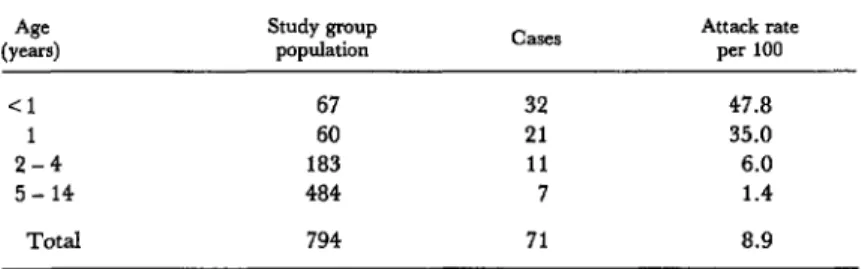
Seventy-one refugee children arriving at the Camp0 Luna Health Center with mild or moderate diarrhea were admitted to the study during November and December of 1978 (Table 1). Those exhibiting severe dehydra- tion or complications (e.g., fever above 39%, bloody stools, more than two stools or two vomiting episodes per hour, convulsions) were excluded from the study and immediate- ly referred to a hospital.
Diagnoses and assessments of dehydration were performed by a trained nurse auxiliary solely on the basis of the following clinical signs: decreased skin turgor; sunken eyes or fontanel; rapid, faint, or irregular radial pulse; diminished urine output; dry mucosa; and general appearance. The auxiliary also noted other presenting symptoms, elicited case histories from the mothers of the patients, and nutritionally assessed those 53 of the 71 patients who were less than 2 years of age ac- cording to the Gbmez classification (Table 2).
Mothers were provided with 2 liters of “Oralyte”7 solution and were instructed to administer as much solution to the children as they could tolerate, beginning with an initial regimen of 2OOcc every 3 to 4 hours. Breast- feeding was encouraged, and water and milk were given ad libitum. The auxiliary demonstrated how to correctly prepare and use the Oralyte solution. She also informed the mothers about proper feeding and wean- ing practices and about prevention, early recognition, and prompt treatment of childhood diarrheal episodes. When the pa- tients were fully rehydrated and without diar- rheal symptoms they were discharged from the study.
7”0ralyte,” or WHO-recommended oral rehydration solution (ORS), contains the following: glucose 20 g.; sodium chloride 3.5 g; sodium bicarbonate 2.5 g; potassium chloride 1.5 g. (To be dissolved in one liter potable water).
Table 1. Age distribution and age-specific diarrhea1 disease attack rates among children in the Camp0 Luna study group (1 November-3 I December 1978).
Age Study group
(Y-4 population Attack rate per 100
Cl 67 32 47.8
1 60 21 35.0
2-4 183 11 6.0
5- 14 484 7 1.4
Total 794 71 8.9
Table 2. Degrees of dehydration among children in the Campo Luna study group.
Degree of dehydration
Age (months)
Mild Moderate &Ye*e Total
NO. (%) No. (W) No. (%) NO. (%I
C6 9 (12.7) 8 (11.3) - - 17 (23.9)
6- 11 7 (9.9) 8 (11.3) - - 15 (21.1)
12-23 12 (16.9) 1: (12.7) - 21 (29.6)
21 24 7 (9.9) (14.1) 1 (lY*, 18 (25.4)
Isaza et al. l DIARRHEAL DISEASE CONTROL 339
Results
Table 1 shows the age distribution of the Camp0 Luna study group. It also shows the estimated age-specific diarrheal disease attack rates, based on the total refugee camp popula- tion and the number of cases observed over the two-month study period. No sex differ- ences were observed with respect to these attack rates.
Eighty-three per cent of the cases occurred in children less than 2 years of age, and 45 per cent afflicted children less than 1 year old.
The relative frequencies of the most com- mon clinical signs vis-Cvis the children’s degree of dehydration upon admission are presented in Table 3. Those showing less than
five of the previously mentioned symptoms were classified as having “mild” dehydration; those with more serious signs (dry mucosa, decreased skin turgor, sunken fontanel) and at least five symptoms were considered “moderate”; one case was judged “severe.“8
Vomiting prior to admission was reported in 43 of 71 (60.6 per cent) of the cases studied and was more frequent in moderately than in mildly rehydrated children (.lO >p> .05). Half of the children presenting symptoms had experienced two days of diarrhea or
‘For logistical reasons it was decided to indude the latter in the study; this exceptional case was later referred t6 hospital services.
Table 3. Degree of assessed dehydration among the 71 Campo Luna children studied-by symptoms, degree of mahmtrition, duration of diarrhea before admission, mean number of stools before admission,
mean duration of treatment, and mean volumes of Oralyte and total fluids consumed.
Assessed degree of dehydration Characteristics
of patients with diarrhea
Mild Moderate S.W.Zre Total
(N-35) (N- 35) (N-1) (N-71)
NO. (W) No. (%) No. (%) NO. (%I
Symptoms watery stools
history of vomiting fever (38%) dry mucosa poor skin turgor sunken fontanell
35 PJO) 35 (100)
1
16 (45.7) 26 (74.3)
1
$Ej
8 (22.9) 1 (‘00)
- - 1 WJ)
- - 1 (100)
- - - - Malnutrition* none mild moderate severe
71 (100) 43 (60.6) 36 (50.7) 31 (43.7) 25 (35.2) 9 (12.7)
undetermined
Mean duration of diarrhea prior to admission (days)
Mean number of watery stools prior to admission
Mean duration of treatment (days) Mean volume of Oralyte
consumption (ml) Mean volume of total fluids
consumed (ml)
16 (45.7) 8
3 1 7 (20.0)
2.4 f 0.25
-
2.8 f 0.12
1,226 f 68
2,277 f 136
7 (20.0) 9
6 3
10 (28.6)
3.6 f 0.44
-
3.4 f 0.14
1,331 *73
2,154 f 112
-
- -
-
-
23 (32.4) 17 (23.9) 9 (12.7) 4 (5.6) 18 (25.4)
3.0 (range: O-10)
4.6 it 0.26 3.1 f 0.10 (range: 2-5) 1,279
2,216 ‘Assessed only in those 53 of the 71 children who were less than 2 years of age.
less before admission. The 35 children judged mildly dehydrated had experienced an average of 2.8 f 0.12 days of diarrhea before admission, compared to 3.4 f 0.14 days for those 35 classed as moderately dehydrated (p<.Ol). Dehydration did not vary
significantly with age. The mean number of watery stools for all patients before admission was 4.6 f 0.26.
Thirty of the 53 children below 2 years of age (57 .O per cent) were found to be mildly to severely malnourished (Table 3); malnutrition was significantly associated with the extent of
dehydration (X2 = 4.567 1 degree of freedom; p = 0.03) but not \jvith the duration of diarrhea before admission.
The mean duration of treatment for all 71 cases was 3.1 f 0.10 days, within a range of 2 to 5 days. The duration of treatment was posi- tively related to the number of symptoms presented upon admission (X* = 10.377, 2 d.f.; .025 >p> .Ol) and with the duration of diarrhea before admission (t = -2.242, 63 d. f. ; p = 0.014) but was not significantly related to nutritional status.
During treatment, the patients consumed
Figure 1. The numbers of children showing different numbers of diarrheal disease signs and symptoms upon admission and at discharge (N = 71). The nine clinical signs and symptoms used for diagnosis were diminished skin turgor; sunken eyes; sunken fontanel; rapid, faint or irregular radial pulse; diminished urine output; dry mucosa; and general appearance. One patient was judged severelv dehvdrated at discharge, another had continuing
vomiting,‘and
Y
12 others bad mucoid stools.
16
14
12
5 6 8 9
NO. OF SIGNS AND SYMPTOMS AT ADMISSION SYMPTOMS AT DISCHARGE
Isaza et al. l DIARRHEAL DISEASE CONTROL 341
an average of 1.279 liters of Oralyte solution per person. The total average fluid intake was 2.216 liters per person. There were no signifi- cant differences between mildly and moder- ately dehydrated patients with regard to either Oralyte intake or total fluid intake.
Sixty-six of 7 1 patients completed the study. One of these, who was judged severely dehydrated upon admission, was referred to a hospital. Of the remaining 65, 52 (80.0 per cent) were discharged completely asymp- tomatic, 12 (18.5 per cent) left fully rehydrated but with mucoid stools persisting; and one patient was discharged despite con- tinued vomiting (Figure 1).
Discussion and Conclusions
The advantages of oral rehydration therapy in a similar refugee-camp setting were clearly demonstrated by Mahalanabis et al. (9)1 although that study dealt primarily with cholera. In a controlled study, Lishnevsky and Potter (10) reported nonsignificant decreases in diarrheal disease durations using oral rehydration therapy with comparable fluid in- take (average 1.300 liters) over the treatment period.
Pizarro et al. (II) reported 92 of 100 Costa
Rican infants with acute diarrhea were suc- cessfully rehydrated with oral fluid admin- istered by their mothers. The present study also underscores the importance of educating mothers with regard to diarrheal disease and the proper use of oral rehydration. Although 59 per cent of the mothers reported they had attempted administering oral therapy to their children before consulting the health center (Oralyte had previously been introduced to Campo Luna mothers through mass health education efforts), only three (4.2 per cent) could identify three or more symptoms of dehydration in their children, and 38 per cent could not identify any.
As McCord and Kielman found in Punjab villages (71, the present study shows health auxiliaries can successfully diagnose the extent of dehydration on a presumptive basis alone. The data also show that two indicators of severity-the duration of treatment and the duration of diarrhea before admission-were significantly associated with the number of dehydration symptoms identified by the aux- iliary. Finally, the results demonstrate that given proper instruction and supervision, mothers can successfully deliver oral rehydra- tion therapy to their children in a field setting.
SUMMARY
Although oral rehyclration’s efficacy in treating Sixty-six of the 71 children completed the course
diarrheal disease has been clearly demonstrated at of treatment. Fifty-two (80 per cent) were complete-
the clinical level, few studies have evaluated its ef- ly asymptomatic at discharge; 12 were fully
ficacy when used by auxiliaries in a field setting. rehydrated but had persistent mucoid stools; one The pilot study reported here provided treatment was discharged despite continued vomiting; and
for 71 mildly to moderately dehydrated children at one, deemed severely dehydrated, was referred to a
a Nicaraguan refugee camp in Honduras. Under hospital. Overall, the study underscored the impor-
nurse auxiliary tutelage and supervision, ap- tance of educating mothers about diarrheal disease
propriate fluids were administered to the children and the proper use of oral rehydration. It also
by their mothers. This pilot study appears to have demonstrated that, given proper instruction and
provided the frost field trial of oral rehyclration supervision, mothers can successfully deliver oral
therapy in an emergency or disaster-related rehydration therapy to their children in a field
REFERENCES
(1) DeVille de Goyet, C. Maladies transmis- sibles et surveillance tpidemiologique lors de dCsastres naturels. Bull WHO 57(2):153-165, 1979. (2) Rohde, J. E. Refugees in India: Health Priorities. In: L. C. Chen (ed.). Disuster in Bungludesh. New York, Oxford University Press,
1973, p. 155.
(3) Nalin, D. R., et al. Oral rehydration and maintenance of children with rotavirus and bacterial diarrheas. Bull WHO 57(3), 1979.
(4) World Health Organization. Oral Therapy for Dehydration in Acute Diarrheal Diseases with Special Reference to the Global Diarrheal Diseases Control Programme. WHO document BAC/DDC/ 79.1. Geneva, Switzerland, 1979.
(5) Sack, R. B., N. F. Pierce, and N. Hirsch- horn. The current status of oral therapy in the treatment of acute diarrheal illness. AmJ Clin Nutr 31:2252-2257, 1978.
(6) Cash, R. A. Oral therapy for diarrhoea. Trofi Doct 9:25-30, 1979.
(7) McCord, C., and A. A. Kielmann. A suc- cessful programme for medical auxiliaries treating childhood diarrhoea and pneumonia. Trofi Doct 8:220-225, 1978.
(8) Kielmann, A. A., and C. McCord. Home treatment of childhood diarrhea in Punjab villages. J Trap Pediatr 23:197-201, 1977.
(9) Mahalanabis, D., A. B. Choudhuri, N. G. Bagchi, A. K. Bhattacharya, and T. W. Sympson. Oral fluid therapy of cholera among Bangladesh refugees. Johns Hopkins Med J 132:197-205, 1973. (10) Lishnevsky, M. S., and R. Potter. Oral rehydration treatment benefits Lao children with diarrhea. WHO Chron 31:421-422, 1977.
(II) Pizarro, D., G. Posada, D. R. Nalin, E. Mohs, and M. Levine. Evaluation of oral therapy for infant diarrhea in an emergency room setting. Bull WHO (in press).
EEC MAKES GRANT FOR DISASTER PREPAREDNESS AND RELIEF
The European Economic Community, through the Commission of the European Communities, has agreed to provide financial support for the Di- saster Preparedness and Emergency Relief Program of the Pan American Health Organization. The grant, for the amount of US$1,584,000, is to be disbursed over a period of live years.
This support is being provided for the purpose of “improving the capability of the countries of the Latin American Region to respond to and minimize the effects of natural catastrophes such as earthquakes and cyclones, and to con- tribute to the process of development and self-support of disaster-prone coun- tries.”
In the immediate future, the grant will be used to “establish or improve mechanisms of coordination, to provide a focal point in the health sector at the national and subregional level for handling disasters, and to prepare health service personnel to act efficiently and rationally in the aftermath of a natural disaster in their own or in neighboring countries requesting assistance.”