Bull Pan Am Hmlth Organ 15(2), 1981.
SOME EPIDEMIOLOGICAL
ASPECTS
OF MATERNAL
BREAST-
FEEDING
IN A POPULATION
ENTITLED
TO SOCIAL
WELFARE
SERVICES
IN MEXICO1
Arturo
Magaiia Chdenas, 2 Luz Maria Padilla Gonz3ez,3 Javier E. Garcia
de Alba,* Rogelio Troyo San Rom&n,5 and Ariel Delgado Becerra6
A survey of breast-feeding practices zua.r conducted among 632 obslekic patients with access to social welfare services in Guadalajara, Mexico. The results in- dicate a decline in the extent and duration of breast-feeding since 1959, and su#est that within the group studied education, higher income, urban living, and access to social welfare services (milk donations) tended to encourage earb weaning.
Introduction
Marked changes have been noted in recent decades in infant feeding patterns, the most significant being a progressive decline in the prevalence and duration of breast-feeding. Although this decline was first observed in the more highly developed countries (1,2,3), re- cent data suggest that the trend toward early weaning is spreading rapidly to the less-devel- oped countries as well (4,5,6).
Early weaning has serious consequences. Since the turn of the century, various studies of how infant morbidity and mortality relate to diet have demonstrated that human milk is more beneficial than formulas prepared with cow’s milk (7,8,9,10). Not only do formula- fed babies have a higher incidence of gastro- enteritis, respiratory infections, and otitis media, but their infections tend to persist
1 Also published in Spanish in the B&tin de la Ojicina Sanitaria Panamericana 90(3):218-228,1981.
2Pediatriciaq Mexican Social Security Institute, Jalis- co State, Mexico.
3Medical Doctor, Coordinated Public Health Services of the State of Jalisco.
4Medical Adviser, Mexican Social Security Institute, Jalisco.
5Engineering Adviser, Mexican Social Security Insti- tute, Jalisco.
%tatistician, Mexican Social Security Institute, Ja- lisco.
longer and their rate of mortality is higher. Early weaning has also been related to a higher incidence of allergies and eczema in in- fants (II), delayed neonatal tetany (12), enamel hypoplasia (13), hyperosmolarity (14, 15), hyperaminoacidemias (16,17,18), food allergies (19), and infantile and probably sub- sequent obesity (20). The limited data avail- able for Mexico do not permit the full extent of the problem to be known. Like data from other developing countries, however, they do indicate a trend toward early weaning.
The study reported here had two major purposes: to provide a retrospective look at changes in patterns of infant feeding in Mex- ico over the past 20 years, and to examine some socioeconomic and cultural factors that could affect the incidence and duration of breast-feeding-including education, employ- ment, income, and rural versus urban envi- ronments.
Materials and Methods
The research was conducted at the obstetric service of the Mexican Social Security Insti- tute’s Clinic 45 in the city of Guadalajara, Mexico, from 1 January to 15 October 1978. A questionnaire was drawn up to provide the basis for interviews, each of which was con- ducted by one of the authors. In the course of
the interview, detailed information was re- quested concerning the diets of all children (except the newborn) during lactation and about a number of other variables considered relevant to breast-feeding patterns. In all, 632 recent maternity patients were interviewed, and the data collected were based on their direct oral responses to the questions asked.
For purposes of data compilation, a card was prepared with spaces for reporting details about the parents’ educational background, occupation, and family income, as well as each listed child’s place of birth, type of social welfare coverage, duration (in months) of breast-feeding, and age (in months) when formula-feeding began. The end product was a compilation of information on the 632 mothers and 2,130 of their children.
In order to evaluate these data, the 2,130 children were divided into five age groups- including those born before 1959, in 1959- 1964, in 1965-1970, in 1971-1976, and in 1977-the divisions being made so that each group contained at least 100 children. The feeding patterns of each subgroup were then assessed and were examined for correlations with the child’s urban or rural birthplace, the mother’s education and occupation, social welfare coverage, and family income. Appro- priate tests were made to determine whether differences observed between the subgroups were statistically meaningful.
Results
Table 1 shows the occupations of the study children’s fathers. It may be seen that most of the fathers were members of the active work- force. Furthermore, as indicated in Table 2, 93 per cent of the families surveyed reported monthly incomes equalling or exceeding the minimum wage. In contrast, as Table 3 shows, only 83 (13.1 per cent) of the mothers interviewed said they had paid employment. Regarding education, 45 per cent of the mo- thers interviewed said they had attended school for six years or more, and 90 per cent
Table 1. Occupations of the study children’s fathers.
Occupation No. %
Laborer 238 37.7
Artisan 156 24.7
White-collar worker 86 13.6
Bricklayer 56 8.9
Technician 42 6.6
Professional 14 2.2
Farmer 12 1.9
Businessman 11 1.7
Unknown 17 2.7
Total 632 100.0
Table 2. Study families’ monthly income, in pesos.
Monthly family income (in pesos)
Unknown
5 2,000 (below mini- mum wage) 2,001-4,000 (at or above
minimum wage) 4,001-6,000 6,001-10,000 > 10,000
Total
No. of
families %
43 6.8
1 0.2
277 43.0
172 27.2
91 14.4
48 7.6
632 100.0
Table 3. Occupations of the study children’s mothers.
Occupation
Housewife
Work outside the home Unknown
Total
No. %
548 86.7
83 13.1
1 0.2
632 100.0
Table 4. Education of the study children’s mothers.
Educational level
No. of
mothers %
Unltnown No schooling
Some primary education Completed primary school
(grades l-8) Secondary education
(grades 9-11) University education
Total
1 0.2
62 9.8
287 45.4
209 33.1
54 8.5
19 3.0
Magaiia Girdems et al. l BREAST-FEEDING IN A MEXICAN POPULATION 141
said they had received some primary school- ing.
A statistically significant (P< 0.001) neg- ative correlation was found between the av- erage duration of breast-feeding (in months) and year of birth, as shown in Figure 1. The data thus appear to show a trend toward re- duced breast-feeding.
Another statistically significant (PC 0.001)
negative correlation was found between dura- tion of breast-feeding and family income. Table 5 shows how long mothers in four dif- ferent family income groups breast-fed their children, and Figure 2 compares feeding pat- terns for children of different ages in two dif- ferent family income groups. (No food except milk was considered in compiling the Figure 2 data.) In general, these data show that breast-
Figure 1. Duration of breast-feeding among five cohorts of children born in different years (before 1959 or in 1959-1964, 1965-1970, 1971-1976, or 1977). Within each cohort, the bars show the percentages
of children breast-fed at 1-3, 4-6, 7-9, 10-12, and over 12 months postpartum. The figures above tbe bars show the average duration of breast-feeding (%) and the standard deviation (S) for
each cohort, as well as the number of chddren (II) in tbe cohort.
1OC
8(
6(
4(
2(
C
I-
I-
I-
>-
I-
)-
x=12.1
%=9.4
F=8.1
X=6.0
x=3.2
.
s=5.3
S=5.8
S=5.8
s=5.5
s=3.7
n=105
n=222
n=533
61109
n=157
‘Before 1959’
Year of birth
CHILDRENS’ AGE IN MONTHS
l-3
10-12
4-6
‘12
Table 5. Duration of breast-feeding among children from families with different monthly incomes.
Monthly family income, in pesos Duration of
breast-feeding (in months)
2,001-4,000 4,001-6,000 No. of No. of children % children w
6,001-10,000 No. of cbfldren %
> 10,000 TOtd No. of No. of children 70 cbiidren %
< 1 157 15.6 113 20.0 58 24.1 59 40.4 432 20.3
l- 3 156 15.5 125 22.0 71 29.6 28 19.2 411 19.3
4- 6 129 12.8 83 15.0 33 13.8 17 11.6 269 12.6
7- 9 143 14.2 57 10.0 22 9.2 17 11.6 252 11.8
10-12 198 19.6 82 14.0 30 12.5 3 2.1 341 16.0
> 12 225 22.3 108 19.0 26 10.8 22 15.1 425 20.0
TOtal 1,008 100.0 568 100.0 240 100.0 146 100.0 2,130 100.0
Figure 2. Breast-feeding versus formula-feeding of milk to infanta of various ages in low-income and high-income families, showing a general tendency
toward less breast-feeding of the infants from high-income families.
BREAST VS BOTTLE FEEDING
m Enfrely breart.fed
Por~,ally brearf.fed
m Entmly bollle-fed
79 ’
ihr
MONTHLY FAMILY INCOME
a< 4,000 peror
0 > 10,000 peror
feeding of more than 6 months’ duration tended to decline as family income rose, and that in each age group the proportion of breast-fed infants was lower among high-in- come families.
The observed relationship between dura- tion of breast-feeding in months and the mo- ther’s occupation is shown in Figure 3. A statistically significant difference (P< 0.001) was observed between the average length of time that housewives and women with paying jobs breast-fed their infants. One of every
Figure 3. Percentages of children breast-fed at different ages (in months) by housewives as compared
to working mothers. The figures to the left of each -curve show the average duration of breast-feeding (X), the standard deviation in each group of children
(S), and the number of children in each group (n).
0
I.3 4-6 7-9 IO.12 t12
Age ,n months
Figure 4. Percentages of children breast-fed at different ages (in months), by rural versus urban
birthplaces. The figures to the left of each curve show the average duration of breast-feeding (3)) the standard deviation for rural-born and urban-born
children (S), and the number of children in each group (n).
‘wr x=lo2
Magaiia Girdems et al. l BREAST-FEEDING IN A MEXICAN POPULATION 143
three working mothers said she had not breast-fed her child.
Figure 4 shows the association observed be- tween duration of breast-feeding and the child’s place of birth. In this regard, a statis- tically significant (P < 0.001) correlation was found between the average length of breast- feeding (in months) and rural (as compared to urban) birthplaces.
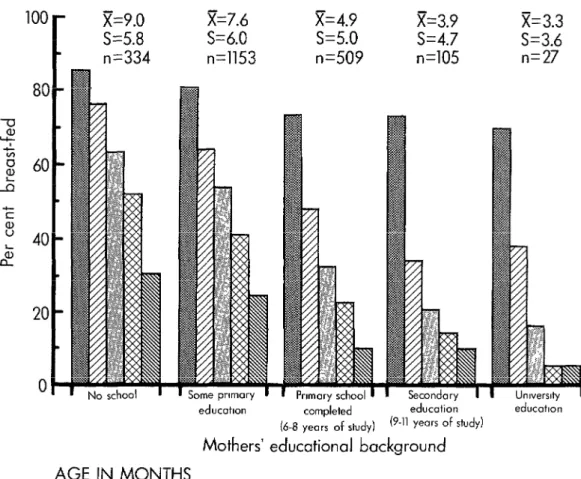
With regard to the relationship between duration of breast-feeding in months and ma- ternal education (Figure 5), a statistically significant difference emerged between the two evaluated groups (P-CO.001) and also be-
tween the two variables involved (P < 0.01).
Finally, a statistically significant (P<O.OOl) negative correlation was found between dura- tion of breast-feeding in months and the fam- ily’s access to social welfare services at the time the child was born (Figure 6). That is, mothers without access to these services tend- 4 on the average, to breast-feed their children longer than those with it.
Discussion and Conclusions
In view of the many underprivileged peo- ple, marked cultural differences, and pro- nounced economic inequalities that still exist in Mexico, our conclusions must logically be
Figure 5. Duration of breast-feeding among five groups of children born to mothers with different educational backgrounds. Within each group, the bars show the percentages of children breast-fed at l-3, 4-6, 7-9, 10-12,
and over 12 months postpartum. The figures above the bars show the average duration of breast-feeding (X) and the standard deviation (S) for each group, as well as the number of children (n) in the group.
100
x=9.0
S=5.8
n=334
x=7.6
x=4.9
x13.9
S=6.0
s=5.0
s=4.7
n=1153
n=509
w105
x=3.3
S=3.6
n=27
80
educatlan
(6-8 ;;rr;‘;;ft,,dy) @-I1 $i:tboi:tudy)
Mothers’ educational background
ed”cat’on
AGE IN MONTHS
Figure 6. Percentages of children breast-fed at different ages (in months) among families with access (lower curve) and without access (upper curve)
to social security services at the time of delivery. The figures to the left of each curve show the average duration of breast-feeding (iz), the standard
deviation in each group of children (S), and the number of children in each group (n).
SOCIAL SECURITY
t
0 I I I
I.3 4.6 7.9 IO-12 I 42 1
Age in months
limited to the universe from which the sample was selected. Thus, it is important to note that the population selected was enjoying the ben- efits of a social security institution that serves most of the country’s actively productive workers (see Tables 1 and 2).
It is also true that the length of time elapsed between some of the study children’s birth- dates and the interview could conceivably have influenced the reliability of some of the data. Nevertheless, childbirth is a memorable event in a woman’s life, and breast-feeding is easily remembered, so there seems no basis for questioning the overall accuracy of the figures. Moreover, as will be seen, our results concur with those of other studies made in Mexico.
The subject of early weaning has been wide- ly discussed in the literature as a more or less generalized and regular trend (I, 2,3,4,5,6,21, 22,23,29,30,32). It involves first the elite classes of society and then, progressively, diverse segments of the general urban and suburban population. At present, as a rule, breast-feeding tends to be limited to less af- fluent urban populations, rural dwellers, and indigenous groups.
This, at least, appears to be the case in
Mexico. Our study documents a clear and progressive decline in breast-feeding, together with increasingly early formula-feeding (see Figure 7). It also indicates that, in the group studied, the risk of early weaning was greater for children born in urban areas than for those with rural backgrounds. Other studies con- ducted in Mexico point to the same pheno- mena, in varying degrees, throughout the country. Sanjur and Cravioto (23) conducted a longitudinal study in Tlaltizapan, Morelos (a town of 6,000 people in the semitropical farming area of Zacatepec) and found that on- ly 9 per cent of all infants were being breast- fed at 6 months of age; this provided a drama- tic contrast to the findings of an earlier 1960 study made in the same place by Navarrete et al. (24), which indicated that 91 per cent of the children were still nursing at that age.
Regarding breast-feeding in urban and in- digenous populations, a study by Vega (25) published in 1977 found that 55.1 per cent of the infants born to the lower classes in the Federal District were still being breast-fed at 6 months of age; also in 1977, Mariscal (26) reported that 60.5 per cent of the children in suburban areas of Mexico City continued to be breast-fed after the eighth month. How- ever, a study of indigenous groups in the Chiapas highlands published by PCrez (27) in 1975 found that hardly any of the children studied were weaned before their first birth-
Figure 7. Percentages of children born at different times who were exclusively formula-fed or at leant
partially breast-fed at 4 months of age, by birth date.
IOO-
--.,WHOLLY OR PARTIALLY BREAST-FED
“I
Befar: 1959 1959;964 1965’1970 19711976 19177
Magaiia Crirdenas et al. l BREAST-FEEDING IN A MEXICAN POPULATION 145
day, and that 33 per cent of them were still nursing at age 2.
As previously noted, our study also found that the level of family income, the mother’s occupation and education, and the use of social security facilities at the time of the baby’s birth all played a significant part in the average duration of breast-feeding.
These data indicate that in our group the opportunity to obtain formula, whether sup- plied by a social security agency or purchased (where family income permitted), had an ad- verse effect on the duration of breast-feeding. We found a negative association between breast-feeding and the family’s position on the income scale, as well as a greater risk of early weaning among the group with social security coverage. Although the hospital’s influence on this group has yet to be spelled out, as a rule hospitals exert a negative influence (Z&29, 23); that is, feeding routines for the newborn are scheduled to suit the convenience of the administrative staff, which favors the use of formula rather than breast-feeding, and we know that mothers tend to adopt the nontradi- tional practices observed during their stay in the maternity ward. Evans (30), Gallegos (S), Brown (311, and Manckeberg (36) have also noted that the availability of a substitute has an adverse effect on breast-feeding.
The role of other factors that initially ap- pear to be important is less certain. Such fac- tors as the mother’s outside employment and maternal schooling may have a greater or lesser effect on certain groups, depending upon the net impact of that factor vis-a-vis complex interactions of other variables. Jobs outside the home do not appear to play a determining role, because fewer than one mother out of every four with nursing-age in- fants work in Latin America.
In Chile, Herrera (32) has reported that work outside the home had an adverse effect on breast-feeding. On the other hand, Marin (33) has asserted that there is no relationship between outside employment and breast- feeding in Chile.
Hirschman (34) found no significant dif-
ference in the index of breast-feeding among working and nonworking mothers in the United States, whereas we did find such a significant difference in the duration of breast- feeding in our group. However, even working mothers in our group nursed their infants an average of 5.6 months, a length of time which is considered adequate.
With regard to maternal education and breast-feeding, the discrepancies between dif- ferent studies are sharper. Hirschman has re- ported an interesting correlation between breast-feeding and educational level. That is, the highest indexes of breast-feeding found in his study were attained by women who had not gone beyond the sixth grade, closely followed by those with 16 or more years of school. Those with intermediate levels of education ranked lowest. As noted, our own study found a negative correlation between the level of education and the duration of breast-feeding. Sanjur (23) has likewise reported that the probability of early weaning increases in direct proportion to the mother’s years of schooling. On the other hand, Herre- ra (32) and Marin (33) failed to find any cor- relation between early weaning and educa- tion. This provides grounds for speculating that there could conceivably be four stages in- volved in the relationship between education and breast-feeding, these being (1) no rela- tionship (cultures of more and less educated mothers homogeneous); (2) a negative rela- tionship (nonindustrial cultures of more and less educated mothers different); (3) a curvi- linear relationship (industrial cultures of more and less educated mothers different); and (4) no relationship (industrial cultures of more and less educated mothers homogeneous).
We can therefore conclude, in accord with our own research and the literature, that no single factor can explain the observed dif- ferences in breast-feeding patterns or those patterns’ historical trends. Consequently, the results obtained are strictly valid only for the group studied, and cannot be used as a basis for easy generalization. A great deal more knowledge about early weaning is therefore needed, and research in this area remains a high-priority task.
Specific matters that remain to be clarified include the length of time breast-feeding is continued in different populations and dif- ferent population groups; the reasons for early weaning by different mothers and different populations; and relationships between breast-feeding and the psychological and emo- tional ties of the mother and her child. All this information is needed to provide a basis for viable programs capable of stemming and reversing the trend toward early weaning.
Among other things, the decline in breast-
feeding has implications that can affect na- tional development planning. According to Jelliffe (35), the following considerations war- rant particular attention: How much do sub- stitutes for human milk cost the family, the community, and-in the final analysis-the nation? Where should such substitutes be pro- duced, or should they be imported in the fu- ture from a protein-deficient world? And what effect might production of substitutes have on the nation’s balance of payments, on eco- nomic and technological dependence, and-in the last analysis-on the possibilities for establishing other development projects?
As for the trend’s more immediate public health implications, these are very clear. That is, breast-feeding has proven superior to bottle-feeding in the developing countries, where it can have a determining influence upon survival in early childhood. Therefore, it is hard to underestimate the importance of learning more about the background factors that influence this trend.
SUMMARY
A survey was conducted to assess the breast- feeding practices of a group of 632 women selected by the obstetric service of the Mexican Social Security Institute at Guadalajara, Mexico. The specific purposes of this research were to determine whether there had been changes in breast-feeding patterns over time, and to examine the possible ef- fects upon breast-feeding of such socioeconomic and cultural factors as maternal education, mater- nal occupation, place of birth, family income, and access to social welfare services.
Most of the women came from economically ac- tive population sectors, and most of their families
had incomes equalling or exceeding the minimum wage. Overall, 45 per cent of the mothers had re- ceived at least six years of primary education.
A progressive decline was documented in the prevalence and duration of breast-feeding over time. Significant correlations were also observed between breast-feeding and the other factors con- sidered. For the population studied, the results sug- gest that the risk of early weaning was greater among children born in urban areas, those whose mothers had access to social welfare services, those born into higher-income families, and those whose mothers had a higher level of education.
REFERENCES
Magaiia CLirdenas et al. l BREAST-FEEDING IN A MEXICAN POPULATION 147
(3) Fomon, J. S. N&c&t infant2 (second edi- tion). Nueva Editorial Interamericana, Mexico City, 1976.
(4) Laurenti, R. Resultados e aches apontadas pe la investigaczo interamericana de mortalidade na in&rcia no Bras% Bol Of Sanit Panam 82(4):344,
1977.
(5) Jelliffe, D. B., and E. F. Jelliffe. Human milk, nutrition, and the world resource crisis.
Science 188:557, 1975.
(6) Gallegos, H., S. Iturra, C. Barros, et al. Estudio de1 estado nutritive y de las condiciones de vida de la poblacion infantil de la comuna de Pu- taendo: Efecto de1 programa de atencibn mCdica y de distribution de leche de1 Servicio National de Salud. Rev Chil Pediatr 41:556, 1970.
(7) Goldman, A. S., and C. W. Smith. Host re- sistance factors in human milk. J Pediatr 82:1082, 1973.
(8) Mata, L., and R. G. Wyatt. The uniqueness of human milk: Host resistance to infection. AmJ Clin Nutr 24:976, 1971.
(9) Cunningham, A. S. Morbidity in breast-fed and artificially fed infants. J Pediatr 90:726, 1977.
(10) Gerrard, J. W. Breast-feeding: Second thoughts. Pediatrics 54~757, 1974.
(11) Applebaum, R. M. The modern manage- ment of successful breast feeding. Pediat Clin North Am 17:203, 1970.
(1.2) Tsang, R. C., E. F. Donovan, and J. J. Steichen. Calcium physiology and pathology in the neonate. Pediatr Clin North Am 23(4):611, 1976.
(13) Stemmler, G. J. Dental defects associated with neonatal symptomatic hypocalcaemia. Arch Dis Child 48~217, 1973.
(14) Davis, D. P. Plasma osmolality and feeding practices of healthy infants in the first three months of life. Br Med J 2:340, 1973.
(1.5) Taitz, L. S., and H. D. Byers. High calorie- osmolar feeding and hypertonic dehydration. Arch Dis Child 47~257, 1972.
(16) Menkes, J. H., D. W. Welcher, H. S. Levi, et al. Relationship of elevated blood tyrosine to the ultimate intellectual performance of premature in- fants. Pediatrics 49:218, 1972.
(17) Gaul& G. E., D. K. Rassin, N. C. RIiha, et al. Milk protein quantity and quality in low-birth- weight infants: III. Effects on sulfur amino acids in plasma and urine. J Pediatr 90:348, 1977.
(18) Mamunes, P., P. E. Prince, N. H. Thorn- ton, et al. Intellectual deficits after transient tyrosinemia in the term neonate. Pediatrics 57:675,
1976.
(19) Lebenthal, E. Cow’s milk protein allergy.
Pediatr Clin North Am 22(4):827, 1975.
(20) Taitz, L. Obesity in pediatric practice: In- fantile obesity. Pediatr Clin North Am 24(1):107, 1977.
(21) Solein de Gonz&lez, N. L. Breast feeding, weaning and acculturation. J Pediatr 62:577, 1963.
(22) Jelliffe, D. B., and E. F. Jelliffe. Lactation, conception and the nutrition of the nursing mother and child. J Pediatr 81:829, 1972.
(23) Sanjur, D. M., J. Cravioto, L. Rosales, et al. Infant feeding and weaning practices in a rural preindustrial setting. Acta P&&r &and (Sup~l.)
200: supp1200:1 + , 1970.
(24) P&z Navarrete, J. L. Operacidn Zacatepec V. BoI Med HOSP Infant MW 17:283, 1960.
(25) Vega France, L., T. Toca, and F. Torres Mfiiioz. Alimentaci6n al seno en las clases populares de la ciudad de M&&o. Salti Ptiblica Mex
19(2):227, 1977.
(26) Mar&al Abascal, C., J. Sori, L. Rey, 0. Bautista, and M. Fiscal. Estudio sobre la lactancia materna en un area suburbana. Bol Mcd Hasp Infant Mcr 34(4):777, 1977.
(27) Perez Hidalgo, C., M. Fern&-rdez, J. Ra- mfrez, et al. La situation nutritional de la pobla- ci6n rural de 10s altos de Chiapas. Salud Ptibiica Mex
17:235, 1975.
(28) Jelliffe, D. B., and E. F. Jelliffe. Editorial: Doulas, confidence, and the science of lactation. J Pcdiatr 84:462, 1974.
(29) Wade, N. Bottle feeding: Adverse effects of a western technology. Science 188:557, 1975.
(30) Evans, N., I. R. Walpole, M. U. Qureshi, et al. Lack of breast feeding and early weaning in infants of Asian immigrants to Wolverhampton.
Arch Dis Child 51:608, 1976.
(31) Brown, R. E. Breast feeding in modern times. AmJ Clin Nutr 26:556, 1973.
(32) Herrera, L. P. Alimentaci6n natural: Estudio en 56 madres de un sector de bajo nivel socioeconomico en la ciudad de Valdivia en 1970.
Rw Chil Pedtktr 42~706, 1971.
(33) Marin, S. P. Lactancia natural: Desaffo en la enfermedad, desnutrici6n y mortalidad infant&
Rev Chil PedLats 45:259, 1974.
(34) Hirschman, C., and J. A. Sweet. Social background and breast feeding among American mothers. Sot Biol21:39, 1974.
(35) Jelliffe, D. B. Introduction. In El valor in- comparable a% Ia leche matema. PAHO Scientific Publication 250. Pan American Health Organiza- tion, Washington, D.C., 1972.